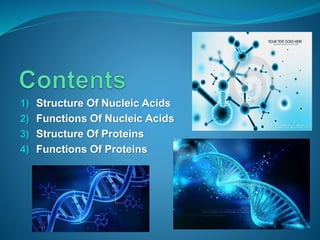
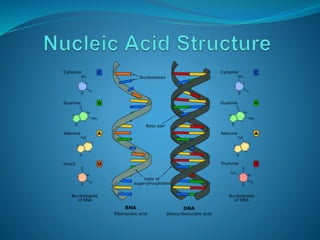
1) Structure Of Nucleic Acids
2) Functions Of Nucleic Acids
3) Structure Of Proteins
4) Functions Of Proteins
Introduction
 It refers to the Nucleic Acids Like DNA & RNA.
 It is divided into 4 levels:
 Primary
 Secondary
 Tertiary
 Quaternary
Primary structure
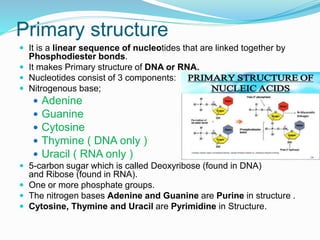
 It is a linear sequence of nucleotides that are linked together by
Phosphodiester bonds.
 It makes Primary structure of DNA or RNA.
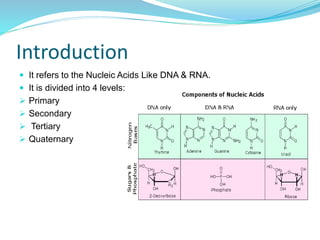
 Nucleotides consist of 3 components:
 Nitrogenous base;
 Adenine
 Guanine
 Cytosine
 Thymine ( DNA only )
 Uracil ( RNA only )
 5-carbon sugar which is called Deoxyribose (found in DNA)
and Ribose (found in RNA).
 One or more phosphate groups.
 The nitrogen bases Adenine and Guanine are Purine in structure .
 Cytosine, Thymine and Uracil are Pyrimidine in Structure.
Secondary structure
 It is the set of interactions between bases.
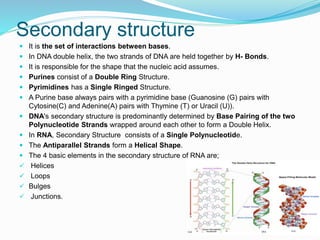
 In DNA double helix, the two strands of DNA are held together by H- Bonds.
 It is responsible for the shape that the nucleic acid assumes.
 Purines consist of a Double Ring Structure.
 Pyrimidines has a Single Ringed Structure.
 A Purine base always pairs with a pyrimidine base (Guanosine (G) pairs with
Cytosine(C) and Adenine(A) pairs with Thymine (T) or Uracil (U)).
 DNA's secondary structure is predominantly determined by Base Pairing of the two
Polynucleotide Strands wrapped around each other to form a Double Helix.
 In RNA, Secondary Structure consists of a Single Polynucleotide.
 The Antiparallel Strands form a Helical Shape.
 The 4 basic elements in the secondary structure of RNA are;
 Helices
 Loops
 Bulges
 Junctions.
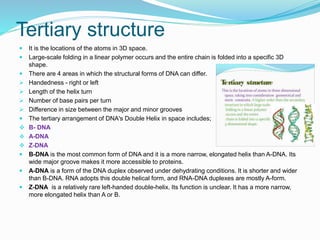
Tertiary structure
 It is the locations of the atoms in 3D space.
 Large-scale folding in a linear polymer occurs and the entire chain is folded into a specific 3D
shape.
 There are 4 areas in which the structural forms of DNA can differ.
 Handedness - right or left
 Length of the helix turn
 Number of base pairs per turn
 Difference in size between the major and minor grooves
 The tertiary arrangement of DNA's Double Helix in space includes;
 B- DNA
 A-DNA
 Z-DNA
 B-DNA is the most common form of DNA and it is a more narrow, elongated helix than A-DNA. Its
wide major groove makes it more accessible to proteins.
 A-DNA is a form of the DNA duplex observed under dehydrating conditions. It is shorter and wider
than B-DNA. RNA adopts this double helical form, and RNA-DNA duplexes are mostly A-form.
 Z-DNA is a relatively rare left-handed double-helix. Its function is unclear. It has a more narrow,
more elongated helix than A or B.
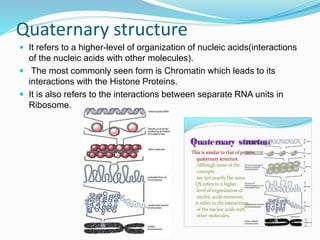
Quaternary structure
 It refers to a higher-level of organization of nucleic acids(interactions
of the nucleic acids with other molecules).
 The most commonly seen form is Chromatin which leads to its
interactions with the Histone Proteins.
 It is also refers to the interactions between separate RNA units in
Ribosome.
Functions of Nucleic Acids
 DNA: Transmission of Hereditary Characters.
 Store house of genetic information control protein
synthesis in cell.
 Direct synthesis of RNA.
 RNA: Direct synthesis of Specific Proteins.
 m-RNA takes genetic message from RNA.
 t-RNA transfers activated amino acid, to the site of
protein synthesis.
 r-RNA are mostly present in the ribosomes, and
responsible for stability of m-RNA.
Introduction
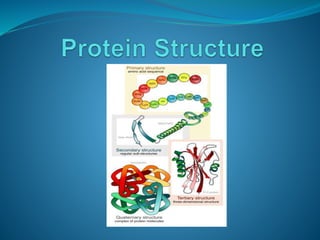
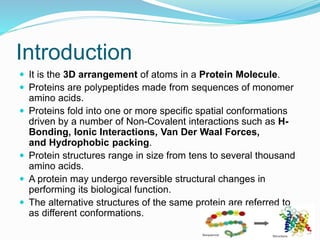
 It is the 3D arrangement of atoms in a Protein Molecule.
 Proteins are polypeptides made from sequences of monomer
amino acids.
 Proteins fold into one or more specific spatial conformations
driven by a number of Non-Covalent interactions such as H-
Bonding, Ionic Interactions, Van Der Waal Forces,
and Hydrophobic packing.
 Protein structures range in size from tens to several thousand
amino acids.
 A protein may undergo reversible structural changes in
performing its biological function.
 The alternative structures of the same protein are referred to
as different conformations.
Primary Structure
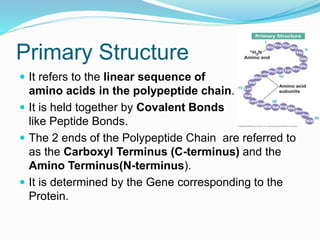
 It refers to the linear sequence of
amino acids in the polypeptide chain.
 It is held together by Covalent Bonds
like Peptide Bonds.
 The 2 ends of the Polypeptide Chain are referred to
as the Carboxyl Terminus (C-terminus) and the
Amino Terminus(N-terminus).
 It is determined by the Gene corresponding to the
Protein.
Secondary Structure
 It refers to highly regular local sub-structures on the actual
polypeptide backbone chain.
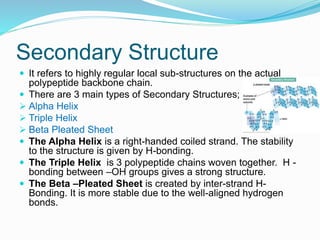
 There are 3 main types of Secondary Structures;
 Alpha Helix
 Triple Helix
 Beta Pleated Sheet
 The Alpha Helix is a right-handed coiled strand. The stability
to the structure is given by H-bonding.
 The Triple Helix is 3 polypeptide chains woven together. H -
bonding between –OH groups gives a strong structure.
 The Beta –Pleated Sheet is created by inter-strand H-
Bonding. It is more stable due to the well-aligned hydrogen
bonds.
Tertiary Structure
 It is the overall 3D shape of an entire protein
molecule.
 The alpha-helixes and beta pleated-sheets
are folded into a compact Globular Structure.
 There are;
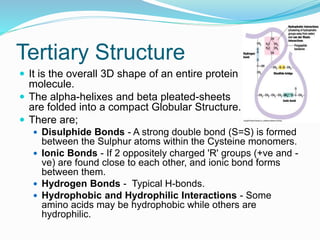
 Disulphide Bonds - A strong double bond (S=S) is formed
between the Sulphur atoms within the Cysteine monomers.
 Ionic Bonds - If 2 oppositely charged 'R' groups (+ve and -
ve) are found close to each other, and ionic bond forms
between them.
 Hydrogen Bonds - Typical H-bonds.
 Hydrophobic and Hydrophilic Interactions - Some
amino acids may be hydrophobic while others are
hydrophilic.
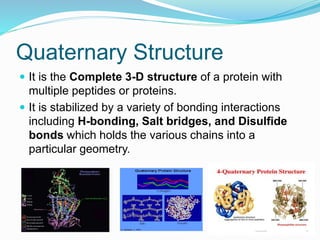
Quaternary Structure
 It is the Complete 3-D structure of a protein with
multiple peptides or proteins.
 It is stabilized by a variety of bonding interactions
including H-bonding, Salt bridges, and Disulfide
bonds which holds the various chains into a
particular geometry.
Functions Of Proteins
 Repair and Maintenance - Protein is termed the building block of the body.
 Energy - Protein is a major source of energy.
 Antibodies - They are specialized proteins involved in defending the body
from antigens (foreign invaders).
 Contractile Proteins - They are responsible for movement. Examples
include actin and myosin.
 Enzymes -They are proteins that facilitate biochemical reactions. They are
often referred to as catalysts because they speed up chemical reactions.
 Hormonal Proteins - They are messenger proteins which help to
coordinate certain bodily activities. Examples include insulin, oxytocin etc.
 Structural Proteins - They are fibrous and stringy and provide support.
Examples include keratin, collagen, and elastin.
 Storage Proteins - It Store Amino Acids. Examples include casein, ferritin.
 Transport Proteins - They are carrier proteins which move molecules from
one place to another around the body. Examples include hemoglobin and
Cytochromes.
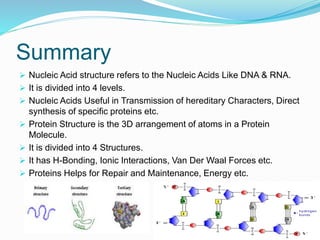
Summary
 Nucleic Acid structure refers to the Nucleic Acids Like DNA & RNA.
 It is divided into 4 levels.
 Nucleic Acids Useful in Transmission of hereditary Characters, Direct
synthesis of specific proteins etc.
 Protein Structure is the 3D arrangement of atoms in a Protein
Molecule.
 It is divided into 4 Structures.
 It has H-Bonding, Ionic Interactions, Van Der Waal Forces etc.
 Proteins Helps for Repair and Maintenance, Energy etc.
References
 Websites
 healthyeating.sfgate.com
 biology.about.com
 nutristrategy.com
 sophia.org
 Journals
 Proteins: Structure, Function, and Bioinformatics(ISI
Journal Citation Reports © Ranking: 2014: 37/73 (Biophysics);
148/290 (Biochemistry & Molecular Biology))
 Nucleic Acids – Chemistry and Applications (J. Org.
Chem., 2013.Copyright © 2013 American Chemical Society)
20

Nucleic Acid / Protein structure & Functions

  • 3.
    1) Structure OfNucleic Acids 2) Functions Of Nucleic Acids 3) Structure Of Proteins 4) Functions Of Proteins
  • 5.
    Introduction  It refersto the Nucleic Acids Like DNA & RNA.  It is divided into 4 levels:  Primary  Secondary  Tertiary  Quaternary
  • 6.
    Primary structure  Itis a linear sequence of nucleotides that are linked together by Phosphodiester bonds.  It makes Primary structure of DNA or RNA.  Nucleotides consist of 3 components:  Nitrogenous base;  Adenine  Guanine  Cytosine  Thymine ( DNA only )  Uracil ( RNA only )  5-carbon sugar which is called Deoxyribose (found in DNA) and Ribose (found in RNA).  One or more phosphate groups.  The nitrogen bases Adenine and Guanine are Purine in structure .  Cytosine, Thymine and Uracil are Pyrimidine in Structure.
  • 7.
    Secondary structure  Itis the set of interactions between bases.  In DNA double helix, the two strands of DNA are held together by H- Bonds.  It is responsible for the shape that the nucleic acid assumes.  Purines consist of a Double Ring Structure.  Pyrimidines has a Single Ringed Structure.  A Purine base always pairs with a pyrimidine base (Guanosine (G) pairs with Cytosine(C) and Adenine(A) pairs with Thymine (T) or Uracil (U)).  DNA's secondary structure is predominantly determined by Base Pairing of the two Polynucleotide Strands wrapped around each other to form a Double Helix.  In RNA, Secondary Structure consists of a Single Polynucleotide.  The Antiparallel Strands form a Helical Shape.  The 4 basic elements in the secondary structure of RNA are;  Helices  Loops  Bulges  Junctions.
  • 8.
    Tertiary structure  Itis the locations of the atoms in 3D space.  Large-scale folding in a linear polymer occurs and the entire chain is folded into a specific 3D shape.  There are 4 areas in which the structural forms of DNA can differ.  Handedness - right or left  Length of the helix turn  Number of base pairs per turn  Difference in size between the major and minor grooves  The tertiary arrangement of DNA's Double Helix in space includes;  B- DNA  A-DNA  Z-DNA  B-DNA is the most common form of DNA and it is a more narrow, elongated helix than A-DNA. Its wide major groove makes it more accessible to proteins.  A-DNA is a form of the DNA duplex observed under dehydrating conditions. It is shorter and wider than B-DNA. RNA adopts this double helical form, and RNA-DNA duplexes are mostly A-form.  Z-DNA is a relatively rare left-handed double-helix. Its function is unclear. It has a more narrow, more elongated helix than A or B.
  • 9.
    Quaternary structure  Itrefers to a higher-level of organization of nucleic acids(interactions of the nucleic acids with other molecules).  The most commonly seen form is Chromatin which leads to its interactions with the Histone Proteins.  It is also refers to the interactions between separate RNA units in Ribosome.
  • 10.
    Functions of NucleicAcids  DNA: Transmission of Hereditary Characters.  Store house of genetic information control protein synthesis in cell.  Direct synthesis of RNA.  RNA: Direct synthesis of Specific Proteins.  m-RNA takes genetic message from RNA.  t-RNA transfers activated amino acid, to the site of protein synthesis.  r-RNA are mostly present in the ribosomes, and responsible for stability of m-RNA.
  • 12.
    Introduction  It isthe 3D arrangement of atoms in a Protein Molecule.  Proteins are polypeptides made from sequences of monomer amino acids.  Proteins fold into one or more specific spatial conformations driven by a number of Non-Covalent interactions such as H- Bonding, Ionic Interactions, Van Der Waal Forces, and Hydrophobic packing.  Protein structures range in size from tens to several thousand amino acids.  A protein may undergo reversible structural changes in performing its biological function.  The alternative structures of the same protein are referred to as different conformations.
  • 13.
    Primary Structure  Itrefers to the linear sequence of amino acids in the polypeptide chain.  It is held together by Covalent Bonds like Peptide Bonds.  The 2 ends of the Polypeptide Chain are referred to as the Carboxyl Terminus (C-terminus) and the Amino Terminus(N-terminus).  It is determined by the Gene corresponding to the Protein.
  • 14.
    Secondary Structure  Itrefers to highly regular local sub-structures on the actual polypeptide backbone chain.  There are 3 main types of Secondary Structures;  Alpha Helix  Triple Helix  Beta Pleated Sheet  The Alpha Helix is a right-handed coiled strand. The stability to the structure is given by H-bonding.  The Triple Helix is 3 polypeptide chains woven together. H - bonding between –OH groups gives a strong structure.  The Beta –Pleated Sheet is created by inter-strand H- Bonding. It is more stable due to the well-aligned hydrogen bonds.
  • 15.
    Tertiary Structure  Itis the overall 3D shape of an entire protein molecule.  The alpha-helixes and beta pleated-sheets are folded into a compact Globular Structure.  There are;  Disulphide Bonds - A strong double bond (S=S) is formed between the Sulphur atoms within the Cysteine monomers.  Ionic Bonds - If 2 oppositely charged 'R' groups (+ve and - ve) are found close to each other, and ionic bond forms between them.  Hydrogen Bonds - Typical H-bonds.  Hydrophobic and Hydrophilic Interactions - Some amino acids may be hydrophobic while others are hydrophilic.
  • 16.
    Quaternary Structure  Itis the Complete 3-D structure of a protein with multiple peptides or proteins.  It is stabilized by a variety of bonding interactions including H-bonding, Salt bridges, and Disulfide bonds which holds the various chains into a particular geometry.
  • 17.
    Functions Of Proteins Repair and Maintenance - Protein is termed the building block of the body.  Energy - Protein is a major source of energy.  Antibodies - They are specialized proteins involved in defending the body from antigens (foreign invaders).  Contractile Proteins - They are responsible for movement. Examples include actin and myosin.  Enzymes -They are proteins that facilitate biochemical reactions. They are often referred to as catalysts because they speed up chemical reactions.  Hormonal Proteins - They are messenger proteins which help to coordinate certain bodily activities. Examples include insulin, oxytocin etc.  Structural Proteins - They are fibrous and stringy and provide support. Examples include keratin, collagen, and elastin.  Storage Proteins - It Store Amino Acids. Examples include casein, ferritin.  Transport Proteins - They are carrier proteins which move molecules from one place to another around the body. Examples include hemoglobin and Cytochromes.
  • 18.
    Summary  Nucleic Acidstructure refers to the Nucleic Acids Like DNA & RNA.  It is divided into 4 levels.  Nucleic Acids Useful in Transmission of hereditary Characters, Direct synthesis of specific proteins etc.  Protein Structure is the 3D arrangement of atoms in a Protein Molecule.  It is divided into 4 Structures.  It has H-Bonding, Ionic Interactions, Van Der Waal Forces etc.  Proteins Helps for Repair and Maintenance, Energy etc.
  • 19.
    References  Websites  healthyeating.sfgate.com biology.about.com  nutristrategy.com  sophia.org  Journals  Proteins: Structure, Function, and Bioinformatics(ISI Journal Citation Reports © Ranking: 2014: 37/73 (Biophysics); 148/290 (Biochemistry & Molecular Biology))  Nucleic Acids – Chemistry and Applications (J. Org. Chem., 2013.Copyright © 2013 American Chemical Society)
  • 20.