NUCLEIC ACIDS
Presented by
Salwa Soliman Salman
Nucleic Acid Structure
Nucleic acids are required for the storage
and expression of genetic information.
There are two chemically distinct types
of nucleic acids:
A. RNA (ribonucleic acid) is a polymer of
ribonucleotides
B. DNA (deoxyribonucleic acid) is a
polymer of deoxyribonucleotides
Nucleotides
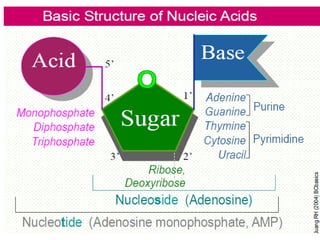
• Monomers for nucleic acid polymers
• Each nucleotide consists of:
1. Pentose sugar
2. Nitrogenous base
3. Phosphate group
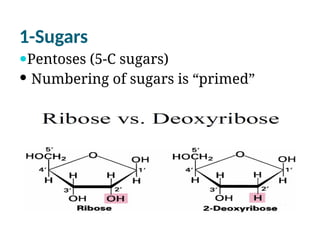
1-Sugars
Pentoses (5-C sugars)
 Numbering of sugars is “primed”
2
-
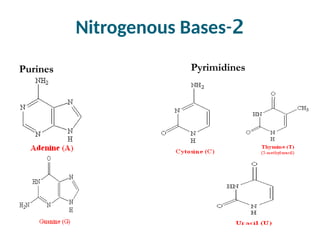
Nitrogenous Bases
Purines Pyrimidines
3
-
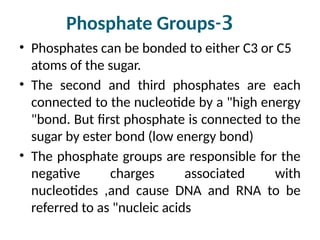
Phosphate Groups
• Phosphates can be bonded to either C3 or C5
atoms of the sugar.
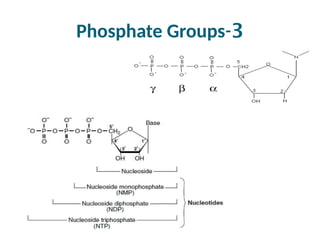
• The second and third phosphates are each
connected to the nucleotide by a "high energy
"bond. But first phosphate is connected to the
sugar by ester bond (low energy bond)
• The phosphate groups are responsible for the
negative charges associated with
nucleotides ,and cause DNA and RNA to be
referred to as "nucleic acids
3
-
Phosphate Groups
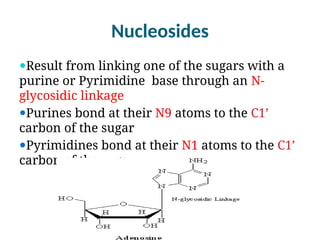
Nucleosides
Result from linking one of the sugars with a
purine or Pyrimidine base through an N-
glycosidic linkage
Purines bond at their N9 atoms to the C1’
carbon of the sugar
Pyrimidines bond at their N1 atoms to the C1’
carbon of the sugar
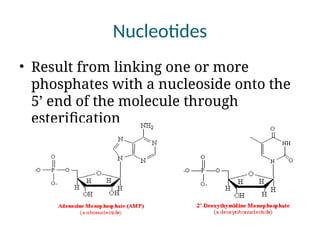
Nucleotides
• Result from linking one or more
phosphates with a nucleoside onto the
5’ end of the molecule through
esterification
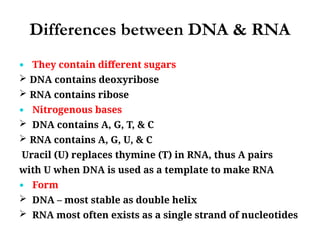
Differences between DNA & RNA
 They contain different sugars
 DNA contains deoxyribose
 RNA contains ribose
 Nitrogenous bases
 DNA contains A, G, T, & C
 RNA contains A, G, U, & C
Uracil (U) replaces thymine (T) in RNA, thus A pairs
with U when DNA is used as a template to make RNA
 Form
 DNA – most stable as double helix
 RNA most often exists as a single strand of nucleotides
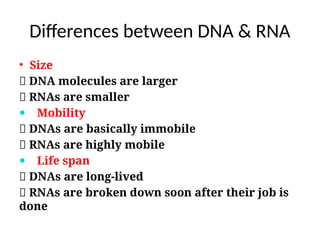
Differences between DNA & RNA
• Size
􀁺 DNA molecules are larger
􀁺 RNAs are smaller
 Mobility
􀁺 DNAs are basically immobile
􀁺 RNAs are highly mobile
 Life span
􀁺 DNAs are long-lived
􀁺 RNAs are broken down soon after their job is
done
Structure of DNA
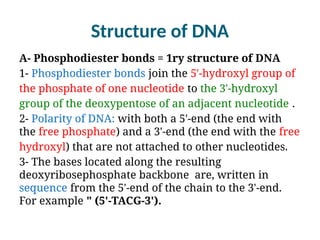
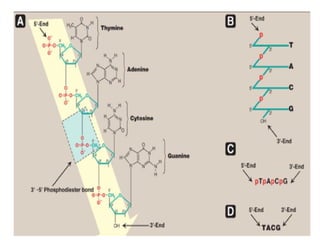
A- Phosphodiester bonds = 1ry structure of DNA
1- Phosphodiester bonds join the 5'-hydroxyl group of
the phosphate of one nucleotide to the 3'-hydroxyl
group of the deoxypentose of an adjacent nucleotide .
2- Polarity of DNA: with both a 5'-end (the end with
the free phosphate) and a 3'-end (the end with the free
hydroxyl) that are not attached to other nucleotides.
3- The bases located along the resulting
deoxyribosephosphate backbone are, written in
sequence from the 5'-end of the chain to the 3'-end.
For example " (5'-TACG-3').
Structure of DNA
B- The Double Helix Structure of DNA = 2ry
structure of DNA (B-form= Watson & Crick 1953)
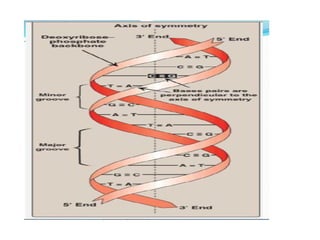
 The double helix, the two chains are coiled
around acommon axis called the axis of symmetry.
 The chains are paired in an antiparallel manner,
that is, the 5'-end of one strand is paired with the 3'-
end of the other strand.
In the DNA helix, the hydrophilic
deoxyribosephosphate backbone of each chain is
on the outside of the molecule, whereas the
hydrophobic bases are stacked inside.
Structure of DNA
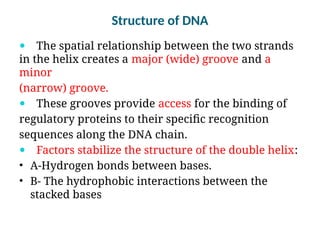
 The spatial relationship between the two strands
in the helix creates a major (wide) groove and a
minor
(narrow) groove.
 These grooves provide access for the binding of
regulatory proteins to their specific recognition
sequences along the DNA chain.
 Factors stabilize the structure of the double helix:
• A-Hydrogen bonds between bases.
• B- The hydrophobic interactions between the
stacked bases
Structure of DNA
• Chargaff's Rule:
DNA has equal numbers of adenine and
thymine residues (A=T) and equal
numbers of cytosine and guanine residues
(G=C)
the total amount of purines equals the total
amount of pyrimidines.
The base pairs are held together by
hydrogen bonds: two between A and T
(A=T) and three between G and C (G = C).
complementary base pairing
Each base will only bond with one other specific base.
 Adenine (A)
 Thymine (T)
 Cytosine (C)
 Guanine (G)
Because of this complementary base pairing, the
order of the bases in one strand determines the
order of the bases in the other strand.
DNA Organization
:
• DNA in a single human cell, if stretched
to its full length is about two meters.
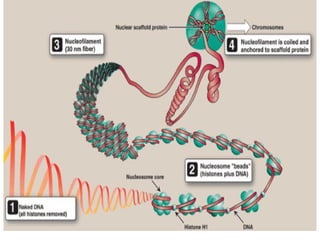
• Eukaryotic DNA is associated with
tightly bound basic proteins, called
histones to form nucleosomes which
appear as beads on strings, which then
further organized to form chromosomes.
Nucleosomes
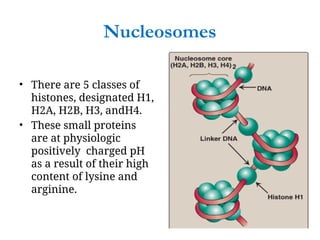
• There are 5 classes of
histones, designated H1,
H2A, H2B, H3, andH4.
• These small proteins
are at physiologic
positively charged pH
as a result of their high
content of lysine and
arginine.
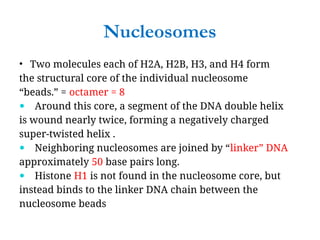
Nucleosomes
• Two molecules each of H2A, H2B, H3, and H4 form
the structural core of the individual nucleosome
“beads.” = octamer = 8
 Around this core, a segment of the DNA double helix
is wound nearly twice, forming a negatively charged
super-twisted helix .
 Neighboring nucleosomes are joined by “linker” DNA
approximately 50 base pairs long.
 Histone H1 is not found in the nucleosome core, but
instead binds to the linker DNA chain between the
nucleosome beads
Higher levels of organization
1-Nucleosomes can be packed more tightly to
form a polynucleosome (6-7 Nucleosomes per
turn) to form 30nm fiber also called
nucleofilament .
2-The fiber is organized into loops that are
anchored by a nuclear scaffold containing
several proteins.
3- Additional levels of organization lead to the
final chromosomal structure .
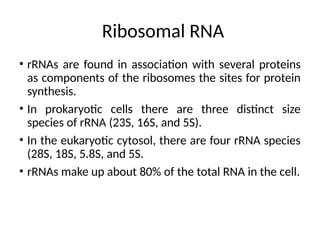
Ribosomal RNA
• rRNAs are found in association with several proteins
as components of the ribosomes the sites for protein
synthesis.
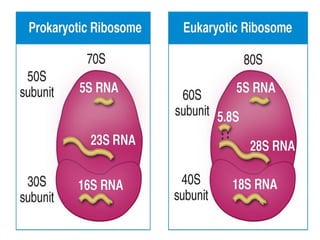
• In prokaryotic cells there are three distinct size
species of rRNA (23S, 16S, and 5S).
• In the eukaryotic cytosol, there are four rRNA species
(28S, 18S, 5.8S, and 5S.
• rRNAs make up about 80% of the total RNA in the cell.
THANK YOU

Nucleic Acid types, chemistry and structure

  • 1.
  • 2.
    Nucleic Acid Structure Nucleicacids are required for the storage and expression of genetic information. There are two chemically distinct types of nucleic acids: A. RNA (ribonucleic acid) is a polymer of ribonucleotides B. DNA (deoxyribonucleic acid) is a polymer of deoxyribonucleotides
  • 3.
    Nucleotides • Monomers fornucleic acid polymers • Each nucleotide consists of: 1. Pentose sugar 2. Nitrogenous base 3. Phosphate group
  • 4.
    1-Sugars Pentoses (5-C sugars) Numbering of sugars is “primed”
  • 5.
  • 6.
    3 - Phosphate Groups • Phosphatescan be bonded to either C3 or C5 atoms of the sugar. • The second and third phosphates are each connected to the nucleotide by a "high energy "bond. But first phosphate is connected to the sugar by ester bond (low energy bond) • The phosphate groups are responsible for the negative charges associated with nucleotides ,and cause DNA and RNA to be referred to as "nucleic acids
  • 7.
  • 8.
    Nucleosides Result from linkingone of the sugars with a purine or Pyrimidine base through an N- glycosidic linkage Purines bond at their N9 atoms to the C1’ carbon of the sugar Pyrimidines bond at their N1 atoms to the C1’ carbon of the sugar
  • 9.
    Nucleotides • Result fromlinking one or more phosphates with a nucleoside onto the 5’ end of the molecule through esterification
  • 11.
    Differences between DNA& RNA  They contain different sugars  DNA contains deoxyribose  RNA contains ribose  Nitrogenous bases  DNA contains A, G, T, & C  RNA contains A, G, U, & C Uracil (U) replaces thymine (T) in RNA, thus A pairs with U when DNA is used as a template to make RNA  Form  DNA – most stable as double helix  RNA most often exists as a single strand of nucleotides
  • 12.
    Differences between DNA& RNA • Size 􀁺 DNA molecules are larger 􀁺 RNAs are smaller  Mobility 􀁺 DNAs are basically immobile 􀁺 RNAs are highly mobile  Life span 􀁺 DNAs are long-lived 􀁺 RNAs are broken down soon after their job is done
  • 13.
    Structure of DNA A-Phosphodiester bonds = 1ry structure of DNA 1- Phosphodiester bonds join the 5'-hydroxyl group of the phosphate of one nucleotide to the 3'-hydroxyl group of the deoxypentose of an adjacent nucleotide . 2- Polarity of DNA: with both a 5'-end (the end with the free phosphate) and a 3'-end (the end with the free hydroxyl) that are not attached to other nucleotides. 3- The bases located along the resulting deoxyribosephosphate backbone are, written in sequence from the 5'-end of the chain to the 3'-end. For example " (5'-TACG-3').
  • 15.
    Structure of DNA B-The Double Helix Structure of DNA = 2ry structure of DNA (B-form= Watson & Crick 1953)  The double helix, the two chains are coiled around acommon axis called the axis of symmetry.  The chains are paired in an antiparallel manner, that is, the 5'-end of one strand is paired with the 3'- end of the other strand. In the DNA helix, the hydrophilic deoxyribosephosphate backbone of each chain is on the outside of the molecule, whereas the hydrophobic bases are stacked inside.
  • 16.
    Structure of DNA The spatial relationship between the two strands in the helix creates a major (wide) groove and a minor (narrow) groove.  These grooves provide access for the binding of regulatory proteins to their specific recognition sequences along the DNA chain.  Factors stabilize the structure of the double helix: • A-Hydrogen bonds between bases. • B- The hydrophobic interactions between the stacked bases
  • 18.
    Structure of DNA •Chargaff's Rule: DNA has equal numbers of adenine and thymine residues (A=T) and equal numbers of cytosine and guanine residues (G=C) the total amount of purines equals the total amount of pyrimidines. The base pairs are held together by hydrogen bonds: two between A and T (A=T) and three between G and C (G = C).
  • 19.
    complementary base pairing Eachbase will only bond with one other specific base.  Adenine (A)  Thymine (T)  Cytosine (C)  Guanine (G) Because of this complementary base pairing, the order of the bases in one strand determines the order of the bases in the other strand.
  • 20.
    DNA Organization : • DNAin a single human cell, if stretched to its full length is about two meters. • Eukaryotic DNA is associated with tightly bound basic proteins, called histones to form nucleosomes which appear as beads on strings, which then further organized to form chromosomes.
  • 21.
    Nucleosomes • There are5 classes of histones, designated H1, H2A, H2B, H3, andH4. • These small proteins are at physiologic positively charged pH as a result of their high content of lysine and arginine.
  • 22.
    Nucleosomes • Two moleculeseach of H2A, H2B, H3, and H4 form the structural core of the individual nucleosome “beads.” = octamer = 8  Around this core, a segment of the DNA double helix is wound nearly twice, forming a negatively charged super-twisted helix .  Neighboring nucleosomes are joined by “linker” DNA approximately 50 base pairs long.  Histone H1 is not found in the nucleosome core, but instead binds to the linker DNA chain between the nucleosome beads
  • 23.
    Higher levels oforganization 1-Nucleosomes can be packed more tightly to form a polynucleosome (6-7 Nucleosomes per turn) to form 30nm fiber also called nucleofilament . 2-The fiber is organized into loops that are anchored by a nuclear scaffold containing several proteins. 3- Additional levels of organization lead to the final chromosomal structure .
  • 30.
    Ribosomal RNA • rRNAsare found in association with several proteins as components of the ribosomes the sites for protein synthesis. • In prokaryotic cells there are three distinct size species of rRNA (23S, 16S, and 5S). • In the eukaryotic cytosol, there are four rRNA species (28S, 18S, 5.8S, and 5S. • rRNAs make up about 80% of the total RNA in the cell.
  • 32.