RICKETS
Rickets is a childhood disorder
involving softening and
weakening of the bones.
It is primarily caused by lack of
vitamin D, calcium, or
phosphate.
Vitamin D is a fat-soluble vitamin that may be absorbed
from the intestines or may be produced by the skin when
the skin is exposed to sunlight (ultraviolet light of sunlight
helps the body to form vitamin D).
The absorbed vitamin D is converted into its active form to
act as a hormone to regulate calcium absorption from the
intestine and to regulate levels of calcium and phosphate in
the bones.
If there is a deficiency of Vitamin D, the body is unable to
properly regulate calcium and phosphate levels. When the
blood levels of these minerals become too low, it results in
destruction of the support matrix of the bones.
In rickets, another mechanism in the body works to increase
the blood calcium level. The parathyroid gland may increase
its functioning rate to compensate for decreased levels of
calcium in the bloodstream.
To increase the level of calcium in the blood the hormone
destroys the calcium present in the bones of the body and
this results in further loss of calcium and phosphorous from
the bones. In severe cases, cysts may develop in the bones.
 Environmental conditions where sunlight exposure
is limited like indoor confinement or working
indoors during daylight hours may reduce source
of vitamin D;
 Inadequate daily consumption - a lack of vitamin D
in the diet, a dietary lack of calcium and
phosphorous may also play a part in nutritional
causes of rickets, have trouble digesting milk
products, people who are lactose intolerant;
 Liver Failure;
 Dark Pigmentation
. Fast growth, increased requirement (relative
deficiency)
. Diseases and drug:
 Liver diseases, renal diseases
 Gastrointestinal diseases
 Antiepileptic
 Glucocorticosteroid
.Malabsorption-Steatorrhoea
Cholecalciferol (vitamin D-3) is formed in the skin from
7-dehydrotachysterol. This steroid undergoes hydroxylation in 2 steps.
Pathophysiology - Metabolism of vitamin D
• The first hydroxylation occurs at position 25 in the liver,
producing calcidiol (25-hydroxycholecalciferol), which
circulates in the plasma as the most abundant of the vitamin D
metabolites and is thought to be a good indicator of overall
vitamin D status.
 Cholecalciferol (vitamin D-3) is formed in the skin from
7-dihydrotachysterol. This steroid undergoes hydroxylation in 2 steps.
Pathophysiology
• The second hydroxylation step occurs in the kidney at the 1 position,
where it undergoes hydroxylation to the active metabolite calcitriol
(1,25-dihydroxycholecalciferol - DHC). This cholecalciferol is not a
vitamin, but a hormone.
Calcitriol acts on regulation of
calcium metabolism:
 Calcitriol promotes absorption of calcium and
phosphorus from the intestine,
 increases reabsorption of phosphate in the kidney,
 acts on bone to release calcium and phosphate;
 Calcitriol may also directly facilitate calcification.
Calcitriol (1,25-DHC) – acts as a hormone rather than a
vitamin, endocrine and paracrine properties
•These actions increase the concentrations of calcium
and phosphorus in extracellular fluid.
• The increase of Ca and
P in extracellular fluid,
in turn, leads to the
calcification of osteoid,
primarily at the
metaphyseal growing
ends of bones but also
throughout all osteoid
in the skeleton.
• Parathyroid hormone
facilitates the 1-hydro-
xylation step in
vitamin D metabolism
 In the vitamin D deficiency state,
hypocalciemia develops, which
stimulates excess parathyroid
hormone, which stimulates renal
phosphorus loss, further
reducing deposition of calcium
in the bone.
 Excess parathyroid hormone
also produces changes in the
bone similar to those occurring
in hyperparathyroidism.
 Early in the course of rickets, the
calcium concentration in the
serum decreases.
 After the parathyroid response, the
calcium concentration usually
returns to the reference range,
though phosphorus levels remain
low.
 Alkaline phosphatase, which is
produced by overactive osteoblast
cells, leaks to the extracellular fluids
so that its concentration rises to
anywhere from moderate elevation
to very high levels.
The history in patients with rickets may include the
following:
 The infant's gestational age, diet and degree of
sunlight exposure should be noted.
 A detailed dietary history should include specifics of
vitamin D and calcium intake.
 A family history of short stature, orthopedic
abnormalities, poor dentition, alopecia, parental
consanguinity may signify inherited rickets.
Evaluation
Rickets is a systemic disease with skeletons
involved most, but the nervous system,
muscular system and other system are also
involved.
 Generalized muscular hypotonia is observed in the most
patients with clinical signs of rickets.
 Craniotabes manifests early in infants, although this
feature may be normal in infants, especially for those
born prematurely.
Clinical signs
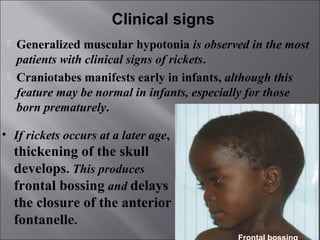
• If rickets occurs at a later age,
thickening of the skull
develops. This produces
frontal bossing and delays
the closure of the anterior
fontanelle.
• Skeletal
deformities
including Bow legs,
Forward projection of
the breastbone -
pigeon chest or pectus
carinatum),
Funnel chest
(pectus excavatum),
"Bumps" in the rib
cage (rachitic rosary)
and asymmetrical or
odd-shaped skull;
Chest deformity
Funnel chest – pectus
excavatum
Pigeon chest
Clinical signs
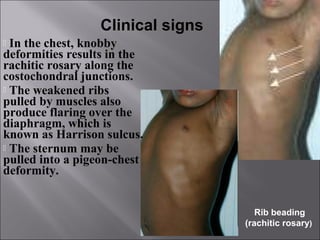
 In the chest, knobby
deformities results in the
rachitic rosary along the
costochondral junctions.
 The weakened ribs
pulled by muscles also
produce flaring over the
diaphragm, which is
known as Harrison sulcus.
 The sternum may be
pulled into a pigeon-chest
deformity.
Rib beading
(rachitic rosary)
Pathway of Vitamin D Production
Knock knee deformity
(genu valgum)
Bowleg deformity
(genu varum)
 The ends of the long bones demonstrate that same
knobby thickening. At the ankle, palpation of the tibial
Clinical signs
malleolus gives
the impression
of a double
epiphysis
(Marfan sign).
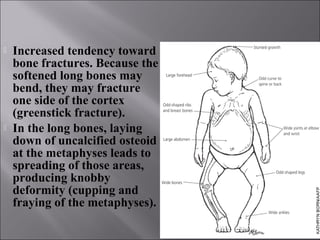
 Increased tendency toward
bone fractures. Because the
softened long bones may
bend, they may fracture
one side of the cortex
(greenstick fracture).
 In the long bones, laying
down of uncalcified osteoid
at the metaphyses leads to
spreading of those areas,
producing knobby
deformity (cupping and
fraying of the metaphyses).
 Spine deformities
(spine curves abnormally,
including scoliosis or
kyphosis).
 In more severe instances
in children older than 2
years, vertebral softening
leads to
kyphoscoliosis
 Pain in the bones of Arms, Legs, Spine, Pelvis.
 Dental deformities
 Delayed formation of teeth
 Defects in the structure of teeth
 Holes in the enamel
 Increased incidence of cavities in the teeth (dental caries)
 Progressive weakness
 Decreased muscle tone (loss of muscle
strength)
 Muscle cramps
 Impaired growth
 Short stature (adults less than 5 feet tall)
Clinical signs
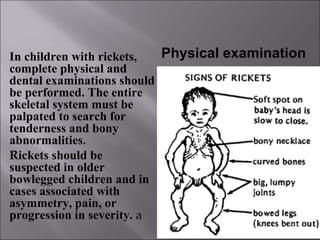
In children with rickets,
complete physical and
dental examinations should
be performed. The entire
skeletal system must be
palpated to search for
tenderness and bony
abnormalities.
Rickets should be
suspected in older
bowlegged children and in
cases associated with
asymmetry, pain, or
progression in severity. a
Physical examination
.Gait disturbances and neurologic abnormalities (such as
hyperreflexia) in all children should be
sought.
. The review of systems should focus on growth and
orthopedic concerns and signs and symptoms of
hypocalcemia, such as muscle cramps, numbness,
paresthesias, tetany and seizures.
Laboratory findings
Laboratory investigation may include:
 serum levels of calcium (total and ionized with
serum albumin),
 phosphorus,
 alkaline phosphatase (ALP)
 parathyroid hormone,
 calcidiol
 urine studies include urinalysis and levels of
urinary calcium and phosphorus.
Decrease
in serum calcium,
serum phosphorus,
calcidiol, calcitriol,
urinary calcium.
The most common laboratory findings in
nutritional rickets are:
Parathyroid hormone,
alkaline phosphatase,
urinary phosphorus
levels are elevated.
 Early on in the course of rickets, the calcium (ionized fraction)
is low; however it is often within the reference range at the
time of diagnosis as parathyroid hormone levels increase.
 Calcidiol (25-hydroxy vitamin D) levels are low, and
parathyroid hormone levels are elevated; however,
determining calcidiol and parathyroid hormone levels is
typically not necessary.
 Calcitriol levels may be normal or elevated because of
increased parathyroid activity.
 The phosphorus level is invariably low for age.
 Alkaline phospohatase levels are elevated.
 A generalized aminoaciduria occurs from the parathyroid
activity; aminoaciduria does not occur in familial
hypophosphatemia rickets (FHR).
Laboratory Studies
 Classic radiographic findings
include:
widening of the distal epiphysis,
fraying and cupping of the
metaphysis, and angular
deformities of the arm and leg
bones.
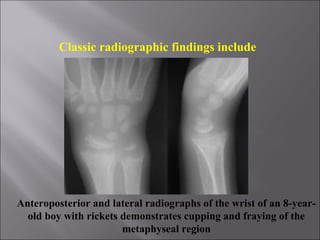
Classic radiographic findings include
Anteroposterior and lateral radiographs of the wrist of an 8-year-
old boy with rickets demonstrates cupping and fraying of the
metaphyseal region
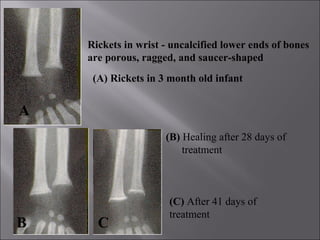
Rickets in wrist - uncalcified lower ends of bones
are porous, ragged, and saucer-shaped
(A) Rickets in 3 month old infant
(B) Healing after 28 days of
treatment
(C) After 41 days of
treatment
A
B C
Radiographic image of wrist and
forearm showing pathologic
fractures of radius and ulna with
rachitic changes of distal end of
radius and ulna.
X-ray in rickets
 Early stage
 Usually begin at 3 months old
 Symptoms: mental psychiatric symptoms
 Irritability, sleeplessness
 Signs: occipital bald
 Laboratory findings: Serum Ca, P normal or
decreased slightly, ALP normal or elevated
slightly, 25(OH)D3 decreased
 X-ray changes: normal or slightly changed
Advanced stage
 On the basis of early rickets, osseous changes
become marked and motor development becomes
delayed.
1. Osseous changes:
1) Head: craniotabes, frontal bossing, boxlike
appearance of skull, delayed closure of anterior
fontanelle
2) Teeth: delayed dentition with abnormal order,
defects
3) Chest: rachitic rosary, Harrison’s groove, pigeon
chest, funnel-shaped chest, flaring of ribs
4) Spinal column: scoliosis, kyphosis, lordosis
5) Extremities: bowlegs, knock knee,
greenstick fracture
6) Rachitic dwarfism
2. Muscular system: potbelly, late in standing and
walking
3. Motor development: delayed
4. Other nervous and mental symptoms
Laboratory findings:
 Serum Ca and P decreased
 ALP elevated
X-ray changes:
Wrist is the best site for watching the changes
Widening of the epiphyseal cartilage
Blurring of the cup-shape metaphyses of long bone
Healing stage:
 Symptoms and signs of Rickets alleviate or
disappear by use of appropriate treatment.
 The blood investigations become normal, except
ALP, that may be slightly elevated.
Sequelae stage:
 All the clinical symptoms and signs disappear.
 Blood investigations and X-ray changes are
recovered, but osseous deformities may be left.
 Usually seen in children after 3 years old.
 I Mild form: small changes of nervous system,
changes of one part of the skeleton;
 II Moderate form: changes of all organs and
systems, changes of two parts of the skeleton;
 III Severe form: damaging function of all
organs and systems, changes of three parts of
the skeleton;
Classification
Types of Rickets
Nutritional
Nutritional rickets results from inadequate
sunlight exposure or inadequate intake of
dietary vitamin D, calcium, or phosphorus.
Vitamin D dependent
 Vitamin D-dependent rickets, type I is secondary to a
defect in the gene that codes for the production of renal
25(OH)D3-1-alpha-hydroxylase.
 Vitamin D-dependent rickets, type II is a rare autosomal
disorder caused by mutations in the vitamin D receptor.
Type II does not respond to vitamin D treatment;
elevated levels of circulating calcitriol differentiate this
type from type I.
Vitamin D resistant
 Rickets refractory to vitamin D treatment may be caused
by the most common heritable form, known as vitamin
D-resistant rickets or familial hypophosphatemic rickets.
 Because of mutations of the phosphate-regulating gene
on the X chromosome, renal wasting of phosphorus at
the proximal tubule level results in hypophosphatemia.
Normal levels of calcitriol are found in this disorder.
Other Conditions That Can Cause Rickets
 Medications
 Antacids
 Anticonvulsants
 Corticosteroids
 Loop diuretics
 Malignancy
 Prematurity
 Diseases of organs associated with vitamin D and calcium
metabolism
 Kidney disease
 Liver and biliary tract disease
 Malabsorption syndromes
 Celiac disease
 Cystic fibrosis (rare)
 Assessed according to the followings:
 1. History
 2. Physical examination
 3. Laboratory findings
 4. X-ray changes
 The replacement of Vitamin D may correct rickets using
these methods of ultraviolet light and medicine. Rickets
heals promptly with 4000 IU of oral vitamin D per day
administered for approximately one month.
 Parents are instructed to take their infants outdoors for
approximately 20 minutes per day with their faces
exposed. Children should also be encouraged to play
outside.
 Foods that are good sources of vitamin D include cod
liver oil, egg yolks, butter and oily fish. Some foods,
including milk and breakfast cereals, are also fortified
with synthetic vitamin D.
1. Special therapy: Vitamin D therapy
 A. General method: Vitamin D 2000-4000 IU/day
for 2-4 weeks, then change to
preventive dosage – 400 IU.
 B. A single large dose: For severe case, or Rickets with
complication, or those who can’t bear oral therapy.
Vitamin D3 200000 – 300000 IU, im,
preventive dosage will be used after 2-3 months.
4. Calcium supplementation: Dosage: 1-3 g/day
 only used for special cases, such as baby fed
mainly with cereal or infants under 3 months of
age and those who have already developed
tetany.
5. Plastic surgery:
In children with bone deformities after 4 years
old plastic surgery may be useful.
 Splints-for correction of deformities
 Corrective osteotomy
1. Pay much attention to the health care of
pregnant and lactating women, instruct them to
take adequate amount of vitamin D.
2. Advocate sunbathing
3. Advocate breast feeding, give supplementary
food on time
Vitamin D supplementation:
In prematures, twins and weak babies, give
Vitamin D 800IU per day,
For term babies and infants the demand of
Vitamin D is 400IU per day,
For those babies who can’t maintain a daily
supplementation, inject muscularly
Vitamin D3 100000-200000 IU.
Rickets

Rickets

  • 1.
  • 2.
    Rickets is achildhood disorder involving softening and weakening of the bones. It is primarily caused by lack of vitamin D, calcium, or phosphate.
  • 3.
    Vitamin D isa fat-soluble vitamin that may be absorbed from the intestines or may be produced by the skin when the skin is exposed to sunlight (ultraviolet light of sunlight helps the body to form vitamin D). The absorbed vitamin D is converted into its active form to act as a hormone to regulate calcium absorption from the intestine and to regulate levels of calcium and phosphate in the bones. If there is a deficiency of Vitamin D, the body is unable to properly regulate calcium and phosphate levels. When the blood levels of these minerals become too low, it results in destruction of the support matrix of the bones.
  • 4.
    In rickets, anothermechanism in the body works to increase the blood calcium level. The parathyroid gland may increase its functioning rate to compensate for decreased levels of calcium in the bloodstream. To increase the level of calcium in the blood the hormone destroys the calcium present in the bones of the body and this results in further loss of calcium and phosphorous from the bones. In severe cases, cysts may develop in the bones.
  • 5.
     Environmental conditionswhere sunlight exposure is limited like indoor confinement or working indoors during daylight hours may reduce source of vitamin D;  Inadequate daily consumption - a lack of vitamin D in the diet, a dietary lack of calcium and phosphorous may also play a part in nutritional causes of rickets, have trouble digesting milk products, people who are lactose intolerant;  Liver Failure;  Dark Pigmentation
  • 6.
    . Fast growth,increased requirement (relative deficiency) . Diseases and drug:  Liver diseases, renal diseases  Gastrointestinal diseases  Antiepileptic  Glucocorticosteroid .Malabsorption-Steatorrhoea
  • 7.
    Cholecalciferol (vitamin D-3)is formed in the skin from 7-dehydrotachysterol. This steroid undergoes hydroxylation in 2 steps. Pathophysiology - Metabolism of vitamin D • The first hydroxylation occurs at position 25 in the liver, producing calcidiol (25-hydroxycholecalciferol), which circulates in the plasma as the most abundant of the vitamin D metabolites and is thought to be a good indicator of overall vitamin D status.
  • 8.
     Cholecalciferol (vitaminD-3) is formed in the skin from 7-dihydrotachysterol. This steroid undergoes hydroxylation in 2 steps. Pathophysiology • The second hydroxylation step occurs in the kidney at the 1 position, where it undergoes hydroxylation to the active metabolite calcitriol (1,25-dihydroxycholecalciferol - DHC). This cholecalciferol is not a vitamin, but a hormone.
  • 10.
    Calcitriol acts onregulation of calcium metabolism:  Calcitriol promotes absorption of calcium and phosphorus from the intestine,  increases reabsorption of phosphate in the kidney,  acts on bone to release calcium and phosphate;  Calcitriol may also directly facilitate calcification. Calcitriol (1,25-DHC) – acts as a hormone rather than a vitamin, endocrine and paracrine properties
  • 11.
    •These actions increasethe concentrations of calcium and phosphorus in extracellular fluid. • The increase of Ca and P in extracellular fluid, in turn, leads to the calcification of osteoid, primarily at the metaphyseal growing ends of bones but also throughout all osteoid in the skeleton. • Parathyroid hormone facilitates the 1-hydro- xylation step in vitamin D metabolism
  • 12.
     In thevitamin D deficiency state, hypocalciemia develops, which stimulates excess parathyroid hormone, which stimulates renal phosphorus loss, further reducing deposition of calcium in the bone.  Excess parathyroid hormone also produces changes in the bone similar to those occurring in hyperparathyroidism.
  • 13.
     Early inthe course of rickets, the calcium concentration in the serum decreases.  After the parathyroid response, the calcium concentration usually returns to the reference range, though phosphorus levels remain low.  Alkaline phosphatase, which is produced by overactive osteoblast cells, leaks to the extracellular fluids so that its concentration rises to anywhere from moderate elevation to very high levels.
  • 14.
    The history inpatients with rickets may include the following:  The infant's gestational age, diet and degree of sunlight exposure should be noted.  A detailed dietary history should include specifics of vitamin D and calcium intake.  A family history of short stature, orthopedic abnormalities, poor dentition, alopecia, parental consanguinity may signify inherited rickets. Evaluation
  • 15.
    Rickets is asystemic disease with skeletons involved most, but the nervous system, muscular system and other system are also involved.
  • 16.
     Generalized muscularhypotonia is observed in the most patients with clinical signs of rickets.  Craniotabes manifests early in infants, although this feature may be normal in infants, especially for those born prematurely. Clinical signs • If rickets occurs at a later age, thickening of the skull develops. This produces frontal bossing and delays the closure of the anterior fontanelle.
  • 17.
    • Skeletal deformities including Bowlegs, Forward projection of the breastbone - pigeon chest or pectus carinatum), Funnel chest (pectus excavatum), "Bumps" in the rib cage (rachitic rosary) and asymmetrical or odd-shaped skull;
  • 18.
    Chest deformity Funnel chest– pectus excavatum Pigeon chest
  • 19.
    Clinical signs  Inthe chest, knobby deformities results in the rachitic rosary along the costochondral junctions.  The weakened ribs pulled by muscles also produce flaring over the diaphragm, which is known as Harrison sulcus.  The sternum may be pulled into a pigeon-chest deformity. Rib beading (rachitic rosary)
  • 20.
    Pathway of VitaminD Production
  • 21.
    Knock knee deformity (genuvalgum) Bowleg deformity (genu varum)
  • 22.
     The endsof the long bones demonstrate that same knobby thickening. At the ankle, palpation of the tibial Clinical signs malleolus gives the impression of a double epiphysis (Marfan sign).
  • 23.
     Increased tendencytoward bone fractures. Because the softened long bones may bend, they may fracture one side of the cortex (greenstick fracture).  In the long bones, laying down of uncalcified osteoid at the metaphyses leads to spreading of those areas, producing knobby deformity (cupping and fraying of the metaphyses).
  • 24.
     Spine deformities (spinecurves abnormally, including scoliosis or kyphosis).  In more severe instances in children older than 2 years, vertebral softening leads to kyphoscoliosis
  • 25.
     Pain inthe bones of Arms, Legs, Spine, Pelvis.  Dental deformities  Delayed formation of teeth  Defects in the structure of teeth  Holes in the enamel  Increased incidence of cavities in the teeth (dental caries)
  • 26.
     Progressive weakness Decreased muscle tone (loss of muscle strength)  Muscle cramps  Impaired growth  Short stature (adults less than 5 feet tall) Clinical signs
  • 27.
    In children withrickets, complete physical and dental examinations should be performed. The entire skeletal system must be palpated to search for tenderness and bony abnormalities. Rickets should be suspected in older bowlegged children and in cases associated with asymmetry, pain, or progression in severity. a Physical examination
  • 28.
    .Gait disturbances andneurologic abnormalities (such as hyperreflexia) in all children should be sought. . The review of systems should focus on growth and orthopedic concerns and signs and symptoms of hypocalcemia, such as muscle cramps, numbness, paresthesias, tetany and seizures.
  • 29.
    Laboratory findings Laboratory investigationmay include:  serum levels of calcium (total and ionized with serum albumin),  phosphorus,  alkaline phosphatase (ALP)  parathyroid hormone,  calcidiol  urine studies include urinalysis and levels of urinary calcium and phosphorus.
  • 30.
    Decrease in serum calcium, serumphosphorus, calcidiol, calcitriol, urinary calcium. The most common laboratory findings in nutritional rickets are: Parathyroid hormone, alkaline phosphatase, urinary phosphorus levels are elevated.
  • 31.
     Early onin the course of rickets, the calcium (ionized fraction) is low; however it is often within the reference range at the time of diagnosis as parathyroid hormone levels increase.  Calcidiol (25-hydroxy vitamin D) levels are low, and parathyroid hormone levels are elevated; however, determining calcidiol and parathyroid hormone levels is typically not necessary.  Calcitriol levels may be normal or elevated because of increased parathyroid activity.  The phosphorus level is invariably low for age.  Alkaline phospohatase levels are elevated.  A generalized aminoaciduria occurs from the parathyroid activity; aminoaciduria does not occur in familial hypophosphatemia rickets (FHR). Laboratory Studies
  • 32.
     Classic radiographicfindings include: widening of the distal epiphysis, fraying and cupping of the metaphysis, and angular deformities of the arm and leg bones.
  • 33.
    Classic radiographic findingsinclude Anteroposterior and lateral radiographs of the wrist of an 8-year- old boy with rickets demonstrates cupping and fraying of the metaphyseal region
  • 34.
    Rickets in wrist- uncalcified lower ends of bones are porous, ragged, and saucer-shaped (A) Rickets in 3 month old infant (B) Healing after 28 days of treatment (C) After 41 days of treatment A B C
  • 35.
    Radiographic image ofwrist and forearm showing pathologic fractures of radius and ulna with rachitic changes of distal end of radius and ulna.
  • 36.
  • 37.
     Early stage Usually begin at 3 months old  Symptoms: mental psychiatric symptoms  Irritability, sleeplessness  Signs: occipital bald  Laboratory findings: Serum Ca, P normal or decreased slightly, ALP normal or elevated slightly, 25(OH)D3 decreased  X-ray changes: normal or slightly changed
  • 38.
    Advanced stage  Onthe basis of early rickets, osseous changes become marked and motor development becomes delayed. 1. Osseous changes: 1) Head: craniotabes, frontal bossing, boxlike appearance of skull, delayed closure of anterior fontanelle 2) Teeth: delayed dentition with abnormal order, defects 3) Chest: rachitic rosary, Harrison’s groove, pigeon chest, funnel-shaped chest, flaring of ribs
  • 39.
    4) Spinal column:scoliosis, kyphosis, lordosis 5) Extremities: bowlegs, knock knee, greenstick fracture 6) Rachitic dwarfism 2. Muscular system: potbelly, late in standing and walking 3. Motor development: delayed 4. Other nervous and mental symptoms
  • 40.
    Laboratory findings:  SerumCa and P decreased  ALP elevated X-ray changes: Wrist is the best site for watching the changes Widening of the epiphyseal cartilage Blurring of the cup-shape metaphyses of long bone
  • 41.
    Healing stage:  Symptomsand signs of Rickets alleviate or disappear by use of appropriate treatment.  The blood investigations become normal, except ALP, that may be slightly elevated. Sequelae stage:  All the clinical symptoms and signs disappear.  Blood investigations and X-ray changes are recovered, but osseous deformities may be left.  Usually seen in children after 3 years old.
  • 42.
     I Mildform: small changes of nervous system, changes of one part of the skeleton;  II Moderate form: changes of all organs and systems, changes of two parts of the skeleton;  III Severe form: damaging function of all organs and systems, changes of three parts of the skeleton; Classification
  • 43.
    Types of Rickets Nutritional Nutritionalrickets results from inadequate sunlight exposure or inadequate intake of dietary vitamin D, calcium, or phosphorus.
  • 44.
    Vitamin D dependent Vitamin D-dependent rickets, type I is secondary to a defect in the gene that codes for the production of renal 25(OH)D3-1-alpha-hydroxylase.  Vitamin D-dependent rickets, type II is a rare autosomal disorder caused by mutations in the vitamin D receptor. Type II does not respond to vitamin D treatment; elevated levels of circulating calcitriol differentiate this type from type I.
  • 45.
    Vitamin D resistant Rickets refractory to vitamin D treatment may be caused by the most common heritable form, known as vitamin D-resistant rickets or familial hypophosphatemic rickets.  Because of mutations of the phosphate-regulating gene on the X chromosome, renal wasting of phosphorus at the proximal tubule level results in hypophosphatemia. Normal levels of calcitriol are found in this disorder.
  • 46.
    Other Conditions ThatCan Cause Rickets  Medications  Antacids  Anticonvulsants  Corticosteroids  Loop diuretics  Malignancy  Prematurity  Diseases of organs associated with vitamin D and calcium metabolism  Kidney disease  Liver and biliary tract disease  Malabsorption syndromes  Celiac disease  Cystic fibrosis (rare)
  • 47.
     Assessed accordingto the followings:  1. History  2. Physical examination  3. Laboratory findings  4. X-ray changes
  • 48.
     The replacementof Vitamin D may correct rickets using these methods of ultraviolet light and medicine. Rickets heals promptly with 4000 IU of oral vitamin D per day administered for approximately one month.  Parents are instructed to take their infants outdoors for approximately 20 minutes per day with their faces exposed. Children should also be encouraged to play outside.  Foods that are good sources of vitamin D include cod liver oil, egg yolks, butter and oily fish. Some foods, including milk and breakfast cereals, are also fortified with synthetic vitamin D.
  • 49.
    1. Special therapy:Vitamin D therapy  A. General method: Vitamin D 2000-4000 IU/day for 2-4 weeks, then change to preventive dosage – 400 IU.  B. A single large dose: For severe case, or Rickets with complication, or those who can’t bear oral therapy. Vitamin D3 200000 – 300000 IU, im, preventive dosage will be used after 2-3 months.
  • 50.
    4. Calcium supplementation:Dosage: 1-3 g/day  only used for special cases, such as baby fed mainly with cereal or infants under 3 months of age and those who have already developed tetany. 5. Plastic surgery: In children with bone deformities after 4 years old plastic surgery may be useful.
  • 51.
     Splints-for correctionof deformities  Corrective osteotomy
  • 52.
    1. Pay muchattention to the health care of pregnant and lactating women, instruct them to take adequate amount of vitamin D. 2. Advocate sunbathing 3. Advocate breast feeding, give supplementary food on time
  • 53.
    Vitamin D supplementation: Inprematures, twins and weak babies, give Vitamin D 800IU per day, For term babies and infants the demand of Vitamin D is 400IU per day, For those babies who can’t maintain a daily supplementation, inject muscularly Vitamin D3 100000-200000 IU.