RICKETS
DR. YASNA KIBRIA
MD Resident(Phase A)
Department of Radiology and Imaging
BSMMU
Rickets (Rachitis)
• Is a metabolic disease of growing bone that is unique to
children especially of first two years of life.
• It is caused by a failure of mineralization of osteoid tissue in
a developing skeleton ,particularly at the growth plate,
especially by imperfect calcification and typically resulting in
soft bones and skeletal deformities.
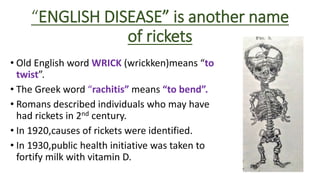
“ENGLISH DISEASE” is another name
of rickets
• Old English word WRICK (wrickken)means “to
twist”.
• The Greek word “rachitis” means “to bend”.
• Romans described individuals who may have
had rickets in 2nd century.
• In 1920,causes of rickets were identified.
• In 1930,public health initiative was taken to
fortify milk with vitamin D.
TYPES OF RICKETS
• Nutritional rickets or vitamin D deficiency rickets.
• Vitamin D dependent rickets:
type 1 & type 2
• Vitamin D resistant rickets (Familial hypophosphataemia).
• Secondary rickets:CLD, End stage renal diseases (CKD) etc.
CAUSES of rickets :
1. Abnormality in vitamin D metabolism
2. Abnormality in phosphate metabolism
3. Calcium deficiency
VITAMIN D :THE SUNSHINE VITAMIN
SOURCES of vitamin D
• Sun light
-synthesized in body
from precursor sterol
• All milk products
(fortified)
• Cod liver oil
• Egg yolk
VITAMIN D METABOLISM
Hypocalcaemic rickets(with secondary
hyperparathyroidism)
• lack of vitamin D (NUTRITIONAL RICKETS) : causes-
-dietary deficiency
-lack of exposure to sunlight
-lack of production of vit D by the body
-black skin immigrants
-exclusive breast feeding without vit D supplementation
-malabsorpsion of vitamin D (gastroenterogenous rickets):
crohn’s disease,coeliac disease etc.
Continue…..
• Chronic liver disease :affects conversion of cholecalciferol to
calcidiol
• Anticonvulsant drugs:phenytoin,phenobarbitone (due to
increased metabolism of vit D by inducing cytochrome p450
enzymes)
RENAL OSTEODYSTROPHY(RENAL RICKETS)
due to loss of renal function failure to synthesize active form of
vitamin D and failure to excrete phosphate reduced calcium
increases PTH increase activity of osteoclasts resulted
osteomalacia/rickets,osteosclerosis,soft tissue calcifications etc.
HEREDITARY RICKETS (vitamin D dependent rickets):
• Type 1 vitamin D dependent rickets (defect in the 1 alpha hydroxylase
enzyme which is responsible for conversion of 25(OH)D into the active
metabolite)
• Type 2 vitamin D dependent rickets (due to end organ resistance to calcitriol
which is usually caused by mutation of gene encoding for vitamin D
receptors)
NUTRITIONAL RICKETS
EPIDEMIOLOGY
• Commonest metabolic bone disease globally.
• Nutritional type is commonest in Asia , Africa and Middle east.
• Incidence rising in the west due to more children staying
indoors and watching TV and playing video games.
• Rates of disease is equal in males and females.
• Affected infants are usually below 1000gm in weight or less
than 28 weeks of gestations.
• AGE: 3-18 months.
CLINICAL MENIFESTATIONS
1. Finding specific to the bone tissues in rickets:
-Symptoms of osteomalacia
- Symptoms of hyperplasia of osteoid tissue
-Symptoms of hypoplasia of osseous tissue
2.Finding non-specific to bone tissue in rickets.
Findings specific to bone tissue
• SYMPTOMS OF OSTEOMALACIA:
Craniotabes
Softening of big fontanelle’s edges
Softening of the ribs
Kyphosis
Bowing of the legs
Findings specific to bone tissue cont.
SYMPTOMS OF HYPERPLASIA OF OSTEOID TISSUE
1. Increase of frontal and occipital tubers(frontal
bossing,caput quadratum,”hot cross bun” skull)
2. Costo-chondral prominence(rachitic rosary)
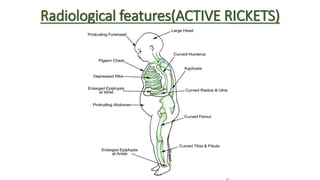
3. Chest deformities(Harrison’s groove and pigeon chest)
Findings specific to bone tissue cont.
•SYMPTOMS OF HYPOPLASIA OSSEOUS TISSUE
1. Delayed fontanelle closure
2. Delayed dentition
3. Enamel hypoplasia
4. Deformities like kyphosis,scoliosis
5. Costal or lower extremity fractures(particularly greenstick
fractures)
6. Lag of growth of tubular bones in length in severe cases.
Findings NOT specific to bone tissue:
• Occipital alopecia
• Muscular hypotonia (floppy baby syndrome)
• Constipation
• Hypocalcaemic tetany
• Anaemia
• Increased risk of respiratory infections
• Growth retardation and low height for age (rachitic dwarfism)
PATHOGENESIS of Rickets
Radiological features(ACTIVE RICKETS)
WIDENING OF
GROWTH PLATE
• Earliest radiological
sign is loss of zone of
provisional
calcification adjacent
to metaphysis.
• Due to deposition of
excess un-mineralized
osteoid.
METAPHYSEAL FRAYING
• Irregular metaphyseal
margins occurring due to
fraying and disorganization
of spongy bone in the
metaphyseal region.
METAPHYSEAL CUPPING
AND SPLAYING
• Protrusion of bulky mass
of cartilaginous cells in
the zone of hypertrophy
into poorly mineralized
metaphysis.
EPIPHYSEAL ABNORMALITY
• Osteopenia
• Irregular and indistinct
borders
• Delayed appearance of
ossification centres.
SHAFT ABNORMALITIES
• Bone density is reduced
due to loss of mineral
content.
• Cortex become thin with a
course trabeculation.
GROWTH PLATE
ABNORMALITIES
• Generalised osteopenia
• Course trabecular pattern
• Frayed paintbrush
metaphyseal
margins(arrows)
• Lack of zone of provisional
calcification
• Widening of the physis
CRANIOTABES
• Occurs due to thinning of
outer table of occipital or
parietal bone.
[CLINICALLY , detected by
gentle pressure by thumbs
over the occipital or posterior
parietal bones , pingpong
sensation will be felt.
**EARLIEST clinical sign of
rickets.]
CAPUT QUADRATUM
• Excess osteoid deposition in
frontal and parietal regions
with posterior flattening of
skull due to supine posture
of infant.
• Squared configuration of the
skull.
• Demineralization of skull.
BOWING OF LONG BONES
• Result of displacement of
growth centres owing to
asymmetrical
musculotendinous pull on
the weakened growth plate.
RACHITIC ROSARY
• Bulbous enlargement of
costo-chondral junction
especially middle ribs.
• Due to deposition of excess
osteoid in zone of
hypertrophy.
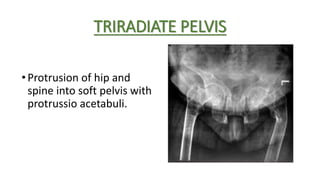
TRIRADIATE PELVIS
•Protrusion of hip and
spine into soft pelvis with
protrussio acetabuli.
IN LONG STANDING CASES:
• Bowing of the long bones.
• Fracture of weight bearing bones.
• Looser’s zones [less than osteomalacia]
• Triangular pelvic cavity.
• Stunted growth.
LABORATORY FINDINGS
• Serum calcium: low or normal
• Serum phosphorus: low
• Serum alkaline phosphatase: markedly raised(though it
is not specific but a sensitive early indicator of rachitic activity)
• Serum PTH: raised
• Serum 25-(OH) D3: low (most sensitive index of vit D status)
** A serum calcium and serum phosphorus product
(mg per 100 ml) above 40 excludes rickets,while a
figure below 30 indicate active rickets.
TREATMENT
• Vitamin D supplementation:
-STOSS THERAPY
-GRADUAL THERAPY
• Either strategy should be followed by daily maintenance of vitamin D
intake of-
400 IU/day if <1 year
600 IU/day if >1 year
• Calcium supplementation(350-1000 mg/day)
Radiological changes
HEALING RICKETS
• Appearance of line of
provisional calcification at the
end of metaphysis.
• Metaphysis shows cupping and
splaying but NO FRAYING.
• The shaft still shows diminished
density.
• Periosteum may show double
periosteal line due to
subperiosteal deposition of
osteoid tissue.
Radiological changes
HEALED RICKETS
• The shaft is calcified.
• The sub-periosteal osteoid tissue
is calcified(no double periosteal
line).
• Splaying and cupping are
corrected.
VITAMIN D RESISTANT RICKETS (FAMILIAL
HYPOPHOSPHATEMIA/X -LINKED HYPOPHOSPHATASIA)
• Most common non-nutritional form of rickets.
• Mode of inheritance –X linked dominant .
• Pathogenic mechanism-defect in proximal tubular reabsorption of phosphate.
• Clinical menifestations-
i. Children present with bowing of lower extrimities
ii. Waddling gait
iii. Coxa vara,genu varum,genu valgum
iv. Short stature
**characteristics of calcium deficient rickets are not evident,e.g. rachitic
rosary,Harrison sulcus.
**pulp deformities and intraglobular dentin are characteristic tooth
abnormalities(in rickets-enamel deformities)
FAMILIAL hypophosphatemia cont…
***This disease is SIMILAR to rickets in radiological appearance
• hypophosphatemia , hyperphosphaturia , elevated serum ALP , normal
serum calcium,vitamin D and serum PTH.
TUMOUR RICKETS (Acquired hypophosphatemia):
• Rarely, hypophosphatemia has been seen in association with tumours of
bone or soft tissues,frequently fibrous in origin.
• association also has been reported with prostatic carcinoma,oat cell
carcinoma of lung,neurofibromatosis,fibrous dysplasia.
• Resection of the tumor causes resolution of the rickets.
HYPOPHOSPHATASIA
• Inherited as autosomal recessive
trait.
• Radiographic picture varies mild to
very severe form of
rickets,depending upon age of
onset.
• Neonatal variety is most severe.
• Low serum ALP and Increased
urinary phosphoethanolomine.
• In severe cases-exaggerated fraying
of metaphysis with uncalcified
osteoid extending into metaphysis.
DIFFERENTIAL DIAGNOSIS
OF RICKETS
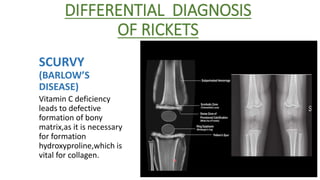
SCURVY
(BARLOW’S
DISEASE)
Vitamin C deficiency
leads to defective
formation of bony
matrix,as it is necessary
for formation
hydroxyproline,which is
vital for collagen.
DIFFERENCE BETWEEN RICKETS AND SCURVY
POINTS RICKETS SCURVY
CAUSES VITAMIN D deficiency VITAMIN C deficiency
PATHOGENESIS
MINERALISATION
Inadequate mineralization
leading to unmineralised
matrix at growth plate.
defective
Faulty collagen synthesis(defective
hydroxylation of lysine and proline) in
bones,cartilages,teeth.
Normal.
PEAK INCIDENCE 3-18 months 6-24 months
CLINICAL FEATURES
ROSARY FORMATION
• Rickets can present
within 2 months of age.
• Bone pain,short
strature,fracture,tooth
deformities etc.
• Knobby and nodular
appearance.
• Rare before 6 months.
• Progressive
irritability,pseudoparaly
sis,haemorrhage into
gum and mucous
membranes etc.
• Angular costochondral
junction with sharper
step-off
AREA OF INVOLVEMENT Zone of hypertrophy Primary spongiosa
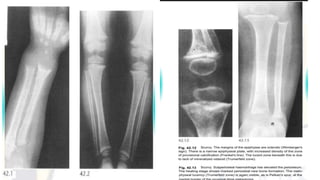
RADIOLOGICAL FEATURES:
1. Epiphysis Epiphyseal centres are
indistinct or invisible .
Epiphysis is small,sharply
marginated by a sclerotic rim
(WIMBERGER’S SIGN)
[termed as signet ring or
ringing of epiphysis]
Cont..
2.Metaphysis : (a)
• Loss of zone of provisional
calcification adjacent to
metaphysis,having faint
irregular outline(FRAYING)
• Splaying and cupping of
metaphysis.
Zone of provisional
calcification at metaphysis is
dense,giving a white line
(FRANKEL’S LINE)
(b) Not found. • Beneath this is a lucent
zone,due to lack of
mineralized
osteoid(TRUMERFELD
ZONE)
• Lateral projection of white
line may lead to formation
of spur or marginal cleft
(PELKAN’S SPUR) ( [corner
sign:great diagnostic value]
Continue…..
3.Shaft abnormalities Cortical thinning with
course trabeculation.
Cortical thinning with
GROUND GLASS
APPERANCE
[CHARACTERISTIC ]
4.SUBPERIOSTEAL LAYER May be found but Less
marked effect.
Sub-periosteal haemorrhage
due to capillary fragility
giving rise to periosteal
elevation.(affected bone
looks like a dumbbell or a
club)
PREVENTION
• Exposure to ultraviolet ray in
sunshine (10-20 minute/day)
• Intake of vitamin D rich foods.
• vitamin D supplementation of
200-400 IU/day.
Rickets

Rickets

  • 1.
    RICKETS DR. YASNA KIBRIA MDResident(Phase A) Department of Radiology and Imaging BSMMU
  • 2.
    Rickets (Rachitis) • Isa metabolic disease of growing bone that is unique to children especially of first two years of life. • It is caused by a failure of mineralization of osteoid tissue in a developing skeleton ,particularly at the growth plate, especially by imperfect calcification and typically resulting in soft bones and skeletal deformities.
  • 3.
    “ENGLISH DISEASE” isanother name of rickets • Old English word WRICK (wrickken)means “to twist”. • The Greek word “rachitis” means “to bend”. • Romans described individuals who may have had rickets in 2nd century. • In 1920,causes of rickets were identified. • In 1930,public health initiative was taken to fortify milk with vitamin D.
  • 4.
    TYPES OF RICKETS •Nutritional rickets or vitamin D deficiency rickets. • Vitamin D dependent rickets: type 1 & type 2 • Vitamin D resistant rickets (Familial hypophosphataemia). • Secondary rickets:CLD, End stage renal diseases (CKD) etc. CAUSES of rickets : 1. Abnormality in vitamin D metabolism 2. Abnormality in phosphate metabolism 3. Calcium deficiency
  • 5.
    VITAMIN D :THESUNSHINE VITAMIN SOURCES of vitamin D • Sun light -synthesized in body from precursor sterol • All milk products (fortified) • Cod liver oil • Egg yolk
  • 6.
  • 7.
    Hypocalcaemic rickets(with secondary hyperparathyroidism) •lack of vitamin D (NUTRITIONAL RICKETS) : causes- -dietary deficiency -lack of exposure to sunlight -lack of production of vit D by the body -black skin immigrants -exclusive breast feeding without vit D supplementation -malabsorpsion of vitamin D (gastroenterogenous rickets): crohn’s disease,coeliac disease etc.
  • 8.
    Continue….. • Chronic liverdisease :affects conversion of cholecalciferol to calcidiol • Anticonvulsant drugs:phenytoin,phenobarbitone (due to increased metabolism of vit D by inducing cytochrome p450 enzymes)
  • 9.
    RENAL OSTEODYSTROPHY(RENAL RICKETS) dueto loss of renal function failure to synthesize active form of vitamin D and failure to excrete phosphate reduced calcium increases PTH increase activity of osteoclasts resulted osteomalacia/rickets,osteosclerosis,soft tissue calcifications etc. HEREDITARY RICKETS (vitamin D dependent rickets): • Type 1 vitamin D dependent rickets (defect in the 1 alpha hydroxylase enzyme which is responsible for conversion of 25(OH)D into the active metabolite) • Type 2 vitamin D dependent rickets (due to end organ resistance to calcitriol which is usually caused by mutation of gene encoding for vitamin D receptors)
  • 10.
    NUTRITIONAL RICKETS EPIDEMIOLOGY • Commonestmetabolic bone disease globally. • Nutritional type is commonest in Asia , Africa and Middle east. • Incidence rising in the west due to more children staying indoors and watching TV and playing video games. • Rates of disease is equal in males and females. • Affected infants are usually below 1000gm in weight or less than 28 weeks of gestations. • AGE: 3-18 months.
  • 11.
    CLINICAL MENIFESTATIONS 1. Findingspecific to the bone tissues in rickets: -Symptoms of osteomalacia - Symptoms of hyperplasia of osteoid tissue -Symptoms of hypoplasia of osseous tissue 2.Finding non-specific to bone tissue in rickets.
  • 12.
    Findings specific tobone tissue • SYMPTOMS OF OSTEOMALACIA: Craniotabes Softening of big fontanelle’s edges Softening of the ribs Kyphosis Bowing of the legs
  • 13.
    Findings specific tobone tissue cont. SYMPTOMS OF HYPERPLASIA OF OSTEOID TISSUE 1. Increase of frontal and occipital tubers(frontal bossing,caput quadratum,”hot cross bun” skull) 2. Costo-chondral prominence(rachitic rosary) 3. Chest deformities(Harrison’s groove and pigeon chest)
  • 14.
    Findings specific tobone tissue cont. •SYMPTOMS OF HYPOPLASIA OSSEOUS TISSUE 1. Delayed fontanelle closure 2. Delayed dentition 3. Enamel hypoplasia 4. Deformities like kyphosis,scoliosis 5. Costal or lower extremity fractures(particularly greenstick fractures) 6. Lag of growth of tubular bones in length in severe cases.
  • 15.
    Findings NOT specificto bone tissue: • Occipital alopecia • Muscular hypotonia (floppy baby syndrome) • Constipation • Hypocalcaemic tetany • Anaemia • Increased risk of respiratory infections • Growth retardation and low height for age (rachitic dwarfism)
  • 17.
  • 18.
  • 19.
    WIDENING OF GROWTH PLATE •Earliest radiological sign is loss of zone of provisional calcification adjacent to metaphysis. • Due to deposition of excess un-mineralized osteoid.
  • 20.
    METAPHYSEAL FRAYING • Irregularmetaphyseal margins occurring due to fraying and disorganization of spongy bone in the metaphyseal region. METAPHYSEAL CUPPING AND SPLAYING • Protrusion of bulky mass of cartilaginous cells in the zone of hypertrophy into poorly mineralized metaphysis.
  • 21.
    EPIPHYSEAL ABNORMALITY • Osteopenia •Irregular and indistinct borders • Delayed appearance of ossification centres. SHAFT ABNORMALITIES • Bone density is reduced due to loss of mineral content. • Cortex become thin with a course trabeculation.
  • 22.
    GROWTH PLATE ABNORMALITIES • Generalisedosteopenia • Course trabecular pattern • Frayed paintbrush metaphyseal margins(arrows) • Lack of zone of provisional calcification • Widening of the physis
  • 23.
    CRANIOTABES • Occurs dueto thinning of outer table of occipital or parietal bone. [CLINICALLY , detected by gentle pressure by thumbs over the occipital or posterior parietal bones , pingpong sensation will be felt. **EARLIEST clinical sign of rickets.]
  • 24.
    CAPUT QUADRATUM • Excessosteoid deposition in frontal and parietal regions with posterior flattening of skull due to supine posture of infant. • Squared configuration of the skull. • Demineralization of skull.
  • 25.
    BOWING OF LONGBONES • Result of displacement of growth centres owing to asymmetrical musculotendinous pull on the weakened growth plate.
  • 26.
    RACHITIC ROSARY • Bulbousenlargement of costo-chondral junction especially middle ribs. • Due to deposition of excess osteoid in zone of hypertrophy.
  • 27.
    TRIRADIATE PELVIS •Protrusion ofhip and spine into soft pelvis with protrussio acetabuli.
  • 28.
    IN LONG STANDINGCASES: • Bowing of the long bones. • Fracture of weight bearing bones. • Looser’s zones [less than osteomalacia] • Triangular pelvic cavity. • Stunted growth.
  • 29.
    LABORATORY FINDINGS • Serumcalcium: low or normal • Serum phosphorus: low • Serum alkaline phosphatase: markedly raised(though it is not specific but a sensitive early indicator of rachitic activity) • Serum PTH: raised • Serum 25-(OH) D3: low (most sensitive index of vit D status) ** A serum calcium and serum phosphorus product (mg per 100 ml) above 40 excludes rickets,while a figure below 30 indicate active rickets.
  • 30.
    TREATMENT • Vitamin Dsupplementation: -STOSS THERAPY -GRADUAL THERAPY • Either strategy should be followed by daily maintenance of vitamin D intake of- 400 IU/day if <1 year 600 IU/day if >1 year • Calcium supplementation(350-1000 mg/day)
  • 31.
    Radiological changes HEALING RICKETS •Appearance of line of provisional calcification at the end of metaphysis. • Metaphysis shows cupping and splaying but NO FRAYING. • The shaft still shows diminished density. • Periosteum may show double periosteal line due to subperiosteal deposition of osteoid tissue.
  • 32.
    Radiological changes HEALED RICKETS •The shaft is calcified. • The sub-periosteal osteoid tissue is calcified(no double periosteal line). • Splaying and cupping are corrected.
  • 33.
    VITAMIN D RESISTANTRICKETS (FAMILIAL HYPOPHOSPHATEMIA/X -LINKED HYPOPHOSPHATASIA) • Most common non-nutritional form of rickets. • Mode of inheritance –X linked dominant . • Pathogenic mechanism-defect in proximal tubular reabsorption of phosphate. • Clinical menifestations- i. Children present with bowing of lower extrimities ii. Waddling gait iii. Coxa vara,genu varum,genu valgum iv. Short stature **characteristics of calcium deficient rickets are not evident,e.g. rachitic rosary,Harrison sulcus. **pulp deformities and intraglobular dentin are characteristic tooth abnormalities(in rickets-enamel deformities)
  • 34.
    FAMILIAL hypophosphatemia cont… ***Thisdisease is SIMILAR to rickets in radiological appearance • hypophosphatemia , hyperphosphaturia , elevated serum ALP , normal serum calcium,vitamin D and serum PTH. TUMOUR RICKETS (Acquired hypophosphatemia): • Rarely, hypophosphatemia has been seen in association with tumours of bone or soft tissues,frequently fibrous in origin. • association also has been reported with prostatic carcinoma,oat cell carcinoma of lung,neurofibromatosis,fibrous dysplasia. • Resection of the tumor causes resolution of the rickets.
  • 35.
    HYPOPHOSPHATASIA • Inherited asautosomal recessive trait. • Radiographic picture varies mild to very severe form of rickets,depending upon age of onset. • Neonatal variety is most severe. • Low serum ALP and Increased urinary phosphoethanolomine. • In severe cases-exaggerated fraying of metaphysis with uncalcified osteoid extending into metaphysis.
  • 36.
    DIFFERENTIAL DIAGNOSIS OF RICKETS SCURVY (BARLOW’S DISEASE) VitaminC deficiency leads to defective formation of bony matrix,as it is necessary for formation hydroxyproline,which is vital for collagen.
  • 37.
    DIFFERENCE BETWEEN RICKETSAND SCURVY POINTS RICKETS SCURVY CAUSES VITAMIN D deficiency VITAMIN C deficiency PATHOGENESIS MINERALISATION Inadequate mineralization leading to unmineralised matrix at growth plate. defective Faulty collagen synthesis(defective hydroxylation of lysine and proline) in bones,cartilages,teeth. Normal. PEAK INCIDENCE 3-18 months 6-24 months
  • 38.
    CLINICAL FEATURES ROSARY FORMATION •Rickets can present within 2 months of age. • Bone pain,short strature,fracture,tooth deformities etc. • Knobby and nodular appearance. • Rare before 6 months. • Progressive irritability,pseudoparaly sis,haemorrhage into gum and mucous membranes etc. • Angular costochondral junction with sharper step-off AREA OF INVOLVEMENT Zone of hypertrophy Primary spongiosa RADIOLOGICAL FEATURES: 1. Epiphysis Epiphyseal centres are indistinct or invisible . Epiphysis is small,sharply marginated by a sclerotic rim (WIMBERGER’S SIGN) [termed as signet ring or ringing of epiphysis]
  • 39.
    Cont.. 2.Metaphysis : (a) •Loss of zone of provisional calcification adjacent to metaphysis,having faint irregular outline(FRAYING) • Splaying and cupping of metaphysis. Zone of provisional calcification at metaphysis is dense,giving a white line (FRANKEL’S LINE) (b) Not found. • Beneath this is a lucent zone,due to lack of mineralized osteoid(TRUMERFELD ZONE) • Lateral projection of white line may lead to formation of spur or marginal cleft (PELKAN’S SPUR) ( [corner sign:great diagnostic value]
  • 40.
    Continue….. 3.Shaft abnormalities Corticalthinning with course trabeculation. Cortical thinning with GROUND GLASS APPERANCE [CHARACTERISTIC ] 4.SUBPERIOSTEAL LAYER May be found but Less marked effect. Sub-periosteal haemorrhage due to capillary fragility giving rise to periosteal elevation.(affected bone looks like a dumbbell or a club)
  • 42.
    PREVENTION • Exposure toultraviolet ray in sunshine (10-20 minute/day) • Intake of vitamin D rich foods. • vitamin D supplementation of 200-400 IU/day.