Rickets
Plan 
• Introduction – Defining the subject 
• (1): Pathogenesis 
• (2): Clinical Presentation and Diagnosis 
• (3): Treatment and Prevention 
• Conclusion
Defining the disease 
• Rickets – word’s orginin is unknown 
– Maybe Rucket – to breath with difficulty, Dorset 
word 
– Or Rhakhis – Spine, Rhachitis ‘’inflammation of 
spine’’ 
Definition: A deficiency disease resulting from a lack of 
vitamin D or calcium and from insufficient exposure to 
sunlight, characterized by defective bone growth and 
occurring chiefly in children. Also called rachitis. 
The American Heritage® Dictionary of the 
English Language
Normal Bone Processes 
• Calcium and Phosphate 
– Constitutes the crystalline component of bone 
• Deficiency leads to disease (i.e., Rickets and/or 
osteomalacia) 
• Rickets: 
– Deficient mineralization at growth plate 
• Osteomalacia: 
– impaired mineralization of the bone matrix. 
• Open plates: Occur in Osteomalacia and rickets. 
• Closed plates: Happens in osteomalacia only!
Mineralization Defects 
• Classified according to Predominant mineral 
deficiency: 
– 1) Phosphopenic (hypophosphatemic) rickets 
• Primarily caused by phosphate deficiency 
– 2) Calcipenic (hypocalcemic) rickets 
• Primarily caused by calcium deficiency 
Associated with decrease levels of phosphorus or 
calcium, respectively.
Pathogensis 
• Growth Plate thickens: 
– Chondrocytes grow and hypertrophy 
– Vascular invasion of growth plate into primary bone 
• Vascular invasion requires mineralization of the growth plate 
cartilage 
• Can be delayed or prevent by deficiency of calcium or 
phosphorous 
• In such circumstances growth plate cartilage accumulates 
and thickens. In addition, the chondrocytes of the growth 
plate becomes disorganised, losing their regular straight 
columned orientation.
The Pathogenic processes.. 
Osteoid Accumulation in metaphysis 
Decreased biochemical resistance of the 
invovled skeletal sites 
 2nd-ary inc- diameter of the growth plate. 
Compensatory mechanism due to decrease 
strenght by increase size 
Bone stability is compromised - if such 
condition does not improve, bowing occurs.
Pathogenesis (Normal) [2] 
Proliferation of 
chondrocytes 
Calcification and 
vascular invasion 
Reserve 
zone 
Maturation 
zone 
Proliferative 
zone 
Hypertrophic 
zone 
Primary 
spongiosa 
2. Shapiro IM, Boyde A. Mineralization of normal and rachitic chick growth cartilage: vascular canals, cartilage 
calcification and osteogenesis. Scanning Microsc 1987; 1:599.
Pathogenesis (Rickets) [3-6] 
Proliferation of 
Thick + Disorganized 
chondrocytes 
cartilage 
Less calcification and 
vascular invasion 
Hypertrophic 
zone 
3. Lacey DL, Huffer WE. Studies on the pathogenesis of avian rickets. I. Changes in epiphyseal and metaphyseal vessels in hypocalcemic and hypophosphatemic rickets. 
Am J Pathol 1982; 109:288. 
4. Huffer WE, Lacey DL. Studies on the pathogenesis of avian rickets II. Necrosis of perforating epiphyseal vessels during recovery from rickets in chicks caused by 
vitamin D3 deficiency. Am J Pathol 1982; 109:302. 
5. Takechi M, Itakura C. Ultrastructural studies of the epiphyseal plate of chicks fed a vitamin D-deficient and low-calcium diet. J Comp Pathol 1995 
6.. Rauch F. The rachitic bone. Endocr Dev 2003; 6:69.
Clinical manifestation 
• Usually @ 
distal forearm, knee, and costochondral 
junctions. 
• Typically @ 
Sites of rapid bone growth, where large 
quantities of calcium and phosphorus are 
required for mineralization.
Clinical Manifestations (Skeletal) [13] 
1. Delay in closure of the fontanelles 
2. Parietal & frontal bossing (due to excess osteoid) 
3. Craniotabes ( soft skull bones) 
4. Enlargement of the costochondral junction 
(rachitic rosary) 
5. The development of Harrison sulcus ( caused by pull of the diaphragmatic attachments 
to the lower ribs) 
6. Pigeon chest deformity (The weakened ribs bend inwards due to the pull of respiratory 
muscles, causing anterior protrusion of sternum) 
7. Enlargement of the wrist + ankle & bowing of the distal radius & ulna 
8. Genus Valgus (knocked), Genus Verus (bowleg), or Windswept deformity (combination 
of valgus deformity of 1 leg with varus deformity of the other leg) 
13. Misra M, Pacaud D, Petryk A, et al. Vitamin D deficiency in children and its management: review of current 
knowledge and recommendations. Pediatrics 2008; 122:398. 
Pictures from http://www.thachers.org
Clinical Manifestations (Extra-Skeletal) 
• Depends upon the type of ricket 
• Hypoplasia of the dental enamel is typical for hypocalcemic rickets, 
whereas abscesses of the teeth occur more often in phosphopenic rickets. 
• Hypocalcemic seizures, decreased muscle tone leading to delayed motor 
milestones, recurrent infections, increased sweating
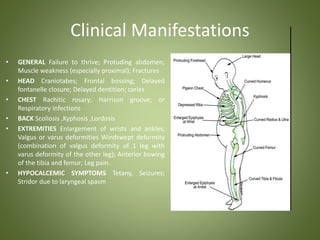
Clinical Manifestations 
• GENERAL Failure to thrive; Protuding abdomen; 
Muscle weakness (especially proximal); Fractures 
• HEAD Craniotabes; Frontal bossing; Delayed 
fontanelle closure; Delayed dentition; caries 
• CHEST Rachitic rosary; Harrison groove; or 
Respiratory infections 
• BACK Scoliosis ,Kyphosis ,Lordosis 
• EXTREMITIES Enlargement of wrists and ankles; 
Valgus or varus deformities Windswept deformity 
(combination of valgus deformity of 1 leg with 
varus deformity of the other leg); Anterior bowing 
of the tibia and femur; Leg pain. 
• HYPOCALCEMIC SYMPTOMS Tetany, Seizures; 
Stridor due to laryngeal spasm
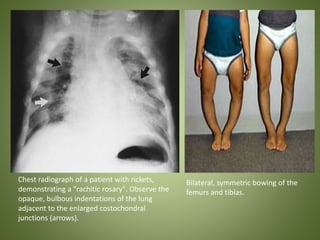
Chest radiograph of a patient with rickets, 
demonstrating a "rachitic rosary". Observe the 
opaque, bulbous indentations of the lung 
adjacent to the enlarged costochondral 
junctions (arrows). 
Bilateral, symmetric bowing of the 
femurs and tibias.
Radiography 
• Best visualised @ growth plate of rapidly 
growing bones. 
– Upper limb  distal Ulna 
– Knee  Metaphyses above and below
As disease progresses: 
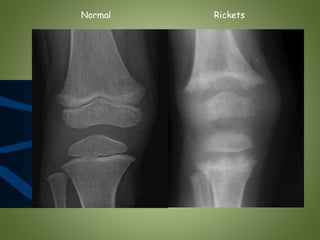
Disorganization of the growth plate becomes 
more apparent: 
1) with cupping, 
2) splaying, 
3) formation of cortical spurs 
4) stippling.
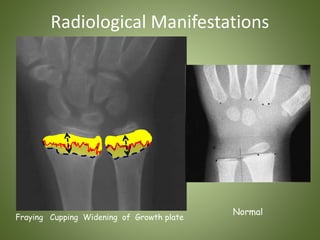
Radiological Manifestations 
Fraying Cupping Widening of Growth plate 
Normal
Diaphysis 
Metaphysis 
Epiphysis 
Growth Plate 
Normal Rickets 
Cupping 
Widening of 
Growth Plate 
Cupping 
Fraying
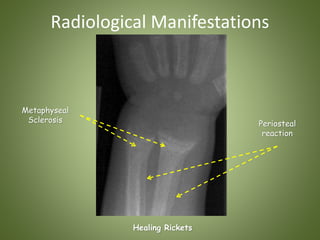
Radiological Manifestations 
Healing Rickets 
Periosteal 
reaction 
Metaphyseal 
Sclerosis
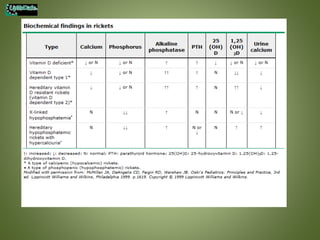
Biochemical Findings in Rickets 
• Alkaline phosphatase: ↑in all forms of rickets 
• Serum phosphorus: ↓ in both hypocalcemic and phosphopenic rickets (normal 5- 
7mg/dl) 
• Serum Ca+2: ↓in hypocalcemic rickets (normal 9-11mg/dl) 
• Serum PTH: ↑in hypocalcemic rickets, but normal in hypophosphatemic rickets 
• 25-OH vitamin D reflect the amount of vitamin D stored in the body, and is ↓in 
vitamin D deficiency. 
• 1,25-OH2 vitamin D can be↓, N or ↑in hypocalcemic rickets and usually is N or 
slightly ↑in phosphopenic rickets
Labs 
• Alkaline phosphatase is increased markedly 
over the age-specific reference range. 
• Excellent marker – participates in mineralization of 
bone and growth plate cartilage.
Evaluation 
• A child with clinical signs of rickets should 
include dietary history with particular 
attention to given calcium and vitamin D 
intake 
• Medication history 
• Measurement of serum creatinine and live 
enzymes
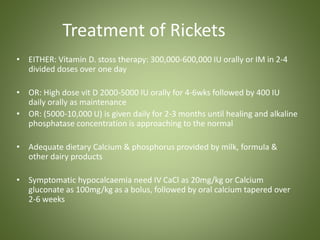
Treatment of Rickets 
• EITHER: Vitamin D. stoss therapy: 300,000-600,000 IU orally or IM in 2-4 
divided doses over one day 
• OR: High dose vit D 2000-5000 IU orally for 4-6wks followed by 400 IU 
daily orally as maintenance 
• OR: (5000-10,000 U) is given daily for 2-3 months until healing and alkaline 
phosphatase concentration is approaching to the normal 
• Adequate dietary Calcium & phosphorus provided by milk, formula & 
other dairy products 
• Symptomatic hypocalcaemia need IV CaCl as 20mg/kg or Calcium 
gluconate as 100mg/kg as a bolus, followed by oral calcium tapered over 
2-6 weeks
PREVENTION 
1.Exposure to sunlight (ultraviolet light) 
Early morning and evening 15 minutes per day 
2. Lactating mothers should receive supplemention 
with milk or vitamin D to ensure prevention of rickets in 
their babies. 
3. Sun exposure to mothers
Prevention 
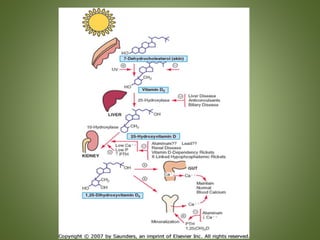
4. Vitamin D supplementation (careful of toxicity): 
In prematures, twins and weak babies, give Vitamin D 
800IU per day 
For term babies and infants the demand of Vitamin D 
is 400IU per day
Prevention 
5. Calcium supplementation: 
0.5-1gm/day, for premature, and weak babies
Outcome 
• Good news: 
– Mostly reversible 
– Some deformities might persist
Conclusion 
• Rickets refers to the changes at the growth 
plate caused by deficient mineralization of 
bone. Happens only before growth plates 
closure. 
• 2 types of rickets 
• Skeletal findings + Extra skeletal findings 
• Certain radiographic findings
ThAnK yOu
Rickets

Rickets

  • 1.
  • 2.
    Plan • Introduction– Defining the subject • (1): Pathogenesis • (2): Clinical Presentation and Diagnosis • (3): Treatment and Prevention • Conclusion
  • 3.
    Defining the disease • Rickets – word’s orginin is unknown – Maybe Rucket – to breath with difficulty, Dorset word – Or Rhakhis – Spine, Rhachitis ‘’inflammation of spine’’ Definition: A deficiency disease resulting from a lack of vitamin D or calcium and from insufficient exposure to sunlight, characterized by defective bone growth and occurring chiefly in children. Also called rachitis. The American Heritage® Dictionary of the English Language
  • 4.
    Normal Bone Processes • Calcium and Phosphate – Constitutes the crystalline component of bone • Deficiency leads to disease (i.e., Rickets and/or osteomalacia) • Rickets: – Deficient mineralization at growth plate • Osteomalacia: – impaired mineralization of the bone matrix. • Open plates: Occur in Osteomalacia and rickets. • Closed plates: Happens in osteomalacia only!
  • 5.
    Mineralization Defects •Classified according to Predominant mineral deficiency: – 1) Phosphopenic (hypophosphatemic) rickets • Primarily caused by phosphate deficiency – 2) Calcipenic (hypocalcemic) rickets • Primarily caused by calcium deficiency Associated with decrease levels of phosphorus or calcium, respectively.
  • 6.
    Pathogensis • GrowthPlate thickens: – Chondrocytes grow and hypertrophy – Vascular invasion of growth plate into primary bone • Vascular invasion requires mineralization of the growth plate cartilage • Can be delayed or prevent by deficiency of calcium or phosphorous • In such circumstances growth plate cartilage accumulates and thickens. In addition, the chondrocytes of the growth plate becomes disorganised, losing their regular straight columned orientation.
  • 7.
    The Pathogenic processes.. Osteoid Accumulation in metaphysis Decreased biochemical resistance of the invovled skeletal sites  2nd-ary inc- diameter of the growth plate. Compensatory mechanism due to decrease strenght by increase size Bone stability is compromised - if such condition does not improve, bowing occurs.
  • 8.
    Pathogenesis (Normal) [2] Proliferation of chondrocytes Calcification and vascular invasion Reserve zone Maturation zone Proliferative zone Hypertrophic zone Primary spongiosa 2. Shapiro IM, Boyde A. Mineralization of normal and rachitic chick growth cartilage: vascular canals, cartilage calcification and osteogenesis. Scanning Microsc 1987; 1:599.
  • 9.
    Pathogenesis (Rickets) [3-6] Proliferation of Thick + Disorganized chondrocytes cartilage Less calcification and vascular invasion Hypertrophic zone 3. Lacey DL, Huffer WE. Studies on the pathogenesis of avian rickets. I. Changes in epiphyseal and metaphyseal vessels in hypocalcemic and hypophosphatemic rickets. Am J Pathol 1982; 109:288. 4. Huffer WE, Lacey DL. Studies on the pathogenesis of avian rickets II. Necrosis of perforating epiphyseal vessels during recovery from rickets in chicks caused by vitamin D3 deficiency. Am J Pathol 1982; 109:302. 5. Takechi M, Itakura C. Ultrastructural studies of the epiphyseal plate of chicks fed a vitamin D-deficient and low-calcium diet. J Comp Pathol 1995 6.. Rauch F. The rachitic bone. Endocr Dev 2003; 6:69.
  • 10.
    Clinical manifestation •Usually @ distal forearm, knee, and costochondral junctions. • Typically @ Sites of rapid bone growth, where large quantities of calcium and phosphorus are required for mineralization.
  • 11.
    Clinical Manifestations (Skeletal)[13] 1. Delay in closure of the fontanelles 2. Parietal & frontal bossing (due to excess osteoid) 3. Craniotabes ( soft skull bones) 4. Enlargement of the costochondral junction (rachitic rosary) 5. The development of Harrison sulcus ( caused by pull of the diaphragmatic attachments to the lower ribs) 6. Pigeon chest deformity (The weakened ribs bend inwards due to the pull of respiratory muscles, causing anterior protrusion of sternum) 7. Enlargement of the wrist + ankle & bowing of the distal radius & ulna 8. Genus Valgus (knocked), Genus Verus (bowleg), or Windswept deformity (combination of valgus deformity of 1 leg with varus deformity of the other leg) 13. Misra M, Pacaud D, Petryk A, et al. Vitamin D deficiency in children and its management: review of current knowledge and recommendations. Pediatrics 2008; 122:398. Pictures from http://www.thachers.org
  • 12.
    Clinical Manifestations (Extra-Skeletal) • Depends upon the type of ricket • Hypoplasia of the dental enamel is typical for hypocalcemic rickets, whereas abscesses of the teeth occur more often in phosphopenic rickets. • Hypocalcemic seizures, decreased muscle tone leading to delayed motor milestones, recurrent infections, increased sweating
  • 13.
    Clinical Manifestations •GENERAL Failure to thrive; Protuding abdomen; Muscle weakness (especially proximal); Fractures • HEAD Craniotabes; Frontal bossing; Delayed fontanelle closure; Delayed dentition; caries • CHEST Rachitic rosary; Harrison groove; or Respiratory infections • BACK Scoliosis ,Kyphosis ,Lordosis • EXTREMITIES Enlargement of wrists and ankles; Valgus or varus deformities Windswept deformity (combination of valgus deformity of 1 leg with varus deformity of the other leg); Anterior bowing of the tibia and femur; Leg pain. • HYPOCALCEMIC SYMPTOMS Tetany, Seizures; Stridor due to laryngeal spasm
  • 14.
    Chest radiograph ofa patient with rickets, demonstrating a "rachitic rosary". Observe the opaque, bulbous indentations of the lung adjacent to the enlarged costochondral junctions (arrows). Bilateral, symmetric bowing of the femurs and tibias.
  • 15.
    Radiography • Bestvisualised @ growth plate of rapidly growing bones. – Upper limb  distal Ulna – Knee  Metaphyses above and below
  • 16.
    As disease progresses: Disorganization of the growth plate becomes more apparent: 1) with cupping, 2) splaying, 3) formation of cortical spurs 4) stippling.
  • 17.
    Radiological Manifestations FrayingCupping Widening of Growth plate Normal
  • 18.
    Diaphysis Metaphysis Epiphysis Growth Plate Normal Rickets Cupping Widening of Growth Plate Cupping Fraying
  • 19.
    Radiological Manifestations HealingRickets Periosteal reaction Metaphyseal Sclerosis
  • 20.
    Biochemical Findings inRickets • Alkaline phosphatase: ↑in all forms of rickets • Serum phosphorus: ↓ in both hypocalcemic and phosphopenic rickets (normal 5- 7mg/dl) • Serum Ca+2: ↓in hypocalcemic rickets (normal 9-11mg/dl) • Serum PTH: ↑in hypocalcemic rickets, but normal in hypophosphatemic rickets • 25-OH vitamin D reflect the amount of vitamin D stored in the body, and is ↓in vitamin D deficiency. • 1,25-OH2 vitamin D can be↓, N or ↑in hypocalcemic rickets and usually is N or slightly ↑in phosphopenic rickets
  • 21.
    Labs • Alkalinephosphatase is increased markedly over the age-specific reference range. • Excellent marker – participates in mineralization of bone and growth plate cartilage.
  • 23.
    Evaluation • Achild with clinical signs of rickets should include dietary history with particular attention to given calcium and vitamin D intake • Medication history • Measurement of serum creatinine and live enzymes
  • 24.
    Treatment of Rickets • EITHER: Vitamin D. stoss therapy: 300,000-600,000 IU orally or IM in 2-4 divided doses over one day • OR: High dose vit D 2000-5000 IU orally for 4-6wks followed by 400 IU daily orally as maintenance • OR: (5000-10,000 U) is given daily for 2-3 months until healing and alkaline phosphatase concentration is approaching to the normal • Adequate dietary Calcium & phosphorus provided by milk, formula & other dairy products • Symptomatic hypocalcaemia need IV CaCl as 20mg/kg or Calcium gluconate as 100mg/kg as a bolus, followed by oral calcium tapered over 2-6 weeks
  • 25.
    PREVENTION 1.Exposure tosunlight (ultraviolet light) Early morning and evening 15 minutes per day 2. Lactating mothers should receive supplemention with milk or vitamin D to ensure prevention of rickets in their babies. 3. Sun exposure to mothers
  • 26.
    Prevention 4. VitaminD supplementation (careful of toxicity): In prematures, twins and weak babies, give Vitamin D 800IU per day For term babies and infants the demand of Vitamin D is 400IU per day
  • 27.
    Prevention 5. Calciumsupplementation: 0.5-1gm/day, for premature, and weak babies
  • 28.
    Outcome • Goodnews: – Mostly reversible – Some deformities might persist
  • 29.
    Conclusion • Ricketsrefers to the changes at the growth plate caused by deficient mineralization of bone. Happens only before growth plates closure. • 2 types of rickets • Skeletal findings + Extra skeletal findings • Certain radiographic findings
  • 30.

Editor's Notes

  • #12 Pictures from http://www.thachers.org/rickets_photos.htm.