Shoulder 
Dislocation 
THURSDAY 20TH NOVEMBER 2014
History: 
 Shoulder dislocation is documented in Egyptian tomb murals as 
early as 3000 BC, with depiction of a manipulation for glenohumeral 
dislocation resembling the Kocher technique. 
A painting in the tomb of Ipuy, 1300BC, 
the sculptor of Ramses II depicts a 
physician reducing a dislocated 
shoulder, using a similar technique 
Kocher described in 1870. 
 Hippocrates detailed the oldest known reduction method still in use 
today. Hippocrates described 13 different techniques, generally 
traction / counter traction.
Epidemiology: 
 ~1.7% population 
 Bimodal distribution: 
 Men in 20-30 yo (M:F 9:1) 
 Women 61-80 (M:F 1:3) 
 Less in children as their epiphyseal plate is weaker and tends to 
fracture before dislocating. 
 More common in elderly as the collagen fibres have fewer cross links 
 weaker capsule / tendons / ligaments.
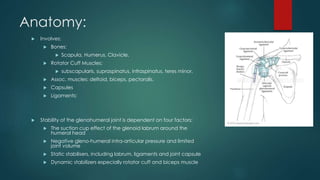
Anatomy: 
 Involves: 
 Bones: 
 Scapula, Humerus, Clavicle. 
 Rotator Cuff Muscles: 
 subscapularis, supraspinatus, infraspinatus, teres minor. 
 Assoc. muscles: deltoid, biceps, pectoralis. 
 Capsules 
 Ligaments: 
 Stability of the glenohumeral joint is dependent on four factors: 
 The suction cup effect of the glenoid labrum around the 
humeral head 
 Negative gleno-humeral intra-articular pressure and limited 
joint volume 
 Static stabilisers, including labrum, ligaments and joint capsule 
 Dynamic stabilizers especially rotator cuff and biceps muscle
Other associated injuries: 
 Fractures: 
 In ~30% cases, most commonly: 
 Hill-Sach’s lesion (Hatchet deformity): ~2/3. Compression fracture that results 
in a groove to the postero-lateral humeral head. 
 Bankart’s Lesion: Specifically refers to disruption of capsule &/or labrum from 
anterro-inferior glenoid rim, commonly refers to any bony glenoid disruption. 
From the impaction of humeral head to anterior inferior glenoid. 
 Assoc. capsular damage & anterior inferior ligament damage 
 High assoc. (85%) with recurrent dislocations. 
 Glenohumeral damage ~55% cases, esp in younger patients. 
 Rotator cuff injury – more common in the elderly. 
 Nerve injury: brachial pl. is possible but axillary nerve most 
commonly damaged ~20-50%. 
 Vascular: axillary artery, rare, but dangerous (H’toma, cool limb, 
absent pulses)
Types
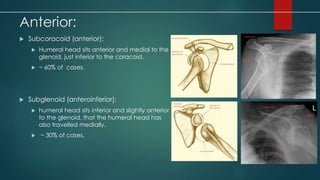
Anterior: 
 Subcoracoid (anterior): 
 Humeral head sits anterior and medial to the 
glenoid, just inferior to the coracoid. 
 ~ 60% of cases. 
 Subglenoid (anteroinferior): 
 humeral head sits inferior and slightly anterior 
to the glenoid, that the humeral head has 
also travelled medially. 
 ~ 30% of cases.
Other 
 POSTERIOR: 
 Different mechanisms: seizure, electrocution. 
 Present with flattened anterior shoulder and prominent coracoid. 
 Can easily go unrecognised. 
 INFERIOR: ‘luxation erecta’ 
 Hyperabduction injury. 
 High rate of vascular, nervous, ligament, tendon injuries.
Xrays: 
 When to do it? Which views. 
 http://www.radiologymasterclass.co.uk/tutorials/musculoskeletal/x-ray_ 
trauma_upper_limb/glenohumeral_joint_x-ray. 
html#top_second_img
Techniques:
POST REDUCTION: 
 Ortho f/u in ~1/52. 
 COMPLICATIONS: 
 Recurrent dislocation: 
 approx 50 – 90% patients under 20 
 Approx 5 to 10% of patients over age 40 
 ? Ways to prevent redislocation: position of immobilization, increasing 
the duration of immobilization, physical therapy, and operative repair. 
 Mobilisation: 
 <30 – immobilise 3 weeks. 
 >30 – begin mobilisation after one week. 
 Position: internal rotation and adduction vs. 10 degrees external rotation 
(anatomically sound but evidence not support benefit).
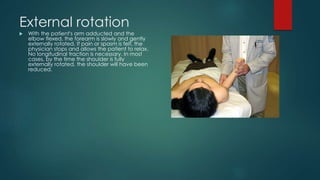
External rotation 
 With the patient's arm adducted and the 
elbow flexed, the forearm is slowly and gently 
externally rotated. If pain or spasm is felt, the 
physician stops and allows the patient to relax. 
No longitudinal traction is necessary. In most 
cases, by the time the shoulder is fully 
externally rotated, the shoulder will have been 
reduced.
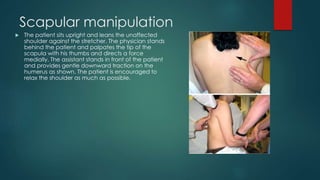
Scapular manipulation 
 The patient sits upright and leans the unaffected 
shoulder against the stretcher. The physician stands 
behind the patient and palpates the tip of the 
scapula with his thumbs and directs a force 
medially. The assistant stands in front of the patient 
and provides gentle downward traction on the 
humerus as shown. The patient is encouraged to 
relax the shoulder as much as possible.
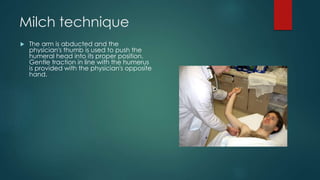
Milch technique 
 The arm is abducted and the 
physician's thumb is used to push the 
humeral head into its proper position. 
Gentle traction in line with the humerus 
is provided with the physician's opposite 
hand.
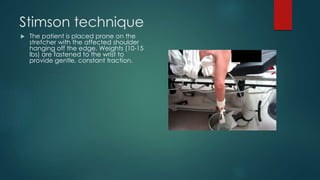
Stimson technique 
 The patient is placed prone on the 
stretcher with the affected shoulder 
hanging off the edge. Weights (10-15 
lbs) are fastened to the wrist to 
provide gentle, constant traction.
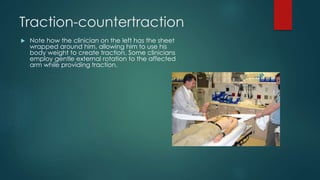
Traction-countertraction 
 Note how the clinician on the left has the sheet 
wrapped around him, allowing him to use his 
body weight to create traction. Some clinicians 
employ gentle external rotation to the affected 
arm while providing traction.
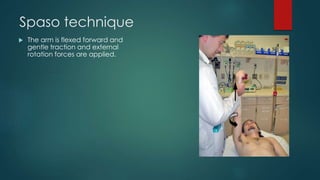
Spaso technique 
 The arm is flexed forward and 
gentle traction and external 
rotation forces are applied.
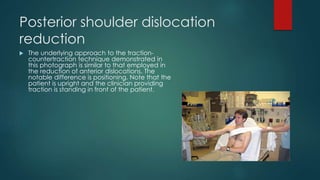
Posterior shoulder dislocation 
reduction 
 The underlying approach to the traction-countertraction 
technique demonstrated in 
this photograph is similar to that employed in 
the reduction of anterior dislocations. The 
notable difference is positioning. Note that the 
patient is upright and the clinician providing 
traction is standing in front of the patient.
Shoulder dislocation

Shoulder dislocation

  • 1.
  • 2.
    History:  Shoulderdislocation is documented in Egyptian tomb murals as early as 3000 BC, with depiction of a manipulation for glenohumeral dislocation resembling the Kocher technique. A painting in the tomb of Ipuy, 1300BC, the sculptor of Ramses II depicts a physician reducing a dislocated shoulder, using a similar technique Kocher described in 1870.  Hippocrates detailed the oldest known reduction method still in use today. Hippocrates described 13 different techniques, generally traction / counter traction.
  • 3.
    Epidemiology:  ~1.7%population  Bimodal distribution:  Men in 20-30 yo (M:F 9:1)  Women 61-80 (M:F 1:3)  Less in children as their epiphyseal plate is weaker and tends to fracture before dislocating.  More common in elderly as the collagen fibres have fewer cross links  weaker capsule / tendons / ligaments.
  • 4.
    Anatomy:  Involves:  Bones:  Scapula, Humerus, Clavicle.  Rotator Cuff Muscles:  subscapularis, supraspinatus, infraspinatus, teres minor.  Assoc. muscles: deltoid, biceps, pectoralis.  Capsules  Ligaments:  Stability of the glenohumeral joint is dependent on four factors:  The suction cup effect of the glenoid labrum around the humeral head  Negative gleno-humeral intra-articular pressure and limited joint volume  Static stabilisers, including labrum, ligaments and joint capsule  Dynamic stabilizers especially rotator cuff and biceps muscle
  • 5.
    Other associated injuries:  Fractures:  In ~30% cases, most commonly:  Hill-Sach’s lesion (Hatchet deformity): ~2/3. Compression fracture that results in a groove to the postero-lateral humeral head.  Bankart’s Lesion: Specifically refers to disruption of capsule &/or labrum from anterro-inferior glenoid rim, commonly refers to any bony glenoid disruption. From the impaction of humeral head to anterior inferior glenoid.  Assoc. capsular damage & anterior inferior ligament damage  High assoc. (85%) with recurrent dislocations.  Glenohumeral damage ~55% cases, esp in younger patients.  Rotator cuff injury – more common in the elderly.  Nerve injury: brachial pl. is possible but axillary nerve most commonly damaged ~20-50%.  Vascular: axillary artery, rare, but dangerous (H’toma, cool limb, absent pulses)
  • 6.
  • 7.
    Anterior:  Subcoracoid(anterior):  Humeral head sits anterior and medial to the glenoid, just inferior to the coracoid.  ~ 60% of cases.  Subglenoid (anteroinferior):  humeral head sits inferior and slightly anterior to the glenoid, that the humeral head has also travelled medially.  ~ 30% of cases.
  • 8.
    Other  POSTERIOR:  Different mechanisms: seizure, electrocution.  Present with flattened anterior shoulder and prominent coracoid.  Can easily go unrecognised.  INFERIOR: ‘luxation erecta’  Hyperabduction injury.  High rate of vascular, nervous, ligament, tendon injuries.
  • 9.
    Xrays:  Whento do it? Which views.  http://www.radiologymasterclass.co.uk/tutorials/musculoskeletal/x-ray_ trauma_upper_limb/glenohumeral_joint_x-ray. html#top_second_img
  • 10.
  • 12.
    POST REDUCTION: Ortho f/u in ~1/52.  COMPLICATIONS:  Recurrent dislocation:  approx 50 – 90% patients under 20  Approx 5 to 10% of patients over age 40  ? Ways to prevent redislocation: position of immobilization, increasing the duration of immobilization, physical therapy, and operative repair.  Mobilisation:  <30 – immobilise 3 weeks.  >30 – begin mobilisation after one week.  Position: internal rotation and adduction vs. 10 degrees external rotation (anatomically sound but evidence not support benefit).
  • 13.
    External rotation With the patient's arm adducted and the elbow flexed, the forearm is slowly and gently externally rotated. If pain or spasm is felt, the physician stops and allows the patient to relax. No longitudinal traction is necessary. In most cases, by the time the shoulder is fully externally rotated, the shoulder will have been reduced.
  • 14.
    Scapular manipulation The patient sits upright and leans the unaffected shoulder against the stretcher. The physician stands behind the patient and palpates the tip of the scapula with his thumbs and directs a force medially. The assistant stands in front of the patient and provides gentle downward traction on the humerus as shown. The patient is encouraged to relax the shoulder as much as possible.
  • 15.
    Milch technique The arm is abducted and the physician's thumb is used to push the humeral head into its proper position. Gentle traction in line with the humerus is provided with the physician's opposite hand.
  • 16.
    Stimson technique The patient is placed prone on the stretcher with the affected shoulder hanging off the edge. Weights (10-15 lbs) are fastened to the wrist to provide gentle, constant traction.
  • 17.
    Traction-countertraction  Notehow the clinician on the left has the sheet wrapped around him, allowing him to use his body weight to create traction. Some clinicians employ gentle external rotation to the affected arm while providing traction.
  • 18.
    Spaso technique The arm is flexed forward and gentle traction and external rotation forces are applied.
  • 19.
    Posterior shoulder dislocation reduction  The underlying approach to the traction-countertraction technique demonstrated in this photograph is similar to that employed in the reduction of anterior dislocations. The notable difference is positioning. Note that the patient is upright and the clinician providing traction is standing in front of the patient.