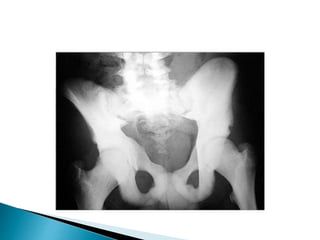
 What does it mean that a lesion is sclerotic?
 Well, generally, it means that it is due to a fairly
slow-growing process.
 Bone reacts to its environment in two ways --
either by removing some of itself or by creating
more of itself.
 If the disorder it is reacting to is rapidly
progressive, there may only be time for retreat
(defense).
 If the process is slower growing, then the bone
may have time to mount an offense and try to form
a sclerotic area around the offender.
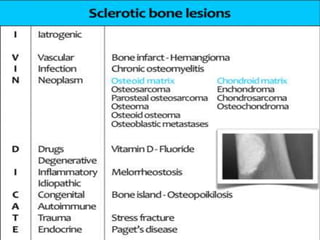
 Vascular
◦ hemangiomas
◦ infarct
 Infection
◦ chronic osteomyelitis
 Neoplasm
◦ primary
 osteoma
 osteosarcoma
◦ metastatic
 prostate
 breast
 Drugs
◦ Vitamin D
◦ fluoride
 Inflammatory/Idiopathic
 Congenital
◦ bone islands
◦ osteopoikilosis
◦ osteopetrosis
◦ pyknodysostosis
 Autoimmune
 Trauma
◦ fracture (stress)
 Endocrine/Metabolic
Paget's disease
 Typical presentation: central lesion in
metaphysis or diaphysis with a well defined
serpentiginous border.
 May resemble cartilaginous tumors.
 Causes: corticosteroid use, sickle cell disease,
trauma, Gaucher's disease, renal
transplantation
 term bone infarction is used for
osteonecrosis within the diaphysis or
metaphysis.
 If the osteonecrosis is located in the
epiphysis, the term avascular osteonecrosis is
used
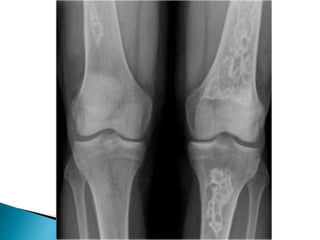
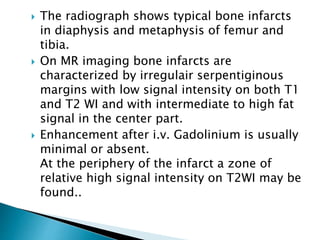
 The radiograph shows typical bone infarcts
in diaphysis and metaphysis of femur and
tibia.
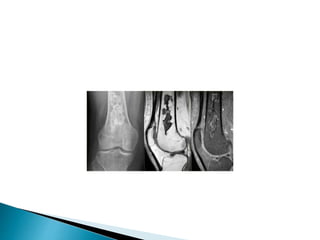
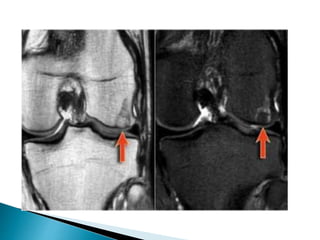
 On MR imaging bone infarcts are
characterized by irregulair serpentiginous
margins with low signal intensity on both T1
and T2 WI and with intermediate to high fat
signal in the center part.
 Enhancement after i.v. Gadolinium is usually
minimal or absent.
At the periphery of the infarct a zone of
relative high signal intensity on T2WI may be
found..
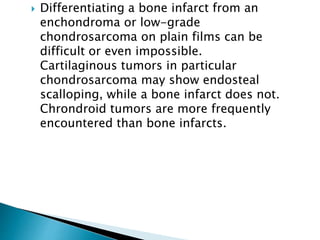
 Differentiating a bone infarct from an
enchondroma or low-grade
chondrosarcoma on plain films can be
difficult or even impossible.
Cartilaginous tumors in particular
chondrosarcoma may show endosteal
scalloping, while a bone infarct does not.
Chrondroid tumors are more frequently
encountered than bone infarcts.
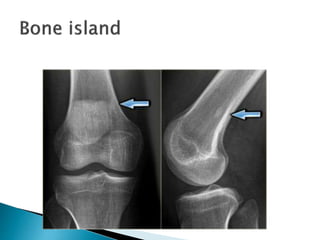
 Benign lesion consisting of well-differentiated
mature bone tissue within the medullary cavity.
 Also known as enostosis
 The shape is usually round or oval.
 Frequently encountered as a coincidental finding
and can be found in any bone.
 Occasionally slowly enlargement can be seen.
 Bone islands can be large at presentation.
 Bone scan shows no high activity, opposed to
low-grade intraosseous osteosarcoma
 Osteopoikilosis is a benign, autosomal
dominant sclerosing dysplasia of bone
characterized by the presence of
numerous bone islands in the skeleton
 x-ray is characterized by a pattern of
numerous white densities of similar size
spread throughout all the bones.
 This is a systemic condition.
 It must be differentiated from blastic
metastasis, which can also present
radiographically as white densities
interspersed throughout bone
 . Blastic metastasis tends to present with
larger and more irregular densities in less
of a uniform pattern.
 Another differentiating factor is age, with
blastic metastasis mostly affecting older
people, and osteopoikilosis being found in
people 20 years of age and younger.
 Typical presentation: well-defined osteolytic
lesion in tarsal bone, patella or epiphysis of a
long bone in a 20-year old with pain and
swelling in a joint.
 Abundant edema is almost always present.
 DD: Ganglion cyst, osteomyelitis, GCT, ABC,
enchondroma.
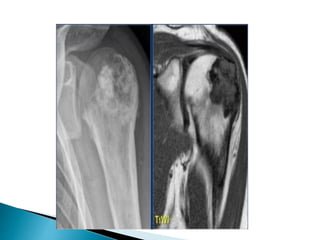
 Here a lesion located in the epi- and
metaphysis of the proximal humerus.
 The lesion is predominantly calcified.
 Coronal T1W image shows lobulated
margins due to the calcifications.
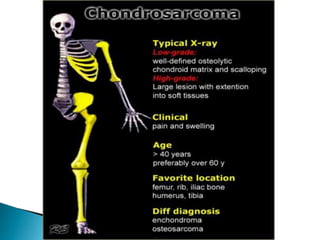
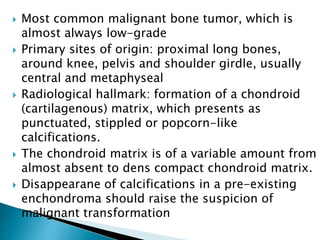
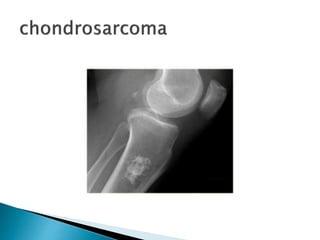
 Most common malignant bone tumor, which is
almost always low-grade
 Primary sites of origin: proximal long bones,
around knee, pelvis and shoulder girdle, usually
central and metaphyseal
 Radiological hallmark: formation of a chondroid
(cartilagenous) matrix, which presents as
punctuated, stippled or popcorn-like
calcifications.
 The chondroid matrix is of a variable amount from
almost absent to dens compact chondroid matrix.
 Disappearane of calcifications in a pre-existing
enchondroma should raise the suspicion of
malignant transformation
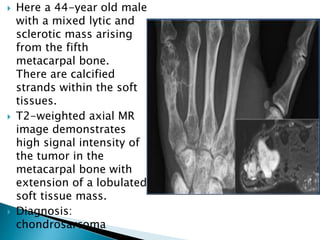
 Here a 44-year old male
with a mixed lytic and
sclerotic mass arising
from the fifth
metacarpal bone.
There are calcified
strands within the soft
tissues.
 T2-weighted axial MR
image demonstrates
high signal intensity of
the tumor in the
metacarpal bone with
extension of a lobulated
soft tissue mass.
 Diagnosis:
chondrosarcoma
 Accounts for 8% of all chondrosaromas.
 Prevalence of 3-5% in patients with
hereditary multiple osteohondromas.
 Development in centrally located
osteochondromas like the pelvis, hip and
shoulder is most common.
 Consider peripheral chondrosaroma in
growing osteochondromas with or without
pain after closure of the physeal plate.
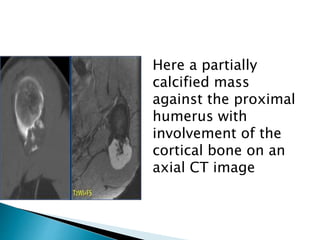
 A juxtacortical
chondrosarcoma has
be considered in the
differential diagnosis
when a mineralized
lesion adjacent to the
cortical bone is seen.
Here a partially
calcified mass
against the proximal
humerus with
involvement of the
cortical bone on an
axial CT image
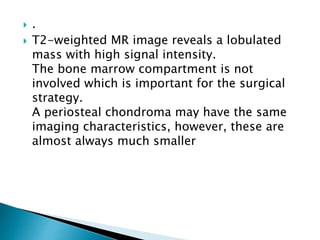
 .
 T2-weighted MR image reveals a lobulated
mass with high signal intensity.
The bone marrow compartment is not
involved which is important for the surgical
strategy.
A periosteal chondroma may have the same
imaging characteristics, however, these are
almost always much smaller
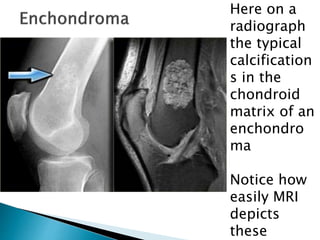
Here on a
radiograph
the typical
calcification
s in the
chondroid
matrix of an
enchondro
ma
Notice how
easily MRI
depicts
these
 Most commonly encountered bone tumor in the
small bones of the hand and foot.
 .Enchondroma is a fairly common benign
cartilaginaous lesion which may present as an
entirely lytic lesion without any calcification, as a
dense calcified lesion or as a mixed leson with
osteolysis and calcifications.
 Enchondromas aswell as low-grade
chondrosarcomas are frequently encountered as
coincidental findings in patients who have a MRI or
bone scan for other reasons.
 Melorrheostosis is a dysplasia of the bone,
characterized by apposition of mature bone
on the outer or inner surface of cortical
bone.
 Usually one bone is involved.
The epiphysis, metaphysis and diaphysis
may be involved.
 Usually new bone is added to one side of
the cortex only.
 Complete envelopment may occur.
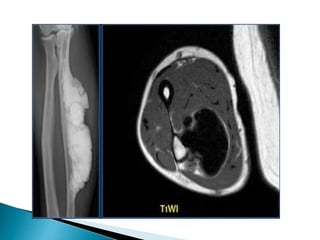
 Here Melorrheostosis of the ulna with the
appearance of candle wax.
A surface osteosarcoma could be considered
in the differential diagnosis
 Axial T1-weighted MR image shows
homogeneous low signal intensity due to the
compact bone apposition.
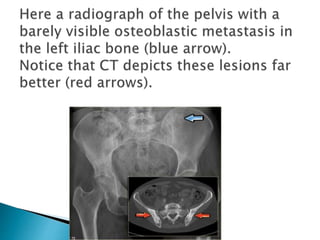
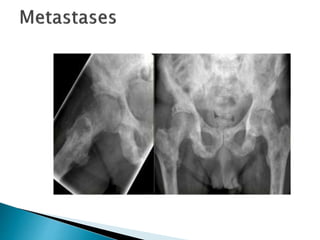
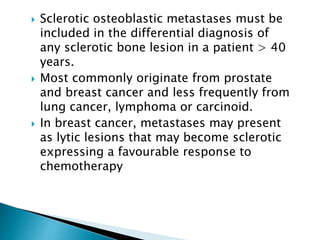
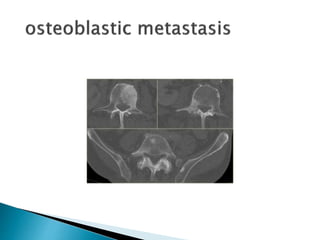
 Sclerotic osteoblastic metastases must be
included in the differential diagnosis of
any sclerotic bone lesion in a patient > 40
years.
 Most commonly originate from prostate
and breast cancer and less frequently from
lung cancer, lymphoma or carcinoid.
 In breast cancer, metastases may present
as lytic lesions that may become sclerotic
expressing a favourable response to
chemotherapy
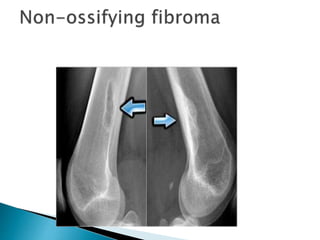
 Non-ossifying fibroma (NOF) can be
encoutered occasionally as a partial or
completely sclerotic lesion.
Typically a NOF presents as an eccentric
well-defined lytic lesion, usually found as
a coincidental finding.
These lesions usually regress
spontaneously and may then become
sclerotic.
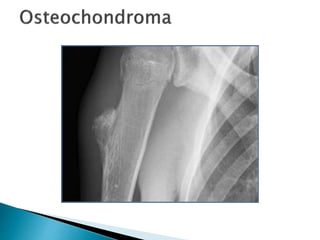
 Osteochondroma is a bony protrusion covered
by a cartilaginous cap.
 Growth of the osteochondroma takes place in
the cap, corresponding with normal enchondral
growth at the growth plates.
 Accordingly, growth of osteochondromas is
allowed until a patient reaches adulthood and
the physeal plates are closed.
 Growth of osteochondromas at adult ages,
which is characterized by a thick cartilaginous
cap (high SI on T2WI) should raise the
suspicion of progression to a peripheral
chondrosarcoma
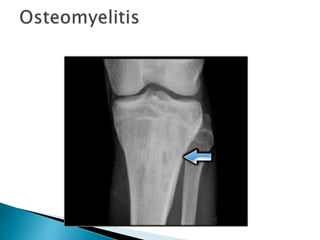
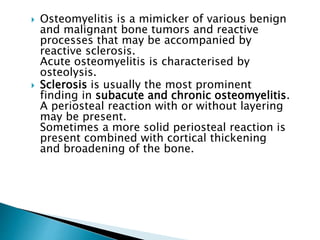
 Osteomyelitis is a mimicker of various benign
and malignant bone tumors and reactive
processes that may be accompanied by
reactive sclerosis.
Acute osteomyelitis is characterised by
osteolysis.
 Sclerosis is usually the most prominent
finding in subacute and chronic osteomyelitis.
A periosteal reaction with or without layering
may be present.
Sometimes a more solid periosteal reaction is
present combined with cortical thickening
and broadening of the bone.
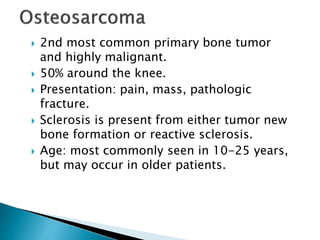
 2nd most common primary bone tumor
and highly malignant.
 50% around the knee.
 Presentation: pain, mass, pathologic
fracture.
 Sclerosis is present from either tumor new
bone formation or reactive sclerosis.
 Age: most commonly seen in 10-25 years,
but may occur in older patients.
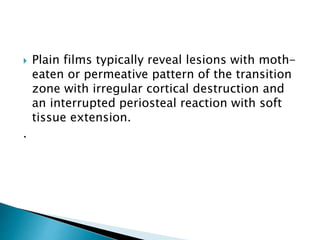
 Plain films typically reveal lesions with moth-
eaten or permeative pattern of the transition
zone with irregular cortical destruction and
an interrupted periosteal reaction with soft
tissue extension.
.
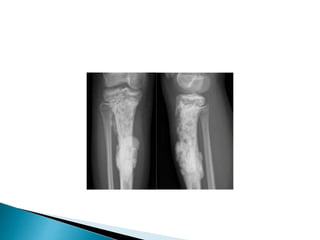
 A periosteal reaction known as Codman's
triangle appears as tumor elevates
periosteum from underlying bone.
 Cortical soft tissue extension may produce
radiating spicules of bone called sunray
appearance
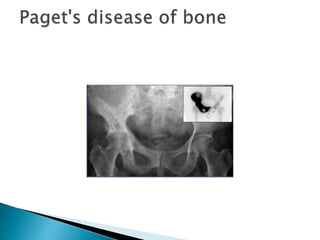
 Paget disease is a chronic disorder of
unknown origin with increased breakdown of
bone and formation of disorganized new
bone.
The most common appearance is the mixed
lytic-sclerotic
.
 In this case we see the pathognomonic
triad of bone expansion,
 cortical thickening and trabecular bone
thickening in the mixed lytic and sclerotic
phase of Paget's disease of right
hemipelvis
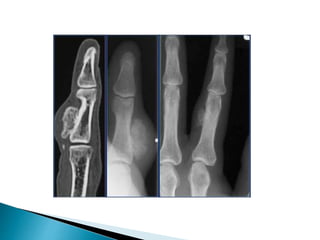
 Subungual exostoses are bony projections
which arise from the dorsal surface of the
distal phalanx, most commonly of the hallux.
These lesions are not osteochondromas, but
consist of reactive cartilage metaplasia
 literally "stone bone", also known
as marble bone disease and
 Albers-Schonberg disease is an
 Extremely rare inherited disorder whereby
the bones harden, becoming dense
 It can cause osteosclerosis.The cause of
the disease is understood to be
malfunctioningosteoclasts.
 THANK YOU

Sclerotic

  • 2.
     What doesit mean that a lesion is sclerotic?  Well, generally, it means that it is due to a fairly slow-growing process.  Bone reacts to its environment in two ways -- either by removing some of itself or by creating more of itself.  If the disorder it is reacting to is rapidly progressive, there may only be time for retreat (defense).  If the process is slower growing, then the bone may have time to mount an offense and try to form a sclerotic area around the offender.
  • 3.
     Vascular ◦ hemangiomas ◦infarct  Infection ◦ chronic osteomyelitis  Neoplasm ◦ primary  osteoma  osteosarcoma ◦ metastatic  prostate  breast
  • 4.
     Drugs ◦ VitaminD ◦ fluoride  Inflammatory/Idiopathic  Congenital ◦ bone islands ◦ osteopoikilosis ◦ osteopetrosis ◦ pyknodysostosis  Autoimmune  Trauma ◦ fracture (stress)  Endocrine/Metabolic Paget's disease
  • 6.
     Typical presentation:central lesion in metaphysis or diaphysis with a well defined serpentiginous border.  May resemble cartilaginous tumors.  Causes: corticosteroid use, sickle cell disease, trauma, Gaucher's disease, renal transplantation
  • 8.
     term boneinfarction is used for osteonecrosis within the diaphysis or metaphysis.  If the osteonecrosis is located in the epiphysis, the term avascular osteonecrosis is used
  • 10.
     The radiographshows typical bone infarcts in diaphysis and metaphysis of femur and tibia.  On MR imaging bone infarcts are characterized by irregulair serpentiginous margins with low signal intensity on both T1 and T2 WI and with intermediate to high fat signal in the center part.  Enhancement after i.v. Gadolinium is usually minimal or absent. At the periphery of the infarct a zone of relative high signal intensity on T2WI may be found..
  • 11.
     Differentiating abone infarct from an enchondroma or low-grade chondrosarcoma on plain films can be difficult or even impossible. Cartilaginous tumors in particular chondrosarcoma may show endosteal scalloping, while a bone infarct does not. Chrondroid tumors are more frequently encountered than bone infarcts.
  • 14.
     Benign lesionconsisting of well-differentiated mature bone tissue within the medullary cavity.  Also known as enostosis  The shape is usually round or oval.  Frequently encountered as a coincidental finding and can be found in any bone.  Occasionally slowly enlargement can be seen.  Bone islands can be large at presentation.  Bone scan shows no high activity, opposed to low-grade intraosseous osteosarcoma
  • 15.
     Osteopoikilosis isa benign, autosomal dominant sclerosing dysplasia of bone characterized by the presence of numerous bone islands in the skeleton
  • 16.
     x-ray ischaracterized by a pattern of numerous white densities of similar size spread throughout all the bones.  This is a systemic condition.  It must be differentiated from blastic metastasis, which can also present radiographically as white densities interspersed throughout bone
  • 17.
     . Blasticmetastasis tends to present with larger and more irregular densities in less of a uniform pattern.  Another differentiating factor is age, with blastic metastasis mostly affecting older people, and osteopoikilosis being found in people 20 years of age and younger.
  • 18.
     Typical presentation:well-defined osteolytic lesion in tarsal bone, patella or epiphysis of a long bone in a 20-year old with pain and swelling in a joint.  Abundant edema is almost always present.  DD: Ganglion cyst, osteomyelitis, GCT, ABC, enchondroma.
  • 20.
     Here alesion located in the epi- and metaphysis of the proximal humerus.  The lesion is predominantly calcified.  Coronal T1W image shows lobulated margins due to the calcifications.
  • 22.
     Most commonmalignant bone tumor, which is almost always low-grade  Primary sites of origin: proximal long bones, around knee, pelvis and shoulder girdle, usually central and metaphyseal  Radiological hallmark: formation of a chondroid (cartilagenous) matrix, which presents as punctuated, stippled or popcorn-like calcifications.  The chondroid matrix is of a variable amount from almost absent to dens compact chondroid matrix.  Disappearane of calcifications in a pre-existing enchondroma should raise the suspicion of malignant transformation
  • 24.
     Here a44-year old male with a mixed lytic and sclerotic mass arising from the fifth metacarpal bone. There are calcified strands within the soft tissues.  T2-weighted axial MR image demonstrates high signal intensity of the tumor in the metacarpal bone with extension of a lobulated soft tissue mass.  Diagnosis: chondrosarcoma
  • 25.
     Accounts for8% of all chondrosaromas.  Prevalence of 3-5% in patients with hereditary multiple osteohondromas.  Development in centrally located osteochondromas like the pelvis, hip and shoulder is most common.  Consider peripheral chondrosaroma in growing osteochondromas with or without pain after closure of the physeal plate.
  • 26.
     A juxtacortical chondrosarcomahas be considered in the differential diagnosis when a mineralized lesion adjacent to the cortical bone is seen.
  • 27.
    Here a partially calcifiedmass against the proximal humerus with involvement of the cortical bone on an axial CT image
  • 28.
     .  T2-weightedMR image reveals a lobulated mass with high signal intensity. The bone marrow compartment is not involved which is important for the surgical strategy. A periosteal chondroma may have the same imaging characteristics, however, these are almost always much smaller
  • 29.
    Here on a radiograph thetypical calcification s in the chondroid matrix of an enchondro ma Notice how easily MRI depicts these
  • 30.
     Most commonlyencountered bone tumor in the small bones of the hand and foot.  .Enchondroma is a fairly common benign cartilaginaous lesion which may present as an entirely lytic lesion without any calcification, as a dense calcified lesion or as a mixed leson with osteolysis and calcifications.  Enchondromas aswell as low-grade chondrosarcomas are frequently encountered as coincidental findings in patients who have a MRI or bone scan for other reasons.
  • 31.
     Melorrheostosis isa dysplasia of the bone, characterized by apposition of mature bone on the outer or inner surface of cortical bone.  Usually one bone is involved. The epiphysis, metaphysis and diaphysis may be involved.  Usually new bone is added to one side of the cortex only.  Complete envelopment may occur.
  • 33.
     Here Melorrheostosisof the ulna with the appearance of candle wax. A surface osteosarcoma could be considered in the differential diagnosis  Axial T1-weighted MR image shows homogeneous low signal intensity due to the compact bone apposition.
  • 35.
     Sclerotic osteoblasticmetastases must be included in the differential diagnosis of any sclerotic bone lesion in a patient > 40 years.  Most commonly originate from prostate and breast cancer and less frequently from lung cancer, lymphoma or carcinoid.  In breast cancer, metastases may present as lytic lesions that may become sclerotic expressing a favourable response to chemotherapy
  • 39.
     Non-ossifying fibroma(NOF) can be encoutered occasionally as a partial or completely sclerotic lesion. Typically a NOF presents as an eccentric well-defined lytic lesion, usually found as a coincidental finding. These lesions usually regress spontaneously and may then become sclerotic.
  • 41.
     Osteochondroma isa bony protrusion covered by a cartilaginous cap.  Growth of the osteochondroma takes place in the cap, corresponding with normal enchondral growth at the growth plates.  Accordingly, growth of osteochondromas is allowed until a patient reaches adulthood and the physeal plates are closed.  Growth of osteochondromas at adult ages, which is characterized by a thick cartilaginous cap (high SI on T2WI) should raise the suspicion of progression to a peripheral chondrosarcoma
  • 43.
     Osteomyelitis isa mimicker of various benign and malignant bone tumors and reactive processes that may be accompanied by reactive sclerosis. Acute osteomyelitis is characterised by osteolysis.  Sclerosis is usually the most prominent finding in subacute and chronic osteomyelitis. A periosteal reaction with or without layering may be present. Sometimes a more solid periosteal reaction is present combined with cortical thickening and broadening of the bone.
  • 44.
     2nd mostcommon primary bone tumor and highly malignant.  50% around the knee.  Presentation: pain, mass, pathologic fracture.  Sclerosis is present from either tumor new bone formation or reactive sclerosis.  Age: most commonly seen in 10-25 years, but may occur in older patients.
  • 45.
     Plain filmstypically reveal lesions with moth- eaten or permeative pattern of the transition zone with irregular cortical destruction and an interrupted periosteal reaction with soft tissue extension. .
  • 46.
     A periostealreaction known as Codman's triangle appears as tumor elevates periosteum from underlying bone.  Cortical soft tissue extension may produce radiating spicules of bone called sunray appearance
  • 48.
     Paget diseaseis a chronic disorder of unknown origin with increased breakdown of bone and formation of disorganized new bone. The most common appearance is the mixed lytic-sclerotic
  • 50.
    .  In thiscase we see the pathognomonic triad of bone expansion,  cortical thickening and trabecular bone thickening in the mixed lytic and sclerotic phase of Paget's disease of right hemipelvis
  • 51.
     Subungual exostosesare bony projections which arise from the dorsal surface of the distal phalanx, most commonly of the hallux. These lesions are not osteochondromas, but consist of reactive cartilage metaplasia
  • 53.
     literally "stonebone", also known as marble bone disease and  Albers-Schonberg disease is an  Extremely rare inherited disorder whereby the bones harden, becoming dense  It can cause osteosclerosis.The cause of the disease is understood to be malfunctioningosteoclasts.
  • 55.