Rickets

Prof. Dr. Saad S Al Ani
Senior Pediatric consultant
Head Of Pediatric Department
Khorfakkan hospital
Sharjah ,UAE
saadsalani@yahoo.com
Background
 Rickets
 is a disease of growing bone that is unique
 to children and adolescents.

 It is caused by a failure of osteoid to calcify
 in a growing person.

 Failure of osteoid to calcify
 in adults is called
 Osteomalacia.
3/8/2012          Rickets Prof. Dr.Saad S Al ani   2
                      Khorfakkan Hospital
Vitamin D deficiency rickets occurs when
  the metabolites of vitamin D are deficient.


  Less commonly, a dietary deficiency of
  calcium or phosphorus may also produce
  rickets


3/8/2012         Rickets Prof. Dr.Saad S Al ani   3
                     Khorfakkan Hospital
Vitamin D-3 (cholecalciferol)
 is formed in the skin from a derivative of
 cholesterol under the stimulus of ultraviolet-
 B light.

 Natural nutritional sources of
 vitamin D are limited primarily
 to fatty, ocean-going fish.


3/8/2012         Rickets Prof. Dr.Saad S Al ani   4
                     Khorfakkan Hospital
Source of vitamin D
1. Ultraviolet light
2. Cod liver oil
3. Ergosterol (vitamin D-2)

Dairy milk is fortified with vitamin D
(400 IU/L)

Human milk contains little
vitamin D(less than 20-40 IU/L)

3/8/2012         Rickets Prof. Dr.Saad S Al ani   5
                     Khorfakkan Hospital
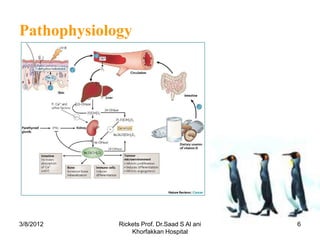
Pathophysiology


3/8/2012     Rickets Prof. Dr.Saad S Al ani   6
                 Khorfakkan Hospital
Cholecalciferol (i.e., vitamin D-3) is formed
 in the skin from 5-dihydrotachysterol.


3/8/2012         Rickets Prof. Dr.Saad S Al ani   7
                     Khorfakkan Hospital
This steroid undergoes hydroxylation in 2
 steps     .


 The first hydroxylation
 Occurs at position 25 in the liver, producing
  calcidiol (25-hydroxycholecalciferol)


3/8/2012        Rickets Prof. Dr.Saad S Al ani   8
                    Khorfakkan Hospital
The second hydroxylation
 Occurs in the kidney at the 1 position,
where it undergoes hydroxylation to
the active metabolite calcitriol
(1,25-dihydroxycholecalciferol )


3/8/2012        Rickets Prof. Dr.Saad S Al ani   9
                    Khorfakkan Hospital
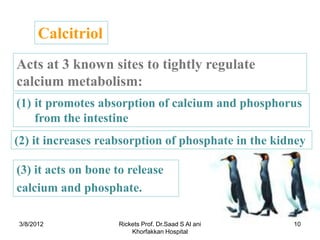
Calcitriol
Acts at 3 known sites to tightly regulate
calcium metabolism:
(1) it promotes absorption of calcium and phosphorus
    from the intestine
(2) it increases reabsorption of phosphate in the kidney

(3) it acts on bone to release
calcium and phosphate.

3/8/2012            Rickets Prof. Dr.Saad S Al ani   10
                        Khorfakkan Hospital
Epidemiology
    The frequency increasing internationally
  1.Children to wear sunscreen while outdoors
  2.Children spend more time
 indoors watching television or
 playing electronic games, instead
 of playing outdoors

     •Lowdon J. Rickets: concerns over the worldwide increase. J Fam Health
     Care. Mar-Apr 2011;21(2):25-9.[Medline].


3/8/2012                          Rickets Prof. Dr.Saad S Al ani              11
                                      Khorfakkan Hospital
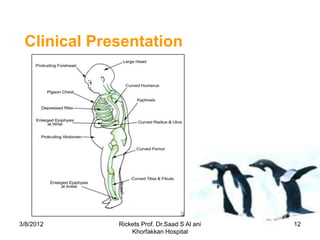
Clinical Presentation


3/8/2012     Rickets Prof. Dr.Saad S Al ani   12
                 Khorfakkan Hospital
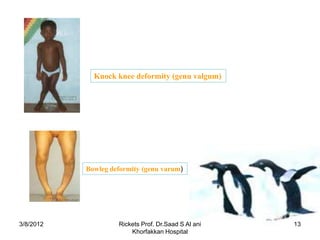
Knock knee deformity (genu valgum)


           Bowleg deformity (genu varum)


3/8/2012            Rickets Prof. Dr.Saad S Al ani   13
                        Khorfakkan Hospital
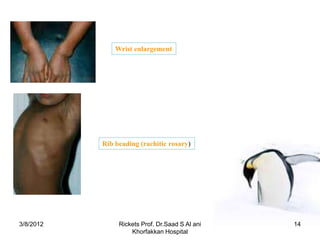
Wrist enlargement


           Rib beading (rachitic rosary)


3/8/2012        Rickets Prof. Dr.Saad S Al ani   14
                    Khorfakkan Hospital
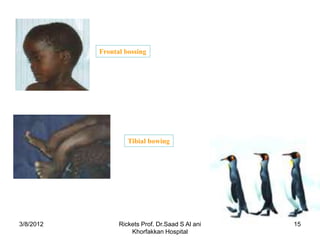
Frontal bossing


                    Tibial bowing


3/8/2012         Rickets Prof. Dr.Saad S Al ani   15
                     Khorfakkan Hospital
Scoliosis


           Harrison's sulcus and pot belly


3/8/2012         Rickets Prof. Dr.Saad S Al ani   16
                     Khorfakkan Hospital
Differential Diagnoses
1. Hypophosphatasia
2. Jansen syndrome
3. Hypophosphatemic vitamin D–resistant
   rickets.
4. Severe calcium deficiency
5. Severe phosphorus deficiency


3/8/2012      Rickets Prof. Dr.Saad S Al ani   17
                  Khorfakkan Hospital
Approach Considerations
  Serum measurements in the workup
  for rickets may include the
  following:
  1.Calcium.2.Phosphorus.3.Alkaline
  phosphatase4.Parathyroidhormone
  5.25-hydroxy vitamin D
  6.1,25-dihydroxyvitamin D
  Radiography is indicated in patients
  with rickets

3/8/2012        Rickets Prof. Dr.Saad S Al ani   18
                    Khorfakkan Hospital
Serum Chemistry

  Calcium (ionized fraction) is low

  Calcidiol (25-hydroxy vitamin D) is low

  Parathyroid hormone is elevated

  Phosphorus level is invariably low for age

 Alkaline phosphatase levels
 are uniformly elevated         .


3/8/2012         Rickets Prof. Dr.Saad S Al ani   19
                     Khorfakkan Hospital
Radiography

   1.      Cupping of the metaphysis
   2.      Fraying of the edge
   3.      Widening of the osteoid tissue
   4.      Hypominiralization of bones


3/8/2012              Rickets Prof. Dr.Saad S Al ani   20
                          Khorfakkan Hospital
Anteroposterior and lateral radiographs of the wrist of an
 8-year-old boy with rickets demonstrates cupping and
 fraying of the metaphyseal region.


3/8/2012             Rickets Prof. Dr.Saad S Al ani           21
                         Khorfakkan Hospital
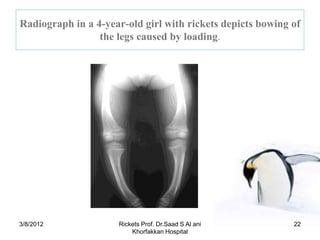
Radiograph in a 4-year-old girl with rickets depicts bowing of
                 the legs caused by loading.


3/8/2012             Rickets Prof. Dr.Saad S Al ani         22
                         Khorfakkan Hospital
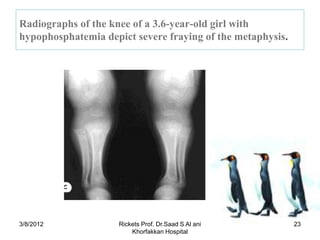
Radiographs of the knee of a 3.6-year-old girl with
hypophosphatemia depict severe fraying of the metaphysis.


3/8/2012             Rickets Prof. Dr.Saad S Al ani         23
                         Khorfakkan Hospital
Treatment & Management

      Treatment for rickets may be
      administered gradually over several
      months or in a single-day dose of 15,000
      mcg (600,000 U) of vitamin D


3/8/2012           Rickets Prof. Dr.Saad S Al ani   24
                       Khorfakkan Hospital
If the gradual method is chosen, 125-250 mcg
(5000-10,000 U) is given daily for 2-3 months
until:
1. Healing is well established
2. Alkaline phosphatase concentration is
    approaching the reference range


3/8/2012        Rickets Prof. Dr.Saad S Al ani   25
                    Khorfakkan Hospital
If the vitamin D dose is administered in a
      single day, it is usually divided into 4 or 6
      oral doses. An intramuscular injection is
      also available
      In nutritional rickets:
      1.Phosphorus level rises in 96 hrs
      2. Radiographic healing is visible in
      6-7 days

3/8/2012            Rickets Prof. Dr.Saad S Al ani    26
                        Khorfakkan Hospital
Rickets Medications


   Vitamin D is a fat-soluble vitamin used to
   prevent or treat vitamin D deficiency


3/8/2012         Rickets Prof. Dr.Saad S Al ani   27
                     Khorfakkan Hospital
Cholecalciferol
(Vitamin D3, D drops Kids, Delta-D3)
1.single-day dose of 15,000 mcg (600,000U),
which is usually divided into 4 or 6 oral doses
An intramuscular injection is also available.
2.An alternative regimen is to give 125-250
mcg (5000-10,000 U) daily for 2-3 months


3/8/2012         Rickets Prof. Dr.Saad S Al ani   28
                     Khorfakkan Hospital
References
  1. McKay CP, Portale A. Emerging topics in ediatric bone and mineral
      disorders 2008. Semin Nephrol. Jul 2009;29(4):370-8.
  2. Lowdon J. Rickets: concerns over the worldwide increase. J Fam
      Health Care. Mar-Apr 2011;21(2):25-9.[Medline].
  3. Chapman T, Sugar N, Done S, Marasigan J, Wambold N, Feldman
      K. Fractures in infants and toddlers with rickets. Pediatr Radiol. Dec
      9 2009;[Medline].
  4. Casey CF, Slawson DC, Neal LR. VItamin D supplementation in
      infants, children, and adolescents. Am Fam Physician. Mar 15
      2010;81(6):745-8. [Medline].
  5. Greer FR. Issues in establishing vitamin D recommendations for
      infants and children. Am J Clin Nutr. Dec 2004;80(6 Suppl):1759S-
      62S. [Medline].
  6. [Guideline] Wagner CL, Greer FR. Prevention of rickets and
      vitamin D deficiency in infants, children, and adolescents. Pediatrics.
      Nov 2008;122(5):1142-52. [Medline].

3/8/2012                   Rickets Prof. Dr.Saad S Al ani                 29
                               Khorfakkan Hospital
3/8/2012   Rickets Prof. Dr.Saad S Al ani   30
               Khorfakkan Hospital

Rickets

  • 1.
    Rickets Prof. Dr. SaadS Al Ani Senior Pediatric consultant Head Of Pediatric Department Khorfakkan hospital Sharjah ,UAE saadsalani@yahoo.com
  • 2.
    Background Rickets isa disease of growing bone that is unique to children and adolescents. It is caused by a failure of osteoid to calcify in a growing person. Failure of osteoid to calcify in adults is called Osteomalacia. 3/8/2012 Rickets Prof. Dr.Saad S Al ani 2 Khorfakkan Hospital
  • 3.
    Vitamin D deficiencyrickets occurs when the metabolites of vitamin D are deficient. Less commonly, a dietary deficiency of calcium or phosphorus may also produce rickets 3/8/2012 Rickets Prof. Dr.Saad S Al ani 3 Khorfakkan Hospital
  • 4.
    Vitamin D-3 (cholecalciferol) is formed in the skin from a derivative of cholesterol under the stimulus of ultraviolet- B light. Natural nutritional sources of vitamin D are limited primarily to fatty, ocean-going fish. 3/8/2012 Rickets Prof. Dr.Saad S Al ani 4 Khorfakkan Hospital
  • 5.
    Source of vitaminD 1. Ultraviolet light 2. Cod liver oil 3. Ergosterol (vitamin D-2) Dairy milk is fortified with vitamin D (400 IU/L) Human milk contains little vitamin D(less than 20-40 IU/L) 3/8/2012 Rickets Prof. Dr.Saad S Al ani 5 Khorfakkan Hospital
  • 6.
    Pathophysiology 3/8/2012 Rickets Prof. Dr.Saad S Al ani 6 Khorfakkan Hospital
  • 7.
    Cholecalciferol (i.e., vitaminD-3) is formed in the skin from 5-dihydrotachysterol. 3/8/2012 Rickets Prof. Dr.Saad S Al ani 7 Khorfakkan Hospital
  • 8.
    This steroid undergoeshydroxylation in 2 steps . The first hydroxylation Occurs at position 25 in the liver, producing calcidiol (25-hydroxycholecalciferol) 3/8/2012 Rickets Prof. Dr.Saad S Al ani 8 Khorfakkan Hospital
  • 9.
    The second hydroxylation Occurs in the kidney at the 1 position, where it undergoes hydroxylation to the active metabolite calcitriol (1,25-dihydroxycholecalciferol ) 3/8/2012 Rickets Prof. Dr.Saad S Al ani 9 Khorfakkan Hospital
  • 10.
    Calcitriol Acts at 3known sites to tightly regulate calcium metabolism: (1) it promotes absorption of calcium and phosphorus from the intestine (2) it increases reabsorption of phosphate in the kidney (3) it acts on bone to release calcium and phosphate. 3/8/2012 Rickets Prof. Dr.Saad S Al ani 10 Khorfakkan Hospital
  • 11.
    Epidemiology The frequency increasing internationally 1.Children to wear sunscreen while outdoors 2.Children spend more time indoors watching television or playing electronic games, instead of playing outdoors •Lowdon J. Rickets: concerns over the worldwide increase. J Fam Health Care. Mar-Apr 2011;21(2):25-9.[Medline]. 3/8/2012 Rickets Prof. Dr.Saad S Al ani 11 Khorfakkan Hospital
  • 12.
    Clinical Presentation 3/8/2012 Rickets Prof. Dr.Saad S Al ani 12 Khorfakkan Hospital
  • 13.
    Knock knee deformity(genu valgum) Bowleg deformity (genu varum) 3/8/2012 Rickets Prof. Dr.Saad S Al ani 13 Khorfakkan Hospital
  • 14.
    Wrist enlargement Rib beading (rachitic rosary) 3/8/2012 Rickets Prof. Dr.Saad S Al ani 14 Khorfakkan Hospital
  • 15.
    Frontal bossing Tibial bowing 3/8/2012 Rickets Prof. Dr.Saad S Al ani 15 Khorfakkan Hospital
  • 16.
    Scoliosis Harrison's sulcus and pot belly 3/8/2012 Rickets Prof. Dr.Saad S Al ani 16 Khorfakkan Hospital
  • 17.
    Differential Diagnoses 1. Hypophosphatasia 2.Jansen syndrome 3. Hypophosphatemic vitamin D–resistant rickets. 4. Severe calcium deficiency 5. Severe phosphorus deficiency 3/8/2012 Rickets Prof. Dr.Saad S Al ani 17 Khorfakkan Hospital
  • 18.
    Approach Considerations Serum measurements in the workup for rickets may include the following: 1.Calcium.2.Phosphorus.3.Alkaline phosphatase4.Parathyroidhormone 5.25-hydroxy vitamin D 6.1,25-dihydroxyvitamin D Radiography is indicated in patients with rickets 3/8/2012 Rickets Prof. Dr.Saad S Al ani 18 Khorfakkan Hospital
  • 19.
    Serum Chemistry Calcium (ionized fraction) is low Calcidiol (25-hydroxy vitamin D) is low Parathyroid hormone is elevated Phosphorus level is invariably low for age Alkaline phosphatase levels are uniformly elevated . 3/8/2012 Rickets Prof. Dr.Saad S Al ani 19 Khorfakkan Hospital
  • 20.
    Radiography 1. Cupping of the metaphysis 2. Fraying of the edge 3. Widening of the osteoid tissue 4. Hypominiralization of bones 3/8/2012 Rickets Prof. Dr.Saad S Al ani 20 Khorfakkan Hospital
  • 21.
    Anteroposterior and lateralradiographs of the wrist of an 8-year-old boy with rickets demonstrates cupping and fraying of the metaphyseal region. 3/8/2012 Rickets Prof. Dr.Saad S Al ani 21 Khorfakkan Hospital
  • 22.
    Radiograph in a4-year-old girl with rickets depicts bowing of the legs caused by loading. 3/8/2012 Rickets Prof. Dr.Saad S Al ani 22 Khorfakkan Hospital
  • 23.
    Radiographs of theknee of a 3.6-year-old girl with hypophosphatemia depict severe fraying of the metaphysis. 3/8/2012 Rickets Prof. Dr.Saad S Al ani 23 Khorfakkan Hospital
  • 24.
    Treatment & Management Treatment for rickets may be administered gradually over several months or in a single-day dose of 15,000 mcg (600,000 U) of vitamin D 3/8/2012 Rickets Prof. Dr.Saad S Al ani 24 Khorfakkan Hospital
  • 25.
    If the gradualmethod is chosen, 125-250 mcg (5000-10,000 U) is given daily for 2-3 months until: 1. Healing is well established 2. Alkaline phosphatase concentration is approaching the reference range 3/8/2012 Rickets Prof. Dr.Saad S Al ani 25 Khorfakkan Hospital
  • 26.
    If the vitaminD dose is administered in a single day, it is usually divided into 4 or 6 oral doses. An intramuscular injection is also available In nutritional rickets: 1.Phosphorus level rises in 96 hrs 2. Radiographic healing is visible in 6-7 days 3/8/2012 Rickets Prof. Dr.Saad S Al ani 26 Khorfakkan Hospital
  • 27.
    Rickets Medications Vitamin D is a fat-soluble vitamin used to prevent or treat vitamin D deficiency 3/8/2012 Rickets Prof. Dr.Saad S Al ani 27 Khorfakkan Hospital
  • 28.
    Cholecalciferol (Vitamin D3, Ddrops Kids, Delta-D3) 1.single-day dose of 15,000 mcg (600,000U), which is usually divided into 4 or 6 oral doses An intramuscular injection is also available. 2.An alternative regimen is to give 125-250 mcg (5000-10,000 U) daily for 2-3 months 3/8/2012 Rickets Prof. Dr.Saad S Al ani 28 Khorfakkan Hospital
  • 29.
    References 1.McKay CP, Portale A. Emerging topics in ediatric bone and mineral disorders 2008. Semin Nephrol. Jul 2009;29(4):370-8. 2. Lowdon J. Rickets: concerns over the worldwide increase. J Fam Health Care. Mar-Apr 2011;21(2):25-9.[Medline]. 3. Chapman T, Sugar N, Done S, Marasigan J, Wambold N, Feldman K. Fractures in infants and toddlers with rickets. Pediatr Radiol. Dec 9 2009;[Medline]. 4. Casey CF, Slawson DC, Neal LR. VItamin D supplementation in infants, children, and adolescents. Am Fam Physician. Mar 15 2010;81(6):745-8. [Medline]. 5. Greer FR. Issues in establishing vitamin D recommendations for infants and children. Am J Clin Nutr. Dec 2004;80(6 Suppl):1759S- 62S. [Medline]. 6. [Guideline] Wagner CL, Greer FR. Prevention of rickets and vitamin D deficiency in infants, children, and adolescents. Pediatrics. Nov 2008;122(5):1142-52. [Medline]. 3/8/2012 Rickets Prof. Dr.Saad S Al ani 29 Khorfakkan Hospital
  • 30.
    3/8/2012 Rickets Prof. Dr.Saad S Al ani 30 Khorfakkan Hospital

Editor's Notes

  • #8 which circulates in the plasma as the most abundant of the vitamin D metabolites and is thought to be a good indicator of overall vitamin D status
  • #9 *Calcidiol circulates in the plasma as the most abundant of the vitamin D metabolites and is thought to be a good indicator of overall vitamin D status
  • #10 This cholecalciferol, which circulates in the bloodstream in minute amounts, is not technically a vitamin but a hormone.
  • #14 which circulates in the plasma as the most abundant of the vitamin D metabolites and is thought to be a good indicator of overall vitamin D status
  • #18 Rare metabolic bone diseases is a rare autosomal dominant form of short-limbed dwarfism in which infants present with metaphyseal chondroplasia. Hereditary disorders of vitamin D metabolism 5. Premature infants who are breast fed and do not receive mineral supplements
  • #19 Infants who are breastfed are at risk for rickets, especially those who: a. receive no oral supplementation b. have darkly pigmented skin
  • #22 Infants who are breastfed are at risk for rickets, especially those who: a. receive no oral supplementation b. have darkly pigmented skin
  • #27 Infants who are breastfed are at risk for rickets, especially those who: a. receive no oral supplementation b. have darkly pigmented skin