 A 40 year old male , a known case of epilepsy presented
with a 4-month history of generalized muscular
discomfort, particularly in her shoulders, present at rest.
The symptoms were not worse in the morning and there
were nonspecific relieving factors. Her weight was
stable.
 On examination she exhibited mild proximal weakness
in both arms and legs, but no muscle tenderness and the
reflexes were preserved. There was no temporal artery or
scalp tenderness, and the remainder of the examination
was unremarkable.
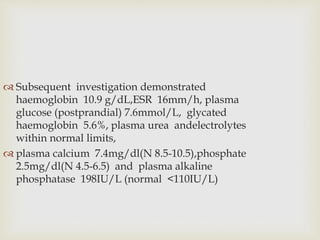
 Subsequent investigation demonstrated
haemoglobin 10.9 g/dL,ESR 16mm/h, plasma
glucose (postprandial) 7.6mmol/L, glycated
haemoglobin 5.6%, plasma urea andelectrolytes
within normal limits,
 plasma calcium 7.4mg/dl(N 8.5-10.5),phosphate
2.5mg/dl(N 4.5-6.5) and plasma alkaline
phosphatase 198IU/L (normal <110IU/L)
 What is the most likely explanation for her symptoms
and what other causes should be considered?
 This patient's presentation with myalgia associated
with a combination of mild hypocalcaemia,
hypophosphataemia and elevation of alkaline
phosphatase is strongly suggestive of Osteomalasia.

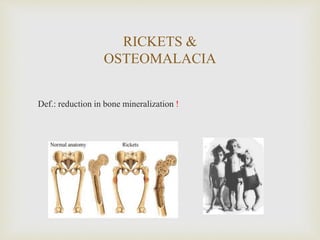
 Rickets and osteomalacia are conditions
characterized by pathological defects in bone matrix
mineralization. Rickets refers specifically to
osteomalacia, where the defect occurs in growing
bone.
 The aetiological factors are diverse, but the end
result is an increased quantity of unmineralized
bone matrix (osteoid).
RICKETS AND
OSTEOMALACIA
RICKETS &
OSTEOMALACIA
Def.: reduction in bone mineralization !

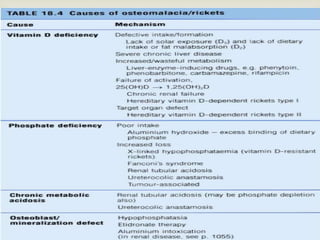
 The conditions may arise in three distinct
 situations:
 • Deficiency or abnormal metabolism of vitamin D
 • Phosphate depletion
 • Chronic metabolic acidosis.
aetiology of
osteomalacia
 Vitamin D deficiency is numerically by far the
mostimportant cause of osteomalacia (or rickets): it
leads to acombined deficiency of calcium and
phosphorus. There is intestinal malabsorption of
calcium and, to a lesser extent Phosphorus. Secondary
hyperparathyroidism results from the fall in plasma
calcium, and the ensuing phosphaturia accelerates the
phosphate deficiency.

 Lack of vitamin D is often due to a combination of poor exposure to
sunlight and dietary deficiency. The elderly are particularly at risk.
 The reason for this is multifactorial and incompletely understood, but
dietary deficiency of vitamin D and calcium, together with binding of
calcium by the phytate contained in chapati flour, may contribute. In
addition,deeply pigmented skin generates less vitamin D3 in
response to a given amount of ultraviolet exposure, an dthis may be
disadvantageous in temperate climates.
 Vitamin D deficiency may complicate fat malabsorption from any
cause.
 Finally, calcium deficiency enhances the rate of degradation of 25(OH)D
in the liver, further exac-erbating the shortage of vitamin D and its
metabolites. abnormality of the 1,25(OH)2D receptor in target tissues
(vitamin D-dependent rickets type II).
 Phosphate depletion is a less common cause of
rickets than deficiency or altered metabolism of
vitamin D. It arises as a result of a reduced maximal
capacity for renal tubular phosphate reabsorption. This
may either be inherited as an X-linked recessive
characteristic (vitamin D-resistant rickets, X-linked
hypophosphataemia) or occur aspart of Fanconi's
syndrome - a more generalized hereditary or
acquired renal tubular defect typified by
aminoaciduria and glycosuria (p. 1057).
 Rarely, excessive ingestion of antacids may restrict
intestinal phosphate absorption to the point where
clinically important phos-phate depletion, and even
osteomalacia or rickets, may appear.
 Chronic metabolic acidosis, usually resulting from
 renal tubular disorders, may lead to rickets or
osteomalacia. The bone lesions usually heal
satisfactorily following treatment to correct the
acidosis.

 In children, failure of bone mineralization gives
rise to classic bone deformities, which include
widening of the metaphyses, prominence of
costochondral junctions (socalled 'rickety rosary'),
and varus or valgus abnormalities of the knee
joints. The bones are painful and statural growth
is reduced.
 In adults, bone pain and tenderness are the most
prominent features. A characteristic proximal
myopathy may develop, and is more common in
cases due to vitamin D deficiency.
Clinical features

 Biochemical
 In osteomalacia due to deficiency or abnormal metabolism
of vitamin D, investigations typically demonstrate a low
normal plasma calcium (leading to secondary hyper-
 parathyroidism), a low plasma phosphate due to phospha-
 turia as a result of increased PTH secretion, and a raised
alkaline phosphatase indicating increased numbers of
 osteoblasts .
 Vitamin D deficiency may be confirmed by measurement of 25-
hydroxyvitamin D in plasma.
 X-linked hypophosphataemia (vitamin D-resistantrickets), on the other
hand, is characterized by normocal-caemia, hypophosphataemia, and
little or no alteration in
plasma alkaline phosphatase level.
Investigation
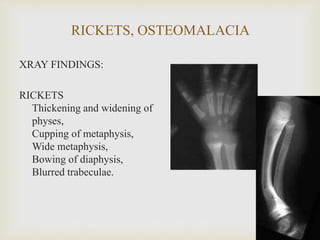
RICKETS, OSTEOMALACIA
XRAY FINDINGS:
RICKETS
Thickening and widening of
physes,
Cupping of metaphysis,
Wide metaphysis,
Bowing of diaphysis,
Blurred trabeculae.
RICKETS, OSTEOMALACIA
XRAY FINDINGS:
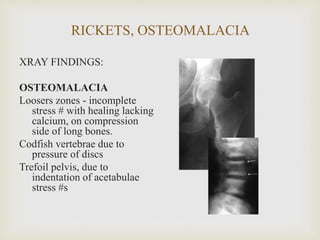
OSTEOMALACIA
Loosers zones - incomplete
stress # with healing lacking
calcium, on compression
side of long bones.
Codfish vertebrae due to
pressure of discs
Trefoil pelvis, due to
indentation of acetabulae
stress #s

Occasionally a bone biopsy may be needed
(following
double tetracycline labelling) to confirm a diagnosis
of
osteomalacia whhen biochemical investigations are
equivocal. This is particularly the case when
seeking possible treatable factors in elderly patients
with decreased bone density.
Histological

 Dietary vitamin D deficiency is treated by oral replace-
ment of vitamins D2 or D3 in physiological quantities(500-
1000 units/day). This can conveniently be given as combined
calcium with vitamin D tablets.
Alternatively,a single i.m. does of 150 000IU of D2 in oil is
effective prophylaxis and treatment for at least 6 months. The
possibility of intestinal malabsorption should be borne in mind,
and appropriate investigation initiated if necessary.
 Osteomalacia associated with anticonvulsant therapy
requires higher doses of vitamin D (3000-6000
units/day)unless a change in anticonvulsant is clinically
feasible.
Management

 Treatment of X-linked hypophosphataemia is
generallyunsatisfactory. The logical treatment is with
oral phosphatesupplements, but the doses needed
are large and they maybe poorly tolerated because of
gastrointestinal side-effects.Oral phosphate works
better when combined with phar-macological
doses of vitamin D, or (and probably best)
incombination with 1,25(OH)2D3. When
1,25(OH)2D3 orlaOHD3 is given, great care must
be taken to adjust the dose against the serum
calcium, as hypercalcaemia may easily be induced.
Management

Rickets and osteomalacia

  • 1.
     A 40year old male , a known case of epilepsy presented with a 4-month history of generalized muscular discomfort, particularly in her shoulders, present at rest. The symptoms were not worse in the morning and there were nonspecific relieving factors. Her weight was stable.  On examination she exhibited mild proximal weakness in both arms and legs, but no muscle tenderness and the reflexes were preserved. There was no temporal artery or scalp tenderness, and the remainder of the examination was unremarkable.
  • 2.
     Subsequent investigationdemonstrated haemoglobin 10.9 g/dL,ESR 16mm/h, plasma glucose (postprandial) 7.6mmol/L, glycated haemoglobin 5.6%, plasma urea andelectrolytes within normal limits,  plasma calcium 7.4mg/dl(N 8.5-10.5),phosphate 2.5mg/dl(N 4.5-6.5) and plasma alkaline phosphatase 198IU/L (normal <110IU/L)
  • 3.
     What isthe most likely explanation for her symptoms and what other causes should be considered?
  • 4.
     This patient'spresentation with myalgia associated with a combination of mild hypocalcaemia, hypophosphataemia and elevation of alkaline phosphatase is strongly suggestive of Osteomalasia.
  • 5.
      Rickets andosteomalacia are conditions characterized by pathological defects in bone matrix mineralization. Rickets refers specifically to osteomalacia, where the defect occurs in growing bone.  The aetiological factors are diverse, but the end result is an increased quantity of unmineralized bone matrix (osteoid). RICKETS AND OSTEOMALACIA
  • 6.
  • 7.
      The conditionsmay arise in three distinct  situations:  • Deficiency or abnormal metabolism of vitamin D  • Phosphate depletion  • Chronic metabolic acidosis. aetiology of osteomalacia
  • 8.
     Vitamin Ddeficiency is numerically by far the mostimportant cause of osteomalacia (or rickets): it leads to acombined deficiency of calcium and phosphorus. There is intestinal malabsorption of calcium and, to a lesser extent Phosphorus. Secondary hyperparathyroidism results from the fall in plasma calcium, and the ensuing phosphaturia accelerates the phosphate deficiency.
  • 9.
      Lack ofvitamin D is often due to a combination of poor exposure to sunlight and dietary deficiency. The elderly are particularly at risk.  The reason for this is multifactorial and incompletely understood, but dietary deficiency of vitamin D and calcium, together with binding of calcium by the phytate contained in chapati flour, may contribute. In addition,deeply pigmented skin generates less vitamin D3 in response to a given amount of ultraviolet exposure, an dthis may be disadvantageous in temperate climates.  Vitamin D deficiency may complicate fat malabsorption from any cause.  Finally, calcium deficiency enhances the rate of degradation of 25(OH)D in the liver, further exac-erbating the shortage of vitamin D and its metabolites. abnormality of the 1,25(OH)2D receptor in target tissues (vitamin D-dependent rickets type II).
  • 10.
     Phosphate depletionis a less common cause of rickets than deficiency or altered metabolism of vitamin D. It arises as a result of a reduced maximal capacity for renal tubular phosphate reabsorption. This may either be inherited as an X-linked recessive characteristic (vitamin D-resistant rickets, X-linked hypophosphataemia) or occur aspart of Fanconi's syndrome - a more generalized hereditary or acquired renal tubular defect typified by aminoaciduria and glycosuria (p. 1057).  Rarely, excessive ingestion of antacids may restrict intestinal phosphate absorption to the point where clinically important phos-phate depletion, and even osteomalacia or rickets, may appear.
  • 11.
     Chronic metabolicacidosis, usually resulting from  renal tubular disorders, may lead to rickets or osteomalacia. The bone lesions usually heal satisfactorily following treatment to correct the acidosis.
  • 13.
      In children,failure of bone mineralization gives rise to classic bone deformities, which include widening of the metaphyses, prominence of costochondral junctions (socalled 'rickety rosary'), and varus or valgus abnormalities of the knee joints. The bones are painful and statural growth is reduced.  In adults, bone pain and tenderness are the most prominent features. A characteristic proximal myopathy may develop, and is more common in cases due to vitamin D deficiency. Clinical features
  • 14.
      Biochemical  Inosteomalacia due to deficiency or abnormal metabolism of vitamin D, investigations typically demonstrate a low normal plasma calcium (leading to secondary hyper-  parathyroidism), a low plasma phosphate due to phospha-  turia as a result of increased PTH secretion, and a raised alkaline phosphatase indicating increased numbers of  osteoblasts .  Vitamin D deficiency may be confirmed by measurement of 25- hydroxyvitamin D in plasma.  X-linked hypophosphataemia (vitamin D-resistantrickets), on the other hand, is characterized by normocal-caemia, hypophosphataemia, and little or no alteration in plasma alkaline phosphatase level. Investigation
  • 15.
    RICKETS, OSTEOMALACIA XRAY FINDINGS: RICKETS Thickeningand widening of physes, Cupping of metaphysis, Wide metaphysis, Bowing of diaphysis, Blurred trabeculae.
  • 16.
    RICKETS, OSTEOMALACIA XRAY FINDINGS: OSTEOMALACIA Looserszones - incomplete stress # with healing lacking calcium, on compression side of long bones. Codfish vertebrae due to pressure of discs Trefoil pelvis, due to indentation of acetabulae stress #s
  • 17.
     Occasionally a bonebiopsy may be needed (following double tetracycline labelling) to confirm a diagnosis of osteomalacia whhen biochemical investigations are equivocal. This is particularly the case when seeking possible treatable factors in elderly patients with decreased bone density. Histological
  • 18.
      Dietary vitaminD deficiency is treated by oral replace- ment of vitamins D2 or D3 in physiological quantities(500- 1000 units/day). This can conveniently be given as combined calcium with vitamin D tablets. Alternatively,a single i.m. does of 150 000IU of D2 in oil is effective prophylaxis and treatment for at least 6 months. The possibility of intestinal malabsorption should be borne in mind, and appropriate investigation initiated if necessary.  Osteomalacia associated with anticonvulsant therapy requires higher doses of vitamin D (3000-6000 units/day)unless a change in anticonvulsant is clinically feasible. Management
  • 19.
      Treatment ofX-linked hypophosphataemia is generallyunsatisfactory. The logical treatment is with oral phosphatesupplements, but the doses needed are large and they maybe poorly tolerated because of gastrointestinal side-effects.Oral phosphate works better when combined with phar-macological doses of vitamin D, or (and probably best) incombination with 1,25(OH)2D3. When 1,25(OH)2D3 orlaOHD3 is given, great care must be taken to adjust the dose against the serum calcium, as hypercalcaemia may easily be induced. Management