NEUROPATHIC
(CHARCOT )FOOT
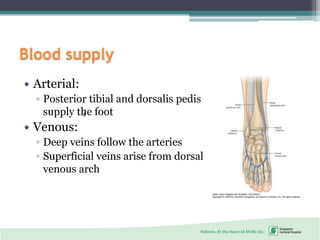
Blood supply
t
 Arterial:
◦ Posterior tibial and dorsalis pedis
supply the foot
 Venous:
◦ Deep veins follow the arteries
◦ Superficial veins arise from dorsal
venous arch
Nerve supply
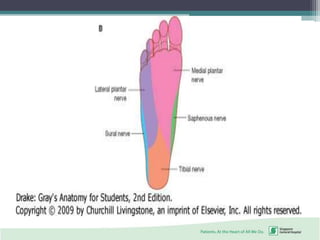
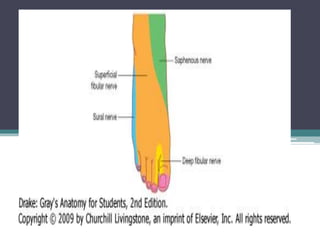
The foot is supplied by the (1)
tibial, (2) deep peroneal, (3)
superficial peroneal, (4)sural,
and (5)saphenous
CHARCOT FOOT
Named after Jean-Martin Charcot (1868)
Charcot noted this disease process as a complication of syphillis
In 1936, Charcot foot was found to be related to diabetic patients
Pathophysiology:
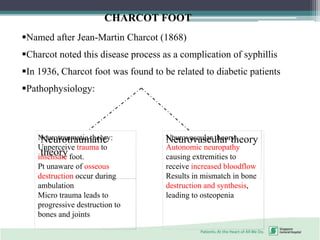
Neurotraumatic
theory
Neurovascular theoryNeurotraumatic theory:
Unperceive trauma to
insensate foot.
Pt unaware of osseous
destruction occur during
ambulation
Micro trauma leads to
progressive destruction to
bones and joints
Neurovascular theory:
Autonomic neuropathy
causing extremities to
receive increased bloodflow
Results in mismatch in bone
destruction and synthesis,
leading to osteopenia
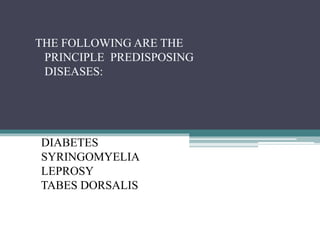
THE FOLLOWING ARE THE
PRINCIPLE PREDISPOSING
DISEASES:
DIABETES
SYRINGOMYELIA
LEPROSY
TABES DORSALIS
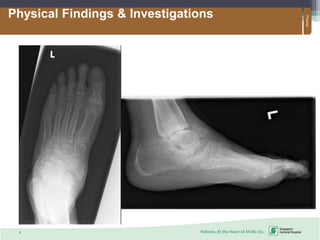
Physical
9
Physical Findings & Investigations
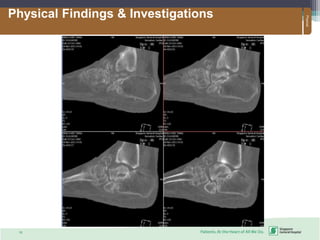
Physical
10
Physical Findings & Investigations
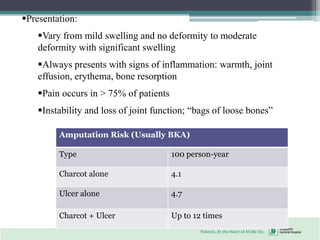
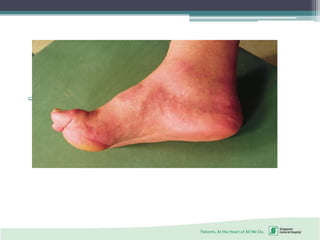
Presentation:
Vary from mild swelling and no deformity to moderate
deformity with significant swelling
Always presents with signs of inflammation: warmth, joint
effusion, erythema, bone resorption
Pain occurs in > 75% of patients
Instability and loss of joint function; “bags of loose bones”
Amputation Risk (Usually BKA)
Type 100 person-year
Charcot alone 4.1
Ulcer alone 4.7
Charcot + Ulcer Up to 12 times
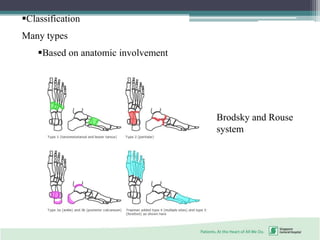
Classification
Many types
Based on anatomic involvement
Brodsky and Rouse
system
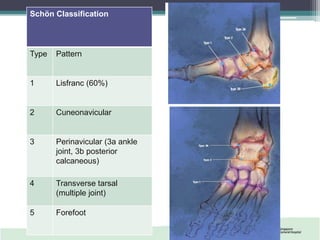
Schön Classification
Type Pattern
1 Lisfranc (60%)
2 Cuneonavicular
3 Perinavicular (3a ankle
joint, 3b posterior
calcaneous)
4 Transverse tarsal
(multiple joint)
5 Forefoot
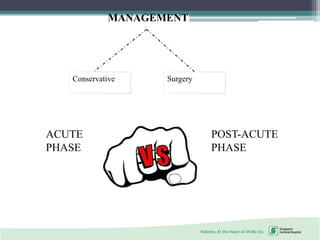
MANAGEMENT
Conservative Surgery
ACUTE
PHASE
POST-ACUTE
PHASE
Acute phase:
Immobilization: e.g. Total contact cast (3-6 months)
Reduction of stress
Ideally non-weight bear
PWB with crutches
Post-acute phase: Patient education and foot care
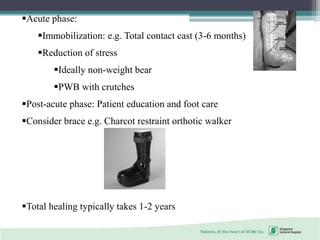
Consider brace e.g. Charcot restraint orthotic walker
Total healing typically takes 1-2 years
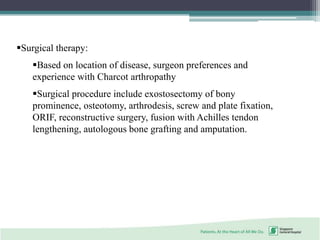
Surgical therapy:
Based on location of disease, surgeon preferences and
experience with Charcot arthropathy
Surgical procedure include exostosectomy of bony
prominence, osteotomy, arthrodesis, screw and plate fixation,
ORIF, reconstructive surgery, fusion with Achilles tendon
lengthening, autologous bone grafting and amputation.
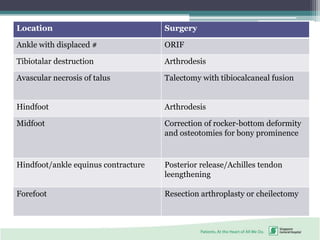
Location Surgery
Ankle with displaced # ORIF
Tibiotalar destruction Arthrodesis
Avascular necrosis of talus Talectomy with tibiocalcaneal fusion
Hindfoot Arthrodesis
Midfoot Correction of rocker-bottom deformity
and osteotomies for bony prominence
Hindfoot/ankle equinus contracture Posterior release/Achilles tendon
leengthening
Forefoot Resection arthroplasty or cheilectomy
DIABETIC FOOT
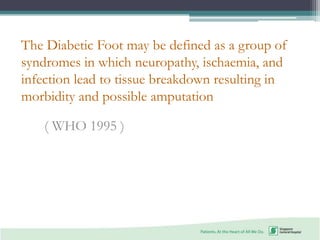
The Diabetic Foot may be defined as a group of
syndromes in which neuropathy, ischaemia, and
infection lead to tissue breakdown resulting in
morbidity and possible amputation
( WHO 1995 )
Peripheral Neuropathy
Sensory
Motor
Autonomic
Precipitating Factors
Trauma
puncture/thermal/stress/footwear
MANAGEMENT
Thank you

Charcot foot

  • 1.
  • 3.
    Blood supply t  Arterial: ◦Posterior tibial and dorsalis pedis supply the foot  Venous: ◦ Deep veins follow the arteries ◦ Superficial veins arise from dorsal venous arch
  • 4.
    Nerve supply The footis supplied by the (1) tibial, (2) deep peroneal, (3) superficial peroneal, (4)sural, and (5)saphenous
  • 7.
    CHARCOT FOOT Named afterJean-Martin Charcot (1868) Charcot noted this disease process as a complication of syphillis In 1936, Charcot foot was found to be related to diabetic patients Pathophysiology: Neurotraumatic theory Neurovascular theoryNeurotraumatic theory: Unperceive trauma to insensate foot. Pt unaware of osseous destruction occur during ambulation Micro trauma leads to progressive destruction to bones and joints Neurovascular theory: Autonomic neuropathy causing extremities to receive increased bloodflow Results in mismatch in bone destruction and synthesis, leading to osteopenia
  • 8.
    THE FOLLOWING ARETHE PRINCIPLE PREDISPOSING DISEASES: DIABETES SYRINGOMYELIA LEPROSY TABES DORSALIS
  • 9.
  • 10.
  • 11.
    Presentation: Vary from mildswelling and no deformity to moderate deformity with significant swelling Always presents with signs of inflammation: warmth, joint effusion, erythema, bone resorption Pain occurs in > 75% of patients Instability and loss of joint function; “bags of loose bones” Amputation Risk (Usually BKA) Type 100 person-year Charcot alone 4.1 Ulcer alone 4.7 Charcot + Ulcer Up to 12 times
  • 12.
    Classification Many types Based onanatomic involvement Brodsky and Rouse system
  • 13.
    Schön Classification Type Pattern 1Lisfranc (60%) 2 Cuneonavicular 3 Perinavicular (3a ankle joint, 3b posterior calcaneous) 4 Transverse tarsal (multiple joint) 5 Forefoot
  • 14.
  • 15.
    Acute phase: Immobilization: e.g.Total contact cast (3-6 months) Reduction of stress Ideally non-weight bear PWB with crutches Post-acute phase: Patient education and foot care Consider brace e.g. Charcot restraint orthotic walker Total healing typically takes 1-2 years
  • 16.
    Surgical therapy: Based onlocation of disease, surgeon preferences and experience with Charcot arthropathy Surgical procedure include exostosectomy of bony prominence, osteotomy, arthrodesis, screw and plate fixation, ORIF, reconstructive surgery, fusion with Achilles tendon lengthening, autologous bone grafting and amputation.
  • 17.
    Location Surgery Ankle withdisplaced # ORIF Tibiotalar destruction Arthrodesis Avascular necrosis of talus Talectomy with tibiocalcaneal fusion Hindfoot Arthrodesis Midfoot Correction of rocker-bottom deformity and osteotomies for bony prominence Hindfoot/ankle equinus contracture Posterior release/Achilles tendon leengthening Forefoot Resection arthroplasty or cheilectomy
  • 18.
  • 19.
    The Diabetic Footmay be defined as a group of syndromes in which neuropathy, ischaemia, and infection lead to tissue breakdown resulting in morbidity and possible amputation ( WHO 1995 )
  • 22.
  • 24.
  • 26.
  • 27.