MULTIPLE
MYELOMA
Most common primary malignant tumor of bone.
Multiple myeloma is a malignant clonal proliferation of
plasma cells in the bone marrow with lytic bone leisions.
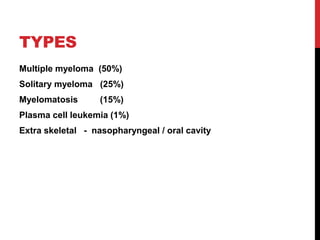
TYPES
Multiple myeloma (50%)
Solitary myeloma (25%)
Myelomatosis (15%)
Plasma cell leukemia (1%)
Extra skeletal - nasopharyngeal / oral cavity
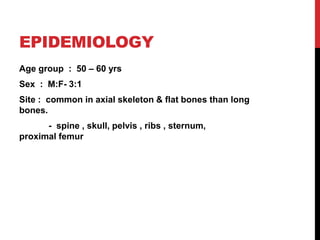
EPIDEMIOLOGY
Age group : 50 – 60 yrs
Sex : M:F- 3:1
Site : common in axial skeleton & flat bones than long
bones.
- spine , skull, pelvis , ribs , sternum,
proximal femur
CLINICAL FEATURES
Bone pain is the most common symptom , which is relieved
by rest.
Persistent localised bone pain signifies pathological
fracture.
No swelling / deformity unless there is pathologic al #
Compressive myelopathy due to vertebral collapse .
CLINICAL
HALLMARKS OF MM
Weight loss , pallor, bleeding tendencies, fatigue
Susceptibility to bacterial infections
Hypercalcemia
Renal failure
Bone destructions lytic lesions)
Presence monoclonal antibody
INVESTIGATIONS
Haemogram shows anaemia , leucopenia ,
thrombocytopenia
ESR is very high
Peripheral smear – NCNA with increased rouleaux formation.
Leucoerythroblastic picture.
Total protein increased with A:G reversal.
S.Ca is increased, ALP normal.
Electrophoresis on serum or urine shows ‘M’ band in the
region of gamma globulin.
Urine may show Bence Jones protein.
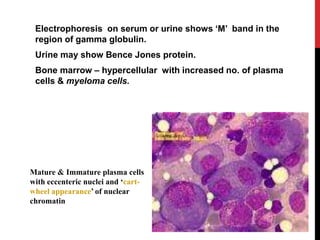
Bone marrow – hypercellular with increased no. of plasma
cells & myeloma cells.
Mature & Immature plasma cells
with eccenteric nuclei and ‘cart-
wheel appearance’ of nuclear
chromatin
RADIOLOGICAL
FINDINGS
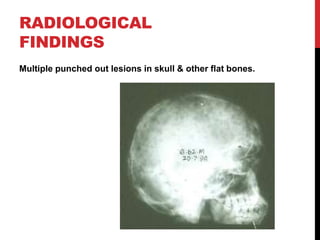
Multiple punched out lesions in skull & other flat bones.
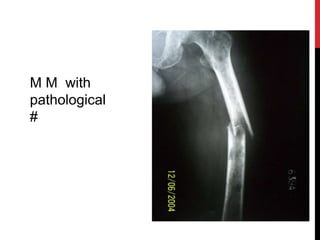
M M with
pathological
#
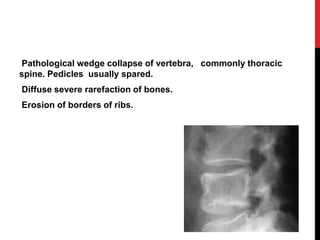
Pathological wedge collapse of vertebra, commonly thoracic
spine. Pedicles usually spared.
Diffuse severe rarefaction of bones.
Erosion of borders of ribs.
CT & MRI
Bone scan in solitarybone lesions helps to detect other sites
of involvement.
S. beta 2 microglogulin is the single most powerful
predictor of survival.
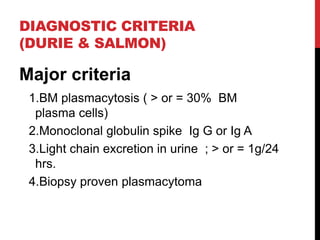
DIAGNOSTIC CRITERIA
(DURIE & SALMON)
Major criteria
1.BM plasmacytosis ( > or = 30% BM
plasma cells)
2.Monoclonal globulin spike Ig G or Ig A
3.Light chain excretion in urine ; > or = 1g/24
hrs.
4.Biopsy proven plasmacytoma
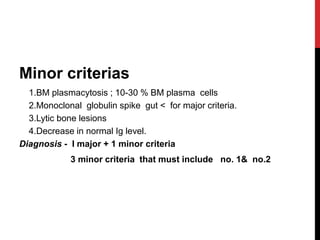
Minor criterias
1.BM plasmacytosis ; 10-30 % BM plasma cells
2.Monoclonal globulin spike gut < for major criteria.
3.Lytic bone lesions
4.Decrease in normal Ig level.
Diagnosis - I major + 1 minor criteria
3 minor criteria that must include no. 1& no.2
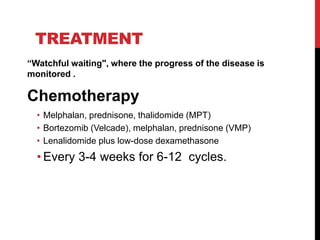
TREATMENT
“Watchful waiting", where the progress of the disease is
monitored .
Chemotherapy
• Melphalan, prednisone, thalidomide (MPT)
• Bortezomib (Velcade), melphalan, prednisone (VMP)
• Lenalidomide plus low-dose dexamethasone
• Every 3-4 weeks for 6-12 cycles.
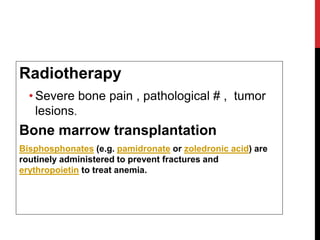
Radiotherapy
• Severe bone pain , pathological # , tumor
lesions.
Bone marrow transplantation
Bisphosphonates (e.g. pamidronate or zoledronic acid) are
routinely administered to prevent fractures and
erythropoietin to treat anemia.
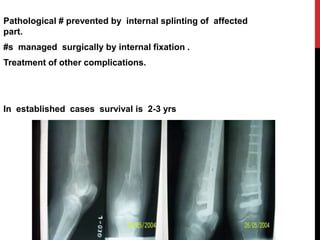
Pathological # prevented by internal splinting of affected
part.
#s managed surgically by internal fixation .
Treatment of other complications.
In established cases survival is 2-3 yrs
Multiple  myeloma

Multiple myeloma

  • 1.
  • 2.
    Most common primarymalignant tumor of bone. Multiple myeloma is a malignant clonal proliferation of plasma cells in the bone marrow with lytic bone leisions.
  • 3.
    TYPES Multiple myeloma (50%) Solitarymyeloma (25%) Myelomatosis (15%) Plasma cell leukemia (1%) Extra skeletal - nasopharyngeal / oral cavity
  • 4.
    EPIDEMIOLOGY Age group :50 – 60 yrs Sex : M:F- 3:1 Site : common in axial skeleton & flat bones than long bones. - spine , skull, pelvis , ribs , sternum, proximal femur
  • 5.
    CLINICAL FEATURES Bone painis the most common symptom , which is relieved by rest. Persistent localised bone pain signifies pathological fracture. No swelling / deformity unless there is pathologic al # Compressive myelopathy due to vertebral collapse .
  • 6.
    CLINICAL HALLMARKS OF MM Weightloss , pallor, bleeding tendencies, fatigue Susceptibility to bacterial infections Hypercalcemia Renal failure Bone destructions lytic lesions) Presence monoclonal antibody
  • 7.
    INVESTIGATIONS Haemogram shows anaemia, leucopenia , thrombocytopenia ESR is very high Peripheral smear – NCNA with increased rouleaux formation. Leucoerythroblastic picture. Total protein increased with A:G reversal. S.Ca is increased, ALP normal.
  • 8.
    Electrophoresis on serumor urine shows ‘M’ band in the region of gamma globulin. Urine may show Bence Jones protein. Bone marrow – hypercellular with increased no. of plasma cells & myeloma cells. Mature & Immature plasma cells with eccenteric nuclei and ‘cart- wheel appearance’ of nuclear chromatin
  • 9.
    RADIOLOGICAL FINDINGS Multiple punched outlesions in skull & other flat bones.
  • 10.
  • 11.
    Pathological wedge collapseof vertebra, commonly thoracic spine. Pedicles usually spared. Diffuse severe rarefaction of bones. Erosion of borders of ribs.
  • 12.
    CT & MRI Bonescan in solitarybone lesions helps to detect other sites of involvement. S. beta 2 microglogulin is the single most powerful predictor of survival.
  • 13.
    DIAGNOSTIC CRITERIA (DURIE &SALMON) Major criteria 1.BM plasmacytosis ( > or = 30% BM plasma cells) 2.Monoclonal globulin spike Ig G or Ig A 3.Light chain excretion in urine ; > or = 1g/24 hrs. 4.Biopsy proven plasmacytoma
  • 14.
    Minor criterias 1.BM plasmacytosis; 10-30 % BM plasma cells 2.Monoclonal globulin spike gut < for major criteria. 3.Lytic bone lesions 4.Decrease in normal Ig level. Diagnosis - I major + 1 minor criteria 3 minor criteria that must include no. 1& no.2
  • 15.
    TREATMENT “Watchful waiting", wherethe progress of the disease is monitored . Chemotherapy • Melphalan, prednisone, thalidomide (MPT) • Bortezomib (Velcade), melphalan, prednisone (VMP) • Lenalidomide plus low-dose dexamethasone • Every 3-4 weeks for 6-12 cycles.
  • 16.
    Radiotherapy • Severe bonepain , pathological # , tumor lesions. Bone marrow transplantation Bisphosphonates (e.g. pamidronate or zoledronic acid) are routinely administered to prevent fractures and erythropoietin to treat anemia.
  • 17.
    Pathological # preventedby internal splinting of affected part. #s managed surgically by internal fixation . Treatment of other complications. In established cases survival is 2-3 yrs