KDIGO 2024
What is there for
diabetologist /
endocrinologist?
Dr. Mahmoud Naguib
Introduc
tion
• The word KDIGO stands for “Kidney Disease:
Improving Global Outcomes”
• KDIGO is the global nonprofit organization that
aims at Improving the care and outcomes of
patients with kidney disease worldwide through
developing and implementing evidence-based
clinical practice guidelines in kidney disease.
• KDIGO guidelines focus on topics related to the
prevention or management of individuals with
kidney diseases.
• This year 2024, KDIGO released new
guidelines for the Evaluation and Management
of Chronic Kidney Disease.
CKD and DM
• CKD is one of the most important causes of morbidity and mortality
globally.
• DM is the most common cause of CKD worldwide.
• A systematic review suggested that screening for CKD is cost-
effective in people with diabetes and hypertension.
• Early diagnosis and slowing CKD progression at early stages should
provide economic benefits and prevent the development of kidney
failure and cardiovascular complications.
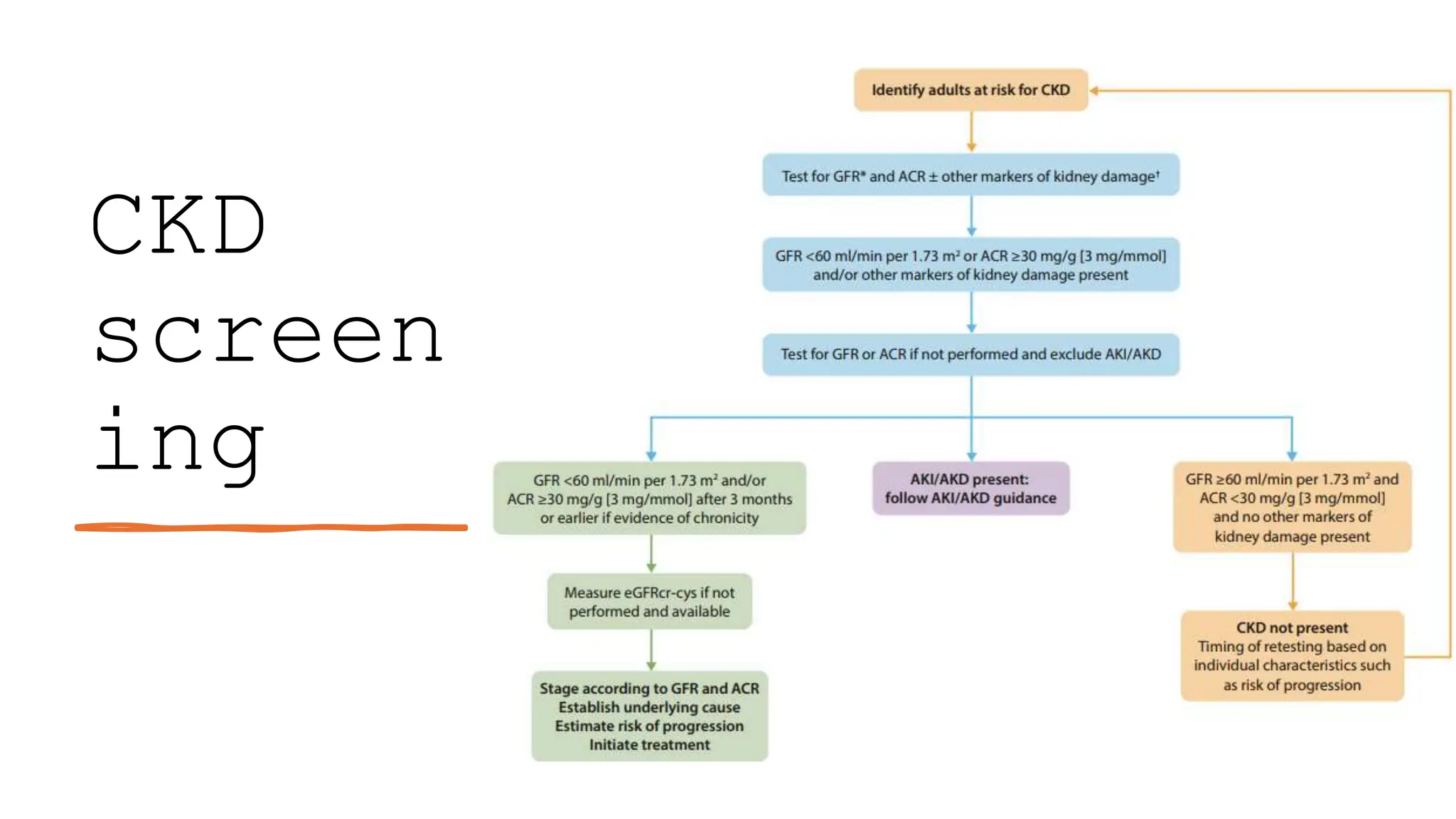
CKD
screen
ing
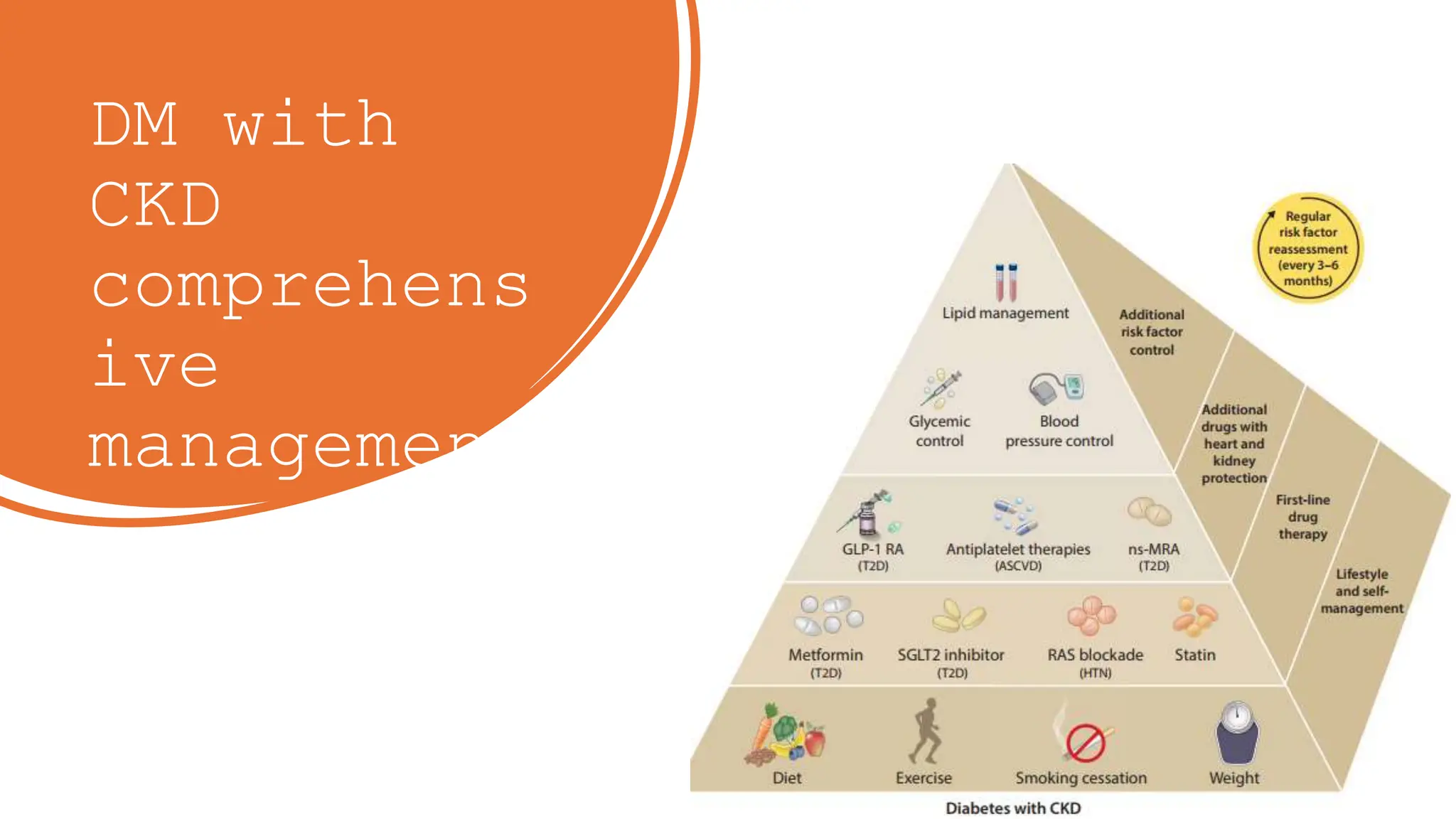
DM with
CKD
comprehens
ive
management
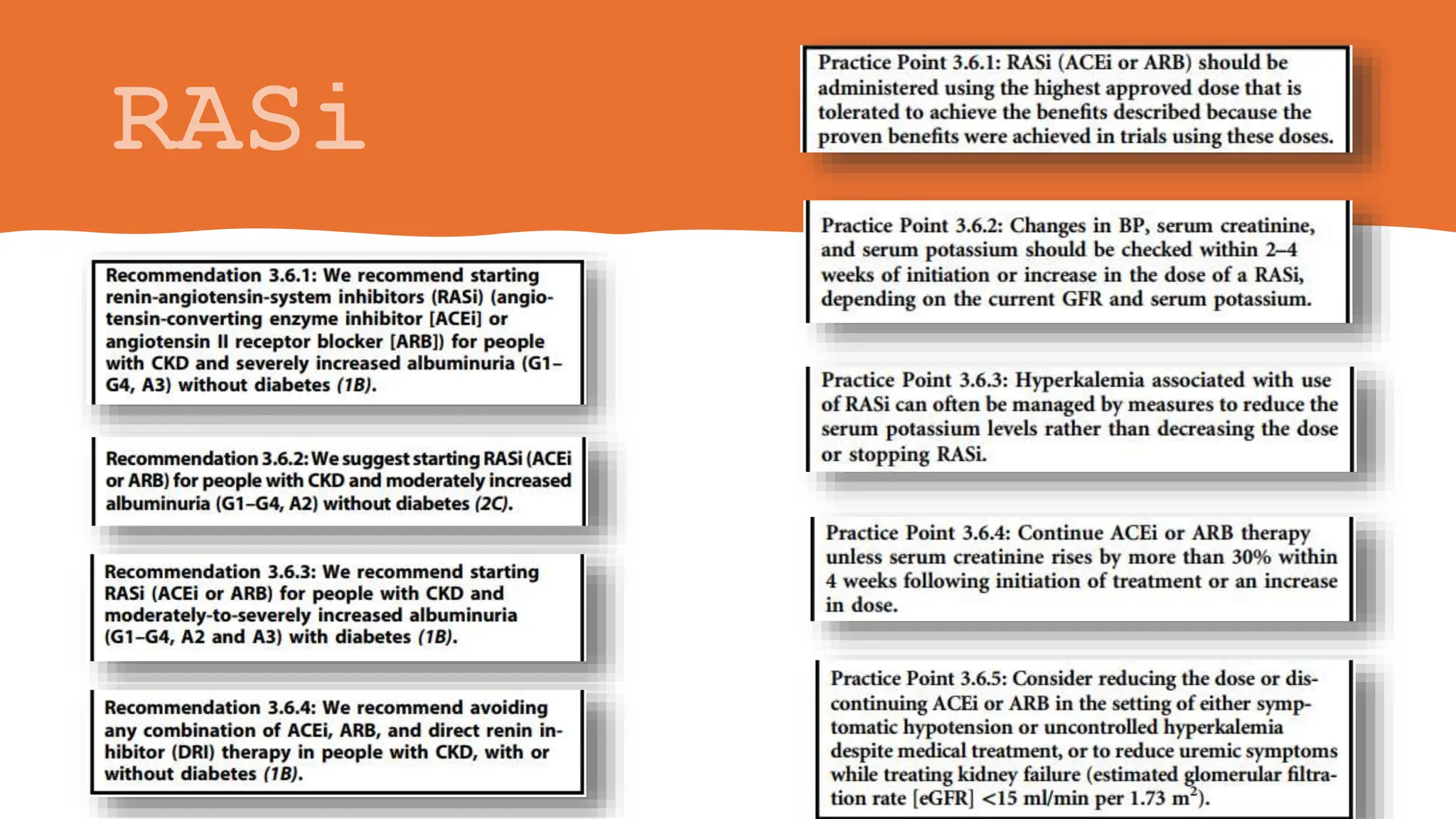
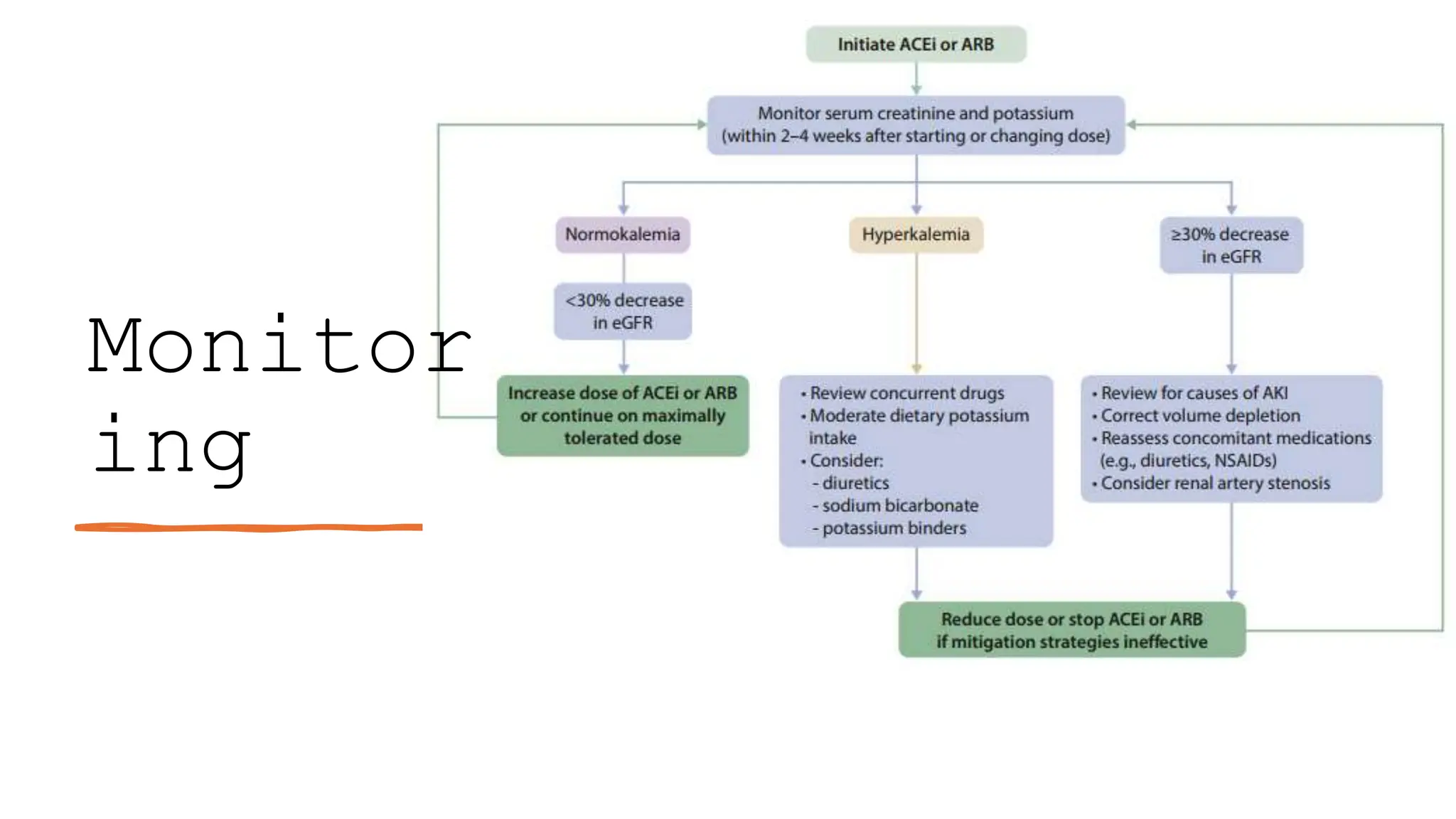
Renin-angiotensin system inhibitors
Monitor
ing
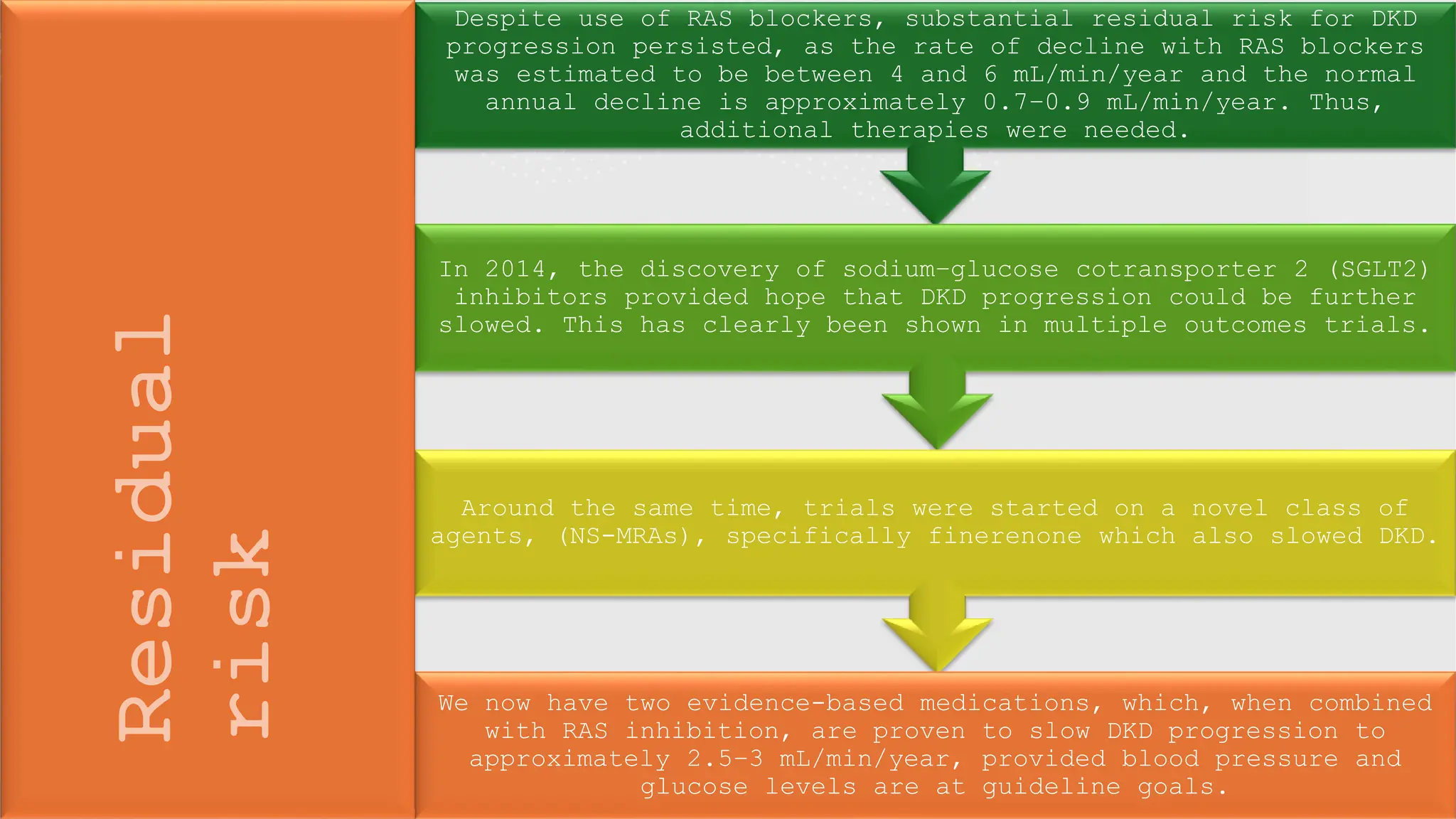
Despite use of RAS blockers, substantial residual risk for DKD
progression persisted, as the rate of decline with RAS blockers
was estimated to be between 4 and 6 mL/min/year and the normal
annual decline is approximately 0.7–0.9 mL/min/year. Thus,
additional therapies were needed.
In 2014, the discovery of sodium–glucose cotransporter 2 (SGLT2)
inhibitors provided hope that DKD progression could be further
slowed. This has clearly been shown in multiple outcomes trials.
Around the same time, trials were started on a novel class of
agents, (NS-MRAs), specifically finerenone which also slowed DKD.
We now have two evidence-based medications, which, when combined
with RAS inhibition, are proven to slow DKD progression to
approximately 2.5–3 mL/min/year, provided blood pressure and
glucose levels are at guideline goals.
Sodium-glucose cotransporter-2
inhibitors
SGLT2i
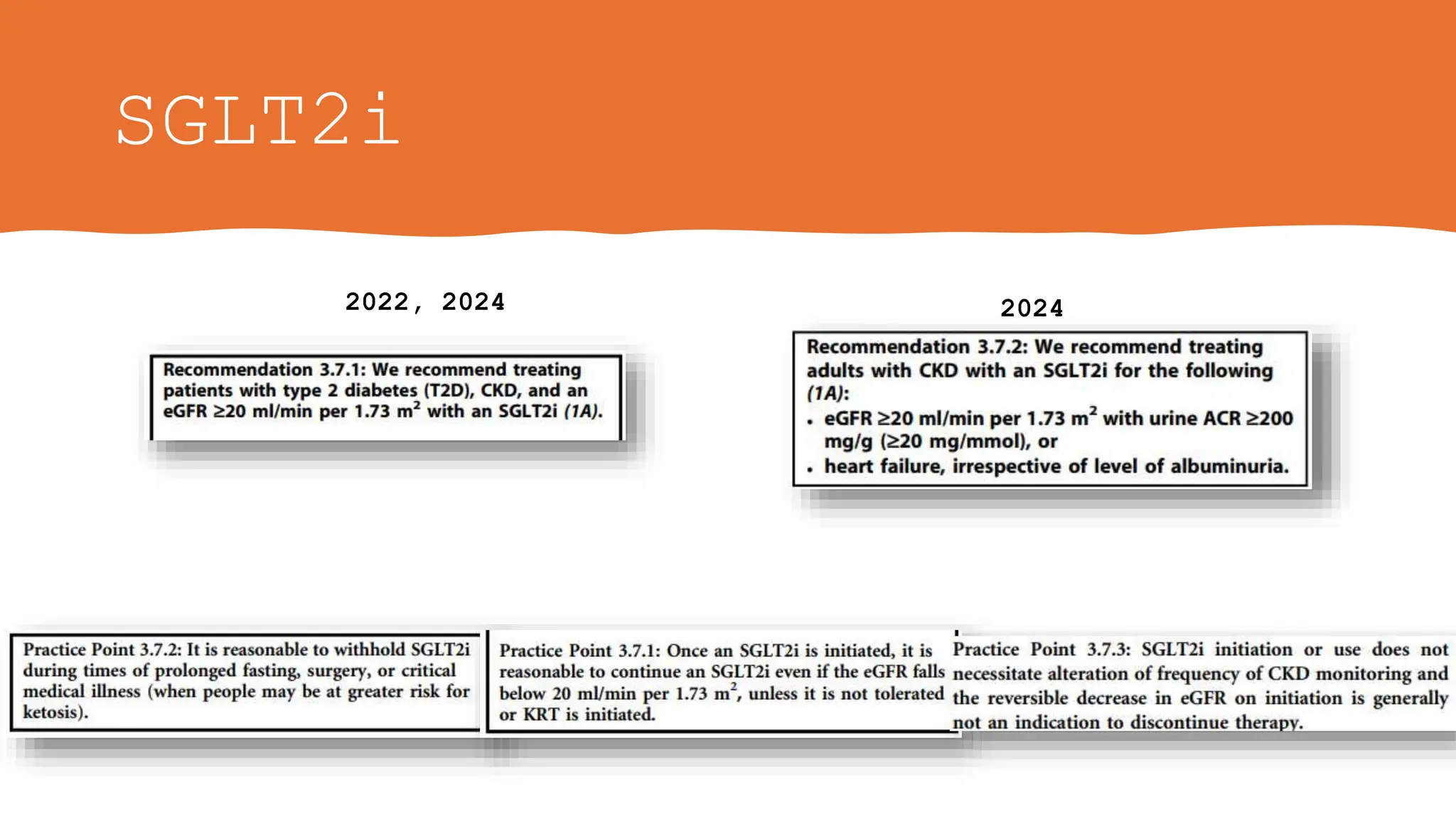
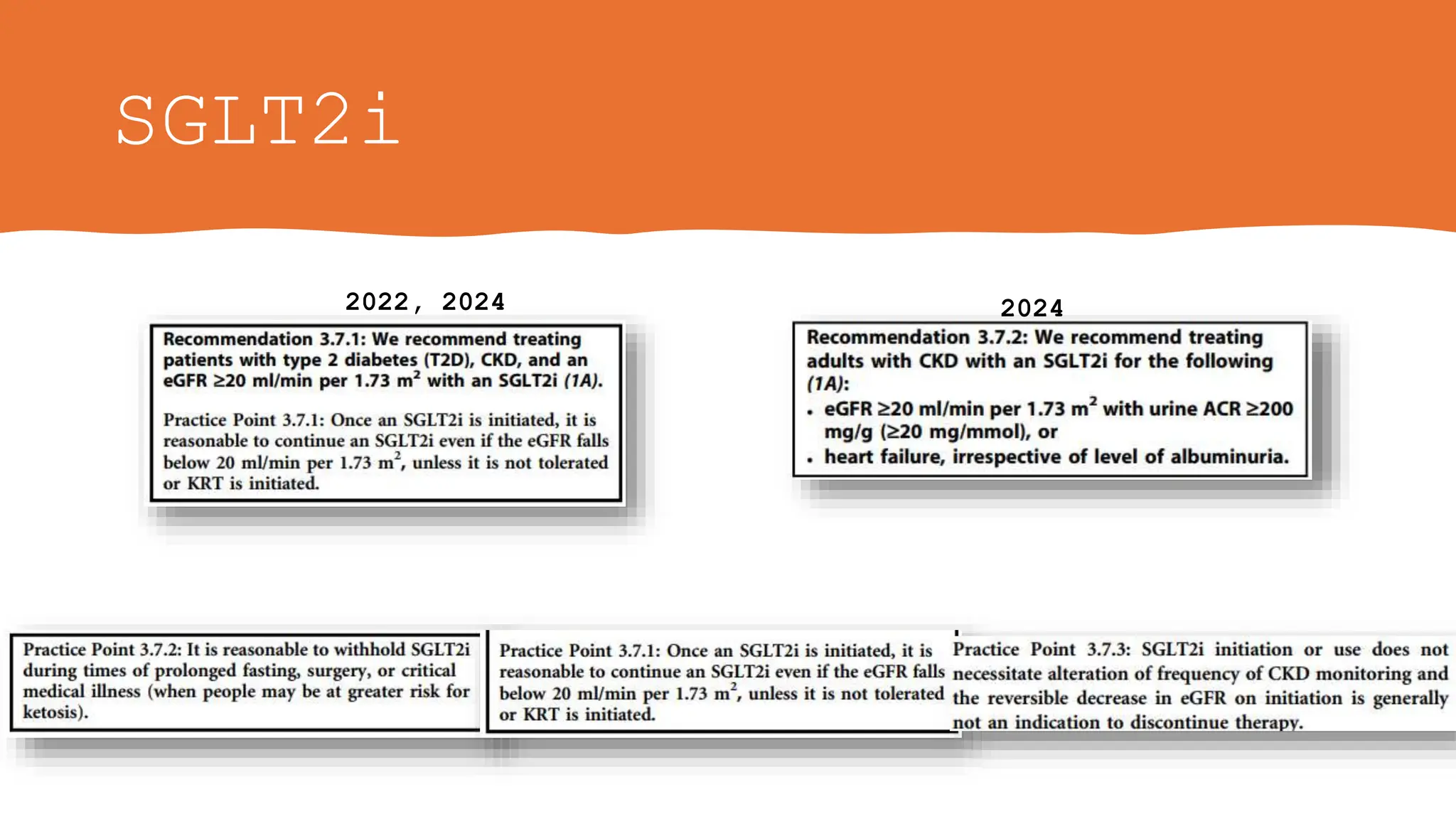
2022, 2024 2024
SGLT2i
benefits
• These recommendations were based on
Several large, placebo-controlled RCTs that
showed the efficacy of SGLT2i which:
Greatly reduce the risk of kidney failure,
AKI, and hospitalization for heart failure,
Moderately reduce the risk of cardiovascular
death and myocardial infarction in people
with and without CKD.
These benefits appear to be irrespective of
diabetes status, cause of kidney disease, or
level of GFR
SGLT2i
benefits
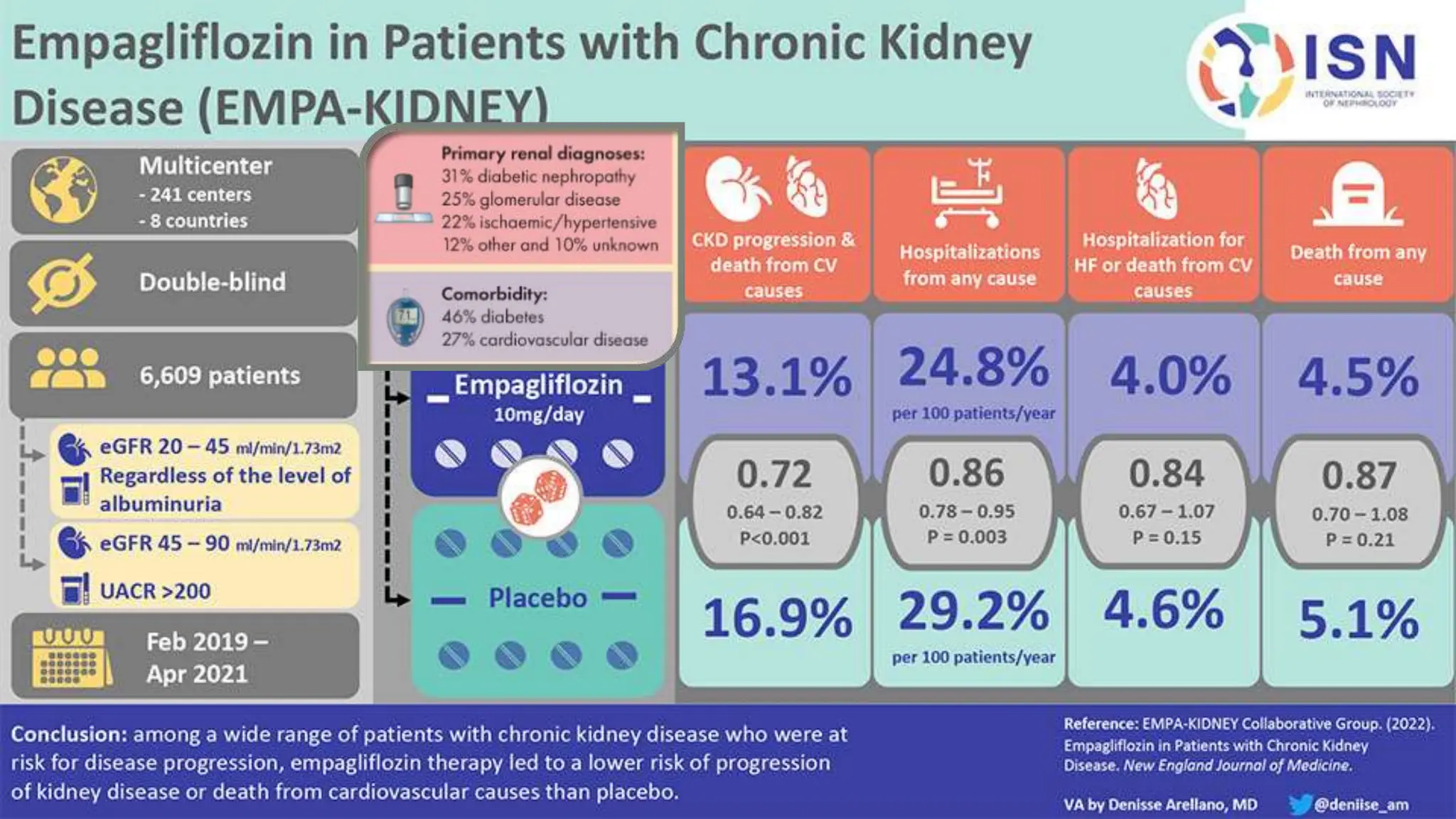
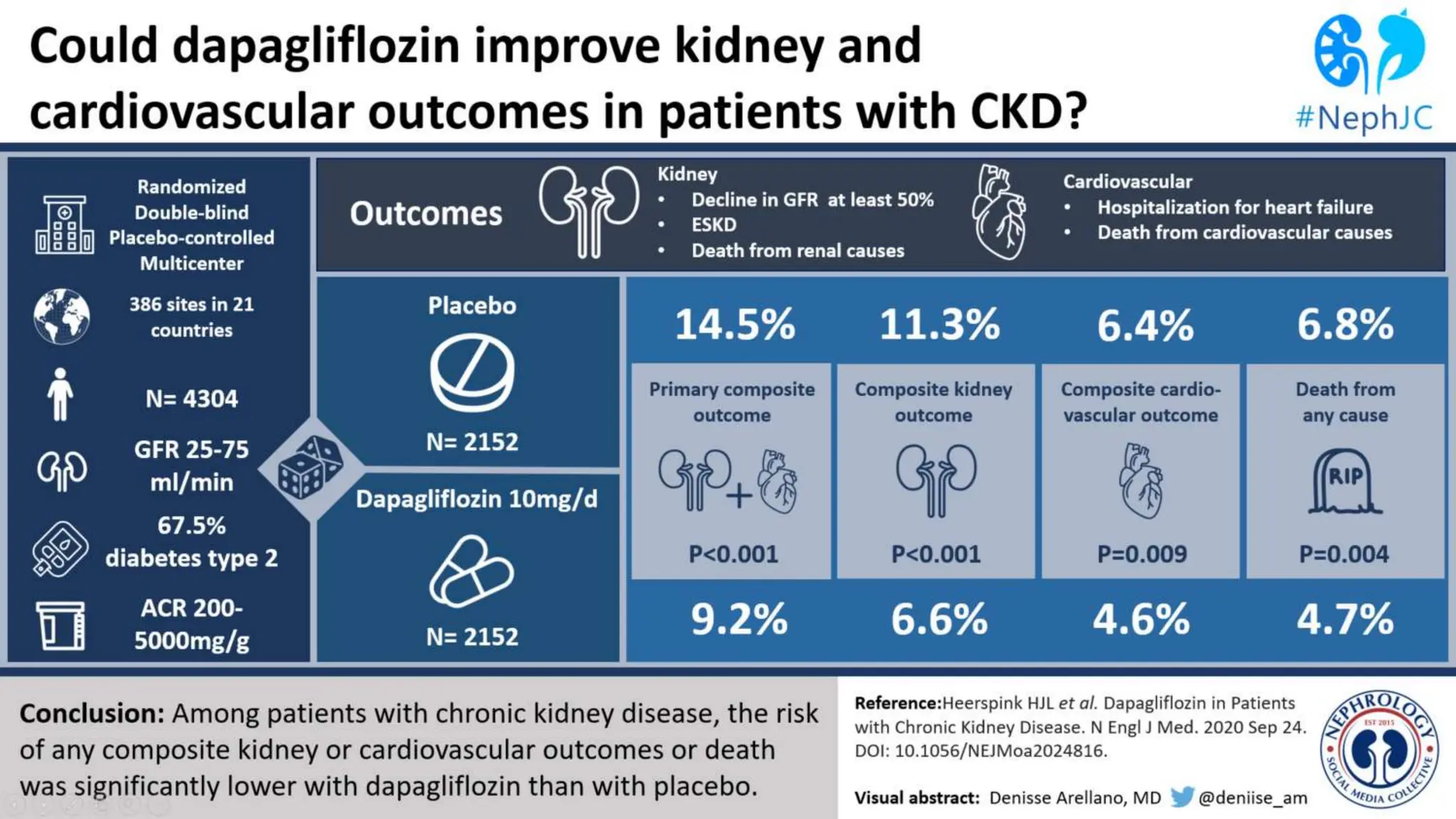
• Two large RCTs (EMPA-KIDNEY) &
(DAPA-CKD) using 2 different SGLT2i
recruited 10,913 participants and focused on
CKD populations at risk of progression,
reporting benefits in terms of kidney disease
progression and cardiovascular mortality.
SGLT2i
benefits
• In a collaborative metanalysis including those 2 and
11 other trials (13 trials with just over 90,000
randomized participants) in comparison with
placebo, those allocated to an SGLT2i experienced:
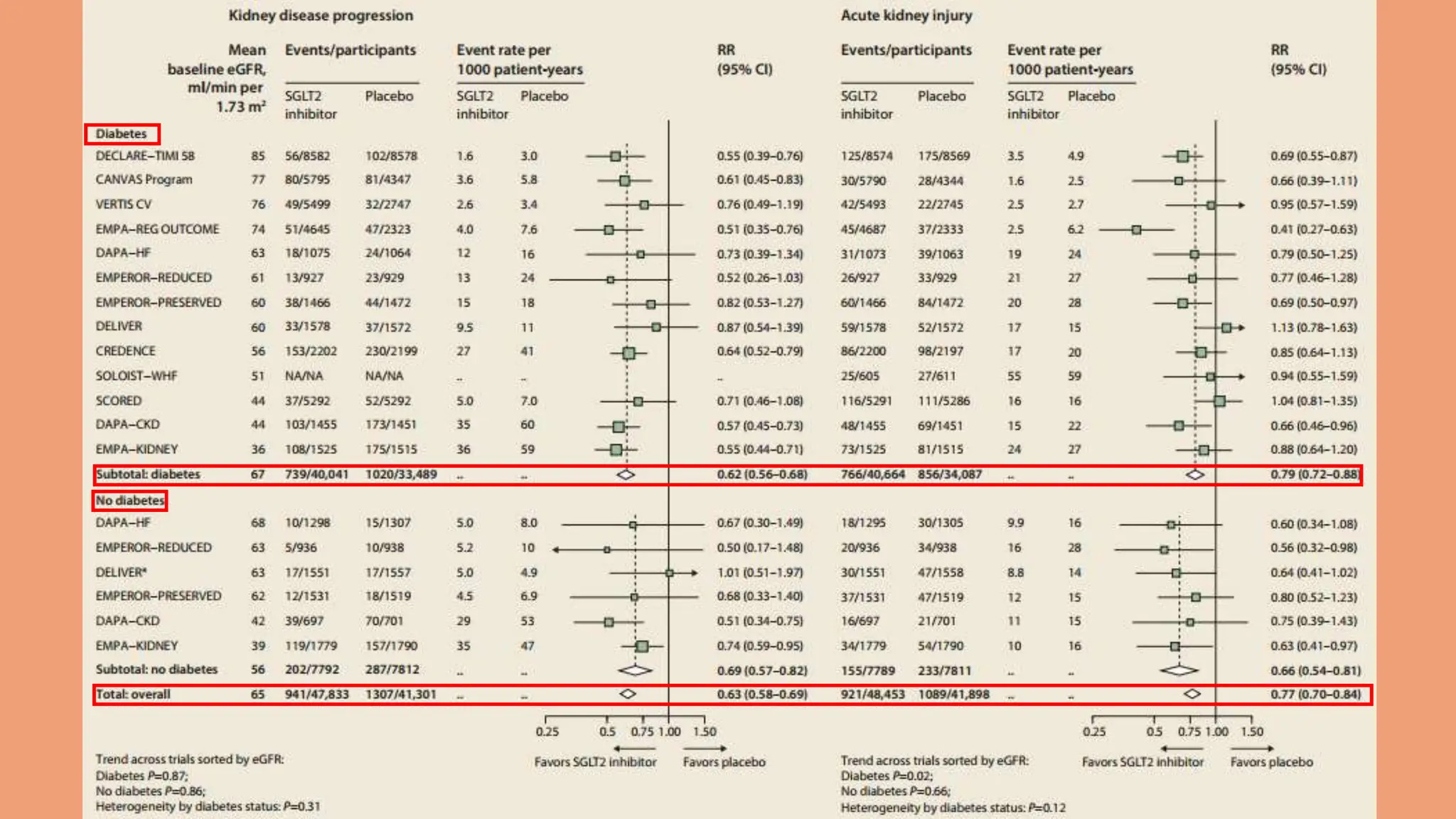
37% reduction in the risk of kidney disease progression
23% reduction in the risk of AKI irrespective of diabetes
status.
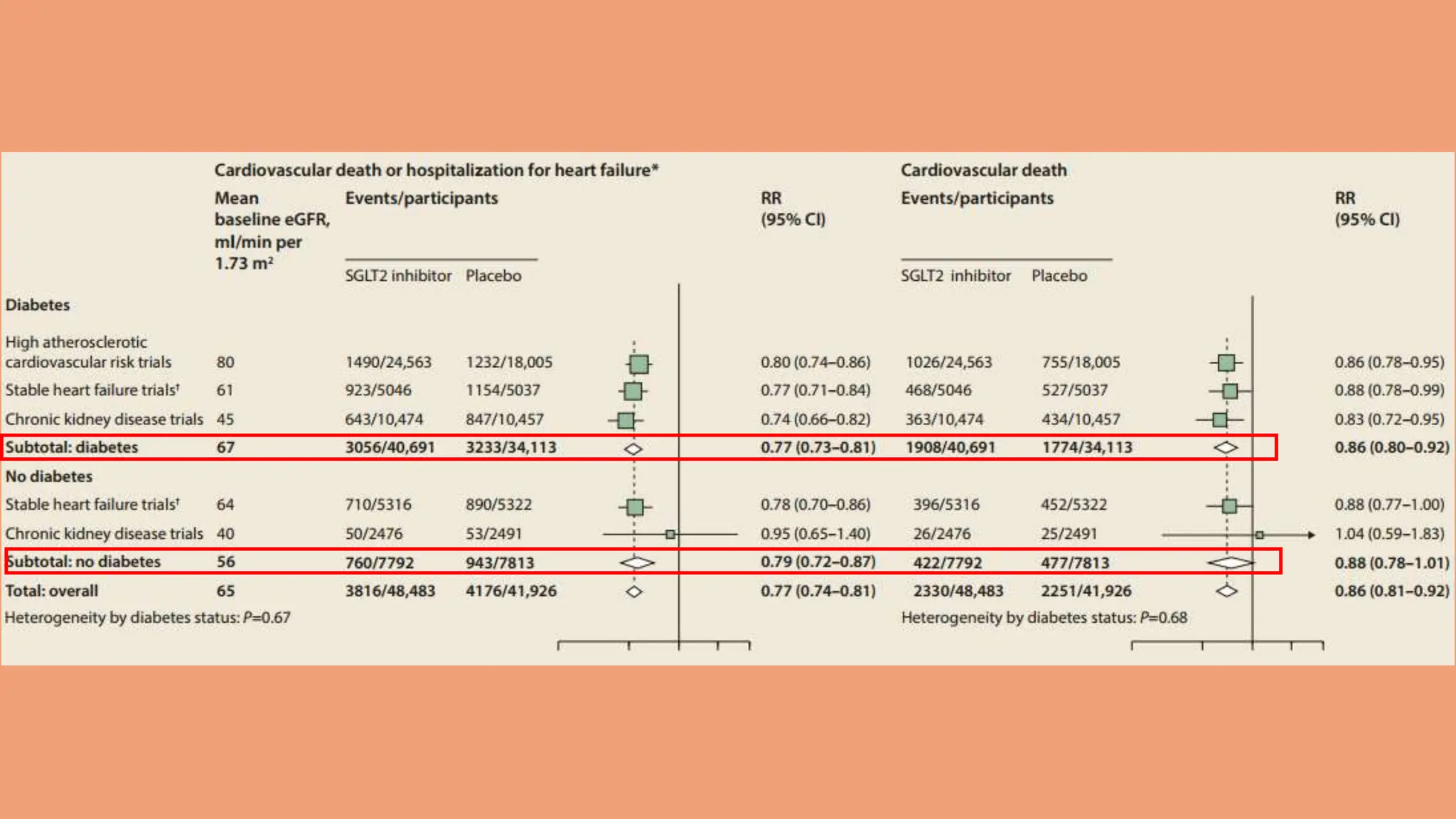
Reduced risk of the composite of cardiovascular death or
hospitalization for heart failure by 23% irrespective of
diabetes status.
10% RR reduction in MACE (Major adverse cardiovascular
events).
Reduced risk of hospitalization from any cause, reduced
BP, uric acid levels, weight/fluid overload, the risk of
serious hyperkalemia.
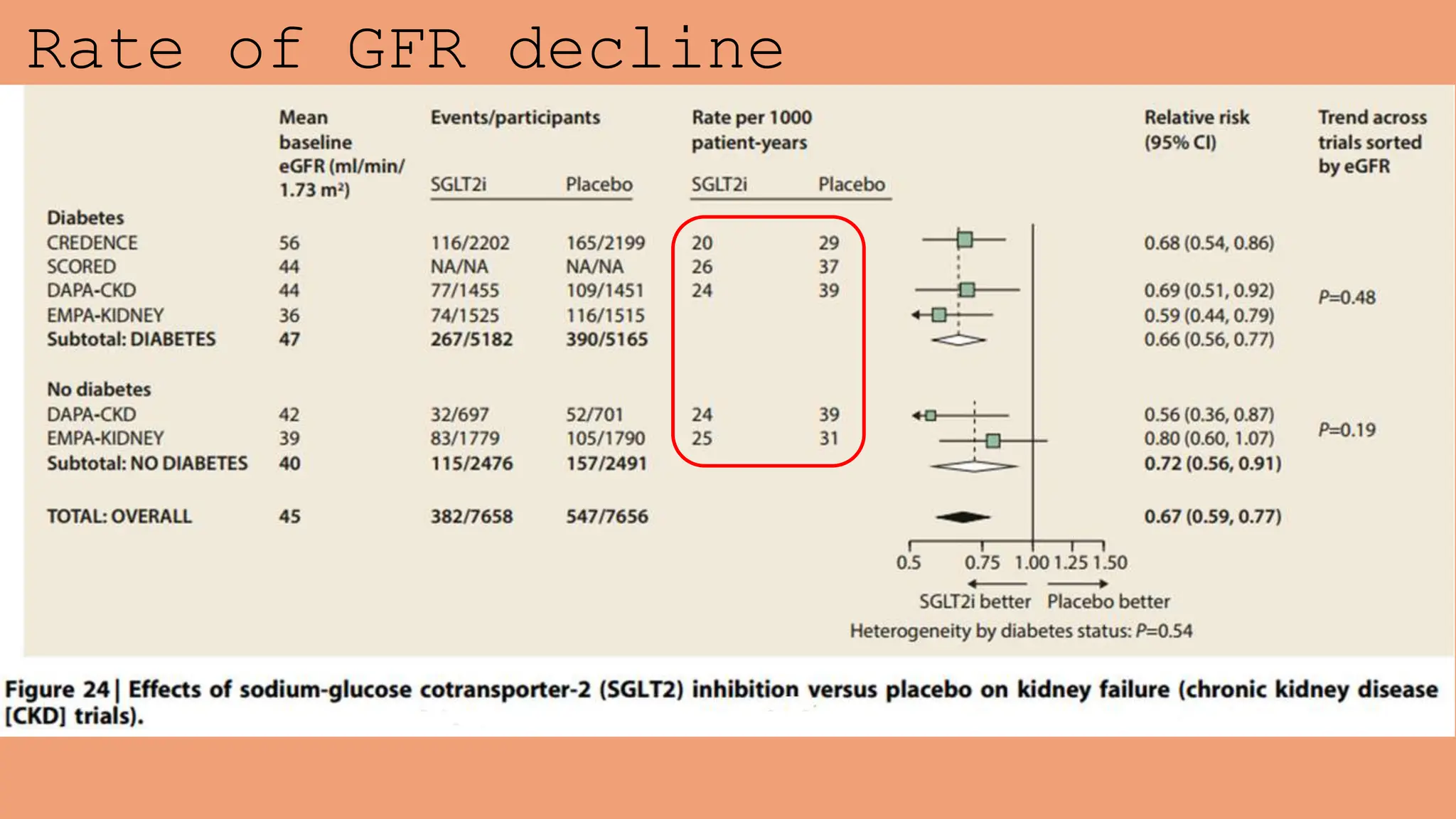
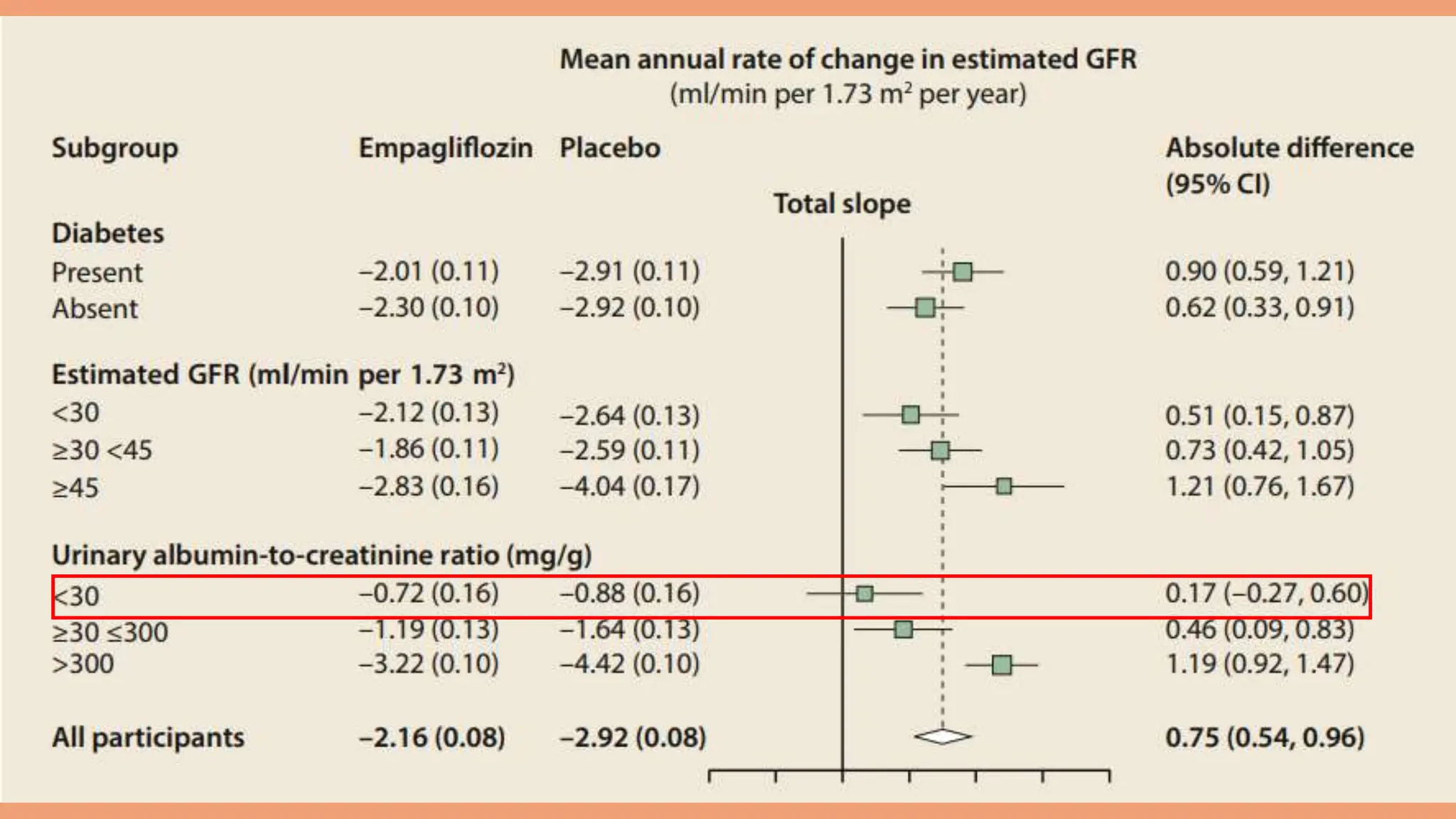
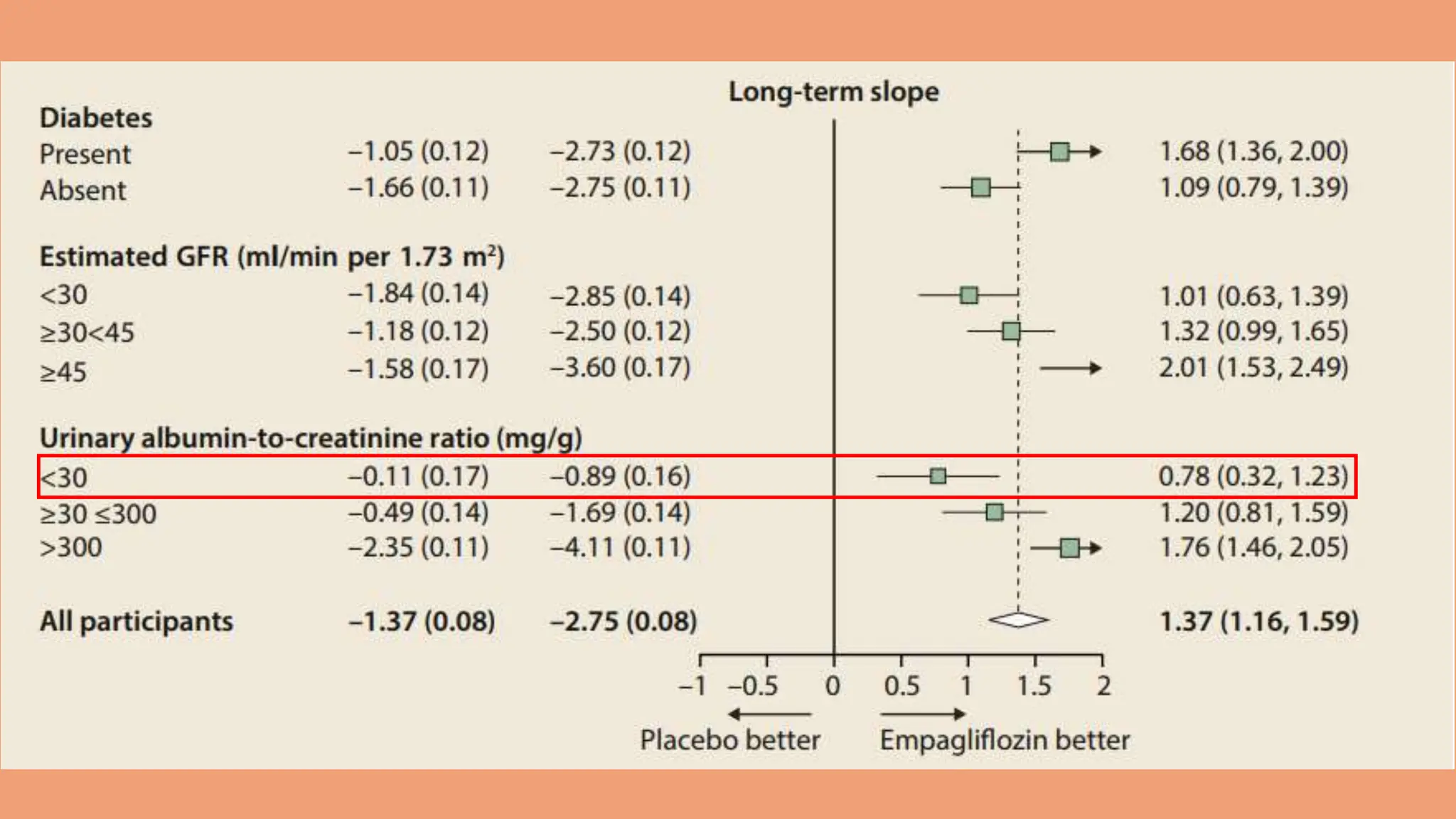
Rate of GFR decline
SGLT2i
harms
• SGLT2i are well tolerated with high levels of
adherence in the RCTs in CKD.
• In the studied populations, any risk of ketoacidosis
or lower-limb amputation resulting from SGLT2i
use was substantially lower than the potential
absolute benefits and generally restricted to people
with diabetes.
SGLT2i
harms
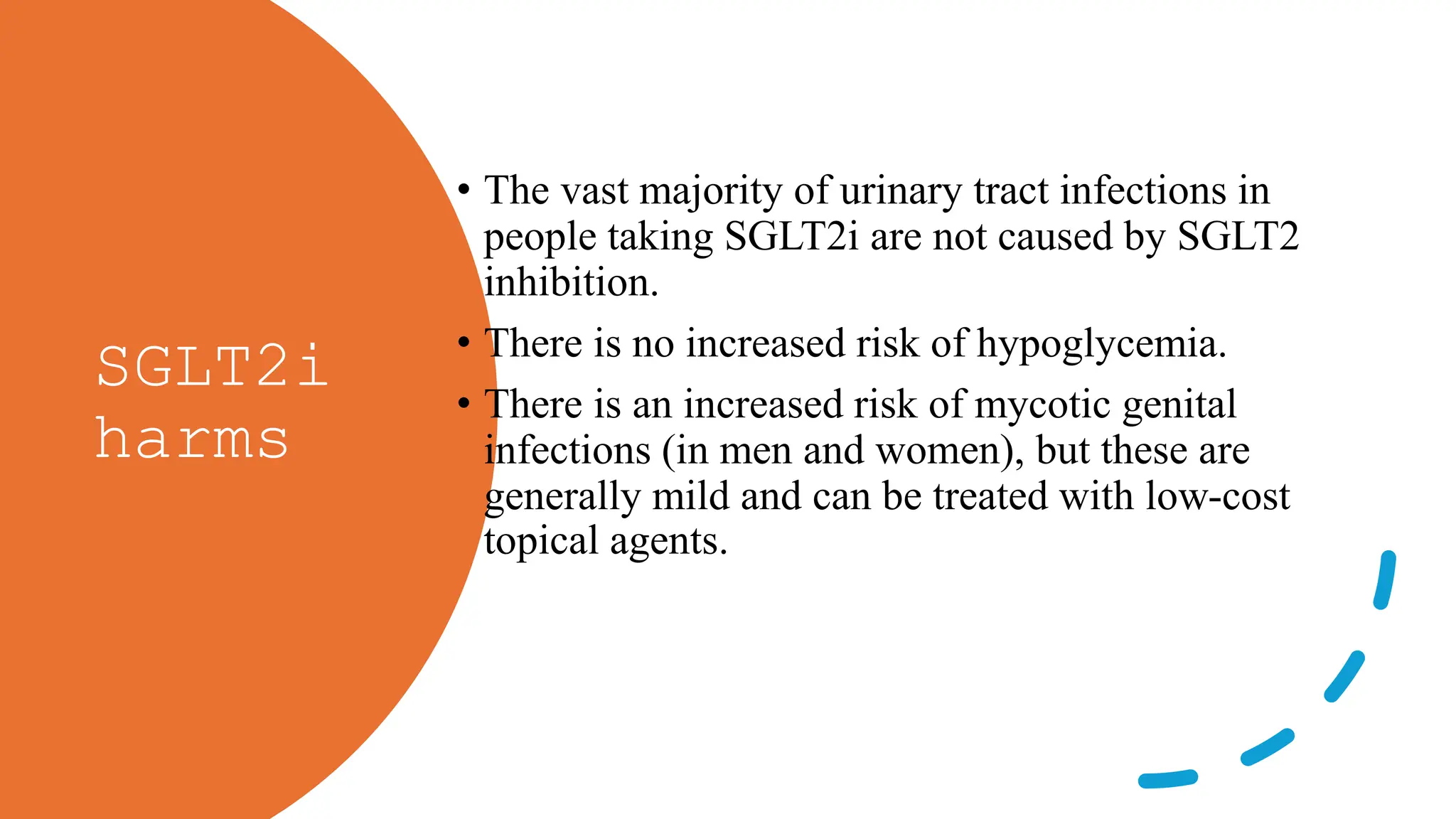
• The vast majority of urinary tract infections in
people taking SGLT2i are not caused by SGLT2
inhibition.
• There is no increased risk of hypoglycemia.
• There is an increased risk of mycotic genital
infections (in men and women), but these are
generally mild and can be treated with low-cost
topical agents.
SGLT2i
benefits vs
harms
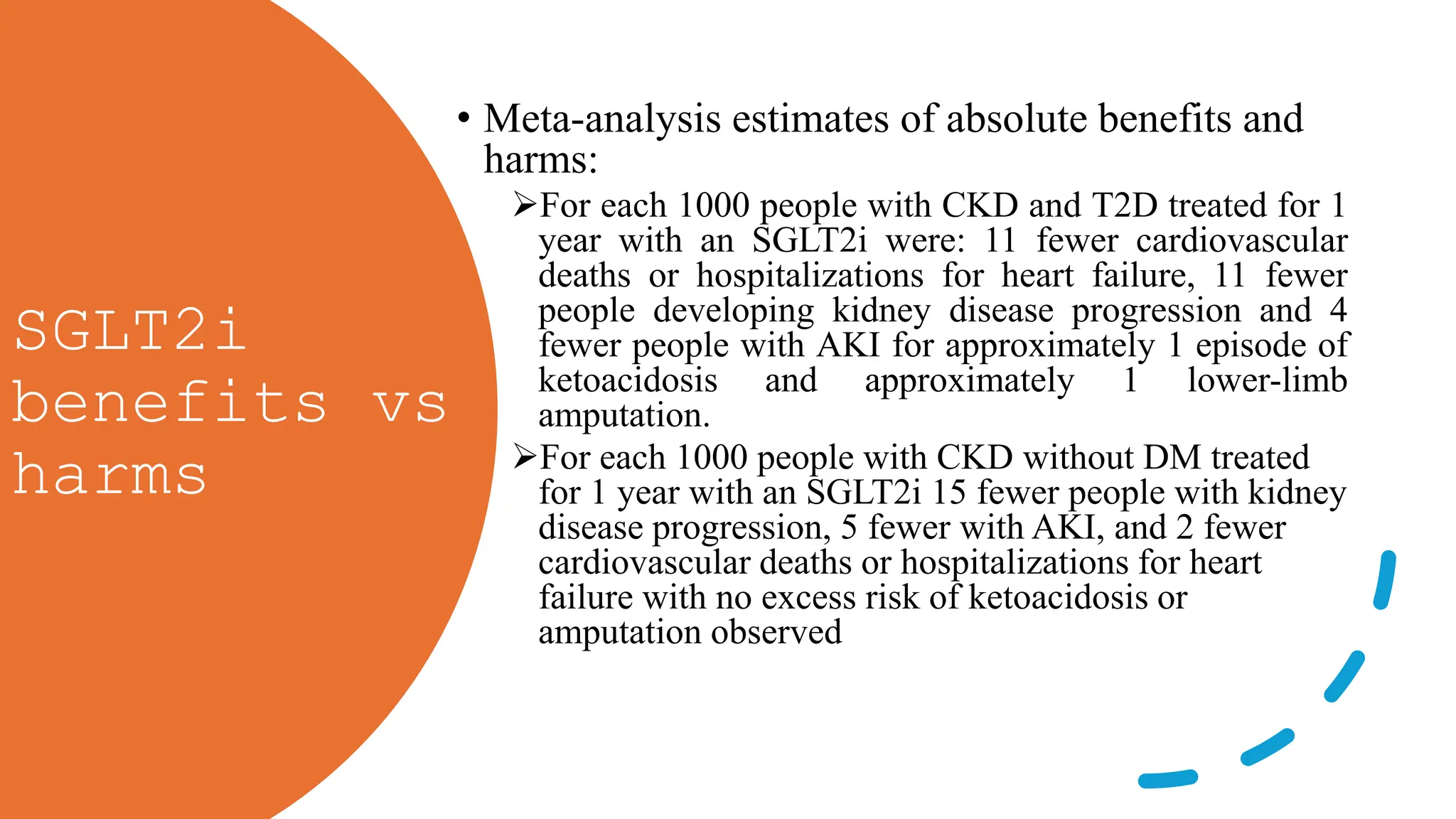
• Meta-analysis estimates of absolute benefits and
harms:
For each 1000 people with CKD and T2D treated for 1
year with an SGLT2i were: 11 fewer cardiovascular
deaths or hospitalizations for heart failure, 11 fewer
people developing kidney disease progression and 4
fewer people with AKI for approximately 1 episode of
ketoacidosis and approximately 1 lower-limb
amputation.
For each 1000 people with CKD without DM treated
for 1 year with an SGLT2i 15 fewer people with kidney
disease progression, 5 fewer with AKI, and 2 fewer
cardiovascular deaths or hospitalizations for heart
failure with no excess risk of ketoacidosis or
amputation observed
SGLT2i
2022, 2024 2024
SGLT2i
• The Work Group judged that fully informed adults without diabetes and low levels of
albuminuria (urine ACR <200 mg/g [<20 mg/mmol]) who have established CKD and an
eGFR of 20–45 ml/min per 1.73 m2 may be particularly motivated to take SGLT2i for the
benefits identified on rate of decline in GFR
• Evidence for benefits on CKD progression in people without diabetes and with low levels of
albuminuria is limited to eGFR slope analyses in heart failure trials and one CKD trial all with
relatively short follow-up periods. However, extrapolation of these eGFR slope results
suggests that important benefits would arise for such people if treated long term and the
initiation of RRT can be delayed.
Mineralocorticoid receptor
antagonists
MRAs
MRAs
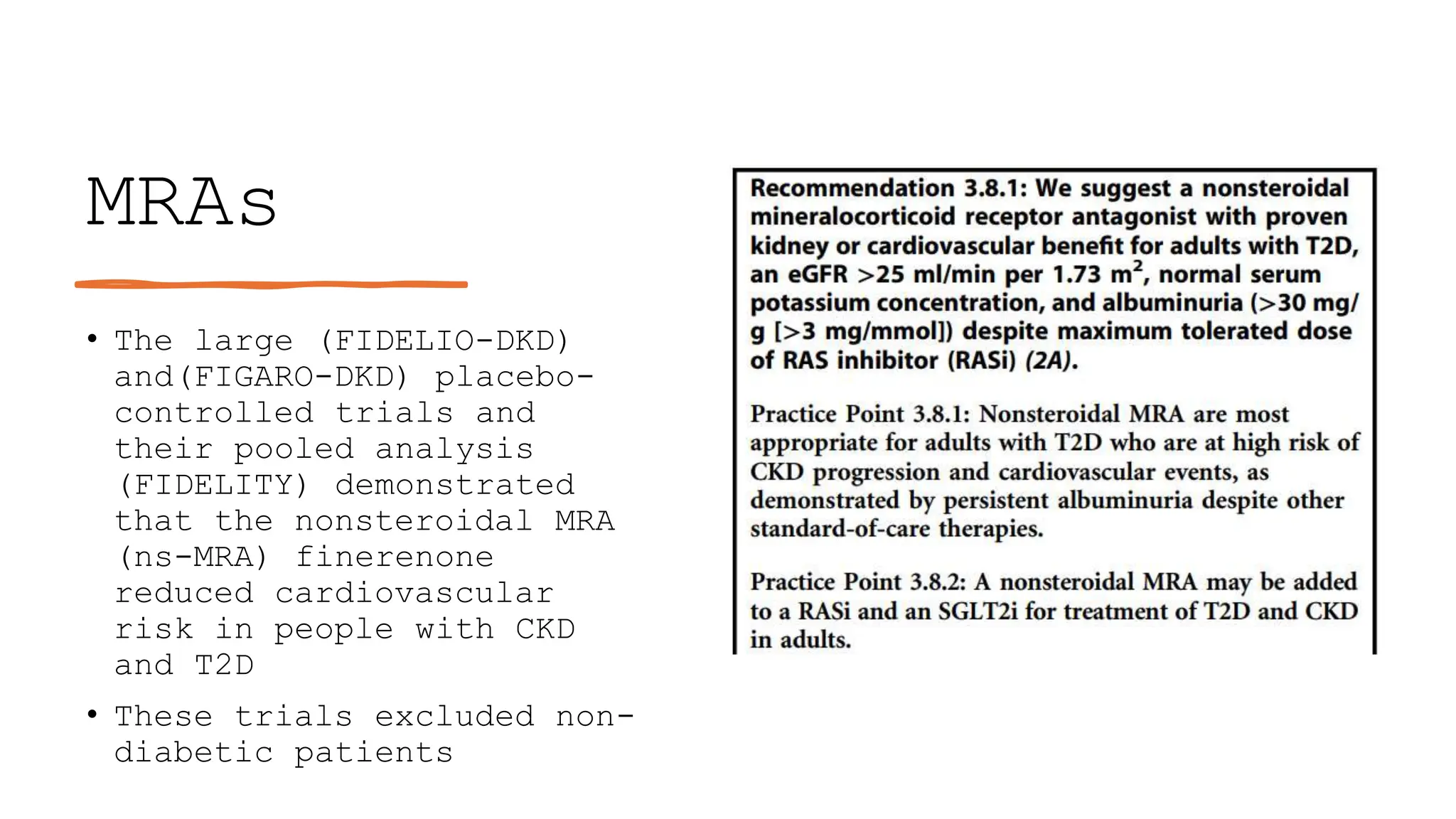
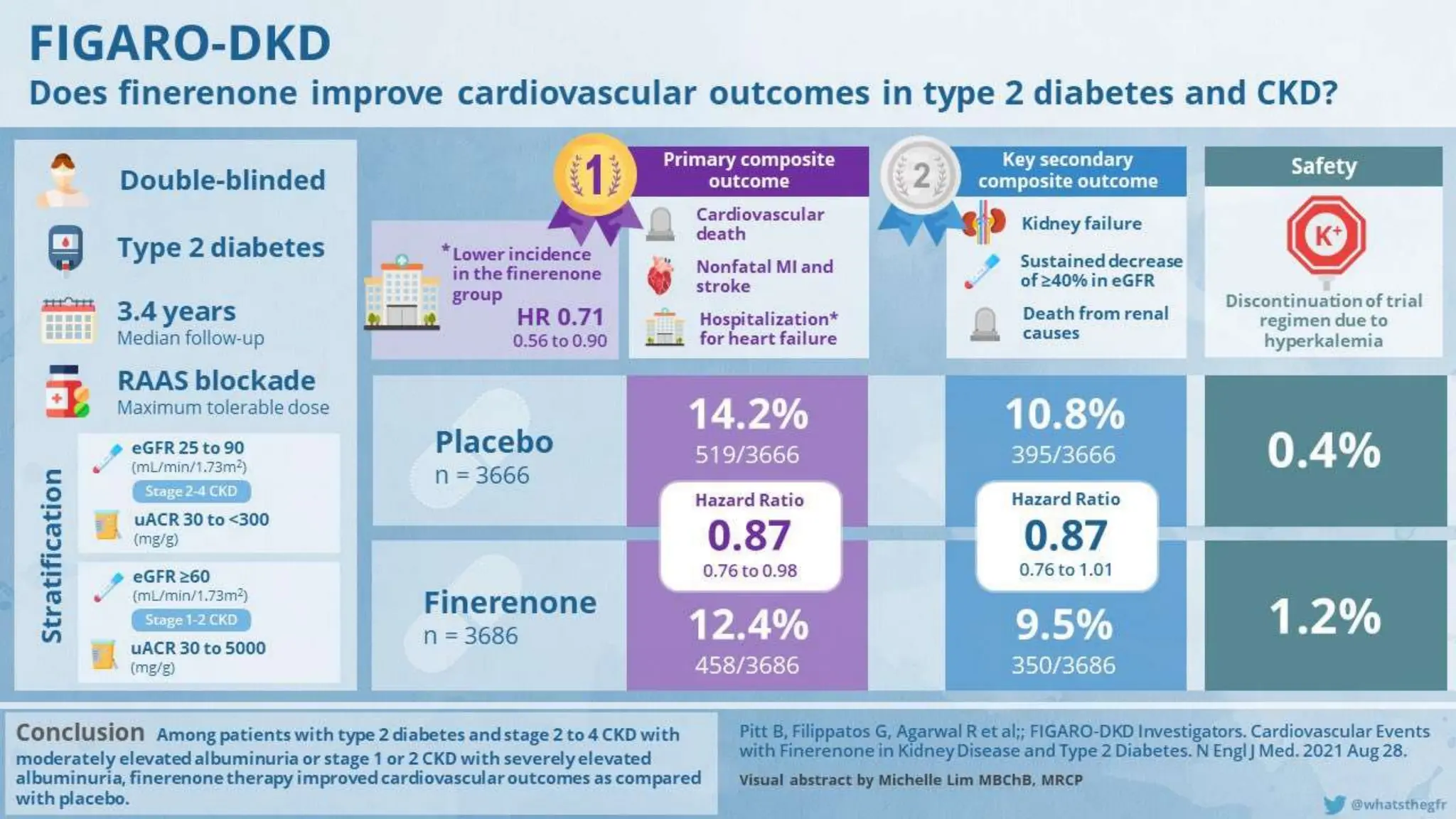
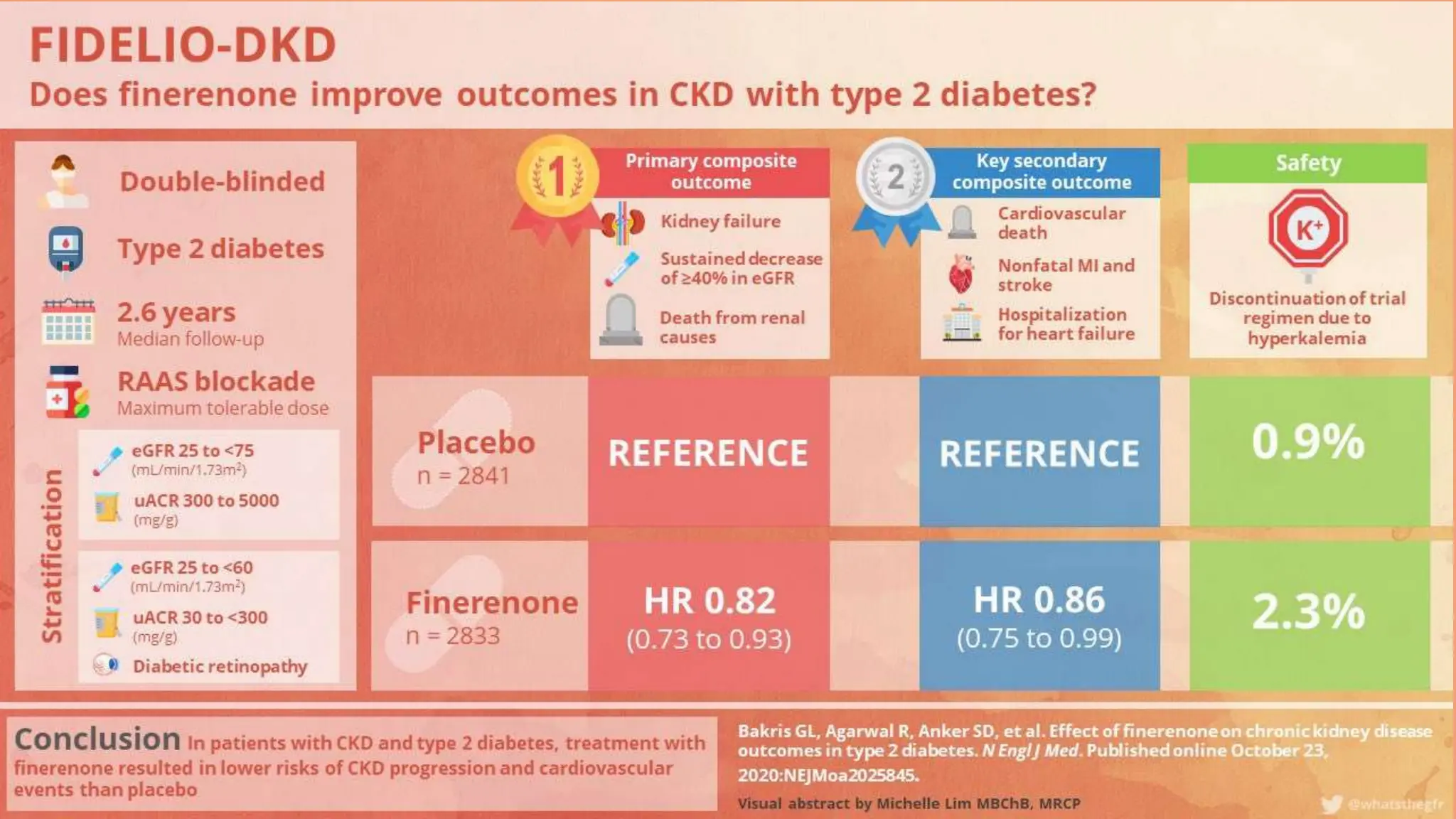
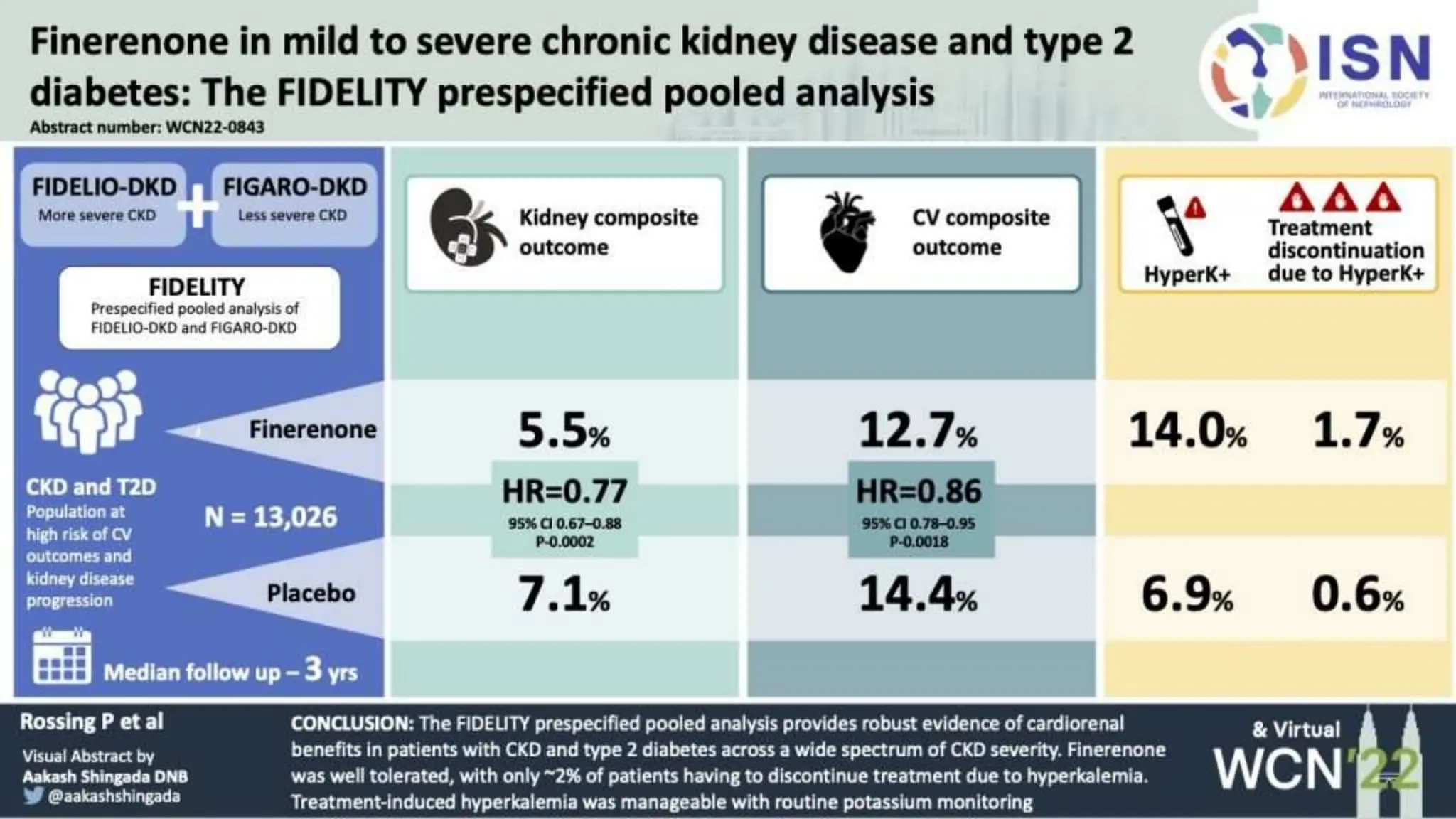
• The large (FIDELIO-DKD)
and(FIGARO-DKD) placebo-
controlled trials and
their pooled analysis
(FIDELITY) demonstrated
that the nonsteroidal MRA
(ns-MRA) finerenone
reduced cardiovascular
risk in people with CKD
and T2D
• These trials excluded non-
diabetic patients
Glucagon-like peptide-1 receptor
agonists
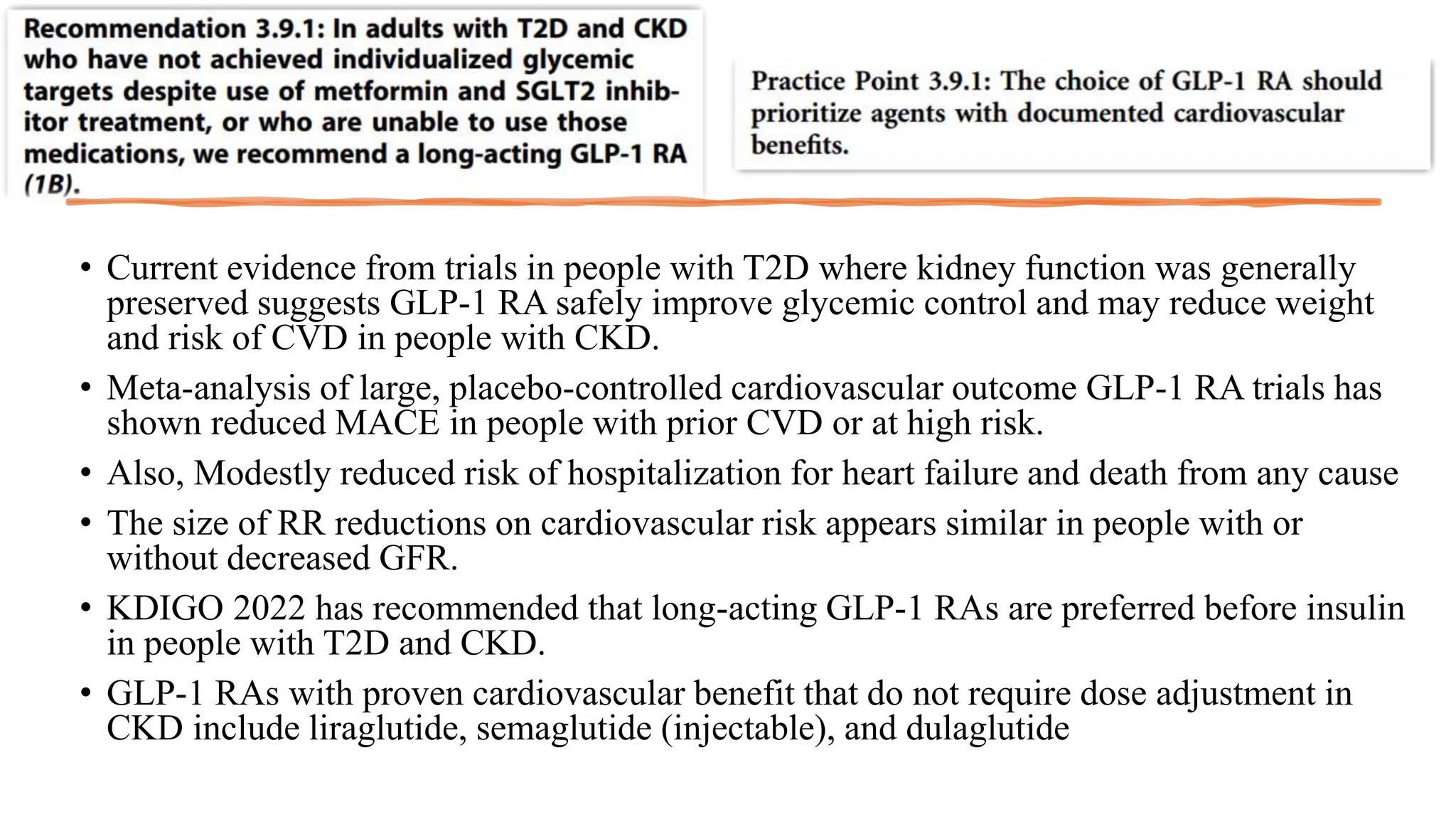
• Current evidence from trials in people with T2D where kidney function was generally
preserved suggests GLP-1 RA safely improve glycemic control and may reduce weight
and risk of CVD in people with CKD.
• Meta-analysis of large, placebo-controlled cardiovascular outcome GLP-1 RA trials has
shown reduced MACE in people with prior CVD or at high risk.
• Also, Modestly reduced risk of hospitalization for heart failure and death from any cause
• The size of RR reductions on cardiovascular risk appears similar in people with or
without decreased GFR.
• KDIGO 2022 has recommended that long-acting GLP-1 RAs are preferred before insulin
in people with T2D and CKD.
• GLP-1 RAs with proven cardiovascular benefit that do not require dose adjustment in
CKD include liraglutide, semaglutide (injectable), and dulaglutide
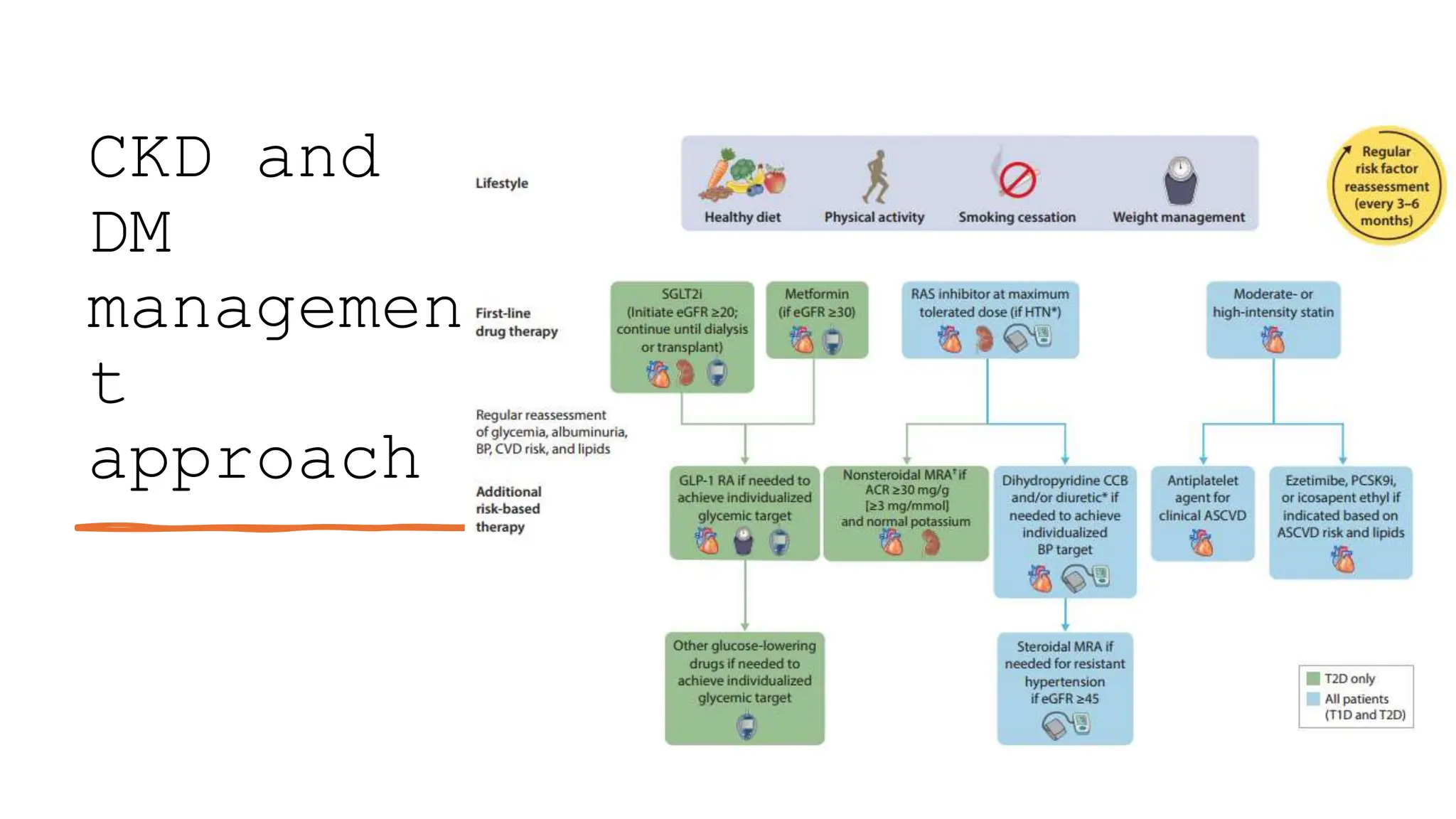
CKD and
DM
managemen
t
approach
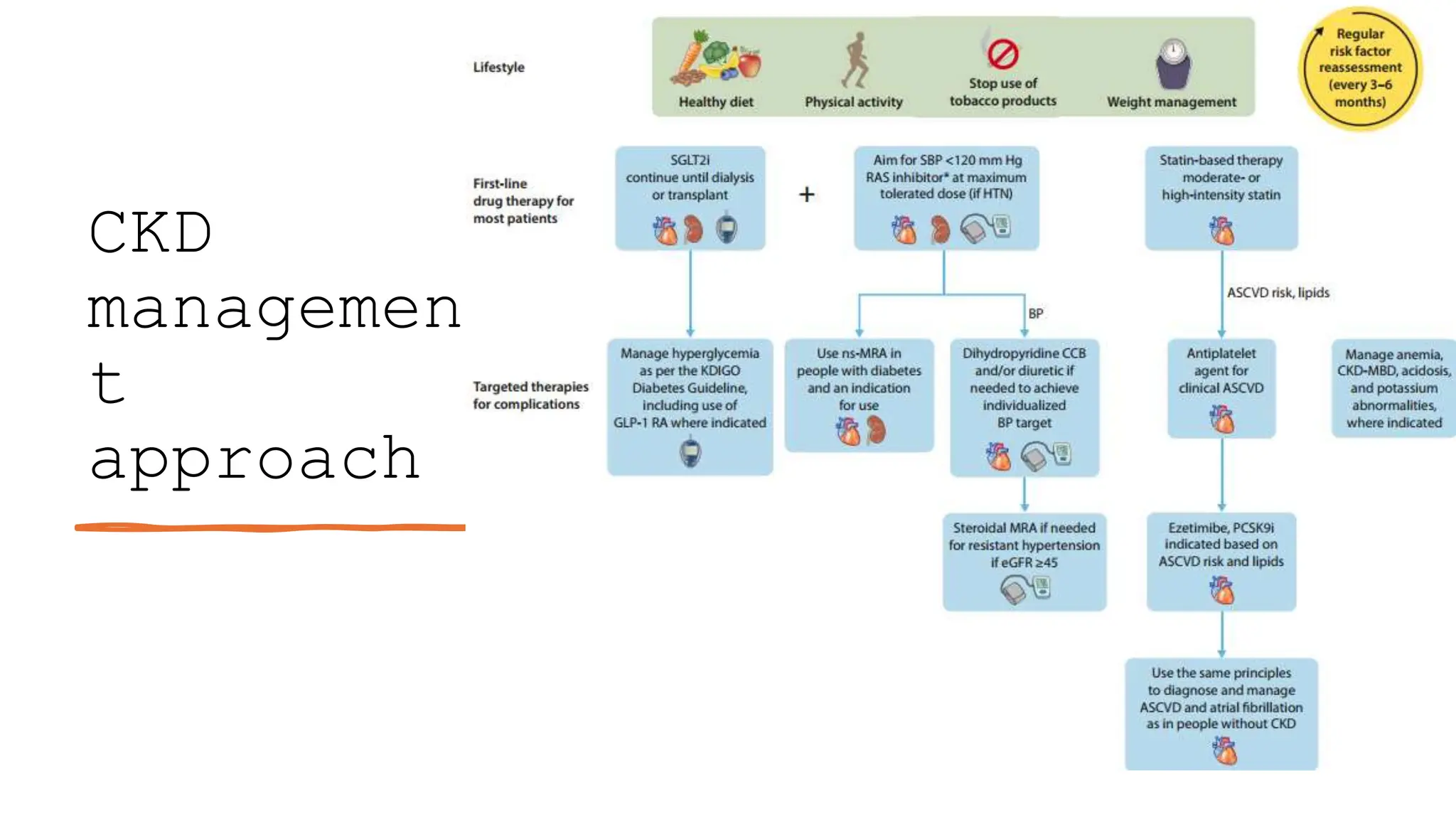
CKD
managemen
t
approach
KDIGO 2024 guidelines for diabetologists

KDIGO 2024 guidelines for diabetologists

  • 1.
    KDIGO 2024 What isthere for diabetologist / endocrinologist? Dr. Mahmoud Naguib
  • 2.
    Introduc tion • The wordKDIGO stands for “Kidney Disease: Improving Global Outcomes” • KDIGO is the global nonprofit organization that aims at Improving the care and outcomes of patients with kidney disease worldwide through developing and implementing evidence-based clinical practice guidelines in kidney disease. • KDIGO guidelines focus on topics related to the prevention or management of individuals with kidney diseases. • This year 2024, KDIGO released new guidelines for the Evaluation and Management of Chronic Kidney Disease.
  • 5.
    CKD and DM •CKD is one of the most important causes of morbidity and mortality globally. • DM is the most common cause of CKD worldwide. • A systematic review suggested that screening for CKD is cost- effective in people with diabetes and hypertension. • Early diagnosis and slowing CKD progression at early stages should provide economic benefits and prevent the development of kidney failure and cardiovascular complications.
  • 6.
  • 7.
  • 8.
  • 10.
  • 11.
    Despite use ofRAS blockers, substantial residual risk for DKD progression persisted, as the rate of decline with RAS blockers was estimated to be between 4 and 6 mL/min/year and the normal annual decline is approximately 0.7–0.9 mL/min/year. Thus, additional therapies were needed. In 2014, the discovery of sodium–glucose cotransporter 2 (SGLT2) inhibitors provided hope that DKD progression could be further slowed. This has clearly been shown in multiple outcomes trials. Around the same time, trials were started on a novel class of agents, (NS-MRAs), specifically finerenone which also slowed DKD. We now have two evidence-based medications, which, when combined with RAS inhibition, are proven to slow DKD progression to approximately 2.5–3 mL/min/year, provided blood pressure and glucose levels are at guideline goals.
  • 12.
  • 13.
  • 14.
    SGLT2i benefits • These recommendationswere based on Several large, placebo-controlled RCTs that showed the efficacy of SGLT2i which: Greatly reduce the risk of kidney failure, AKI, and hospitalization for heart failure, Moderately reduce the risk of cardiovascular death and myocardial infarction in people with and without CKD. These benefits appear to be irrespective of diabetes status, cause of kidney disease, or level of GFR
  • 15.
    SGLT2i benefits • Two largeRCTs (EMPA-KIDNEY) & (DAPA-CKD) using 2 different SGLT2i recruited 10,913 participants and focused on CKD populations at risk of progression, reporting benefits in terms of kidney disease progression and cardiovascular mortality.
  • 18.
    SGLT2i benefits • In acollaborative metanalysis including those 2 and 11 other trials (13 trials with just over 90,000 randomized participants) in comparison with placebo, those allocated to an SGLT2i experienced: 37% reduction in the risk of kidney disease progression 23% reduction in the risk of AKI irrespective of diabetes status. Reduced risk of the composite of cardiovascular death or hospitalization for heart failure by 23% irrespective of diabetes status. 10% RR reduction in MACE (Major adverse cardiovascular events). Reduced risk of hospitalization from any cause, reduced BP, uric acid levels, weight/fluid overload, the risk of serious hyperkalemia.
  • 20.
    Rate of GFRdecline
  • 22.
    SGLT2i harms • SGLT2i arewell tolerated with high levels of adherence in the RCTs in CKD. • In the studied populations, any risk of ketoacidosis or lower-limb amputation resulting from SGLT2i use was substantially lower than the potential absolute benefits and generally restricted to people with diabetes.
  • 23.
    SGLT2i harms • The vastmajority of urinary tract infections in people taking SGLT2i are not caused by SGLT2 inhibition. • There is no increased risk of hypoglycemia. • There is an increased risk of mycotic genital infections (in men and women), but these are generally mild and can be treated with low-cost topical agents.
  • 24.
    SGLT2i benefits vs harms • Meta-analysisestimates of absolute benefits and harms: For each 1000 people with CKD and T2D treated for 1 year with an SGLT2i were: 11 fewer cardiovascular deaths or hospitalizations for heart failure, 11 fewer people developing kidney disease progression and 4 fewer people with AKI for approximately 1 episode of ketoacidosis and approximately 1 lower-limb amputation. For each 1000 people with CKD without DM treated for 1 year with an SGLT2i 15 fewer people with kidney disease progression, 5 fewer with AKI, and 2 fewer cardiovascular deaths or hospitalizations for heart failure with no excess risk of ketoacidosis or amputation observed
  • 25.
  • 26.
    SGLT2i • The WorkGroup judged that fully informed adults without diabetes and low levels of albuminuria (urine ACR <200 mg/g [<20 mg/mmol]) who have established CKD and an eGFR of 20–45 ml/min per 1.73 m2 may be particularly motivated to take SGLT2i for the benefits identified on rate of decline in GFR • Evidence for benefits on CKD progression in people without diabetes and with low levels of albuminuria is limited to eGFR slope analyses in heart failure trials and one CKD trial all with relatively short follow-up periods. However, extrapolation of these eGFR slope results suggests that important benefits would arise for such people if treated long term and the initiation of RRT can be delayed.
  • 29.
  • 30.
  • 31.
    MRAs • The large(FIDELIO-DKD) and(FIGARO-DKD) placebo- controlled trials and their pooled analysis (FIDELITY) demonstrated that the nonsteroidal MRA (ns-MRA) finerenone reduced cardiovascular risk in people with CKD and T2D • These trials excluded non- diabetic patients
  • 36.
  • 37.
    • Current evidencefrom trials in people with T2D where kidney function was generally preserved suggests GLP-1 RA safely improve glycemic control and may reduce weight and risk of CVD in people with CKD. • Meta-analysis of large, placebo-controlled cardiovascular outcome GLP-1 RA trials has shown reduced MACE in people with prior CVD or at high risk. • Also, Modestly reduced risk of hospitalization for heart failure and death from any cause • The size of RR reductions on cardiovascular risk appears similar in people with or without decreased GFR. • KDIGO 2022 has recommended that long-acting GLP-1 RAs are preferred before insulin in people with T2D and CKD. • GLP-1 RAs with proven cardiovascular benefit that do not require dose adjustment in CKD include liraglutide, semaglutide (injectable), and dulaglutide
  • 38.
  • 39.