Hypophosphatemic
Rickets
BY: AGBONKHESE EGHONGHON SARAH
6TH Course Grodno State Medical University
INTRODUCTION
 Hypophosphatemic rickets is a form of rickets that is characterized by low
serum phosphate levels and resistance to treatment with ultraviolet
radiation or vitamin D ingestion
 Since the early 20th century, ultraviolet radiation or vitamin D ingestion
has been recognized as a cure for nutritional rickets,but certain forms of
rachitic disease have remained refractory to this therapy. Study of these
cases revealed low serum phosphate concentration as a common factor.
Familial occurrence of this condition led to the diagnosis of familial
hypophosphatemic rickets(X-linked hypophosphatemic rickets). Treatment
with even high doses of vitamin D produced no change in the state of
these patients,leading to the term vitamin D ̶ resistant rickets.
X-linked hypophosphatemia (XLH)
 X-linked hypophosphatemia (XLH) is a dominant disorder and accounts for
more than 80% of all familial hypophosphatemia. XLH is considered to be a
systemic disorder, from mutation of the phosphate-regulating gene
homologous to endopeptidases on the X chromosome
(PHEX). PHEX stimulates fibroblast growth factor-23 (FGF-23), expressed in
bone. FGF-23 requires heparin and Klotho for binding to the proximal
tubule to stimulate phosphaturia. Circulating FGF-23 concentrations have
been shown to be 5 times higher in XLH patients, resulting in significant
phosphaturia. Finally, XLH patients demonstrate a normal or low serum
concentration of 1,25-dihydroxyvitamin D3, suggestive of inadequate
formation of this vitamin D metabolite.
Autosomal dominant hypophosphatemic
 The remaining 20% of familial
hypophosphatemia patients have
autosomal dominant
hypophosphatemic rickets from
gain-of-function autosomal
recessive hypophosphatemic
rickets and hereditary
hypophosphatemic rickets with
hypercalciuria.
Clinical Signs
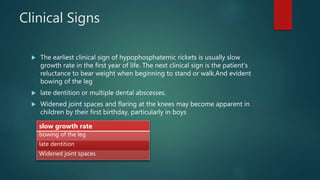
 The earliest clinical sign of hypophosphatemic rickets is usually slow
growth rate in the first year of life. The next clinical sign is the patient's
reluctance to bear weight when beginning to stand or walk.And evident
bowing of the leg
 late dentition or multiple dental abscesses.
 Widened joint spaces and flaring at the knees may become apparent in
children by their first birthday, particularly in boys
slow growth rate
bowing of the leg
late dentition
Widened joint spaces
Differential Diagnoses
 Renal tubular acidosis
 Hereditary hypophosphatemic rickets with hypocalciuria
 Fanconi syndrome (types I and II)
 Vitamin D ̶ dependent rickets (types I and II)
 Vitamin D ̶ deficient rickets
 Pseudohypoparathyroidism
 Cystinosis
 Tyrosinemia
Diagnoses
Laboratory Parameters
• Focus on serum calcium, phosphate, and alkaline phosphatase levels
• Increased alkaline phosphatase levels
• Carefully evaluate serum phosphate levels in the first year of life, because
the concentration reference range for infants (5.0-7.5 mg/dL) is high
compared with that for adults (2.7-4.5 mg/dL). Hypophosphatemia can
easily be missed in a baby.
• Increased or normal Serum parathyroid hormone levels
• Decreased or normal calcitriol levels
URINE ANALYSIS; Increased phosphate level
Diagnoses
Imaging studies;
• Radiography of the wrists, knees, ankles, and long bones shows no
pathognomonic sign.
• MRI reveals maximum physial widening and transverse degree of
widening—that correlate with alkaline phosphatase levels.
Renal Tubular Phosphate Reabsorption;To evaluate percentage of
phosphate reabsorbed.
Phosphate Clearance (CPi) / Creatinine Clearance (Ccr)] X 100%
Cpi=[Urine Phosphate (mg/dL) X Volume (mL/min)] / Plasma Phosphate
(mg/dL)
normal TRP >90%
TRP in XLH is 60%;
Management
Burosumab;
A monoclonal IgG1 antibody that binds excess fibroblast growth factor 23
(FGF23). This action normalizes phosphorus levels, improves bone
mineralization, improves rickets in children, and helps to heal fractures in
adults
 <1 year: Safety and efficacy not established
 ≥1 year: 0.8 mg/kg SC q2Weeks; round dose to nearest 10 mg
 Minimum weight-based starting dose is 10 mg up to a maximum dose of
90 mg
Management
1,25-dihydroxy-vitamin D (calcitriol).
• The use of calcitriol is to diminishes the danger of hypercalcemia.
• Initial: 0.015-0.02 mcg/kg PO qDay
• Maintenance: 0.03-0.06 mcg/kg PO qDay
• No more than 2 mcg PO qDay
Phosphate replacement;potassium phosphate/sodium acid
phosphate (Rx)
Surgical care
Osteotomy to realign
extremely distorted leg
curvatures may be necessary
for children whose diagnosis
was delayed or whose initial
treatment was inadequate.
Skull deformity may require
treatment for
synostosis. Spontaneous
abscesses often require
periodic dental procedures.
REFERENCES
 https://emedicine.medscape.com/article/922305-overview
Hypophosphatemic rickets

Hypophosphatemic rickets

  • 1.
    Hypophosphatemic Rickets BY: AGBONKHESE EGHONGHONSARAH 6TH Course Grodno State Medical University
  • 2.
    INTRODUCTION  Hypophosphatemic ricketsis a form of rickets that is characterized by low serum phosphate levels and resistance to treatment with ultraviolet radiation or vitamin D ingestion  Since the early 20th century, ultraviolet radiation or vitamin D ingestion has been recognized as a cure for nutritional rickets,but certain forms of rachitic disease have remained refractory to this therapy. Study of these cases revealed low serum phosphate concentration as a common factor. Familial occurrence of this condition led to the diagnosis of familial hypophosphatemic rickets(X-linked hypophosphatemic rickets). Treatment with even high doses of vitamin D produced no change in the state of these patients,leading to the term vitamin D ̶ resistant rickets.
  • 4.
    X-linked hypophosphatemia (XLH) X-linked hypophosphatemia (XLH) is a dominant disorder and accounts for more than 80% of all familial hypophosphatemia. XLH is considered to be a systemic disorder, from mutation of the phosphate-regulating gene homologous to endopeptidases on the X chromosome (PHEX). PHEX stimulates fibroblast growth factor-23 (FGF-23), expressed in bone. FGF-23 requires heparin and Klotho for binding to the proximal tubule to stimulate phosphaturia. Circulating FGF-23 concentrations have been shown to be 5 times higher in XLH patients, resulting in significant phosphaturia. Finally, XLH patients demonstrate a normal or low serum concentration of 1,25-dihydroxyvitamin D3, suggestive of inadequate formation of this vitamin D metabolite.
  • 5.
    Autosomal dominant hypophosphatemic The remaining 20% of familial hypophosphatemia patients have autosomal dominant hypophosphatemic rickets from gain-of-function autosomal recessive hypophosphatemic rickets and hereditary hypophosphatemic rickets with hypercalciuria.
  • 6.
    Clinical Signs  Theearliest clinical sign of hypophosphatemic rickets is usually slow growth rate in the first year of life. The next clinical sign is the patient's reluctance to bear weight when beginning to stand or walk.And evident bowing of the leg  late dentition or multiple dental abscesses.  Widened joint spaces and flaring at the knees may become apparent in children by their first birthday, particularly in boys slow growth rate bowing of the leg late dentition Widened joint spaces
  • 7.
    Differential Diagnoses  Renaltubular acidosis  Hereditary hypophosphatemic rickets with hypocalciuria  Fanconi syndrome (types I and II)  Vitamin D ̶ dependent rickets (types I and II)  Vitamin D ̶ deficient rickets  Pseudohypoparathyroidism  Cystinosis  Tyrosinemia
  • 8.
    Diagnoses Laboratory Parameters • Focuson serum calcium, phosphate, and alkaline phosphatase levels • Increased alkaline phosphatase levels • Carefully evaluate serum phosphate levels in the first year of life, because the concentration reference range for infants (5.0-7.5 mg/dL) is high compared with that for adults (2.7-4.5 mg/dL). Hypophosphatemia can easily be missed in a baby. • Increased or normal Serum parathyroid hormone levels • Decreased or normal calcitriol levels URINE ANALYSIS; Increased phosphate level
  • 9.
    Diagnoses Imaging studies; • Radiographyof the wrists, knees, ankles, and long bones shows no pathognomonic sign. • MRI reveals maximum physial widening and transverse degree of widening—that correlate with alkaline phosphatase levels. Renal Tubular Phosphate Reabsorption;To evaluate percentage of phosphate reabsorbed. Phosphate Clearance (CPi) / Creatinine Clearance (Ccr)] X 100% Cpi=[Urine Phosphate (mg/dL) X Volume (mL/min)] / Plasma Phosphate (mg/dL) normal TRP >90% TRP in XLH is 60%;
  • 10.
    Management Burosumab; A monoclonal IgG1antibody that binds excess fibroblast growth factor 23 (FGF23). This action normalizes phosphorus levels, improves bone mineralization, improves rickets in children, and helps to heal fractures in adults  <1 year: Safety and efficacy not established  ≥1 year: 0.8 mg/kg SC q2Weeks; round dose to nearest 10 mg  Minimum weight-based starting dose is 10 mg up to a maximum dose of 90 mg
  • 11.
    Management 1,25-dihydroxy-vitamin D (calcitriol). •The use of calcitriol is to diminishes the danger of hypercalcemia. • Initial: 0.015-0.02 mcg/kg PO qDay • Maintenance: 0.03-0.06 mcg/kg PO qDay • No more than 2 mcg PO qDay Phosphate replacement;potassium phosphate/sodium acid phosphate (Rx)
  • 12.
    Surgical care Osteotomy torealign extremely distorted leg curvatures may be necessary for children whose diagnosis was delayed or whose initial treatment was inadequate. Skull deformity may require treatment for synostosis. Spontaneous abscesses often require periodic dental procedures.
  • 13.