Retinal detachment
Introduction
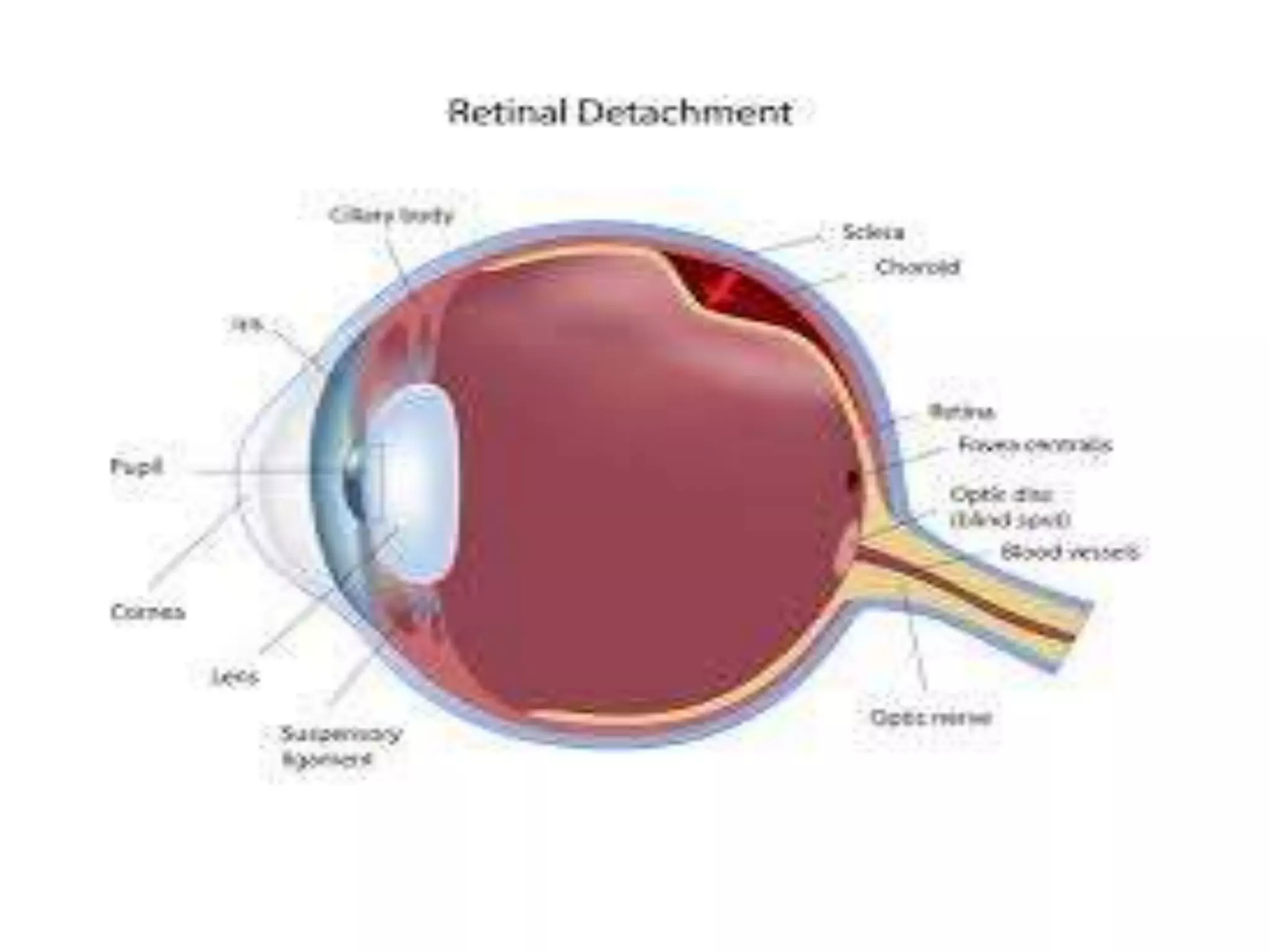
• Retinal detachment is a disorder of the eye in
which the retina separates from the layer
underneath. Symptoms include an increase in the
number of floaters, flashes of light, and
worsening of the outer part of the visual
field. This may be described as a curtain over part
of the field of vision. Without treatment
permanent loss of vision may occur.
• The mechanism most commonly involves a break in the
retina that then allows the fluid in the eye to get
behind the retina. A break in the retina can occur from
a posterior vitreous detachment, injury to the eye, or
inflammation of the eye. Other risk factors include
being short sighted and previous cataract surgery.
Retinal detachments also rarely occur due to achoroidal
tumor. Diagnosis is by either looking at the back of the
eye with an ophthalmoscope or by ultrasound
Epidemiology
• The incidence of retinal detachment in otherwise normal eyes is
around 5 new cases in 100,000 persons per year. Detachment is
more frequent in middle-aged or elderly populations, with rates of
around 20 in 100,000 per year. The lifetime risk in normal
individuals is about 1 in 300. Asymptomatic retinal breaks are
present in about 6% of eyes in both clinical and autopsy studies.
• Retinal detachment is more common in people with
severe myopia, in whom the retina is more thinly stretched. In
such patients, lifetime risk rises to 1 in 20.
• Retinal detachment is more frequent after surgery for cataracts.
Contd…
• Although retinal detachment usually occurs
in just one eye, there is a 15% chance of it
developing in the other eye, and this risk
increases to 25–30% in patients who have
had a retinal detachment and cataracts
extracted from both eyes.
Risk factors
• Severe myopia,
• Retinal tears,
• Trauma,
• Family history,
• Complications from cataract surgery.
• Injury
• Advanced diabetes
• Activities that increase intra ocular pressure
can cause retinal detachment:
• High-impact sports or in high speed sports.
• Diving and skydiving
• As bungee jumping or roller coaster rides.
• Valsalva maneuver
• Weightlifting
• Aging — retinal detachment is more common in
people over age 50
• Previous retinal detachment in one eye
• A family history of retinal detachment
• Extreme nearsightedness (myopia)
• Previous eye surgery, such as cataract removal
• Previous severe eye injury
• Previous other eye disease or inflammation
Genetic factors promoting local inflammation
and photoreceptor degeneration may also be involved in the development of
the disease.
Glaucoma
AIDS
Cataract surgery
Diabetic retinopathy
Eclampsia
Family history of retinal
detachment
Homocysteinuria
Malignant hypertension
Metastatic cancer, which
spreads to the eye (eye
cancer)
Retinoblastoma
Severe myopia
Smoking and passive
smoking
Stickler syndrome
Von Hippel-Lindau disease
Signs and symptoms
• A rhegmatogenous retinal detachment is commonly
preceded by a posterior vitreous detachment which
gives rise to these symptoms:
 flashes of light (photopsia) – very brief in the
extreme peripheral (outside of center) part of vision
 a sudden dramatic increase in the number
of floaters
 a ring of floaters or hairs just to the temporal (skull)
side of the central vision
• Bright flashes of light, especially
in peripheral vision
• Blurred vision
• Floaters in the eye
• Shadow or blindness in a part of the visual
field of one eye
Diagnosis
• Retinal detachment can be examined by:
 Ultrasound.
 Fluorescein Angiography
 Tonometry
 Ophthalmoscopy
 Refraction Test
 Color Vision Test
 Visual Acuity
 Slit-lamp Examination
Types
 RHEGMATOGENOUS RETINAL DETACHMENT –
• A rhegmatogenous retinal detachment occurs due to a break in the
retina (called a retinal tear) that allows fluid to pass from the
vitreous space into the subretinal space between the sensory retina
and the retinal pigment epithelium. Retinal breaks are divided into
three types – holes, tears and dialyses. Holes form due to retinal
atrophy especially within an area of lattice degeneration. Tears are
due to vitreoretinal traction. Dialyses are very peripheral and
circumferential, and may be either tractional or atrophic. The
atrophic form most often occurs as idiopathic dialysis of the young.
 Exudative, serous, or secondary retinal detachment –
• An exudative retinal detachment occurs due to
inflammation, injury or vascular abnormalities that results in
fluid accumulating underneath the retina without the
presence of a hole, tear, or break.
• Although rare, exudative detachment can be caused by the
growth of a tumor on the layers of tissue beneath the retina,
namely the choroid. This cancer is called a choroidal
melanoma.
Tractional Retinal Detachment –
• A tractional retinal detachment occurs when
fibrous or fibrovascular tissue, caused by an
injury, inflammation or neovascularization,
pulls the sensory retina from the retinal
pigment epithelium
Treatment
• There are several methods of treating a
detached retina, each of which depends on
finding and closing the breaks that have
formed in the retina.
Cryopexy and Laser Photocoagulation
• Cryotherapy (freezing) or laser
photocoagulation are occasionally used alone
to wall off a small area of retinal detachment
so that the detachment does not spread.
 Scleral Buckle Surgery
• Scleral buckle surgery is an established treatment in which the
eye surgeon sews one or more silicone bands to the sclera. The
bands push the wall of the eye inward against the retinal hole,
closing the break or reducing fluid flow through it and reducing
the effect of vitreous traction thereby allowing the retina to re-
attach.
• Cryotherapy (freezing) is applied around retinal breaks prior to
placing the buckle. Often subretinal fluid is drained as part of
the buckling procedure. The buckle remains in situ.
 Pneumatic Retinopexy
• This operation is generally performed in the doctor's office
under local anesthesia. It is another method of repairing a
retinal detachment in which a gas bubble is injected into the
eye after which laser or freezing treatment is applied to the
retinal hole. The patient's head is then positioned so that the
bubble rests against the retinal hole. Patients may have to
keep their heads tilted for several days to keep the gas bubble
in contact with the retinal hole.
 Vitrectomy
• Vitrectomy is an increasingly used treatment for retinal detachment.
It involves the removal of the vitreous gel and is usually combined
with filling the eye with either a gas bubble or silicone oil (PDMS).
An advantage of using gas in this operation is that there is no myopic
shift after the operation and gas is absorbed within a few weeks.
PDMS, if used, needs to be removed after a period of 2–8 months
depending on surgeon's preference. A disadvantage is that a
vitrectomy always leads to more rapid progression of a cataract in
the operated eye.
Prognosis
• 85 percent of cases will be successfully treated with one
operation with the remaining 15 percent requiring 2 or more
operations.
• After treatment patients gradually regain their vision over a
period of a few weeks, although the visual acuity may not be
as good as it was prior to the detachment, particularly if
the macula was involved in the area of the detachment.
• Currently, about 95 percent of cases of retinal
detachment can be repaired successfully. Treatment
failures usually involve either the failure to
recognize all sites of detachment, the formation of
new retinal breaks, or proliferative
vitreoretinopathy.
Prognosis
Prevention
• Use protective eye wear to prevent eye
trauma.
• Control of blood sugar in diabetic patients.
• Frequent visits to eye specialist.
Summary
• Introduction
• Epidemiology
• Risk factors
• Signs and symptoms
• Diagnosis
• Types
• Treatment
• Prognosis
• Prevention
Thank you

Retinal detachment

  • 1.
  • 3.
    Introduction • Retinal detachmentis a disorder of the eye in which the retina separates from the layer underneath. Symptoms include an increase in the number of floaters, flashes of light, and worsening of the outer part of the visual field. This may be described as a curtain over part of the field of vision. Without treatment permanent loss of vision may occur.
  • 4.
    • The mechanismmost commonly involves a break in the retina that then allows the fluid in the eye to get behind the retina. A break in the retina can occur from a posterior vitreous detachment, injury to the eye, or inflammation of the eye. Other risk factors include being short sighted and previous cataract surgery. Retinal detachments also rarely occur due to achoroidal tumor. Diagnosis is by either looking at the back of the eye with an ophthalmoscope or by ultrasound
  • 5.
    Epidemiology • The incidenceof retinal detachment in otherwise normal eyes is around 5 new cases in 100,000 persons per year. Detachment is more frequent in middle-aged or elderly populations, with rates of around 20 in 100,000 per year. The lifetime risk in normal individuals is about 1 in 300. Asymptomatic retinal breaks are present in about 6% of eyes in both clinical and autopsy studies. • Retinal detachment is more common in people with severe myopia, in whom the retina is more thinly stretched. In such patients, lifetime risk rises to 1 in 20. • Retinal detachment is more frequent after surgery for cataracts.
  • 6.
    Contd… • Although retinaldetachment usually occurs in just one eye, there is a 15% chance of it developing in the other eye, and this risk increases to 25–30% in patients who have had a retinal detachment and cataracts extracted from both eyes.
  • 7.
    Risk factors • Severemyopia, • Retinal tears, • Trauma, • Family history, • Complications from cataract surgery. • Injury • Advanced diabetes
  • 8.
    • Activities thatincrease intra ocular pressure can cause retinal detachment: • High-impact sports or in high speed sports. • Diving and skydiving • As bungee jumping or roller coaster rides. • Valsalva maneuver • Weightlifting
  • 9.
    • Aging —retinal detachment is more common in people over age 50 • Previous retinal detachment in one eye • A family history of retinal detachment • Extreme nearsightedness (myopia) • Previous eye surgery, such as cataract removal • Previous severe eye injury • Previous other eye disease or inflammation
  • 10.
    Genetic factors promotinglocal inflammation and photoreceptor degeneration may also be involved in the development of the disease. Glaucoma AIDS Cataract surgery Diabetic retinopathy Eclampsia Family history of retinal detachment Homocysteinuria Malignant hypertension Metastatic cancer, which spreads to the eye (eye cancer) Retinoblastoma Severe myopia Smoking and passive smoking Stickler syndrome Von Hippel-Lindau disease
  • 11.
    Signs and symptoms •A rhegmatogenous retinal detachment is commonly preceded by a posterior vitreous detachment which gives rise to these symptoms:  flashes of light (photopsia) – very brief in the extreme peripheral (outside of center) part of vision  a sudden dramatic increase in the number of floaters  a ring of floaters or hairs just to the temporal (skull) side of the central vision
  • 12.
    • Bright flashesof light, especially in peripheral vision • Blurred vision • Floaters in the eye • Shadow or blindness in a part of the visual field of one eye
  • 13.
    Diagnosis • Retinal detachmentcan be examined by:  Ultrasound.  Fluorescein Angiography  Tonometry  Ophthalmoscopy  Refraction Test  Color Vision Test  Visual Acuity  Slit-lamp Examination
  • 14.
    Types  RHEGMATOGENOUS RETINALDETACHMENT – • A rhegmatogenous retinal detachment occurs due to a break in the retina (called a retinal tear) that allows fluid to pass from the vitreous space into the subretinal space between the sensory retina and the retinal pigment epithelium. Retinal breaks are divided into three types – holes, tears and dialyses. Holes form due to retinal atrophy especially within an area of lattice degeneration. Tears are due to vitreoretinal traction. Dialyses are very peripheral and circumferential, and may be either tractional or atrophic. The atrophic form most often occurs as idiopathic dialysis of the young.
  • 15.
     Exudative, serous,or secondary retinal detachment – • An exudative retinal detachment occurs due to inflammation, injury or vascular abnormalities that results in fluid accumulating underneath the retina without the presence of a hole, tear, or break. • Although rare, exudative detachment can be caused by the growth of a tumor on the layers of tissue beneath the retina, namely the choroid. This cancer is called a choroidal melanoma.
  • 16.
    Tractional Retinal Detachment– • A tractional retinal detachment occurs when fibrous or fibrovascular tissue, caused by an injury, inflammation or neovascularization, pulls the sensory retina from the retinal pigment epithelium
  • 18.
    Treatment • There areseveral methods of treating a detached retina, each of which depends on finding and closing the breaks that have formed in the retina.
  • 19.
    Cryopexy and LaserPhotocoagulation • Cryotherapy (freezing) or laser photocoagulation are occasionally used alone to wall off a small area of retinal detachment so that the detachment does not spread.
  • 21.
     Scleral BuckleSurgery • Scleral buckle surgery is an established treatment in which the eye surgeon sews one or more silicone bands to the sclera. The bands push the wall of the eye inward against the retinal hole, closing the break or reducing fluid flow through it and reducing the effect of vitreous traction thereby allowing the retina to re- attach. • Cryotherapy (freezing) is applied around retinal breaks prior to placing the buckle. Often subretinal fluid is drained as part of the buckling procedure. The buckle remains in situ.
  • 23.
     Pneumatic Retinopexy •This operation is generally performed in the doctor's office under local anesthesia. It is another method of repairing a retinal detachment in which a gas bubble is injected into the eye after which laser or freezing treatment is applied to the retinal hole. The patient's head is then positioned so that the bubble rests against the retinal hole. Patients may have to keep their heads tilted for several days to keep the gas bubble in contact with the retinal hole.
  • 24.
     Vitrectomy • Vitrectomyis an increasingly used treatment for retinal detachment. It involves the removal of the vitreous gel and is usually combined with filling the eye with either a gas bubble or silicone oil (PDMS). An advantage of using gas in this operation is that there is no myopic shift after the operation and gas is absorbed within a few weeks. PDMS, if used, needs to be removed after a period of 2–8 months depending on surgeon's preference. A disadvantage is that a vitrectomy always leads to more rapid progression of a cataract in the operated eye.
  • 25.
    Prognosis • 85 percentof cases will be successfully treated with one operation with the remaining 15 percent requiring 2 or more operations. • After treatment patients gradually regain their vision over a period of a few weeks, although the visual acuity may not be as good as it was prior to the detachment, particularly if the macula was involved in the area of the detachment.
  • 26.
    • Currently, about95 percent of cases of retinal detachment can be repaired successfully. Treatment failures usually involve either the failure to recognize all sites of detachment, the formation of new retinal breaks, or proliferative vitreoretinopathy. Prognosis
  • 27.
    Prevention • Use protectiveeye wear to prevent eye trauma. • Control of blood sugar in diabetic patients. • Frequent visits to eye specialist.
  • 28.
    Summary • Introduction • Epidemiology •Risk factors • Signs and symptoms • Diagnosis • Types • Treatment • Prognosis • Prevention
  • 29.