BLINDNESS       Presentation by DR.VIOLET (de Sa) PINTO Lecturer, Department of PSM
Objectives: At the end of the session the student shall have knowledge of : Blindness :definition, categories of visual impairment, its causes and problem statement Changing concepts in healthcare with regards to eye care Prevention of blindness :primary, secondary and tertiary prevention  Vision 2020
“ Visual acuity of less than 3/60 (Snellen) or its equivalent.” Non specialized personnel,  in absence of appropriate vision charts   “ Inability to count fingers in daylight at a distance of 3 meters.”   Definition
  CATEGORIES OF VISUAL IMPAIRMENT   If it is 6/18 or better  =  0 or no visual   impairment No light  perception  Light perception 4  1/60(finger  counting at 1  meter) 1/60(fingercounting at I  meter) 3  3/60 Blindness 3/60 2  6/60 6/60 1  6/18 Low vision Minimum = or > than Maximum < than Visual acuity Categories of visual impairment
PROBLEM STATEMENT   Estimated 180 million people are visually disabled, nearly 45 million blind, 4 out of 5 living in developing countries. Major causes…..cataract, glaucoma, trachoma, childhood blindness, onchoceriasis. 32% are aged 45-59 yrs, large majority 58% are over 60 yrs.  SEAR has 1/3 rd  of the world’s blind,50% of world’s blind children.
INDIA  Causes of blindness Cataract  62.6%  more with advancing age senile cataract- decade  earlier  Uncorrected   19.7%  Refractive error Glaucoma   5.8% Posterior   4.7% segment pathology   Corneal Opacity   0.9% Others   6.2%  Injuries  1.2%  cottage industry- carpentry,  blacksmitty, stone crushing,  chiseling Congenital disorder, uveitis, retina detachment,tumours,diabetes,HT, diseases of nervous system, leprosy.
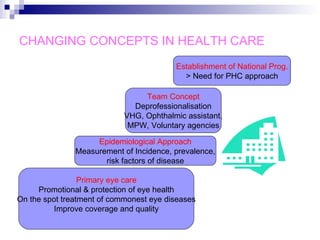
CHANGING CONCEPTS IN HEALTH CARE Primary eye care Promotional & protection of eye health On the spot treatment of commonest eye diseases Improve coverage and quality Establishment of National Prog. > Need for PHC approach Team Concept Deprofessionalisation VHG, Ophthalmic assistant, MPW, Voluntary agencies Epidemiological Approach Measurement of Incidence, prevalence, risk factors of disease
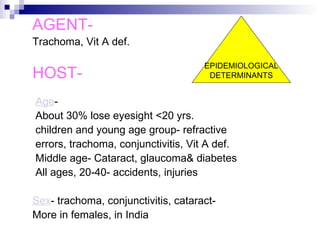
AGENT-   Trachoma, Vit A def.  HOST-   Age -  About 30% lose eyesight <20 yrs. children and young age group- refractive errors, trachoma, conjunctivitis, Vit A def. Middle age- Cataract, glaucoma& diabetes All ages, 20-40- accidents, injuries Sex - trachoma, conjunctivitis, cataract- More in females, in India EPIDEMIOLOGICAL  DETERMINANTS
ENVIRONMENT- Malnutrition - Vit A def.- even due to measles and diarrhoea PEM related- severe corneal  destruction(keratomalacia)6mth- 3yrs.& 4 -6yrs. Occupation  –  Cottage industry, workshops, factories, flying objects, gases. Doctors- x rays, u.v. rays, premature cataract Social class  – twice more prevalent in low social classes EPIDEMIOLOGICAL  DETERMINANTS
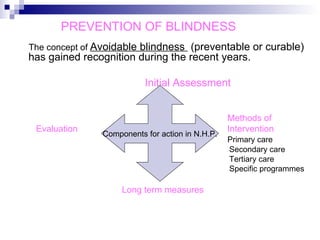
PREVENTION OF BLINDNESS The concept of  Avoidable blindness  (preventable or curable)  has gained recognition during the recent years. Initial Assessment Methods of  Evaluation  Intervention Primary care Secondary care Tertiary care Specific programmes Long term measures Components for action in N.H.P .
1)   INITIAL ASSESSMENT   Prevalence surveys – magnitude, distribution, causes Setting priorities and development of appropriate intervention programmes.
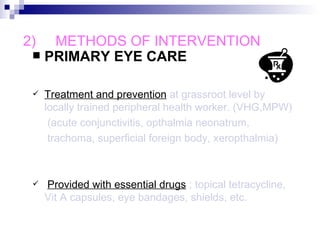
2)  METHODS OF INTERVENTION PRIMARY EYE CARE Treatment and prevention  at grassroot level by locally trained peripheral health worker. (VHG,MPW) (acute conjunctivitis, opthalmia neonatrum,  trachoma, superficial foreign body, xeropthalmia) Provided with essential drugs  ; topical tetracycline, Vit A capsules, eye bandages, shields, etc.
Trained to refer difficult cases  (eg. Corneal ulcer, penetrating foreign bodies, painful eye conditions & infections which do not respond to treatment) to nearest PHC & district hospital. Promotion  of personal hygiene, sanitation, good diet, safety in general. Currently 1 VHG / 1000 population, 2 MPW / 5000 population.
SECONDARY CARE Definitive management of common blinding conditions  such as cataract, trichiasis, entropion, ocular trauma, glaucoma,etc. PHC’s and district hospitals   where eye departments or eye clinics  are established.
Mobile clinics-   Disadv- lacks permanence, adv- problem specific best use of local  resource, provide inexpensive eye care  Eye camp approach- cataract, general eye health, surveys.
TERTIARY CARE   At National /Regional capitals, often associated with Medical colleges & institutes of medicine (National Institute for Blind, Dehradun) Sophisticated eye care- retinal detachment , corneal Grafting Eye banks- Maximum states passed Corneal grafting Acts Education of blind in special schools and utilisation of their services (employment)
SPECIFIC PROGRAMMES TRACHOMA CONTROL- Endemic trachoma and associated infections, major cause of preventable blindness. Early diagnosis and treatment Mass campaigns with topical teracycline Improvement of SE conditions  TC Programme launched 1963. merged NBCP in 1976.  SCHOOL EYE HEALTH SERVICES- Screened  & treated for refractive errors, squint,ambylopia, trachoma H.E. – good posture, proper lighting, avoidance of glare, angle between books and eye.
VIT A PROPHYLAXIS 2 lakh IU given 6 monthly 1-6 yrs., surveillance OCCUPATIONAL EYE HEALTH SERVICES Education, protective devices, improve safety of machines, proper illumination, pre placement examination.
3) LONG TERM MEASURES Improving quality of life, modifying factors responsible for persistence of eye health problems. Poor sanitation , lack of adequate safe water supplies, increase intake of food rich in Vit A, lack of personal hygiene. Health Education Create community awareness of the problem Motivate community to accept total eye health programmes. To secure community participation. EVALUATION Evaluation of objectives.
  VISION 2020 “ A global initiative to eliminate avoidable blindness by WHO on 18 th  feb.1999.” Objective : Assist member states in developing sustainable systems, which will enable them to eliminate avoidable blindness from major causes.
Plan of Action for country has following features: Target diseases: Cataract, refractive errors, childhood blindness, glaucoma, diabetic retinopathy. H.R.D. as well as infrastructure and technology developmnt. At various levels of health system. Proposed 4 tier system
Prof. leadership, strategy.developmnt, CME,Standards,quality assurance, Research .  C.O.E. 20 Training centers Tertiary care including retinal surg.,Corneal transplant.  200 Service Centers  2000 Cataract Surgery Othr common eye surg. Facilities for refraction Referral services Vision Centers  20,000 Refraction and prescription of glasses Primary eye care School eye screening  Screening and referral services
Thank You

Blindness Prevention and Control

  • 1.
    BLINDNESS Presentation by DR.VIOLET (de Sa) PINTO Lecturer, Department of PSM
  • 2.
    Objectives: At theend of the session the student shall have knowledge of : Blindness :definition, categories of visual impairment, its causes and problem statement Changing concepts in healthcare with regards to eye care Prevention of blindness :primary, secondary and tertiary prevention Vision 2020
  • 3.
    “ Visual acuityof less than 3/60 (Snellen) or its equivalent.” Non specialized personnel, in absence of appropriate vision charts “ Inability to count fingers in daylight at a distance of 3 meters.” Definition
  • 4.
    CATEGORIESOF VISUAL IMPAIRMENT If it is 6/18 or better = 0 or no visual impairment No light perception Light perception 4 1/60(finger counting at 1 meter) 1/60(fingercounting at I meter) 3 3/60 Blindness 3/60 2 6/60 6/60 1 6/18 Low vision Minimum = or > than Maximum < than Visual acuity Categories of visual impairment
  • 5.
    PROBLEM STATEMENT Estimated 180 million people are visually disabled, nearly 45 million blind, 4 out of 5 living in developing countries. Major causes…..cataract, glaucoma, trachoma, childhood blindness, onchoceriasis. 32% are aged 45-59 yrs, large majority 58% are over 60 yrs. SEAR has 1/3 rd of the world’s blind,50% of world’s blind children.
  • 6.
    INDIA Causesof blindness Cataract 62.6% more with advancing age senile cataract- decade earlier Uncorrected 19.7% Refractive error Glaucoma 5.8% Posterior 4.7% segment pathology Corneal Opacity 0.9% Others 6.2% Injuries 1.2% cottage industry- carpentry, blacksmitty, stone crushing, chiseling Congenital disorder, uveitis, retina detachment,tumours,diabetes,HT, diseases of nervous system, leprosy.
  • 7.
    CHANGING CONCEPTS INHEALTH CARE Primary eye care Promotional & protection of eye health On the spot treatment of commonest eye diseases Improve coverage and quality Establishment of National Prog. > Need for PHC approach Team Concept Deprofessionalisation VHG, Ophthalmic assistant, MPW, Voluntary agencies Epidemiological Approach Measurement of Incidence, prevalence, risk factors of disease
  • 8.
    AGENT- Trachoma, Vit A def. HOST- Age - About 30% lose eyesight <20 yrs. children and young age group- refractive errors, trachoma, conjunctivitis, Vit A def. Middle age- Cataract, glaucoma& diabetes All ages, 20-40- accidents, injuries Sex - trachoma, conjunctivitis, cataract- More in females, in India EPIDEMIOLOGICAL DETERMINANTS
  • 9.
    ENVIRONMENT- Malnutrition -Vit A def.- even due to measles and diarrhoea PEM related- severe corneal destruction(keratomalacia)6mth- 3yrs.& 4 -6yrs. Occupation – Cottage industry, workshops, factories, flying objects, gases. Doctors- x rays, u.v. rays, premature cataract Social class – twice more prevalent in low social classes EPIDEMIOLOGICAL DETERMINANTS
  • 10.
    PREVENTION OF BLINDNESSThe concept of Avoidable blindness (preventable or curable) has gained recognition during the recent years. Initial Assessment Methods of Evaluation Intervention Primary care Secondary care Tertiary care Specific programmes Long term measures Components for action in N.H.P .
  • 11.
    1) INITIAL ASSESSMENT Prevalence surveys – magnitude, distribution, causes Setting priorities and development of appropriate intervention programmes.
  • 12.
    2) METHODSOF INTERVENTION PRIMARY EYE CARE Treatment and prevention at grassroot level by locally trained peripheral health worker. (VHG,MPW) (acute conjunctivitis, opthalmia neonatrum, trachoma, superficial foreign body, xeropthalmia) Provided with essential drugs ; topical tetracycline, Vit A capsules, eye bandages, shields, etc.
  • 13.
    Trained to referdifficult cases (eg. Corneal ulcer, penetrating foreign bodies, painful eye conditions & infections which do not respond to treatment) to nearest PHC & district hospital. Promotion of personal hygiene, sanitation, good diet, safety in general. Currently 1 VHG / 1000 population, 2 MPW / 5000 population.
  • 14.
    SECONDARY CARE Definitivemanagement of common blinding conditions such as cataract, trichiasis, entropion, ocular trauma, glaucoma,etc. PHC’s and district hospitals where eye departments or eye clinics are established.
  • 15.
    Mobile clinics- Disadv- lacks permanence, adv- problem specific best use of local resource, provide inexpensive eye care Eye camp approach- cataract, general eye health, surveys.
  • 16.
    TERTIARY CARE At National /Regional capitals, often associated with Medical colleges & institutes of medicine (National Institute for Blind, Dehradun) Sophisticated eye care- retinal detachment , corneal Grafting Eye banks- Maximum states passed Corneal grafting Acts Education of blind in special schools and utilisation of their services (employment)
  • 17.
    SPECIFIC PROGRAMMES TRACHOMACONTROL- Endemic trachoma and associated infections, major cause of preventable blindness. Early diagnosis and treatment Mass campaigns with topical teracycline Improvement of SE conditions TC Programme launched 1963. merged NBCP in 1976. SCHOOL EYE HEALTH SERVICES- Screened & treated for refractive errors, squint,ambylopia, trachoma H.E. – good posture, proper lighting, avoidance of glare, angle between books and eye.
  • 18.
    VIT A PROPHYLAXIS2 lakh IU given 6 monthly 1-6 yrs., surveillance OCCUPATIONAL EYE HEALTH SERVICES Education, protective devices, improve safety of machines, proper illumination, pre placement examination.
  • 19.
    3) LONG TERMMEASURES Improving quality of life, modifying factors responsible for persistence of eye health problems. Poor sanitation , lack of adequate safe water supplies, increase intake of food rich in Vit A, lack of personal hygiene. Health Education Create community awareness of the problem Motivate community to accept total eye health programmes. To secure community participation. EVALUATION Evaluation of objectives.
  • 20.
    VISION2020 “ A global initiative to eliminate avoidable blindness by WHO on 18 th feb.1999.” Objective : Assist member states in developing sustainable systems, which will enable them to eliminate avoidable blindness from major causes.
  • 21.
    Plan of Actionfor country has following features: Target diseases: Cataract, refractive errors, childhood blindness, glaucoma, diabetic retinopathy. H.R.D. as well as infrastructure and technology developmnt. At various levels of health system. Proposed 4 tier system
  • 22.
    Prof. leadership, strategy.developmnt,CME,Standards,quality assurance, Research . C.O.E. 20 Training centers Tertiary care including retinal surg.,Corneal transplant. 200 Service Centers 2000 Cataract Surgery Othr common eye surg. Facilities for refraction Referral services Vision Centers 20,000 Refraction and prescription of glasses Primary eye care School eye screening Screening and referral services
  • 23.