RETINAL
DETACHMENT
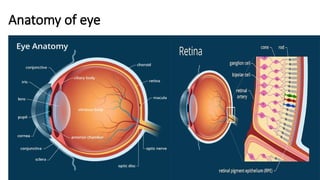
Anatomy of eye
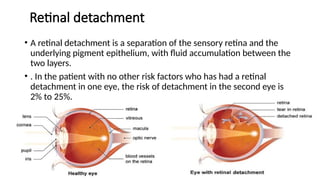
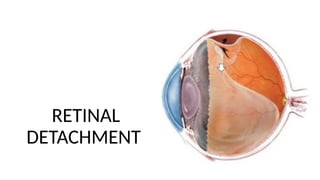
Retinal detachment
• A retinal detachment is a separation of the sensory retina and the
underlying pigment epithelium, with fluid accumulation between the
two layers.
• . In the patient with no other risk factors who has had a retinal
detachment in one eye, the risk of detachment in the second eye is
2% to 25%.
Predisposing factors
Age :The condition is most common in 40-60 years. However, age is no
bar.
• Sex :More common in males (M:F-3:2).
• myopia
• previous intraocular surgery such as aphakia or pseudophakia,
• a family history of retinal detachment
• Trauma and inflammation.
• Retinal necrosis with the formation of retinal breaks can occur in the
ARN syndrome and in cytomegalovirus retinitis.
Classification
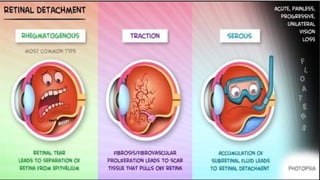
Clinico-etiologically retinal detachment can be classified into three
types:
1. Rhegmatogenous or primary retinal detachment,
2. Tractional retinal detachment, and
3. Exudative retinal detachment.
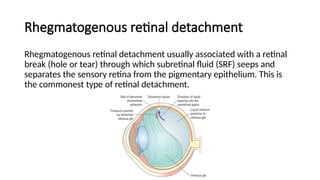
Rhegmatogenous retinal detachment
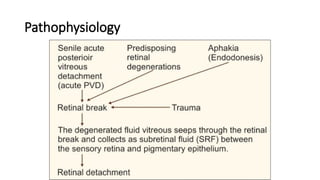
Rhegmatogenous retinal detachment usually associated with a retinal
break (hole or tear) through which subretinal fluid (SRF) seeps and
separates the sensory retina from the pigmentary epithelium. This is
the commonest type of retinal detachment.
Pathophysiology
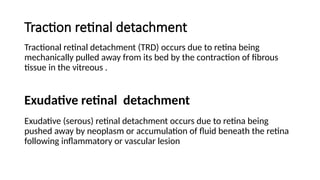
Traction retinal detachment
Tractional retinal detachment (TRD) occurs due to retina being
mechanically pulled away from its bed by the contraction of fibrous
tissue in the vitreous .
Exudative (serous) retinal detachment occurs due to retina being
pushed away by neoplasm or accumulation of fluid beneath the retina
following inflammatory or vascular lesion
Exudative retinal detachment
Clinical manifestations
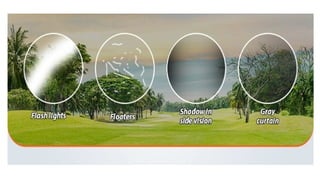
• Sometimes the first symptoms observed is transient flashes of light
(photopsia) in a particular part of visual field.
• Once a retinal break occurs there is release of pigment or a small
hemorrhage which manifest as floater or small moving spots in pts field
of vision .
• Once retinal detachment occurs curtains or veils obscuring the field of
vision.
• Pt experience fall in visual acuity when macula becomes detached or
large bullous detachment obstructs the fovea.
• Visual field loss occurs in the opposite quadrant of actual detachment.
Diagnosis
• History and physical examination
• Visual acuity measurement
• Opthalmoscopy
• Slit lamp microscopy
• Ultrasound of cornea,lens,or vitreous is hazy or opaque
Management
• There is no known medical treatment for a detached retina. The goal
of surgical repair of retinal detachment is to place the retina back in
contact with the choroid and to seal the accompanying holes and
breaks.
1.Laser Photocoagulation
• If the retina is torn or the detachment is slight, a laser can be used to
burn the edges of the tear and halt progression. If the detachment is
small, the laser can seal the retina against the choroid. Laser surgery
is usually performed as an outpatient procedure under local
anesthesia.
2.Cryopexy
• Cryopexy uses nitrous oxide to freeze the tissue behind the retinal tear,
stimulating scar tissue formation that will seal the edges of the tear. It is
usually done as an outpatient procedure with the client under local anesthesia
3.Pneumatic Retinopexy
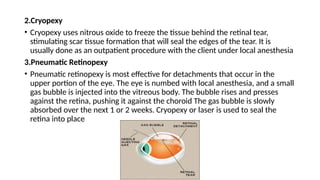
• Pneumatic retinopexy is most effective for detachments that occur in the
upper portion of the eye. The eye is numbed with local anesthesia, and a small
gas bubble is injected into the vitreous body. The bubble rises and presses
against the retina, pushing it against the choroid The gas bubble is slowly
absorbed over the next 1 or 2 weeks. Cryopexy or laser is used to seal the
retina into place
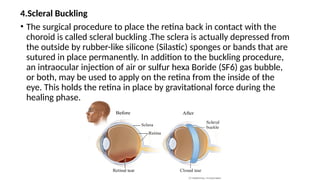
4.Scleral Buckling
• The surgical procedure to place the retina back in contact with the
choroid is called scleral buckling .The sclera is actually depressed from
the outside by rubber-like silicone (Silastic) sponges or bands that are
sutured in place permanently. In addition to the buckling procedure,
an intraocular injection of air or sulfur hexa Boride (SF6) gas bubble,
or both, may be used to apply on the retina from the inside of the
eye. This holds the retina in place by gravitational force during the
healing phase.
Nursing management
• Helping the patient cope with fears and reality of loss of vision and to adapt to changes
in vision.
• Following surgery observe eye patch for any drainage ,assess pain and presence of
nausea .
• Activity restrictions may be necessary if an air or gas bubble has been injected .The
patient is placed usually head down and to one side so that bubble can apply maximum
pressure on retina.
• Postoperative eye medications generally antibiotic steroid combination eye drop to
prevent infection and inflammation. Cycloplegic agents –to dilate pupil and relax ciliary
muscles
• Instruct the client to clean eye with warm tap water using clean cloth .warm compress
can be continued at home .
• Advice to use eye glasses or shield .
• Advice to avoid vigorous exercise.
Retinal detachment and it's management

  • 1.
  • 2.
  • 3.
    Retinal detachment • Aretinal detachment is a separation of the sensory retina and the underlying pigment epithelium, with fluid accumulation between the two layers. • . In the patient with no other risk factors who has had a retinal detachment in one eye, the risk of detachment in the second eye is 2% to 25%.
  • 4.
    Predisposing factors Age :Thecondition is most common in 40-60 years. However, age is no bar. • Sex :More common in males (M:F-3:2). • myopia • previous intraocular surgery such as aphakia or pseudophakia, • a family history of retinal detachment • Trauma and inflammation. • Retinal necrosis with the formation of retinal breaks can occur in the ARN syndrome and in cytomegalovirus retinitis.
  • 5.
    Classification Clinico-etiologically retinal detachmentcan be classified into three types: 1. Rhegmatogenous or primary retinal detachment, 2. Tractional retinal detachment, and 3. Exudative retinal detachment.
  • 6.
    Rhegmatogenous retinal detachment Rhegmatogenousretinal detachment usually associated with a retinal break (hole or tear) through which subretinal fluid (SRF) seeps and separates the sensory retina from the pigmentary epithelium. This is the commonest type of retinal detachment.
  • 7.
  • 8.
    Traction retinal detachment Tractionalretinal detachment (TRD) occurs due to retina being mechanically pulled away from its bed by the contraction of fibrous tissue in the vitreous . Exudative (serous) retinal detachment occurs due to retina being pushed away by neoplasm or accumulation of fluid beneath the retina following inflammatory or vascular lesion Exudative retinal detachment
  • 10.
    Clinical manifestations • Sometimesthe first symptoms observed is transient flashes of light (photopsia) in a particular part of visual field. • Once a retinal break occurs there is release of pigment or a small hemorrhage which manifest as floater or small moving spots in pts field of vision . • Once retinal detachment occurs curtains or veils obscuring the field of vision. • Pt experience fall in visual acuity when macula becomes detached or large bullous detachment obstructs the fovea. • Visual field loss occurs in the opposite quadrant of actual detachment.
  • 12.
    Diagnosis • History andphysical examination • Visual acuity measurement • Opthalmoscopy • Slit lamp microscopy • Ultrasound of cornea,lens,or vitreous is hazy or opaque
  • 13.
    Management • There isno known medical treatment for a detached retina. The goal of surgical repair of retinal detachment is to place the retina back in contact with the choroid and to seal the accompanying holes and breaks. 1.Laser Photocoagulation • If the retina is torn or the detachment is slight, a laser can be used to burn the edges of the tear and halt progression. If the detachment is small, the laser can seal the retina against the choroid. Laser surgery is usually performed as an outpatient procedure under local anesthesia.
  • 14.
    2.Cryopexy • Cryopexy usesnitrous oxide to freeze the tissue behind the retinal tear, stimulating scar tissue formation that will seal the edges of the tear. It is usually done as an outpatient procedure with the client under local anesthesia 3.Pneumatic Retinopexy • Pneumatic retinopexy is most effective for detachments that occur in the upper portion of the eye. The eye is numbed with local anesthesia, and a small gas bubble is injected into the vitreous body. The bubble rises and presses against the retina, pushing it against the choroid The gas bubble is slowly absorbed over the next 1 or 2 weeks. Cryopexy or laser is used to seal the retina into place
  • 15.
    4.Scleral Buckling • Thesurgical procedure to place the retina back in contact with the choroid is called scleral buckling .The sclera is actually depressed from the outside by rubber-like silicone (Silastic) sponges or bands that are sutured in place permanently. In addition to the buckling procedure, an intraocular injection of air or sulfur hexa Boride (SF6) gas bubble, or both, may be used to apply on the retina from the inside of the eye. This holds the retina in place by gravitational force during the healing phase.
  • 16.
    Nursing management • Helpingthe patient cope with fears and reality of loss of vision and to adapt to changes in vision. • Following surgery observe eye patch for any drainage ,assess pain and presence of nausea . • Activity restrictions may be necessary if an air or gas bubble has been injected .The patient is placed usually head down and to one side so that bubble can apply maximum pressure on retina. • Postoperative eye medications generally antibiotic steroid combination eye drop to prevent infection and inflammation. Cycloplegic agents –to dilate pupil and relax ciliary muscles • Instruct the client to clean eye with warm tap water using clean cloth .warm compress can be continued at home . • Advice to use eye glasses or shield . • Advice to avoid vigorous exercise.