BLINDNESS
BLINDNESS
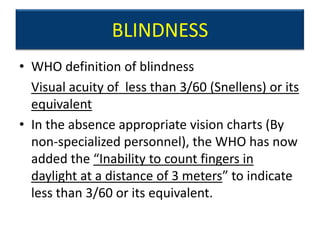
• WHO definition of blindness
  Visual acuity of less than 3/60 (Snellens) or its
  equivalent
• In the absence appropriate vision charts (By
  non-specialized personnel), the WHO has now
  added the “Inability to count fingers in
  daylight at a distance of 3 meters” to indicate
  less than 3/60 or its equivalent.
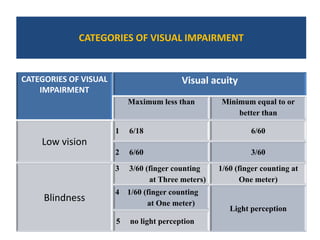
CATEGORIES OF VISUAL IMPAIRMENT


CATEGORIES OF VISUAL                       Visual acuity
    IMPAIRMENT
                           Maximum less than        Minimum equal to or
                                                        better than

                       1   6/18                              6/60
    Low vision
                       2   6/60                              3/60

                       3   3/60 (finger counting    1/60 (finger counting at
                                 at Three meters)          One meter)
                       4   1/60 (finger counting
     Blindness                   at One meter)
                                                       Light perception
                       5   no light perception
The problem
world
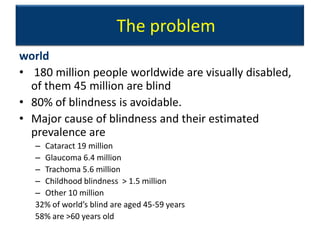
• 180 million people worldwide are visually disabled,
  of them 45 million are blind
• 80% of blindness is avoidable.
• Major cause of blindness and their estimated
  prevalence are
   – Cataract 19 million
   – Glaucoma 6.4 million
   – Trachoma 5.6 million
   – Childhood blindness > 1.5 million
   – Other 10 million
   32% of world’s blind are aged 45-59 years
   58% are >60 years old
India
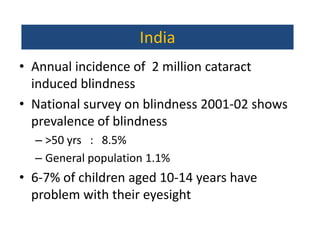
• Annual incidence of 2 million cataract
  induced blindness
• National survey on blindness 2001-02 shows
  prevalence of blindness
  – >50 yrs : 8.5%
  – General population 1.1%
• 6-7% of children aged 10-14 years have
  problem with their eyesight
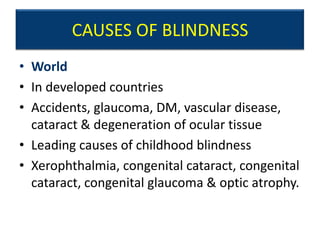
CAUSES OF BLINDNESS
• World
• In developed countries
• Accidents, glaucoma, DM, vascular disease,
  cataract & degeneration of ocular tissue
• Leading causes of childhood blindness
• Xerophthalmia, congenital cataract, congenital
  cataract, congenital glaucoma & optic atrophy.
India

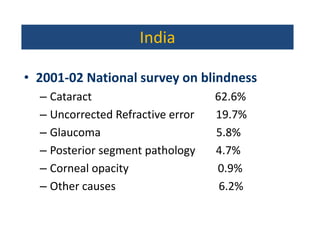
• 2001-02 National survey on blindness
  – Cataract                       62.6%
  – Uncorrected Refractive error   19.7%
  – Glaucoma                       5.8%
  – Posterior segment pathology    4.7%
  – Corneal opacity                0.9%
  – Other causes                    6.2%
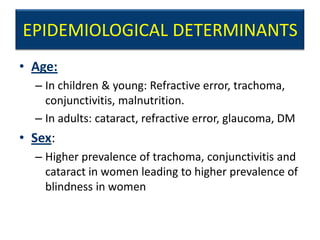
EPIDEMIOLOGICAL DETERMINANTS
• Age:
  – In children & young: Refractive error, trachoma,
    conjunctivitis, malnutrition.
  – In adults: cataract, refractive error, glaucoma, DM
• Sex:
  – Higher prevalence of trachoma, conjunctivitis and
    cataract in women leading to higher prevalence of
    blindness in women
• Malnutrition:
  – Infectious diseases of childhood especially measles &
    diarrhoea
  – PEM
  – Severe blinding corneal destruction due to vit. A
    deficiency in first 4 to 6 years of life.
• Occupation:
  – People working in factories, workshop, industries are
    prone to eye injuries because of exposure to dust,
    airborne particles, flying objects, gases, fumes,
    radiation.
• Social class:
  – Surveys indicate that blindness twice more
    prevalent in poorer classes than in the well to do.
• Social factors:
  – Basic social factors are ignorance, poverty, low
    standards of personal and community hygiene and
    inadequate health care services.
PREVENTION OF BLINDNESS
The components for action in national
  programmes for the prevention of blindness
  comprise the following
• Initial assessment
• Methods of intervention
  – primary eye care
  – secondary care
  – tertiary care
  – specific programmes
• Long term measures
• Evaluation
• Initial assessment
  – Assess the magnitude, geographic distribution,
    and causes of blindness within the country by
    prevalence survey.
METHODS OF INTERVENTION
• Primary eye care
  – Wide range of eye conditions can be treated or prevented
    at grass root level by locally trained health workers who
    are first to make contact with the community.
  – They are also trained to refer the difficult cases to the
    nearest PHC or district hospital.
  – Their activities also involve promotion of personal hygiene,
    sanitation, good dietary habits and safety in general.
  – The final objective is to increase the coverage ans quality
    of eye health care through Primary health care approach
    and thereby improve the utilization of existing resources.
• Secondary care:
  – Involves definitive management of common
    blinding conditions as cataract, trichiasis,
    entropion, ocular trauma, glaucoma.
  – It is provided in PHCs and district hospitals where
    eye depts are established.
  – May involve the use of mobile eye clinics
  – The great advantage of this strategy is, it is
    problem specific and makes best use of local
    resources and provides inexpensive eye care to
    the population at the peripheral level.
• Tertiary care
  – Established in the national or regional capitals and
    are often associated with medical colleges and
    institutes of medicine.
  – Provide sophisticated eye care such as retinal
    detachment surgery, corneal grafting which are
    not available in the secondary centres.
  – Other measures of rehabilitation comprise
    education of blind in the special schools &
    utilisation of their services in the gainful
    employment.
• Specific programmes
  – Trachoma control
  – School eye health services: Screening and
    treatment , Health education
  – Vit.A prophylaxis
  – Occupational eye health services
LONG TERM MEASURES

– Aimed at improving quality of life
– Modifying or attacking the factors responsible for
  the persistence of eye health problems.
• Poor sanitation
• Lack of adequate safe water supply
• Poor nutrition
• Lack of personal hyegine
NATIONAL PROGRAMME FOR CONTROL
           OF BLINDNESS
• Launched in 1976
• 100 % centrally sponsored programme
• It incorporates the earlier trachoma control
  programme started in the year 1968

• Goal: To reduce the prevalence of blindness
  from 1.4 to 0.3% by 2000.
• In the year 2006-07: prevalence was 1.0%
STRATEGY OF PROGRAMME:

• Strengthening service delivery
• Developing human resource for eye care
• Promoting out-reach activities & public
  awareness
• Developing institutional capacity
• To establish eye care facilities for every 5 lac
  persons.
REVISED STRATEGIES:
• More comprehensive by strengthening services for other
  causes of blindness
• To shift from eye camp approach to fixed facility surgical
  approach and from conventional surgery to IOL
  implantation.
• To expand World bank project like building eye care
  infrastructure all over country
• To strengthen the participation of Voluntary organization
  in programme and to earmark geographical areas to
  NGOs.
• To enhance coverage of eye care services in tribal and
  other under served areas
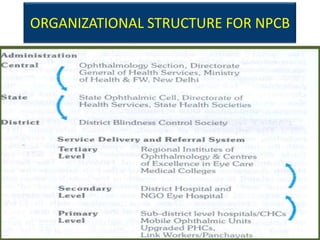
ORGANIZATIONAL STRUCTURE FOR NPCB
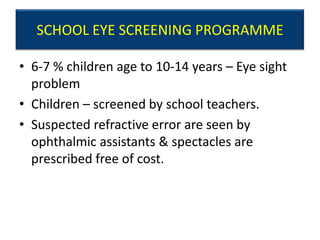
SCHOOL EYE SCREENING PROGRAMME

• 6-7 % children age to 10-14 years – Eye sight
  problem
• Children – screened by school teachers.
• Suspected refractive error are seen by
  ophthalmic assistants & spectacles are
  prescribed free of cost.
COLLECTION & UTILIZATION OF DONATED EYE

• 40,000 donated eyes every year

• Hospital retrieval programme- major strategy
  for collection of eyes.

• Eye donation fortnight-25th Aug to 8th Sept
Vision 2020: The Right to Sight
• Global initiative to reduce avoidable
  (Preventable and curable) blindness by the
  year 2020.
• Main features:
  – Target Diseases
  – Human resource development and infrastructure
    and technology development.
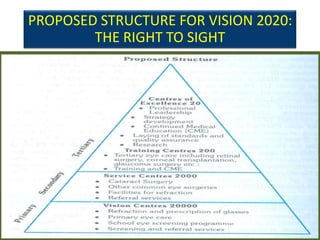
PROPOSED STRUCTURE FOR VISION 2020:
        THE RIGHT TO SIGHT

Blindness

  • 1.
  • 2.
    BLINDNESS • WHO definitionof blindness Visual acuity of less than 3/60 (Snellens) or its equivalent • In the absence appropriate vision charts (By non-specialized personnel), the WHO has now added the “Inability to count fingers in daylight at a distance of 3 meters” to indicate less than 3/60 or its equivalent.
  • 3.
    CATEGORIES OF VISUALIMPAIRMENT CATEGORIES OF VISUAL Visual acuity IMPAIRMENT Maximum less than Minimum equal to or better than 1 6/18 6/60 Low vision 2 6/60 3/60 3 3/60 (finger counting 1/60 (finger counting at at Three meters) One meter) 4 1/60 (finger counting Blindness at One meter) Light perception 5 no light perception
  • 4.
    The problem world • 180million people worldwide are visually disabled, of them 45 million are blind • 80% of blindness is avoidable. • Major cause of blindness and their estimated prevalence are – Cataract 19 million – Glaucoma 6.4 million – Trachoma 5.6 million – Childhood blindness > 1.5 million – Other 10 million 32% of world’s blind are aged 45-59 years 58% are >60 years old
  • 5.
    India • Annual incidenceof 2 million cataract induced blindness • National survey on blindness 2001-02 shows prevalence of blindness – >50 yrs : 8.5% – General population 1.1% • 6-7% of children aged 10-14 years have problem with their eyesight
  • 6.
    CAUSES OF BLINDNESS •World • In developed countries • Accidents, glaucoma, DM, vascular disease, cataract & degeneration of ocular tissue • Leading causes of childhood blindness • Xerophthalmia, congenital cataract, congenital cataract, congenital glaucoma & optic atrophy.
  • 7.
    India • 2001-02 Nationalsurvey on blindness – Cataract 62.6% – Uncorrected Refractive error 19.7% – Glaucoma 5.8% – Posterior segment pathology 4.7% – Corneal opacity 0.9% – Other causes 6.2%
  • 8.
    EPIDEMIOLOGICAL DETERMINANTS • Age: – In children & young: Refractive error, trachoma, conjunctivitis, malnutrition. – In adults: cataract, refractive error, glaucoma, DM • Sex: – Higher prevalence of trachoma, conjunctivitis and cataract in women leading to higher prevalence of blindness in women
  • 9.
    • Malnutrition: – Infectious diseases of childhood especially measles & diarrhoea – PEM – Severe blinding corneal destruction due to vit. A deficiency in first 4 to 6 years of life. • Occupation: – People working in factories, workshop, industries are prone to eye injuries because of exposure to dust, airborne particles, flying objects, gases, fumes, radiation.
  • 10.
    • Social class: – Surveys indicate that blindness twice more prevalent in poorer classes than in the well to do. • Social factors: – Basic social factors are ignorance, poverty, low standards of personal and community hygiene and inadequate health care services.
  • 11.
    PREVENTION OF BLINDNESS Thecomponents for action in national programmes for the prevention of blindness comprise the following • Initial assessment • Methods of intervention – primary eye care – secondary care – tertiary care – specific programmes • Long term measures • Evaluation
  • 12.
    • Initial assessment – Assess the magnitude, geographic distribution, and causes of blindness within the country by prevalence survey.
  • 13.
    METHODS OF INTERVENTION •Primary eye care – Wide range of eye conditions can be treated or prevented at grass root level by locally trained health workers who are first to make contact with the community. – They are also trained to refer the difficult cases to the nearest PHC or district hospital. – Their activities also involve promotion of personal hygiene, sanitation, good dietary habits and safety in general. – The final objective is to increase the coverage ans quality of eye health care through Primary health care approach and thereby improve the utilization of existing resources.
  • 14.
    • Secondary care: – Involves definitive management of common blinding conditions as cataract, trichiasis, entropion, ocular trauma, glaucoma. – It is provided in PHCs and district hospitals where eye depts are established. – May involve the use of mobile eye clinics – The great advantage of this strategy is, it is problem specific and makes best use of local resources and provides inexpensive eye care to the population at the peripheral level.
  • 15.
    • Tertiary care – Established in the national or regional capitals and are often associated with medical colleges and institutes of medicine. – Provide sophisticated eye care such as retinal detachment surgery, corneal grafting which are not available in the secondary centres. – Other measures of rehabilitation comprise education of blind in the special schools & utilisation of their services in the gainful employment.
  • 16.
    • Specific programmes – Trachoma control – School eye health services: Screening and treatment , Health education – Vit.A prophylaxis – Occupational eye health services
  • 17.
    LONG TERM MEASURES –Aimed at improving quality of life – Modifying or attacking the factors responsible for the persistence of eye health problems. • Poor sanitation • Lack of adequate safe water supply • Poor nutrition • Lack of personal hyegine
  • 18.
    NATIONAL PROGRAMME FORCONTROL OF BLINDNESS • Launched in 1976 • 100 % centrally sponsored programme • It incorporates the earlier trachoma control programme started in the year 1968 • Goal: To reduce the prevalence of blindness from 1.4 to 0.3% by 2000. • In the year 2006-07: prevalence was 1.0%
  • 19.
    STRATEGY OF PROGRAMME: •Strengthening service delivery • Developing human resource for eye care • Promoting out-reach activities & public awareness • Developing institutional capacity • To establish eye care facilities for every 5 lac persons.
  • 20.
    REVISED STRATEGIES: • Morecomprehensive by strengthening services for other causes of blindness • To shift from eye camp approach to fixed facility surgical approach and from conventional surgery to IOL implantation. • To expand World bank project like building eye care infrastructure all over country • To strengthen the participation of Voluntary organization in programme and to earmark geographical areas to NGOs. • To enhance coverage of eye care services in tribal and other under served areas
  • 21.
  • 22.
    SCHOOL EYE SCREENINGPROGRAMME • 6-7 % children age to 10-14 years – Eye sight problem • Children – screened by school teachers. • Suspected refractive error are seen by ophthalmic assistants & spectacles are prescribed free of cost.
  • 23.
    COLLECTION & UTILIZATIONOF DONATED EYE • 40,000 donated eyes every year • Hospital retrieval programme- major strategy for collection of eyes. • Eye donation fortnight-25th Aug to 8th Sept
  • 24.
    Vision 2020: TheRight to Sight • Global initiative to reduce avoidable (Preventable and curable) blindness by the year 2020. • Main features: – Target Diseases – Human resource development and infrastructure and technology development.
  • 25.
    PROPOSED STRUCTURE FORVISION 2020: THE RIGHT TO SIGHT