By
Assistant Professor of Ophthalmology
Sohag University
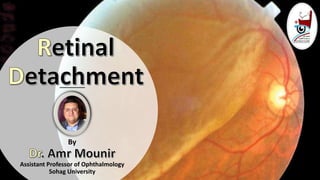
• Retinal detachment refers
to separation of the inner
layers of the retina from the
underlying retinal pigment
epithelium (RPE, choroid).
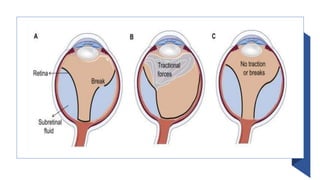
Rhegmatogenous retinal
detachment
(the most common type)
• This results when a hole, tear, or
break in the neuronal layer allows
fluid from the vitreous to seep
between and separate sensory and
RPE layers.
• Vitreous becomes more
syneretic (liquefied) with
age.
• Posterior vitreous
detachment (PVD).
• Myopia, aphakia or
pseudophakia, familial
conditions, and
inflammation.
• These results from
adhesions between
the vitreous
gel/fibrovascular
proliferation and
the retina
• Contraction of vitreous or areas
of fibrovascular proliferation
• The severity of retinal
detachment is influenced by
the timing and degree of
shrinkage of the vitreous and
fibrovascular proliferations.
• It may occur in a number of
conditions, such as proliferative
diabetic retinopathy (PDR),
retinal vein occlusion, trauma,
sickling hemoglobinopathies,
and retinopathy of prematurity.
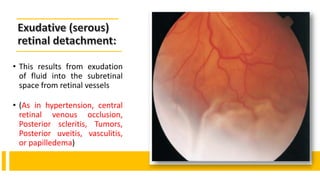
• This results from exudation
of fluid into the subretinal
space from retinal vessels
• (As in hypertension, central
retinal venous occlusion,
Posterior scleritis, Tumors,
Posterior uveitis, vasculitis,
or papilledema)
• Floaters
• Visual field defect
(developing over time;
may help localize
detachment)
.Photopsia (common
initially)
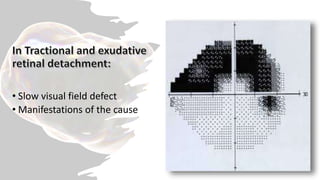
• Slow visual field defect
• Manifestations of the cause
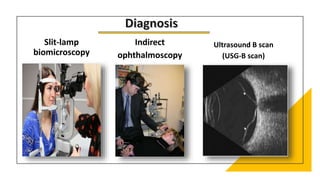
Slit-lamp
biomicroscopy
Indirect
ophthalmoscopy
Ultrasound B scan
(USG-B scan)
General Principles
• Find all the retinal breaks in
Rhegmatogenous Retinal
Detachment
• Seal all the retinal breaks in
Rhegmatogenous Retinal
Detachment
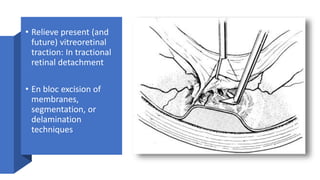
• Relieve present (and
future) vitreoretinal
traction: In tractional
retinal detachment
• En bloc excision of
membranes,
segmentation, or
delamination
techniques
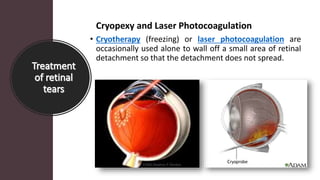
Cryopexy and Laser Photocoagulation
• Cryotherapy (freezing) or laser photocoagulation are
occasionally used alone to wall off a small area of retinal
detachment so that the detachment does not spread.
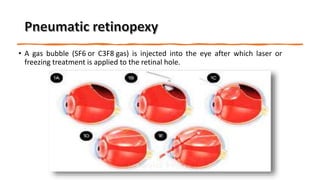
• A gas bubble (SF6 or C3F8 gas) is injected into the eye after which laser or
freezing treatment is applied to the retinal hole.
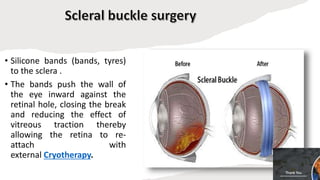
• Silicone bands (bands, tyres)
to the sclera .
• The bands push the wall of
the eye inward against the
retinal hole, closing the break
and reducing the effect of
vitreous traction thereby
allowing the retina to re-
attach with
external Cryotherapy.
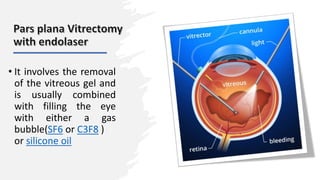
• It involves the removal
of the vitreous gel and
is usually combined
with filling the eye
with either a gas
bubble(SF6 or C3F8 )
or silicone oil
Retinal detachment

Retinal detachment

  • 1.
    By Assistant Professor ofOphthalmology Sohag University
  • 2.
    • Retinal detachmentrefers to separation of the inner layers of the retina from the underlying retinal pigment epithelium (RPE, choroid).
  • 3.
    Rhegmatogenous retinal detachment (the mostcommon type) • This results when a hole, tear, or break in the neuronal layer allows fluid from the vitreous to seep between and separate sensory and RPE layers.
  • 4.
    • Vitreous becomesmore syneretic (liquefied) with age. • Posterior vitreous detachment (PVD). • Myopia, aphakia or pseudophakia, familial conditions, and inflammation.
  • 5.
    • These resultsfrom adhesions between the vitreous gel/fibrovascular proliferation and the retina
  • 6.
    • Contraction ofvitreous or areas of fibrovascular proliferation • The severity of retinal detachment is influenced by the timing and degree of shrinkage of the vitreous and fibrovascular proliferations. • It may occur in a number of conditions, such as proliferative diabetic retinopathy (PDR), retinal vein occlusion, trauma, sickling hemoglobinopathies, and retinopathy of prematurity.
  • 7.
    • This resultsfrom exudation of fluid into the subretinal space from retinal vessels • (As in hypertension, central retinal venous occlusion, Posterior scleritis, Tumors, Posterior uveitis, vasculitis, or papilledema)
  • 9.
    • Floaters • Visualfield defect (developing over time; may help localize detachment) .Photopsia (common initially)
  • 10.
    • Slow visualfield defect • Manifestations of the cause
  • 11.
  • 12.
    General Principles • Findall the retinal breaks in Rhegmatogenous Retinal Detachment • Seal all the retinal breaks in Rhegmatogenous Retinal Detachment
  • 13.
    • Relieve present(and future) vitreoretinal traction: In tractional retinal detachment • En bloc excision of membranes, segmentation, or delamination techniques
  • 14.
    Cryopexy and LaserPhotocoagulation • Cryotherapy (freezing) or laser photocoagulation are occasionally used alone to wall off a small area of retinal detachment so that the detachment does not spread.
  • 15.
    • A gasbubble (SF6 or C3F8 gas) is injected into the eye after which laser or freezing treatment is applied to the retinal hole.
  • 16.
    • Silicone bands(bands, tyres) to the sclera . • The bands push the wall of the eye inward against the retinal hole, closing the break and reducing the effect of vitreous traction thereby allowing the retina to re- attach with external Cryotherapy.
  • 17.
    • It involvesthe removal of the vitreous gel and is usually combined with filling the eye with either a gas bubble(SF6 or C3F8 ) or silicone oil