RETINAL
DETACHEMENT
JAISON THOMAS DANIEL
NURSING TUTOR,
YFCON, ratnagiri
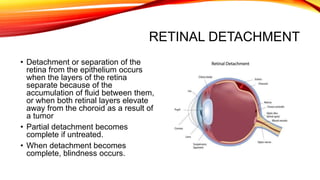
RETINAL DETACHMENT
• Detachment or separation of the
retina from the epithelium occurs
when the layers of the retina
separate because of the
accumulation of fluid between them,
or when both retinal layers elevate
away from the choroid as a result of
a tumor
• Partial detachment becomes
complete if untreated.
• When detachment becomes
complete, blindness occurs.
RETINAL DETACHMENT
• A detached retina is a serious and
sight-threatening event.
• Unless the retina is reattached
soon, permanent vision loss may
result.
• So it is considered as a ophthalmic
emergency.
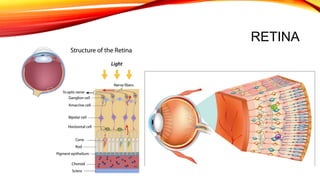
RETINA
EPIDEMIOLOGY
• The incidence of retinal detachment in otherwise normal eyes is around 5 new
cases in 100,000 persons per year
• Detachment is more frequent in middle aged or elderly populations, with rates
of around 20 in 100,000 per year
• The lifetime risk in normal individuals is about 1 in 300
• Retinal detachment is more common in people with severe myopia (above 5–
6 diopters), in whom the retina is more thinly stretched. In such patients, life
time risk rises to 1 in 20.
• About two thirds of cases of retinal detachment occur in myopics. Myopic
retinal detachment patients tend to be younger than nonmyopic ones.
TYPE
• There are three types of retinal detachment:
• Rhegmatogenous
• Tractional
• Exudative
RHEGMATOGENOUS RETINAL
DETACHMENT
• Rhegmatogenous detachment is the most common form deriving its name
from rhegma, meaning rent or break.
• It occurs due to a break in the retina (called a retinal tear)
• Retinal breaks are divided into three types – holes, tears and dialyses.
• In this condition, a hole or tear develops in the sensory retina, allowing some
of the liquid vitreous to seep through the sensory retina and detach it from
the RPE.
• People at risk for this type of detachment include those with high myopia or
aphakia after cataract surgery
EXUDATIVE RETINAL
DETACHMENT
• It also known as serous, or secondary retinal detachment
• It occurs due to inflammation, injury or vascular abnormalities
• Exudative or serous detachments occur when subretinal fluid accumulates
and causes detachment without any corresponding break in the retina.
• The etiologic factors are often tumor growth or inflammation.
• Fluid accumulating underneath the retina without the presence of a hole,
tear, or break.
TRACTIONAL RETINAL
DETACHMENT
• Tractional retinal detachment occurs when fibrous or fibrovascular tissue,
pulls the sensory retina from the retinal pigment epithelium.
• It occurs when fibrous or fibrovascular tissue, pulls the sensory retina from
the retinal pigment epithelium.
• The hemorrhages and fibrous proliferation associated with those conditions
exert a pulling force on the delicate retina.
• High incidence rate in patients with diabetic retinopathy, vitreous
hemorrhage, or the retinopathy of prematurity
RISK FACTORS
• Severe myopia
• Retinal tear
• Family history
• Other eye diseases or disorders,
such as
• Retinoschisis
• Uveitis
• Degenerative myopia
• Lattice degeneration
• Eye injury
• Tumors
• Systemic diseases such as diabetes
& sickle cell disease
• Complications from cataract surgery
CLINICAL MANIFESTATIONS
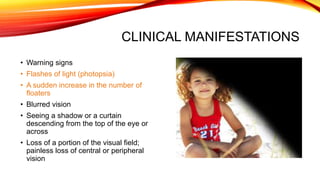
• Warning signs
• Flashes of light (photopsia)
• A sudden increase in the number of
floaters
• Blurred vision
• Seeing a shadow or a curtain
descending from the top of the eye or
across
• Loss of a portion of the visual field;
painless loss of central or peripheral
vision
Photopsia Floters
DIAGNOSIS
• Elicit history for any of the following:
• History of trauma
• Previous ophthalmologic surgery
• Previous eye conditions (eg, uveitis
and vitreous hemorrhage)
• Duration of visual symptoms and visual
loss D
DIAGNOSIS
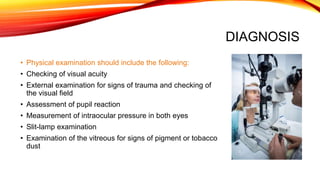
• Physical examination should include the following:
• Checking of visual acuity
• External examination for signs of trauma and checking of
the visual field
• Assessment of pupil reaction
• Measurement of intraocular pressure in both eyes
• Slit-lamp examination
• Examination of the vitreous for signs of pigment or tobacco
dust
DIAGNOSIS
• Fundus photography or
ophthalmoscopy.
• Fundus photography :
larger instrument than the
ophthalmoscope
• Ultrasound
MANAGEMENT
• Visual improvement is much greater when the retina is repaired before the
macula is detached.
• Once the retina is reattached, v
• General principles of treatment:
• 1. Find all retinal breaks
• 2. Seal all retinal breaks
• 3. Relieve present (and future) vitreo retinal tractionision usually improves
and then stabilizes.
MANAGEMENT
• Prehospital Care
• Since the condition is a medical emergency immediate treatment is necessary.
• Keep the patient NPO (absolutely no solid foods or fluids) in anticipation of retinal
surgery
• In cases of associated trauma, protect the globe with metallic eye shield
• Avoid any pressure on the globe and to limit activity to a minimum until further
evaluation
• ED treatment of retinal detachment consists of evaluating the patient and treating
any unstable vital signs, preparing the patient for possible emergency surgery.
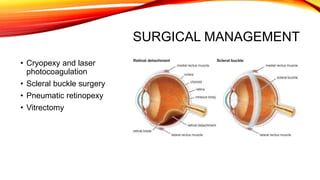
SURGICAL MANAGEMENT
• Cryopexy and laser
photocoagulation
• Scleral buckle surgery
• Pneumatic retinopexy
• Vitrectomy
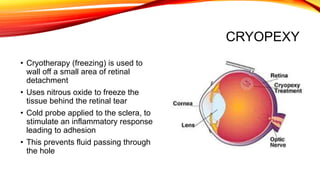
CRYOPEXY
• Cryotherapy (freezing) is used to
wall off a small area of retinal
detachment
• Uses nitrous oxide to freeze the
tissue behind the retinal tear
• Cold probe applied to the sclera, to
stimulate an inflammatory response
leading to adhesion
• This prevents fluid passing through
the hole
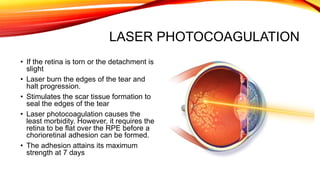
LASER PHOTOCOAGULATION
• If the retina is torn or the detachment is
slight
• Laser burn the edges of the tear and
halt progression.
• Stimulates the scar tissue formation to
seal the edges of the tear
• Laser photocoagulation causes the
least morbidity. However, it requires the
retina to be flat over the RPE before a
chorioretinal adhesion can be formed.
• The adhesion attains its maximum
strength at 7 days
LASER DIATHERMY
• Diathermy, an alternating electrical current of 13.56 MHz is generated.
• As the current passes through the tissue, resistance of the tissue gives rise to heat.
• This heat coagulates the tissue.
• Diathermy produces an adequate RPE adhesion, but it produces immediate scleral
shrinkage with subsequent scleral necrosis
SCLERAL BUCKLE SURGERY
• Surgeon sews silicone bands to the sclera (the white outer coat of the
eyeball)
• The bands push the wall of the eye inward against the retinal hole
• Cryotherapy (freezing) is applied around retinal breaks prior to placing the
buckle Scleral buckle surgery
• Subretinal fluid is drained as part of the buckling procedure
• The buckle remains in situ
• The most common side effect of a scleral operation is myopic shift. Myopic
shift: the operated eye will be more short sighted after the operation
SCLERAL BUCKLE SURGERY
• Types of scleral buckling:
• Radial scleral buckle
• Circumferential scleral buckle
• Encircling buckles
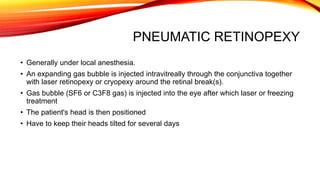
PNEUMATIC RETINOPEXY
• Generally under local anesthesia.
• An expanding gas bubble is injected intravitreally through the conjunctiva together
with laser retinopexy or cryopexy around the retinal break(s).
• Gas bubble (SF6 or C3F8 gas) is injected into the eye after which laser or freezing
treatment
• The patient's head is then positioned
• Have to keep their heads tilted for several days
PNEUMATIC RETINOPEXY
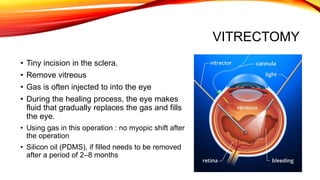
VITRECTOMY
• Tiny incision in the sclera.
• Remove vitreous
• Gas is often injected to into the eye
• During the healing process, the eye makes
fluid that gradually replaces the gas and fills
the eye.
• Using gas in this operation : no myopic shift after
the operation
• Silicon oil (PDMS), if filled needs to be removed
after a period of 2–8 months
POSTOPERATIVE
COMPLICATIONS
• Incresed IOP.
• Endophthalmitis.
• Development of other retinal detachments
• Development of cataracts.
• Loss of turgor of the eye.
PRE OPERATIVE MANAGEMENT
• Assess the visual acuity of the client’s non-operative eye prior to surgery
• Assess the client’s support systems and the possible effect of impaired vision
on lifestyle and ability to perform ADLs in the post- operative period
• Safety measures such as installing hand rails, especially if the client has
limited vision in the unaffected eye
• Remove all eye makeup and contact lenses or glasses prior to surgery
• Mydriatic (pupil-dilating) or cycloplegic (ciliary- paralytic) drops and drops to
lower intraocular pressure may be prescribed preoperatively.
POST OPERATIVE MANAGEMENT
• Monitor status of the eye dressing following surgery.
• Assess dressings for the presence of bleeding or drainage
• Maintain the eye patch or eye shield in place. The eye patch or shield helps
prevent inadvertent injury to the operative site
• Place the client in a semi-Fowler’s or Fowler’s position , having the client lie
on the unaffected side.These positions reduce intraocular pressure in the
affected eye.
• Assess the client and medicate or assist to avoid vomiting coughing ,
sneezing or straining as needed. These activities increase intraocular
pressure
POST OPERATIVE MANAGEMENT
• After surgery for a detached retina, the client is positioned so that the
detachment is dependent or inferior.
• Assess comfort and medicate as necessary for complaints of an aching or
scratchy sensation in affected eye . Immediately report any com
• Assess for potential surgical complications:
• Pain in or drainage from the affected eye
• Hemorrhage with blood in the anterior chamber eye
• Flashes of light, floaters, or the sensation of a curtain being drawn over the eye
(indicators of retinal detachment)
• Cloudy appearance to the cornea (corneal edema).
POST OPERATIVE MANAGEMENT
• Evidence of any of the above manifestations or unusual complaints by the
client should be reported to the physician at once
• Approach the client on the unaffected side.This approach facilitates eye
contact and communicationplaint of sudden, sharp eye pain to the physician.
• Place all personal articles and the call bell within easy reach . These
measures prevent stretching and straining by the client
• Assist with ambulation and personal care activities as needed. Assistance
may be necessary to maintain
POST OPERATIVE MANAGEMENT
• Antibiotic ,anti-inflammatory and other systemic and eye medications as
prescribed . Medications are prescribed post operatively to prevent infection
or inflammation of the operative site, maintain pupil constriction , and control
intraocular pressure
• Administer antiemetic medication as needed. It is important to prevent
vomiting to maintain normal intraocular pressures.
HOME CARE
• Adequate lighting
• Promote unrestricted ambulation
• Removal of hazards like rugs, clutters, unnecessary furniture.
• Provision of hand rails in hallways, bathrooms
• Access to radio and television
• Voice activated switches
• Pill organizers
• Large print newspapers, magazines
THANK YOU

Retinal detachment

  • 1.
  • 2.
    RETINAL DETACHMENT • Detachmentor separation of the retina from the epithelium occurs when the layers of the retina separate because of the accumulation of fluid between them, or when both retinal layers elevate away from the choroid as a result of a tumor • Partial detachment becomes complete if untreated. • When detachment becomes complete, blindness occurs.
  • 3.
    RETINAL DETACHMENT • Adetached retina is a serious and sight-threatening event. • Unless the retina is reattached soon, permanent vision loss may result. • So it is considered as a ophthalmic emergency.
  • 4.
  • 5.
    EPIDEMIOLOGY • The incidenceof retinal detachment in otherwise normal eyes is around 5 new cases in 100,000 persons per year • Detachment is more frequent in middle aged or elderly populations, with rates of around 20 in 100,000 per year • The lifetime risk in normal individuals is about 1 in 300 • Retinal detachment is more common in people with severe myopia (above 5– 6 diopters), in whom the retina is more thinly stretched. In such patients, life time risk rises to 1 in 20. • About two thirds of cases of retinal detachment occur in myopics. Myopic retinal detachment patients tend to be younger than nonmyopic ones.
  • 6.
    TYPE • There arethree types of retinal detachment: • Rhegmatogenous • Tractional • Exudative
  • 7.
    RHEGMATOGENOUS RETINAL DETACHMENT • Rhegmatogenousdetachment is the most common form deriving its name from rhegma, meaning rent or break. • It occurs due to a break in the retina (called a retinal tear) • Retinal breaks are divided into three types – holes, tears and dialyses. • In this condition, a hole or tear develops in the sensory retina, allowing some of the liquid vitreous to seep through the sensory retina and detach it from the RPE. • People at risk for this type of detachment include those with high myopia or aphakia after cataract surgery
  • 8.
    EXUDATIVE RETINAL DETACHMENT • Italso known as serous, or secondary retinal detachment • It occurs due to inflammation, injury or vascular abnormalities • Exudative or serous detachments occur when subretinal fluid accumulates and causes detachment without any corresponding break in the retina. • The etiologic factors are often tumor growth or inflammation. • Fluid accumulating underneath the retina without the presence of a hole, tear, or break.
  • 9.
    TRACTIONAL RETINAL DETACHMENT • Tractionalretinal detachment occurs when fibrous or fibrovascular tissue, pulls the sensory retina from the retinal pigment epithelium. • It occurs when fibrous or fibrovascular tissue, pulls the sensory retina from the retinal pigment epithelium. • The hemorrhages and fibrous proliferation associated with those conditions exert a pulling force on the delicate retina. • High incidence rate in patients with diabetic retinopathy, vitreous hemorrhage, or the retinopathy of prematurity
  • 10.
    RISK FACTORS • Severemyopia • Retinal tear • Family history • Other eye diseases or disorders, such as • Retinoschisis • Uveitis • Degenerative myopia • Lattice degeneration • Eye injury • Tumors • Systemic diseases such as diabetes & sickle cell disease • Complications from cataract surgery
  • 11.
    CLINICAL MANIFESTATIONS • Warningsigns • Flashes of light (photopsia) • A sudden increase in the number of floaters • Blurred vision • Seeing a shadow or a curtain descending from the top of the eye or across • Loss of a portion of the visual field; painless loss of central or peripheral vision
  • 12.
  • 13.
    DIAGNOSIS • Elicit historyfor any of the following: • History of trauma • Previous ophthalmologic surgery • Previous eye conditions (eg, uveitis and vitreous hemorrhage) • Duration of visual symptoms and visual loss D
  • 14.
    DIAGNOSIS • Physical examinationshould include the following: • Checking of visual acuity • External examination for signs of trauma and checking of the visual field • Assessment of pupil reaction • Measurement of intraocular pressure in both eyes • Slit-lamp examination • Examination of the vitreous for signs of pigment or tobacco dust
  • 15.
    DIAGNOSIS • Fundus photographyor ophthalmoscopy. • Fundus photography : larger instrument than the ophthalmoscope • Ultrasound
  • 16.
    MANAGEMENT • Visual improvementis much greater when the retina is repaired before the macula is detached. • Once the retina is reattached, v • General principles of treatment: • 1. Find all retinal breaks • 2. Seal all retinal breaks • 3. Relieve present (and future) vitreo retinal tractionision usually improves and then stabilizes.
  • 17.
    MANAGEMENT • Prehospital Care •Since the condition is a medical emergency immediate treatment is necessary. • Keep the patient NPO (absolutely no solid foods or fluids) in anticipation of retinal surgery • In cases of associated trauma, protect the globe with metallic eye shield • Avoid any pressure on the globe and to limit activity to a minimum until further evaluation • ED treatment of retinal detachment consists of evaluating the patient and treating any unstable vital signs, preparing the patient for possible emergency surgery.
  • 18.
    SURGICAL MANAGEMENT • Cryopexyand laser photocoagulation • Scleral buckle surgery • Pneumatic retinopexy • Vitrectomy
  • 19.
    CRYOPEXY • Cryotherapy (freezing)is used to wall off a small area of retinal detachment • Uses nitrous oxide to freeze the tissue behind the retinal tear • Cold probe applied to the sclera, to stimulate an inflammatory response leading to adhesion • This prevents fluid passing through the hole
  • 20.
    LASER PHOTOCOAGULATION • Ifthe retina is torn or the detachment is slight • Laser burn the edges of the tear and halt progression. • Stimulates the scar tissue formation to seal the edges of the tear • Laser photocoagulation causes the least morbidity. However, it requires the retina to be flat over the RPE before a chorioretinal adhesion can be formed. • The adhesion attains its maximum strength at 7 days
  • 21.
    LASER DIATHERMY • Diathermy,an alternating electrical current of 13.56 MHz is generated. • As the current passes through the tissue, resistance of the tissue gives rise to heat. • This heat coagulates the tissue. • Diathermy produces an adequate RPE adhesion, but it produces immediate scleral shrinkage with subsequent scleral necrosis
  • 22.
    SCLERAL BUCKLE SURGERY •Surgeon sews silicone bands to the sclera (the white outer coat of the eyeball) • The bands push the wall of the eye inward against the retinal hole • Cryotherapy (freezing) is applied around retinal breaks prior to placing the buckle Scleral buckle surgery • Subretinal fluid is drained as part of the buckling procedure • The buckle remains in situ • The most common side effect of a scleral operation is myopic shift. Myopic shift: the operated eye will be more short sighted after the operation
  • 23.
  • 24.
    SCLERAL BUCKLE SURGERY •Types of scleral buckling: • Radial scleral buckle • Circumferential scleral buckle • Encircling buckles
  • 25.
    PNEUMATIC RETINOPEXY • Generallyunder local anesthesia. • An expanding gas bubble is injected intravitreally through the conjunctiva together with laser retinopexy or cryopexy around the retinal break(s). • Gas bubble (SF6 or C3F8 gas) is injected into the eye after which laser or freezing treatment • The patient's head is then positioned • Have to keep their heads tilted for several days
  • 26.
  • 27.
    VITRECTOMY • Tiny incisionin the sclera. • Remove vitreous • Gas is often injected to into the eye • During the healing process, the eye makes fluid that gradually replaces the gas and fills the eye. • Using gas in this operation : no myopic shift after the operation • Silicon oil (PDMS), if filled needs to be removed after a period of 2–8 months
  • 28.
    POSTOPERATIVE COMPLICATIONS • Incresed IOP. •Endophthalmitis. • Development of other retinal detachments • Development of cataracts. • Loss of turgor of the eye.
  • 29.
    PRE OPERATIVE MANAGEMENT •Assess the visual acuity of the client’s non-operative eye prior to surgery • Assess the client’s support systems and the possible effect of impaired vision on lifestyle and ability to perform ADLs in the post- operative period • Safety measures such as installing hand rails, especially if the client has limited vision in the unaffected eye • Remove all eye makeup and contact lenses or glasses prior to surgery • Mydriatic (pupil-dilating) or cycloplegic (ciliary- paralytic) drops and drops to lower intraocular pressure may be prescribed preoperatively.
  • 30.
    POST OPERATIVE MANAGEMENT •Monitor status of the eye dressing following surgery. • Assess dressings for the presence of bleeding or drainage • Maintain the eye patch or eye shield in place. The eye patch or shield helps prevent inadvertent injury to the operative site • Place the client in a semi-Fowler’s or Fowler’s position , having the client lie on the unaffected side.These positions reduce intraocular pressure in the affected eye. • Assess the client and medicate or assist to avoid vomiting coughing , sneezing or straining as needed. These activities increase intraocular pressure
  • 31.
    POST OPERATIVE MANAGEMENT •After surgery for a detached retina, the client is positioned so that the detachment is dependent or inferior. • Assess comfort and medicate as necessary for complaints of an aching or scratchy sensation in affected eye . Immediately report any com • Assess for potential surgical complications: • Pain in or drainage from the affected eye • Hemorrhage with blood in the anterior chamber eye • Flashes of light, floaters, or the sensation of a curtain being drawn over the eye (indicators of retinal detachment) • Cloudy appearance to the cornea (corneal edema).
  • 32.
    POST OPERATIVE MANAGEMENT •Evidence of any of the above manifestations or unusual complaints by the client should be reported to the physician at once • Approach the client on the unaffected side.This approach facilitates eye contact and communicationplaint of sudden, sharp eye pain to the physician. • Place all personal articles and the call bell within easy reach . These measures prevent stretching and straining by the client • Assist with ambulation and personal care activities as needed. Assistance may be necessary to maintain
  • 33.
    POST OPERATIVE MANAGEMENT •Antibiotic ,anti-inflammatory and other systemic and eye medications as prescribed . Medications are prescribed post operatively to prevent infection or inflammation of the operative site, maintain pupil constriction , and control intraocular pressure • Administer antiemetic medication as needed. It is important to prevent vomiting to maintain normal intraocular pressures.
  • 34.
    HOME CARE • Adequatelighting • Promote unrestricted ambulation • Removal of hazards like rugs, clutters, unnecessary furniture. • Provision of hand rails in hallways, bathrooms • Access to radio and television • Voice activated switches • Pill organizers • Large print newspapers, magazines
  • 35.