CHALAZION
MARIA SAEED
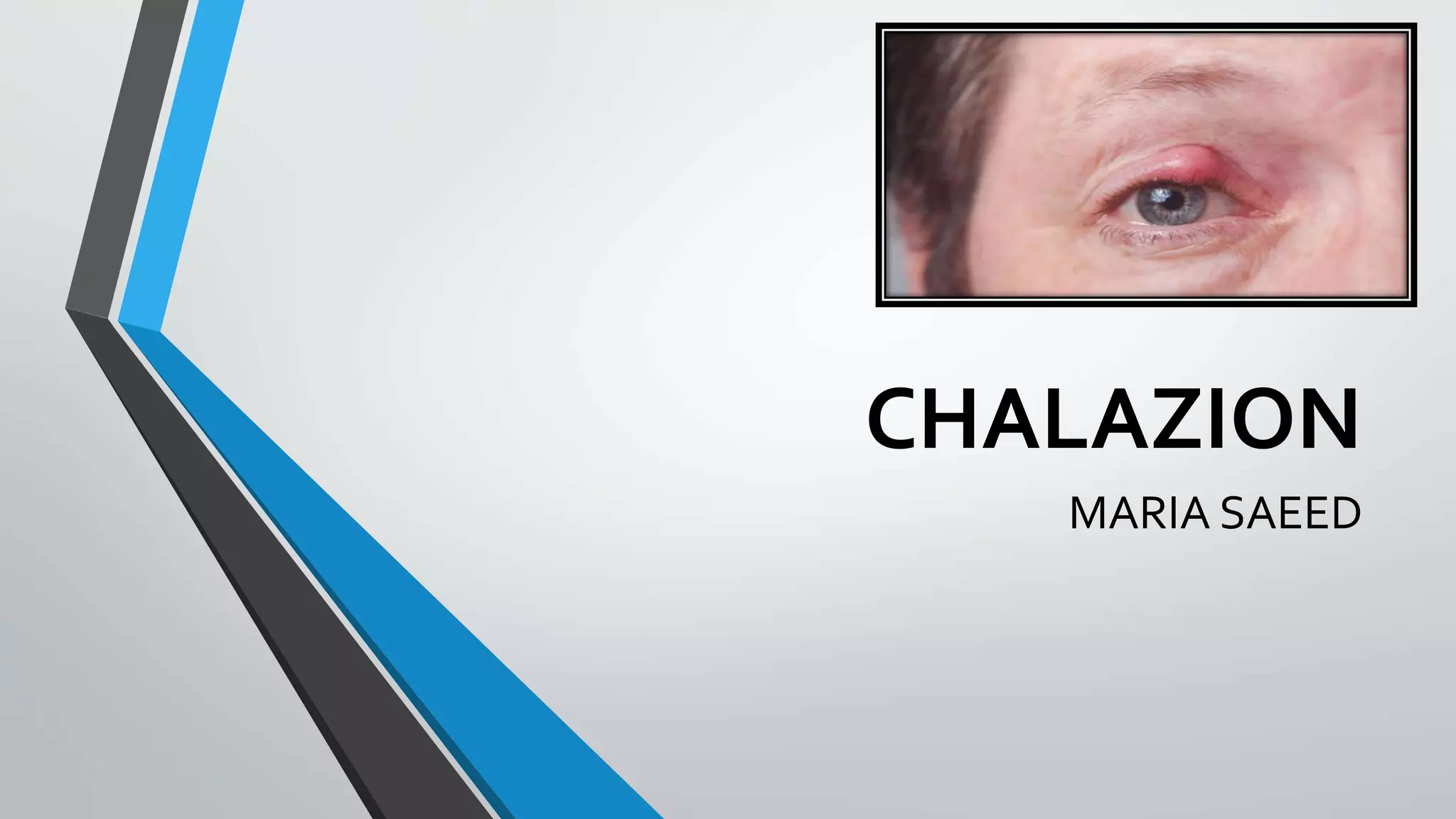
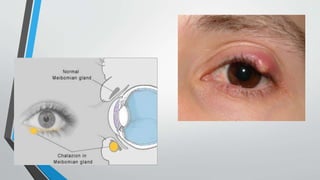
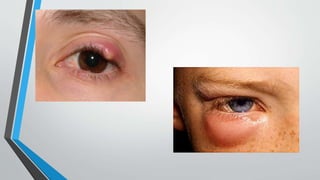
• A chalazion is a slowly developing lump that forms due to blockage and
swelling of an oil gland in the eyelid.
• A chalazion is generally not an infection. It often starts out as a very small
red, tender, swollen area of the eyelid.
• In a few days, it may change to a painless slow-growing lump the size of a
pea.
Characteristics of a chalazion:
• Painless bump.
• Caused by a thickening of the fluid in the oil glands (meibomian glands) of the
eyelid.
• Tearing and mild irritation.
• Blurred vision.
• More common in adults than children; most frequently occurs in people aged 30-50.
Risk factors
• Acne rosacea
• Chronic blepharitis (inflammation of the eyelids, often from excess bacteria)
• Seborrhea
• Tuberculosis
• Viral infection
• Rarely, they may be an indication of an infection or skin cancer
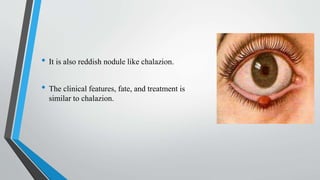
Marginal chalazion
• Nodules, but infected chalazia may result in preseptal cellulitis.
• Marginal chalazia are those located at the eyelid margin and usually result from
superior extension (of a lower lid chalazion) beyond the lid margin
• or inferior extension (of an upper lid chalazion) beyond the lid margin.
• It is also reddish nodule like chalazion.
• The clinical features, fate, and treatment is
similar to chalazion.
Pathophysiology
General Pathology
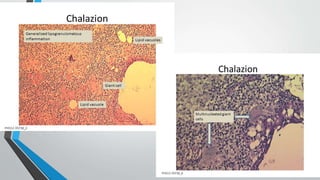
• Microscopic study shows chronic granulomatous inflammation
compromised of multinucleated giant cells and epithelioid cells surrounding a
lipid globule.
• Neutrophils, lymphocytes and plasma cells may are often present.
Pathophysiology
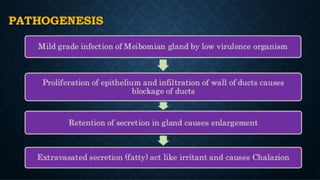
• Meiboiman glands are a sebaceous glands found in eyelids. They secrete Oily
components of tears.
• Chalazia are inflammatory lesions that form due to stasis of gland secretion
with resultant inspissation of gland orifice and incite a granulomatous
inflammatory response.
• Conjunctival granuloma.
• Meibomian glands are embedded in the tarsal plate of the eyelids; therefore,
edema due blockage of these glands is ordinarily contained to the conjunctival
portion of the lid.
Cont..
• A chalazion may enlarge and break through the tarsal plate to the external
portion of the lid.
• Chalazia due to blockage of Zeis glands are usually located along the lid
margin. The Zeis gland inflammation is termed as External Chalazion.
• The Meiboiman gland inflammation is termed as Internal Chalazion.
Cont..
• Chalazia differ from hordeola in that they form as a result of gland
obstruction and sterile inflammation rather than infection.
• A chalazion is characterized by a mass of granulation tissue and chronic
inflammation (with lymphocytes and lipid-laden macrophages), an internal
or external hordeolum is primarily represent acute focal infectious process
with necrotic debris i.e: abscess.
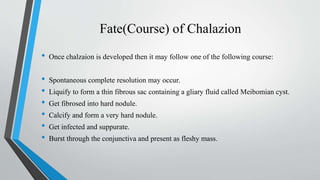
Fate(Course) of Chalazion
• Once chalzaion is developed then it may follow one of the following course:
• Spontaneous complete resolution may occur.
• Liquify to form a thin fibrous sac containing a gliary fluid called Meibomian cyst.
• Get fibrosed into hard nodule.
• Calcify and form a very hard nodule.
• Get infected and suppurate.
• Burst through the conjunctiva and present as fleshy mass.
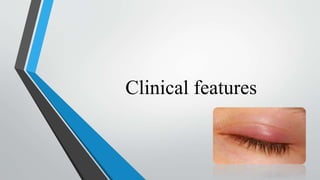
Clinical features
CLINICAL FEATURES
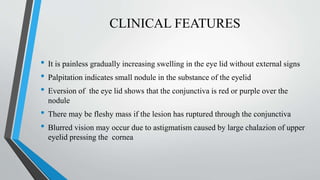
• It is painless gradually increasing swelling in the eye lid without external signs
• Palpitation indicates small nodule in the substance of the eyelid
• Eversion of the eye lid shows that the conjunctiva is red or purple over the
nodule
• There may be fleshy mass if the lesion has ruptured through the conjunctiva
• Blurred vision may occur due to astigmatism caused by large chalazion of upper
eyelid pressing the cornea
Diagnosis
Diagnosis
• A chalazion is best diagnosed by eye doctor who can advise you on treatment
options. Necessary testing might include:
Patient history to determine symptoms and the presence of any general health
problems that may be contributing to the eye problem.
External examination of the eye, including lid structure, skin texture and
eyelash appearance.
Evaluation of the lid margins, base of the eyelashes and oil gland openings
using bright light and magnification
Differential Diagnosis
• Sebaceous gland adenoma
• Sebaceous gland carcinoma
• Sarcoid granuloma
• Dermal tuberclosis
• Fungal infection
• Foreign body granuloma.
TREATMENT
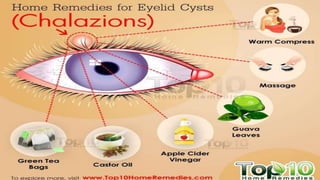
Home Treatment
• A chalazion usually requires very little medical treatment and tends to clear up on
its own within a few weeks.
• There are several safe ways to promote drainage and speed up the healing process.
These include:
Warm Compresses.
Gentle Massage.
Over-the-Counter.
Warm compresses
• Applying a warm compress to the affected eye can help soften any hardened oil
blocking the gland ducts.
To make and use a warm compress:
Soak a soft, clean cloth or cotton pad in a bowl of warm water.
Wring out any excess liquid.
Apply the damp cloth or pad to the eyelid for 10–15 minutes.
Continue wetting the compress often to keep it warm.
Repeat this several times a day until the swelling goes down.
Gentle massage
• Gently massaging the eyelids for several minutes each day can help the oil ducts
drain more effectively.
• Before doing so, ensure that the hands are clean to reduce the risk of infection.
• Once the chalazion begins to drain, keep the area clean and avoid touching it
with bare hands.
Over-the-counter treatments
• A number of over-the-counter products can help treat a chalazion or stye. These
may reduce irritation, prevent infection, and speed up the healing process.
• Some of these products include:
 Ointments
 Solutions
Medicated eye pads.
Surgery
• It is the most common method of treatment.
• The lesion is incised and contents are curetted from conjunctival side by
vertical incision
Complications
Complications
Potential complications of chalazia include:
• lash loss
• lid notching
• other cosmetic deformity
• adjunctive infections
• leads to the development of hordeolum
• preseptal cellulitis
Cont..
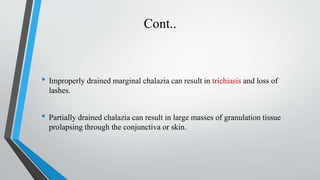
• Improperly drained marginal chalazia can result in trichiasis and loss of
lashes.
• Partially drained chalazia can result in large masses of granulation tissue
prolapsing through the conjunctiva or skin.
Cont..
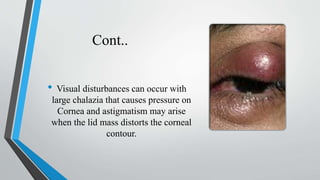
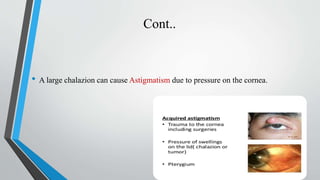
• Visual disturbances can occur with
large chalazia that causes pressure on
Cornea and astigmatism may arise
when the lid mass distorts the corneal
contour.
Cont..
• A large chalazion can cause Astigmatism due to pressure on the cornea.
Prevention
Prevention:
Cleansing the eye area every day can help prevent a chalazion from
developing or recurring.
Using premoistened cleansing wipes to keep the oil glands from becoming
blocked.
Avoid rubbing the eyes.
Protecting the eyes from dust and air pollution. e.g: by wearing sunglasses
when outdoors.
Replacing eye makeup every 6 months to prevent bacterial growth.
Chalazion
Chalazion

Chalazion

  • 1.
  • 2.
    • A chalazionis a slowly developing lump that forms due to blockage and swelling of an oil gland in the eyelid. • A chalazion is generally not an infection. It often starts out as a very small red, tender, swollen area of the eyelid. • In a few days, it may change to a painless slow-growing lump the size of a pea.
  • 3.
    Characteristics of achalazion: • Painless bump. • Caused by a thickening of the fluid in the oil glands (meibomian glands) of the eyelid. • Tearing and mild irritation. • Blurred vision. • More common in adults than children; most frequently occurs in people aged 30-50.
  • 4.
    Risk factors • Acnerosacea • Chronic blepharitis (inflammation of the eyelids, often from excess bacteria) • Seborrhea • Tuberculosis • Viral infection • Rarely, they may be an indication of an infection or skin cancer
  • 5.
    Marginal chalazion • Nodules,but infected chalazia may result in preseptal cellulitis. • Marginal chalazia are those located at the eyelid margin and usually result from superior extension (of a lower lid chalazion) beyond the lid margin • or inferior extension (of an upper lid chalazion) beyond the lid margin.
  • 6.
    • It isalso reddish nodule like chalazion. • The clinical features, fate, and treatment is similar to chalazion.
  • 7.
  • 8.
    General Pathology • Microscopicstudy shows chronic granulomatous inflammation compromised of multinucleated giant cells and epithelioid cells surrounding a lipid globule. • Neutrophils, lymphocytes and plasma cells may are often present.
  • 10.
    Pathophysiology • Meiboiman glandsare a sebaceous glands found in eyelids. They secrete Oily components of tears. • Chalazia are inflammatory lesions that form due to stasis of gland secretion with resultant inspissation of gland orifice and incite a granulomatous inflammatory response. • Conjunctival granuloma. • Meibomian glands are embedded in the tarsal plate of the eyelids; therefore, edema due blockage of these glands is ordinarily contained to the conjunctival portion of the lid.
  • 11.
    Cont.. • A chalazionmay enlarge and break through the tarsal plate to the external portion of the lid. • Chalazia due to blockage of Zeis glands are usually located along the lid margin. The Zeis gland inflammation is termed as External Chalazion. • The Meiboiman gland inflammation is termed as Internal Chalazion.
  • 13.
    Cont.. • Chalazia differfrom hordeola in that they form as a result of gland obstruction and sterile inflammation rather than infection. • A chalazion is characterized by a mass of granulation tissue and chronic inflammation (with lymphocytes and lipid-laden macrophages), an internal or external hordeolum is primarily represent acute focal infectious process with necrotic debris i.e: abscess.
  • 15.
    Fate(Course) of Chalazion •Once chalzaion is developed then it may follow one of the following course: • Spontaneous complete resolution may occur. • Liquify to form a thin fibrous sac containing a gliary fluid called Meibomian cyst. • Get fibrosed into hard nodule. • Calcify and form a very hard nodule. • Get infected and suppurate. • Burst through the conjunctiva and present as fleshy mass.
  • 16.
  • 17.
    CLINICAL FEATURES • Itis painless gradually increasing swelling in the eye lid without external signs • Palpitation indicates small nodule in the substance of the eyelid • Eversion of the eye lid shows that the conjunctiva is red or purple over the nodule • There may be fleshy mass if the lesion has ruptured through the conjunctiva • Blurred vision may occur due to astigmatism caused by large chalazion of upper eyelid pressing the cornea
  • 18.
  • 19.
    Diagnosis • A chalazionis best diagnosed by eye doctor who can advise you on treatment options. Necessary testing might include: Patient history to determine symptoms and the presence of any general health problems that may be contributing to the eye problem. External examination of the eye, including lid structure, skin texture and eyelash appearance. Evaluation of the lid margins, base of the eyelashes and oil gland openings using bright light and magnification

  • 20.
    Differential Diagnosis • Sebaceousgland adenoma • Sebaceous gland carcinoma • Sarcoid granuloma • Dermal tuberclosis • Fungal infection • Foreign body granuloma.
  • 21.
  • 22.
    Home Treatment • Achalazion usually requires very little medical treatment and tends to clear up on its own within a few weeks. • There are several safe ways to promote drainage and speed up the healing process. These include: Warm Compresses. Gentle Massage. Over-the-Counter.

  • 23.
    Warm compresses • Applyinga warm compress to the affected eye can help soften any hardened oil blocking the gland ducts. To make and use a warm compress: Soak a soft, clean cloth or cotton pad in a bowl of warm water. Wring out any excess liquid. Apply the damp cloth or pad to the eyelid for 10–15 minutes. Continue wetting the compress often to keep it warm. Repeat this several times a day until the swelling goes down.
  • 25.
    Gentle massage • Gentlymassaging the eyelids for several minutes each day can help the oil ducts drain more effectively. • Before doing so, ensure that the hands are clean to reduce the risk of infection. • Once the chalazion begins to drain, keep the area clean and avoid touching it with bare hands.
  • 26.
    Over-the-counter treatments • Anumber of over-the-counter products can help treat a chalazion or stye. These may reduce irritation, prevent infection, and speed up the healing process. • Some of these products include:  Ointments  Solutions Medicated eye pads.
  • 27.
    Surgery • It isthe most common method of treatment. • The lesion is incised and contents are curetted from conjunctival side by vertical incision
  • 28.
  • 29.
    Complications Potential complications ofchalazia include: • lash loss • lid notching • other cosmetic deformity • adjunctive infections • leads to the development of hordeolum • preseptal cellulitis
  • 31.
    Cont.. • Improperly drainedmarginal chalazia can result in trichiasis and loss of lashes. • Partially drained chalazia can result in large masses of granulation tissue prolapsing through the conjunctiva or skin.
  • 32.
    Cont.. • Visual disturbancescan occur with large chalazia that causes pressure on Cornea and astigmatism may arise when the lid mass distorts the corneal contour.
  • 33.
    Cont.. • A largechalazion can cause Astigmatism due to pressure on the cornea.
  • 34.
  • 35.
    Prevention: Cleansing the eyearea every day can help prevent a chalazion from developing or recurring. Using premoistened cleansing wipes to keep the oil glands from becoming blocked. Avoid rubbing the eyes. Protecting the eyes from dust and air pollution. e.g: by wearing sunglasses when outdoors. Replacing eye makeup every 6 months to prevent bacterial growth.