INTRODUCTION
To provide qualitative care of psychiatric
patients and to fulfill professional obligation
towards psychiatric care, in 1973, the Division
of Psychiatric and Mental Health Nursing.
If the nurse is able to follow the standards of
Mental Health Nursing by maintaining
accurate records based on observation and
they can be able to avoid intelligently in
getting involved in personal issues.
For e.g., Client’s will related to property,
giving wrong information related to client to
his family or to other welfare/situational
agency or to any type of assaults (physical
or sexual assault).
If the nurse fails to follow the standards
perfectly in her practice it will be referred to
as, ‘NEGLIGENCE’.
DEFINITIONS
1. Advanced practice registered nurse in
psychiatric-mental health (APRN-PMH) -
A licensed registered nurse (RN),
educationally prepared at least at the
master's degree level in the specialty, whose
graduate level preparation is distinguished by
a depth of knowledge of advanced clinical
nursing skills.
2. Brief therapy - Treatment that focuses on the
resolution of a specific problem or behavior in
a limited number of sessions.
3. Case management - An intervention in which
health care is integrated, coordinated, and
advocated for individuals, families, and
groups who require services.
4. Crisis intervention – A short-term therapeutic
process that focuses on the rapid resolution
of an immediate crisis or emergency using
available personnel, family, and/or
environmental factors.
5. National Council of State Boards of Nursing -
A membership organization comprised of
states’ boards of nursing that recommends
practice guidelines and addresses practice
issues.
6. Nurse Practice Act – State statute that
defines the legal limits of practice for
registered nurses.
7. Milieu therapy/therapeutic environment –
A type of psychotherapy using the total
environment to provide a therapeutic
community.
8. Clinical Nurse Specialist(Nurse practitioner) –
An advanced practice nurse (APRN) with
Master’s degree in a specialty area of practice
with specific competencies outlined in the
scope and standards of practice for each
specialty.
9. Autonomy- It implies self-determination,
independence, and shared power. For
psychiatric nursing, attaining autonomy means
being able to exercise control over psychiatric
nursing practice.
10. Accountability – It means to be answerable to
someone for something. It focuses
responsibility on the individual nurse for
personal actions, or perhaps lack of actions.
11.Nursing practice standards – Authoritative
statements that describe a level of care or
performance, common to the profession of
nursing, by which the quality of nursing can be
judged. They include activities related to
assessment, diagnosis, outcomes, planning,
intervention, evaluation, ethics etc.
CATEGORIES OF STANDARDS OF
MENTAL HEALTH NURSING
There are mainly two
categories or types of mental
health nursing standards:
I. Professional Practice
Standards
II. Professional Performance
Standards
1. THEORY
 Theories were formulated based on scientific
phenomena of concern to nurse and to
provide basis for nursing interventions.
 Hence nurse must apply appropriate theory
which is scientifically based to take necessary
decisions related to nursing practice.
2. ASSESSMENT/DATA
COLLECTION
 To adopt nursing process in a
systemic way, assessment is the
first step to carry out
systematically to enable the
nurse to draw sound
conclusions in order to
diagnose the client’s condition
and to plan unnecessary
interventions to improve clients
condition by promoting their
mental health.
 The data will be gathered in a systemic manner
factual, realistic, accurate, and relevant
information related to psychology, psychiatry,
psychological and biophysical sciences and
essential for professional psychiatric nurses to
assess the client’s condition.
Scientific techniques and various resources will
be used to collect the data, e.g., clinical
observation, interview, physical examination,
health assessment and mental status
examination etc.
2. ASSESSMENT
Nursing conditions
 Self awareness
 Accurate observation
 Therapeutic
communication
 Responsive dimensions
of care
Nursing Behaviors
→Establish nursing
contact
→Obtain information
from patient and family
→Validate date with
patient
→Organize data
3. DIAGNOSIS
 Nurse will utilize the standard classification
of mental disorders to infer the conclusions
supported by analyzing the recorded data,
which has been assessed to determine the
nursing diagnosis by following scientific
investigation.
 Nurse will identify the actual and potential
health problems of the specified client
within the scope of nursing practice, which
will promote the nurse to plan for required
nursing interventions on logical basis.
3. DIAGNOSIS
Nursing conditions
 Logical decision making
 Knowledge of normal
parameters
 Inductive and deductive
reasoning
 Socio-cultural sensitivity
Nursing behaviors
→Identify patterns in data
→Compare data with norms
→Analyze and synthesize
data
→Problem and strengths
identified
→Validate problems with
patient
→Formulate nursing
diagnosis
4. OUTCOME IDENTIFICATION
 The clinical nurse has to plan individualized
holistic interventions by identifying expected
outcomes through implementing nursing
care activities to attain the fullest extent of
their capabilities.
 There are mainly 3 types of goals:
 Short term goal
 Long term goal
 Immediate goal
4. OUTCOME IDENTIFICATION
Nursing conditions
 Critical thinking skills
 Partnership with patient
and family
Nursing behaviors
→Hypothesizing
→Specific expected
outcomes
→Validate goals with
patients
5. PLANNING
 The solving approach will be utilized in
developing nursing care plans. Nurse
develops a plan of care with specific goals
that prescribes interventions to attain
expected outcomes, delineating nursing
actions unique to each client’s needs.
Nursing care plans is used to guide the
therapeutic interventions which effectively
achieves the described outcome.
5. PLANNING
Nursing conditions
 Application of theory
 Respect for patient and
family
Nursing behaviors
→Prioritize goals
→Identify nursing
activities
→Validate plan with
patient
6. IMPLEMENTATION OF
THERAPEUTIC INTERVENTIONS
 Nurse will assist the client in meeting their
Activities of Daily Living (ADL) in a goal
directed way, to promote self-care activities
in order to achieve physical and psychological
adequate well being of the individuals.
 A combination of treatment modalities e.g.,
Psychotherapy along with drug therapy and
comprehensive health services will be
planned to relieve the clinical manifestations
of mental illness.
 Rehabilitative and Restorative services will be
planned to achieve independence and to
attain to normalcy. Consultation services are
aimed to influence the client’s care plans and
to bring effective change in the systems. Nurse
are accountable for their services and
practices, which has to be prepared
adequately.
6. IMPLEMENTATION OF THERAPEUTIC
INTERVENTIONS
Standard 6A. COORDINATION OF CARE
• The psychiatric mental health registered
nurse coordinates care delivery.
Standard 6B.HEALTH TEACHING AND HEALTH
PROMOTION
• The psychiatric mental health registered
nurse employs strategies to promote health
and a safe environment.
6. IMPLEMENTATION OF THERAPEUTIC
INTERVENTIONS
Standard 6C. MILIEU THERAPY
• The psychiatric mental health registered nurse
provides, structures, and maintains a safe and
therapeutic environment in collaboration with
the patients, families and other health care
clinicians.
6. IMPLEMENTATION OF THERAPEUTIC
INTERVENTIONS
Standard 6D. PHARMACOLOGICAL,
BIOLOGICAL AND COMPLEMENTARY
INTERVENTIONS
• The psychiatric-mental registered nurse uses
knowledge of pharmacological, biological and
complementary interventions and applies
clinical skills to restore the patient’s health
and prevent further disability.
6. IMPLEMENTATION OF THERAPEUTIC
INTERVENTIONS
Standard 6E. PRESCRIPTIVE
AUTHORITY AND TREATMENT
• The APRN-PMH prescribes or
recommends, pharmacological
agents for patients with mental
health problems and psychiatric
disorders based on individual
characteristics, such as culture,
ethnicity, gender, religious beliefs,
age and physical health problems.
6. IMPLEMENTATION OF THERAPEUTIC
INTERVENTIONS
Standard 6F. PSYCHOTHERAPY
• The Psychiatric Mental Health Advanced
Practice Registered Nurse conducts individual,
couples, group, and/or family psychotherapy
using evidence-based psychotherapeutic
frameworks, interpersonal transactions and
nurse-patient therapeutic relationship.
6. IMPLEMENTATION OF THERAPEUTIC
INTERVENTIONS
Standard 6G. CONSULTATION
• The psychiatric mental health advanced
practice nurse provides consultation to
influence the identified plan, enhance the
abilities of other clinicians to provide services
for patients and effect change.
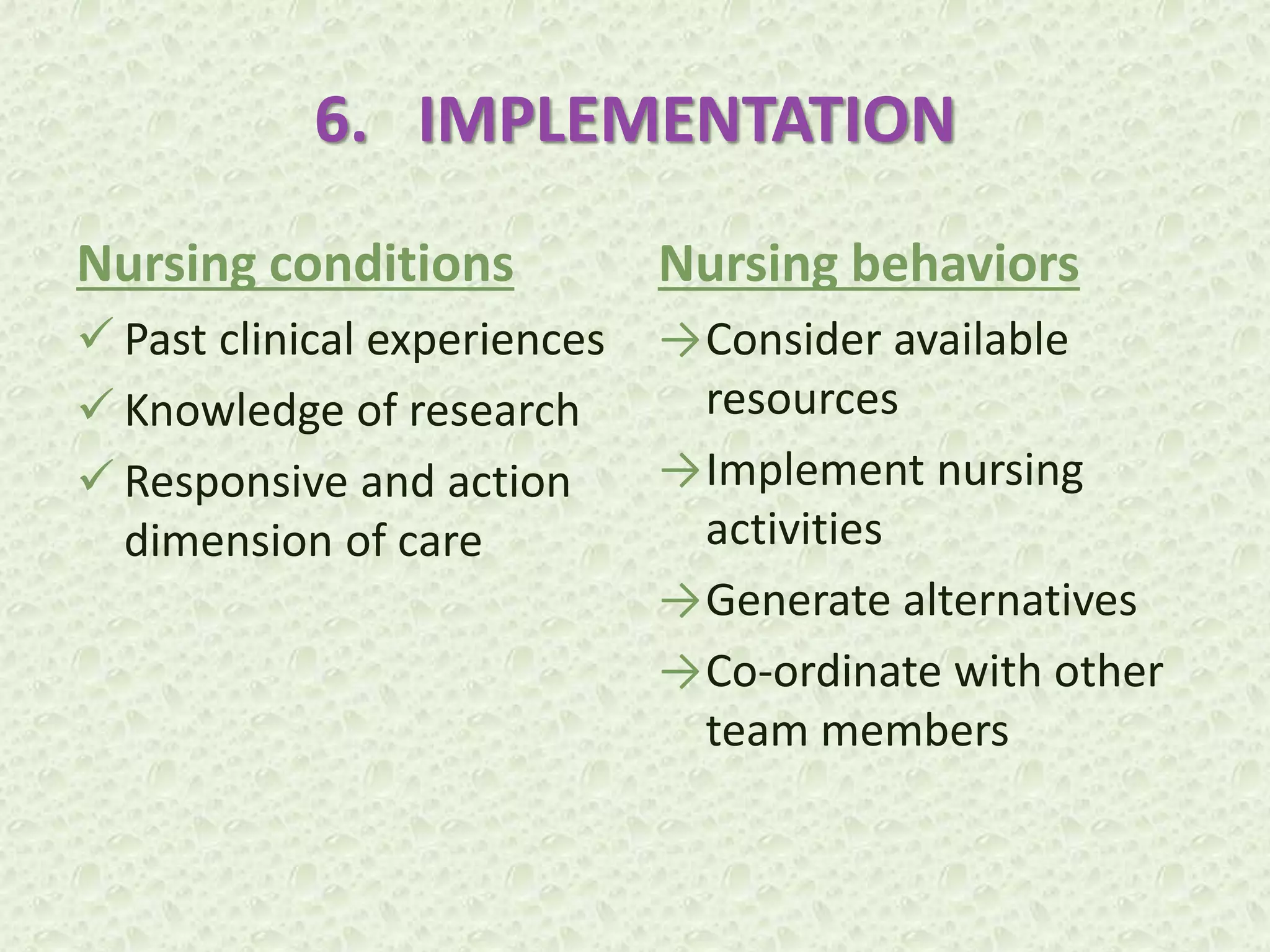
6. IMPLEMENTATION
Nursing conditions
 Past clinical experiences
 Knowledge of research
 Responsive and action
dimension of care
Nursing behaviors
→Consider available
resources
→Implement nursing
activities
→Generate alternatives
→Co-ordinate with other
team members
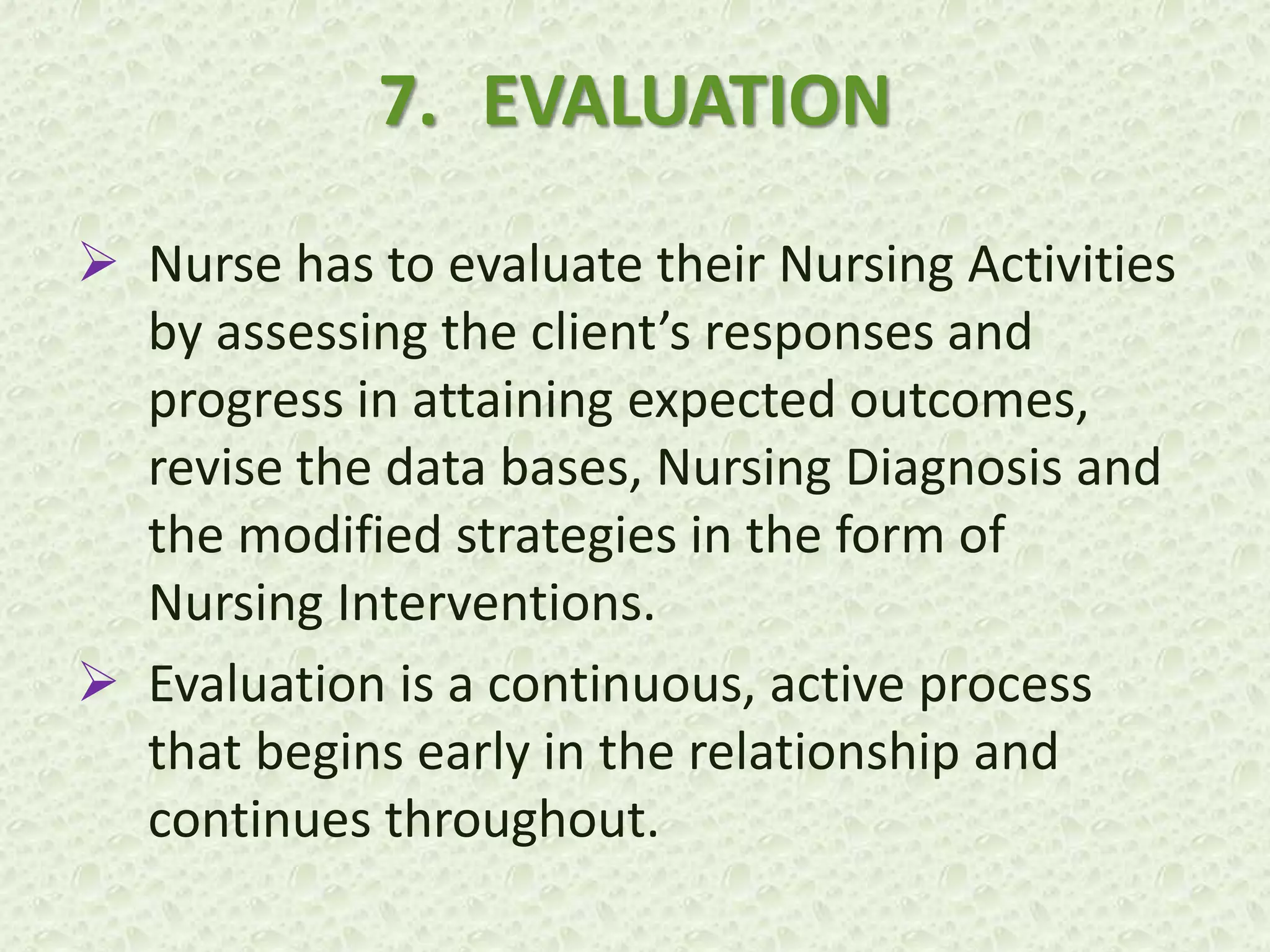
7. EVALUATION
 Nurse has to evaluate their Nursing Activities
by assessing the client’s responses and
progress in attaining expected outcomes,
revise the data bases, Nursing Diagnosis and
the modified strategies in the form of
Nursing Interventions.
 Evaluation is a continuous, active process
that begins early in the relationship and
continues throughout.
7. EVALUATION
Nursing conditions
 Supervision
 Self-analysis
 Peer review
 Patient and family
participation
Nursing behaviors
→Compare patient’s
responses and expected
outcome
→Review nursing process
→Participate in quality
improvement activities
1. QUALITY ASSURANCE BY PEER
REVIEW
To evaluate quality of nursing care provided to
the clients, nurses will participate in peer
review discussions staff evaluation
programmes and assurance process etc. to
ensure the client’s prognosis and who receives
qualitative care.
1. QUALITY ASSURANCE BY PEER
REVIEW
Nursing conditions
 Personal and
professional integrity
 Openness to inquiry
 Critical thinking skills
Nursing behaviors
→Identify improvement
opportunities
→Collect and analyze
relevant data
→Formulate a planned
approach for
improvement
→Implement suggested
changes
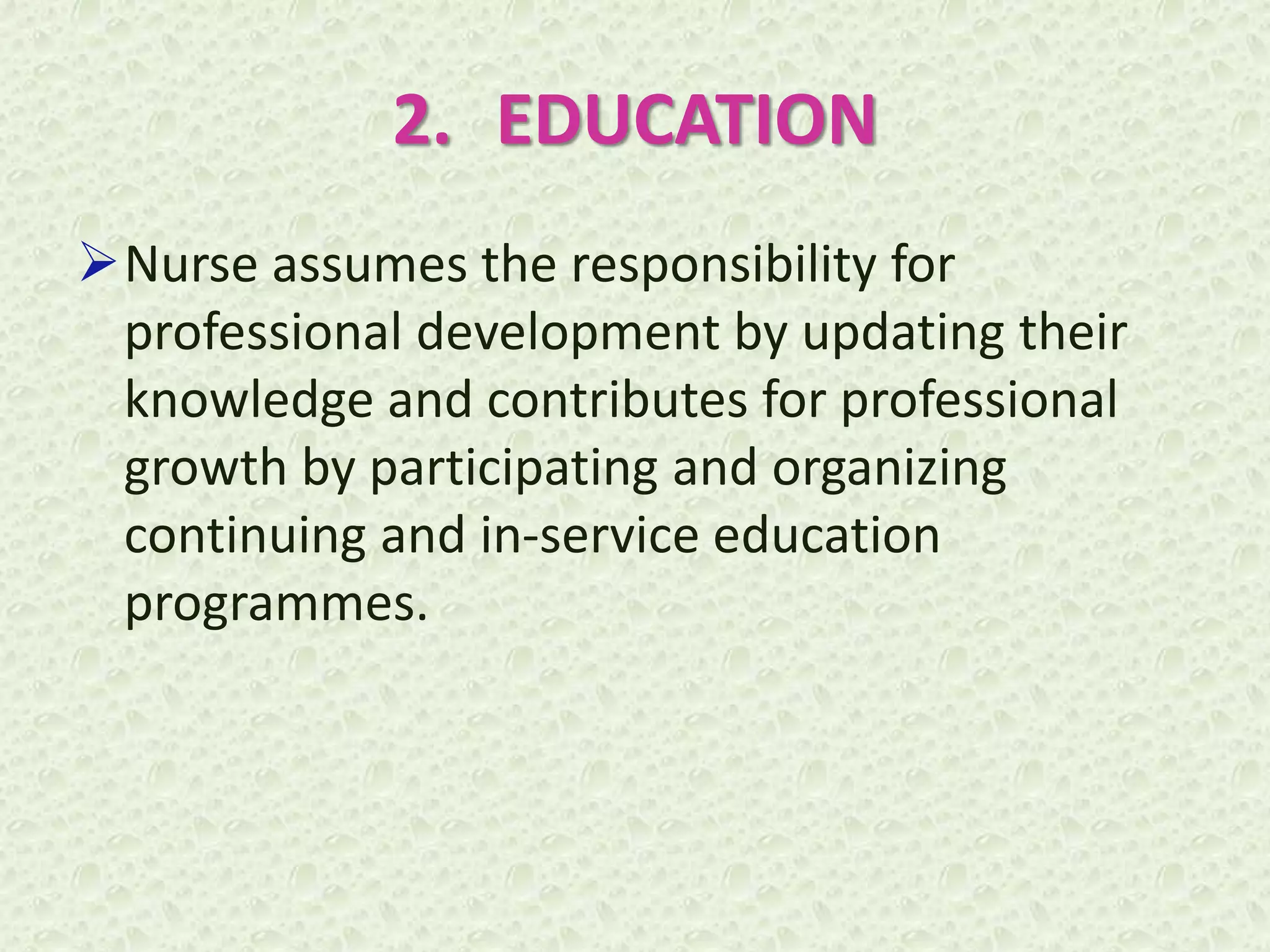
2. EDUCATION
Nurse assumes the responsibility for
professional development by updating their
knowledge and contributes for professional
growth by participating and organizing
continuing and in-service education
programmes.
2. EDUCATION
Nursing conditions
 Intellectual curiosity
 Desire for professional
growth
 Access to new
information
Nursing behaviors
→Seek out new
knowledge and learning
experiences
→Apply new information
in clinical practice
→Demonstrate increasing
mastery of nursing
3. ETHICS
Nurse will maintain the personal and
professional code of ethics in accordance with
legal status and dedicates the qualitative
activities to render nursing care activities.
3. ETHICS
Nursing conditions
 Ability to engage in
introspection
 Sensitivity to social and
moral issues
 Commitment to value
clarification process
Nursing behaviors
→Guide practice by the
code for nurses
→Practice with legal and
ethical responsibility
→Act as patient and
family advocate
4. RESEARCH
Nurses are contributing to psychiatric nursing
and mental health field by innovations theory
and practice and participates in Research
programmes communicates their research
findings through publications. Implements
innovative research strategies for improving
the client’s condition.
4. RESEARCH
Nursing conditions
 Quest for new
knowledge or answer to
questions
 Acute observational and
analytical skills
 Persistence and
attention to detail
Nursing behaviors
→Review reports of
nursing research
→Generate questions and
identify clinical
problems
→Implement research
findings in practice
5. RESOURCE UTILIZATION
Nurses as a member of multidisciplinary team,
co-ordinates with interdisciplinary health care
professional and utilize varied resources for
adopting nursing process to the client in-order
to provide qualitative services.
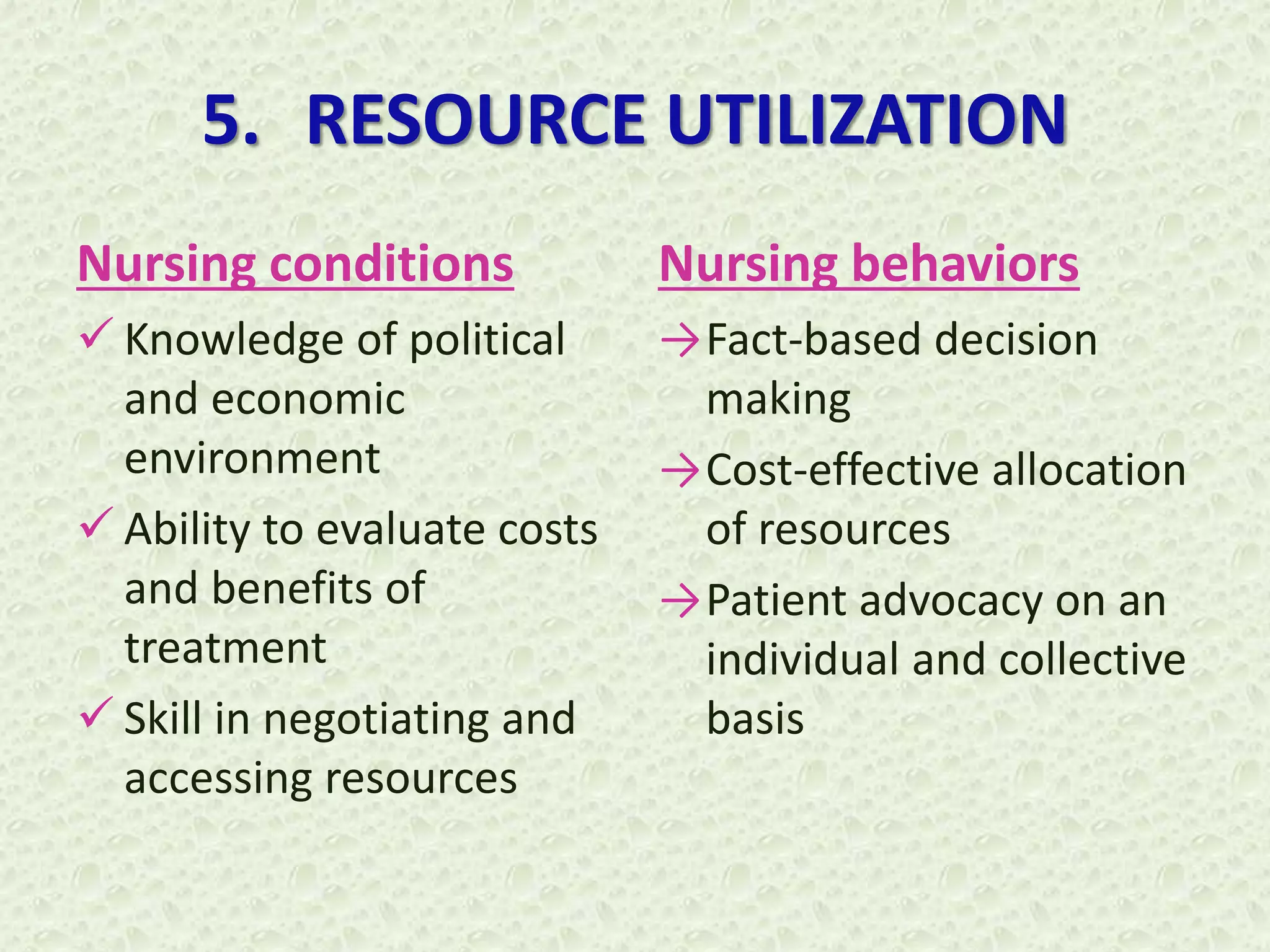
5. RESOURCE UTILIZATION
Nursing conditions
 Knowledge of political
and economic
environment
 Ability to evaluate costs
and benefits of
treatment
 Skill in negotiating and
accessing resources
Nursing behaviors
→Fact-based decision
making
→Cost-effective allocation
of resources
→Patient advocacy on an
individual and collective
basis
6. LEADERSHIP
Learning experiences are provided for other
nursing personnel by adopting different
leadership styles and fulfilling supervisory
responsibilities.
6. LEADERSHIP
Nursing conditions
 Professional self-
efficacy
 Creativity, flexibility and
openness to change
 Commitment to
improving the current
system
Nursing behaviors
→Professional
assertiveness
→Thoughtful risk-taking
→Teach and mentor
others
→Participate in
organizational/system
governance
7. PROFESSIONAL PRACTICE
EVALUATION
The psychiatric mental health registered nurse
evaluates his/her own practice in relation to
the professional practice standards and
guidelines, relevant statutes, rules, and
regulations.
8. COLLEGIALITY
The psychiatric mental health registered nurse
interacts with and contributes to the
professional development of peers and
colleagues.
9. COLLABORATION
The psychiatric mental health registered nurse
collaborates with patients, family and others
in the conduct of nursing practice.
Standards of psy..
Standards of psy..

Standards of psy..

  • 2.
    INTRODUCTION To provide qualitativecare of psychiatric patients and to fulfill professional obligation towards psychiatric care, in 1973, the Division of Psychiatric and Mental Health Nursing. If the nurse is able to follow the standards of Mental Health Nursing by maintaining accurate records based on observation and they can be able to avoid intelligently in getting involved in personal issues.
  • 3.
    For e.g., Client’swill related to property, giving wrong information related to client to his family or to other welfare/situational agency or to any type of assaults (physical or sexual assault). If the nurse fails to follow the standards perfectly in her practice it will be referred to as, ‘NEGLIGENCE’.
  • 4.
    DEFINITIONS 1. Advanced practiceregistered nurse in psychiatric-mental health (APRN-PMH) - A licensed registered nurse (RN), educationally prepared at least at the master's degree level in the specialty, whose graduate level preparation is distinguished by a depth of knowledge of advanced clinical nursing skills.
  • 5.
    2. Brief therapy- Treatment that focuses on the resolution of a specific problem or behavior in a limited number of sessions. 3. Case management - An intervention in which health care is integrated, coordinated, and advocated for individuals, families, and groups who require services. 4. Crisis intervention – A short-term therapeutic process that focuses on the rapid resolution of an immediate crisis or emergency using available personnel, family, and/or environmental factors.
  • 6.
    5. National Councilof State Boards of Nursing - A membership organization comprised of states’ boards of nursing that recommends practice guidelines and addresses practice issues. 6. Nurse Practice Act – State statute that defines the legal limits of practice for registered nurses. 7. Milieu therapy/therapeutic environment – A type of psychotherapy using the total environment to provide a therapeutic community.
  • 7.
    8. Clinical NurseSpecialist(Nurse practitioner) – An advanced practice nurse (APRN) with Master’s degree in a specialty area of practice with specific competencies outlined in the scope and standards of practice for each specialty. 9. Autonomy- It implies self-determination, independence, and shared power. For psychiatric nursing, attaining autonomy means being able to exercise control over psychiatric nursing practice.
  • 8.
    10. Accountability –It means to be answerable to someone for something. It focuses responsibility on the individual nurse for personal actions, or perhaps lack of actions. 11.Nursing practice standards – Authoritative statements that describe a level of care or performance, common to the profession of nursing, by which the quality of nursing can be judged. They include activities related to assessment, diagnosis, outcomes, planning, intervention, evaluation, ethics etc.
  • 9.
    CATEGORIES OF STANDARDSOF MENTAL HEALTH NURSING There are mainly two categories or types of mental health nursing standards: I. Professional Practice Standards II. Professional Performance Standards
  • 11.
    1. THEORY  Theorieswere formulated based on scientific phenomena of concern to nurse and to provide basis for nursing interventions.  Hence nurse must apply appropriate theory which is scientifically based to take necessary decisions related to nursing practice.
  • 12.
    2. ASSESSMENT/DATA COLLECTION  Toadopt nursing process in a systemic way, assessment is the first step to carry out systematically to enable the nurse to draw sound conclusions in order to diagnose the client’s condition and to plan unnecessary interventions to improve clients condition by promoting their mental health.
  • 13.
     The datawill be gathered in a systemic manner factual, realistic, accurate, and relevant information related to psychology, psychiatry, psychological and biophysical sciences and essential for professional psychiatric nurses to assess the client’s condition. Scientific techniques and various resources will be used to collect the data, e.g., clinical observation, interview, physical examination, health assessment and mental status examination etc.
  • 14.
    2. ASSESSMENT Nursing conditions Self awareness  Accurate observation  Therapeutic communication  Responsive dimensions of care Nursing Behaviors →Establish nursing contact →Obtain information from patient and family →Validate date with patient →Organize data
  • 15.
    3. DIAGNOSIS  Nursewill utilize the standard classification of mental disorders to infer the conclusions supported by analyzing the recorded data, which has been assessed to determine the nursing diagnosis by following scientific investigation.  Nurse will identify the actual and potential health problems of the specified client within the scope of nursing practice, which will promote the nurse to plan for required nursing interventions on logical basis.
  • 16.
    3. DIAGNOSIS Nursing conditions Logical decision making  Knowledge of normal parameters  Inductive and deductive reasoning  Socio-cultural sensitivity Nursing behaviors →Identify patterns in data →Compare data with norms →Analyze and synthesize data →Problem and strengths identified →Validate problems with patient →Formulate nursing diagnosis
  • 17.
    4. OUTCOME IDENTIFICATION The clinical nurse has to plan individualized holistic interventions by identifying expected outcomes through implementing nursing care activities to attain the fullest extent of their capabilities.  There are mainly 3 types of goals:  Short term goal  Long term goal  Immediate goal
  • 18.
    4. OUTCOME IDENTIFICATION Nursingconditions  Critical thinking skills  Partnership with patient and family Nursing behaviors →Hypothesizing →Specific expected outcomes →Validate goals with patients
  • 19.
    5. PLANNING  Thesolving approach will be utilized in developing nursing care plans. Nurse develops a plan of care with specific goals that prescribes interventions to attain expected outcomes, delineating nursing actions unique to each client’s needs. Nursing care plans is used to guide the therapeutic interventions which effectively achieves the described outcome.
  • 20.
    5. PLANNING Nursing conditions Application of theory  Respect for patient and family Nursing behaviors →Prioritize goals →Identify nursing activities →Validate plan with patient
  • 21.
    6. IMPLEMENTATION OF THERAPEUTICINTERVENTIONS  Nurse will assist the client in meeting their Activities of Daily Living (ADL) in a goal directed way, to promote self-care activities in order to achieve physical and psychological adequate well being of the individuals.  A combination of treatment modalities e.g., Psychotherapy along with drug therapy and comprehensive health services will be planned to relieve the clinical manifestations of mental illness.
  • 22.
     Rehabilitative andRestorative services will be planned to achieve independence and to attain to normalcy. Consultation services are aimed to influence the client’s care plans and to bring effective change in the systems. Nurse are accountable for their services and practices, which has to be prepared adequately.
  • 23.
    6. IMPLEMENTATION OFTHERAPEUTIC INTERVENTIONS Standard 6A. COORDINATION OF CARE • The psychiatric mental health registered nurse coordinates care delivery. Standard 6B.HEALTH TEACHING AND HEALTH PROMOTION • The psychiatric mental health registered nurse employs strategies to promote health and a safe environment.
  • 24.
    6. IMPLEMENTATION OFTHERAPEUTIC INTERVENTIONS Standard 6C. MILIEU THERAPY • The psychiatric mental health registered nurse provides, structures, and maintains a safe and therapeutic environment in collaboration with the patients, families and other health care clinicians.
  • 25.
    6. IMPLEMENTATION OFTHERAPEUTIC INTERVENTIONS Standard 6D. PHARMACOLOGICAL, BIOLOGICAL AND COMPLEMENTARY INTERVENTIONS • The psychiatric-mental registered nurse uses knowledge of pharmacological, biological and complementary interventions and applies clinical skills to restore the patient’s health and prevent further disability.
  • 26.
    6. IMPLEMENTATION OFTHERAPEUTIC INTERVENTIONS Standard 6E. PRESCRIPTIVE AUTHORITY AND TREATMENT • The APRN-PMH prescribes or recommends, pharmacological agents for patients with mental health problems and psychiatric disorders based on individual characteristics, such as culture, ethnicity, gender, religious beliefs, age and physical health problems.
  • 27.
    6. IMPLEMENTATION OFTHERAPEUTIC INTERVENTIONS Standard 6F. PSYCHOTHERAPY • The Psychiatric Mental Health Advanced Practice Registered Nurse conducts individual, couples, group, and/or family psychotherapy using evidence-based psychotherapeutic frameworks, interpersonal transactions and nurse-patient therapeutic relationship.
  • 29.
    6. IMPLEMENTATION OFTHERAPEUTIC INTERVENTIONS Standard 6G. CONSULTATION • The psychiatric mental health advanced practice nurse provides consultation to influence the identified plan, enhance the abilities of other clinicians to provide services for patients and effect change.
  • 30.
    6. IMPLEMENTATION Nursing conditions Past clinical experiences  Knowledge of research  Responsive and action dimension of care Nursing behaviors →Consider available resources →Implement nursing activities →Generate alternatives →Co-ordinate with other team members
  • 31.
    7. EVALUATION  Nursehas to evaluate their Nursing Activities by assessing the client’s responses and progress in attaining expected outcomes, revise the data bases, Nursing Diagnosis and the modified strategies in the form of Nursing Interventions.  Evaluation is a continuous, active process that begins early in the relationship and continues throughout.
  • 32.
    7. EVALUATION Nursing conditions Supervision  Self-analysis  Peer review  Patient and family participation Nursing behaviors →Compare patient’s responses and expected outcome →Review nursing process →Participate in quality improvement activities
  • 34.
    1. QUALITY ASSURANCEBY PEER REVIEW To evaluate quality of nursing care provided to the clients, nurses will participate in peer review discussions staff evaluation programmes and assurance process etc. to ensure the client’s prognosis and who receives qualitative care.
  • 35.
    1. QUALITY ASSURANCEBY PEER REVIEW Nursing conditions  Personal and professional integrity  Openness to inquiry  Critical thinking skills Nursing behaviors →Identify improvement opportunities →Collect and analyze relevant data →Formulate a planned approach for improvement →Implement suggested changes
  • 36.
    2. EDUCATION Nurse assumesthe responsibility for professional development by updating their knowledge and contributes for professional growth by participating and organizing continuing and in-service education programmes.
  • 37.
    2. EDUCATION Nursing conditions Intellectual curiosity  Desire for professional growth  Access to new information Nursing behaviors →Seek out new knowledge and learning experiences →Apply new information in clinical practice →Demonstrate increasing mastery of nursing
  • 38.
    3. ETHICS Nurse willmaintain the personal and professional code of ethics in accordance with legal status and dedicates the qualitative activities to render nursing care activities.
  • 39.
    3. ETHICS Nursing conditions Ability to engage in introspection  Sensitivity to social and moral issues  Commitment to value clarification process Nursing behaviors →Guide practice by the code for nurses →Practice with legal and ethical responsibility →Act as patient and family advocate
  • 40.
    4. RESEARCH Nurses arecontributing to psychiatric nursing and mental health field by innovations theory and practice and participates in Research programmes communicates their research findings through publications. Implements innovative research strategies for improving the client’s condition.
  • 41.
    4. RESEARCH Nursing conditions Quest for new knowledge or answer to questions  Acute observational and analytical skills  Persistence and attention to detail Nursing behaviors →Review reports of nursing research →Generate questions and identify clinical problems →Implement research findings in practice
  • 42.
    5. RESOURCE UTILIZATION Nursesas a member of multidisciplinary team, co-ordinates with interdisciplinary health care professional and utilize varied resources for adopting nursing process to the client in-order to provide qualitative services.
  • 43.
    5. RESOURCE UTILIZATION Nursingconditions  Knowledge of political and economic environment  Ability to evaluate costs and benefits of treatment  Skill in negotiating and accessing resources Nursing behaviors →Fact-based decision making →Cost-effective allocation of resources →Patient advocacy on an individual and collective basis
  • 44.
    6. LEADERSHIP Learning experiencesare provided for other nursing personnel by adopting different leadership styles and fulfilling supervisory responsibilities.
  • 45.
    6. LEADERSHIP Nursing conditions Professional self- efficacy  Creativity, flexibility and openness to change  Commitment to improving the current system Nursing behaviors →Professional assertiveness →Thoughtful risk-taking →Teach and mentor others →Participate in organizational/system governance
  • 46.
    7. PROFESSIONAL PRACTICE EVALUATION Thepsychiatric mental health registered nurse evaluates his/her own practice in relation to the professional practice standards and guidelines, relevant statutes, rules, and regulations.
  • 47.
    8. COLLEGIALITY The psychiatricmental health registered nurse interacts with and contributes to the professional development of peers and colleagues.
  • 48.
    9. COLLABORATION The psychiatricmental health registered nurse collaborates with patients, family and others in the conduct of nursing practice.