SUDESHNA BANERJEE DUTTA
LECTURER
S.R.S.V.M B.SC NURSING COLLEGE
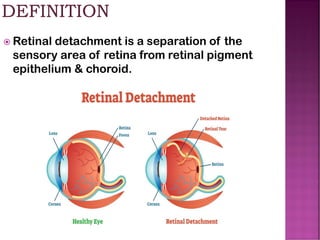
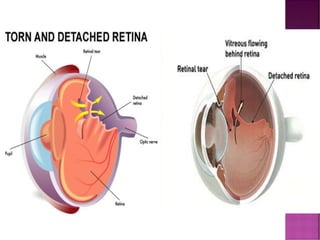
 Retinal detachment is a separation of the
sensory area of retina from retinal pigment
epithelium & choroid.
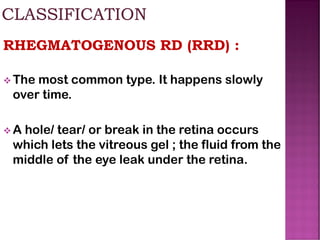
RHEGMATOGENOUS RD (RRD) :
❖ The most common type. It happens slowly
over time.
❖ A hole/ tear/ or break in the retina occurs
which lets the vitreous gel ; the fluid from the
middle of the eye leak under the retina.
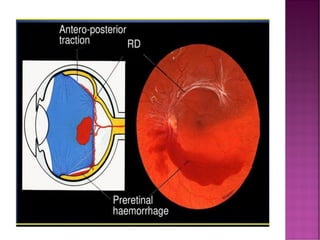
TRACTIONAL RD (TRD) :
❖ Happens when scar tissue or other tissue
grows on your retina and pulls it away from
the layer underneath. It can lead to
serious vision loss.
❖ This type is often found in people
with diabetes who have severe diabetic
retinopathy, or damage to blood vessels in the
retina.
EXUDATIVE RD (ERD) :
❖ It happens when fluid collects under your
retina, but there's no tear. It can affect
both eyes.
❖ This type of detachment is often comes from
an eye injury or as a complication of a wide
range of diseases.
➢ Trauma
➢ Aging
➢ High myopia
➢ Diabetes retinopathy
➢ Uveitis
➢ Macular degeneration
➢ Tumor
➢ Aphakia after cataract surgery
➢ Dark spots
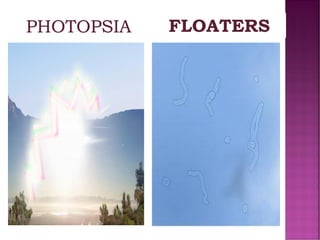
➢ Photopsia (presence of perceived flashes of
light in the field of vision)
➢ Blurred vision
➢ Slight feeling of heaviness in eye
➢ Visual field loss
FLOATERSs
➢ Opthalmoscopy
➢ Slit lamp examination
➢ Cryosurgery (uses extreme cold produced by
liquid nitrogen or argon gas to destroy cancer
cells and abnormal tissue)
➢ Electrodiathermy
➢ Scleral bucking (Scleral buckling is a type of
eye surgery to correct a detached retina and
restore vision)
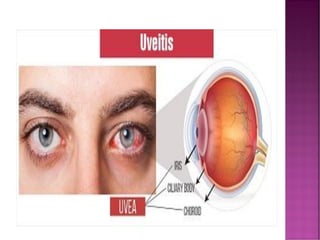
➢ It’s a form of eye inflammation (uveal tissue)
➢ It affects the middle layer of tissue in the eye
wall. They include eye redness pain &
blurred vision.
➢ The condition can affect one or both eyes.
Primarily affects people aged between 20-
50, but, may also affect children.
Exogenous infections:
 Foreign bodies
 Penetrating injuries
 Corneal ulcer perforation
 Any post operative infection
Endogenous infections:
 Any infections in the blood
 Keratitis (an inflammation of the cornea)
 Conjunctivitis
➢ Autoimmune disease
➢ Allergic uveitis
➢ Traumatic
➢ Toxic uveitis
➢ Idiopthic
➢ Burning sensation
➢ Photophobia
➢ Irregular pupil
➢ Eye pain
➢ Floaters
➢ Headache
➢ Fundus examination
➢ Radiology (X-Ray)
➢ Corticosteroids (prednisolone,
dexamethasone, betamethasone)
➢ Anti-diabetic drug
➢ Antiviral (400 mg oral acyclovir five times
daily )
➢ Azithromycin, tetracycline, erythromycin
Retinal detachment & uveitis

Retinal detachment & uveitis

  • 1.
  • 2.
     Retinal detachmentis a separation of the sensory area of retina from retinal pigment epithelium & choroid.
  • 3.
    RHEGMATOGENOUS RD (RRD): ❖ The most common type. It happens slowly over time. ❖ A hole/ tear/ or break in the retina occurs which lets the vitreous gel ; the fluid from the middle of the eye leak under the retina.
  • 5.
    TRACTIONAL RD (TRD): ❖ Happens when scar tissue or other tissue grows on your retina and pulls it away from the layer underneath. It can lead to serious vision loss. ❖ This type is often found in people with diabetes who have severe diabetic retinopathy, or damage to blood vessels in the retina.
  • 7.
    EXUDATIVE RD (ERD): ❖ It happens when fluid collects under your retina, but there's no tear. It can affect both eyes. ❖ This type of detachment is often comes from an eye injury or as a complication of a wide range of diseases.
  • 8.
    ➢ Trauma ➢ Aging ➢High myopia ➢ Diabetes retinopathy ➢ Uveitis ➢ Macular degeneration ➢ Tumor ➢ Aphakia after cataract surgery
  • 9.
    ➢ Dark spots ➢Photopsia (presence of perceived flashes of light in the field of vision) ➢ Blurred vision ➢ Slight feeling of heaviness in eye ➢ Visual field loss
  • 10.
  • 12.
  • 13.
    ➢ Cryosurgery (usesextreme cold produced by liquid nitrogen or argon gas to destroy cancer cells and abnormal tissue) ➢ Electrodiathermy ➢ Scleral bucking (Scleral buckling is a type of eye surgery to correct a detached retina and restore vision)
  • 15.
    ➢ It’s aform of eye inflammation (uveal tissue) ➢ It affects the middle layer of tissue in the eye wall. They include eye redness pain & blurred vision. ➢ The condition can affect one or both eyes. Primarily affects people aged between 20- 50, but, may also affect children.
  • 17.
    Exogenous infections:  Foreignbodies  Penetrating injuries  Corneal ulcer perforation  Any post operative infection Endogenous infections:  Any infections in the blood  Keratitis (an inflammation of the cornea)  Conjunctivitis
  • 18.
    ➢ Autoimmune disease ➢Allergic uveitis ➢ Traumatic ➢ Toxic uveitis ➢ Idiopthic
  • 19.
    ➢ Burning sensation ➢Photophobia ➢ Irregular pupil ➢ Eye pain ➢ Floaters ➢ Headache
  • 20.
    ➢ Fundus examination ➢Radiology (X-Ray)
  • 21.
    ➢ Corticosteroids (prednisolone, dexamethasone,betamethasone) ➢ Anti-diabetic drug ➢ Antiviral (400 mg oral acyclovir five times daily ) ➢ Azithromycin, tetracycline, erythromycin