CLINICAL REFRACTION
Dr Saurabh Kushwaha
Resident Ophthalmology
SCOPE
 Introduction
 Objective refraction
 Retinoscopy
 Autorefractometry
 Subjective refraction
 Monocular refraction
 Binocular refraction
 Correction for near vision
INTRODUCTION
 History
 Visual acuity
 Ophthalmic examination
 Retinoscopy/ Autorefractometry
 Monocular Subjective refinement
 Binocular balancing
 Near vision correction
OBJECTIVE REFRACTION
 Retinoscopy
 Autorefractometry
 Photorefraction
 Electrophysiological methods
RETINOSCOPY
 Prerequisite
• Dark room
• Trial set
• Trial frame
• Distance vision chart
• Near vision chart
• Retinoscope
TYPES OF RETINOSCOPE
 Reflecting (mirror)
• Plane mirror
• Priestley Smith’s mirror
 Self illuminated
• Spot retinoscope
• Streak retinoscope
TYPES OF RETINOSCOPY
 Dynamic retinoscopy
 Static retinoscopy
• Wet retinoscopy
• Dry retinoscopy
PROCEDURE OF RETINOSCOPY
 Ask the patient to fixate on target
 Patient’s RE examined with the examiner’s
RE with the retinoscope in right hand
 Working Distance about 1 m.
 Examiner’s both eyes should be open
 Examiner not to obstruct the view of target
 Examiner observes a red reflex in the
pupillary area
 Retinoscope is moved in both horizontal or
vertical meridians
INFERENCES OF RETINOSCOPY
PROPERTIES OF REFLEX
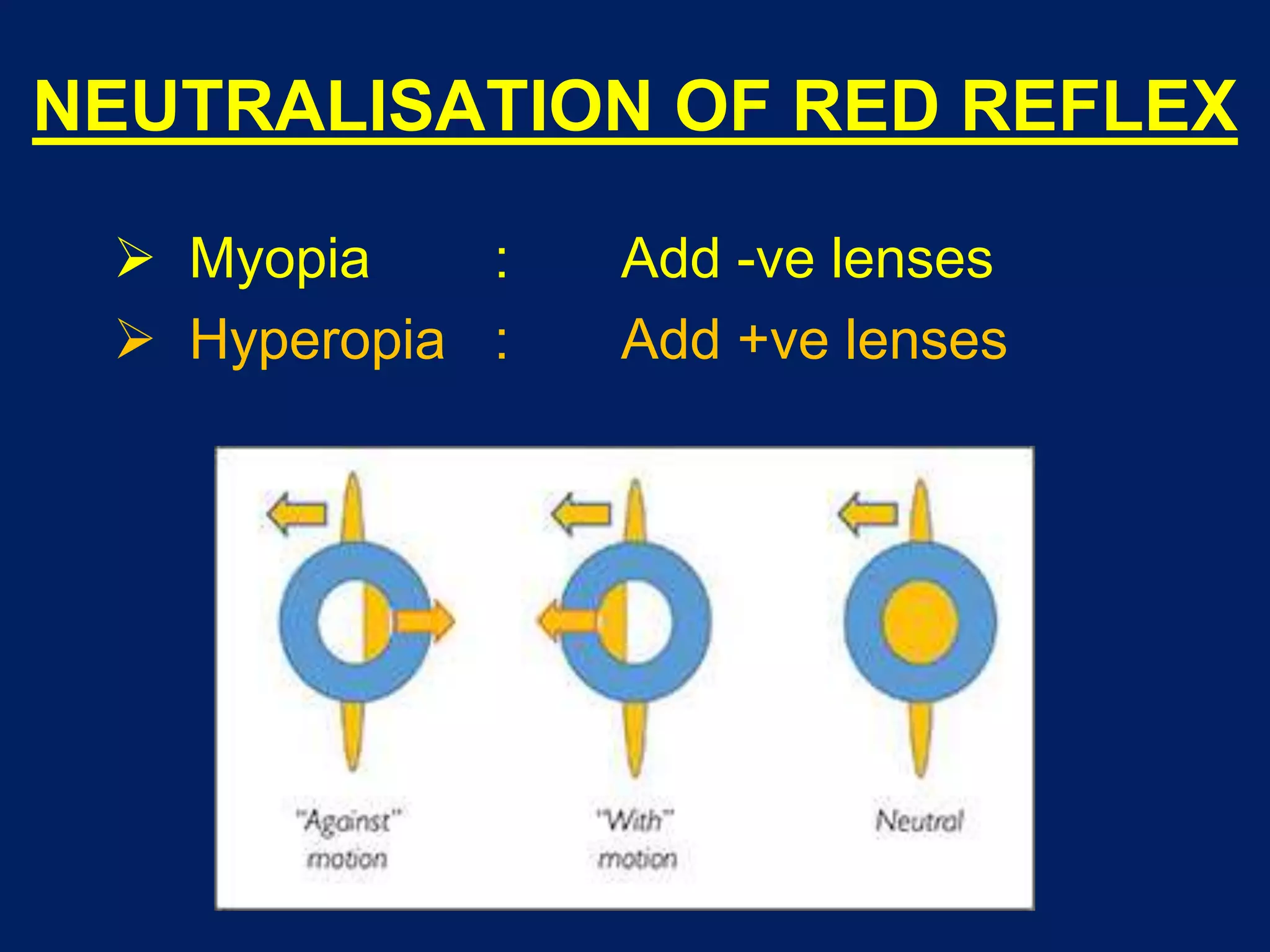
Movement
With Need more plus
Against Need more minus
Brightness
Dim Far from neutralization
Bright Close to neutralization
Width
Narrow Far from neutralization
Wide Close to neutralization
Speed
Slow Far from neutralization
Fast Close to neutralization
NEUTRALISATION OF RED REFLEX
 Myopia : Add -ve lenses
 Hyperopia : Add +ve lenses
CYCLOPLEGICS IN RETINOSCOPY
S
N
o
Drug Name Age Peak
Effect
Duratio
n of
action
Time of
retinosco
py
PCT Tonus
allowan
ce
1. Atropine 1% <5
yrs
2-3
days
10-20
days
4th Day After 3
wks
1.0 D
2. Homatropine
2%
5-8
yrs
60-90
min
48-72
hrs
After 90
mins
After 3
days
0.5 D
3. Cyclopentolate
1%
8-20
yrs
80-90
min
6-18 hrs After 90
mins
After 3
days
0.75 D
4. Tropicamide
0.5%, 1%
- 20-40
min
4-6 hrs - - -
5. Phenylephrine
5%, 10%
- 30-40
min
4-6 hrs - - -
PROBLEMS OF RETINOSCOPY
 Poor or invisible red reflex
 Changing retinoscopy findings
 Scissoring shadows
 Spherical aberrations
 Conflicting shadows
 Triangular shadow
AUTOREFRACTOMETRY
 Optical principles
• The Scheiner’s principle
• The Optometer principle
 Types of autorefractometer
• Objective
• Subjective
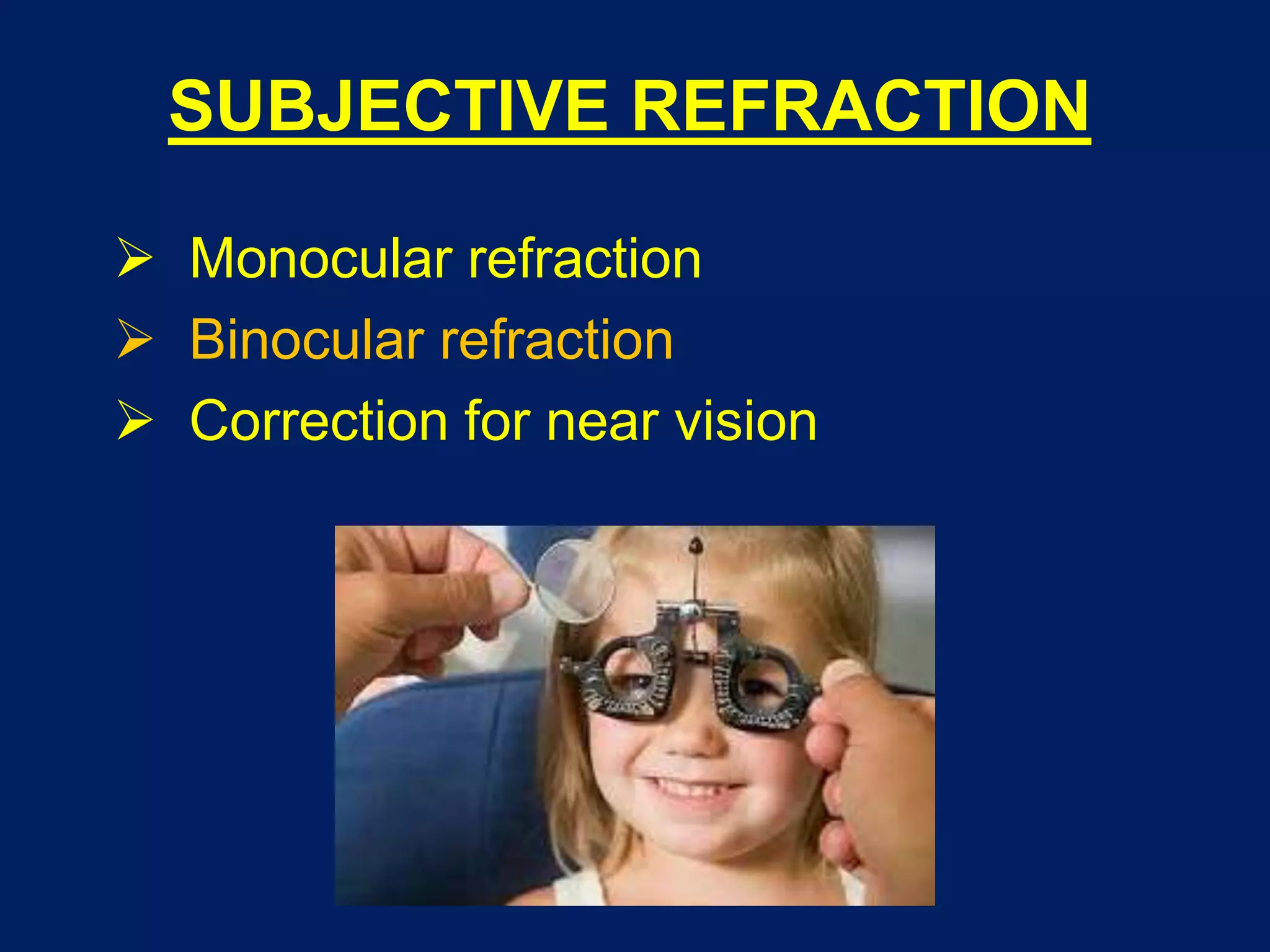
SUBJECTIVE REFRACTION
 Monocular refraction
 Binocular refraction
 Correction for near vision
MONOCULAR REFRACTION
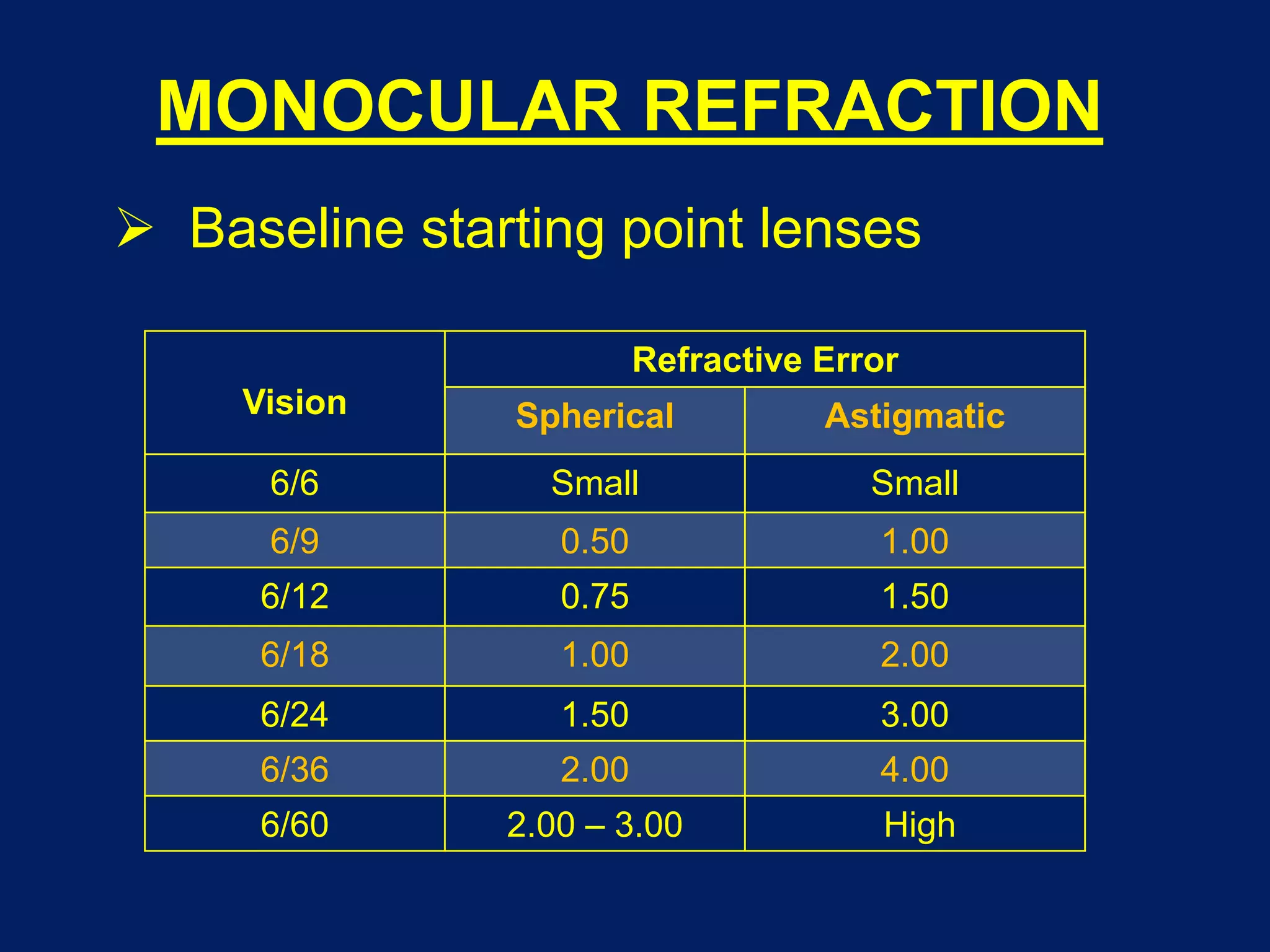
 Baseline starting point lenses
Vision
Refractive Error
Spherical Astigmatic
6/6 Small Small
6/9 0.50 1.00
6/12 0.75 1.50
6/18 1.00 2.00
6/24 1.50 3.00
6/36 2.00 4.00
6/60 2.00 – 3.00 High
 Refining the spherical lenses
 Refining the cylindrical lenses
• Astigmatic clock dial & fogging
 Jackson’s cross cylinder technique
• To bring circle of least confusion on retina
• To refine astigmatic axis and then power
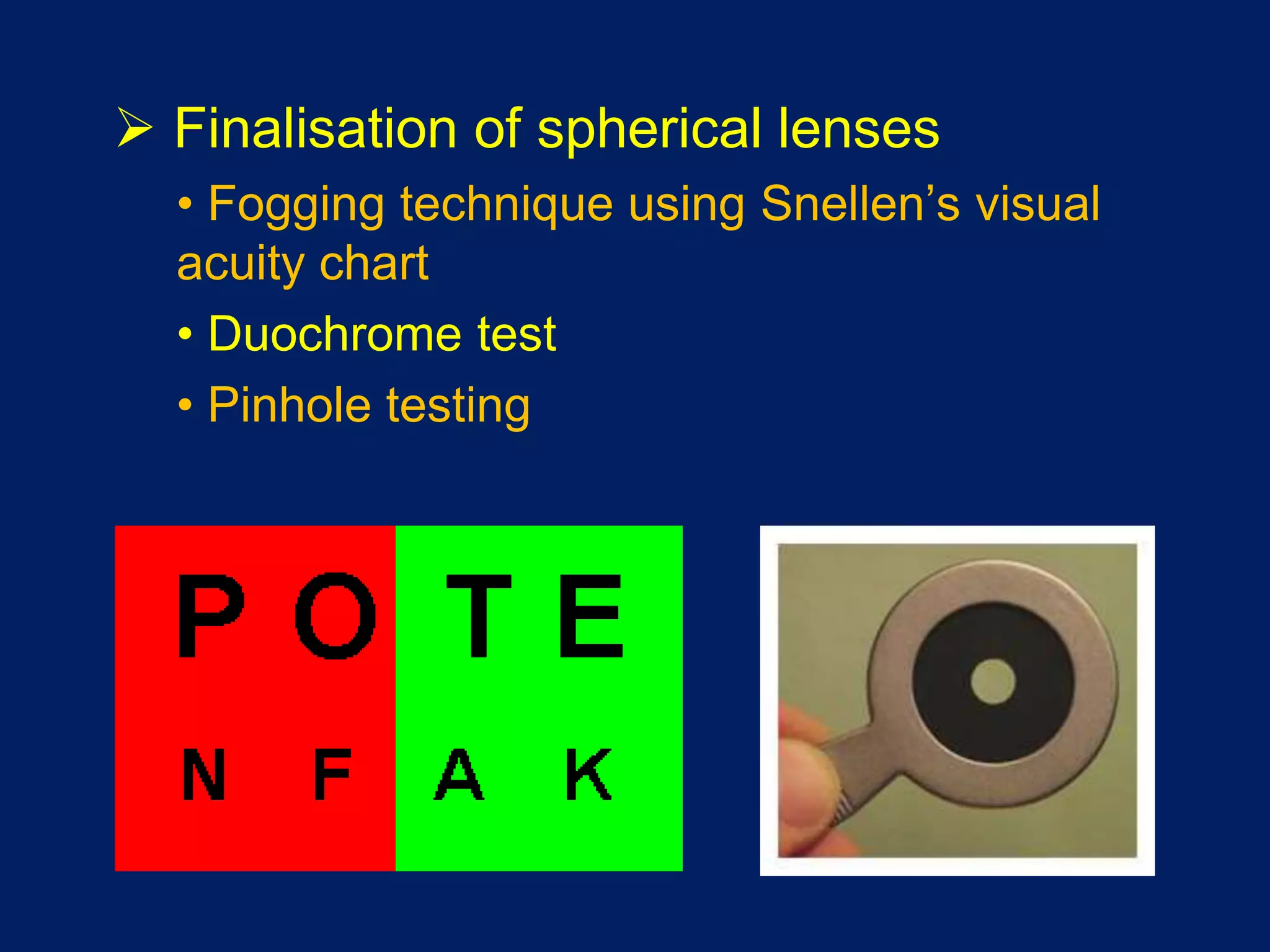
 Finalisation of spherical lenses
• Fogging technique using Snellen’s visual
acuity chart
• Duochrome test
• Pinhole testing
BINOCULAR REFRACTION
 Fogging & alternate occlusion method
 Duochrome test with fogging
 Prism dissociated method
CORRECTION OF NEAR VISION
 Dynamic retinoscopy
 Determination of near add
THANK YOU

Clinical refraction

  • 1.
    CLINICAL REFRACTION Dr SaurabhKushwaha Resident Ophthalmology
  • 2.
    SCOPE  Introduction  Objectiverefraction  Retinoscopy  Autorefractometry  Subjective refraction  Monocular refraction  Binocular refraction  Correction for near vision
  • 3.
    INTRODUCTION  History  Visualacuity  Ophthalmic examination  Retinoscopy/ Autorefractometry  Monocular Subjective refinement  Binocular balancing  Near vision correction
  • 4.
    OBJECTIVE REFRACTION  Retinoscopy Autorefractometry  Photorefraction  Electrophysiological methods
  • 5.
    RETINOSCOPY  Prerequisite • Darkroom • Trial set • Trial frame • Distance vision chart • Near vision chart • Retinoscope
  • 6.
    TYPES OF RETINOSCOPE Reflecting (mirror) • Plane mirror • Priestley Smith’s mirror
  • 7.
     Self illuminated •Spot retinoscope • Streak retinoscope
  • 8.
    TYPES OF RETINOSCOPY Dynamic retinoscopy  Static retinoscopy • Wet retinoscopy • Dry retinoscopy
  • 9.
    PROCEDURE OF RETINOSCOPY Ask the patient to fixate on target  Patient’s RE examined with the examiner’s RE with the retinoscope in right hand  Working Distance about 1 m.  Examiner’s both eyes should be open  Examiner not to obstruct the view of target  Examiner observes a red reflex in the pupillary area  Retinoscope is moved in both horizontal or vertical meridians
  • 10.
    INFERENCES OF RETINOSCOPY PROPERTIESOF REFLEX Movement With Need more plus Against Need more minus Brightness Dim Far from neutralization Bright Close to neutralization Width Narrow Far from neutralization Wide Close to neutralization Speed Slow Far from neutralization Fast Close to neutralization
  • 11.
    NEUTRALISATION OF REDREFLEX  Myopia : Add -ve lenses  Hyperopia : Add +ve lenses
  • 12.
    CYCLOPLEGICS IN RETINOSCOPY S N o DrugName Age Peak Effect Duratio n of action Time of retinosco py PCT Tonus allowan ce 1. Atropine 1% <5 yrs 2-3 days 10-20 days 4th Day After 3 wks 1.0 D 2. Homatropine 2% 5-8 yrs 60-90 min 48-72 hrs After 90 mins After 3 days 0.5 D 3. Cyclopentolate 1% 8-20 yrs 80-90 min 6-18 hrs After 90 mins After 3 days 0.75 D 4. Tropicamide 0.5%, 1% - 20-40 min 4-6 hrs - - - 5. Phenylephrine 5%, 10% - 30-40 min 4-6 hrs - - -
  • 13.
    PROBLEMS OF RETINOSCOPY Poor or invisible red reflex  Changing retinoscopy findings  Scissoring shadows  Spherical aberrations  Conflicting shadows  Triangular shadow
  • 14.
    AUTOREFRACTOMETRY  Optical principles •The Scheiner’s principle • The Optometer principle  Types of autorefractometer • Objective • Subjective
  • 15.
    SUBJECTIVE REFRACTION  Monocularrefraction  Binocular refraction  Correction for near vision
  • 16.
    MONOCULAR REFRACTION  Baselinestarting point lenses Vision Refractive Error Spherical Astigmatic 6/6 Small Small 6/9 0.50 1.00 6/12 0.75 1.50 6/18 1.00 2.00 6/24 1.50 3.00 6/36 2.00 4.00 6/60 2.00 – 3.00 High
  • 17.
     Refining thespherical lenses
  • 18.
     Refining thecylindrical lenses • Astigmatic clock dial & fogging
  • 19.
     Jackson’s crosscylinder technique • To bring circle of least confusion on retina • To refine astigmatic axis and then power
  • 20.
     Finalisation ofspherical lenses • Fogging technique using Snellen’s visual acuity chart • Duochrome test • Pinhole testing
  • 21.
    BINOCULAR REFRACTION  Fogging& alternate occlusion method  Duochrome test with fogging  Prism dissociated method
  • 22.
    CORRECTION OF NEARVISION  Dynamic retinoscopy  Determination of near add
  • 23.