MEMORY 
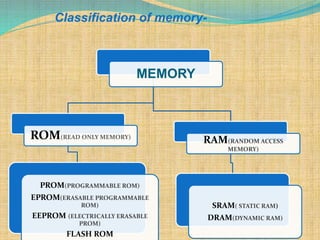
ROM(READ ONLY MEMORY) 
PROM(PROGRAMMABLE ROM) 
EPROM(ERASABLE PROGRAMMABLE 
ROM) 
EEPROM (ELECTRICALLY ERASABLE 
PROM) 
FLASH ROM 
RAM(RANDOM ACCESS 
MEMORY) 
SRAM( STATIC RAM) 
DRAM(DYNAMIC RAM) 
Classification of memory-
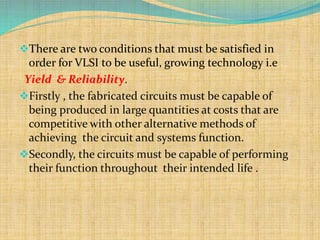
There are two conditions that must be satisfied in 
order for VLSI to be useful, growing technology i.e 
Yield & Reliability. 
Firstly , the fabricated circuits must be capable of 
being produced in large quantities at costs that are 
competitive with other alternative methods of 
achieving the circuit and systems function. 
Secondly, the circuits must be capable of performing 
their function throughout their intended life .
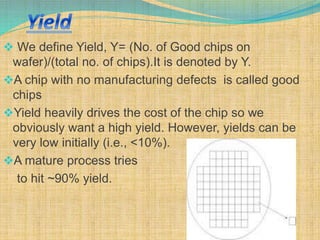
 We define Yield, Y= (No. of Good chips on 
wafer)/(total no. of chips).It is denoted by Y. 
A chip with no manufacturing defects is called good 
chips 
Yield heavily drives the cost of the chip so we 
obviously want a high yield. However, yields can be 
very low initially (i.e., <10%). 
A mature process tries 
to hit ~90% yield.
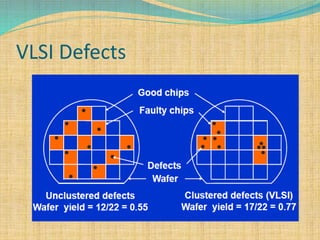
VLSI Defects
The term reliability is defined as , the probability that 
an item will perform a required function under stated 
conditions for a stated period of time. 
The “required function” must include a definition of 
satisfactory operation and unsatisfactory operation or 
failure. The program’s output simply state “good” or 
“bad”. 
The “stated conditions” in the definition comprise with 
total physical environment including the mechanical, 
thermal, and electrical conditions of expected use. 
The “stated period of time” is the time during which 
satisfactory operation is required.
Memories ,both SRAM and DRAM, are operating 
under low signal-to-noise conditions. Maximizing the 
signals while minimizing the noise contributions to 
achieve stable memory operation .Another problem 
plaguing memory design is the low yield due to 
structural and intermittent defects. 
A tremendous effort is 
being made to produce memory cells that 
generate as large a signal as possible per unit 
area. Notwithstanding this effort ,the produced 
signal quality decreases gradually with an 
increase in density. 
 At the same time , the increased integration 
density raises the noise level, due to the 
intersignal coupling.
With increasing die size and integration density, a 
reduction in yield is to be expected ,notwithstanding 
the improvements in the manufacturing process. 
Causes for malfunctioning of a part can be both 
material defects and process variations. 
Memory designers use two approaches to combat 
low yields and to reduce the cost of these complex 
components: redundancy and error correction. 
The latter technique has the advantage that it also 
addresses the occasional occurrence of a soft error.
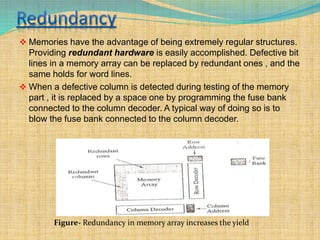
 Memories have the advantage of being extremely regular structures. 
Providing redundant hardware is easily accomplished. Defective bit 
lines in a memory array can be replaced by redundant ones , and the 
same holds for word lines. 
 When a defective column is detected during testing of the memory 
part , it is replaced by a space one by programming the fuse bank 
connected to the column decoder. A typical way of doing so is to 
blow the fuse bank connected to the column decoder. 
Figure- Redundancy in memory array increases the yield
 A typical way of doing so is to blow the fuses using a 
programming laser or pulsed current. Laser programming has 
a minimal impact on memory performance and occupies small 
chip area. It does not require special equipment and increased 
wafer handling time. 
The pulsed current approach can be executed by a 
standard tester ,but bears larger overhead .A similar 
approach is followed for the defective word lines. 
Whenever a failing word line is addressed ,the word 
redundancy system enables a redundant word line. 
 In modern memories ,as many as over 100 defective 
elements can be replaced by spare ones for an additional 
overhead of less than 5. Even embedded SRAM 
memories, to be used in systems on-a-chip ,now come 
with redundancy.
Redundancy helps correct faults that affect a large 
section of the memory such as defective bit lines or 
word lines. It is ineffective when dealing with scattered 
point errors such as local errors caused by material 
defects . Achieving a reasonable fault coverage requires 
too much redundancy under these circumstances and 
results in a large area overhead. A better approach to 
address these faults is to use error correction. 
 The idea behind this scheme is to use redundancy in 
the data representation so that an erroneous bit(s) can 
be detected and even corrected. Adding a parity bit to 
data word, for instance, provides a way of 
detecting(but not correcting) an error.
 An important observation is that error correction not 
only combats technology-related faults, but is also an 
effective way of dealing with soft errors and time 
variant faults.
Reliability and yield

Reliability and yield

  • 2.
    MEMORY ROM(READ ONLYMEMORY) PROM(PROGRAMMABLE ROM) EPROM(ERASABLE PROGRAMMABLE ROM) EEPROM (ELECTRICALLY ERASABLE PROM) FLASH ROM RAM(RANDOM ACCESS MEMORY) SRAM( STATIC RAM) DRAM(DYNAMIC RAM) Classification of memory-
  • 3.
    There are twoconditions that must be satisfied in order for VLSI to be useful, growing technology i.e Yield & Reliability. Firstly , the fabricated circuits must be capable of being produced in large quantities at costs that are competitive with other alternative methods of achieving the circuit and systems function. Secondly, the circuits must be capable of performing their function throughout their intended life .
  • 4.
     We defineYield, Y= (No. of Good chips on wafer)/(total no. of chips).It is denoted by Y. A chip with no manufacturing defects is called good chips Yield heavily drives the cost of the chip so we obviously want a high yield. However, yields can be very low initially (i.e., <10%). A mature process tries to hit ~90% yield.
  • 5.
  • 6.
    The term reliabilityis defined as , the probability that an item will perform a required function under stated conditions for a stated period of time. The “required function” must include a definition of satisfactory operation and unsatisfactory operation or failure. The program’s output simply state “good” or “bad”. The “stated conditions” in the definition comprise with total physical environment including the mechanical, thermal, and electrical conditions of expected use. The “stated period of time” is the time during which satisfactory operation is required.
  • 7.
    Memories ,both SRAMand DRAM, are operating under low signal-to-noise conditions. Maximizing the signals while minimizing the noise contributions to achieve stable memory operation .Another problem plaguing memory design is the low yield due to structural and intermittent defects. A tremendous effort is being made to produce memory cells that generate as large a signal as possible per unit area. Notwithstanding this effort ,the produced signal quality decreases gradually with an increase in density.  At the same time , the increased integration density raises the noise level, due to the intersignal coupling.
  • 8.
    With increasing diesize and integration density, a reduction in yield is to be expected ,notwithstanding the improvements in the manufacturing process. Causes for malfunctioning of a part can be both material defects and process variations. Memory designers use two approaches to combat low yields and to reduce the cost of these complex components: redundancy and error correction. The latter technique has the advantage that it also addresses the occasional occurrence of a soft error.
  • 9.
     Memories havethe advantage of being extremely regular structures. Providing redundant hardware is easily accomplished. Defective bit lines in a memory array can be replaced by redundant ones , and the same holds for word lines.  When a defective column is detected during testing of the memory part , it is replaced by a space one by programming the fuse bank connected to the column decoder. A typical way of doing so is to blow the fuse bank connected to the column decoder. Figure- Redundancy in memory array increases the yield
  • 10.
     A typicalway of doing so is to blow the fuses using a programming laser or pulsed current. Laser programming has a minimal impact on memory performance and occupies small chip area. It does not require special equipment and increased wafer handling time. The pulsed current approach can be executed by a standard tester ,but bears larger overhead .A similar approach is followed for the defective word lines. Whenever a failing word line is addressed ,the word redundancy system enables a redundant word line.  In modern memories ,as many as over 100 defective elements can be replaced by spare ones for an additional overhead of less than 5. Even embedded SRAM memories, to be used in systems on-a-chip ,now come with redundancy.
  • 11.
    Redundancy helps correctfaults that affect a large section of the memory such as defective bit lines or word lines. It is ineffective when dealing with scattered point errors such as local errors caused by material defects . Achieving a reasonable fault coverage requires too much redundancy under these circumstances and results in a large area overhead. A better approach to address these faults is to use error correction.  The idea behind this scheme is to use redundancy in the data representation so that an erroneous bit(s) can be detected and even corrected. Adding a parity bit to data word, for instance, provides a way of detecting(but not correcting) an error.
  • 12.
     An importantobservation is that error correction not only combats technology-related faults, but is also an effective way of dealing with soft errors and time variant faults.