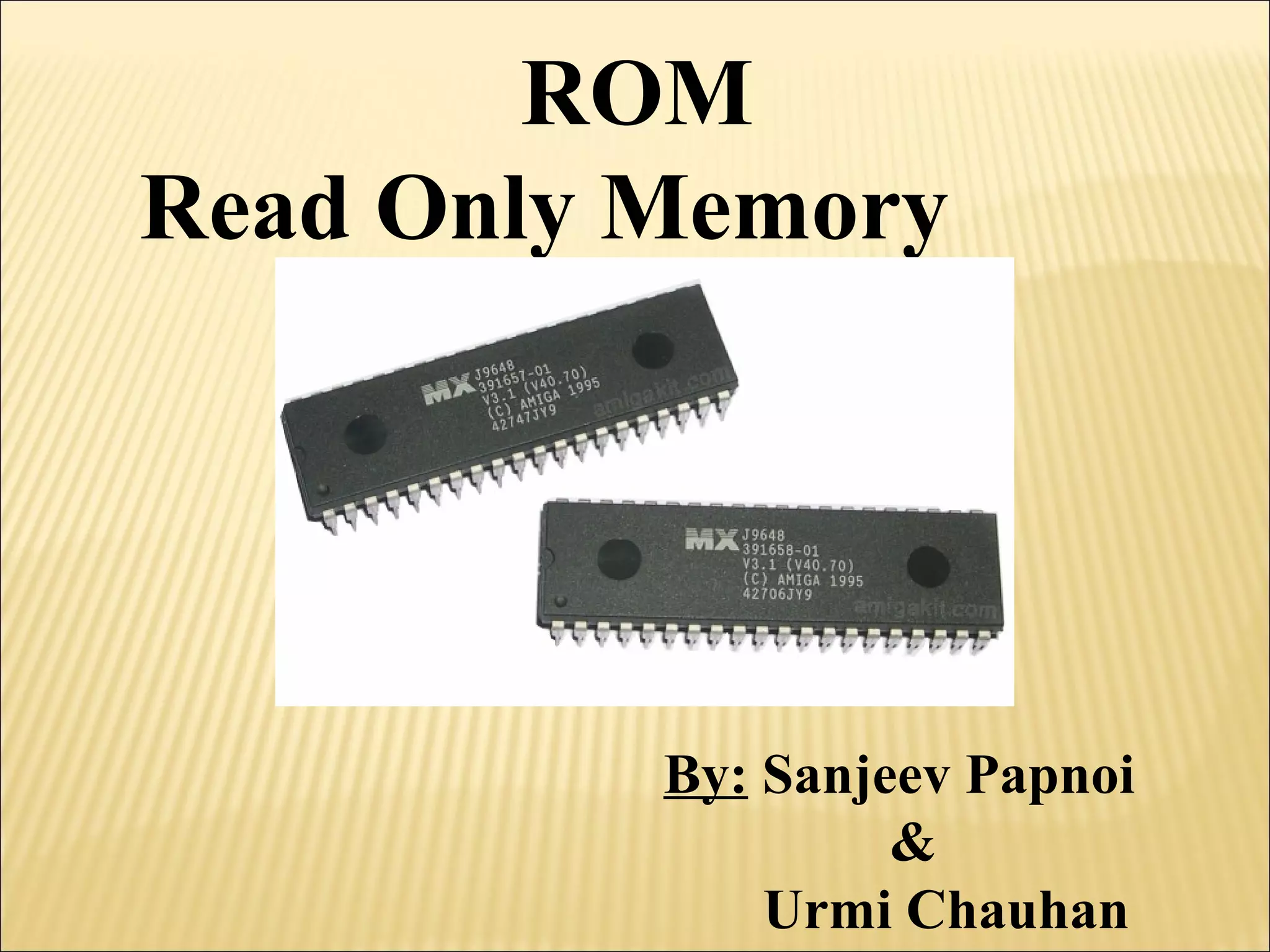
ROM 
Read Only Memory 
By: Sanjeev Papnoi 
& 
Urmi Chauhan
Introduction 
 Read-only memory (ROM) is a class of storage 
medium used in computers and other electronic 
devices. Data stored in ROM cannot be modified, or 
can be modified only slowly or with difficulty. 
 Read Only Memories (ROM) or Programmable 
Read Only Memories (PROM) have: 
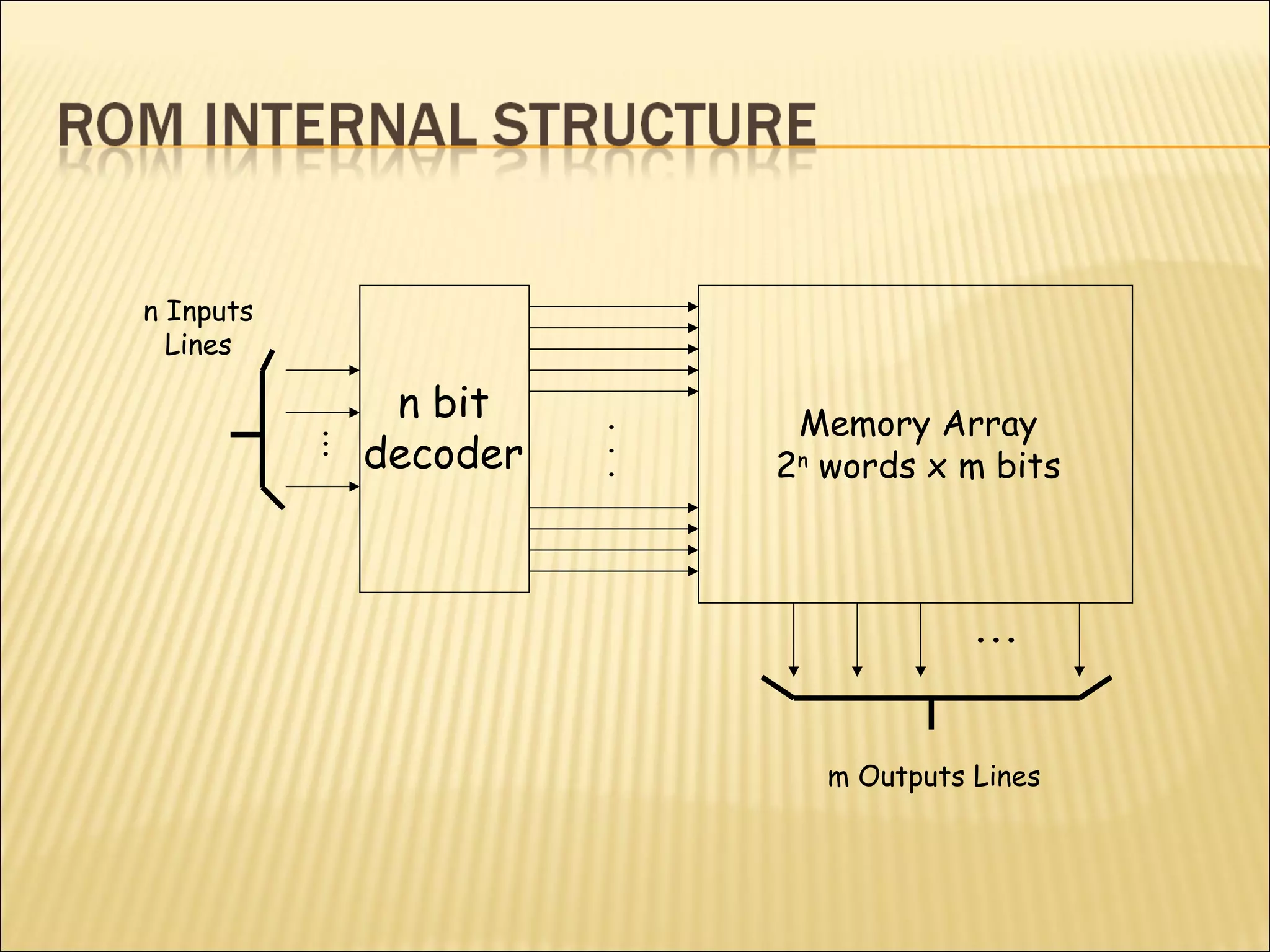
N input lines, 
M output lines, and 
2N decoded minterms. 
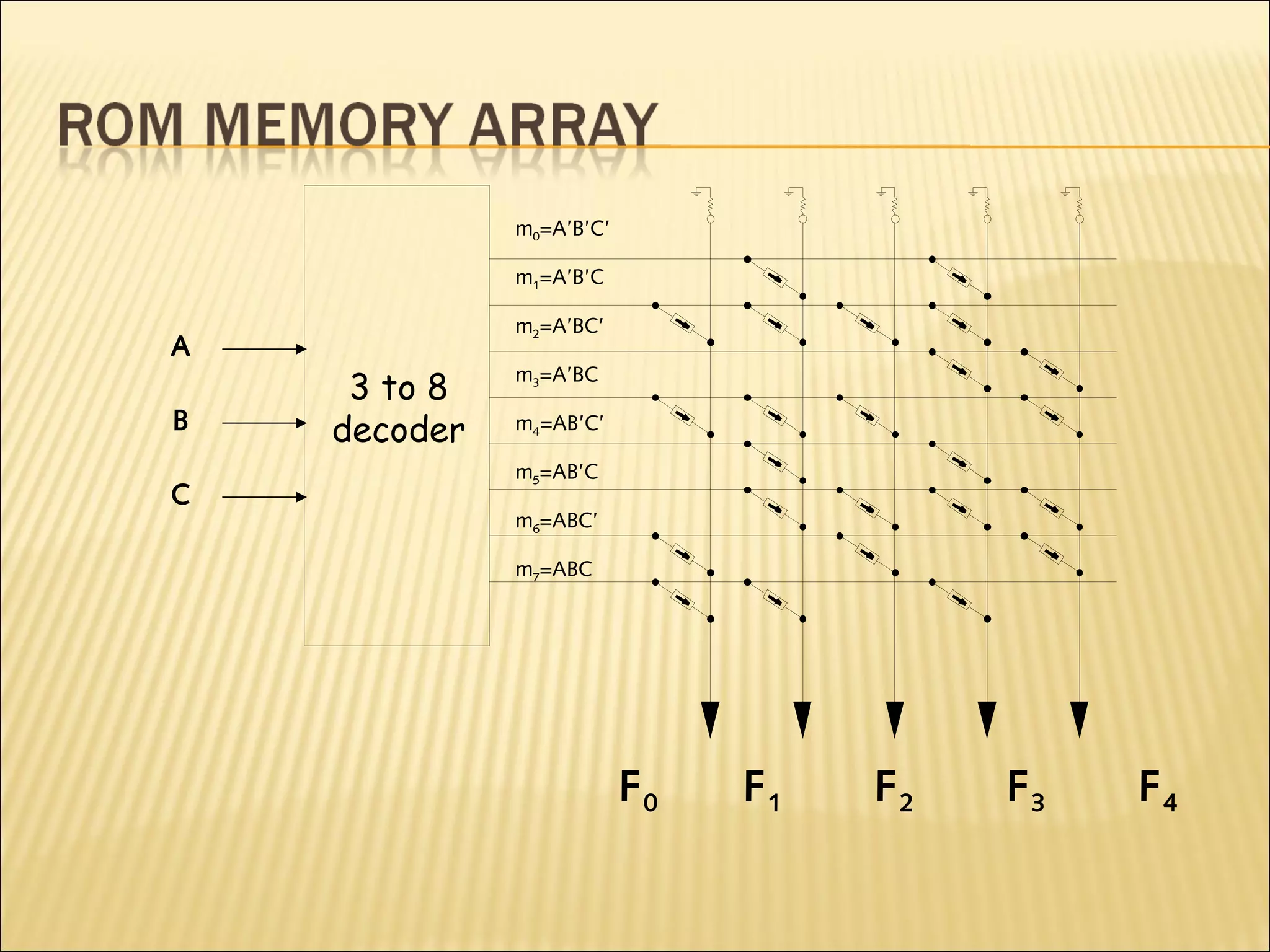
 Fixed AND array with 2N outputs implementing all 
N-literal minterms.
 Programmable OR Array with M outputs 
lines to form up to M sum of minterm 
expressions. 
 A program for a ROM or PROM is simply a 
multiple-output truth table 
 If a 1 entry, a connection is made to the 
corresponding minterm for the corresponding 
output. 
 If a 0, no connection is made 
Can be viewed as a memory with the inputs as 
addresses of data (output values), hence 
ROM or PROM names!
Read only memory (ROM) 
ROM holds programs and data permanently even when computer 
is switched off 
Data can be read by the CPU in any order so ROM is also direct 
access 
The contents of ROM are fixed at the time of manufacture 
Stores a program called the bootstrap loader that helps start up 
the computer 
Access time of between 10 and 50 nanoseconds
5 
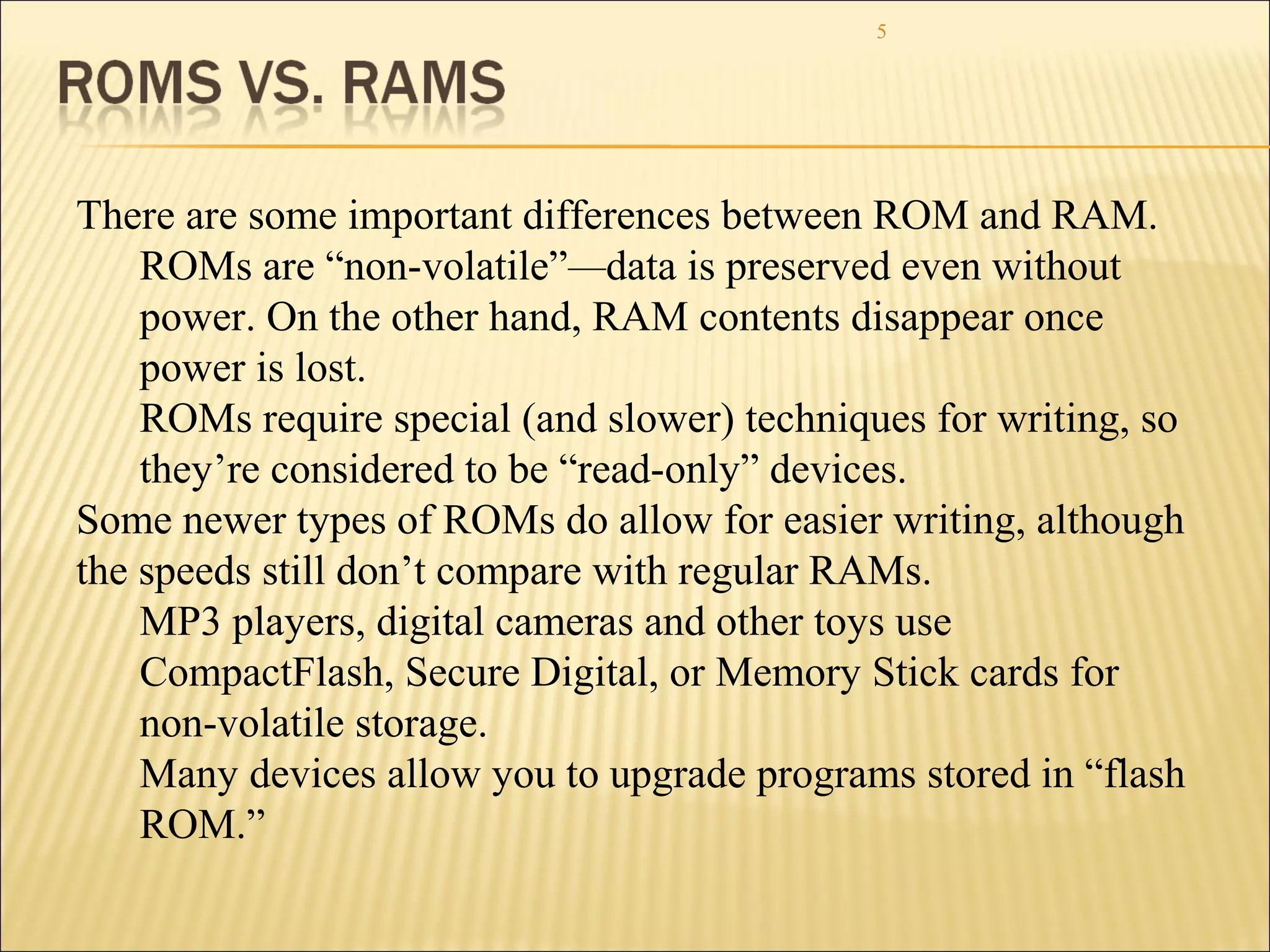
There are some important differences between ROM and RAM. 
ROMs are “non-volatile”—data is preserved even without 
power. On the other hand, RAM contents disappear once 
power is lost. 
ROMs require special (and slower) techniques for writing, so 
they’re considered to be “read-only” devices. 
Some newer types of ROMs do allow for easier writing, although 
the speeds still don’t compare with regular RAMs. 
MP3 players, digital cameras and other toys use 
CompactFlash, Secure Digital, or Memory Stick cards for 
non-volatile storage. 
Many devices allow you to upgrade programs stored in “flash 
ROM.”
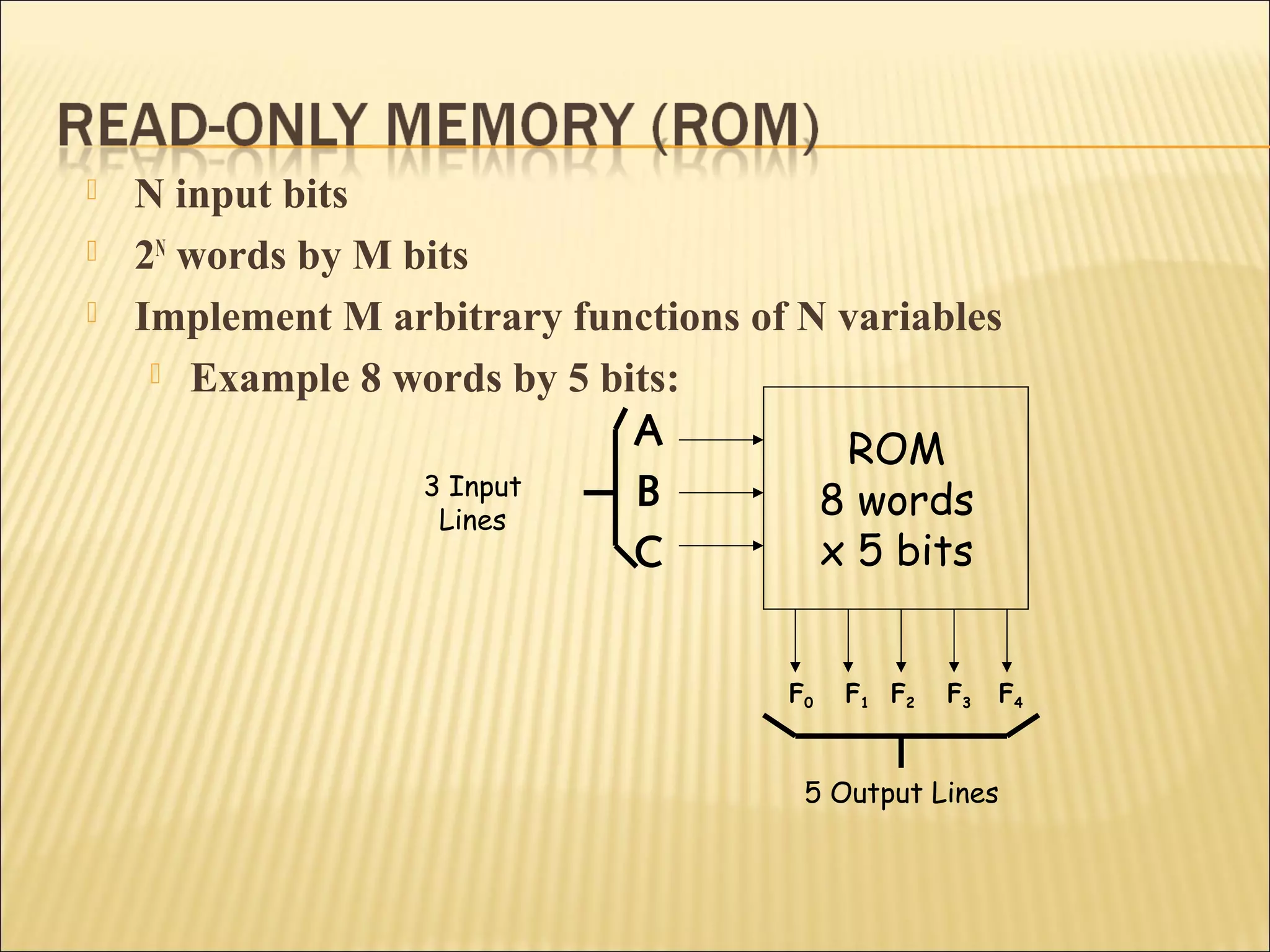
 N input bits 
 2N words by M bits 
 Implement M arbitrary functions of N variables 
 Example 8 words by 5 bits: 
3 Input 
Lines 
A 
B 
C 
ROM 
8 words 
x 5 bits 
F0 F1 F2 F3 F4 
5 Output Lines
... 
n Inputs 
Lines 
n bit 
decoder 
... 
m Outputs Lines 
... 
Memory Array 
2n words x m bits
3 to 8 
decoder 
A 
B 
C 
m0=A’B’C’ 
m1=A’B’C 
m2=A’BC’ 
m3=A’BC 
m4=AB’C’ 
m5=AB’C 
m6=ABC’ 
m7=ABC 
F0 F1 F2 F3 F4
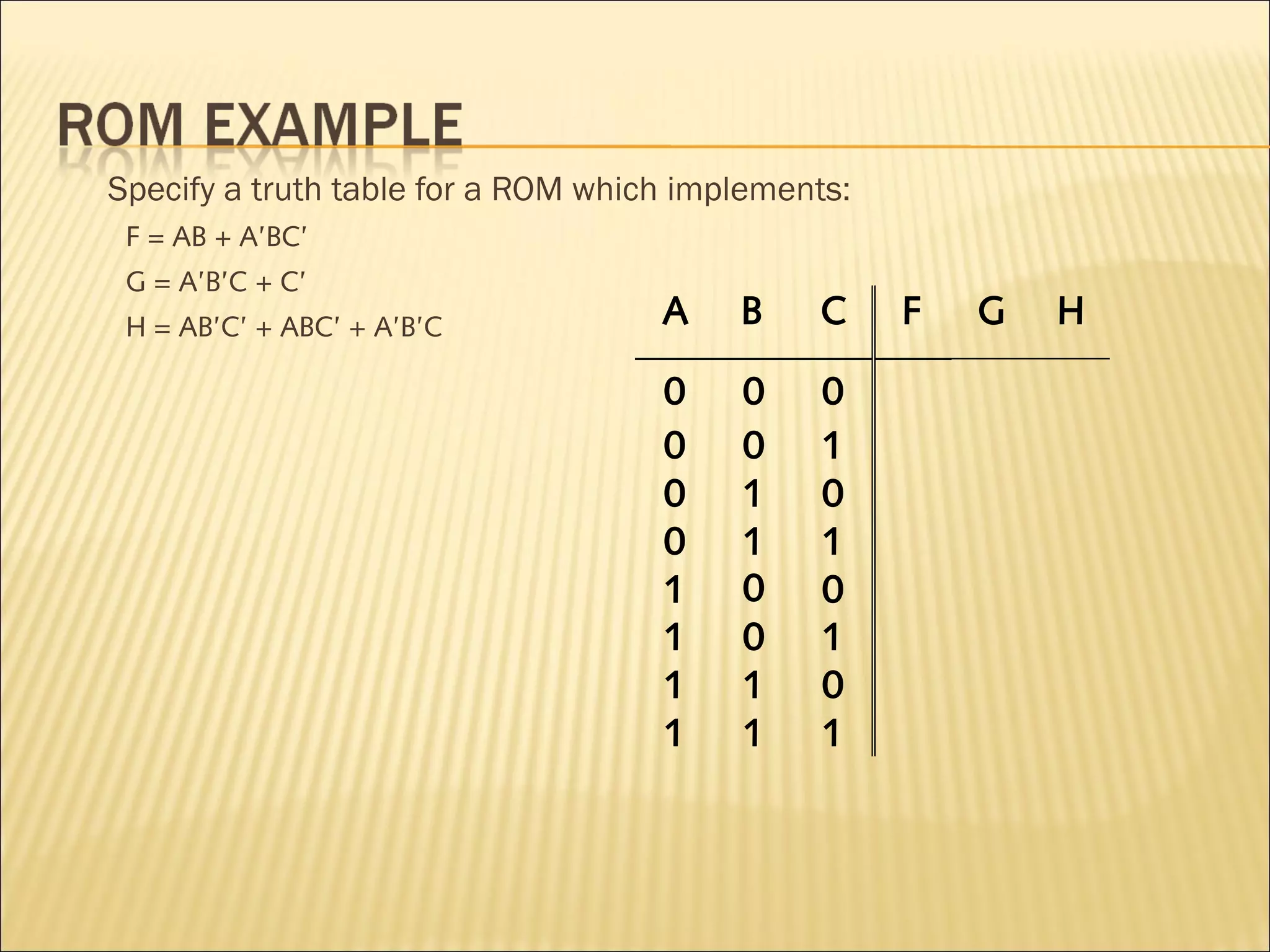
Specify a truth table for a ROM which implements: 
F = AB + A’BC’ 
G = A’B’C + C’ 
H = AB’C’ + ABC’ + A’B’C 
A B C F G H 
0 0 0 
0 0 1 
0 1 0 
0 1 1 
1 0 0 
1 0 1 
1 1 0 
1 1 1
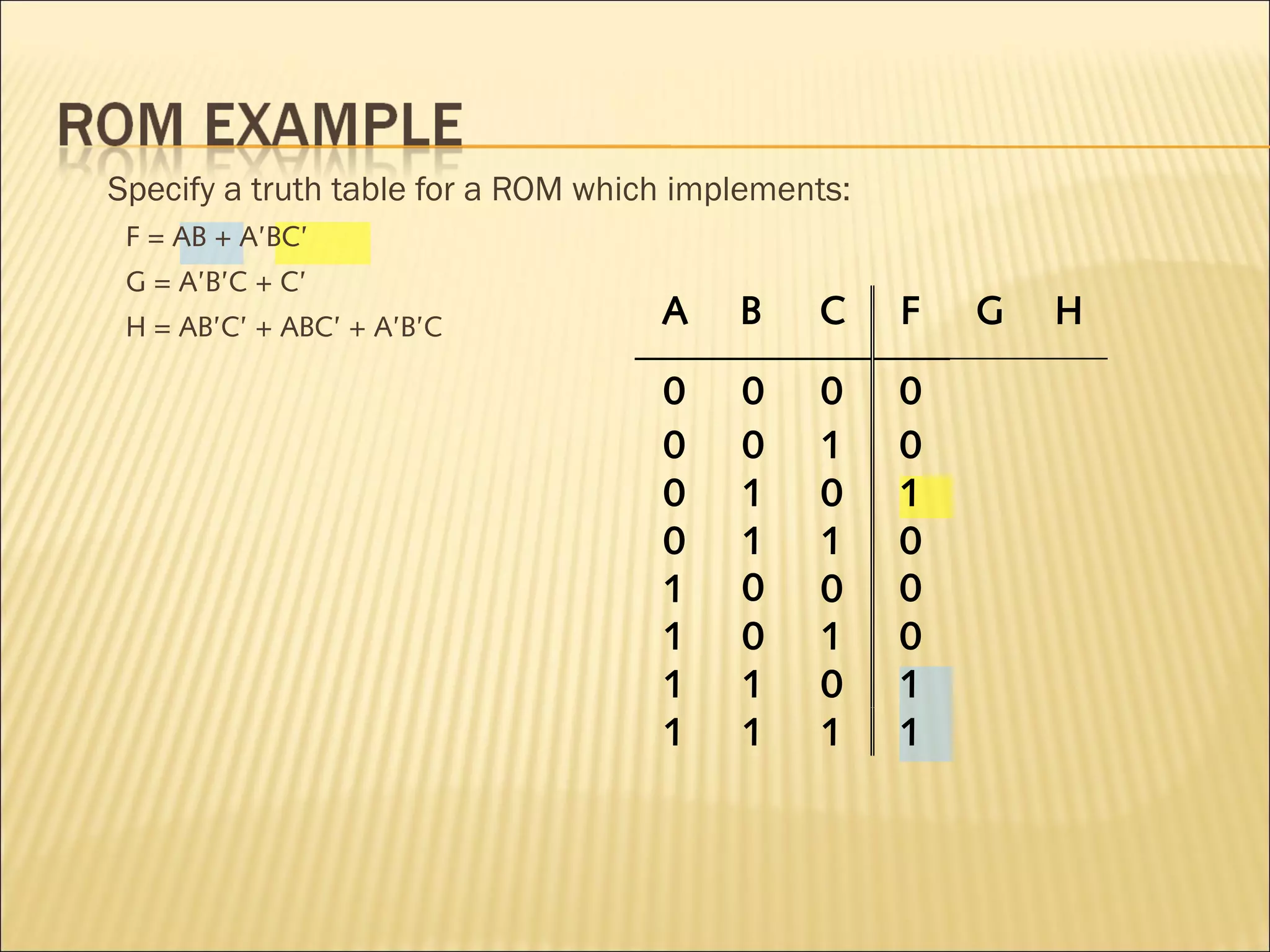
Specify a truth table for a ROM which implements: 
F = AB + A’BC’ 
G = A’B’C + C’ 
H = AB’C’ + ABC’ + A’B’C 
A B C F G H 
0 0 0 0 
0 0 1 0 
0 1 0 1 
0 1 1 0 
1 0 0 0 
1 0 1 0 
1 1 0 1 
1 1 1 1
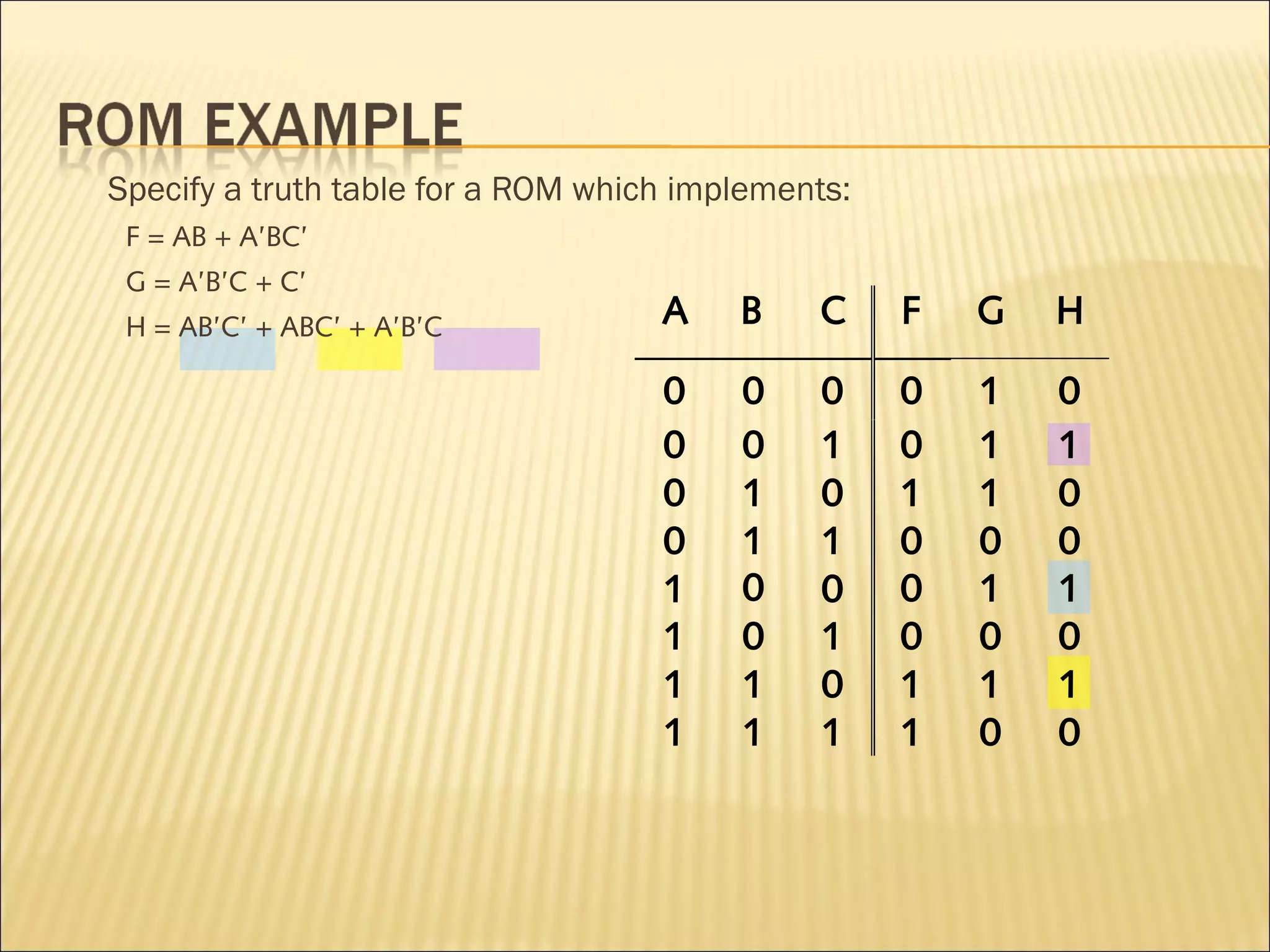
Specify a truth table for a ROM which implements: 
F = AB + A’BC’ 
G = A’B’C + C’ 
H = AB’C’ + ABC’ + A’B’C A B C F G H 
0 0 0 0 1 0 
0 0 1 0 1 1 
0 1 0 1 1 0 
0 1 1 0 0 0 
1 0 0 0 1 1 
1 0 1 0 0 0 
1 1 0 1 1 1 
1 1 1 1 0 0
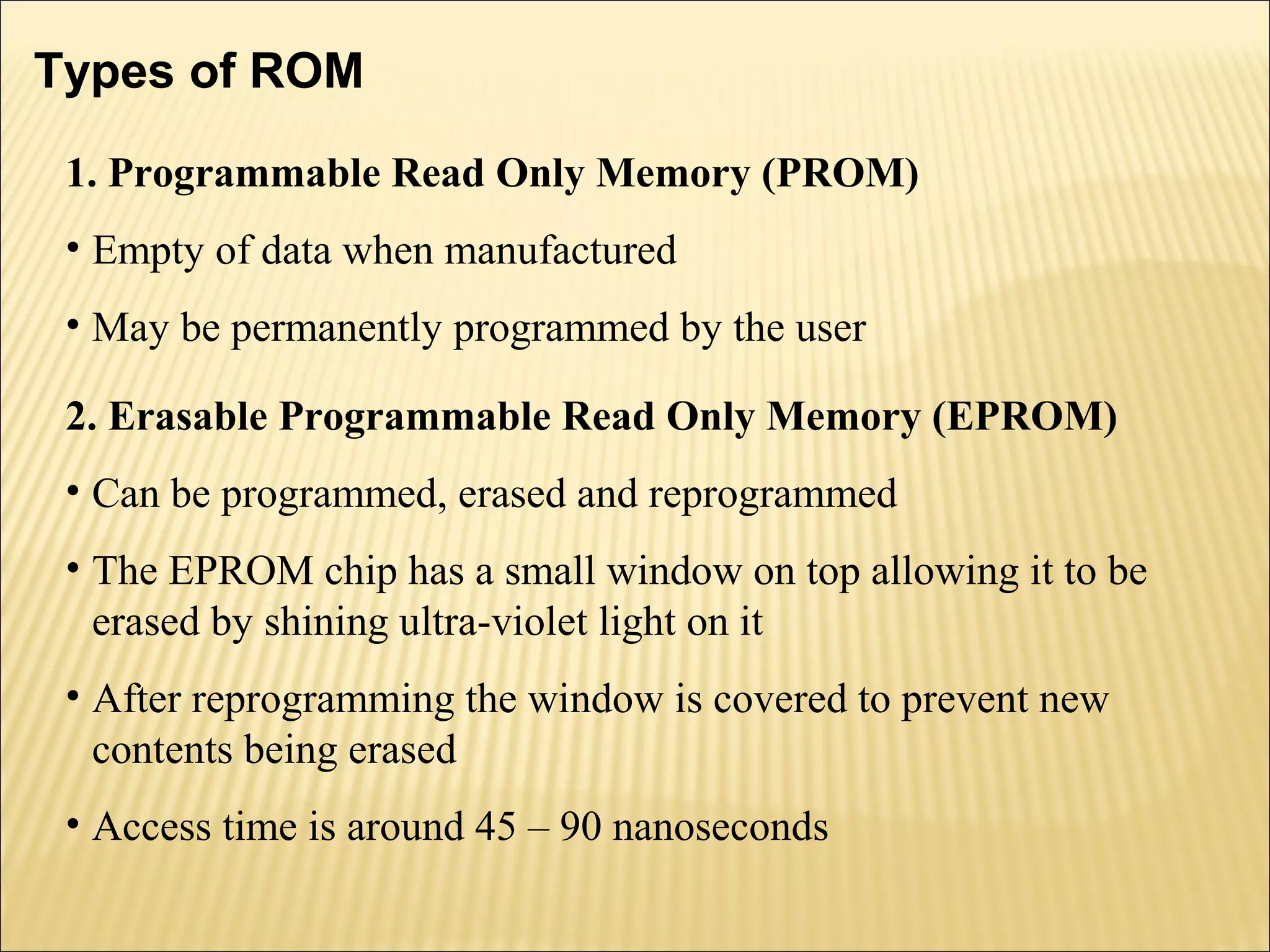
Types of ROM 
1. Programmable Read Only Memory (PROM) 
• Empty of data when manufactured 
• May be permanently programmed by the user 
2. Erasable Programmable Read Only Memory (EPROM) 
• Can be programmed, erased and reprogrammed 
• The EPROM chip has a small window on top allowing it to be 
erased by shining ultra-violet light on it 
• After reprogramming the window is covered to prevent new 
contents being erased 
• Access time is around 45 – 90 nanoseconds
Types of ROM 
3. Electrically Erasable Programmable Read Only Memory 
(EEPROM) 
• Reprogrammed electrically without using ultraviolet light 
• Must be removed from the computer and placed in a special 
machine to do this 
• Access times between 45 and 200 nanoseconds 
4. Flash ROM 
• Similar to EEPROM 
• However, can be reprogrammed while still in the computer 
• Easier to upgrade programs stored in Flash ROM 
• Used to store programs in devices e.g. modems 
• Access time is around 45 – 90 nanoseconds
PROM 
One step up from the masked ROM is the PROM 
(programmable ROM), which is purchased in an 
unprogrammed state. If you were to look at the 
contents of an unprogrammed PROM, the data is 
made up entirely of 1's. The process of writing your 
data to the PROM involves a special piece of 
equipment called a device programmer. The device 
programmer writes data to the device one word at a 
time by applying an electrical charge to the input 
pins of the chip. Once a PROM has been 
programmed in this way, its contents can never be 
changed. If the code or data stored in the PROM 
must be changed, the current device must be 
discarded. As a result, PROMs are also known as 
one-time programmable (OTP) devices.
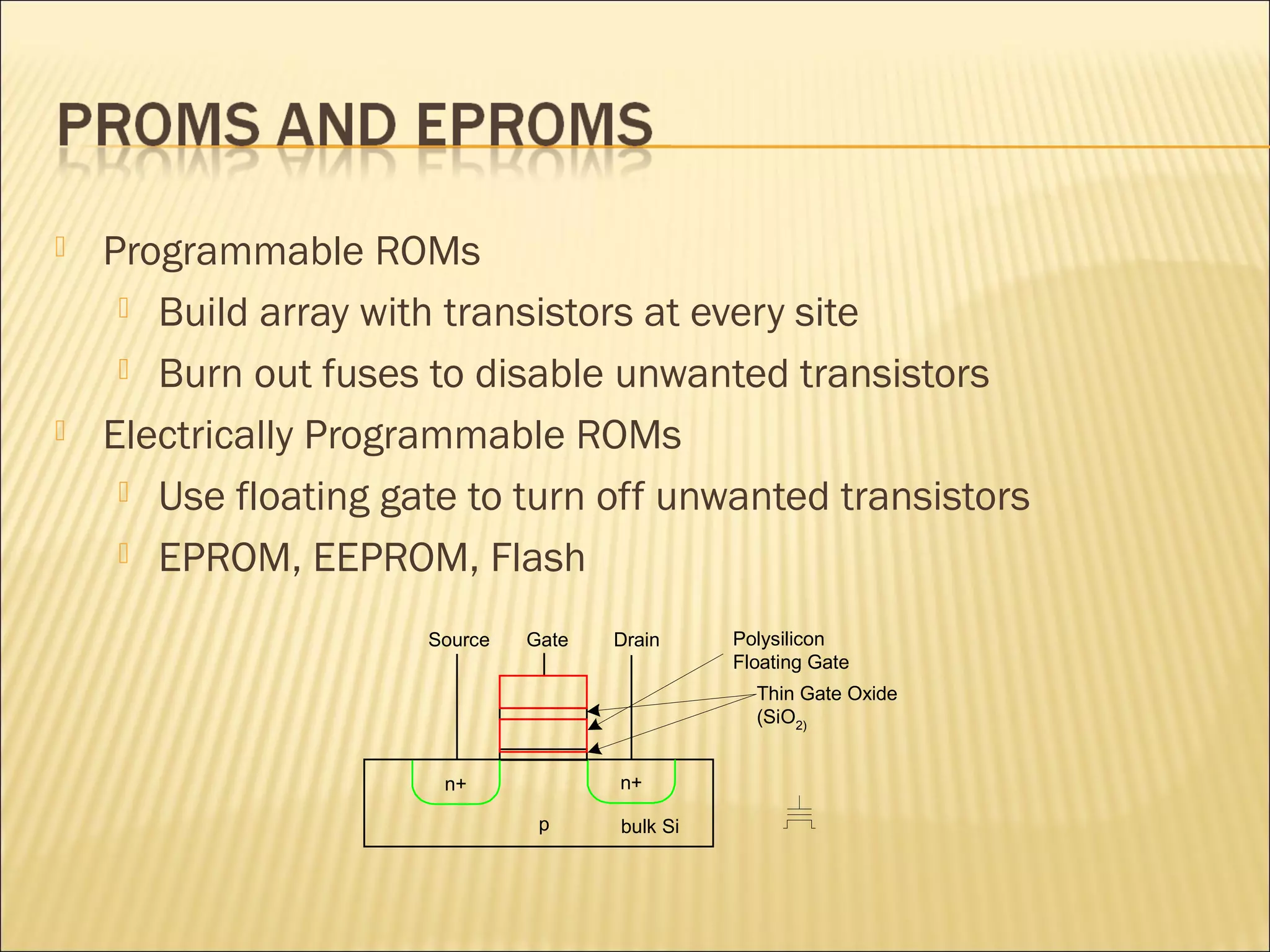
 Programmable ROMs 
 Build array with transistors at every site 
 Burn out fuses to disable unwanted transistors 
 Electrically Programmable ROMs 
 Use floating gate to turn off unwanted transistors 
 EPROM, EEPROM, Flash 
Source Gate Drain 
n+ 
p 
bulk Si 
Thin Gate Oxide 
(SiO2) 
n+ 
Polysilicon 
Floating Gate
EPROM 
An EPROM (erasable-and-programmable ROM) is 
programmed in exactly the same manner as a 
PROM. However, EPROMs can be erased and 
reprogrammed repeatedly. To erase an EPROM, you 
simply expose the device to a strong source of 
ultraviolet light. (A window in the top of the device 
allows the light to reach the silicon.) By doing this, 
you essentially reset the entire chip to its initial-un-programmed- 
state. Though more expensive than 
PROMs, their ability to be reprogrammed makes 
EPROMs an essential part of the software 
development and testing process.
 Development of the EPROM memory cell started with investigation 
of faulty integrated circuits where the gate connections of transistors 
had broken. Stored charge on these isolated gates changed their 
properties. The EPROM was invented by Dov Frohman of Intel in 
1971, who was awarded US patent 3660819 in 1972. 
 Each storage location of an EPROM consists of a single 
field-effect transistor. Each field-effect transistor consists of a 
channel in the semiconductor body of the device. Source and drain 
contacts are made to regions at the end of the channel. An insulating 
layer of oxide is grown over the channel, then a conductive (silicon 
or aluminum) gate electrode is deposited, and a further thick layer of 
oxide is deposited over the gate electrode. The floating gate electrode 
has no connections to other parts of the integrated circuit and is 
completely insulated by the surrounding layers of oxide. A control 
gate electrode is deposited and further oxide covers it
To retrieve data from the EPROM, the 
address represented by the values at the 
address pins of the EPROM is decoded and 
used to connect one word (usually an 8-bit 
byte) of storage to the output buffer 
amplifiers. Each bit of the word is a 1 or 0, 
depending on the storage transistor being 
switched on or off, conducting or non-conducting. 
The switching state of the field-effect 
transistor is controlled by the voltage on the 
control gate of the transistor. Presence of a 
voltage on this gate creates a conductive 
channel in the transistor, switching it on. In 
effect, the stored charge on the floating gate 
allows the threshold voltage of the 
transistor to be programmed.
Storing data in the memory requires selecting a given address and 
applying a higher voltage to the transistors. This creates an 
avalanche discharge of electrons, which have enough energy to 
pass through the insulating oxide layer and accumulate on the gate 
electrode. When the high voltage is removed, the electrons are 
trapped on the electrode.[3] Because of the high insulation value of 
the silicon oxide surrounding the gate, the stored charge cannot 
readily leak away and the data can be retained for decades.
The programming process is not electrically reversible. To erase 
the data stored in the array of transistors, ultraviolet light is 
directed onto the die. Photons of the UV light cause ionization 
within the silicon oxide, which allow the stored charge on the 
floating gate to dissipate. Since the whole memory array is 
exposed, all the memory is erased at the same time. The process 
takes several minutes for UV lamps of convenient sizes; sunlight 
would erase a chip in weeks, and indoor fluorescent lighting over 
several years. Generally the EPROMs must be removed from 
equipment to be erased, since it's not usually practical to build in a 
UV lamp to erase parts in-circuit. The Electrically Erasable 
Programmable Read-Only Memory (EEPROM) was developed to 
provide an electrical erase function and has now mostly displaced 
ultraviolet-erased parts.
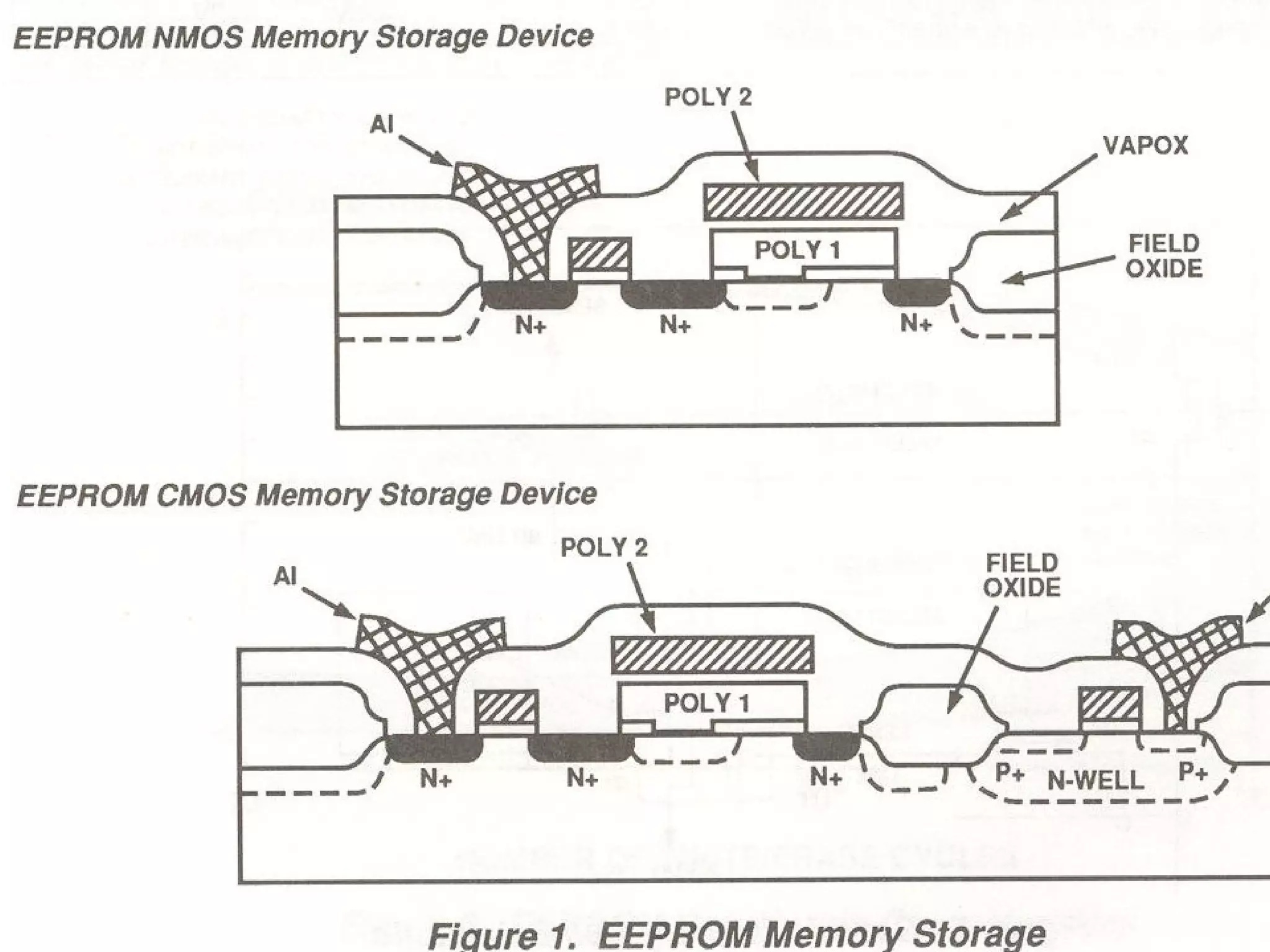
EEPROM 
 EEPROMS are electrically-erasable-and-programmable. 
Internally, they are similar to EPROMs, but the erase 
operation is accomplished electrically, rather than by exposure 
to ultraviolet light. Any byte within an EEPROM may be 
erased and rewritten. Once written, the new data will remain in 
the device forever-or at least until it is electrically erased. The 
primary tradeoff for this improved functionality is higher cost, 
though write cycles are also significantly longer than writes to 
a RAM. So you wouldn't want to use an EEPROM for your 
main system memory.
 Flash memory stores information in an array of memory cells 
made from floating-gate transistors. In traditional single-level cell 
(SLC) devices, each cell stores only one bit of information. Some 
newer flash memory, known as multi-level cell (MLC) devices, 
including triple-level cell (TLC) devices, can store more than one 
bit per cell by choosing between multiple levels of electrical 
charge to apply to the floating gates of its cells. 
 The floating gate may be conductive (typically polysilicon in most 
kinds of flash memory) or non-conductive (as in SONOS flash 
memory).
 Flash memory combines the best features of the memory 
devices described thus far. Flash memory devices are high 
density, low cost, nonvolatile, fast (to read, but not to write), 
and electrically reprogrammable. These advantages are 
overwhelming and, as a direct result, the use of flash memory 
has increased dramatically in embedded systems. From a 
software viewpoint, flash and EEPROM technologies are very 
similar. The major difference is that flash devices can only be 
erased one sector at a time, not byte-by-byte. Typical sector 
sizes are in the range 256 bytes to 16KB. Despite this 
disadvantage, flash is much more popular than EEPROM and 
is rapidly displacing many of the ROM devices as well.
Thank you

Read Only Memory

  • 1.
    ROM Read OnlyMemory By: Sanjeev Papnoi & Urmi Chauhan
  • 2.
    Introduction  Read-onlymemory (ROM) is a class of storage medium used in computers and other electronic devices. Data stored in ROM cannot be modified, or can be modified only slowly or with difficulty.  Read Only Memories (ROM) or Programmable Read Only Memories (PROM) have: N input lines, M output lines, and 2N decoded minterms.  Fixed AND array with 2N outputs implementing all N-literal minterms.
  • 3.
     Programmable ORArray with M outputs lines to form up to M sum of minterm expressions.  A program for a ROM or PROM is simply a multiple-output truth table  If a 1 entry, a connection is made to the corresponding minterm for the corresponding output.  If a 0, no connection is made Can be viewed as a memory with the inputs as addresses of data (output values), hence ROM or PROM names!
  • 4.
    Read only memory(ROM) ROM holds programs and data permanently even when computer is switched off Data can be read by the CPU in any order so ROM is also direct access The contents of ROM are fixed at the time of manufacture Stores a program called the bootstrap loader that helps start up the computer Access time of between 10 and 50 nanoseconds
  • 5.
    5 There aresome important differences between ROM and RAM. ROMs are “non-volatile”—data is preserved even without power. On the other hand, RAM contents disappear once power is lost. ROMs require special (and slower) techniques for writing, so they’re considered to be “read-only” devices. Some newer types of ROMs do allow for easier writing, although the speeds still don’t compare with regular RAMs. MP3 players, digital cameras and other toys use CompactFlash, Secure Digital, or Memory Stick cards for non-volatile storage. Many devices allow you to upgrade programs stored in “flash ROM.”
  • 6.
     N inputbits  2N words by M bits  Implement M arbitrary functions of N variables  Example 8 words by 5 bits: 3 Input Lines A B C ROM 8 words x 5 bits F0 F1 F2 F3 F4 5 Output Lines
  • 7.
    ... n Inputs Lines n bit decoder ... m Outputs Lines ... Memory Array 2n words x m bits
  • 8.
    3 to 8 decoder A B C m0=A’B’C’ m1=A’B’C m2=A’BC’ m3=A’BC m4=AB’C’ m5=AB’C m6=ABC’ m7=ABC F0 F1 F2 F3 F4
  • 9.
    Specify a truthtable for a ROM which implements: F = AB + A’BC’ G = A’B’C + C’ H = AB’C’ + ABC’ + A’B’C A B C F G H 0 0 0 0 0 1 0 1 0 0 1 1 1 0 0 1 0 1 1 1 0 1 1 1
  • 10.
    Specify a truthtable for a ROM which implements: F = AB + A’BC’ G = A’B’C + C’ H = AB’C’ + ABC’ + A’B’C A B C F G H 0 0 0 0 0 0 1 0 0 1 0 1 0 1 1 0 1 0 0 0 1 0 1 0 1 1 0 1 1 1 1 1
  • 11.
    Specify a truthtable for a ROM which implements: F = AB + A’BC’ G = A’B’C + C’ H = AB’C’ + ABC’ + A’B’C A B C F G H 0 0 0 0 1 0 0 0 1 0 1 1 0 1 0 1 1 0 0 1 1 0 0 0 1 0 0 0 1 1 1 0 1 0 0 0 1 1 0 1 1 1 1 1 1 1 0 0
  • 12.
    Types of ROM 1. Programmable Read Only Memory (PROM) • Empty of data when manufactured • May be permanently programmed by the user 2. Erasable Programmable Read Only Memory (EPROM) • Can be programmed, erased and reprogrammed • The EPROM chip has a small window on top allowing it to be erased by shining ultra-violet light on it • After reprogramming the window is covered to prevent new contents being erased • Access time is around 45 – 90 nanoseconds
  • 13.
    Types of ROM 3. Electrically Erasable Programmable Read Only Memory (EEPROM) • Reprogrammed electrically without using ultraviolet light • Must be removed from the computer and placed in a special machine to do this • Access times between 45 and 200 nanoseconds 4. Flash ROM • Similar to EEPROM • However, can be reprogrammed while still in the computer • Easier to upgrade programs stored in Flash ROM • Used to store programs in devices e.g. modems • Access time is around 45 – 90 nanoseconds
  • 14.
    PROM One stepup from the masked ROM is the PROM (programmable ROM), which is purchased in an unprogrammed state. If you were to look at the contents of an unprogrammed PROM, the data is made up entirely of 1's. The process of writing your data to the PROM involves a special piece of equipment called a device programmer. The device programmer writes data to the device one word at a time by applying an electrical charge to the input pins of the chip. Once a PROM has been programmed in this way, its contents can never be changed. If the code or data stored in the PROM must be changed, the current device must be discarded. As a result, PROMs are also known as one-time programmable (OTP) devices.
  • 15.
     Programmable ROMs  Build array with transistors at every site  Burn out fuses to disable unwanted transistors  Electrically Programmable ROMs  Use floating gate to turn off unwanted transistors  EPROM, EEPROM, Flash Source Gate Drain n+ p bulk Si Thin Gate Oxide (SiO2) n+ Polysilicon Floating Gate
  • 16.
    EPROM An EPROM(erasable-and-programmable ROM) is programmed in exactly the same manner as a PROM. However, EPROMs can be erased and reprogrammed repeatedly. To erase an EPROM, you simply expose the device to a strong source of ultraviolet light. (A window in the top of the device allows the light to reach the silicon.) By doing this, you essentially reset the entire chip to its initial-un-programmed- state. Though more expensive than PROMs, their ability to be reprogrammed makes EPROMs an essential part of the software development and testing process.
  • 17.
     Development ofthe EPROM memory cell started with investigation of faulty integrated circuits where the gate connections of transistors had broken. Stored charge on these isolated gates changed their properties. The EPROM was invented by Dov Frohman of Intel in 1971, who was awarded US patent 3660819 in 1972.  Each storage location of an EPROM consists of a single field-effect transistor. Each field-effect transistor consists of a channel in the semiconductor body of the device. Source and drain contacts are made to regions at the end of the channel. An insulating layer of oxide is grown over the channel, then a conductive (silicon or aluminum) gate electrode is deposited, and a further thick layer of oxide is deposited over the gate electrode. The floating gate electrode has no connections to other parts of the integrated circuit and is completely insulated by the surrounding layers of oxide. A control gate electrode is deposited and further oxide covers it
  • 18.
    To retrieve datafrom the EPROM, the address represented by the values at the address pins of the EPROM is decoded and used to connect one word (usually an 8-bit byte) of storage to the output buffer amplifiers. Each bit of the word is a 1 or 0, depending on the storage transistor being switched on or off, conducting or non-conducting. The switching state of the field-effect transistor is controlled by the voltage on the control gate of the transistor. Presence of a voltage on this gate creates a conductive channel in the transistor, switching it on. In effect, the stored charge on the floating gate allows the threshold voltage of the transistor to be programmed.
  • 19.
    Storing data inthe memory requires selecting a given address and applying a higher voltage to the transistors. This creates an avalanche discharge of electrons, which have enough energy to pass through the insulating oxide layer and accumulate on the gate electrode. When the high voltage is removed, the electrons are trapped on the electrode.[3] Because of the high insulation value of the silicon oxide surrounding the gate, the stored charge cannot readily leak away and the data can be retained for decades.
  • 20.
    The programming processis not electrically reversible. To erase the data stored in the array of transistors, ultraviolet light is directed onto the die. Photons of the UV light cause ionization within the silicon oxide, which allow the stored charge on the floating gate to dissipate. Since the whole memory array is exposed, all the memory is erased at the same time. The process takes several minutes for UV lamps of convenient sizes; sunlight would erase a chip in weeks, and indoor fluorescent lighting over several years. Generally the EPROMs must be removed from equipment to be erased, since it's not usually practical to build in a UV lamp to erase parts in-circuit. The Electrically Erasable Programmable Read-Only Memory (EEPROM) was developed to provide an electrical erase function and has now mostly displaced ultraviolet-erased parts.
  • 21.
    EEPROM  EEPROMSare electrically-erasable-and-programmable. Internally, they are similar to EPROMs, but the erase operation is accomplished electrically, rather than by exposure to ultraviolet light. Any byte within an EEPROM may be erased and rewritten. Once written, the new data will remain in the device forever-or at least until it is electrically erased. The primary tradeoff for this improved functionality is higher cost, though write cycles are also significantly longer than writes to a RAM. So you wouldn't want to use an EEPROM for your main system memory.
  • 23.
     Flash memorystores information in an array of memory cells made from floating-gate transistors. In traditional single-level cell (SLC) devices, each cell stores only one bit of information. Some newer flash memory, known as multi-level cell (MLC) devices, including triple-level cell (TLC) devices, can store more than one bit per cell by choosing between multiple levels of electrical charge to apply to the floating gates of its cells.  The floating gate may be conductive (typically polysilicon in most kinds of flash memory) or non-conductive (as in SONOS flash memory).
  • 24.
     Flash memorycombines the best features of the memory devices described thus far. Flash memory devices are high density, low cost, nonvolatile, fast (to read, but not to write), and electrically reprogrammable. These advantages are overwhelming and, as a direct result, the use of flash memory has increased dramatically in embedded systems. From a software viewpoint, flash and EEPROM technologies are very similar. The major difference is that flash devices can only be erased one sector at a time, not byte-by-byte. Typical sector sizes are in the range 256 bytes to 16KB. Despite this disadvantage, flash is much more popular than EEPROM and is rapidly displacing many of the ROM devices as well.
  • 25.