EMERGINIG
MEMORY
TECHNOLOGY

BY
VIDYA REDDY
Position Statement
Emerging NVM are very attractive
 Combing the speed of SRAM, the density of DRAM,
and the non-volatility of Flash memory.
Attractive features
 high density, low leakage, non-volatile.

Undesirable features:
 Write-related: long write-latency, high write-energy.
 low endurance (e.g. PCRAM).
 Cost (Needs large volume production).
Solution: Hybrid cache/mem/storage + 3D?
Enabling unique applications.
OUTLINE
 Introduction
 Modelling
-

MRAM/PCRAM modelling

 Architecture
-

MRAM/PCRAM stacking
HCA: Hybrid Cache Architecture
Hybrid storage system

 Application
-

Exascale computing

 Conclusion
Memories principles
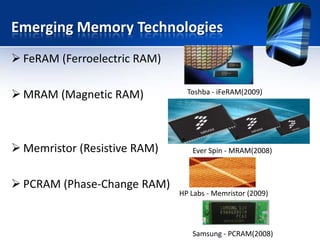
Emerging Memory Technologies
 FeRAM (Ferroelectric RAM)

 MRAM (Magnetic RAM)

 Memristor (Resistive RAM)
 PCRAM (Phase-Change RAM)

Toshba - iFeRAM(2009)

Ever Spin - MRAM(2008)

HP Labs - Memristor (2009)

Samsung - PCRAM(2008)
Traditional Memory Hierarchies
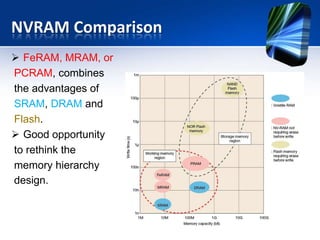
NVRAM Comparison
 FeRAM, MRAM, or
PCRAM, combines
the advantages of
SRAM, DRAM and
Flash.
 Good opportunity
to rethink the
memory hierarchy
design.
Emerging Non-volatile Memory
(NVM)

Magnetic RAM (MRAM)

Phase-change RAM (PCRAM)
SRAM vs. MRAM
Area(65nm)

3.66mm2SRAM

3.30mm^2MRAM

Capacity

128KB

512KB

Read latency

2.25ns

2.32ns

Write latency

2.26ns

11.02ns

Read energy

0.90ns

0.86ns

Write energy

0.80ns

5.0ns

Cache configuration

Leakage power

2MB(16*128KB)SRAM Cache

2.09W

8MB(16*512KB)MRAM Cache

0.20W

Pros: Low leakage power, high density.
Cons: Long write latency and large write energy.
Cont……..
 High Density
 Low Leakage power and high dynamic power
 Fast Read
 Slow Write
 Low Read Energy High Write Energy

 Reduce cache miss rate and increase hit latency
Replace SRAM caches with MRAM ?
Direct Replacement
 Replace SRAM with MRAM of same area.
 The number of banks are kept the same.
 The capacity of L2 cache increases by 4X.
Observation 1
Replacing SRAM L2 caches directly with MRAM
can reduce the access miss rate of L2caches.
However, the long access latency to MRAM
cache has a negative impact on the performance.
When the write intensity is high, it even results in
performance degradation.
Direct MRAM replacement may harm performance.
How is power consumption?
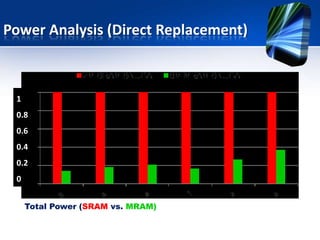
Power Analysis (Direct Replacement)

1
0.8
0.6
0.4
0.2
0
Total Power (SRAM vs. MRAM)
Observation 2
Replacing SRAM L2 caches directly with MRAM
can greatly reduce the leakage power.
When the write intensity is high, the dynamic
power increases significantly because of the high
write energy of MRAM cache.
How to improve the performance and further reduce power of
MRAM?
SRAM-MRAM Hybrid L2 Cache

Using hybrid L2 cache,

MRAM write intensities are reduced
Comparisons
Feature

SRAM

eRAM

STTRAM/MRAM

PCRAM

Density

Low(1)

High(4)

High(4)

Very High(16)

Speed

Very fast

Fast

Fast for read,
Slow for write

Slow for read,
very slow for
write

Dynamic
power

Low

Medium

Low for read,
Very high for
write

Medium for
read,
high for write

Leakage
power

High

Medium

Low

Low

no volatility

no

Yes

Yes

Yes
HCA: Hybrid Cache Architecture
 A hybrid cache/memory architecture can be used.
 Two possibilities for this are
- an STT-RAM or SRAM hybrid on-chip cache.
- A PCRAM or DRAM hybrid main memory.

 In such a hybrid architecture, instead of building a pure STT-RAMbased cache ,a pure PCRAM-based main memory.
 We could replace a portion of the MRAM or PCRAM cells with
SRAM or DRAM elements, respectively.
Emerging NVM Applications
General Conclusions
 The emerging NVM business will be very dynamic over the next five
years, thanks to improvements in scalability/cost and density of
emerging NVM chips:
- PCM devices, the densest NVM in 2012 at 1GB, will reach 8GB by
2018 -> could replace NOR Flash Memory in mobile phones and will
also be used as Storage Class Memory in Enterprise Storage.
- MRAM/STTMRAM chips will reach 8 - 16 GB in 2018 -> It will be
widely sold as a Storage Class Memory, and possibly as a DRAM
successor in Enterprise Storage after 2018.
Cont……..
-

RRAM will reach between 32GB – 2TB in 2018 thanks to 3D
capability -> gradually be adopted in the Mass Storage market
dominated by NAND technology, in addition to limited market
adoption in lower-density applications like Industrial and Enterprise
Storage.

- FRAM will be more stable in terms of scalability, with 8 – 16MB chips
available by 2018 -> development of new FRAM material could raise
scalability, but we don’t expect it to be widely industrialized and
commercialized before 2018.
Emt

Emt

  • 1.
  • 2.
    Position Statement Emerging NVMare very attractive  Combing the speed of SRAM, the density of DRAM, and the non-volatility of Flash memory. Attractive features  high density, low leakage, non-volatile. Undesirable features:  Write-related: long write-latency, high write-energy.  low endurance (e.g. PCRAM).  Cost (Needs large volume production). Solution: Hybrid cache/mem/storage + 3D? Enabling unique applications.
  • 3.
    OUTLINE  Introduction  Modelling - MRAM/PCRAMmodelling  Architecture - MRAM/PCRAM stacking HCA: Hybrid Cache Architecture Hybrid storage system  Application - Exascale computing  Conclusion
  • 4.
  • 5.
    Emerging Memory Technologies FeRAM (Ferroelectric RAM)  MRAM (Magnetic RAM)  Memristor (Resistive RAM)  PCRAM (Phase-Change RAM) Toshba - iFeRAM(2009) Ever Spin - MRAM(2008) HP Labs - Memristor (2009) Samsung - PCRAM(2008)
  • 6.
  • 7.
    NVRAM Comparison  FeRAM,MRAM, or PCRAM, combines the advantages of SRAM, DRAM and Flash.  Good opportunity to rethink the memory hierarchy design.
  • 8.
    Emerging Non-volatile Memory (NVM) MagneticRAM (MRAM) Phase-change RAM (PCRAM)
  • 9.
    SRAM vs. MRAM Area(65nm) 3.66mm2SRAM 3.30mm^2MRAM Capacity 128KB 512KB Readlatency 2.25ns 2.32ns Write latency 2.26ns 11.02ns Read energy 0.90ns 0.86ns Write energy 0.80ns 5.0ns Cache configuration Leakage power 2MB(16*128KB)SRAM Cache 2.09W 8MB(16*512KB)MRAM Cache 0.20W Pros: Low leakage power, high density. Cons: Long write latency and large write energy.
  • 10.
    Cont……..  High Density Low Leakage power and high dynamic power  Fast Read  Slow Write  Low Read Energy High Write Energy  Reduce cache miss rate and increase hit latency Replace SRAM caches with MRAM ?
  • 11.
    Direct Replacement  ReplaceSRAM with MRAM of same area.  The number of banks are kept the same.  The capacity of L2 cache increases by 4X.
  • 12.
    Observation 1 Replacing SRAML2 caches directly with MRAM can reduce the access miss rate of L2caches. However, the long access latency to MRAM cache has a negative impact on the performance. When the write intensity is high, it even results in performance degradation. Direct MRAM replacement may harm performance. How is power consumption?
  • 13.
    Power Analysis (DirectReplacement) 1 0.8 0.6 0.4 0.2 0 Total Power (SRAM vs. MRAM)
  • 14.
    Observation 2 Replacing SRAML2 caches directly with MRAM can greatly reduce the leakage power. When the write intensity is high, the dynamic power increases significantly because of the high write energy of MRAM cache. How to improve the performance and further reduce power of MRAM?
  • 15.
    SRAM-MRAM Hybrid L2Cache Using hybrid L2 cache, MRAM write intensities are reduced
  • 16.
    Comparisons Feature SRAM eRAM STTRAM/MRAM PCRAM Density Low(1) High(4) High(4) Very High(16) Speed Very fast Fast Fastfor read, Slow for write Slow for read, very slow for write Dynamic power Low Medium Low for read, Very high for write Medium for read, high for write Leakage power High Medium Low Low no volatility no Yes Yes Yes
  • 17.
    HCA: Hybrid CacheArchitecture
  • 18.
    HCA: Hybrid CacheArchitecture  A hybrid cache/memory architecture can be used.  Two possibilities for this are - an STT-RAM or SRAM hybrid on-chip cache. - A PCRAM or DRAM hybrid main memory.  In such a hybrid architecture, instead of building a pure STT-RAMbased cache ,a pure PCRAM-based main memory.  We could replace a portion of the MRAM or PCRAM cells with SRAM or DRAM elements, respectively.
  • 19.
  • 20.
    General Conclusions  Theemerging NVM business will be very dynamic over the next five years, thanks to improvements in scalability/cost and density of emerging NVM chips: - PCM devices, the densest NVM in 2012 at 1GB, will reach 8GB by 2018 -> could replace NOR Flash Memory in mobile phones and will also be used as Storage Class Memory in Enterprise Storage. - MRAM/STTMRAM chips will reach 8 - 16 GB in 2018 -> It will be widely sold as a Storage Class Memory, and possibly as a DRAM successor in Enterprise Storage after 2018.
  • 21.
    Cont…….. - RRAM will reachbetween 32GB – 2TB in 2018 thanks to 3D capability -> gradually be adopted in the Mass Storage market dominated by NAND technology, in addition to limited market adoption in lower-density applications like Industrial and Enterprise Storage. - FRAM will be more stable in terms of scalability, with 8 – 16MB chips available by 2018 -> development of new FRAM material could raise scalability, but we don’t expect it to be widely industrialized and commercialized before 2018.