Memory Design for SOC
INTRODUCTION
The memory system is often the most costly part of the
system and it largely determines the performance(closer faster)
Regardless of the processors and the interconnect, the
application cannot be executed any faster than the
memory system, which provides the instructions and the
operands hence the memory system largely determines
the performance
so Memory design is the key to system design
Memory design involves a number of considerations.
The primary consideration is the application requirements:
the operating system, the size, and the variability of the
application processes.
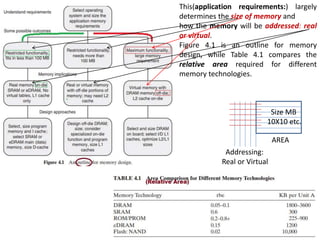
This(application requirements:) largely determines the size of
memory and
how the memory will be addressed: real or virtual.
Figure 4.1 is an outline for memory design, while Table 4.1
compares the relative area required for different memory
technologies.
This(application requirements:) largely
determines the size of memory and
how the memory will be addressed: real
or virtual.
Figure 4.1 is an outline for memory
design, while Table 4.1 compares the
relative area required for different
memory technologies.
Size MB
10X10 etc.
AREA
Addressing:
Real or Virtual
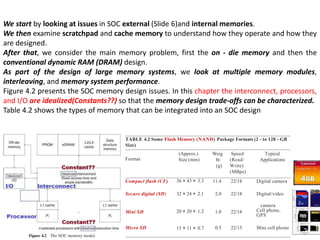
We start by looking at issues in SOC external (Slide 6)and internal memories.
We then examine scratchpad and cache memory to understand how they operate and how they
are designed.
After that, we consider the main memory problem, first the on - die memory and then the
conventional dynamic RAM (DRAM) design.
As part of the design of large memory systems, we look at multiple memory modules,
interleaving, and memory system performance.
Figure 4.2 presents the SOC memory design issues. In this chapter the interconnect, processors,
and I/O are idealized(Constants??) so that the memory design trade-offs can be characterized.
Table 4.2 shows the types of memory that can be integrated into an SOC design
TABLE 4.2 Some Flash Memory (NAND) Package Formats (2 - to 128 - GB
Size)
Format
(Approx.)
Size (mm)
Weig
ht
(g)
Speed
(Read/
Write)
(MBps)
Typical
Applications
Compact flash (CF) 36 × 43 × 3.3 11.4 22/18 Digital camera
Secure digital (SD) 32 × 24 × 2.1 2.0 22/18 Digital/video
Mini SD 20 × 20 × 1.2 1.0 22/18
camera
Cell phone,
GPS
Micro SD 15 × 11 × 0.7 0.5 22/15 Mini cell phone
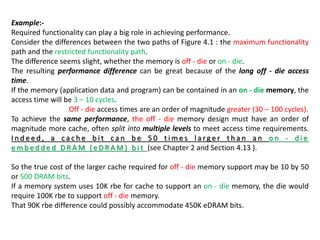
Example:-
Required functionality can play a big role in achieving performance.
Consider the differences between the two paths of Figure 4.1 : the maximum functionality
path and the restricted functionality path.
The difference seems slight, whether the memory is off - die or on - die.
The resulting performance difference can be great because of the long off - die access
time.
If the memory (application data and program) can be contained in an on - die memory, the
access time will be 3 – 10 cycles.
Off - die access times are an order of magnitude greater (30 – 100 cycles).
To achieve the same performance, the off - die memory design must have an order of
magnitude more cache, often split into multiple levels to meet access time requirements.
I n d e e d , a c a c h e b i t c a n b e 5 0 t i m e s l a rg e r t h a n a n o n - d i e
e m b e d d e d D R A M ( e D R A M ) b i t (see Chapter 2 and Section 4.13 ).
So the true cost of the larger cache required for off - die memory support may be 10 by 50
or 500 DRAM bits.
If a memory system uses 10K rbe for cache to support an on - die memory, the die would
require 100K rbe to support off - die memory.
That 90K rbe difference could possibly accommodate 450K eDRAM bits.
Overview of SOC External Memory:
Flash
Flash technology is a rapidly developing technology with improvements announced
regularly.
Flash is not really a memory replacement but is probably better viewed as a disk
replacement(External).
However, in some circumstances and configurations, it can serve the dual purpose of
memory and nonvolatile backup storage.
Flash memory consists of an array of floating gate transistors. These transistors are similar
to MOS transistors but with a two-gate structure: a control gate and an insulated floating
gate. Charge stored on the floating gate is trapped there, providing a nonvolatile
storage. While the data can be rewritten, the current technology has a limited number of
reliable rewrite cycles, usually less than a million.
Since degradation with use can be a problem, error detection and correction are frequently
implemented.
While the density is excellent for
semiconductor devices, the write cycle
limitation generally restricts the usage to
storing infrequently modified data, such as
programs and large files.
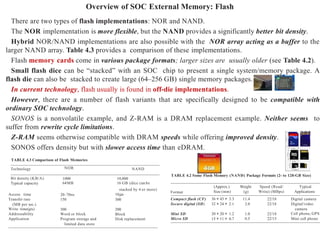
There are two types of flash implementations: NOR and NAND.
The NOR implementation is more flexible, but the NAND provides a significantly better bit density.
Hybrid NOR/NAND implementations are also possible with the NOR array acting as a buffer to the
larger NAND array. Table 4.3 provides a comparison of these implementations.
Flash memory cards come in various package formats; larger sizes are usually older (see Table 4.2).
Small flash dice can be “stacked” with an SOC chip to present a single system/memory package. A
flash die can also be stacked to create large (64–256 GB) single memory packages.
In current technology, flash usually is found in off-die implementations.
However, there are a number of flash variants that are specifically designed to be compatible with
ordinary SOC technology.
SONOS is a nonvolatile example, and Z-RAM is a DRAM replacement example. Neither seems to
suffer from rewrite cycle limitations.
Z-RAM seems otherwise compatible with DRAM speeds while offering improved density.
SONOS offers density but with slower access time than eDRAM.
TABLE 4.3 Comparison of Flash Memories
Technology NOR NAND
Bit density (KB/A)
Typical capacity
1000
64MB
10,000
16 GB (dice can be
stacked by 4 or more)
10μs
300
Access time
Transfer rate
(MB per sec.)
Write time(μs)
Addressability
Application
20–70ns
150
300
Word or block
Program storage and
limited data store
200
Block
Disk replacement
Format
(Approx.)
Size (mm)
Weight
(g)
Speed (Read/
Write) (MBps)
Typical
Applications
Compact flash (CF) 36 × 43 × 3.3 11.4 22/18 Digital camera
Secure digital (SD) 32 × 24 × 2.1 2.0 22/18 Digital/video
Mini SD 20 × 20 × 1.2 1.0 22/18
camera
Cell phone, GPS
Micro SD 15 × 11 × 0.7 0.5 22/15 Mini cell phone
TABLE 4.2 Some Flash Memory (NAND) Package Formats (2- to 128-GB Size)
Overview of SOC External Memory: Flash
Overview of SOC Internal Memory:
Placement
The most important and obvious factor in memory system design is the placement of the main memory:
on-die (the same die as the processor) or
off-die (on its own die or on a module with multiple dice).
As pointed out in Chapter1, this factor distinguishes conventional workstation processors and application oriented
board designs from SOC designs.
The design of the memory system is limited by two basic parameters that determine memory systems performance.
The first parameter is the access time. This is the time for a processor request to be transmitted to the memory
system, access a datum, and return it back to the processor. Access time is largely a function of the physical
parameters of the memory system—the physical distance between the processor and the memory system, or the bus
delay, the chip delay, and so on.
The second parameter is memory bandwidth, the ability of the memory to respond to requests per unit time.
Bandwidth is primarily determined by the way the physical memory system is organized—the number of
independent memory arrays and the use of special sequential accessing modes.
The cache system must compensate for limits on memory access time and bandwidth.
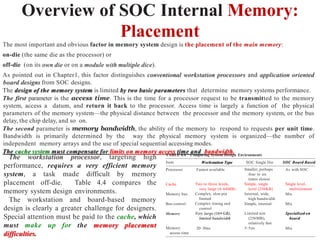
TABLE 4.4 Comparing System Design Environments
Workstation Type SOC Single Die
Item SOC Board Based
Processor Fastest available Smaller, perhaps
four to six
times slower
Simple, single
level (256KB)
Internal, wide,
high bandwidth
Simple, internal
As with SOC
Cache Two to three levels,
very large (4–64MB)
Complex, slow pin
limited
Complex timing and
control
Very large (16+GB),
limited bandwidth
Single level,
multielement
Mix
Memory bus
Bus control Mix
Memory Limited size
(256MB),
relatively fast
3–5ns
Specialized on
board
Memory
access time
20–30ns Mix
The workstation processor, targeting high
performance, requires a very efficient memory
system, a task made difficult by memory
placement off-die. Table 4.4 compares the
memory system design environments.
The workstation and board-based memory
design is clearly a greater challenge for designers.
Special attention must be paid to the cache, which
must make up for the memory placement
difficulties.
The Size of Memory
As it will become obvious in this chapter, designing for large off-die memory is the key
problem in system board designs.
So why not limit memory to sizes that could be incorporated on a die?
In a virtual memory system, we can still access large address spaces for applications.
For workstations, the application environment (represented by the operating system) has
grown considerably (see Figure 4.3). As the environment continues to grow, so too does the
working set or the active pages of storage. This requires more real (physical) memory to hold
a sufficient number of pages to avoid excessive page swapping, which can destroy performance.
Board-based systems face a slightly different problem. Here, the media-based data sets are
naturally very large and require large bandwidths from memory and substantial processing
ability from the media processor.
Board-based systems have an advantage, however, as the access time is rarely a problem so
long as the bandwidth requirements are met. How much memory can we put on a die? Well,
that depends on the technology (feature size) and the required performance..
0
1400
1200
1000
800
600
400
200
1600
XP
ME
98
NT
95
Disk
Space
(MB)
Required Disk Space
Figure 4.3: Required disk space for several
generations of Microsoft’s Windows operating system.
The newer Vista operating system requires 6GB.
Table 4.1 shows the area occupied for various
technologies(Memory Technology). The eDRAM size
assumes a relatively large memory array (see later in
this chapter). So, for example, in a 45-nm technology,
we might expect to have about 49.2 kA/cm2
or about 8
MB of eDRAM. Advancing circuit design and
technology could significantly improve that, but it does
seem that about 64 MB would be a limit, unless a
compatible flash technology becomes available
SCRATCHPADS AND CACHE
MEMORY
• Smaller memories are almost always faster than larger memory, so it is useful to keep frequently used (or
anticipated) instructions and data in a small, easily accessible (one cycle access) memory. If this memory is
managed directly by the programmer, it is called a scratchpad memory; if it is managed by the hardware, it
is called a cache.
• Since management is a cumbersome process, most general-purpose computers use only cache memory.
• SOC, however, offers the potential of having the scratchpad alternative. Assuming that the application is
well-known, the programmer can explicitly control data transfers in anticipation of use.
• Eliminating the cache control hardware offers additional area for larger scratchpad size, again improving
performance.
• SOC implements scratchpads usually for data and not for instructions, as simple caches work well for
instructions. Furthermore, it is not worth the programming effort to directly manage instruction transfers.
• The rest of this section treats the theory and experience of cache memory. Because there has been so much
written about cache, it is easy to forget the simpler and older scratchpad approach, but with SOC, sometimes the
simple approach is best.
• Caches work on the basis of the locality of program behavior. There are three principles involved:
1. Spatial Locality. Given an access to a particular location in memory, there is a high probability that other
accesses will be made to either that or neighboring locations within the lifetime of the program.
2.Temporal Locality. Given a sequence of references to n locations, there will be references into the same
locations with high probability.
3.Sequentiality. Given that a reference has been made to location s, it is likely that within the next few
references, there will be a reference to the location of s + 1. This is a special case of spatial locality.
• The cache designer must deal with the processor’s accessing requirements on the one hand, and the memory
system’s requirements on the other. Effective cache designs balance these within cost constraints.
BASIC NOTIONS
• Processor references contained in the cache are called cache hits.
• Processor references not found in the cache are called cache misses.
• On a cache miss, the cache fetches the missing data from memory and places it in the cache.
• Usually, the cache fetches an associated region of memory called the line. The line consists of one or more physical
words accessed from a higher-level cache or main memory. The physical word is the basic unit of access to the memory.
• The processor–cache interface has a number(6) of parameters. Those that directly affect processor performance (Figure
4.4) include the following 6 parameters :
1. Physical word—unit of transfer between processor and cache. Typical physical word sizes:
• 2–4 bytes—minimum, used in small core-type processors
• 8 bytes and larger—multiple instruction issue processors (superscalar)
2. Block size (sometimes called line)—usually the basic unit of transfer between cache and memory. It consists of n
physical words transferred from the main memory via the bus.
3. Access time for a cache hit—this is a property of the cache size and organization.
4. Access time for a cache miss—property of the memory and bus.
5. Time to compute a real address given a virtual address (not-in-translation look aside buffer [TLB] time)—property of the
address translation facility.
6. Number of processor requests per cycle.
Cache performance is measured by the miss rate or the probability that a reference made to the cache is not found. The miss
rate times the miss time is the delay penalty due to the cache miss. In simple processors, the processor stalls on a cache miss.
IS CACHE A PART OF THE PROCESSOR?
For many IP designs, t h e f i r s t - l e v e l c a c h e i s
i n t e g r a t e d i n t o t h e p r o c e s s o r d e s i g n , so what
and why do we need to know cache details? The most obvious answer
is that an SOC consists of multiple processors that must share
memory, usually through a second-level cache. Moreover, the details
of the first-level cache may be essential in achieving memory
consistency and proper program operation. So for our purpose, the cache
is a separate, important piece of the SOC. We design the SOC memory
hierarchy, not an isolated cache.
CACHE ORGANIZATION
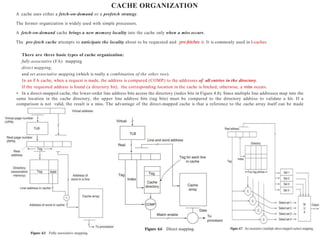
A cache uses either a fetch-on-demand or a prefetch strategy.
The former organization is widely used with simple processors.
A fetch-on-demand cache brings a new memory locality into the cache only when a miss occurs.
The pre-fetch cache attempts to anticipate the locality about to be requested and pre-fetches it. It is commonly used in I-caches.
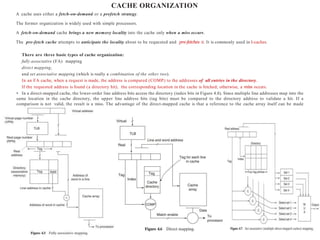
There are three basic types of cache organization:
fully associative (FA) mapping
direct mapping,
and set associative mapping (which is really a combination of the other two).
In an FA cache, when a request is made, the address is compared (COMP) to the addresses of all entries in the directory.
If the requested address is found (a directory hit), the corresponding location in the cache is fetched; otherwise, a miss occurs.
• In a direct-mapped cache, the lower-order line address bits access the directory (index bits in Figure 4.8). Since multiple line addresses map into the
same location in the cache directory, the upper line address bits (tag bits) must be compared to the directory address to validate a hit. If a
comparison is not valid, the result is a miss. The advantage of the direct-mapped cache is that a reference to the cache array itself can be made
simultaneously withthe access to thedirectory.
CACHE ORGANIZATION
A cache uses either a fetch-on-demand or a prefetch strategy.
The former organization is widely used with simple processors.
A fetch-on-demand cache brings a new memory locality into the cache only when a miss occurs.
The pre-fetch cache attempts to anticipate the locality about to be requested and pre-fetches it. It is commonly used in I-caches.
There are three basic types of cache organization:
fully associative (FA) mapping
direct mapping,
and set associative mapping (which is really a combination of the other two).
In an FA cache, when a request is made, the address is compared (COMP) to the addresses of all entries in the directory.
If the requested address is found (a directory hit), the corresponding location in the cache is fetched; otherwise, a miss occurs.
• In a direct-mapped cache, the lower-order line address bits access the directory (index bits in Figure 4.8). Since multiple line addresses map into the
same location in the cache directory, the upper line address bits (tag bits) must be compared to the directory address to validate a hit. If a
comparison is not valid, the result is a miss. The advantage of the direct-mapped cache is that a reference to the cache array itself can be made
simultaneously withthe access to thedirectory.
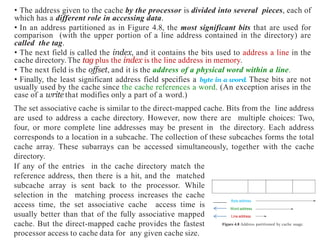
• The address given to the cache by the processor is divided into several pieces, each of
which has a different role in accessing data.
• In an address partitioned as in Figure 4.8, the most significant bits that are used for
comparison (with the upper portion of a line address contained in the directory) are
called the tag.
• The next field is called the index, and it contains the bits used to address a line in the
cache directory.The tag plus the index is the line address in memory.
• The next field is the offset, and it is the address of a physical word within a line.
• Finally, the least significant address field specifies a byte in a word. These bits are not
usually used by the cache since the cache references a word. (An exception arises in the
case of a write that modifies only a part of a word.)
Byte address
Word address
Line address
Figure 4.8 Address partitioned by cache usage.
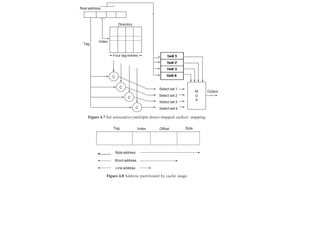
The set associative cache is similar to the direct-mapped cache. Bits from the line address
are used to address a cache directory. However, now there are multiple choices: Two,
four, or more complete line addresses may be present in the directory. Each address
corresponds to a location in a subcache. The collection of these subcaches forms the total
cache array. These subarrays can be accessed simultaneously, together with the cache
directory.
If any of the entries in the cache directory match the
reference address, then there is a hit, and the matched
subcache array is sent back to the processor. While
selection in the matching process increases the cache
access time, the set associative cache access time is
usually better than that of the fully associative mapped
cache. But the direct-mapped cache provides the fastest
processor access to cache data for any given cache size.
Figure 4.7 Set associative (multiple direct-mapped caches) mapping.
Directory
Four tag entries
Select set 1
Select set 2
Select set 3
Select set 4
C
C
C
C
M
U
X
Output
Real address
Tag
Index
Tag Index Offset Byte
Byte address
Word address
Line address
Figure 4.8 Address partitioned by cache usage.
CACHE DATA
• Cache size largely determines cache performance (miss rate).
• The larger the cache, the lower the miss rate. doubling the size halves the miss rate
• Almost all cache miss rate data are empirical and, as such, have
certain limitations.
• Cache data are strongly program dependent. Also, data are
frequently based upon older machines, where the memory and
program size were fixed and small.
• Such data show low miss rate for relatively small size caches.
Thus, there is a tendency for the measured miss rate of a particular
cache size to increase over time. This is simply the result of
measurements made on programs of increasing size.
• Some time ago, Smith developed a series of design target miss
rates (DTMRs) that represent an estimate of what a designer could
expect from an integrated (instruction and data) cache. These data
are presented in Figure 4.9 and give an idea of typical miss rates as
a function of cache and line sizes.
• For cache sizes larger than 1 MB, a general rule is that doubling the
size halves the miss rate. The general rule is less valid in transaction-
based programs.
0.01
134 MEMORY DESIGN: SYSTEM-ON-CHIP AND BOARD-BASEDSYSTEMS
Unified cache
1.0
Design
target
miss
rate
8
16
32
64
128
0.1
Line size (bytes)
4
0.001
10 100 1000 10,000 100,000 1,000,000
Cache size (bytes)
Figure 4.9 A design target miss rate per reference to memory (fully associative,
demand fetch, fetch [allocate] on write, copy-back with LRU replacement) [223, 224].
WRITE POLICIES
• How is memory updated on a write? One could write to
both cache and memory (write-through or WT), or write only
to the cache (copy-back or CB sometimes called write-back),
updating memory when the line is replaced.
• These two strategies are the basic cache write policies
(Figure 4.10).
•The write-through cache (Figure 4.10a) stores into both
cache and main memory on each CPU store.
Advantage: This retains a consistent (up-to-date) image of
program activity in memory.
Disadvantage: Memory bandwidth may be high—dominated by
write traffic.
•In the copy-back cache (Figure 4.10b), the new data are
written to memory when the line is replaced. This requires
keeping track of modified (or “dirty”)lines, but results in
reduced memory traffic for writes:
1. Dirty bit is set if a write occurs anywhere in line.
2.From various traces, the probability that a line to be replaced is dirty is 47% on
average (ranging from 22% to 80%).
3.Rule of thumb: Half of the data lines replaced are dirty. So, for a data cache,
assume 50% are dirty lines, and for an integrated cache, assume 30% are dirty
lines.
• Most larger caches use copy-back;
• write-through is usually restricted to either small caches or special-purpose
caches that provide an up-to-date image of memory.
Finally, what should we do when a write (or store) instruction misses in the cache? We
can fetch that line from memory (write allocate or WA) or just write into memory
(no write allocate or NWA). Most write-through caches do not allocate on writes
(WTNWA) and most copy back caches do allocate (CBWA).
4.8 STRATEGIES FOR LINE REPLACEMENT AT MISS(Cache) TIME
• What happens on a cache miss?
If the processor reference address is not found in the directory, a cache miss occurs.
Two actions must promptly be taken:
(1) The missed line must be fetched from the main memory, and
(2) one of the current cache lines must be designated for replacement by the
currently accessed line (the missed line).
1. Fetching a Line
In a write-through cache, fetching a line involves accessing the missed line and the
replaced line is discarded (written over).
For a copy-back policy, we first determine whether the line to be replaced is dirty
(has been written to) or not. If the line is clean, the situation is the same as with the
write-through cache. However, if the line is dirty, we must write the replaced line
back to memory.
In accessing a line, the fastest approach is the nonblocking cache or the
prefetching cache. This approach is applicable in both write-through and copy- back
caches.
Here, the cache has additional control hardware to allow the cache miss to be
handled (or bypassed), while the processor continues to execute. This strategy only
works when the miss is accessing cache data that are not currently required by the
processor.
Nonblocking caches perform best with compilers that provide prefetching of lines
in anticipation of processor use.
The effectiveness of nonblocking caches depends on
1. The number of misses that can be bypassed while the processor continues to
execute; and
2. The effectiveness of the prefetch and the adequateness of the buffers to hold the
prefetch information; the longer the prefetch is made before expected use, the less
the miss delay, but this also means that the buffers or registers are occupied and
2. Line Replacement
The replacement policy selects a line for replacement when the cache is full. There
are three replacement policies that are widely used:
1.Least Recently Used (LRU). The line that was least recently accessed (by a read
or write) is replaced.
2.First In–First Out (FIFO). The line that had been in the cache the longest is
replaced.
3.Random Replacement (RAND). Replacement is determined randomly.
Since the LRU policy corresponds to the concept of temporal locality, it is generally
the preferred policy. It is also the most complex to implement. Each line has a
counter(recall program counter) that is updated on a read (or write). Since these
counters could be large, it is common to create an approximation to the true LRU
with smaller counters.
While LRU performs better than either FIFO or RAND, the use of the simpler
RAND or FIFO only amplifies the LRU miss rate (DTMR) by about 1.10 (i.e.,
10%).
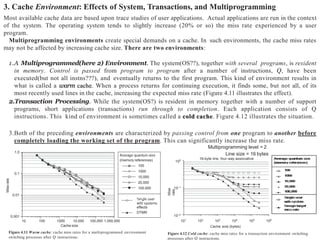
3. Cache Environment: Effects of System, Transactions, and Multiprogramming
Most available cache data are based upon trace studies of user applications. Actual applications are run in the context
of the system. The operating system tends to slightly increase (20% or so) the miss rate experienced by a user
program.
Multiprogramming environments create special demands on a cache. In such environments, the cache miss rates
may not be affected by increasing cache size. There are two environments:
1.A Multiprogrammed(here 2) Environment. The system(OS??), together with several programs, is resident
in memory. Control is passed from program to program after a number of instructions, Q, have been
executed(but not all instns???), and eventually returns to the first program. This kind of environment results in
what is called a warm cache. When a process returns for continuing execution, it finds some, but not all, of its
most recently used lines in the cache, increasing the expected miss rate (Figure 4.11 illustrates the effect).
2.Transaction Processing. While the system(OS?) is resident in memory together with a number of support
programs, short applications (transactions) run through to completion. Each application consists of Q
instructions. This kind of environment is sometimes called a cold cache. Figure 4.12 illustrates the situation.
3.Both of the preceding environments are characterized by passing control from one program to another before
completely loading the working set of the program. This can significantly increase the miss rate.
Multiprogramming level = 2
Line size = 16 bytes
0.001
0.01
0.1
1.0
10 100 1000 10,000 100,000 1,000,000
Cache size
Figure 4.11 Warm cache: cache miss rates for a multiprogrammed environment
switching processes after Q instructions.
Miss
rate
(memory references)
100
1000
10,000
20,000
100,000
effects
DTMR
10–1
100
16-byte line, four-way associative
10–2
101
102
103
104
105
106
Cache size (bytes)
Figure 4.12 Cold cache: cache miss rates for a transaction environment switching
processes after Q instructions.
Miss
rate
9.OTHER TYPES OF CACHE
So far, we have considered only the simple integrated(doesn’t mean p+cache) cache (also called a “unified” cache), which contains both data D and
instructions I.
In the next few sections, we consider various other types of cache. The list we present (Table 4.5) is hardly exhaustive (by no means Exhaustive(very thorough
or complete)) but it illustrates some of the variety of cache designs possible for special or even commonplace applications.
Most currently available microprocessors use split I - and D - caches, described in the next section
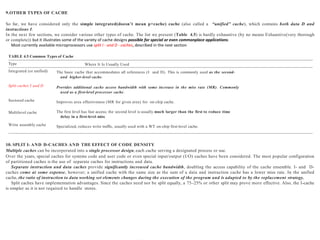
TABLE 4.5 Common Types of Cache
Type Where It Is Usually Used
Integrated (or unified) The basic cache that accommodates all references (I and D). This is commonly used as the second-
and higher-level cache.
Provides additional cache access bandwidth with some increase in the miss rate (MR). Commonly
used as a first-level processor cache.
Improves area effectiveness (MR for given area) for on-chip cache.
The first level has fast access; the second level is usually much larger than the first to reduce time
delay in a first-level miss.
Specialized, reduces write traffic, usually used with a WT on-chip first-level cache.
Split caches I and D
Sectored cache
Multilevel cache
Write assembly cache
10. SPLIT I- AND D-CACHES AND THE EFFECT OF CODE DENSITY
Multiple caches can be incorporated into a single processor design, each cache serving a designated process or use.
Over the years, special caches for systems code and user code or even special input/output (I/O) caches have been considered. The most popular configuration
of partitioned caches is the use of separate caches for instructions and data.
Separate instruction and data caches provide significantly increased cache bandwidth, doubling the access capability of the cache ensemble. I- and D-
caches come at some expense, however; a unified cache with the same size as the sum of a data and instruction cache has a lower miss rate. In the unified
cache, the ratio of instruction to data working set elements changes during the execution of the program and is adapted to by the replacement strategy.
Split caches have implementation advantages. Since the caches need not be split equally, a 75–25% or other split may prove more effective. Also, the I-cache
is simpler as it is not required to handle stores.
11. MULTILEVEL CACHES
1. Limits on Cache Array Size
The cache consists of a static RAM (SRAM) array of storage cells.
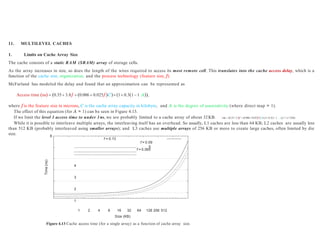
As the array increases in size, so does the length of the wires required to access its most remote cell. This translates into the cache access delay, which is a
function of the cache size, organization, and the process technology (feature size, f).
McFarland has modeled the delay and found that an approximation can be represented as
Access time ns  0.35 3.8f  0.006  0.025f C 1 0.31 1 A,
where f is the feature size in microns, C is the cache array capacity in kilobyte, and A is the degree of associativity (where direct map = 1).
The effect of this equation (for A = 1) can be seen in Figure 4.13.
If we limit the level 1 access time to under 1ns, we are probably limited to a cache array of about 32KB. 1ns  0.35 3.8f 0.0060.025f C10.311 . 1,=>c=32kb
While it is possible to interleave multiple arrays, the interleaving itself has an overhead. So usually, L1 caches are less than 64 KB; L2 caches are usually less
than 512 KB (probably interleaved using smaller arrays); and L3 caches use multiple arrays of 256 KB or more to create large caches, often limited by die
size. 6
Time
(ns)
f = 0.13
f = 0.09
5
f = 0.065
4
3
2
1
1 2 4 8 16 32 64 128 256 512
Size (KB)
Figure 4.13 Cache access time (for a single array) as a function of cache array size.
4.11.2 Evaluating Multilevel Caches
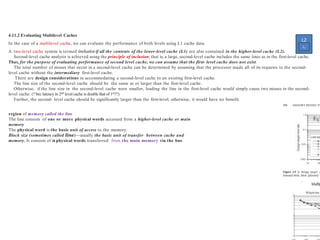
In the case of a multilevel cache, we can evaluate the performance of both levels using L1 cache data.
A two-level cache system is termed inclusive if all the contents of the lower-level cache (L1) are also contained in the higher-level cache (L2).
Second-level cache analysis is achieved using the principle of inclusion; that is, a large, second-level cache includes the same lines as in the first-level cache.
Thus, for the purpose of evaluating performance of second level cache, we can assume that the first- level cache does not exist.
The total number of misses that occur in a second-level cache can be determined by assuming that the processor made all of its requests to the second-
level cache without the intermediary first-level cache.
There are design considerations in accommodating a second-level cache to an existing first-level cache.
The line size of the second-level cache should be the same as or larger than the first-level cache.
Otherwise, if the line size in the second-level cache were smaller, loading the line in the first-level cache would simply cause two misses in the second-
level cache. (? bec latency in 2nd level cache is double that of 1st??)
Further, the second- level cache should be significantly larger than the first-level; otherwise, it would have no benefit.
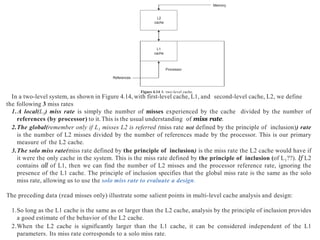
L2
L1
region of memory called the line
The line consists of one or more physical words accessed from a higher-level cache or main
memory
The physical word is the basic unit of access to the memory.
Block size (sometimes called line)—usually the basic unit of transfer between cache and
memory, It consists of n physical words transferred from the main memory via the bus.
Processor
References
Figure 4.14 A two-level cache.
L1
cache
L2
cache
Memory
In a two-level system, as shown in Figure 4.14, with first-level cache, L1, and second-level cache, L2, we define
the following 3 miss rates
1.A local(L1) miss rate is simply the number of misses experienced by the cache divided by the number of
references (by processor) to it.This is the usual understanding of miss rate.
2.The global(remember only if L1 misses L2 is referred (miss rate not defined by the principle of inclusion)) rate
is the number of L2 misses divided by the number of references made by the processor. This is our primary
measure of the L2 cache.
3.The solo miss rate(miss rate defined by the principle of inclusion) is the miss rate the L2 cache would have if
it were the only cache in the system. This is the miss rate defined by the principle of inclusion (of L1??). If L2
contains all of L1, then we can find the number of L2 misses and the processor reference rate, ignoring the
presence of the L1 cache. The principle of inclusion specifies that the global miss rate is the same as the solo
miss rate, allowing us to use the solo miss rate to evaluate a design.
The preceding data (read misses only) illustrate some salient points in multi-level cache analysis and design:
1.So long as the L1 cache is the same as or larger than the L2 cache, analysis by the principle of inclusion provides
a good estimate of the behavior of the L2 cache.
2.When the L2 cache is significantly larger than the L1 cache, it can be considered independent of the L1
parameters. Its miss rate corresponds to a solo miss rate.
EXAMPLE 4.1
SOC L1 Cache L2 Cache
NetSilicon NS9775 [185]
NXP LH7A404 [186]
Freescale e600 [101] Freescale
PowerQUICC
III [102]
ARM1136J(F)-S [24]
8-KB I-cache, 4-KB D-cache 8-KB I-cache, 8-KB D-
cache
32-KB I-cache, 32-KB D-cache 32-KB I-cache, 32-KB
D-cache
—
—
1 MB with ECC 256 KBwith
ECC
64-KB I-cache, 64-KB D-cache Max 512KB
L1
L2
L2 more than four times the L1 size
Miss penalties:
Miss in L1, hit in L2:
Miss in L1, miss in L2:
2 cycles
15 cycles
Suppose we have a two-level cache with miss rates of 4% (L1) and 1% (L2). Suppose the miss in L1 and the hit in L2 penalty is 2
cycles, and the miss penalty in both caches is 15 cycles (13 cycles more than a hit in L2). If a processor makes one reference per
instruction, we can compute the excess Cycles Per Instruction (CPIs) due to cache misses as follows:
Excess CPI due to L1 misses
 1.0 refr/ inst  0.04 misses /refr  2 cycles/ miss
 0.08 CPI
Excess CPI due to L2 misses
 1.0 refr/ inst  0.01 misses/ refr  13 cycles/ miss
 0.13 CPI.
Note: the L2 miss penalty is 13 cycles, not 15 cycles, since the 1% L2 misses have already been “charged” 2 cycles in the excess L1 CPI:
Total effect  excess L1 CPI  excess L2 CPI
 0.08 0.13
 0.21CPI.
The cache configurations for some recent SOCs are shown in Table 4.6.
TABLE 4.6 SOC Cache Organization
4.16 MODELS OF SIMPLE PROCESSOR–MEMORY INTERACTION
In systems with multiple processors or with complex single processors, requests may congest the memory system.
Either multiple requests may occur at the same time, providing bus or network congestion, (or)
requests arising from different sources may request access to the memory system.
Requests that cannot be immediately honored by the memory system result in memory systems contention. This
contention degrades the bandwidth and is possible to achieve from the memory system.
In the simplest possible arrangement, a single simple processor makes a request to a single memory module. The
processor ceases activity (as with a blocking cache) and waits for service from the module. When the module
responds, the processor resumes activity. Under such an arrangement, the results are completely predictable.
There can be no contention of the memory system since only one request is made at a time to the memory
module.
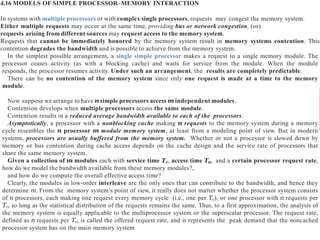
Now suppose we arrange to have n simple processors access m independent modules.
Contention develops when multiple processors access the same module.
Contention results in a reduced average bandwidth available to each of the processors.
Asymptotically, a processor with a nonblocking cache making n requests to the memory system during a memory
cycle resembles the n processor m module memory system, at least from a modeling point of view. But in modern
systems, processors are usually buffered from the memory system. Whether or not a processor is slowed down by
memory or bus contention during cache access depends on the cache design and the service rate of processors that
share the same memory system.
Given a collection of m modules each with service time Tc, access time Ta, and a certain processor request rate,
how do we model the bandwidth available from these memory modules?,
and how do we compute the overall effective access time?
Clearly, the modules in low-order interleave are the only ones that can contribute to the bandwidth, and hence they
determine m. From the memory system’s point of view, it really does not matter whether the processor system consists
of n processors, each making one request every memory cycle (i.e., one per Tc), or one processor with n requests per
Tc, so long as the statistical distribution of the requests remains the same. Thus, to a first approximation, the analysis of
the memory system is equally applicable to the multiprocessor system or the superscalar processor. The request rate,
defined as n requests per Tc, is called the offered request rate, and it represents the peak demand that the noncached
processor system has on the main memory system
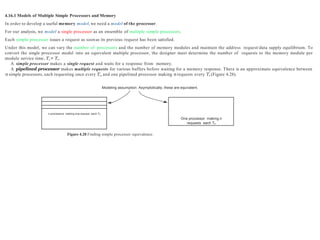
Modeling assumption: Asymptotically, these are equivalent.
4.16.1 Models of Multiple Simple Processors and Memory
In order to develop a useful memory model, we need a model of the processor.
For our analysis, we model a single processor as an ensemble of multiple simple processors.
Each simple processor issues a request as soonas its previous request has been satisfied.
Under this model, we can vary the number of processors and the number of memory modules and maintain the address request/data supply equilibrium. To
convert the single processor model into an equivalent multiple processor, the designer must determine the number of requests to the memory module per
module service time, Ts = Tc.
A simple processor makes a single request and waits for a response from memory.
A pipelined processor makes multiple requests for various buffers before waiting for a memory response. There is an approximate equivalence between
n simple processors, each requesting once every Ts, and one pipelined processor making n requests every Ts (Figure 4.28).
Figure 4.28 Finding simple processor equivalence.
n processors making one request each Tc
One processor making n
requests each Tc
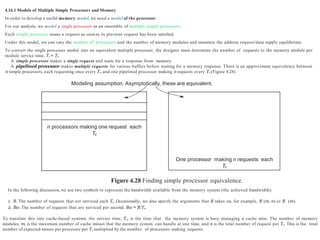
Modeling assumption: Asymptotically, these are equivalent.
4.16.1 Models of Multiple Simple Processors and Memory
In order to develop a useful memory model, we need a model of the processor.
For our analysis, we model a single processor as an ensemble of multiple simple processors.
Each simple processor issues a request as soonas its previous request has been satisfied.
Under this model, we can vary the number of processors and the number of memory modules and maintain the address request/data supply equilibrium.
To convert the single processor model into an equivalent multiple processor, the designer must determine the number of requests to the memory module per
module service time, Ts = Tc.
A simple processor makes a single request and waits for a response from memory.
A pipelined processor makes multiple requests for various buffers before waiting for a memory response. There is an approximate equivalence between
n simple processors, each requesting once every Ts, and one pipelined processor making n requests every Ts (Figure 4.28).
Figure 4.28 Finding simple processor equivalence.
n processors making one request each
Tc
One processor making n requests each
Tc
In the following discussion, we use two symbols to represent the bandwidth available from the memory system (the achieved bandwidth):
1. B. The number of requests that are serviced each Ts. Occasionally, we also specify the arguments that B takes on, for example, B (m, n) or B (m).
2. Bw. The number of requests that are serviced per second: Bw = B/Ts.
To translate this into cache-based systems, the service time, Ts, is the time that the memory system is busy managing a cache miss. The number of memory
modules, m, is the maximum number of cache misses that the memory system can handle at one time, and n is the total number of request per Ts. This is the total
number of expected misses per processor per Ts multiplied by the number of processors making requests.
4.16.2 The Strecker-Ravi Model
This is a simple yet useful model for estimating contention. The original model was developed by Strecker and independently by Ravi.
It assumes that there are n simple processor requests made per memory cycle and
there are mmemory modules.
Further, we assume that there is no bus contention.
The Strecker model assumes that the memory request pattern for the processors is uniform and the probability of any one request to a particular
memory module is simply 1/m.
The key modeling assumption is that the state of the memory system at the beginning of the cycle is not dependent upon any previous action on the part
of the memory—hence, not dependent upon contention in the past (i.e., Markovian). Unserved requests are discarded at the end of the memory cycle.
The following modeling approximations are made:
1. A processor issues a request as soon as its previous request has been satisfied.
2. The memory request pattern from each processor is assumed to be uni- formly distributed; that is, the probability of any one request being made
to a particular memory module is 1/m.
3. The state of the memory system at the beginning of each memory cycle (i.e., which processors are awaiting service at which modules) is ignored
by assuming that all unserviced requests are discarded at the end of each memory cycle and that the processors randomly issue new requests.
Analysis:
Let the average number of memory requests serviced per memory cycle be represented by B (m, n). This is also equal to the average number of
memory modules busy during each memory cycle. Looking at events from any given module’s point of view during each memory cycle, we have
Prob a given processor does not reference the module  1 1/m
Prob no processor references the module  Prob the module is idle  1  1/m
Prob the module is busy  1 1 1/mn
B m, n  average number of busy modules  m1 1 1/mn
.
The achieved memory bandwidth is less than the theoretical maximum due to contention. By neglecting congestion in previous cycles, this analysis
results in an optimistic value for the bandwidth. Still, it is a simple estimate that should be used conservatively.
It has been shown by Bhandarkar [41] that B (m, n) is almost perfectly symmetrical in m and n. He exploited this fact to develop a more accurate
expression for B (m, n), which is
Bm, n  K [11 1/K  l
] where K = max (m, n) and l = min (me, n).
We can use this to model a typical processor ensemble.
160 MEMORY DESIGN: SYSTEM-ON-CHIP AND BOARD-BASEDSYSTEMS
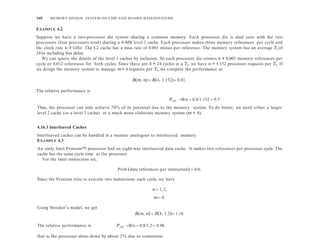
EXAMPLE 4.2
Suppose we have a two-processor die system sharing a common memory. Each processor die is dual core with the two
processors (four processors total) sharing a 4-MB level 2 cache. Each processor makes three memory references per cycle and
the clock rate is 4 GHz. The L2 cache has a miss rate of 0.001 misses per reference. The memory system has an average Ts of
24ns including bus delay.
We can ignore the details of the level 1 caches by inclusion. So each processor die creates 6 × 0.001 memory references per
cycle or 0.012 references for both cycles. Since there are 4 × 24 cycles in a Ts, we have n = 1.152 processor requests per Ts. If
we design the memory system to manage m= 4 requests per Ts, we compute the performance as
Bm, n  B4, 1.152 0.81.
The relative performance is
Thus, the processor can only achieve 70% of its potential due to the memory system. To do better, we need either a larger
level 2 cache (or a level 3 cache) or a much more elaborate memory system (m = 8).
4.16.3 Interleaved Caches
Interleaved caches can be handled in a manner analogous to interleaved memory.
EXAMPLE 4.3
An early Intel Pentium™ processor had an eight-way interleaved data cache. It makes two references per processor cycle. The
cache has the same cycle time as the processor.
For the Intel instruction set,
Prob data references per instruction  0.6.
Since the Pentium tries to execute two instructions each cycle, we have
n  1, 2,
m 8.
Using Strecker’s model, we get
Bm, n  B8, 1.2 1.18.
The relative performance is Prel B/n  0.8/1.2  0.98.
that is, the processor slows down by about 2% due to contention.
Prel B/n  0.8/1.152  0.7.
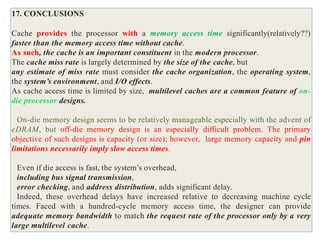
17. CONCLUSIONS
Cache provides the processor with a memory access time significantly(relatively??)
faster than the memory access time without cache.
As such, the cache is an important constituent in the modern processor.
The cache miss rate is largely determined by the size of the cache, but
any estimate of miss rate must consider the cache organization, the operating system,
the system’s environment, and I/O effects.
As cache access time is limited by size, multilevel caches are a common feature of on-
die processor designs.
On-die memory design seems to be relatively manageable especially with the advent of
eDRAM, but off-die memory design is an especially difficult problem. The primary
objective of such designs is capacity (or size); however, large memory capacity and pin
limitations necessarily imply slow access times.
Even if die access is fast, the system’s overhead,
including bus signal transmission,
error checking, and address distribution, adds significant delay.
Indeed, these overhead delays have increased relative to decreasing machine cycle
times. Faced with a hundred-cycle memory access time, the designer can provide
adequate memory bandwidth to match the request rate of the processor only by a very
large multilevel cache.

UNIT 3 Memory Design for SOC.ppUNIT 3 Memory Design for SOC.pptx

  • 1.
  • 2.
    INTRODUCTION The memory systemis often the most costly part of the system and it largely determines the performance(closer faster) Regardless of the processors and the interconnect, the application cannot be executed any faster than the memory system, which provides the instructions and the operands hence the memory system largely determines the performance so Memory design is the key to system design Memory design involves a number of considerations. The primary consideration is the application requirements: the operating system, the size, and the variability of the application processes. This(application requirements:) largely determines the size of memory and how the memory will be addressed: real or virtual. Figure 4.1 is an outline for memory design, while Table 4.1 compares the relative area required for different memory technologies.
  • 3.
    This(application requirements:) largely determinesthe size of memory and how the memory will be addressed: real or virtual. Figure 4.1 is an outline for memory design, while Table 4.1 compares the relative area required for different memory technologies. Size MB 10X10 etc. AREA Addressing: Real or Virtual
  • 4.
    We start bylooking at issues in SOC external (Slide 6)and internal memories. We then examine scratchpad and cache memory to understand how they operate and how they are designed. After that, we consider the main memory problem, first the on - die memory and then the conventional dynamic RAM (DRAM) design. As part of the design of large memory systems, we look at multiple memory modules, interleaving, and memory system performance. Figure 4.2 presents the SOC memory design issues. In this chapter the interconnect, processors, and I/O are idealized(Constants??) so that the memory design trade-offs can be characterized. Table 4.2 shows the types of memory that can be integrated into an SOC design TABLE 4.2 Some Flash Memory (NAND) Package Formats (2 - to 128 - GB Size) Format (Approx.) Size (mm) Weig ht (g) Speed (Read/ Write) (MBps) Typical Applications Compact flash (CF) 36 × 43 × 3.3 11.4 22/18 Digital camera Secure digital (SD) 32 × 24 × 2.1 2.0 22/18 Digital/video Mini SD 20 × 20 × 1.2 1.0 22/18 camera Cell phone, GPS Micro SD 15 × 11 × 0.7 0.5 22/15 Mini cell phone
  • 5.
    Example:- Required functionality canplay a big role in achieving performance. Consider the differences between the two paths of Figure 4.1 : the maximum functionality path and the restricted functionality path. The difference seems slight, whether the memory is off - die or on - die. The resulting performance difference can be great because of the long off - die access time. If the memory (application data and program) can be contained in an on - die memory, the access time will be 3 – 10 cycles. Off - die access times are an order of magnitude greater (30 – 100 cycles). To achieve the same performance, the off - die memory design must have an order of magnitude more cache, often split into multiple levels to meet access time requirements. I n d e e d , a c a c h e b i t c a n b e 5 0 t i m e s l a rg e r t h a n a n o n - d i e e m b e d d e d D R A M ( e D R A M ) b i t (see Chapter 2 and Section 4.13 ). So the true cost of the larger cache required for off - die memory support may be 10 by 50 or 500 DRAM bits. If a memory system uses 10K rbe for cache to support an on - die memory, the die would require 100K rbe to support off - die memory. That 90K rbe difference could possibly accommodate 450K eDRAM bits.
  • 6.
    Overview of SOCExternal Memory: Flash Flash technology is a rapidly developing technology with improvements announced regularly. Flash is not really a memory replacement but is probably better viewed as a disk replacement(External). However, in some circumstances and configurations, it can serve the dual purpose of memory and nonvolatile backup storage. Flash memory consists of an array of floating gate transistors. These transistors are similar to MOS transistors but with a two-gate structure: a control gate and an insulated floating gate. Charge stored on the floating gate is trapped there, providing a nonvolatile storage. While the data can be rewritten, the current technology has a limited number of reliable rewrite cycles, usually less than a million. Since degradation with use can be a problem, error detection and correction are frequently implemented. While the density is excellent for semiconductor devices, the write cycle limitation generally restricts the usage to storing infrequently modified data, such as programs and large files.
  • 7.
    There are twotypes of flash implementations: NOR and NAND. The NOR implementation is more flexible, but the NAND provides a significantly better bit density. Hybrid NOR/NAND implementations are also possible with the NOR array acting as a buffer to the larger NAND array. Table 4.3 provides a comparison of these implementations. Flash memory cards come in various package formats; larger sizes are usually older (see Table 4.2). Small flash dice can be “stacked” with an SOC chip to present a single system/memory package. A flash die can also be stacked to create large (64–256 GB) single memory packages. In current technology, flash usually is found in off-die implementations. However, there are a number of flash variants that are specifically designed to be compatible with ordinary SOC technology. SONOS is a nonvolatile example, and Z-RAM is a DRAM replacement example. Neither seems to suffer from rewrite cycle limitations. Z-RAM seems otherwise compatible with DRAM speeds while offering improved density. SONOS offers density but with slower access time than eDRAM. TABLE 4.3 Comparison of Flash Memories Technology NOR NAND Bit density (KB/A) Typical capacity 1000 64MB 10,000 16 GB (dice can be stacked by 4 or more) 10μs 300 Access time Transfer rate (MB per sec.) Write time(μs) Addressability Application 20–70ns 150 300 Word or block Program storage and limited data store 200 Block Disk replacement Format (Approx.) Size (mm) Weight (g) Speed (Read/ Write) (MBps) Typical Applications Compact flash (CF) 36 × 43 × 3.3 11.4 22/18 Digital camera Secure digital (SD) 32 × 24 × 2.1 2.0 22/18 Digital/video Mini SD 20 × 20 × 1.2 1.0 22/18 camera Cell phone, GPS Micro SD 15 × 11 × 0.7 0.5 22/15 Mini cell phone TABLE 4.2 Some Flash Memory (NAND) Package Formats (2- to 128-GB Size) Overview of SOC External Memory: Flash
  • 8.
    Overview of SOCInternal Memory: Placement The most important and obvious factor in memory system design is the placement of the main memory: on-die (the same die as the processor) or off-die (on its own die or on a module with multiple dice). As pointed out in Chapter1, this factor distinguishes conventional workstation processors and application oriented board designs from SOC designs. The design of the memory system is limited by two basic parameters that determine memory systems performance. The first parameter is the access time. This is the time for a processor request to be transmitted to the memory system, access a datum, and return it back to the processor. Access time is largely a function of the physical parameters of the memory system—the physical distance between the processor and the memory system, or the bus delay, the chip delay, and so on. The second parameter is memory bandwidth, the ability of the memory to respond to requests per unit time. Bandwidth is primarily determined by the way the physical memory system is organized—the number of independent memory arrays and the use of special sequential accessing modes. The cache system must compensate for limits on memory access time and bandwidth. TABLE 4.4 Comparing System Design Environments Workstation Type SOC Single Die Item SOC Board Based Processor Fastest available Smaller, perhaps four to six times slower Simple, single level (256KB) Internal, wide, high bandwidth Simple, internal As with SOC Cache Two to three levels, very large (4–64MB) Complex, slow pin limited Complex timing and control Very large (16+GB), limited bandwidth Single level, multielement Mix Memory bus Bus control Mix Memory Limited size (256MB), relatively fast 3–5ns Specialized on board Memory access time 20–30ns Mix The workstation processor, targeting high performance, requires a very efficient memory system, a task made difficult by memory placement off-die. Table 4.4 compares the memory system design environments. The workstation and board-based memory design is clearly a greater challenge for designers. Special attention must be paid to the cache, which must make up for the memory placement difficulties.
  • 9.
    The Size ofMemory As it will become obvious in this chapter, designing for large off-die memory is the key problem in system board designs. So why not limit memory to sizes that could be incorporated on a die? In a virtual memory system, we can still access large address spaces for applications. For workstations, the application environment (represented by the operating system) has grown considerably (see Figure 4.3). As the environment continues to grow, so too does the working set or the active pages of storage. This requires more real (physical) memory to hold a sufficient number of pages to avoid excessive page swapping, which can destroy performance. Board-based systems face a slightly different problem. Here, the media-based data sets are naturally very large and require large bandwidths from memory and substantial processing ability from the media processor. Board-based systems have an advantage, however, as the access time is rarely a problem so long as the bandwidth requirements are met. How much memory can we put on a die? Well, that depends on the technology (feature size) and the required performance.. 0 1400 1200 1000 800 600 400 200 1600 XP ME 98 NT 95 Disk Space (MB) Required Disk Space Figure 4.3: Required disk space for several generations of Microsoft’s Windows operating system. The newer Vista operating system requires 6GB. Table 4.1 shows the area occupied for various technologies(Memory Technology). The eDRAM size assumes a relatively large memory array (see later in this chapter). So, for example, in a 45-nm technology, we might expect to have about 49.2 kA/cm2 or about 8 MB of eDRAM. Advancing circuit design and technology could significantly improve that, but it does seem that about 64 MB would be a limit, unless a compatible flash technology becomes available
  • 10.
    SCRATCHPADS AND CACHE MEMORY •Smaller memories are almost always faster than larger memory, so it is useful to keep frequently used (or anticipated) instructions and data in a small, easily accessible (one cycle access) memory. If this memory is managed directly by the programmer, it is called a scratchpad memory; if it is managed by the hardware, it is called a cache. • Since management is a cumbersome process, most general-purpose computers use only cache memory. • SOC, however, offers the potential of having the scratchpad alternative. Assuming that the application is well-known, the programmer can explicitly control data transfers in anticipation of use. • Eliminating the cache control hardware offers additional area for larger scratchpad size, again improving performance. • SOC implements scratchpads usually for data and not for instructions, as simple caches work well for instructions. Furthermore, it is not worth the programming effort to directly manage instruction transfers. • The rest of this section treats the theory and experience of cache memory. Because there has been so much written about cache, it is easy to forget the simpler and older scratchpad approach, but with SOC, sometimes the simple approach is best. • Caches work on the basis of the locality of program behavior. There are three principles involved: 1. Spatial Locality. Given an access to a particular location in memory, there is a high probability that other accesses will be made to either that or neighboring locations within the lifetime of the program. 2.Temporal Locality. Given a sequence of references to n locations, there will be references into the same locations with high probability. 3.Sequentiality. Given that a reference has been made to location s, it is likely that within the next few references, there will be a reference to the location of s + 1. This is a special case of spatial locality. • The cache designer must deal with the processor’s accessing requirements on the one hand, and the memory system’s requirements on the other. Effective cache designs balance these within cost constraints.
  • 11.
    BASIC NOTIONS • Processorreferences contained in the cache are called cache hits. • Processor references not found in the cache are called cache misses. • On a cache miss, the cache fetches the missing data from memory and places it in the cache. • Usually, the cache fetches an associated region of memory called the line. The line consists of one or more physical words accessed from a higher-level cache or main memory. The physical word is the basic unit of access to the memory. • The processor–cache interface has a number(6) of parameters. Those that directly affect processor performance (Figure 4.4) include the following 6 parameters : 1. Physical word—unit of transfer between processor and cache. Typical physical word sizes: • 2–4 bytes—minimum, used in small core-type processors • 8 bytes and larger—multiple instruction issue processors (superscalar) 2. Block size (sometimes called line)—usually the basic unit of transfer between cache and memory. It consists of n physical words transferred from the main memory via the bus. 3. Access time for a cache hit—this is a property of the cache size and organization. 4. Access time for a cache miss—property of the memory and bus. 5. Time to compute a real address given a virtual address (not-in-translation look aside buffer [TLB] time)—property of the address translation facility. 6. Number of processor requests per cycle. Cache performance is measured by the miss rate or the probability that a reference made to the cache is not found. The miss rate times the miss time is the delay penalty due to the cache miss. In simple processors, the processor stalls on a cache miss. IS CACHE A PART OF THE PROCESSOR? For many IP designs, t h e f i r s t - l e v e l c a c h e i s i n t e g r a t e d i n t o t h e p r o c e s s o r d e s i g n , so what and why do we need to know cache details? The most obvious answer is that an SOC consists of multiple processors that must share memory, usually through a second-level cache. Moreover, the details of the first-level cache may be essential in achieving memory consistency and proper program operation. So for our purpose, the cache is a separate, important piece of the SOC. We design the SOC memory hierarchy, not an isolated cache.
  • 12.
    CACHE ORGANIZATION A cacheuses either a fetch-on-demand or a prefetch strategy. The former organization is widely used with simple processors. A fetch-on-demand cache brings a new memory locality into the cache only when a miss occurs. The pre-fetch cache attempts to anticipate the locality about to be requested and pre-fetches it. It is commonly used in I-caches. There are three basic types of cache organization: fully associative (FA) mapping direct mapping, and set associative mapping (which is really a combination of the other two). In an FA cache, when a request is made, the address is compared (COMP) to the addresses of all entries in the directory. If the requested address is found (a directory hit), the corresponding location in the cache is fetched; otherwise, a miss occurs. • In a direct-mapped cache, the lower-order line address bits access the directory (index bits in Figure 4.8). Since multiple line addresses map into the same location in the cache directory, the upper line address bits (tag bits) must be compared to the directory address to validate a hit. If a comparison is not valid, the result is a miss. The advantage of the direct-mapped cache is that a reference to the cache array itself can be made simultaneously withthe access to thedirectory.
  • 13.
    CACHE ORGANIZATION A cacheuses either a fetch-on-demand or a prefetch strategy. The former organization is widely used with simple processors. A fetch-on-demand cache brings a new memory locality into the cache only when a miss occurs. The pre-fetch cache attempts to anticipate the locality about to be requested and pre-fetches it. It is commonly used in I-caches. There are three basic types of cache organization: fully associative (FA) mapping direct mapping, and set associative mapping (which is really a combination of the other two). In an FA cache, when a request is made, the address is compared (COMP) to the addresses of all entries in the directory. If the requested address is found (a directory hit), the corresponding location in the cache is fetched; otherwise, a miss occurs. • In a direct-mapped cache, the lower-order line address bits access the directory (index bits in Figure 4.8). Since multiple line addresses map into the same location in the cache directory, the upper line address bits (tag bits) must be compared to the directory address to validate a hit. If a comparison is not valid, the result is a miss. The advantage of the direct-mapped cache is that a reference to the cache array itself can be made simultaneously withthe access to thedirectory.
  • 14.
    • The addressgiven to the cache by the processor is divided into several pieces, each of which has a different role in accessing data. • In an address partitioned as in Figure 4.8, the most significant bits that are used for comparison (with the upper portion of a line address contained in the directory) are called the tag. • The next field is called the index, and it contains the bits used to address a line in the cache directory.The tag plus the index is the line address in memory. • The next field is the offset, and it is the address of a physical word within a line. • Finally, the least significant address field specifies a byte in a word. These bits are not usually used by the cache since the cache references a word. (An exception arises in the case of a write that modifies only a part of a word.) Byte address Word address Line address Figure 4.8 Address partitioned by cache usage. The set associative cache is similar to the direct-mapped cache. Bits from the line address are used to address a cache directory. However, now there are multiple choices: Two, four, or more complete line addresses may be present in the directory. Each address corresponds to a location in a subcache. The collection of these subcaches forms the total cache array. These subarrays can be accessed simultaneously, together with the cache directory. If any of the entries in the cache directory match the reference address, then there is a hit, and the matched subcache array is sent back to the processor. While selection in the matching process increases the cache access time, the set associative cache access time is usually better than that of the fully associative mapped cache. But the direct-mapped cache provides the fastest processor access to cache data for any given cache size.
  • 15.
    Figure 4.7 Setassociative (multiple direct-mapped caches) mapping. Directory Four tag entries Select set 1 Select set 2 Select set 3 Select set 4 C C C C M U X Output Real address Tag Index Tag Index Offset Byte Byte address Word address Line address Figure 4.8 Address partitioned by cache usage.
  • 16.
    CACHE DATA • Cachesize largely determines cache performance (miss rate). • The larger the cache, the lower the miss rate. doubling the size halves the miss rate • Almost all cache miss rate data are empirical and, as such, have certain limitations. • Cache data are strongly program dependent. Also, data are frequently based upon older machines, where the memory and program size were fixed and small. • Such data show low miss rate for relatively small size caches. Thus, there is a tendency for the measured miss rate of a particular cache size to increase over time. This is simply the result of measurements made on programs of increasing size. • Some time ago, Smith developed a series of design target miss rates (DTMRs) that represent an estimate of what a designer could expect from an integrated (instruction and data) cache. These data are presented in Figure 4.9 and give an idea of typical miss rates as a function of cache and line sizes. • For cache sizes larger than 1 MB, a general rule is that doubling the size halves the miss rate. The general rule is less valid in transaction- based programs.
  • 17.
    0.01 134 MEMORY DESIGN:SYSTEM-ON-CHIP AND BOARD-BASEDSYSTEMS Unified cache 1.0 Design target miss rate 8 16 32 64 128 0.1 Line size (bytes) 4 0.001 10 100 1000 10,000 100,000 1,000,000 Cache size (bytes) Figure 4.9 A design target miss rate per reference to memory (fully associative, demand fetch, fetch [allocate] on write, copy-back with LRU replacement) [223, 224].
  • 18.
    WRITE POLICIES • Howis memory updated on a write? One could write to both cache and memory (write-through or WT), or write only to the cache (copy-back or CB sometimes called write-back), updating memory when the line is replaced. • These two strategies are the basic cache write policies (Figure 4.10). •The write-through cache (Figure 4.10a) stores into both cache and main memory on each CPU store. Advantage: This retains a consistent (up-to-date) image of program activity in memory. Disadvantage: Memory bandwidth may be high—dominated by write traffic. •In the copy-back cache (Figure 4.10b), the new data are written to memory when the line is replaced. This requires keeping track of modified (or “dirty”)lines, but results in reduced memory traffic for writes:
  • 19.
    1. Dirty bitis set if a write occurs anywhere in line. 2.From various traces, the probability that a line to be replaced is dirty is 47% on average (ranging from 22% to 80%). 3.Rule of thumb: Half of the data lines replaced are dirty. So, for a data cache, assume 50% are dirty lines, and for an integrated cache, assume 30% are dirty lines. • Most larger caches use copy-back; • write-through is usually restricted to either small caches or special-purpose caches that provide an up-to-date image of memory. Finally, what should we do when a write (or store) instruction misses in the cache? We can fetch that line from memory (write allocate or WA) or just write into memory (no write allocate or NWA). Most write-through caches do not allocate on writes (WTNWA) and most copy back caches do allocate (CBWA).
  • 20.
    4.8 STRATEGIES FORLINE REPLACEMENT AT MISS(Cache) TIME • What happens on a cache miss? If the processor reference address is not found in the directory, a cache miss occurs. Two actions must promptly be taken: (1) The missed line must be fetched from the main memory, and (2) one of the current cache lines must be designated for replacement by the currently accessed line (the missed line).
  • 21.
    1. Fetching aLine In a write-through cache, fetching a line involves accessing the missed line and the replaced line is discarded (written over). For a copy-back policy, we first determine whether the line to be replaced is dirty (has been written to) or not. If the line is clean, the situation is the same as with the write-through cache. However, if the line is dirty, we must write the replaced line back to memory. In accessing a line, the fastest approach is the nonblocking cache or the prefetching cache. This approach is applicable in both write-through and copy- back caches. Here, the cache has additional control hardware to allow the cache miss to be handled (or bypassed), while the processor continues to execute. This strategy only works when the miss is accessing cache data that are not currently required by the processor. Nonblocking caches perform best with compilers that provide prefetching of lines in anticipation of processor use. The effectiveness of nonblocking caches depends on 1. The number of misses that can be bypassed while the processor continues to execute; and 2. The effectiveness of the prefetch and the adequateness of the buffers to hold the prefetch information; the longer the prefetch is made before expected use, the less the miss delay, but this also means that the buffers or registers are occupied and
  • 22.
    2. Line Replacement Thereplacement policy selects a line for replacement when the cache is full. There are three replacement policies that are widely used: 1.Least Recently Used (LRU). The line that was least recently accessed (by a read or write) is replaced. 2.First In–First Out (FIFO). The line that had been in the cache the longest is replaced. 3.Random Replacement (RAND). Replacement is determined randomly. Since the LRU policy corresponds to the concept of temporal locality, it is generally the preferred policy. It is also the most complex to implement. Each line has a counter(recall program counter) that is updated on a read (or write). Since these counters could be large, it is common to create an approximation to the true LRU with smaller counters. While LRU performs better than either FIFO or RAND, the use of the simpler RAND or FIFO only amplifies the LRU miss rate (DTMR) by about 1.10 (i.e., 10%).
  • 23.
    3. Cache Environment:Effects of System, Transactions, and Multiprogramming Most available cache data are based upon trace studies of user applications. Actual applications are run in the context of the system. The operating system tends to slightly increase (20% or so) the miss rate experienced by a user program. Multiprogramming environments create special demands on a cache. In such environments, the cache miss rates may not be affected by increasing cache size. There are two environments: 1.A Multiprogrammed(here 2) Environment. The system(OS??), together with several programs, is resident in memory. Control is passed from program to program after a number of instructions, Q, have been executed(but not all instns???), and eventually returns to the first program. This kind of environment results in what is called a warm cache. When a process returns for continuing execution, it finds some, but not all, of its most recently used lines in the cache, increasing the expected miss rate (Figure 4.11 illustrates the effect). 2.Transaction Processing. While the system(OS?) is resident in memory together with a number of support programs, short applications (transactions) run through to completion. Each application consists of Q instructions. This kind of environment is sometimes called a cold cache. Figure 4.12 illustrates the situation. 3.Both of the preceding environments are characterized by passing control from one program to another before completely loading the working set of the program. This can significantly increase the miss rate. Multiprogramming level = 2 Line size = 16 bytes 0.001 0.01 0.1 1.0 10 100 1000 10,000 100,000 1,000,000 Cache size Figure 4.11 Warm cache: cache miss rates for a multiprogrammed environment switching processes after Q instructions. Miss rate (memory references) 100 1000 10,000 20,000 100,000 effects DTMR 10–1 100 16-byte line, four-way associative 10–2 101 102 103 104 105 106 Cache size (bytes) Figure 4.12 Cold cache: cache miss rates for a transaction environment switching processes after Q instructions. Miss rate
  • 24.
    9.OTHER TYPES OFCACHE So far, we have considered only the simple integrated(doesn’t mean p+cache) cache (also called a “unified” cache), which contains both data D and instructions I. In the next few sections, we consider various other types of cache. The list we present (Table 4.5) is hardly exhaustive (by no means Exhaustive(very thorough or complete)) but it illustrates some of the variety of cache designs possible for special or even commonplace applications. Most currently available microprocessors use split I - and D - caches, described in the next section TABLE 4.5 Common Types of Cache Type Where It Is Usually Used Integrated (or unified) The basic cache that accommodates all references (I and D). This is commonly used as the second- and higher-level cache. Provides additional cache access bandwidth with some increase in the miss rate (MR). Commonly used as a first-level processor cache. Improves area effectiveness (MR for given area) for on-chip cache. The first level has fast access; the second level is usually much larger than the first to reduce time delay in a first-level miss. Specialized, reduces write traffic, usually used with a WT on-chip first-level cache. Split caches I and D Sectored cache Multilevel cache Write assembly cache 10. SPLIT I- AND D-CACHES AND THE EFFECT OF CODE DENSITY Multiple caches can be incorporated into a single processor design, each cache serving a designated process or use. Over the years, special caches for systems code and user code or even special input/output (I/O) caches have been considered. The most popular configuration of partitioned caches is the use of separate caches for instructions and data. Separate instruction and data caches provide significantly increased cache bandwidth, doubling the access capability of the cache ensemble. I- and D- caches come at some expense, however; a unified cache with the same size as the sum of a data and instruction cache has a lower miss rate. In the unified cache, the ratio of instruction to data working set elements changes during the execution of the program and is adapted to by the replacement strategy. Split caches have implementation advantages. Since the caches need not be split equally, a 75–25% or other split may prove more effective. Also, the I-cache is simpler as it is not required to handle stores.
  • 25.
    11. MULTILEVEL CACHES 1.Limits on Cache Array Size The cache consists of a static RAM (SRAM) array of storage cells. As the array increases in size, so does the length of the wires required to access its most remote cell. This translates into the cache access delay, which is a function of the cache size, organization, and the process technology (feature size, f). McFarland has modeled the delay and found that an approximation can be represented as Access time ns  0.35 3.8f  0.006  0.025f C 1 0.31 1 A, where f is the feature size in microns, C is the cache array capacity in kilobyte, and A is the degree of associativity (where direct map = 1). The effect of this equation (for A = 1) can be seen in Figure 4.13. If we limit the level 1 access time to under 1ns, we are probably limited to a cache array of about 32KB. 1ns  0.35 3.8f 0.0060.025f C10.311 . 1,=>c=32kb While it is possible to interleave multiple arrays, the interleaving itself has an overhead. So usually, L1 caches are less than 64 KB; L2 caches are usually less than 512 KB (probably interleaved using smaller arrays); and L3 caches use multiple arrays of 256 KB or more to create large caches, often limited by die size. 6 Time (ns) f = 0.13 f = 0.09 5 f = 0.065 4 3 2 1 1 2 4 8 16 32 64 128 256 512 Size (KB) Figure 4.13 Cache access time (for a single array) as a function of cache array size.
  • 26.
    4.11.2 Evaluating MultilevelCaches In the case of a multilevel cache, we can evaluate the performance of both levels using L1 cache data. A two-level cache system is termed inclusive if all the contents of the lower-level cache (L1) are also contained in the higher-level cache (L2). Second-level cache analysis is achieved using the principle of inclusion; that is, a large, second-level cache includes the same lines as in the first-level cache. Thus, for the purpose of evaluating performance of second level cache, we can assume that the first- level cache does not exist. The total number of misses that occur in a second-level cache can be determined by assuming that the processor made all of its requests to the second- level cache without the intermediary first-level cache. There are design considerations in accommodating a second-level cache to an existing first-level cache. The line size of the second-level cache should be the same as or larger than the first-level cache. Otherwise, if the line size in the second-level cache were smaller, loading the line in the first-level cache would simply cause two misses in the second- level cache. (? bec latency in 2nd level cache is double that of 1st??) Further, the second- level cache should be significantly larger than the first-level; otherwise, it would have no benefit. L2 L1 region of memory called the line The line consists of one or more physical words accessed from a higher-level cache or main memory The physical word is the basic unit of access to the memory. Block size (sometimes called line)—usually the basic unit of transfer between cache and memory, It consists of n physical words transferred from the main memory via the bus.
  • 27.
    Processor References Figure 4.14 Atwo-level cache. L1 cache L2 cache Memory In a two-level system, as shown in Figure 4.14, with first-level cache, L1, and second-level cache, L2, we define the following 3 miss rates 1.A local(L1) miss rate is simply the number of misses experienced by the cache divided by the number of references (by processor) to it.This is the usual understanding of miss rate. 2.The global(remember only if L1 misses L2 is referred (miss rate not defined by the principle of inclusion)) rate is the number of L2 misses divided by the number of references made by the processor. This is our primary measure of the L2 cache. 3.The solo miss rate(miss rate defined by the principle of inclusion) is the miss rate the L2 cache would have if it were the only cache in the system. This is the miss rate defined by the principle of inclusion (of L1??). If L2 contains all of L1, then we can find the number of L2 misses and the processor reference rate, ignoring the presence of the L1 cache. The principle of inclusion specifies that the global miss rate is the same as the solo miss rate, allowing us to use the solo miss rate to evaluate a design. The preceding data (read misses only) illustrate some salient points in multi-level cache analysis and design: 1.So long as the L1 cache is the same as or larger than the L2 cache, analysis by the principle of inclusion provides a good estimate of the behavior of the L2 cache. 2.When the L2 cache is significantly larger than the L1 cache, it can be considered independent of the L1 parameters. Its miss rate corresponds to a solo miss rate.
  • 28.
    EXAMPLE 4.1 SOC L1Cache L2 Cache NetSilicon NS9775 [185] NXP LH7A404 [186] Freescale e600 [101] Freescale PowerQUICC III [102] ARM1136J(F)-S [24] 8-KB I-cache, 4-KB D-cache 8-KB I-cache, 8-KB D- cache 32-KB I-cache, 32-KB D-cache 32-KB I-cache, 32-KB D-cache — — 1 MB with ECC 256 KBwith ECC 64-KB I-cache, 64-KB D-cache Max 512KB L1 L2 L2 more than four times the L1 size Miss penalties: Miss in L1, hit in L2: Miss in L1, miss in L2: 2 cycles 15 cycles Suppose we have a two-level cache with miss rates of 4% (L1) and 1% (L2). Suppose the miss in L1 and the hit in L2 penalty is 2 cycles, and the miss penalty in both caches is 15 cycles (13 cycles more than a hit in L2). If a processor makes one reference per instruction, we can compute the excess Cycles Per Instruction (CPIs) due to cache misses as follows: Excess CPI due to L1 misses  1.0 refr/ inst  0.04 misses /refr  2 cycles/ miss  0.08 CPI Excess CPI due to L2 misses  1.0 refr/ inst  0.01 misses/ refr  13 cycles/ miss  0.13 CPI. Note: the L2 miss penalty is 13 cycles, not 15 cycles, since the 1% L2 misses have already been “charged” 2 cycles in the excess L1 CPI: Total effect  excess L1 CPI  excess L2 CPI  0.08 0.13  0.21CPI. The cache configurations for some recent SOCs are shown in Table 4.6. TABLE 4.6 SOC Cache Organization
  • 29.
    4.16 MODELS OFSIMPLE PROCESSOR–MEMORY INTERACTION In systems with multiple processors or with complex single processors, requests may congest the memory system. Either multiple requests may occur at the same time, providing bus or network congestion, (or) requests arising from different sources may request access to the memory system. Requests that cannot be immediately honored by the memory system result in memory systems contention. This contention degrades the bandwidth and is possible to achieve from the memory system. In the simplest possible arrangement, a single simple processor makes a request to a single memory module. The processor ceases activity (as with a blocking cache) and waits for service from the module. When the module responds, the processor resumes activity. Under such an arrangement, the results are completely predictable. There can be no contention of the memory system since only one request is made at a time to the memory module. Now suppose we arrange to have n simple processors access m independent modules. Contention develops when multiple processors access the same module. Contention results in a reduced average bandwidth available to each of the processors. Asymptotically, a processor with a nonblocking cache making n requests to the memory system during a memory cycle resembles the n processor m module memory system, at least from a modeling point of view. But in modern systems, processors are usually buffered from the memory system. Whether or not a processor is slowed down by memory or bus contention during cache access depends on the cache design and the service rate of processors that share the same memory system. Given a collection of m modules each with service time Tc, access time Ta, and a certain processor request rate, how do we model the bandwidth available from these memory modules?, and how do we compute the overall effective access time? Clearly, the modules in low-order interleave are the only ones that can contribute to the bandwidth, and hence they determine m. From the memory system’s point of view, it really does not matter whether the processor system consists of n processors, each making one request every memory cycle (i.e., one per Tc), or one processor with n requests per Tc, so long as the statistical distribution of the requests remains the same. Thus, to a first approximation, the analysis of the memory system is equally applicable to the multiprocessor system or the superscalar processor. The request rate, defined as n requests per Tc, is called the offered request rate, and it represents the peak demand that the noncached processor system has on the main memory system
  • 30.
    Modeling assumption: Asymptotically,these are equivalent. 4.16.1 Models of Multiple Simple Processors and Memory In order to develop a useful memory model, we need a model of the processor. For our analysis, we model a single processor as an ensemble of multiple simple processors. Each simple processor issues a request as soonas its previous request has been satisfied. Under this model, we can vary the number of processors and the number of memory modules and maintain the address request/data supply equilibrium. To convert the single processor model into an equivalent multiple processor, the designer must determine the number of requests to the memory module per module service time, Ts = Tc. A simple processor makes a single request and waits for a response from memory. A pipelined processor makes multiple requests for various buffers before waiting for a memory response. There is an approximate equivalence between n simple processors, each requesting once every Ts, and one pipelined processor making n requests every Ts (Figure 4.28). Figure 4.28 Finding simple processor equivalence. n processors making one request each Tc One processor making n requests each Tc
  • 31.
    Modeling assumption: Asymptotically,these are equivalent. 4.16.1 Models of Multiple Simple Processors and Memory In order to develop a useful memory model, we need a model of the processor. For our analysis, we model a single processor as an ensemble of multiple simple processors. Each simple processor issues a request as soonas its previous request has been satisfied. Under this model, we can vary the number of processors and the number of memory modules and maintain the address request/data supply equilibrium. To convert the single processor model into an equivalent multiple processor, the designer must determine the number of requests to the memory module per module service time, Ts = Tc. A simple processor makes a single request and waits for a response from memory. A pipelined processor makes multiple requests for various buffers before waiting for a memory response. There is an approximate equivalence between n simple processors, each requesting once every Ts, and one pipelined processor making n requests every Ts (Figure 4.28). Figure 4.28 Finding simple processor equivalence. n processors making one request each Tc One processor making n requests each Tc In the following discussion, we use two symbols to represent the bandwidth available from the memory system (the achieved bandwidth): 1. B. The number of requests that are serviced each Ts. Occasionally, we also specify the arguments that B takes on, for example, B (m, n) or B (m). 2. Bw. The number of requests that are serviced per second: Bw = B/Ts. To translate this into cache-based systems, the service time, Ts, is the time that the memory system is busy managing a cache miss. The number of memory modules, m, is the maximum number of cache misses that the memory system can handle at one time, and n is the total number of request per Ts. This is the total number of expected misses per processor per Ts multiplied by the number of processors making requests.
  • 32.
    4.16.2 The Strecker-RaviModel This is a simple yet useful model for estimating contention. The original model was developed by Strecker and independently by Ravi. It assumes that there are n simple processor requests made per memory cycle and there are mmemory modules. Further, we assume that there is no bus contention. The Strecker model assumes that the memory request pattern for the processors is uniform and the probability of any one request to a particular memory module is simply 1/m. The key modeling assumption is that the state of the memory system at the beginning of the cycle is not dependent upon any previous action on the part of the memory—hence, not dependent upon contention in the past (i.e., Markovian). Unserved requests are discarded at the end of the memory cycle. The following modeling approximations are made: 1. A processor issues a request as soon as its previous request has been satisfied. 2. The memory request pattern from each processor is assumed to be uni- formly distributed; that is, the probability of any one request being made to a particular memory module is 1/m. 3. The state of the memory system at the beginning of each memory cycle (i.e., which processors are awaiting service at which modules) is ignored by assuming that all unserviced requests are discarded at the end of each memory cycle and that the processors randomly issue new requests. Analysis: Let the average number of memory requests serviced per memory cycle be represented by B (m, n). This is also equal to the average number of memory modules busy during each memory cycle. Looking at events from any given module’s point of view during each memory cycle, we have Prob a given processor does not reference the module  1 1/m Prob no processor references the module  Prob the module is idle  1  1/m Prob the module is busy  1 1 1/mn B m, n  average number of busy modules  m1 1 1/mn . The achieved memory bandwidth is less than the theoretical maximum due to contention. By neglecting congestion in previous cycles, this analysis results in an optimistic value for the bandwidth. Still, it is a simple estimate that should be used conservatively. It has been shown by Bhandarkar [41] that B (m, n) is almost perfectly symmetrical in m and n. He exploited this fact to develop a more accurate expression for B (m, n), which is Bm, n  K [11 1/K  l ] where K = max (m, n) and l = min (me, n). We can use this to model a typical processor ensemble.
  • 33.
    160 MEMORY DESIGN:SYSTEM-ON-CHIP AND BOARD-BASEDSYSTEMS EXAMPLE 4.2 Suppose we have a two-processor die system sharing a common memory. Each processor die is dual core with the two processors (four processors total) sharing a 4-MB level 2 cache. Each processor makes three memory references per cycle and the clock rate is 4 GHz. The L2 cache has a miss rate of 0.001 misses per reference. The memory system has an average Ts of 24ns including bus delay. We can ignore the details of the level 1 caches by inclusion. So each processor die creates 6 × 0.001 memory references per cycle or 0.012 references for both cycles. Since there are 4 × 24 cycles in a Ts, we have n = 1.152 processor requests per Ts. If we design the memory system to manage m= 4 requests per Ts, we compute the performance as Bm, n  B4, 1.152 0.81. The relative performance is Thus, the processor can only achieve 70% of its potential due to the memory system. To do better, we need either a larger level 2 cache (or a level 3 cache) or a much more elaborate memory system (m = 8). 4.16.3 Interleaved Caches Interleaved caches can be handled in a manner analogous to interleaved memory. EXAMPLE 4.3 An early Intel Pentium™ processor had an eight-way interleaved data cache. It makes two references per processor cycle. The cache has the same cycle time as the processor. For the Intel instruction set, Prob data references per instruction  0.6. Since the Pentium tries to execute two instructions each cycle, we have n  1, 2, m 8. Using Strecker’s model, we get Bm, n  B8, 1.2 1.18. The relative performance is Prel B/n  0.8/1.2  0.98. that is, the processor slows down by about 2% due to contention. Prel B/n  0.8/1.152  0.7.
  • 35.
    17. CONCLUSIONS Cache providesthe processor with a memory access time significantly(relatively??) faster than the memory access time without cache. As such, the cache is an important constituent in the modern processor. The cache miss rate is largely determined by the size of the cache, but any estimate of miss rate must consider the cache organization, the operating system, the system’s environment, and I/O effects. As cache access time is limited by size, multilevel caches are a common feature of on- die processor designs. On-die memory design seems to be relatively manageable especially with the advent of eDRAM, but off-die memory design is an especially difficult problem. The primary objective of such designs is capacity (or size); however, large memory capacity and pin limitations necessarily imply slow access times. Even if die access is fast, the system’s overhead, including bus signal transmission, error checking, and address distribution, adds significant delay. Indeed, these overhead delays have increased relative to decreasing machine cycle times. Faced with a hundred-cycle memory access time, the designer can provide adequate memory bandwidth to match the request rate of the processor only by a very large multilevel cache.