Dr. Samawiya Farooq
Introduction
A reflex is an involuntary or automatic action that your
body does in response to something without even
having to think aboutit
Neonatal reflexes – inborn reflexes present at birth &
occur in a predictablefashion
Normally developing newborn should respond to
certain stimuli with thesereflexes
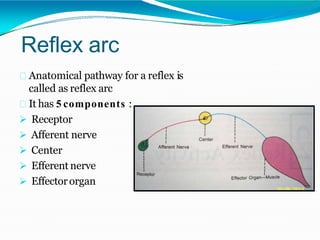
Reflex arc
Anatomical pathway for a reflex is
called as reflex arc
It has 5 components :
 Receptor
 Afferent nerve
 Center
 Efferent nerve
 Effectororgan
Classification of reflexes
Depending upon whether inborn or acquired
 Unconditioned reflexes, inborn reflex
 Conditioned reflexes/acquired reflexes
Depending upon the situation of the center
 Cerebellar reflexes
 Cortical reflex
 Midbrain reflex
 Bulbar or medullary reflexes
 Spinal reflexes
Depending upon the purpose
 Protective/flexor reflexes
 Antigravity/extensor reflexes
 Depending upon clinical basis
 Superficial reflexes
 Mucus membrane
 Cutaneous reflex
 Deep reflexes
 Visceral reflexes
 Pathological reflexes
Significance of reflexes
Helps to identify whether the child is developing
normally or not
Tells about what abnormalities the child may be
having if all reflexes are not proper
Knowledge of development of motor skills – helps to
identify whether development is going on at a proper
rate or not
Types of
reflexes
General bodyreflexes :
 Moro reflex/Startle reflex
 Palmar/grasp reflex
 Plantar graspreflex
 Walking/stepping reflex
 Limb placement reflex
 Asymmetric tonic neck reflex
 Symmetric tonic neck reflex
 Babinski’s reflex
 Babkin reflex
 Parachute reflex
 Landau reflex
 Withdrawal reflex
 Trunk incurvation reflex
 Tendon reflexes
 Gallant’s reflex
Tonic labyrinthine reflex
Facial reflexes :
 Nasal reflex
 Blink reflex
 Doll’s eye reflex
 Auditory orienting reflex
Oral reflexes :
 Rooting reflex
 Sucking reflex
 Swallowing reflex
 Gag reflex
 Cry reflex
General body reflexes
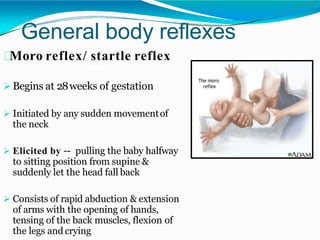
Moro reflex/ startle reflex
 Begins at 28weeks of gestation
 Initiated by any sudden movementof
the neck
 Elicited by -- pulling the baby halfway
to sitting position from supine &
suddenly let the head fall back
 Consists of rapid abduction & extension
of arms with the opening of hands,
tensing of the back muscles, flexion of
the legs and crying
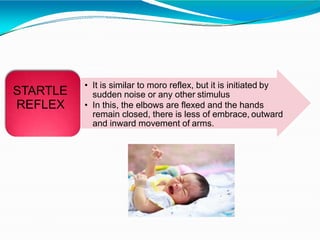
• It is similar to moro reflex, but it is initiated by
sudden noise or any other stimulus
• In this, the elbows are flexed and the hands
remain closed, there is less of embrace, outward
and inward movement of arms.
STARTLE
REFLEX
Within moments, the arms come together again
Clinical significance
Its nature gives an indication of muscle tone
Failure of the arms to move freely or the hands toopen
fully indicates hypotonia.
It fades rapidly and is not normally elicited after 6
months of age.
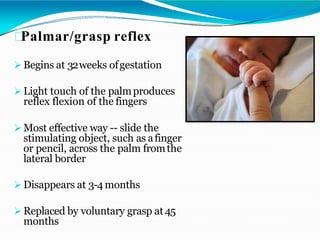
Palmar/grasp reflex
 Begins at 32weeks ofgestation
 Light touch of the palmproduces
reflex flexion of the fingers
 Most effective way -- slide the
stimulating object, such as afinger
or pencil, across the palm fromthe
lateral border
 Disappears at 3-4months
 Replaced by voluntary grasp at45
months
Clinical significance
 Exceptionally strong grasp reflex -- spastic form of cerebral
palsy & Kernicterus
 May be asymmetrical in hemiplagia & in cases of cerebral
damage
 Persistence beyond 3-4months indicate spastic form of
palsy
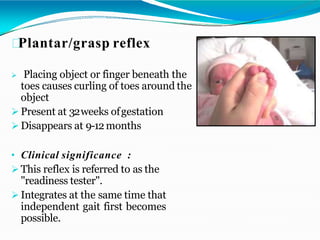
Plantar/grasp reflex
 Placing object or finger beneath the
toes causes curling of toes around the
object
 Present at 32weeks ofgestation
 Disappears at 9-12 months
• Clinical significance :
 This reflex is referred to as the
"readiness tester".
 Integrates at the same time that
independent gait first becomes
possible.
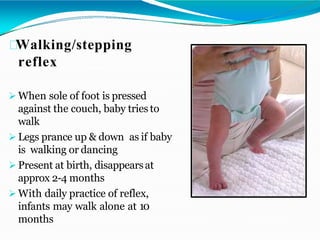
Walking/stepping
reflex
 When sole of foot is pressed
against the couch, baby tries to
walk
 Legs prance up & down as if baby
is walking or dancing
 Present at birth, disappearsat
approx 2-4 months
 With daily practice of reflex,
infants may walk alone at 10
months
Clinical significance
Premature infants will tend to walk in a toe-heel
fashion while more mature infants will walk in a
heel-toe pattern.
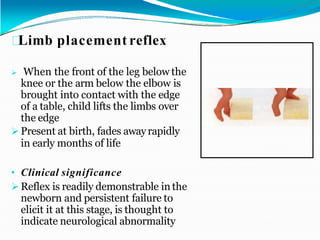
Limb placement reflex
 When the front of the leg below the
knee or the arm below the elbow is
brought into contact with the edge
of a table, child lifts the limbs over
the edge
 Present at birth, fades awayrapidly
in early months of life
• Clinical significance
 Reflex is readily demonstrable in the
newborn and persistent failure to
elicit it at this stage, is thought to
indicate neurological abnormality
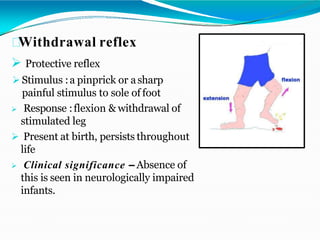
Withdrawal reflex
 Protective reflex
 Stimulus :a pinprick or asharp
painful stimulus to sole of foot
 Response :flexion & withdrawal of
stimulated leg
 Present at birth, persists throughout
life
 Clinical significance – Absence of
this is seen in neurologically impaired
infants.
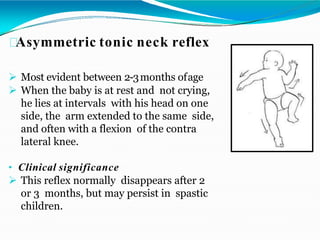
Asymmetric tonic neck reflex
 Most evident between 2-3months ofage
 When the baby is at rest and not crying,
he lies at intervals with his head on one
side, the arm extended to the same side,
and often with a flexion of the contra
lateral knee.
• Clinical significance
 This reflex normally disappears after 2
or 3 months, but may persist in spastic
children.
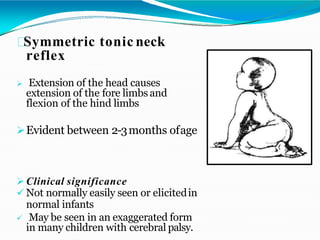
Symmetric tonic neck
reflex
 Extension of the head causes
extension of the fore limbs and
flexion of the hind limbs
Evident between 2-3months ofage
 Clinical significance
 Not normally easily seen or elicitedin
normal infants
 May be seen in an exaggerated form
in many children with cerebral palsy.
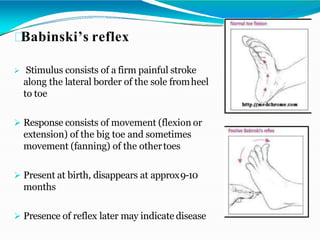
Babinski’s reflex
 Stimulus consists of a firm painful stroke
along the lateral border of the sole fromheel
to toe
 Response consists of movement (flexion or
extension) of the big toe and sometimes
movement (fanning) of the othertoes
 Present at birth, disappears at approx9-10
months
 Presence of reflex later may indicate disease
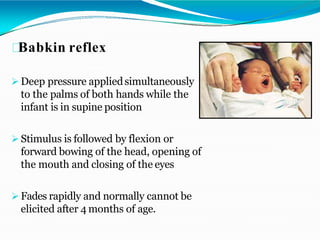
Babkin reflex
 Deep pressure appliedsimultaneously
to the palms of both hands while the
infant is in supine position
 Stimulus is followed by flexion or
forward bowing of the head, opening of
the mouth and closing of the eyes
 Fades rapidly and normally cannot be
elicited after 4 months of age.
• Clinical significance
 Reflex can be demonstrated in the newborn, thus showing
a hand-mouth neurological link, even at that early stage
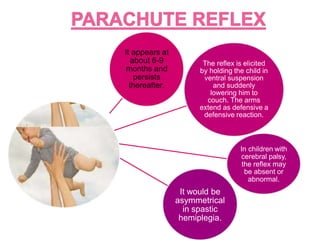
It appears at
about 6-9
months and
persists
thereafter.
The reflex is elicited
by holding the child in
ventral suspension
and suddenly
lowering him to
couch. The arms
extend as defensive a
defensive reaction.
In children with
cerebral palsy,
the reflex may
be absent or
abnormal.
It would be
asymmetrical
in spastic
hemiplegia.
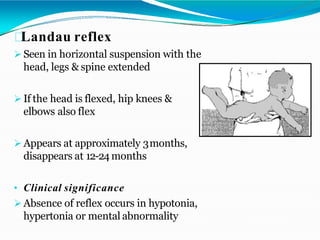
Landau reflex
 Seen in horizontal suspension with the
head, legs & spine extended
 If the head is flexed, hip knees &
elbows also flex
 Appears at approximately 3months,
disappears at 12-24 months
• Clinical significance
 Absence of reflex occurs in hypotonia,
hypertonia or mental abnormality
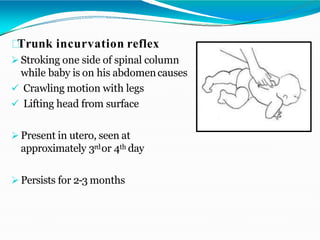
Trunk incurvation reflex
 Stroking one side of spinal column
while baby is on his abdomencauses
 Crawling motion with legs
 Lifting head from surface
 Present in utero, seen at
approximately 3rdor 4th day
 Persists for 2-3 months
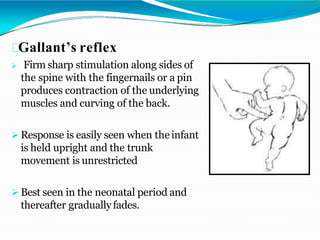
Gallant’s reflex
 Firm sharp stimulation along sides of
the spine with the fingernails or a pin
produces contraction of the underlying
muscles and curving of the back.
 Response is easily seen when theinfant
is held upright and the trunk
movement is unrestricted
 Best seen in the neonatal period and
thereafter graduallyfades.
Tendon reflexes
Simple monosynaptic reflexes, which are elicited bya
sudden stretch of a muscletendon
Occurs when the tendon istapped
Present throughout life
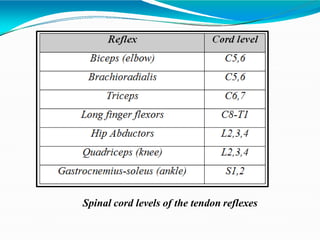
Spinal cord levels of the tendon reflexes
Clinical significance
 Useful diagnostically for :
Detection of upper motor neuron lesions(exaggerated
response)
Myopathic conditions (depressed or absentresponse)
Localization of the segmental lesions of thecord.
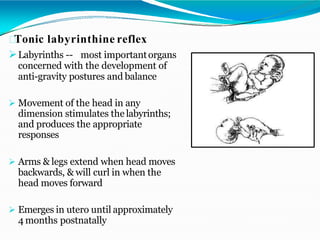
Tonic labyrinthine reflex
Labyrinths -- most importantorgans
concerned with the development of
anti-gravity postures and balance
 Movement of the head in any
dimension stimulates the labyrinths;
and produces the appropriate
responses
 Arms & legs extend when head moves
backwards, & will curl in when the
head moves forward
 Emerges in utero until approximately
4 months postnatally
Facial reflexes
Nasal reflex
 Stimulation of the face or nasal cavity with water orlocal
irritants produces apnea in neonates
 Breathing stops in expiration with laryngeal closure in
infants – bradycardia & lowering of cardiac output
 Blood flow to skin, splanchnic areas muscles & kidney
decreases
 Flow to the heart & brain remains protected
Blink reflex
 A bright light suddenly shone into the eyes, a puff ofair
upon the sensitive cornea or a sudden loud noise will
produce immediate blinking of the eyes
 Purpose – to protect the eyes from foreign bodies &bright
light
 May be associated tensing of the neck muscles, turning of
the head away from the stimulus, frowning and crying
 Reflexes are easily seen in the neonate and continue to be
present throughout life
Clinical significance
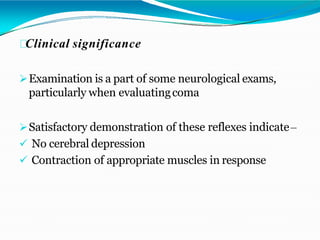
Examination is a part of some neurological exams,
particularly when evaluatingcoma
Satisfactory demonstration of these reflexes indicate–
 No cerebral depression
 Contraction of appropriate muscles in response
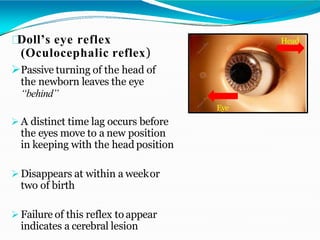
Doll’s eye reflex
(Oculocephalic reflex)
Passive turning of the head of
the newborn leaves the eye
“behind”
 A distinct time lag occurs before
the eyes move to a new position
in keeping with the head position
 Disappears at within a weekor
two of birth
 Failure of this reflex to appear
indicates a cerebral lesion
Head
Eye
Auditory orientingreflex
 A sudden loud and unpleasant noise :
 May produce the blink reflex
 Infant may remain still and show increased alertness
 Quieter sounds usually cause reflex eye and head turning tothe
side of the sound, as if to locate it
 Seen first at about 4 months of age
 Thereafter, head turning towards sound stimuli occurs and the
accuracy of localization increases rapidly by 9-10 months
Clinical significance
 Reflex responses are made use of in tests of infants for
hearing loss
 Pattern of the localization responses indicates the level of
neurological maturity
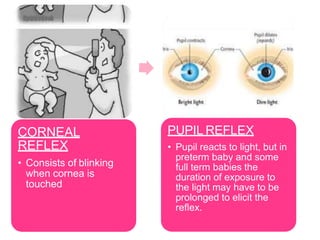
CORNEAL
REFLEX
• Consists of blinking
when cornea is
touched
PUPIL REFLEX
• Pupil reacts to light, but in
preterm baby and some
full term babies the
duration of exposure to
the light may have to be
prolonged to elicit the
reflex.
Oral reflexes
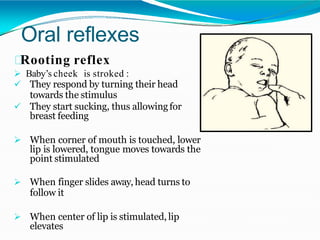
Rooting reflex
 Baby’s cheek is stroked :
 They respond by turning their head
towards the stimulus
 They start sucking, thus allowingfor
breast feeding
 When corner of mouth is touched, lower
lip is lowered, tongue moves towards the
point stimulated
 When finger slides away, head turns to
follow it
 When center of lip is stimulated, lip
elevates
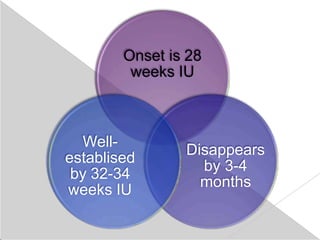
Onset is 28
weeks IU
Disappears
by 3-4
months
Well-
establised
by 32-34
weeks IU
Clinical significance
Persistence can interfere withsucking
Absence of this is seen in neurologically impaired
infants.
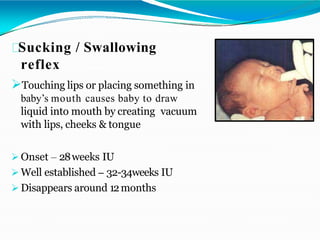
Sucking / Swallowing
reflex
Touching lips or placing something in
baby’s mouth causes baby to draw
liquid into mouth by creating vacuum
with lips, cheeks & tongue
 Onset – 28weeks IU
 Well established – 32-34weeks IU
 Disappears around 12months
Clinical significance :
Persistence may inhibit voluntary sucking
Sigmund Freud - Any kind of deprivation of the
activity will lead to fixation resulting in oral habits
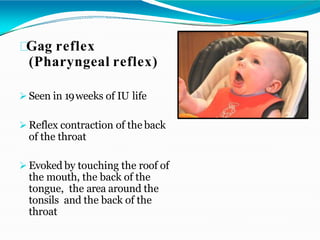
Gag reflex
(Pharyngeal reflex)
 Seen in 19weeks of IU life
 Reflex contraction of the back
of the throat
 Evoked by touching the roof of
the mouth, the back of the
tongue, the area around the
tonsils and the back of the
throat
Functional significance
 It, along with reflexive pharyngeal swallowing, prevents
something from entering the throat except as part of
normal swallowing and helps prevent choking
 Clinical significance
 Absence of the gag reflex -- symptom of a number of
severe medical conditions :
 Damage to the glossopharyngeal nerve, the vagus nerve,
 Brain death.
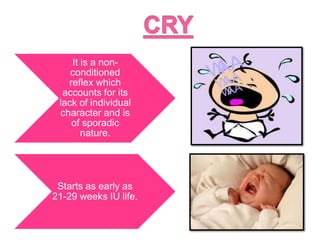
It is a non-
conditioned
reflex which
accounts for its
lack of individual
character and is
of sporadic
nature.
Starts as early as
21-29 weeks IU life.
Importance of cry
 It is infant’s first verbal communication
 Can be interpreted as a message of urgency ordistress
 Indicates:
 Hunger
 Pain
 Discomfort
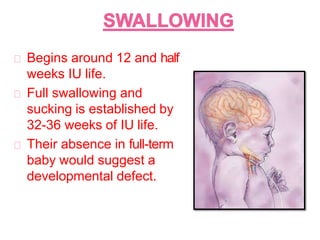
Begins around 12 and half
weeks IU life.
Full swallowing and
sucking is established by
32-36 weeks of IU life.
Their absence in full-term
baby would suggest a
developmental defect.
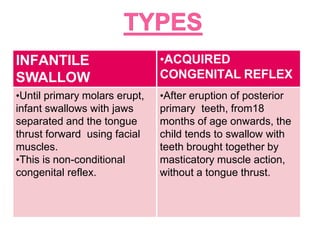
INFANTILE
SWALLOW
•ACQUIRED
CONGENITAL REFLEX
•Until primary molars erupt,
infant swallows with jaws
separated and the tongue
thrust forward using facial
muscles.
•This is non-conditional
congenital reflex.
•After eruption of posterior
primary teeth, from18
months of age onwards, the
child tends to swallow with
teeth brought together by
masticatory muscle action,
without a tongue thrust.
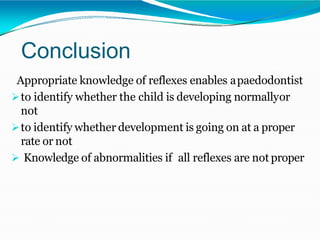
Conclusion
Appropriate knowledge of reflexes enables apaedodontist
to identify whether the child is developing normallyor
not
to identify whether development is going on at a proper
rate or not
 Knowledge of abnormalities if all reflexes are not proper
Reflexes-lec3.pptx

Reflexes-lec3.pptx

  • 1.
  • 2.
    Introduction A reflex isan involuntary or automatic action that your body does in response to something without even having to think aboutit Neonatal reflexes – inborn reflexes present at birth & occur in a predictablefashion Normally developing newborn should respond to certain stimuli with thesereflexes
  • 3.
    Reflex arc Anatomical pathwayfor a reflex is called as reflex arc It has 5 components :  Receptor  Afferent nerve  Center  Efferent nerve  Effectororgan
  • 4.
    Classification of reflexes Dependingupon whether inborn or acquired  Unconditioned reflexes, inborn reflex  Conditioned reflexes/acquired reflexes
  • 5.
    Depending upon thesituation of the center  Cerebellar reflexes  Cortical reflex  Midbrain reflex  Bulbar or medullary reflexes  Spinal reflexes
  • 6.
    Depending upon thepurpose  Protective/flexor reflexes  Antigravity/extensor reflexes  Depending upon clinical basis  Superficial reflexes  Mucus membrane  Cutaneous reflex  Deep reflexes  Visceral reflexes  Pathological reflexes
  • 7.
    Significance of reflexes Helpsto identify whether the child is developing normally or not Tells about what abnormalities the child may be having if all reflexes are not proper Knowledge of development of motor skills – helps to identify whether development is going on at a proper rate or not
  • 8.
  • 9.
    General bodyreflexes : Moro reflex/Startle reflex  Palmar/grasp reflex  Plantar graspreflex  Walking/stepping reflex  Limb placement reflex  Asymmetric tonic neck reflex  Symmetric tonic neck reflex  Babinski’s reflex  Babkin reflex  Parachute reflex  Landau reflex
  • 10.
     Withdrawal reflex Trunk incurvation reflex  Tendon reflexes  Gallant’s reflex Tonic labyrinthine reflex Facial reflexes :  Nasal reflex  Blink reflex  Doll’s eye reflex  Auditory orienting reflex
  • 11.
    Oral reflexes : Rooting reflex  Sucking reflex  Swallowing reflex  Gag reflex  Cry reflex
  • 12.
    General body reflexes Mororeflex/ startle reflex  Begins at 28weeks of gestation  Initiated by any sudden movementof the neck  Elicited by -- pulling the baby halfway to sitting position from supine & suddenly let the head fall back  Consists of rapid abduction & extension of arms with the opening of hands, tensing of the back muscles, flexion of the legs and crying
  • 13.
    • It issimilar to moro reflex, but it is initiated by sudden noise or any other stimulus • In this, the elbows are flexed and the hands remain closed, there is less of embrace, outward and inward movement of arms. STARTLE REFLEX
  • 14.
    Within moments, thearms come together again Clinical significance Its nature gives an indication of muscle tone Failure of the arms to move freely or the hands toopen fully indicates hypotonia. It fades rapidly and is not normally elicited after 6 months of age.
  • 15.
    Palmar/grasp reflex  Beginsat 32weeks ofgestation  Light touch of the palmproduces reflex flexion of the fingers  Most effective way -- slide the stimulating object, such as afinger or pencil, across the palm fromthe lateral border  Disappears at 3-4months  Replaced by voluntary grasp at45 months
  • 16.
    Clinical significance  Exceptionallystrong grasp reflex -- spastic form of cerebral palsy & Kernicterus  May be asymmetrical in hemiplagia & in cases of cerebral damage  Persistence beyond 3-4months indicate spastic form of palsy
  • 17.
    Plantar/grasp reflex  Placingobject or finger beneath the toes causes curling of toes around the object  Present at 32weeks ofgestation  Disappears at 9-12 months • Clinical significance :  This reflex is referred to as the "readiness tester".  Integrates at the same time that independent gait first becomes possible.
  • 18.
    Walking/stepping reflex  When soleof foot is pressed against the couch, baby tries to walk  Legs prance up & down as if baby is walking or dancing  Present at birth, disappearsat approx 2-4 months  With daily practice of reflex, infants may walk alone at 10 months
  • 19.
    Clinical significance Premature infantswill tend to walk in a toe-heel fashion while more mature infants will walk in a heel-toe pattern.
  • 20.
    Limb placement reflex When the front of the leg below the knee or the arm below the elbow is brought into contact with the edge of a table, child lifts the limbs over the edge  Present at birth, fades awayrapidly in early months of life • Clinical significance  Reflex is readily demonstrable in the newborn and persistent failure to elicit it at this stage, is thought to indicate neurological abnormality
  • 21.
    Withdrawal reflex  Protectivereflex  Stimulus :a pinprick or asharp painful stimulus to sole of foot  Response :flexion & withdrawal of stimulated leg  Present at birth, persists throughout life  Clinical significance – Absence of this is seen in neurologically impaired infants.
  • 22.
    Asymmetric tonic neckreflex  Most evident between 2-3months ofage  When the baby is at rest and not crying, he lies at intervals with his head on one side, the arm extended to the same side, and often with a flexion of the contra lateral knee. • Clinical significance  This reflex normally disappears after 2 or 3 months, but may persist in spastic children.
  • 23.
    Symmetric tonic neck reflex Extension of the head causes extension of the fore limbs and flexion of the hind limbs Evident between 2-3months ofage  Clinical significance  Not normally easily seen or elicitedin normal infants  May be seen in an exaggerated form in many children with cerebral palsy.
  • 24.
    Babinski’s reflex  Stimulusconsists of a firm painful stroke along the lateral border of the sole fromheel to toe  Response consists of movement (flexion or extension) of the big toe and sometimes movement (fanning) of the othertoes  Present at birth, disappears at approx9-10 months  Presence of reflex later may indicate disease
  • 25.
    Babkin reflex  Deeppressure appliedsimultaneously to the palms of both hands while the infant is in supine position  Stimulus is followed by flexion or forward bowing of the head, opening of the mouth and closing of the eyes  Fades rapidly and normally cannot be elicited after 4 months of age.
  • 26.
    • Clinical significance Reflex can be demonstrated in the newborn, thus showing a hand-mouth neurological link, even at that early stage
  • 27.
    It appears at about6-9 months and persists thereafter. The reflex is elicited by holding the child in ventral suspension and suddenly lowering him to couch. The arms extend as defensive a defensive reaction. In children with cerebral palsy, the reflex may be absent or abnormal. It would be asymmetrical in spastic hemiplegia.
  • 28.
    Landau reflex  Seenin horizontal suspension with the head, legs & spine extended  If the head is flexed, hip knees & elbows also flex  Appears at approximately 3months, disappears at 12-24 months • Clinical significance  Absence of reflex occurs in hypotonia, hypertonia or mental abnormality
  • 29.
    Trunk incurvation reflex Stroking one side of spinal column while baby is on his abdomencauses  Crawling motion with legs  Lifting head from surface  Present in utero, seen at approximately 3rdor 4th day  Persists for 2-3 months
  • 30.
    Gallant’s reflex  Firmsharp stimulation along sides of the spine with the fingernails or a pin produces contraction of the underlying muscles and curving of the back.  Response is easily seen when theinfant is held upright and the trunk movement is unrestricted  Best seen in the neonatal period and thereafter graduallyfades.
  • 31.
    Tendon reflexes Simple monosynapticreflexes, which are elicited bya sudden stretch of a muscletendon Occurs when the tendon istapped Present throughout life
  • 32.
    Spinal cord levelsof the tendon reflexes
  • 33.
    Clinical significance  Usefuldiagnostically for : Detection of upper motor neuron lesions(exaggerated response) Myopathic conditions (depressed or absentresponse) Localization of the segmental lesions of thecord.
  • 34.
    Tonic labyrinthine reflex Labyrinths-- most importantorgans concerned with the development of anti-gravity postures and balance  Movement of the head in any dimension stimulates the labyrinths; and produces the appropriate responses  Arms & legs extend when head moves backwards, & will curl in when the head moves forward  Emerges in utero until approximately 4 months postnatally
  • 35.
    Facial reflexes Nasal reflex Stimulation of the face or nasal cavity with water orlocal irritants produces apnea in neonates  Breathing stops in expiration with laryngeal closure in infants – bradycardia & lowering of cardiac output  Blood flow to skin, splanchnic areas muscles & kidney decreases  Flow to the heart & brain remains protected
  • 36.
    Blink reflex  Abright light suddenly shone into the eyes, a puff ofair upon the sensitive cornea or a sudden loud noise will produce immediate blinking of the eyes  Purpose – to protect the eyes from foreign bodies &bright light  May be associated tensing of the neck muscles, turning of the head away from the stimulus, frowning and crying  Reflexes are easily seen in the neonate and continue to be present throughout life
  • 37.
    Clinical significance Examination isa part of some neurological exams, particularly when evaluatingcoma Satisfactory demonstration of these reflexes indicate–  No cerebral depression  Contraction of appropriate muscles in response
  • 38.
    Doll’s eye reflex (Oculocephalicreflex) Passive turning of the head of the newborn leaves the eye “behind”  A distinct time lag occurs before the eyes move to a new position in keeping with the head position  Disappears at within a weekor two of birth  Failure of this reflex to appear indicates a cerebral lesion Head Eye
  • 39.
    Auditory orientingreflex  Asudden loud and unpleasant noise :  May produce the blink reflex  Infant may remain still and show increased alertness  Quieter sounds usually cause reflex eye and head turning tothe side of the sound, as if to locate it  Seen first at about 4 months of age  Thereafter, head turning towards sound stimuli occurs and the accuracy of localization increases rapidly by 9-10 months
  • 40.
    Clinical significance  Reflexresponses are made use of in tests of infants for hearing loss  Pattern of the localization responses indicates the level of neurological maturity
  • 41.
    CORNEAL REFLEX • Consists ofblinking when cornea is touched PUPIL REFLEX • Pupil reacts to light, but in preterm baby and some full term babies the duration of exposure to the light may have to be prolonged to elicit the reflex.
  • 42.
    Oral reflexes Rooting reflex Baby’s cheek is stroked :  They respond by turning their head towards the stimulus  They start sucking, thus allowingfor breast feeding  When corner of mouth is touched, lower lip is lowered, tongue moves towards the point stimulated  When finger slides away, head turns to follow it  When center of lip is stimulated, lip elevates
  • 43.
    Onset is 28 weeksIU Disappears by 3-4 months Well- establised by 32-34 weeks IU
  • 44.
    Clinical significance Persistence caninterfere withsucking Absence of this is seen in neurologically impaired infants.
  • 45.
    Sucking / Swallowing reflex Touchinglips or placing something in baby’s mouth causes baby to draw liquid into mouth by creating vacuum with lips, cheeks & tongue  Onset – 28weeks IU  Well established – 32-34weeks IU  Disappears around 12months
  • 46.
    Clinical significance : Persistencemay inhibit voluntary sucking Sigmund Freud - Any kind of deprivation of the activity will lead to fixation resulting in oral habits
  • 47.
    Gag reflex (Pharyngeal reflex) Seen in 19weeks of IU life  Reflex contraction of the back of the throat  Evoked by touching the roof of the mouth, the back of the tongue, the area around the tonsils and the back of the throat
  • 48.
    Functional significance  It,along with reflexive pharyngeal swallowing, prevents something from entering the throat except as part of normal swallowing and helps prevent choking  Clinical significance  Absence of the gag reflex -- symptom of a number of severe medical conditions :  Damage to the glossopharyngeal nerve, the vagus nerve,  Brain death.
  • 49.
    It is anon- conditioned reflex which accounts for its lack of individual character and is of sporadic nature. Starts as early as 21-29 weeks IU life.
  • 50.
    Importance of cry It is infant’s first verbal communication  Can be interpreted as a message of urgency ordistress  Indicates:  Hunger  Pain  Discomfort
  • 51.
    Begins around 12and half weeks IU life. Full swallowing and sucking is established by 32-36 weeks of IU life. Their absence in full-term baby would suggest a developmental defect.
  • 52.
    INFANTILE SWALLOW •ACQUIRED CONGENITAL REFLEX •Until primarymolars erupt, infant swallows with jaws separated and the tongue thrust forward using facial muscles. •This is non-conditional congenital reflex. •After eruption of posterior primary teeth, from18 months of age onwards, the child tends to swallow with teeth brought together by masticatory muscle action, without a tongue thrust.
  • 53.
    Conclusion Appropriate knowledge ofreflexes enables apaedodontist to identify whether the child is developing normallyor not to identify whether development is going on at a proper rate or not  Knowledge of abnormalities if all reflexes are not proper