NEWBORN
REFLEXES
BY :- DR. KRISHNA SHARMA
INTERN
GUIDED BY :- DR. BHARAT SHAH
DR. HETAL GOHIL
WHAT IS A REFLEX ?
A reflex is a involuntary action that the body does in response to stimulation
without awareness.
Neonatal reflexes or primitive reflexes are the inborn behavioural pattern that
develop in newborn.
They should be fully present at birth and are gradually inhibited by higher
center in the brain.
TYPES OF REFLEXES
• GENERAL BODY REFLEX
• FACIAL REFLEX
• ORAL REFLEX
Brainstem mediated Midbrain & cortex Spinal cord
Moro’s reflex Parachute reflex Galant reflex
Sucking reflex Perez reflex
GENERAL BODY REFLEXES
Moro reflex/ Startle reflex
Palmar /Grasp reflex
Planter grasp reflex
Walking /stepping reflex
Asymmetric tonic neck reflex
Symmetric tonic neck reflex
Babinski’s reflex
Babkin reflex
Parachute reflex
Galant’s reflex
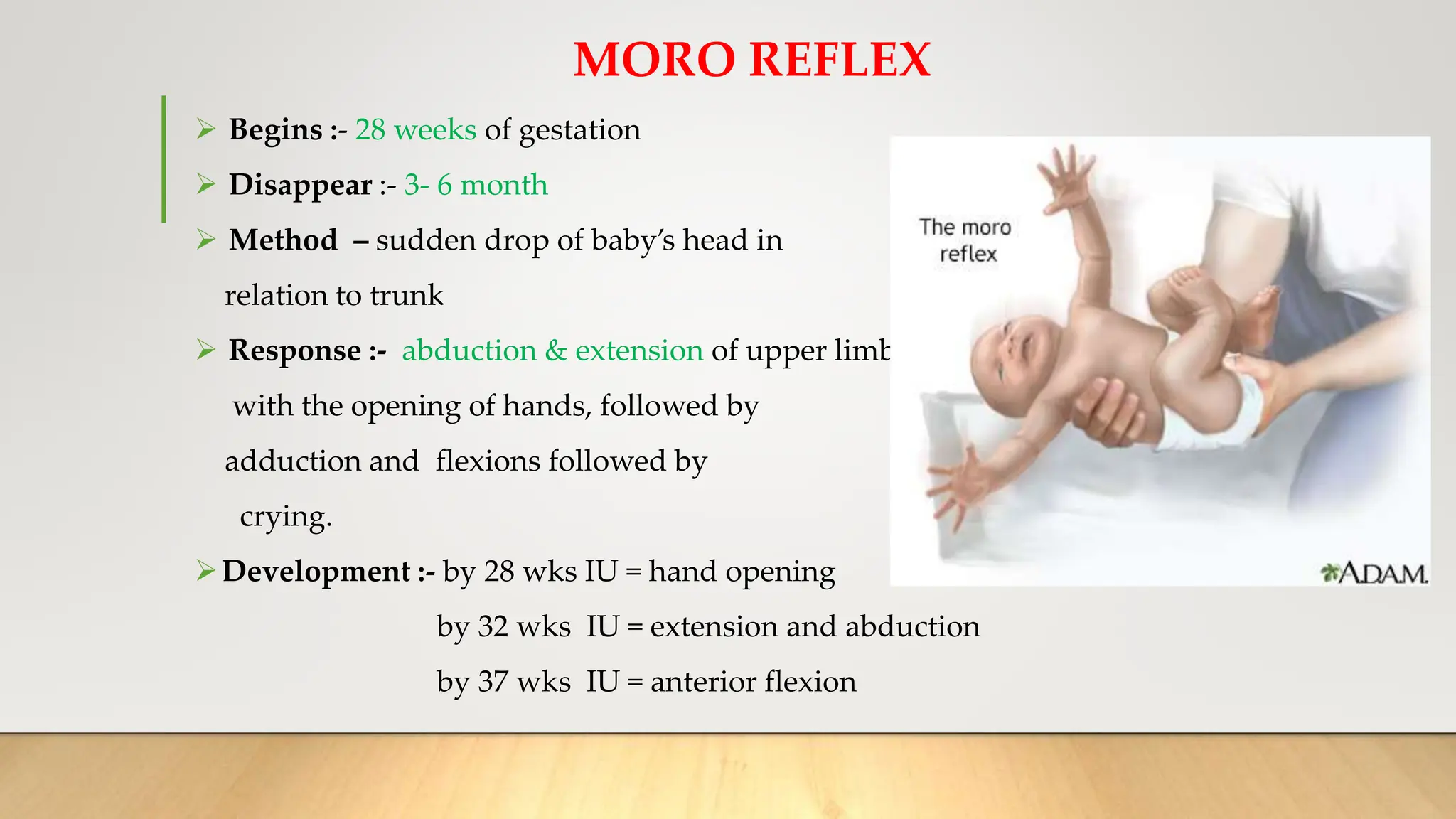
MORO REFLEX
 Begins :- 28 weeks of gestation
 Disappear :- 3- 6 month
 Method – sudden drop of baby’s head in
relation to trunk
 Response :- abduction & extension of upper limb
with the opening of hands, followed by
adduction and flexions followed by
crying.
Development :- by 28 wks IU = hand opening
by 32 wks IU = extension and abduction
by 37 wks IU = anterior flexion
MORO REFLEX
• CLINICAL SIGNIFICANCE
Its nature gives an indication of muscle tone
Failure of the arms to move freely or the hands to open fully indicates hypotonia.
Depressed / absent more reflex:
 cerebral depression (eg, birth asphyxia )
Exaggerated moro reflex:
Cerebral irritability
Asymmetric moro reflex:
Brachial palsy, fracture of clavicle or humerus, and hemiplegia
MORO REFLEX
PALMAR/ GRASP REFLEX
Begins :- 32 weeks of gestation
Disappears:- 3-4 months
Light touch of the palmar surface produces reflex flexion of the fingers
Most effective way –slid the stimulating object, such as a finger or pencil, across
the palm from the lateral border
Replaced by voluntary grasp at 4-5 months
PALMAR/ GRASP REFLEX
• CLINICAL SIGNIFICANCE
Persistence beyond 3-4 months indicate spastic form of cerebral palsy &
kernicterus
May be asymmetrical in hemiplegia & in case of cerebral damage
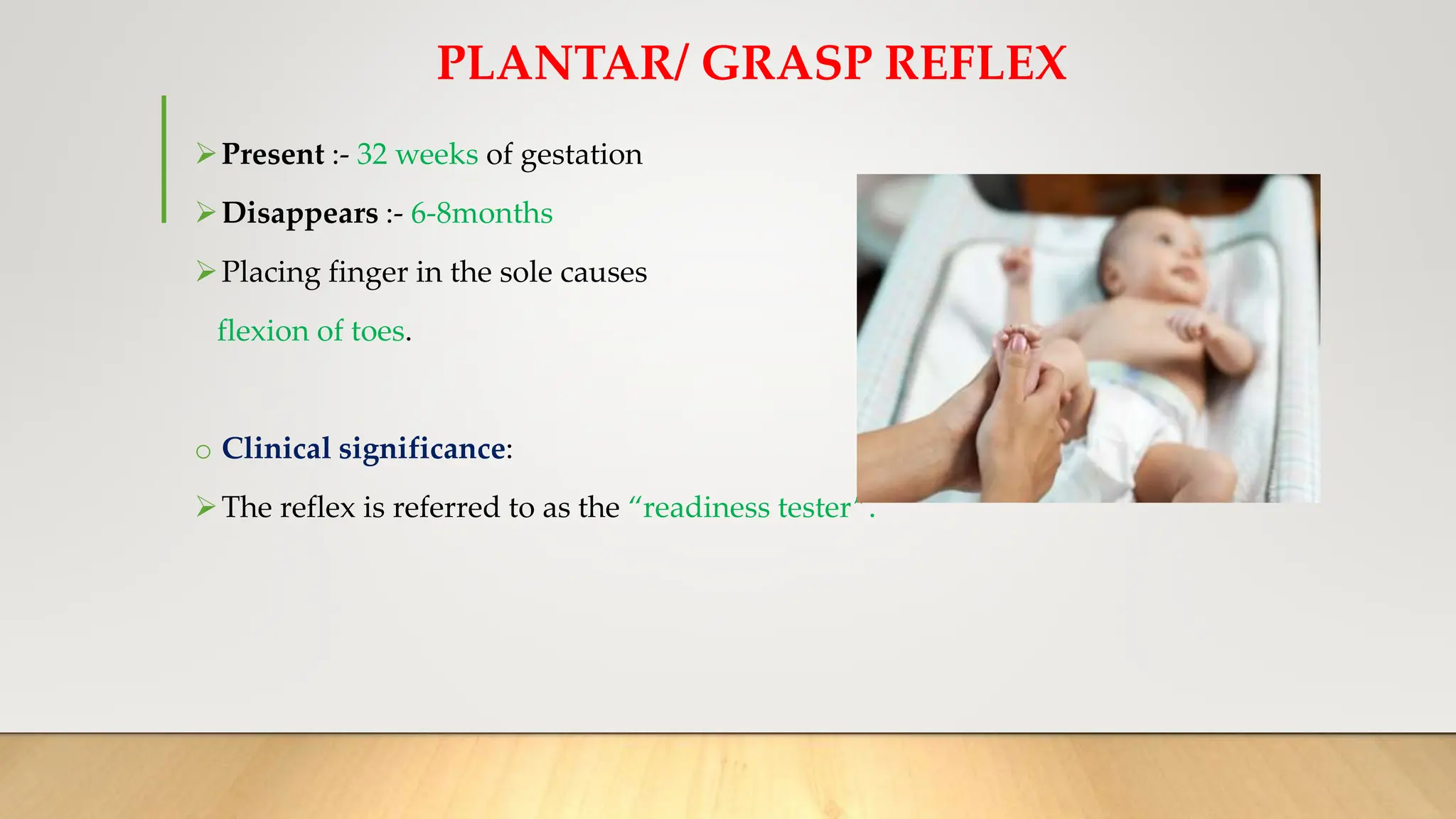
PLANTAR/ GRASP REFLEX
Present :- 32 weeks of gestation
Disappears :- 6-8months
Placing finger in the sole causes
flexion of toes.
o Clinical significance:
The reflex is referred to as the “readiness tester”.
PALMAR AND PLANTAR RELEXES
WALKING/ STEPPING REFLEX
 Present in full term babies > 1.8 kg weight
 Disappears at approx 5-6 weeks.
 When sole of foot is pressed against the
couch edge, baby tries to walk
 Legs prance up & down as if baby is
walking or dancing
 Reflex reappear at 10 months . that’s how baby learn how to walk
o Clinical significance
 Premature infants will tend to walk in a toe-heel fashion while more mature infants
will walk in heel-toe pattern.
WALKING/ STEPPING REFLEX
ASYMMETRIC TONIC NECK REFLEX
When the child’s head is turned to the one side, the arm
on that side will extended and the opposite limb flexed.
Most evident between 2-3 months of age
Disappers :- 6 months of age.
o Clinical significance
Persistence of most frequently observed
abnormality of the infantile reflexes in infants
with neurological lesions.
Greatly disrupts development
ASYMMETRIC TONIC NECK REFLEX
SYMMETRIC TONIC NECK REFLEX
Extension of the head causes extension
of the fore limbs and flexion of the hind
limbs
Evident between 2-3 months of age
o Clinical significance:
Not normally easily seen or elicited in
normal infants
May be seen in an exaggerated form
in many children with cerebral palsy.
SYMMETRIC TONIC NECK REFLEX
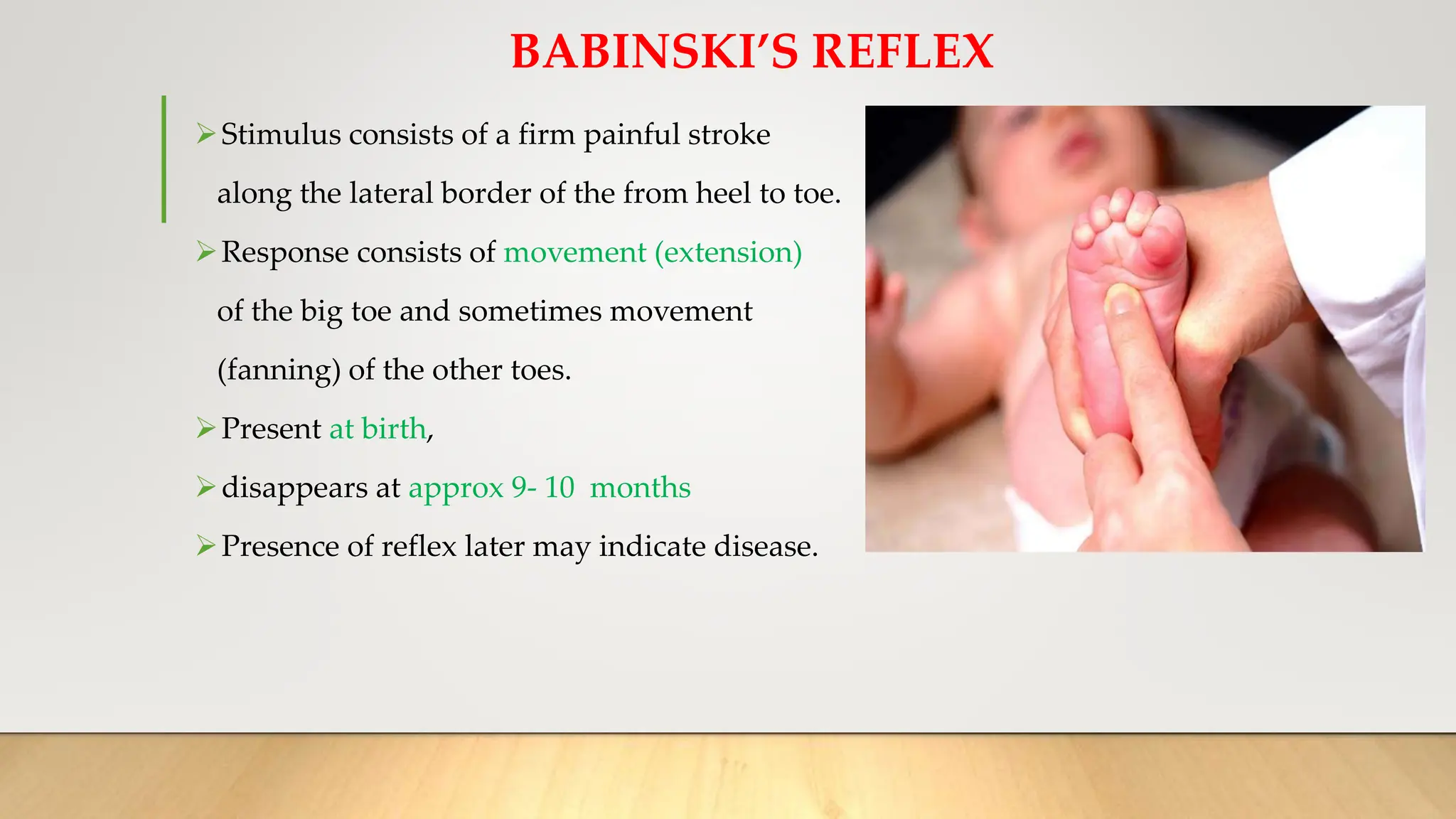
BABINSKI’S REFLEX
Stimulus consists of a firm painful stroke
along the lateral border of the from heel to toe.
Response consists of movement (extension)
of the big toe and sometimes movement
(fanning) of the other toes.
Present at birth,
disappears at approx 9- 10 months
Presence of reflex later may indicate disease.
BABINSKI’S REFLEX
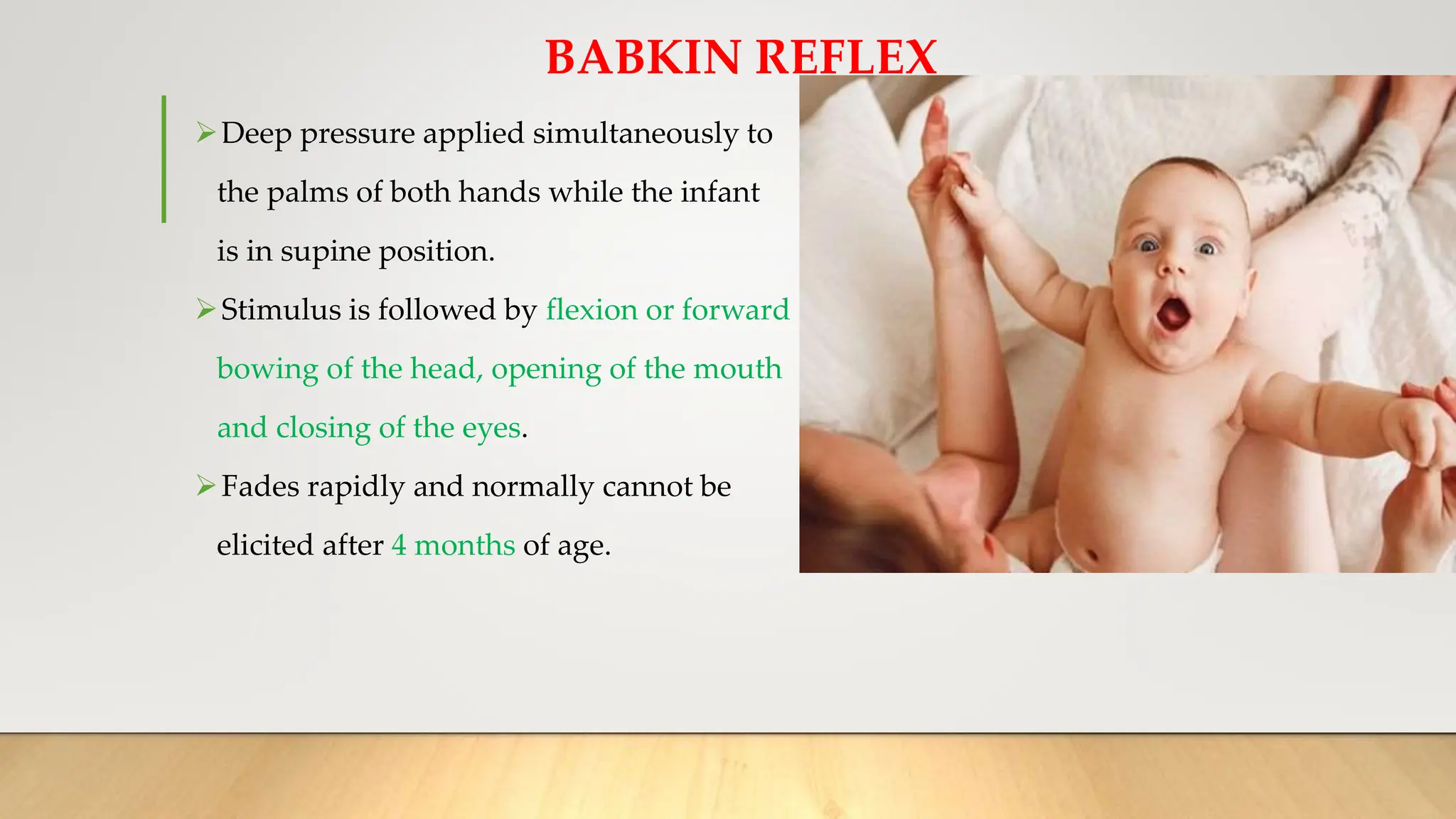
BABKIN REFLEX
Deep pressure applied simultaneously to
the palms of both hands while the infant
is in supine position.
Stimulus is followed by flexion or forward
bowing of the head, opening of the mouth
and closing of the eyes.
Fades rapidly and normally cannot be
elicited after 4 months of age.
BABKIN REFLEX
o Clinical significance
Reflex can be demonstrated in the newborn, thus showing a hand- mouth
neurological link, even at that early stage.
BABKIN REFLEX
PARACHUTE REFLEX
Appears:- 6-9 months &
persists there after.
Method :- by holding the child in ventral
suspension & suddenly lowering him to
the couch.
Arms extend as a defensive reaction.
o Clinical significance
Absent or abnormal in children with
cerebral palsy.
Would be asymmetrical in spastic hemiplegia
PARACHUTE REFLEX
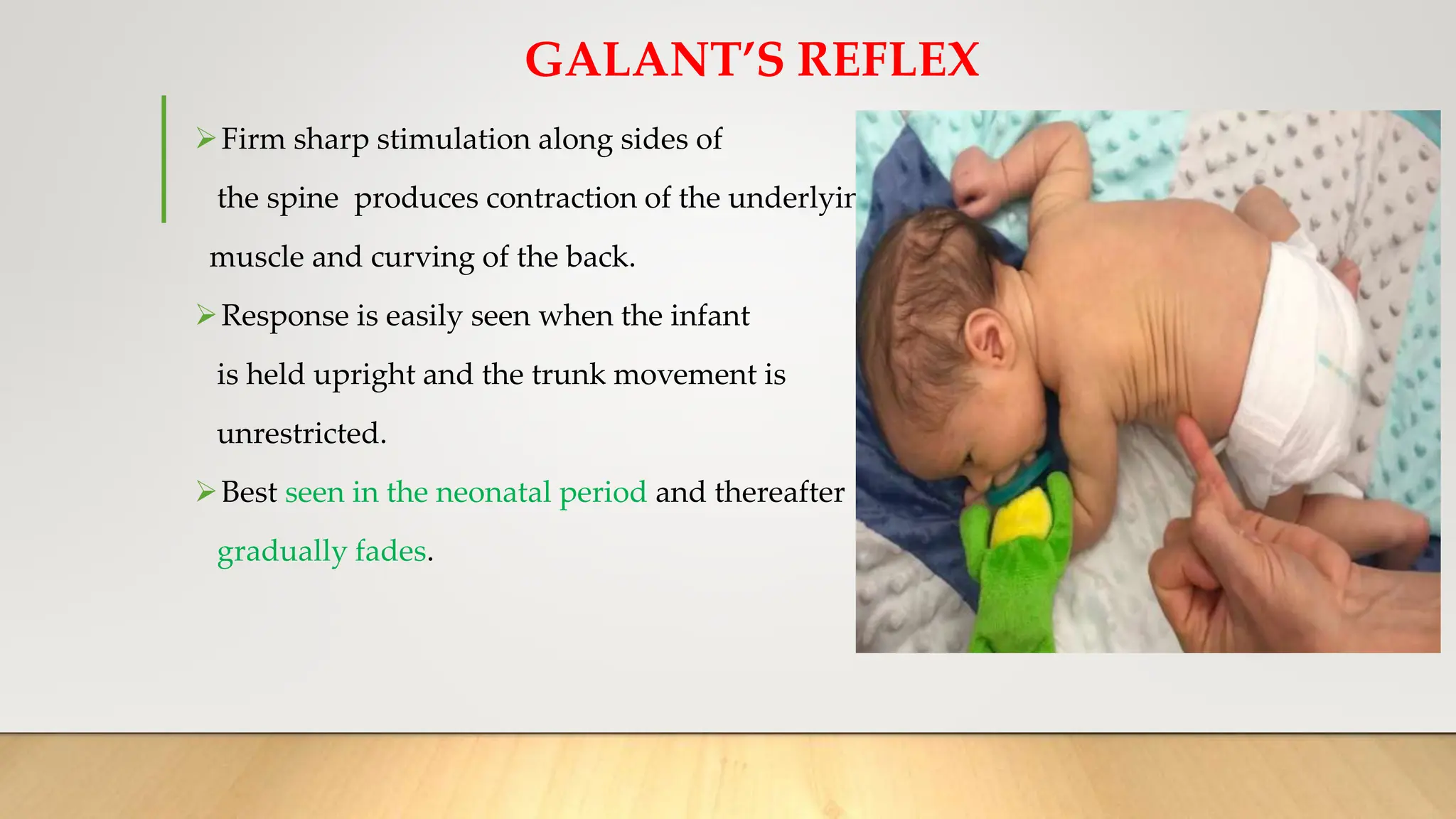
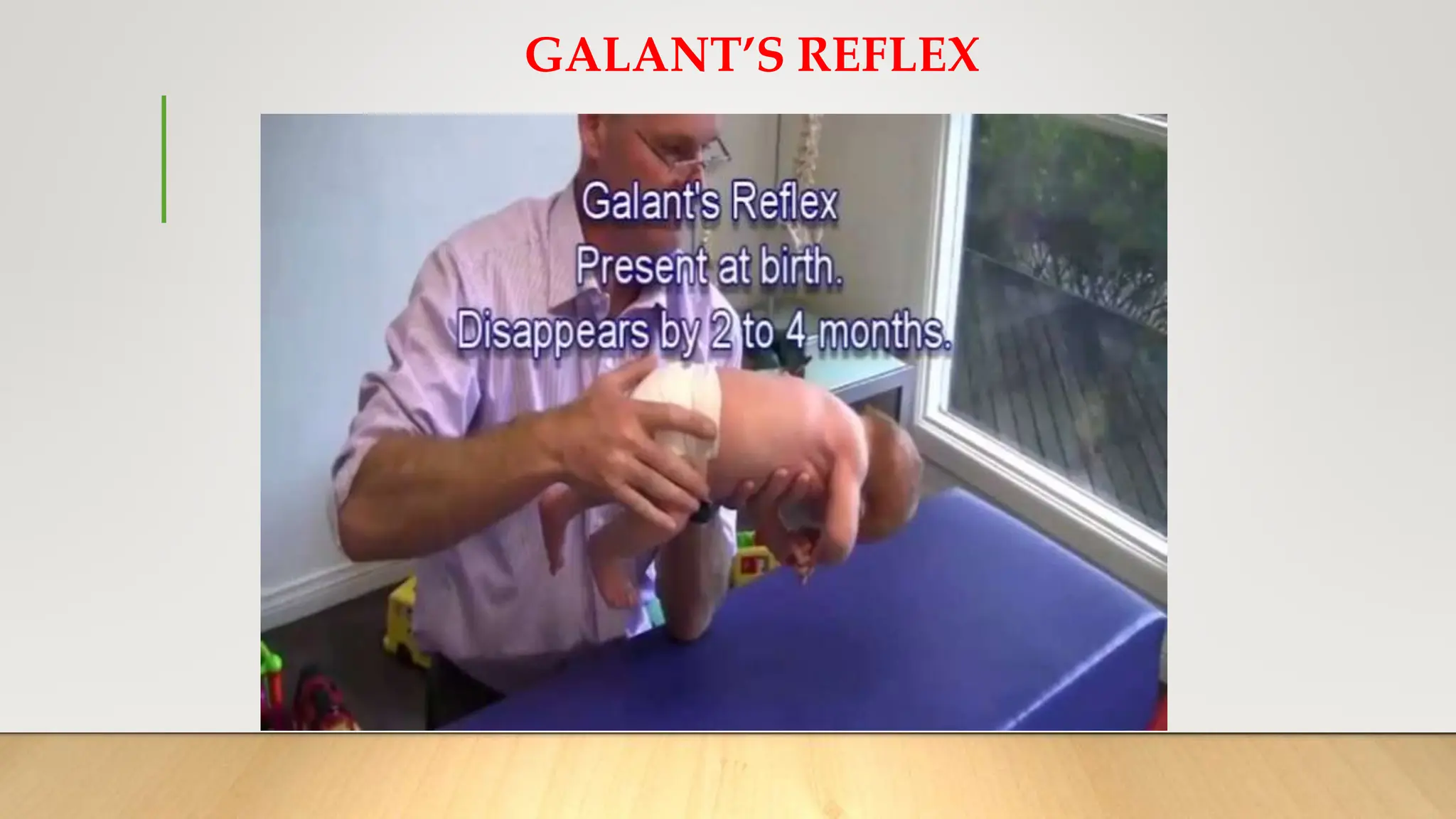
GALANT’S REFLEX
Firm sharp stimulation along sides of
the spine produces contraction of the underlying
muscle and curving of the back.
Response is easily seen when the infant
is held upright and the trunk movement is
unrestricted.
Best seen in the neonatal period and thereafter
gradually fades.
GALANT’S REFLEX
FACIAL REFLEXES
FACIAL REFLEXES
Blink reflex
Doll’s eye reflex
Auditory orienting reflex
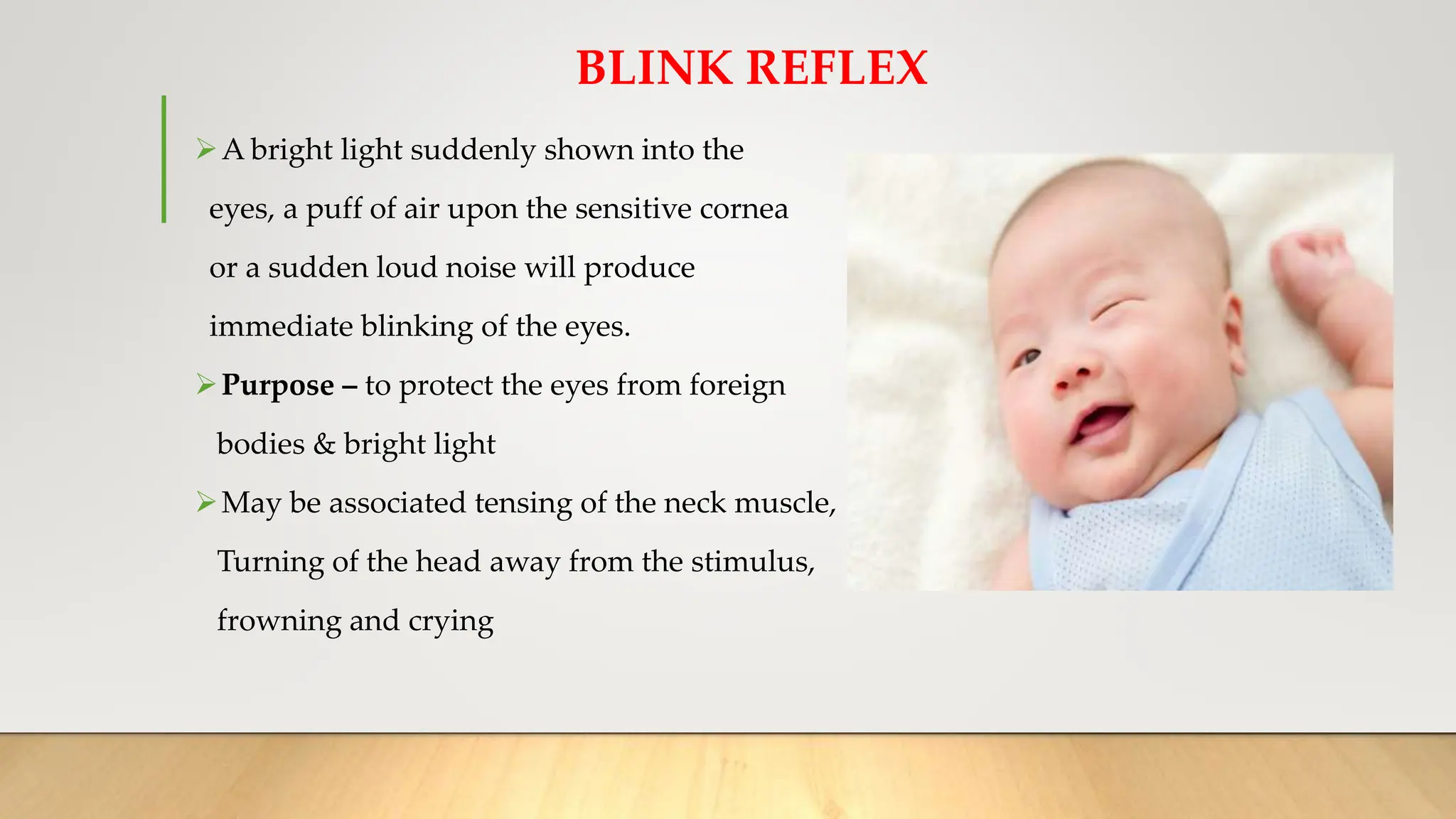
BLINK REFLEX
A bright light suddenly shown into the
eyes, a puff of air upon the sensitive cornea
or a sudden loud noise will produce
immediate blinking of the eyes.
Purpose – to protect the eyes from foreign
bodies & bright light
May be associated tensing of the neck muscle,
Turning of the head away from the stimulus,
frowning and crying
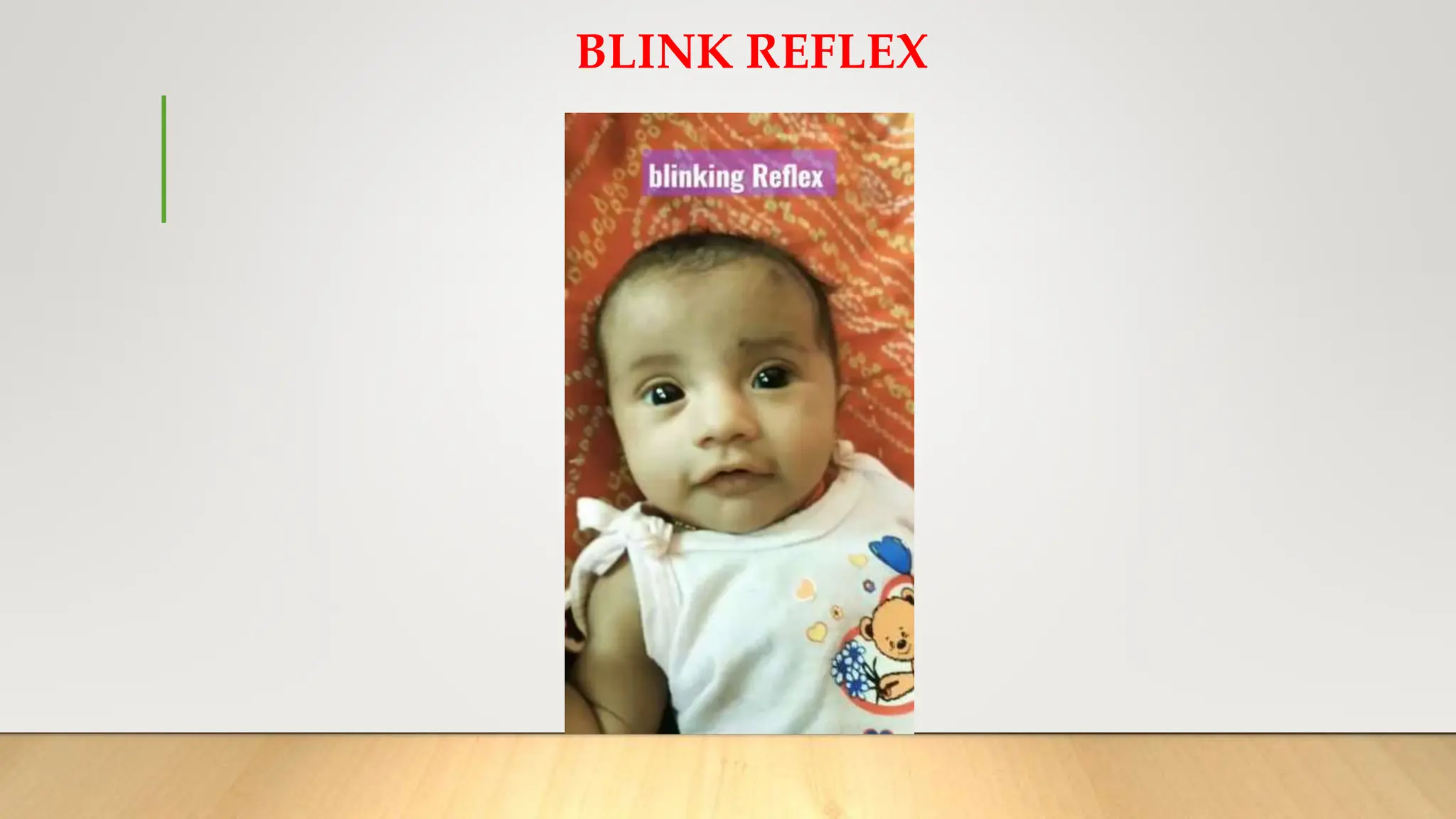
BLINK REFLEX
Reflexes are easily seen in the neonate and continue to be present throughout
life.
o Clinical significance
Examination is part of some neurological exams, particularly when evaluating
coma.
Satisfactory demonstration of these reflexes indicate-
No cerebral depression
Contraction of appropriate muscles in response.
BLINK REFLEX
DOLL’S EYE REFLEX
(OCULOCEPHALIC REFLEX)
Passive turning of the head of the newborn
leaves the eye “ behind”
A distinct time lag occurs before the eyes
move to a new position in keeping with
the head position.
Disappears at within a week or two of birth
Failure of this reflex to appear indicates a cerebral
lesion
DOLL’S EYE REFLEX
AUDITORY ORIENTING REFLEX
A sudden loud and unpleasant noise.
May produce the blink reflex.
Infant may remain still and show increased alertness.
Quieter sounds usually cause reflex eye and head turning to the side of the
sound, as if to locate it.
Seen first at about 4 months of age
Thereafter, head turning towards sound stimuli occurs and the accuracy of
localization increases rapidly by 9-10 months.
AUDITORY ORIENTING REFLEX
o Clinical significance
Reflex responses are made use of in tests of infants for hearing loss.
Pattern of the localization responses indicates the level of neurological maturity.
ORAL REFLEXES
ORAL REFLEXES
Rooting reflex
Sucking reflex
Swallowing reflex
Gag reflex
ROOTING REFLEX
• Baby’s cheek is stroked:
They respond by turning their head
towards the stimulus.
They start try to find breast, thus allowing for
breast feeding
When finger slides away , head turns to follow it.
ROOTING REFLEX
Onset – 28 weeks IU
Well established – 32-34 weeks IU
Disappears at 3- 4 months
o Clinical significance
Persistence can interfere with sucking
Absence of this is seen in neurological impaired infants.
ROOTING REFLEX
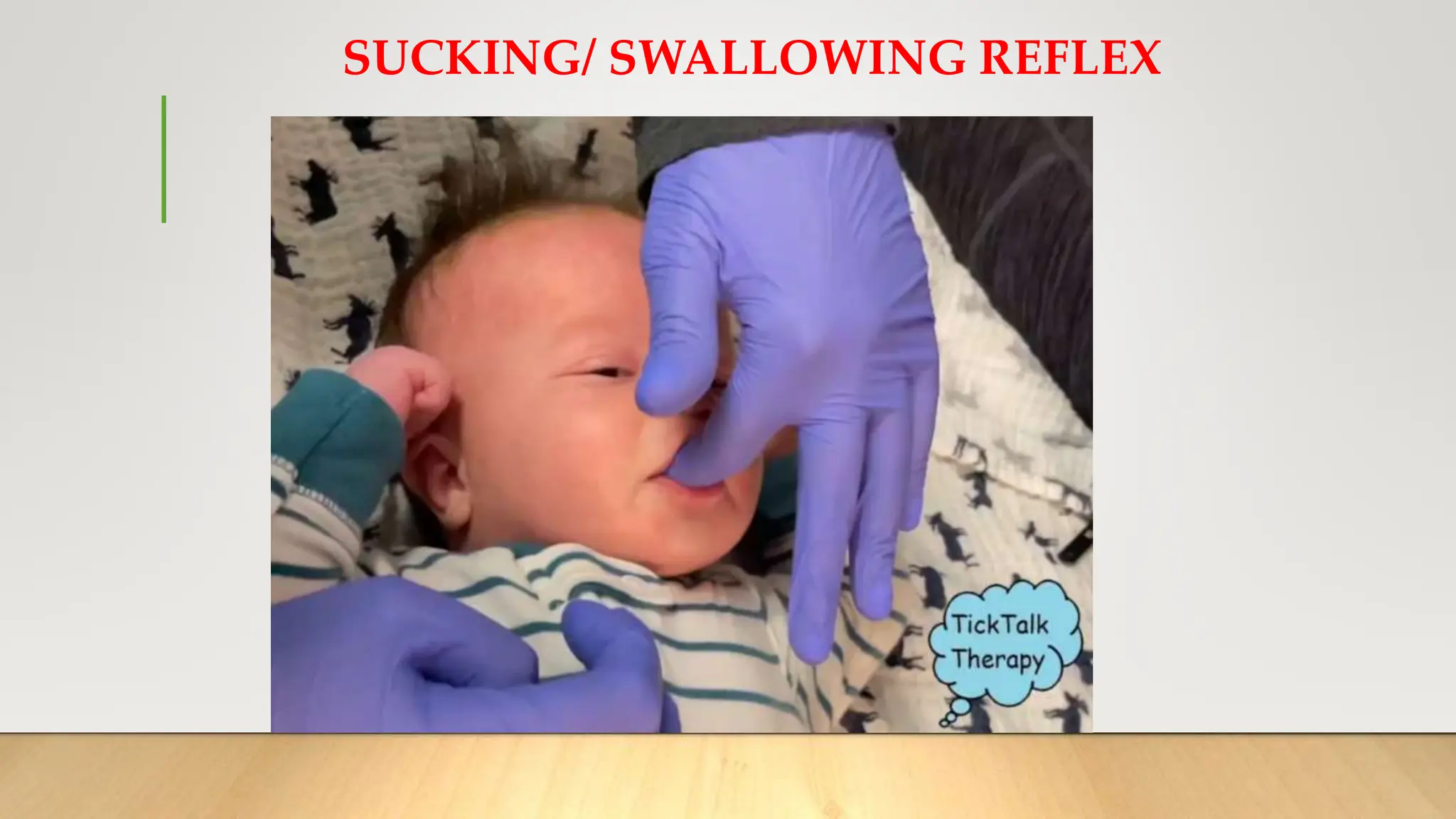
SUCKING/ SWALLOWING REFLEX
Touching lips or placing finger in
baby’s hard palate causes baby to start
sucking the finger.
Onset – 28 weeks IU
Well established at 32- 34 weeks IU
Disappears around 12 months
SUCKING/ SWALLOWING REFLEX
GAG REFLEX
(PHARYNGEAL REFLEX)
Seen in 19 weeks of IU life
Reflex contraction of the back of
the throat
Evoked by touching uvula.
GAG REFLEX
(PHARYNGEAL REFLEX
o Functional significance
It, along with reflexive pharyngeal swallowing, prevent something from entering
the throat except as part of normal swallowing and helps prevent choking.
o Clinical significance
Absence of the gag reflex – symptom of a number of severe medical condition
Damage to the glossopharyngeal nerve, the vagus nerve,
braindeath
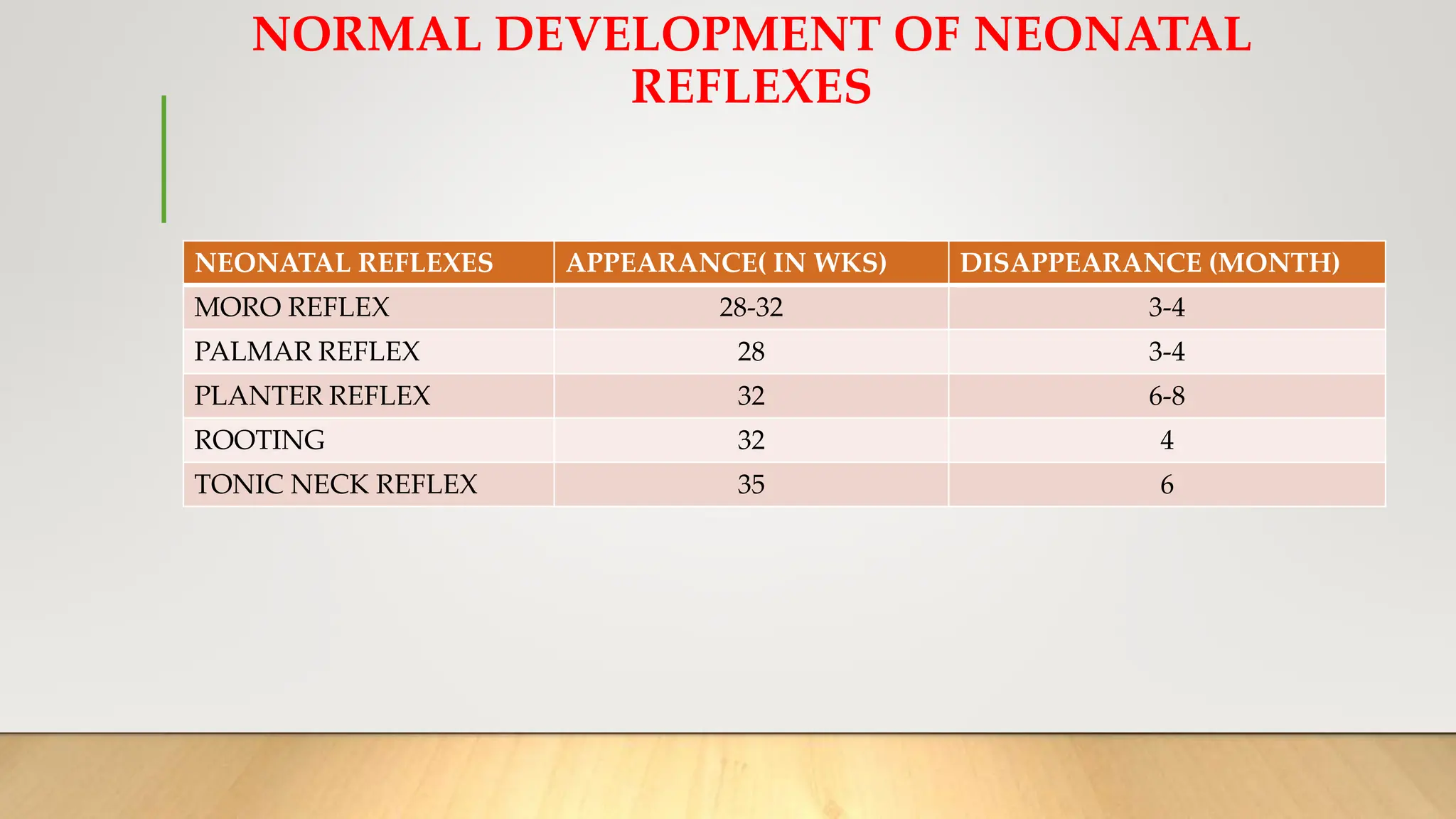
NORMAL DEVELOPMENT OF NEONATAL
REFLEXES
NEONATAL REFLEXES APPEARANCE( IN WKS) DISAPPEARANCE (MONTH)
MORO REFLEX 28-32 3-4
PALMAR REFLEX 28 3-4
PLANTER REFLEX 32 6-8
ROOTING 32 4
TONIC NECK REFLEX 35 6
neonatal reflex.pptx

neonatal reflex.pptx

  • 1.
    NEWBORN REFLEXES BY :- DR.KRISHNA SHARMA INTERN GUIDED BY :- DR. BHARAT SHAH DR. HETAL GOHIL
  • 2.
    WHAT IS AREFLEX ? A reflex is a involuntary action that the body does in response to stimulation without awareness. Neonatal reflexes or primitive reflexes are the inborn behavioural pattern that develop in newborn. They should be fully present at birth and are gradually inhibited by higher center in the brain.
  • 3.
    TYPES OF REFLEXES •GENERAL BODY REFLEX • FACIAL REFLEX • ORAL REFLEX Brainstem mediated Midbrain & cortex Spinal cord Moro’s reflex Parachute reflex Galant reflex Sucking reflex Perez reflex
  • 4.
    GENERAL BODY REFLEXES Mororeflex/ Startle reflex Palmar /Grasp reflex Planter grasp reflex Walking /stepping reflex Asymmetric tonic neck reflex Symmetric tonic neck reflex Babinski’s reflex Babkin reflex Parachute reflex Galant’s reflex
  • 5.
    MORO REFLEX  Begins:- 28 weeks of gestation  Disappear :- 3- 6 month  Method – sudden drop of baby’s head in relation to trunk  Response :- abduction & extension of upper limb with the opening of hands, followed by adduction and flexions followed by crying. Development :- by 28 wks IU = hand opening by 32 wks IU = extension and abduction by 37 wks IU = anterior flexion
  • 6.
    MORO REFLEX • CLINICALSIGNIFICANCE Its nature gives an indication of muscle tone Failure of the arms to move freely or the hands to open fully indicates hypotonia. Depressed / absent more reflex:  cerebral depression (eg, birth asphyxia ) Exaggerated moro reflex: Cerebral irritability Asymmetric moro reflex: Brachial palsy, fracture of clavicle or humerus, and hemiplegia
  • 7.
  • 8.
    PALMAR/ GRASP REFLEX Begins:- 32 weeks of gestation Disappears:- 3-4 months Light touch of the palmar surface produces reflex flexion of the fingers Most effective way –slid the stimulating object, such as a finger or pencil, across the palm from the lateral border Replaced by voluntary grasp at 4-5 months
  • 9.
    PALMAR/ GRASP REFLEX •CLINICAL SIGNIFICANCE Persistence beyond 3-4 months indicate spastic form of cerebral palsy & kernicterus May be asymmetrical in hemiplegia & in case of cerebral damage
  • 10.
    PLANTAR/ GRASP REFLEX Present:- 32 weeks of gestation Disappears :- 6-8months Placing finger in the sole causes flexion of toes. o Clinical significance: The reflex is referred to as the “readiness tester”.
  • 11.
  • 12.
    WALKING/ STEPPING REFLEX Present in full term babies > 1.8 kg weight  Disappears at approx 5-6 weeks.  When sole of foot is pressed against the couch edge, baby tries to walk  Legs prance up & down as if baby is walking or dancing  Reflex reappear at 10 months . that’s how baby learn how to walk o Clinical significance  Premature infants will tend to walk in a toe-heel fashion while more mature infants will walk in heel-toe pattern.
  • 13.
  • 14.
    ASYMMETRIC TONIC NECKREFLEX When the child’s head is turned to the one side, the arm on that side will extended and the opposite limb flexed. Most evident between 2-3 months of age Disappers :- 6 months of age. o Clinical significance Persistence of most frequently observed abnormality of the infantile reflexes in infants with neurological lesions. Greatly disrupts development
  • 15.
  • 16.
    SYMMETRIC TONIC NECKREFLEX Extension of the head causes extension of the fore limbs and flexion of the hind limbs Evident between 2-3 months of age o Clinical significance: Not normally easily seen or elicited in normal infants May be seen in an exaggerated form in many children with cerebral palsy.
  • 17.
  • 18.
    BABINSKI’S REFLEX Stimulus consistsof a firm painful stroke along the lateral border of the from heel to toe. Response consists of movement (extension) of the big toe and sometimes movement (fanning) of the other toes. Present at birth, disappears at approx 9- 10 months Presence of reflex later may indicate disease.
  • 19.
  • 20.
    BABKIN REFLEX Deep pressureapplied simultaneously to the palms of both hands while the infant is in supine position. Stimulus is followed by flexion or forward bowing of the head, opening of the mouth and closing of the eyes. Fades rapidly and normally cannot be elicited after 4 months of age.
  • 21.
    BABKIN REFLEX o Clinicalsignificance Reflex can be demonstrated in the newborn, thus showing a hand- mouth neurological link, even at that early stage.
  • 22.
  • 23.
    PARACHUTE REFLEX Appears:- 6-9months & persists there after. Method :- by holding the child in ventral suspension & suddenly lowering him to the couch. Arms extend as a defensive reaction. o Clinical significance Absent or abnormal in children with cerebral palsy. Would be asymmetrical in spastic hemiplegia
  • 24.
  • 25.
    GALANT’S REFLEX Firm sharpstimulation along sides of the spine produces contraction of the underlying muscle and curving of the back. Response is easily seen when the infant is held upright and the trunk movement is unrestricted. Best seen in the neonatal period and thereafter gradually fades.
  • 26.
  • 27.
  • 28.
    FACIAL REFLEXES Blink reflex Doll’seye reflex Auditory orienting reflex
  • 29.
    BLINK REFLEX A brightlight suddenly shown into the eyes, a puff of air upon the sensitive cornea or a sudden loud noise will produce immediate blinking of the eyes. Purpose – to protect the eyes from foreign bodies & bright light May be associated tensing of the neck muscle, Turning of the head away from the stimulus, frowning and crying
  • 30.
    BLINK REFLEX Reflexes areeasily seen in the neonate and continue to be present throughout life. o Clinical significance Examination is part of some neurological exams, particularly when evaluating coma. Satisfactory demonstration of these reflexes indicate- No cerebral depression Contraction of appropriate muscles in response.
  • 31.
  • 32.
    DOLL’S EYE REFLEX (OCULOCEPHALICREFLEX) Passive turning of the head of the newborn leaves the eye “ behind” A distinct time lag occurs before the eyes move to a new position in keeping with the head position. Disappears at within a week or two of birth Failure of this reflex to appear indicates a cerebral lesion
  • 33.
  • 34.
    AUDITORY ORIENTING REFLEX Asudden loud and unpleasant noise. May produce the blink reflex. Infant may remain still and show increased alertness. Quieter sounds usually cause reflex eye and head turning to the side of the sound, as if to locate it. Seen first at about 4 months of age Thereafter, head turning towards sound stimuli occurs and the accuracy of localization increases rapidly by 9-10 months.
  • 35.
    AUDITORY ORIENTING REFLEX oClinical significance Reflex responses are made use of in tests of infants for hearing loss. Pattern of the localization responses indicates the level of neurological maturity.
  • 36.
  • 37.
    ORAL REFLEXES Rooting reflex Suckingreflex Swallowing reflex Gag reflex
  • 38.
    ROOTING REFLEX • Baby’scheek is stroked: They respond by turning their head towards the stimulus. They start try to find breast, thus allowing for breast feeding When finger slides away , head turns to follow it.
  • 39.
    ROOTING REFLEX Onset –28 weeks IU Well established – 32-34 weeks IU Disappears at 3- 4 months o Clinical significance Persistence can interfere with sucking Absence of this is seen in neurological impaired infants.
  • 40.
  • 41.
    SUCKING/ SWALLOWING REFLEX Touchinglips or placing finger in baby’s hard palate causes baby to start sucking the finger. Onset – 28 weeks IU Well established at 32- 34 weeks IU Disappears around 12 months
  • 42.
  • 43.
    GAG REFLEX (PHARYNGEAL REFLEX) Seenin 19 weeks of IU life Reflex contraction of the back of the throat Evoked by touching uvula.
  • 44.
    GAG REFLEX (PHARYNGEAL REFLEX oFunctional significance It, along with reflexive pharyngeal swallowing, prevent something from entering the throat except as part of normal swallowing and helps prevent choking. o Clinical significance Absence of the gag reflex – symptom of a number of severe medical condition Damage to the glossopharyngeal nerve, the vagus nerve, braindeath
  • 45.
    NORMAL DEVELOPMENT OFNEONATAL REFLEXES NEONATAL REFLEXES APPEARANCE( IN WKS) DISAPPEARANCE (MONTH) MORO REFLEX 28-32 3-4 PALMAR REFLEX 28 3-4 PLANTER REFLEX 32 6-8 ROOTING 32 4 TONIC NECK REFLEX 35 6