IMMUNIZATION
By
Mr. Ravi Rai Dangi
Assistant Professor
Fellowship in Neonatal Nursing
MSc. Child Health Nursing
DEFINITION:-
 It is a process of artificially inducing
immunity or providing protection from
disease.
 ACTIVE IMMUNISATION
 PASSIVE IMMUNISATION
IMMUNOGENIC & PROTECTIVE
EFFICACY
 IMMUNOGENIC EFFICACY:- refers to its
ability to induce an immune response.
 PROTECTIVE EFFICACY:- refers to actual
protection against diseases.
 In case of live viral and toxoid vaccines,
antibody response always result in
protection
 But that may not be true for killed
vaccines.
HISTORICAL ASPECTS :-
 Jenner developed the small pox vaccine in
1796.
 Louis Pasteur developed the rabies
prophylaxis in the year 1885.
 Expanded programme of immunisation was
started by WHO in 1974 and in India in 1978.
 Universal immunisation programme in India
started in 1985.
 Child vaccine initiatives :-with support from
various agencies- 1991.
 Global programme on vaccines by WHO in
1993.
ACHIEVEMENTS:-
 Small pox eradicated in the year 1977.
 EPI coverage of >80% was achieved by 1990.
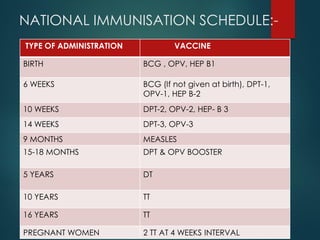
NATIONAL IMMUNISATION SCHEDULE:-
TYPE OF ADMINISTRATION VACCINE
BIRTH BCG , OPV, HEP B1
6 WEEKS BCG (If not given at birth), DPT-1,
OPV-1, HEP B-2
10 WEEKS DPT-2, OPV-2, HEP- B 3
14 WEEKS DPT-3, OPV-3
9 MONTHS MEASLES
15-18 MONTHS DPT & OPV BOOSTER
5 YEARS DT
10 YEARS TT
16 YEARS TT
PREGNANT WOMEN 2 TT AT 4 WEEKS INTERVAL
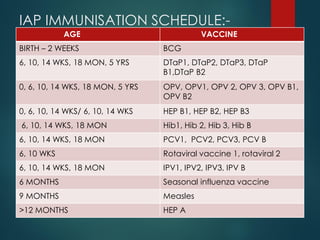
IAP IMMUNISATION SCHEDULE:-
AGE VACCINE
BIRTH – 2 WEEKS BCG
6, 10, 14 WKS, 18 MON, 5 YRS DTaP1, DTaP2, DTaP3, DTaP
B1,DTaP B2
0, 6, 10, 14 WKS, 18 MON, 5 YRS OPV, OPV1, OPV 2, OPV 3, OPV B1,
OPV B2
0, 6, 10, 14 WKS/ 6, 10, 14 WKS HEP B1, HEP B2, HEP B3
6, 10, 14 WKS, 18 MON Hib1, Hib 2, Hib 3, Hib B
6, 10, 14 WKS, 18 MON PCV1, PCV2, PCV3, PCV B
6, 10 WKS Rotaviral vaccine 1, rotaviral 2
6, 10, 14 WKS, 18 MON IPV1, IPV2, IPV3, IPV B
6 MONTHS Seasonal influenza vaccine
9 MONTHS Measles
>12 MONTHS HEP A
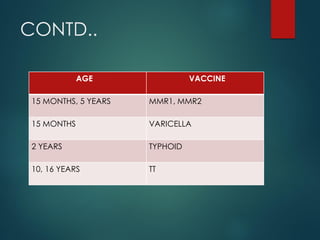
CONTD..
AGE VACCINE
15 MONTHS, 5 YEARS MMR1, MMR2
15 MONTHS VARICELLA
2 YEARS TYPHOID
10, 16 YEARS TT
VACCINES:-
 BCG VACCINATION:-
 It is a live attenuated strain of mycobacterium
tuberculosis bovine strain.
 Potency is maintained when freeze dried at 4
degree celsius.
 BCG is a single dose, administered intradermally
over left deltoid.
 Dose- 0.1 ml
 Contraindicated in immunodeficient babies.
 Side effects:- axillary adenitis.
 DIPTHERIA VACCINE:-
 Immunity depends on antibody production against the
exotoxin C. Diptheriae.
 Natural immunity is acquired by apparent or in apparent
infection.
 The toxoid vaccine adsorbed with Aluminium hydroxide is
usually combined with pertusis and TT.
 Immunization done at 6, 10, 14 wks and booster at 18 & 5
years.
 Dose – 0.5 ml, I/M
 Contraindicated:- Pt’s with convulsion, severe reactions to first
dose, progressive neurological disorders.
 Side effects:- fever, local induration, pain
PERTUSIS:-
 Given with DPT.
 Contains killed organism of B.pertusis.
 3 doses at 6, 10, 14 weeks.
 Protective efficacy is 75-80%.
 Contraindicated :- progressive neurologic
disease, prolonged cry, convulsions after first.
 Side effects:- fever, local pain, swelling,
irritability.
 ACELLULAR PERTUSIS VACCINE:-
CONT...
 TETANUS VACCINE:-
 Neonatal tetanus is an important cause of mortality.
 No natural immunity.
 Tetanus toxin is very toxic.
 Usually administered in combination with DP and
DPT at 6,1o,14 wks and booster at 18 months and 5
years.
 To protect against neonatal tetanus, TT is
administered to the mother.
 POLIOMYELITIS VACCINES:-
 Inactivated polio virus developed by Salk.
 Live attenuated developed by Sabin.
 Supplied as trivalent antigen.
 ORAL POLIO VACCINE( OPV):-
 OPV is given mainly in 5 doses.
 Potency – stable at 4- 8 degree Celsius.
 INACTIVATED POLIOVIRUS VACCINE:-
 Cell culture grown, formalin inactivated and
purified poliovirus suspension.
 Primary immunisation, requires 3 doses at 6, 10, 14
weeks & booster at 18 months.
 Given subcutaneously or intramuscularly.
 Can be given to immunosuppressed patients.
 Safe vaccines.
 HEPATITIS B VACCINE:-
 Two types of vaccines are present.
 Given at 0, 6, 14 weeks.
 Preparation is in liquid forms.
 Dose – 0.5 ml( < 10 years), 1 ml(> 10
years).
 Contraindication – none
 Side effects:- local pain, erythema.
 Measles vaccine:-
 Live attenuated vaccine.
 Most popular are Schwartz, Edmonston- Zagreb.
 Grown in cell cultures of human, canine or avian
origin.
 Its shelf life is at least one year at 4-8 degree
Celsius. Given S/C or I/M.
 Sometimes develop mild to moderate fever
 Contraindicated in patients with
immunosuppression.
 RUBELLA VACCINE:-
 To prevent congenital rubella.
 Three attenuated virus are available, namely HPV
77, Cendehill and RA 77.
 Given in combination with measles and mumps.
 Immunization to be given in pre- pubertal stage.
 Contra-indication- immunosuppression.
 Adverse reaction – lymphadenopathy, arthralgia,
skin rash.
 MUMPS VACCINE:-
 Live attenuated vaccine.
 Combined with measles & rubella( MMR).
 Given at 15 months.
 Complication of mumps is orchitis and
oophritis.
 Efficacy is 75- 90%
 HAEMOPHILUS INFLUENZAE VACCINES:-
 H. Influenzae type B, an important cause of
meningitis & pneumonia.
 Contains H. Influenza capsular oligosaccharide-b,
liquid in nature.
 Given at 6, 10, 14weeks & booster at 18 months.
 Given I/M
 Adverse effects:- none
 Contraindication- those hypersensitive to vaccine
component.
 ROTAVIRUS VACCINE:-
 Most common cause of diarrhoeal
disease.
 Main causative serotypes are G1- G4.
 Vaccine given at 6 weeks then at 10
weeks.
 Adverse effects- irritability, vomiting (rare).
 Contraindications- none.
 Typhoid vaccine:-
 3 types are present.
 Vaccine available in liquid form.
 Given as a single dose of 0.5 ml( I/M)
 Given at 2 years of age
 Protective efficacy is 70- 80%
 Side effects- no severe side effects.
 PNEUMOCOCCAL VACCINES:-
 Strep. Pneuomoniae is one of the most important
cause of respiratory infection.
 Vaccine composed of 25 microgram of purified
capsular polysaccharide antigen.
 Available in lyophilised form.
 Efficacy is 90%.
 Given at 6, 10, 14 weeks and booster at18 months
at anterior lateral thigh.
 Contraindication:- none
 Side effects- none
 HEPATITIS A VACCINE:-
 Killed, inactivated vaccine.
 Recommended for those who are at increased
risk for infections.
 Same preparations as IPV.
 Available in liquid form, stored at 2- 8 degree
Celsius.
 Administered as I/M.
 Dose -0.5ml
 Contra-indications- none
 Side effects- fever (rare)
 VARICELLA VACCINE:-
 Prepared from live attenuated Oka strain of
varicella zoster virus.
 Considered safe, immunogenic and cost-
effective.
 Acc to IAP schedule given at15 months.
 Available in lyophilised forms.
 Storage at -15 degree Celsius.
 Dose – 0.5 ml.
 Given – S/C on deltoid.
 Protective efficacy- 95 -100%.
Contd..
 Contra- indications- none.
 Side – effects- fever, mild varicella type disease
might be observed within 1 week for which no
treatment required.
 Immunity with vaccine is for 10- 20 years.
 Following a natural infection it is lifelong.
 COMBINATION VACCINE:-
 EASY 5 is an example ( consists of DPT/ Hib/ HEP –B)
 BENEFITS:-
 Reduced number of injections.
 Reduced pain and parental anxiety.
 High compliance, low dropout.
 Reduced number of visits.
 Less storage space.
 Less burden on cold chain.
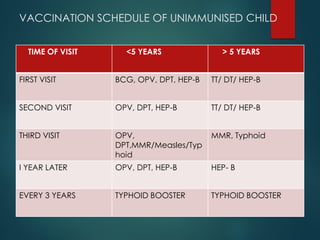
VACCINATION SCHEDULE OF UNIMMUNISED CHILD
TIME OF VISIT <5 YEARS > 5 YEARS
FIRST VISIT BCG, OPV, DPT, HEP-B TT/ DT/ HEP-B
SECOND VISIT OPV, DPT, HEP-B TT/ DT/ HEP-B
THIRD VISIT OPV,
DPT,MMR/Measles/Typ
hoid
MMR, Typhoid
I YEAR LATER OPV, DPT, HEP-B HEP- B
EVERY 3 YEARS TYPHOID BOOSTER TYPHOID BOOSTER
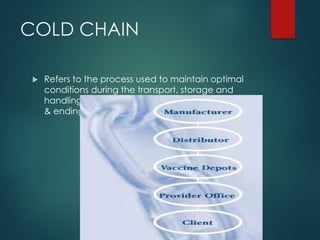
COLD CHAIN
 Refers to the process used to maintain optimal
conditions during the transport, storage and
handling of vaccines starting at the manufacturer
& ending with administration to the client.
Importance of cold chain:-
 Vaccines are sensitive biological
products.
 With exposure to temperatures outside
the recommended range leads to loss of
potency.
 Maintaining potency of vaccines is very
important for various reasons.
Placement of vaccines in
refrigerators
 Put vaccines and diluents on the top
and middle shelves of the main section
 OPV and measles vaccine on the top
shelf
BCG, Pentavalent and TT vaccines on the
middle shelves
 Diluents next to the vaccines with which
they were supplied
 Arrange the boxes of vaccine in stacks
between which the air can move.
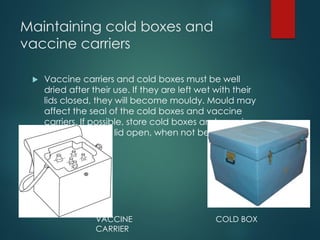
Maintaining cold boxes and
vaccine carriers
 Vaccine carriers and cold boxes must be well
dried after their use. If they are left wet with their
lids closed, they will become mouldy. Mould may
affect the seal of the cold boxes and vaccine
carriers. If possible, store cold boxes and vaccine
carriers with the lid open, when not being used.
VACCINE
CARRIER
COLD BOX
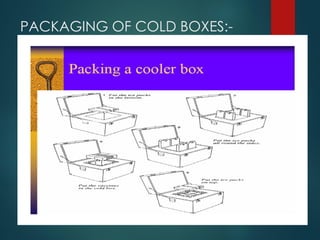
PACKAGING OF COLD BOXES:-
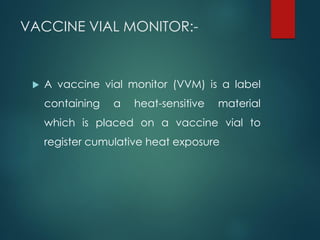
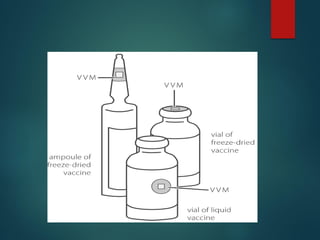
VACCINE VIAL MONITOR:-
 A vaccine vial monitor (VVM) is a label
containing a heat-sensitive material
which is placed on a vaccine vial to
register cumulative heat exposure
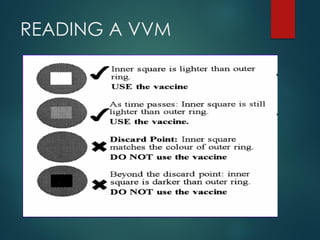
READING A VVM
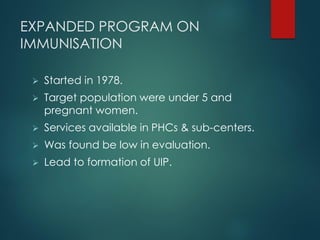
EXPANDED PROGRAM ON
IMMUNISATION
 Started in 1978.
 Target population were under 5 and
pregnant women.
 Services available in PHCs & sub-centers.
 Was found be low in evaluation.
 Lead to formation of UIP.
UNIVERSAL IMMUNISATION PROGRAM:-
 Started in 1985.
 Target population:- infants, under 1 age.
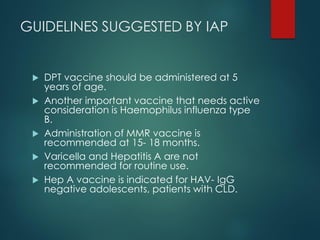
GUIDELINES SUGGESTED BY IAP
 DPT vaccine should be administered at 5
years of age.
 Another important vaccine that needs active
consideration is Haemophilus influenza type
B.
 Administration of MMR vaccine is
recommended at 15- 18 months.
 Varicella and Hepatitis A are not
recommended for routine use.
 Hep A vaccine is indicated for HAV- IgG
negative adolescents, patients with CLD.
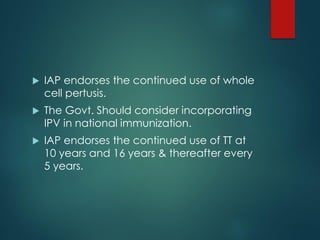
 IAP endorses the continued use of whole
cell pertusis.
 The Govt. Should consider incorporating
IPV in national immunization.
 IAP endorses the continued use of TT at
10 years and 16 years & thereafter every
5 years.
BIBLIOGRAPHY:-
 OP Ghai, Essential Pediatrics, CBS Publishers, 6th
edition(revised), pg no. 189-200.
 Whaley & Wong, Essentials of Paediatric Nursing,
Mosby Publication, 5th edition, pg no 1105-1112.
 Parul Datta, Paediatric Nursing, Jaypee Publication,
2nd edition, pg no 75-80.
 Manoj Yadav, Concise course in child health
nursing, PV publication, 2nd edition, pg no. 247-252.
 www.immunisation/hhp.
 www.coldchain/hhp
Immunization

Immunization

  • 1.
    IMMUNIZATION By Mr. Ravi RaiDangi Assistant Professor Fellowship in Neonatal Nursing MSc. Child Health Nursing
  • 2.
    DEFINITION:-  It isa process of artificially inducing immunity or providing protection from disease.  ACTIVE IMMUNISATION  PASSIVE IMMUNISATION
  • 3.
    IMMUNOGENIC & PROTECTIVE EFFICACY IMMUNOGENIC EFFICACY:- refers to its ability to induce an immune response.  PROTECTIVE EFFICACY:- refers to actual protection against diseases.  In case of live viral and toxoid vaccines, antibody response always result in protection  But that may not be true for killed vaccines.
  • 4.
    HISTORICAL ASPECTS :- Jenner developed the small pox vaccine in 1796.  Louis Pasteur developed the rabies prophylaxis in the year 1885.  Expanded programme of immunisation was started by WHO in 1974 and in India in 1978.  Universal immunisation programme in India started in 1985.  Child vaccine initiatives :-with support from various agencies- 1991.  Global programme on vaccines by WHO in 1993.
  • 5.
    ACHIEVEMENTS:-  Small poxeradicated in the year 1977.  EPI coverage of >80% was achieved by 1990.
  • 6.
    NATIONAL IMMUNISATION SCHEDULE:- TYPEOF ADMINISTRATION VACCINE BIRTH BCG , OPV, HEP B1 6 WEEKS BCG (If not given at birth), DPT-1, OPV-1, HEP B-2 10 WEEKS DPT-2, OPV-2, HEP- B 3 14 WEEKS DPT-3, OPV-3 9 MONTHS MEASLES 15-18 MONTHS DPT & OPV BOOSTER 5 YEARS DT 10 YEARS TT 16 YEARS TT PREGNANT WOMEN 2 TT AT 4 WEEKS INTERVAL
  • 7.
    IAP IMMUNISATION SCHEDULE:- AGEVACCINE BIRTH – 2 WEEKS BCG 6, 10, 14 WKS, 18 MON, 5 YRS DTaP1, DTaP2, DTaP3, DTaP B1,DTaP B2 0, 6, 10, 14 WKS, 18 MON, 5 YRS OPV, OPV1, OPV 2, OPV 3, OPV B1, OPV B2 0, 6, 10, 14 WKS/ 6, 10, 14 WKS HEP B1, HEP B2, HEP B3 6, 10, 14 WKS, 18 MON Hib1, Hib 2, Hib 3, Hib B 6, 10, 14 WKS, 18 MON PCV1, PCV2, PCV3, PCV B 6, 10 WKS Rotaviral vaccine 1, rotaviral 2 6, 10, 14 WKS, 18 MON IPV1, IPV2, IPV3, IPV B 6 MONTHS Seasonal influenza vaccine 9 MONTHS Measles >12 MONTHS HEP A
  • 8.
    CONTD.. AGE VACCINE 15 MONTHS,5 YEARS MMR1, MMR2 15 MONTHS VARICELLA 2 YEARS TYPHOID 10, 16 YEARS TT
  • 9.
    VACCINES:-  BCG VACCINATION:- It is a live attenuated strain of mycobacterium tuberculosis bovine strain.  Potency is maintained when freeze dried at 4 degree celsius.  BCG is a single dose, administered intradermally over left deltoid.  Dose- 0.1 ml  Contraindicated in immunodeficient babies.  Side effects:- axillary adenitis.
  • 10.
     DIPTHERIA VACCINE:- Immunity depends on antibody production against the exotoxin C. Diptheriae.  Natural immunity is acquired by apparent or in apparent infection.  The toxoid vaccine adsorbed with Aluminium hydroxide is usually combined with pertusis and TT.  Immunization done at 6, 10, 14 wks and booster at 18 & 5 years.  Dose – 0.5 ml, I/M  Contraindicated:- Pt’s with convulsion, severe reactions to first dose, progressive neurological disorders.  Side effects:- fever, local induration, pain
  • 11.
    PERTUSIS:-  Given withDPT.  Contains killed organism of B.pertusis.  3 doses at 6, 10, 14 weeks.  Protective efficacy is 75-80%.  Contraindicated :- progressive neurologic disease, prolonged cry, convulsions after first.  Side effects:- fever, local pain, swelling, irritability.  ACELLULAR PERTUSIS VACCINE:-
  • 12.
    CONT...  TETANUS VACCINE:- Neonatal tetanus is an important cause of mortality.  No natural immunity.  Tetanus toxin is very toxic.  Usually administered in combination with DP and DPT at 6,1o,14 wks and booster at 18 months and 5 years.  To protect against neonatal tetanus, TT is administered to the mother.
  • 13.
     POLIOMYELITIS VACCINES:- Inactivated polio virus developed by Salk.  Live attenuated developed by Sabin.  Supplied as trivalent antigen.  ORAL POLIO VACCINE( OPV):-  OPV is given mainly in 5 doses.  Potency – stable at 4- 8 degree Celsius.
  • 14.
     INACTIVATED POLIOVIRUSVACCINE:-  Cell culture grown, formalin inactivated and purified poliovirus suspension.  Primary immunisation, requires 3 doses at 6, 10, 14 weeks & booster at 18 months.  Given subcutaneously or intramuscularly.  Can be given to immunosuppressed patients.  Safe vaccines.
  • 15.
     HEPATITIS BVACCINE:-  Two types of vaccines are present.  Given at 0, 6, 14 weeks.  Preparation is in liquid forms.  Dose – 0.5 ml( < 10 years), 1 ml(> 10 years).  Contraindication – none  Side effects:- local pain, erythema.
  • 16.
     Measles vaccine:- Live attenuated vaccine.  Most popular are Schwartz, Edmonston- Zagreb.  Grown in cell cultures of human, canine or avian origin.  Its shelf life is at least one year at 4-8 degree Celsius. Given S/C or I/M.  Sometimes develop mild to moderate fever  Contraindicated in patients with immunosuppression.
  • 17.
     RUBELLA VACCINE:- To prevent congenital rubella.  Three attenuated virus are available, namely HPV 77, Cendehill and RA 77.  Given in combination with measles and mumps.  Immunization to be given in pre- pubertal stage.  Contra-indication- immunosuppression.  Adverse reaction – lymphadenopathy, arthralgia, skin rash.
  • 18.
     MUMPS VACCINE:- Live attenuated vaccine.  Combined with measles & rubella( MMR).  Given at 15 months.  Complication of mumps is orchitis and oophritis.  Efficacy is 75- 90%
  • 19.
     HAEMOPHILUS INFLUENZAEVACCINES:-  H. Influenzae type B, an important cause of meningitis & pneumonia.  Contains H. Influenza capsular oligosaccharide-b, liquid in nature.  Given at 6, 10, 14weeks & booster at 18 months.  Given I/M  Adverse effects:- none  Contraindication- those hypersensitive to vaccine component.
  • 20.
     ROTAVIRUS VACCINE:- Most common cause of diarrhoeal disease.  Main causative serotypes are G1- G4.  Vaccine given at 6 weeks then at 10 weeks.  Adverse effects- irritability, vomiting (rare).  Contraindications- none.
  • 21.
     Typhoid vaccine:- 3 types are present.  Vaccine available in liquid form.  Given as a single dose of 0.5 ml( I/M)  Given at 2 years of age  Protective efficacy is 70- 80%  Side effects- no severe side effects.
  • 22.
     PNEUMOCOCCAL VACCINES:- Strep. Pneuomoniae is one of the most important cause of respiratory infection.  Vaccine composed of 25 microgram of purified capsular polysaccharide antigen.  Available in lyophilised form.  Efficacy is 90%.  Given at 6, 10, 14 weeks and booster at18 months at anterior lateral thigh.  Contraindication:- none  Side effects- none
  • 23.
     HEPATITIS AVACCINE:-  Killed, inactivated vaccine.  Recommended for those who are at increased risk for infections.  Same preparations as IPV.  Available in liquid form, stored at 2- 8 degree Celsius.  Administered as I/M.  Dose -0.5ml  Contra-indications- none  Side effects- fever (rare)
  • 24.
     VARICELLA VACCINE:- Prepared from live attenuated Oka strain of varicella zoster virus.  Considered safe, immunogenic and cost- effective.  Acc to IAP schedule given at15 months.  Available in lyophilised forms.  Storage at -15 degree Celsius.  Dose – 0.5 ml.  Given – S/C on deltoid.  Protective efficacy- 95 -100%.
  • 25.
    Contd..  Contra- indications-none.  Side – effects- fever, mild varicella type disease might be observed within 1 week for which no treatment required.  Immunity with vaccine is for 10- 20 years.  Following a natural infection it is lifelong.
  • 26.
     COMBINATION VACCINE:- EASY 5 is an example ( consists of DPT/ Hib/ HEP –B)  BENEFITS:-  Reduced number of injections.  Reduced pain and parental anxiety.  High compliance, low dropout.  Reduced number of visits.  Less storage space.  Less burden on cold chain.
  • 27.
    VACCINATION SCHEDULE OFUNIMMUNISED CHILD TIME OF VISIT <5 YEARS > 5 YEARS FIRST VISIT BCG, OPV, DPT, HEP-B TT/ DT/ HEP-B SECOND VISIT OPV, DPT, HEP-B TT/ DT/ HEP-B THIRD VISIT OPV, DPT,MMR/Measles/Typ hoid MMR, Typhoid I YEAR LATER OPV, DPT, HEP-B HEP- B EVERY 3 YEARS TYPHOID BOOSTER TYPHOID BOOSTER
  • 28.
    COLD CHAIN  Refersto the process used to maintain optimal conditions during the transport, storage and handling of vaccines starting at the manufacturer & ending with administration to the client.
  • 29.
    Importance of coldchain:-  Vaccines are sensitive biological products.  With exposure to temperatures outside the recommended range leads to loss of potency.  Maintaining potency of vaccines is very important for various reasons.
  • 30.
    Placement of vaccinesin refrigerators  Put vaccines and diluents on the top and middle shelves of the main section  OPV and measles vaccine on the top shelf BCG, Pentavalent and TT vaccines on the middle shelves  Diluents next to the vaccines with which they were supplied  Arrange the boxes of vaccine in stacks between which the air can move.
  • 31.
    Maintaining cold boxesand vaccine carriers  Vaccine carriers and cold boxes must be well dried after their use. If they are left wet with their lids closed, they will become mouldy. Mould may affect the seal of the cold boxes and vaccine carriers. If possible, store cold boxes and vaccine carriers with the lid open, when not being used. VACCINE CARRIER COLD BOX
  • 32.
  • 33.
    VACCINE VIAL MONITOR:- A vaccine vial monitor (VVM) is a label containing a heat-sensitive material which is placed on a vaccine vial to register cumulative heat exposure
  • 35.
  • 36.
    EXPANDED PROGRAM ON IMMUNISATION Started in 1978.  Target population were under 5 and pregnant women.  Services available in PHCs & sub-centers.  Was found be low in evaluation.  Lead to formation of UIP.
  • 37.
    UNIVERSAL IMMUNISATION PROGRAM:- Started in 1985.  Target population:- infants, under 1 age.
  • 38.
    GUIDELINES SUGGESTED BYIAP  DPT vaccine should be administered at 5 years of age.  Another important vaccine that needs active consideration is Haemophilus influenza type B.  Administration of MMR vaccine is recommended at 15- 18 months.  Varicella and Hepatitis A are not recommended for routine use.  Hep A vaccine is indicated for HAV- IgG negative adolescents, patients with CLD.
  • 39.
     IAP endorsesthe continued use of whole cell pertusis.  The Govt. Should consider incorporating IPV in national immunization.  IAP endorses the continued use of TT at 10 years and 16 years & thereafter every 5 years.
  • 40.
    BIBLIOGRAPHY:-  OP Ghai,Essential Pediatrics, CBS Publishers, 6th edition(revised), pg no. 189-200.  Whaley & Wong, Essentials of Paediatric Nursing, Mosby Publication, 5th edition, pg no 1105-1112.  Parul Datta, Paediatric Nursing, Jaypee Publication, 2nd edition, pg no 75-80.  Manoj Yadav, Concise course in child health nursing, PV publication, 2nd edition, pg no. 247-252.  www.immunisation/hhp.  www.coldchain/hhp