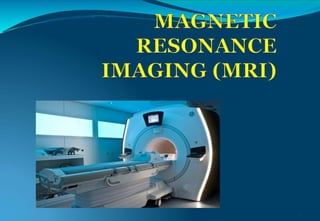
MRI uses powerful magnets and radio waves to generate detailed images of the inside of the body. It has several key components, including a superconducting magnet that provides a strong magnetic field, gradient coils that vary the field to provide positional information, and RF coils that transmit pulses to excite protons and receive their signals. To function properly, the superconducting magnet must be cooled to very low temperatures using liquid helium, and advanced cooling systems like laser cooling are being developed and researched. The computer system digitizes the received signals and applies transformations to construct images that can reveal soft tissue structures and abnormalities.