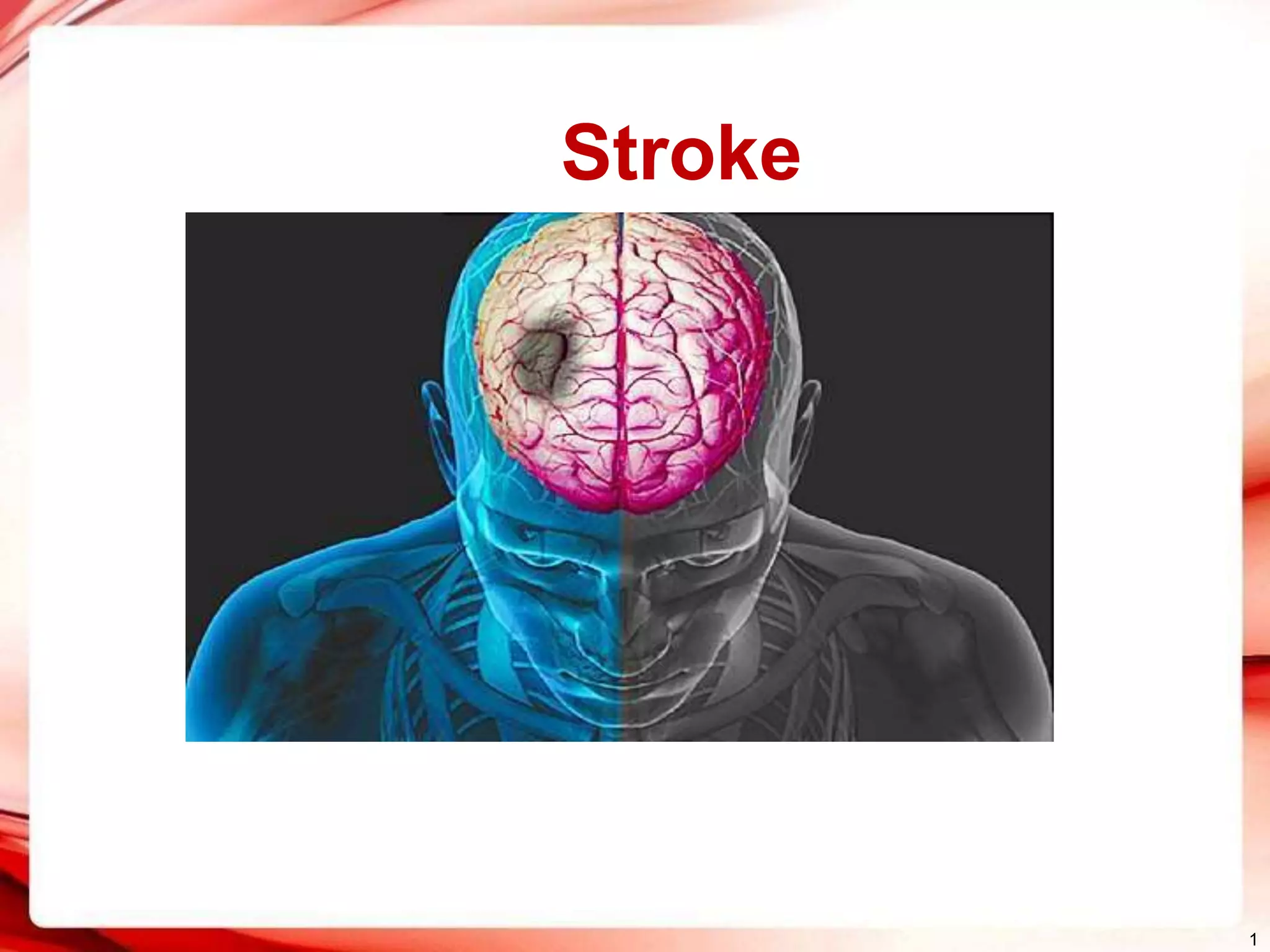
Stroke
1
5
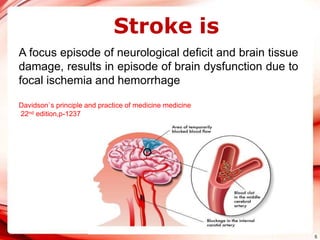
Stroke is
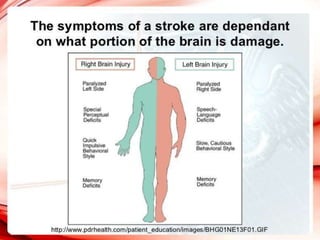
A focus episode of neurological deficit and brain tissue
damage, results in episode of brain dysfunction due to
focal ischemia and hemorrhage
Davidson`s principle and practice of medicine medicine
22nd edition,p-1237
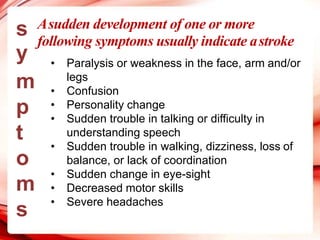
s Asudden development of one or more
y
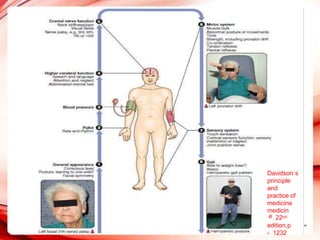
following symptoms usually indicate astroke
m
p
t
o
m
s
• Paralysis or weakness in the face, arm and/or
legs
• Confusion
• Personality change
• Sudden trouble in talking or difficulty in
understanding speech
• Sudden trouble in walking, dizziness, loss of
balance, or lack of coordination
• Sudden change in eye-sight
• Decreased motor skills
• Severe headaches
Davidson`s
principle
and
practice of
medicine
medicin
e 22nd
edition,p
- 1232
Risk factors of Stroke
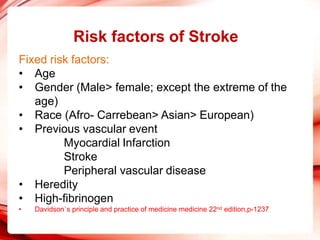
Fixed risk factors:
• Age
• Gender (Male> female; except the extreme of the
age)
• Race (Afro- Carrebean> Asian> European)
• Previous vascular event
Myocardial Infarction
Stroke
Peripheral vascular disease
• Heredity
• High-fibrinogen
• Davidson`s principle and practice of medicine medicine 22nd edition,p-1237
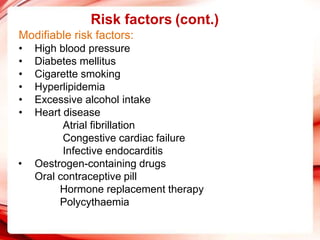
Risk factors (cont.)
Modifiable risk factors:
• High blood pressure
• Diabetes mellitus
• Cigarette smoking
• Hyperlipidemia
• Excessive alcohol intake
• Heart disease
Atrial fibrillation
Congestive cardiac failure
Infective endocarditis
• Oestrogen-containing drugs
Oral contraceptive pill
Hormone replacement therapy
Polycythaemia
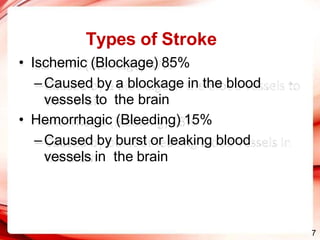
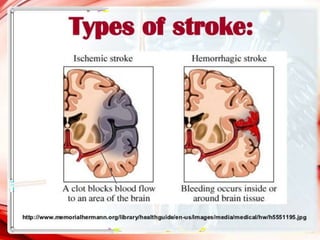
Types of Stroke
• Ischemic (Blockage) 85%
–Caused by a blockage in the blood
vessels to the brain
• Hemorrhagic (Bleeding) 15%
–Caused by burst or leaking blood
vessels in the brain
7
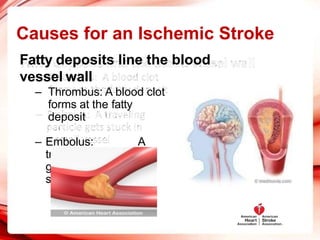
Causes for an Ischemic Stroke
Fatty deposits line the blood
vessel wall
– Thrombus: A blood clot
forms at the fatty
deposit
– Embolus: A
traveling particle
gets stuck in a
small vessel
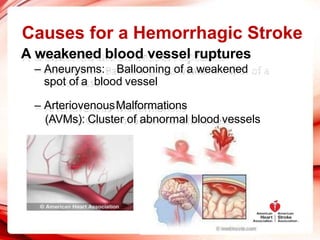
Causes for a Hemorrhagic Stroke
A weakened blood vessel ruptures
– Aneurysms: Ballooning of a weakened
spot of a blood vessel
– ArteriovenousMalformations
(AVMs): Cluster of abnormal blood vessels
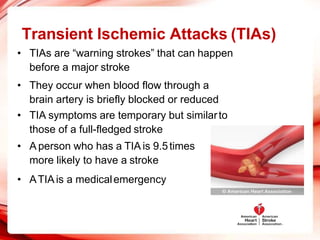
Transient Ischemic Attacks (TIAs)
• TIAs are “warning strokes” that can happen
before a major stroke
• They occur when blood flow through a
brain artery is briefly blocked or reduced
• TIA symptoms are temporary but similarto
those of a full-fledged stroke
• A person who has a TIA is 9.5times
more likely to have a stroke
• ATIAis a medicalemergency
Transient ischemic attack (TIA)
Sudden deficit due to cerebral ischemia
no stroke on imaging
most resolve in <1 h
Ddx: seizure, migraine, hypoglycemia, amyloid
spells, TGA, anxiety
Physical exam
General: murmurs, carotid & subclavian bruits,
peripheral emboli, endocarditis stigmata
Pathophysiology of stroke
Of the 180–300 patients per 100 000 population
presenting annually with a stroke, 85% sustain a
cerebral infarction due to inadequate blood flow to part
of the brain, and most of the remainder have an
intracerebral hemorrhage.
Davidson`s principle and practice of medicine medicine 22nd edition,p-1237
Pathophysiology (cont.)
Cerebral infarction:
• Caused by thromboembolic disease secondary
to atherosclerosis in the major extra cranial
arteries (carotid artery and aortic arch)
• Takes some hours to complete
Davidson`s principle and practice of medicine medicine 22nd edition,p-
1237
Pathophysiology (cont.)
Intracerebral Hemorrhage
• Intracerebral hemorrhage causes about 10% of
acute stroke events but is more common in low-
income countries
• Results from rupture of a blood vessel within the
brain parenchyma
• Hemorrhage frequently occurs into an area of brain
infarction
Davidson`s principle and practice of medicine medicine 22nd
edition,p-1237
Complication
• Chest infection
• Dehydration
• Hyponatremia
• Hypoxaemia
• Seizures
• Hypoglycaemia
• Deep venous
thrombosis
• Frozen shoulder
• Pressure sores
• UTI
• Constipation
• Depression and anxiety
Davidson`s principle and practice of medicine medicine 22nd edition,p-
1237-38
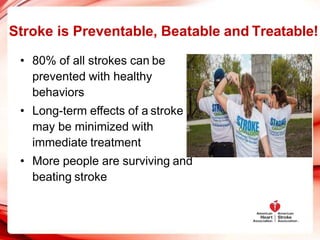
Stroke is Preventable, Beatable and Treatable!
• 80% of all strokes can be
prevented with healthy
behaviors
• Long-term effects of a stroke
may be minimized with
immediate treatment
• More people are surviving and
beating stroke
1
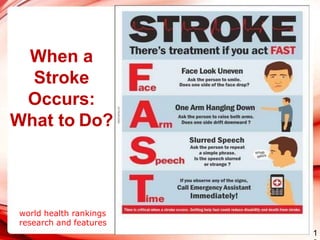
When a
Stroke
Occurs:
What to Do?
world health rankings
research and features
TREATMENT
• Stroke is always medical emergency
• 50% of the patient may need to treat in the hospital
• Treatment guidelines differs according to type of
stroke
Treatment of Ischemic stroke
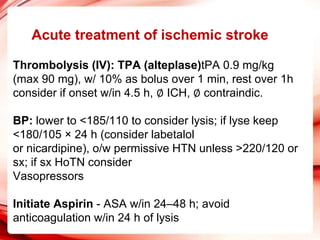
Acute treatment of ischemic stroke
Thrombolysis (IV): TPA (alteplase)tPA 0.9 mg/kg
(max 90 mg), w/ 10% as bolus over 1 min, rest over 1h
consider if onset w/in 4.5 h, ∅ ICH, ∅ contraindic.
BP: lower to <185/110 to consider lysis; if lyse keep
<180/105 × 24 h (consider labetalol
or nicardipine), o/w permissive HTN unless >220/120 or
sx; if sx HoTN consider
Vasopressors
Initiate Aspirin - ASA w/in 24–48 h; avoid
anticoagulation w/in 24 h of lysis
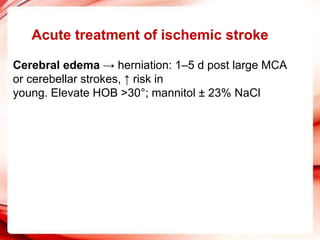
Acute treatment of ischemic stroke
Cerebral edema → herniation: 1–5 d post large MCA
or cerebellar strokes, ↑ risk in
young. Elevate HOB >30°; mannitol ± 23% NaCl
General treatment
 Care of nutrition-by ryles tube if needed
 Care of bladder by self retaining catheter
 Care of skin, limb by frequent posture change
 Care of mouth by frequent mouth wash
Symptomatic treatment
 Treatment of co-existing disease like hypertension,
diabetes mellitus, cardiac disease, renal disease
etc
 Intravenous fluid in all cases in normal saline if not
contraindicated
Treatment (cont.)
 If hypertension: drugs are preferred are ACE
inhibitors, ARB, Calcium- channel blocker, diuretics,
alpha-blockers, beta-blockers etc
 If diabetes in acute stage of stroke is always by
insulin, preferably by soluble insulin, target blood
sugar is 7-8 mmol (post prandial)
 For cardiac disease, it is better to consult with
appropriate physician and to avoid excess load on
heart side by side
Treatment of complication
 If any complications like- aspiration pneumonia,
UTI, bed sore, convulsion, headache, insomnia,
constipation; appropriate drugs should be applied
Specific treatment
 Antiplatelet, Aspirin 300mg stat and then 75-150mg
daily for life long. If aspirin is contraindicated then
clopidogrel 75mg daily for life long.
 Low molecular heparin or oral anticoagulation for
cardioembolic stroke
 Lipid lowering agent for dyslipidaemia
 Physiotherapy
Treatment of hemorrhagic
stroke
Treatment (cont.)
 Reverse coagulopathy, INR <1.4. Plt >100k, no need for plt
tx if on antiplt Rx. 2-3 mo after recovers, can restart antiplt
 Rx BP control w/, nicardipine or labetalol. BP goal <140 for
1st 24 h, then <160
 SAH: endovasc coiling vs. surg clipping (depends on
location, comorbid.of aneurysm/AVM; nimodipine to ↓ risk of
vasospasm
 Surg evac: EDH; SDH if >1 cm or rapid ↑; IPH
Treatment (cont.)
 General and symptomatic treatment are like
ischemic stroke
 The difference is in specific treatment
Specific treatment
 Antiplatelet and anticoagulant in any form is contraindicated
in hemorrhagic stroke
 Supportive treatment should be continued
 Surgical treatment is needed in some case of Intra-cranial
hemorrhage (ICH) and sub arachnoid hemorrhage (SAH)
 NSAIDs are contraindicated in headache
 Paracetamol and tramadol is used for headache in SAH
 In SAH oral Nimodipine 60mg 4/5 times daily for 2-3 weeks
are given to prevent vasospasm
Surgery in stroke
• Occasionally surgery has role in ischemic stoke.
E.g. in hemispheric stroke- craniotomy can be done
to decompress brain
• But in ICH if patient is gradually becoming
unconscious and if the hematoma size is >60ml; in
approachable area, surgery is done for life saving
purpose
• In case of SAH particularly aneurysmal bleeding-
clipping or coiling is done
Rehabilitation
The ultimate objective is to rehabilitate the patient. The
patient should be referred to the physical medicine
expert as a part of rehab as early as possible
Outcome
With appropriate treatment 30-40% patient is cured.
(e.g. they can go back to their original work), 30%
patient remains disabled, and 20% may die
1
Can I Prevent a Stroke?
Knowing the risk factors of the stroke is
the first step.
Now we can get start
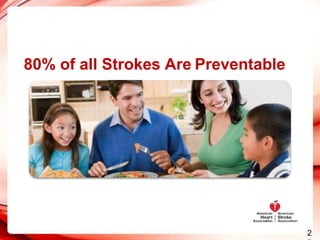
80% of all Strokes Are Preventable
2
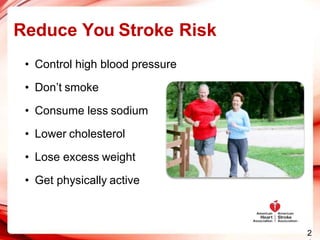
Reduce You Stroke Risk
• Control high blood pressure
• Don’t smoke
• Consume less sodium
• Lower cholesterol
• Lose excess weight
• Get physically active
2
Stop Smoking
• Smoking accelerates the forming of clots, thickens
blood, and increases plaque buildup in the arteries. If
you smoke, stop!
• Ask your doctor about nicotine patches, counseling,
or programs that have worked for others.
• Don’t get discouraged – It could take several
attempts.
• Keep trying – Quitting smoking can have almost
immediate beneficial effects on your health.
Get to Your Healthy Weight
• Carrying extra weight can make you more apt to
develop high blood pressure, heart problems, and
diabetes – all increasing your risk of stroke
• Talk to your doctor about your ideal weight, body
mass index, and percentage of body fat to make
sure you’re in a healthy range.
• Losing just 10 pounds can improve your health and
reduce your risk of stroke
Be Active
• Physical activity can help you lose weight and
reduce stress which can lower blood pressure and
cholesterol, control diabetes, and improve your
overall health
• Talk to your doctor about starting an exercise
program
• Try to be active for 30 minutes every day
• If you can’t do it all at once, try to be active for 10 to
15 minutes at a time
Watch What You Eat
• This is about nutrition – not dieting. The food
choices you make can improve your health and
reduce your risk of stroke
• Eat plenty of fruits and vegetables, which are high
in fiber
• Limit salt to help lower your blood pressure.
• Eat less cholesterol and fat which can create
plaque buildup in your arteries
2

Stroke CVa.pptx

  • 1.
  • 2.
    5 Stroke is A focusepisode of neurological deficit and brain tissue damage, results in episode of brain dysfunction due to focal ischemia and hemorrhage Davidson`s principle and practice of medicine medicine 22nd edition,p-1237
  • 3.
    s Asudden developmentof one or more y following symptoms usually indicate astroke m p t o m s • Paralysis or weakness in the face, arm and/or legs • Confusion • Personality change • Sudden trouble in talking or difficulty in understanding speech • Sudden trouble in walking, dizziness, loss of balance, or lack of coordination • Sudden change in eye-sight • Decreased motor skills • Severe headaches
  • 5.
  • 6.
    Risk factors ofStroke Fixed risk factors: • Age • Gender (Male> female; except the extreme of the age) • Race (Afro- Carrebean> Asian> European) • Previous vascular event Myocardial Infarction Stroke Peripheral vascular disease • Heredity • High-fibrinogen • Davidson`s principle and practice of medicine medicine 22nd edition,p-1237
  • 7.
    Risk factors (cont.) Modifiablerisk factors: • High blood pressure • Diabetes mellitus • Cigarette smoking • Hyperlipidemia • Excessive alcohol intake • Heart disease Atrial fibrillation Congestive cardiac failure Infective endocarditis • Oestrogen-containing drugs Oral contraceptive pill Hormone replacement therapy Polycythaemia
  • 8.
    Types of Stroke •Ischemic (Blockage) 85% –Caused by a blockage in the blood vessels to the brain • Hemorrhagic (Bleeding) 15% –Caused by burst or leaking blood vessels in the brain 7
  • 10.
    Causes for anIschemic Stroke Fatty deposits line the blood vessel wall – Thrombus: A blood clot forms at the fatty deposit – Embolus: A traveling particle gets stuck in a small vessel
  • 11.
    Causes for aHemorrhagic Stroke A weakened blood vessel ruptures – Aneurysms: Ballooning of a weakened spot of a blood vessel – ArteriovenousMalformations (AVMs): Cluster of abnormal blood vessels
  • 12.
    Transient Ischemic Attacks(TIAs) • TIAs are “warning strokes” that can happen before a major stroke • They occur when blood flow through a brain artery is briefly blocked or reduced • TIA symptoms are temporary but similarto those of a full-fledged stroke • A person who has a TIA is 9.5times more likely to have a stroke • ATIAis a medicalemergency
  • 13.
    Transient ischemic attack(TIA) Sudden deficit due to cerebral ischemia no stroke on imaging most resolve in <1 h Ddx: seizure, migraine, hypoglycemia, amyloid spells, TGA, anxiety Physical exam General: murmurs, carotid & subclavian bruits, peripheral emboli, endocarditis stigmata
  • 14.
    Pathophysiology of stroke Ofthe 180–300 patients per 100 000 population presenting annually with a stroke, 85% sustain a cerebral infarction due to inadequate blood flow to part of the brain, and most of the remainder have an intracerebral hemorrhage. Davidson`s principle and practice of medicine medicine 22nd edition,p-1237
  • 15.
    Pathophysiology (cont.) Cerebral infarction: •Caused by thromboembolic disease secondary to atherosclerosis in the major extra cranial arteries (carotid artery and aortic arch) • Takes some hours to complete Davidson`s principle and practice of medicine medicine 22nd edition,p- 1237
  • 16.
    Pathophysiology (cont.) Intracerebral Hemorrhage •Intracerebral hemorrhage causes about 10% of acute stroke events but is more common in low- income countries • Results from rupture of a blood vessel within the brain parenchyma • Hemorrhage frequently occurs into an area of brain infarction Davidson`s principle and practice of medicine medicine 22nd edition,p-1237
  • 17.
    Complication • Chest infection •Dehydration • Hyponatremia • Hypoxaemia • Seizures • Hypoglycaemia • Deep venous thrombosis • Frozen shoulder • Pressure sores • UTI • Constipation • Depression and anxiety Davidson`s principle and practice of medicine medicine 22nd edition,p- 1237-38
  • 18.
    Stroke is Preventable,Beatable and Treatable! • 80% of all strokes can be prevented with healthy behaviors • Long-term effects of a stroke may be minimized with immediate treatment • More people are surviving and beating stroke
  • 19.
    1 When a Stroke Occurs: What toDo? world health rankings research and features
  • 20.
    TREATMENT • Stroke isalways medical emergency • 50% of the patient may need to treat in the hospital • Treatment guidelines differs according to type of stroke
  • 21.
  • 22.
    Acute treatment ofischemic stroke Thrombolysis (IV): TPA (alteplase)tPA 0.9 mg/kg (max 90 mg), w/ 10% as bolus over 1 min, rest over 1h consider if onset w/in 4.5 h, ∅ ICH, ∅ contraindic. BP: lower to <185/110 to consider lysis; if lyse keep <180/105 × 24 h (consider labetalol or nicardipine), o/w permissive HTN unless >220/120 or sx; if sx HoTN consider Vasopressors Initiate Aspirin - ASA w/in 24–48 h; avoid anticoagulation w/in 24 h of lysis
  • 23.
    Acute treatment ofischemic stroke Cerebral edema → herniation: 1–5 d post large MCA or cerebellar strokes, ↑ risk in young. Elevate HOB >30°; mannitol ± 23% NaCl
  • 24.
    General treatment  Careof nutrition-by ryles tube if needed  Care of bladder by self retaining catheter  Care of skin, limb by frequent posture change  Care of mouth by frequent mouth wash
  • 25.
    Symptomatic treatment  Treatmentof co-existing disease like hypertension, diabetes mellitus, cardiac disease, renal disease etc  Intravenous fluid in all cases in normal saline if not contraindicated
  • 26.
    Treatment (cont.)  Ifhypertension: drugs are preferred are ACE inhibitors, ARB, Calcium- channel blocker, diuretics, alpha-blockers, beta-blockers etc  If diabetes in acute stage of stroke is always by insulin, preferably by soluble insulin, target blood sugar is 7-8 mmol (post prandial)  For cardiac disease, it is better to consult with appropriate physician and to avoid excess load on heart side by side
  • 27.
    Treatment of complication If any complications like- aspiration pneumonia, UTI, bed sore, convulsion, headache, insomnia, constipation; appropriate drugs should be applied
  • 28.
    Specific treatment  Antiplatelet,Aspirin 300mg stat and then 75-150mg daily for life long. If aspirin is contraindicated then clopidogrel 75mg daily for life long.  Low molecular heparin or oral anticoagulation for cardioembolic stroke  Lipid lowering agent for dyslipidaemia  Physiotherapy
  • 29.
  • 30.
    Treatment (cont.)  Reversecoagulopathy, INR <1.4. Plt >100k, no need for plt tx if on antiplt Rx. 2-3 mo after recovers, can restart antiplt  Rx BP control w/, nicardipine or labetalol. BP goal <140 for 1st 24 h, then <160  SAH: endovasc coiling vs. surg clipping (depends on location, comorbid.of aneurysm/AVM; nimodipine to ↓ risk of vasospasm  Surg evac: EDH; SDH if >1 cm or rapid ↑; IPH
  • 31.
    Treatment (cont.)  Generaland symptomatic treatment are like ischemic stroke  The difference is in specific treatment
  • 32.
    Specific treatment  Antiplateletand anticoagulant in any form is contraindicated in hemorrhagic stroke  Supportive treatment should be continued  Surgical treatment is needed in some case of Intra-cranial hemorrhage (ICH) and sub arachnoid hemorrhage (SAH)  NSAIDs are contraindicated in headache  Paracetamol and tramadol is used for headache in SAH  In SAH oral Nimodipine 60mg 4/5 times daily for 2-3 weeks are given to prevent vasospasm
  • 33.
    Surgery in stroke •Occasionally surgery has role in ischemic stoke. E.g. in hemispheric stroke- craniotomy can be done to decompress brain • But in ICH if patient is gradually becoming unconscious and if the hematoma size is >60ml; in approachable area, surgery is done for life saving purpose • In case of SAH particularly aneurysmal bleeding- clipping or coiling is done
  • 34.
    Rehabilitation The ultimate objectiveis to rehabilitate the patient. The patient should be referred to the physical medicine expert as a part of rehab as early as possible
  • 35.
    Outcome With appropriate treatment30-40% patient is cured. (e.g. they can go back to their original work), 30% patient remains disabled, and 20% may die
  • 36.
    1 Can I Preventa Stroke?
  • 37.
    Knowing the riskfactors of the stroke is the first step. Now we can get start
  • 38.
    80% of allStrokes Are Preventable 2
  • 39.
    Reduce You StrokeRisk • Control high blood pressure • Don’t smoke • Consume less sodium • Lower cholesterol • Lose excess weight • Get physically active 2
  • 40.
    Stop Smoking • Smokingaccelerates the forming of clots, thickens blood, and increases plaque buildup in the arteries. If you smoke, stop! • Ask your doctor about nicotine patches, counseling, or programs that have worked for others. • Don’t get discouraged – It could take several attempts. • Keep trying – Quitting smoking can have almost immediate beneficial effects on your health.
  • 41.
    Get to YourHealthy Weight • Carrying extra weight can make you more apt to develop high blood pressure, heart problems, and diabetes – all increasing your risk of stroke • Talk to your doctor about your ideal weight, body mass index, and percentage of body fat to make sure you’re in a healthy range. • Losing just 10 pounds can improve your health and reduce your risk of stroke
  • 42.
    Be Active • Physicalactivity can help you lose weight and reduce stress which can lower blood pressure and cholesterol, control diabetes, and improve your overall health • Talk to your doctor about starting an exercise program • Try to be active for 30 minutes every day • If you can’t do it all at once, try to be active for 10 to 15 minutes at a time
  • 43.
    Watch What YouEat • This is about nutrition – not dieting. The food choices you make can improve your health and reduce your risk of stroke • Eat plenty of fruits and vegetables, which are high in fiber • Limit salt to help lower your blood pressure. • Eat less cholesterol and fat which can create plaque buildup in your arteries
  • 44.