 Pain Management
 Skin Disorders and Their Management
 Psychological Consequences of Amputation
 Amputation is just the beginning and not the end of a
treatment! The amputation surgeon and prosthetist have
joined together to become the lifelong advisors to the
amputee who will wear an artificial limb for the rest of
his life.
 A dermatologist is capable of rendering valuable aid to
not only the amputee but also other members of the
rehabilitation team, for he is familiar with the problems
of the skin that can result from the wearing of an
artificial limb.
 Post-amputation Limb pain is often the result of
surgical trauma, wound healing complications, tissue
loading effects, local scarring, and central neuropathic
phenomenon. Limb pain may be categorized as
immediate post-operative pain, extrinsic residual limb
pain, intrinsic residual limb pain, and phantom limb
pain. Unfortunately, most authors have not
discriminated carefully between residual limb pain
and phantom limb pain which makes the literature
confusing as to the incidence and prevalence of each
of these postamputation pain problems.
 Immediate postoperative pain is almost always present
following amputation and is the direct result of the
surgical trauma to bone, nerve, and soft tissue.
 Postoperative pain can be expected to resolve within
three weeks or less, as with pain following any major
surgical procedure
 This pain is often described as sharp, is localized to the
surgical site, is usually self limiting, and resolves as the
edema decreases and the surgical wound heals.
 Management
› In the immediate postoperative period the primary method
of pain control is medication utilizing intravenous or
epidural delivery of pain medication via patient controlled
analgesia.
› The patient is commonly transitioned to oral analgesic
medication by post-operative day 3 or 4.
› The adjunctive measures for edema include elastic wraps,
elastic stump socks, semi-rigid dressings, and rigid plaster
casts.
 Extrinsic residual limb pain is usually mechanical in
origin related to the prosthetic socket or other prosthetic
components.
 Intrinsic residual limb pain is often due to
› underlying disease process
› surgical trauma
› bone abnormality
› local scar
› neuroma
› central neuropathic phenomenon.
 Residual limb pain may result from infection,
ischemia, tumor recurrence, joint dysfunction, or
stress fractures.
› The pain is often described as generalized and
usually requires medical or surgical intervention.
 Intrinsic residual limb pain resulting from surgical
trauma may be due to poor surgical technique such that
the bone is improperly trimmed, wound dehiscence, as
well as ischemia resulting in inadequate closure due to
poor vascularization of the muscles and skin.
 Bony overgrowth at the distal end of the residual limb
most often occurs in children and only occasionally in
adults. This bony overgrowth often results in a bone
spicule.
 Management
› The pain is often managed by socket modifications to offload
pressure over painful areas. When prosthetic modification is not
satisfactory surgical intervention is usually required.
 Entrapment of nerves in scar tissue occurs
within the surgical incision at all levels.
 This pain is usually exacerbated with shear
force or pressure directly to the healed scar
tissue.
 Treatment
› Initial treatment usually includes prosthetic
modifications to reduce loading of pressure sensitive
areas through a better distributed load or reduced
shear force on adjacent tissues.
› Treatment may also include injections as well as
medication intervention. Surgical intervention rarely
provides adequate relief for intrinsic residual limb
pain secondary to scar formation.
 Neuromas at the surgical site are the most common
etiology of intrinsic residual limb pain.
 Neuromas result of the normal nerve re-growth during
the healing process.
 Treatment
› Medical intervention for limb pain resulting from neuromas have
utilized nonsteroidal anti-inflammatory drugs, tricyclic anti-
depressants, and anti-convulsants with limited success.
 Residual limb pain may also be the manifestation of
autonomic nervous system abnormalities involving the
sympathetic post-ganglion neurons after peripheral
nerve injury.
 This manifestation is classified as Complex Regional
Pain Syndrome (CRPS).
 The phantom limb is the perceived presence of the
amputated body part.
 Phantom limb experience was first referenced by
d'Ambroise Pare, a 16th century military surgeon for
Napoleon, in 1551.
 Silas Weir Mitchell, a Civil War surgeon, was the first to
use the term phantom limb pain in a scientific report in
1871.
 In working with numerous amputees over the years,
specific information regarding the various clinical
problems has been assembled and correlated in an
effort to benefit the individual amputee.
 Stump and socket hygiene is important in relation to
several clinical disorders of the skin, and accordingly, a
specific hygienic program for care of the stump and
socket has been developed.
 Poor hygiene may be an important factor in producing some
pathologic conditions of the stump skin. If a routine cleansing
program is not employed, bacterial and fungal infections, and
persistence of infected cysts can eventuate.
 Amputees should be advised in a program and asked to purchase
a plastic squeeze container of a liquid detergent containing
chlorhexidine gluconate, triclosan, or hexachlorophene. These are
relatively inexpensive and available in drugstores throughout the
world with and without a prescription.
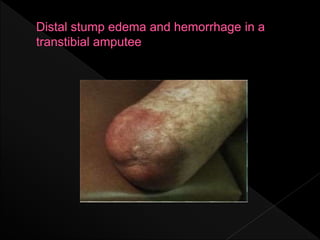
 A transtibial amputee wearing a total-contact socket
must adapt to the heat, rub, and perspiration generated
within the socket. The amputee can expect mild edema
and a reactive hyperemia or redness when first
becoming accustomed to the prosthesis.
 These changes are the inevitable result of the altered
conditions that are now forced on the skin and
subcutaneous tissues of the stump.
 An amputee can have an acute or chronic skin
inflammatory reaction caused by contact with an irritant
or allergenic substance.
 The irritant form of contact dermatitis is the most
common and can result from contact of the skin with
strong chemicals or other known irritants.
 Nonspecific eczematization of the stump has been seen
in a variety of instances as an acute or chronic
persistent, weeping, itching area of dermatitis over the
distal portion of the stump.
 A number of authors have described the appearance of
multiple cysts, frequently called post-traumatic
epidermoid cysts, in the skin of amputees' stumps in
association with the wearing of an artificial limb.
 Bacterial folliculitis and furuncles or boils are often
encountered in amputees with hairy, oily skin, with the
condition aggravated by sweating and rub from the
socket wall.
 It is usually worse in the late spring and summer when
increased warmth and moisture from perspiration
promote maceration of the skin within the socket, which
in turn favors invasion of the hair follicle by bacteria.
 An irritated cutaneous papilloma can be snipped off and
the base cauterized.
 Chronic ulcers of the stump may result from bacterial
infection or from poor cutaneous nutrition secondary to
edema or to an underlying vascular disorder. In some
instances localized pressure from a poorly fitting
prosthesis can produce erosion followed by ulceration.
 Amputation surgeons, prosthetists, and engineers are applied
scientists from whom great technical assistance is expected.
Through their efforts, we have made great strides in our knowledge
and technical ability to produce the finest of prostheses, but their
skills must be combined with the contributions of the dermatologist
in the solution of the many skin problems of the amputee.
 Loss of a limb can have a considerable psychological
impact. Many people who have had an amputation
report feeling emotions such as grief and bereavement,
similar to experiencing the death of a loved one.
 Coming to terms with the psychological impact of an
amputation is therefore often as important as coping
with the physical demands.
 depression
 anxiety
 denial (refusing to accept they need to make changes,
such as having physiotherapy, to adapt to life with an
amputation)
 grief (a profound sense of loss and bereavement)
 feeling suicidal
 Talk to your care team about your thoughts and feelings,
especially if you are feeling depressed or suicidal. You
may require additional treatment, such
as antidepressants or counselling, to improve your
ability to cope with living with an amputation.
 People who have had an amputation due to trauma
(especially members of the armed forces injured while
serving in Iraq or Afghanistan) have an increased risk of
developing Post-Traumatic Stress Disorder (PTSD).
 PTSD is when a person experiences a number of
unpleasant symptoms after a traumatic event, such as
‘reliving’ the event and feeling anxious all the time.
Complications After Amputation.pptx

Complications After Amputation.pptx

  • 2.
     Pain Management Skin Disorders and Their Management  Psychological Consequences of Amputation
  • 3.
     Amputation isjust the beginning and not the end of a treatment! The amputation surgeon and prosthetist have joined together to become the lifelong advisors to the amputee who will wear an artificial limb for the rest of his life.  A dermatologist is capable of rendering valuable aid to not only the amputee but also other members of the rehabilitation team, for he is familiar with the problems of the skin that can result from the wearing of an artificial limb.
  • 5.
     Post-amputation Limbpain is often the result of surgical trauma, wound healing complications, tissue loading effects, local scarring, and central neuropathic phenomenon. Limb pain may be categorized as immediate post-operative pain, extrinsic residual limb pain, intrinsic residual limb pain, and phantom limb pain. Unfortunately, most authors have not discriminated carefully between residual limb pain and phantom limb pain which makes the literature confusing as to the incidence and prevalence of each of these postamputation pain problems.
  • 6.
     Immediate postoperativepain is almost always present following amputation and is the direct result of the surgical trauma to bone, nerve, and soft tissue.  Postoperative pain can be expected to resolve within three weeks or less, as with pain following any major surgical procedure  This pain is often described as sharp, is localized to the surgical site, is usually self limiting, and resolves as the edema decreases and the surgical wound heals.
  • 7.
     Management › Inthe immediate postoperative period the primary method of pain control is medication utilizing intravenous or epidural delivery of pain medication via patient controlled analgesia. › The patient is commonly transitioned to oral analgesic medication by post-operative day 3 or 4. › The adjunctive measures for edema include elastic wraps, elastic stump socks, semi-rigid dressings, and rigid plaster casts.
  • 8.
     Extrinsic residuallimb pain is usually mechanical in origin related to the prosthetic socket or other prosthetic components.
  • 9.
     Intrinsic residuallimb pain is often due to › underlying disease process › surgical trauma › bone abnormality › local scar › neuroma › central neuropathic phenomenon.
  • 10.
     Residual limbpain may result from infection, ischemia, tumor recurrence, joint dysfunction, or stress fractures. › The pain is often described as generalized and usually requires medical or surgical intervention.
  • 11.
     Intrinsic residuallimb pain resulting from surgical trauma may be due to poor surgical technique such that the bone is improperly trimmed, wound dehiscence, as well as ischemia resulting in inadequate closure due to poor vascularization of the muscles and skin.
  • 12.
     Bony overgrowthat the distal end of the residual limb most often occurs in children and only occasionally in adults. This bony overgrowth often results in a bone spicule.  Management › The pain is often managed by socket modifications to offload pressure over painful areas. When prosthetic modification is not satisfactory surgical intervention is usually required.
  • 13.
     Entrapment ofnerves in scar tissue occurs within the surgical incision at all levels.  This pain is usually exacerbated with shear force or pressure directly to the healed scar tissue.  Treatment › Initial treatment usually includes prosthetic modifications to reduce loading of pressure sensitive areas through a better distributed load or reduced shear force on adjacent tissues. › Treatment may also include injections as well as medication intervention. Surgical intervention rarely provides adequate relief for intrinsic residual limb pain secondary to scar formation.
  • 14.
     Neuromas atthe surgical site are the most common etiology of intrinsic residual limb pain.  Neuromas result of the normal nerve re-growth during the healing process.  Treatment › Medical intervention for limb pain resulting from neuromas have utilized nonsteroidal anti-inflammatory drugs, tricyclic anti- depressants, and anti-convulsants with limited success.
  • 15.
     Residual limbpain may also be the manifestation of autonomic nervous system abnormalities involving the sympathetic post-ganglion neurons after peripheral nerve injury.  This manifestation is classified as Complex Regional Pain Syndrome (CRPS).
  • 16.
     The phantomlimb is the perceived presence of the amputated body part.  Phantom limb experience was first referenced by d'Ambroise Pare, a 16th century military surgeon for Napoleon, in 1551.  Silas Weir Mitchell, a Civil War surgeon, was the first to use the term phantom limb pain in a scientific report in 1871.
  • 18.
     In workingwith numerous amputees over the years, specific information regarding the various clinical problems has been assembled and correlated in an effort to benefit the individual amputee.  Stump and socket hygiene is important in relation to several clinical disorders of the skin, and accordingly, a specific hygienic program for care of the stump and socket has been developed.
  • 19.
     Poor hygienemay be an important factor in producing some pathologic conditions of the stump skin. If a routine cleansing program is not employed, bacterial and fungal infections, and persistence of infected cysts can eventuate.  Amputees should be advised in a program and asked to purchase a plastic squeeze container of a liquid detergent containing chlorhexidine gluconate, triclosan, or hexachlorophene. These are relatively inexpensive and available in drugstores throughout the world with and without a prescription.
  • 20.
     A transtibialamputee wearing a total-contact socket must adapt to the heat, rub, and perspiration generated within the socket. The amputee can expect mild edema and a reactive hyperemia or redness when first becoming accustomed to the prosthesis.  These changes are the inevitable result of the altered conditions that are now forced on the skin and subcutaneous tissues of the stump.
  • 24.
     An amputeecan have an acute or chronic skin inflammatory reaction caused by contact with an irritant or allergenic substance.  The irritant form of contact dermatitis is the most common and can result from contact of the skin with strong chemicals or other known irritants.
  • 26.
     Nonspecific eczematizationof the stump has been seen in a variety of instances as an acute or chronic persistent, weeping, itching area of dermatitis over the distal portion of the stump.
  • 27.
     A numberof authors have described the appearance of multiple cysts, frequently called post-traumatic epidermoid cysts, in the skin of amputees' stumps in association with the wearing of an artificial limb.
  • 29.
     Bacterial folliculitisand furuncles or boils are often encountered in amputees with hairy, oily skin, with the condition aggravated by sweating and rub from the socket wall.  It is usually worse in the late spring and summer when increased warmth and moisture from perspiration promote maceration of the skin within the socket, which in turn favors invasion of the hair follicle by bacteria.
  • 34.
     An irritatedcutaneous papilloma can be snipped off and the base cauterized.
  • 35.
     Chronic ulcersof the stump may result from bacterial infection or from poor cutaneous nutrition secondary to edema or to an underlying vascular disorder. In some instances localized pressure from a poorly fitting prosthesis can produce erosion followed by ulceration.
  • 36.
     Amputation surgeons,prosthetists, and engineers are applied scientists from whom great technical assistance is expected. Through their efforts, we have made great strides in our knowledge and technical ability to produce the finest of prostheses, but their skills must be combined with the contributions of the dermatologist in the solution of the many skin problems of the amputee.
  • 38.
     Loss ofa limb can have a considerable psychological impact. Many people who have had an amputation report feeling emotions such as grief and bereavement, similar to experiencing the death of a loved one.  Coming to terms with the psychological impact of an amputation is therefore often as important as coping with the physical demands.
  • 39.
     depression  anxiety denial (refusing to accept they need to make changes, such as having physiotherapy, to adapt to life with an amputation)  grief (a profound sense of loss and bereavement)  feeling suicidal
  • 40.
     Talk toyour care team about your thoughts and feelings, especially if you are feeling depressed or suicidal. You may require additional treatment, such as antidepressants or counselling, to improve your ability to cope with living with an amputation.
  • 41.
     People whohave had an amputation due to trauma (especially members of the armed forces injured while serving in Iraq or Afghanistan) have an increased risk of developing Post-Traumatic Stress Disorder (PTSD).  PTSD is when a person experiences a number of unpleasant symptoms after a traumatic event, such as ‘reliving’ the event and feeling anxious all the time.