Growth and
development- toddler
By
T.Janaki,
M.Sc(N) I year
Child health nursing
Toddler
Toddler is of the developmental age
group from 1 year to 3 years of age.
Biologic growth:
1. weight :
Average weight gain is 1.8 – 2.7 kg / year
Birth weight quadriples at 21/2 years
2. Height
height increases about 10 to 12.5cm/ year
 at 2yrs ht is about 85 cm
 Arms and legs grow at a faster rate than head and
trunk
 Lumbar lordosis of spine is less evident
 Legs have a bowing appearance ( tibial torsion )
 Ratio of upper segment : lower segment= 1.7 : 1
Head circumference
 The rate of increase in head circumference slows
 HC is equal to CC by 1 to 2 yrs
 The rate of increase slows until at age 5 yrs
 At 2 yrs HC IS 49 TO 50 cm
• The anterior fontanel closes between 1 and 11/2 yrs of
age
Chest circumference
• Continues to increase in size and exceeds head
circumference during the toddler year. AP diameter is
less than lateral diameter.
• Midarm circumference: 13 – 16 cm.
DENTITION
• Central incisors - 6 to 8 months
• Lateral incisors - 8 to 11 months
• Canines-16 to 20 months
• First molars-10 to 16 months
• Second molars-20 to 30 months
Physiologic parameters
Temperature : 97.8 – 98.4 ° f
Pulse : 1-2 years – 110 -130/ mt
3 years - 100-120/mt
Respiration : 24-40/mt
Blood pressure : systolic: 91 – 93 mmhg
diastolic: 56 mmhg
Maturation of system
The physiologic functioning of the body is mature by the
end of the toddler period with the exception of the
endocrine and reproductive system.
• INTEGUMENTARY SYSTEM
• The resistance of the skin to infection and its ability to
prevent fluid loss is increased as the epidermis and the
dermis become more tightly connected to each other.
• Sebum production is inadequate.
• CARDIOVASCULAR SYSTEM
• Pulse rate is 110/mt
• Blood pressure is 99/64mmhg
• The heart and blood vessels increase in size.
• The need for Hb is greater than during infancy, a slightly
higher RBC count is necessary.
RESPIRATORY SYSTEM
The structure increase in size, with increase in thoracic
volume.
Thus leading to decrease in respiratory rate 26/mt
Because of short straight eustachian tube through
infection easily reach the ears from the nasopharynx.
Respirations are still abdominal
Genitourinary system:
By 2 years, toddler is able to conserve water &
concentrate urine.
Myelination of nerves to urethral sphincter & increased
ability of bladder to control urine helps in controlling
elimination.
GASTROINTESTINAL SYSTEM
The salivary gland reaches functional maturity
by the end of second yr
The capacity of stomach increases
HCL secretion in stomach increases,providing
protection against various types of organism
IMMUNE SYSTEM
Because passive immunity from the mother
decreases during infancy, immunization is
essential
The production of IgM,reaches adult levels
during later part of first yr of life
NERVOUS SYSTEM
The number of brain cells is complete by the
beginning of toddler period .
They continue to grow until the brain has reached
2/3rd
of its adult size at 2yrs and 3/4th
of adult size
by 3yrs of age.
As the child matures, specific areas of brain
develop, such as brocas area for speech.
Other areas of the cerebral cortex develops as the
child achieves motor control of the extremities
and sphincters.
Myelination of the spinal cord is achieved
gradualy as toddlers show increasing
ability to exert control over posture and
coordinated movements
As a result , the child is able to stand alone before
being able to walk, and to walk before running and
jumping
After 2yrs , myelination slows down to reach
completion during puberty.
Motor development
GROSS MOTOR SKILL
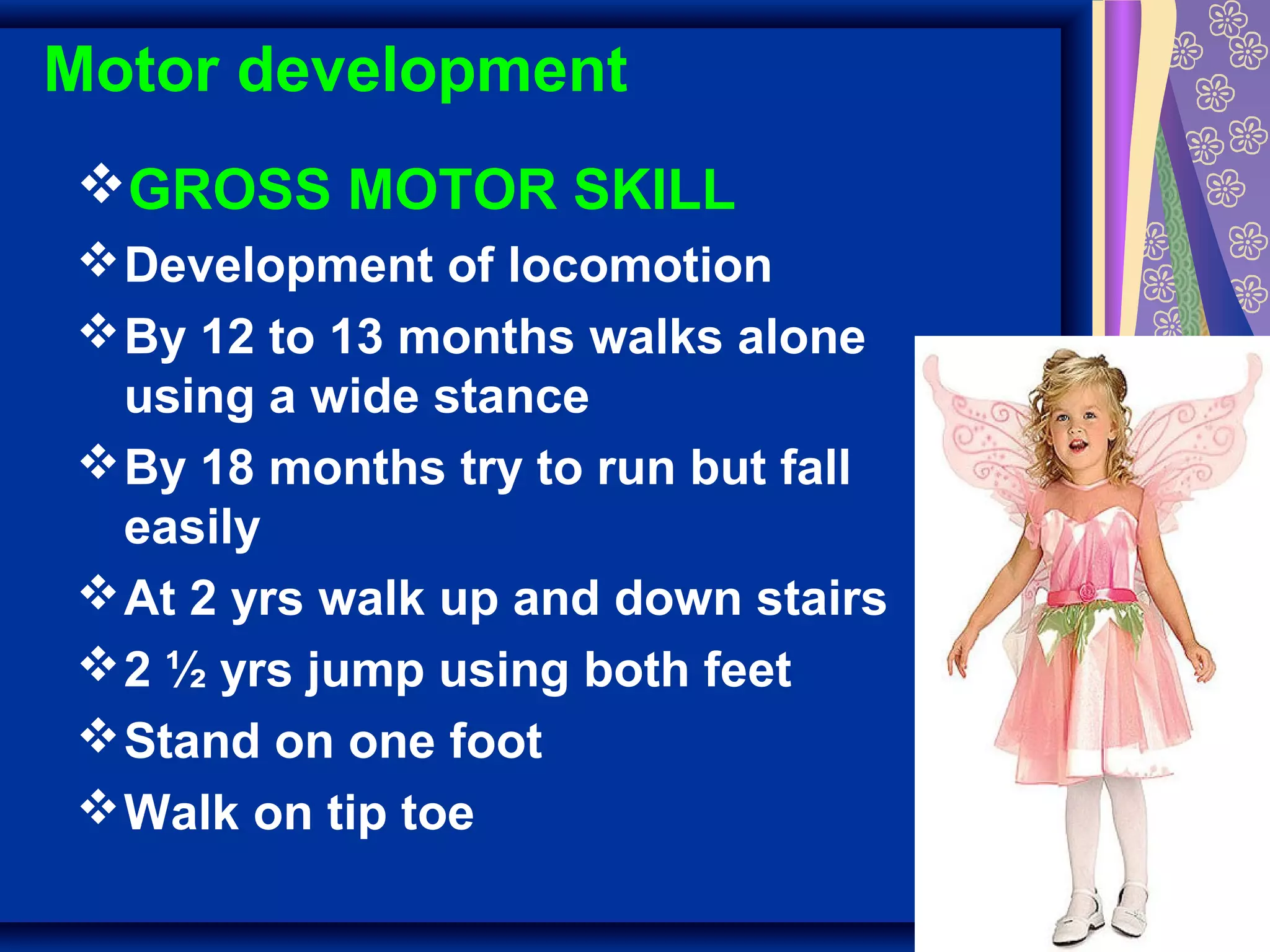
Development of locomotion
By 12 to 13 months walks alone
using a wide stance
By 18 months try to run but fall
easily
At 2 yrs walk up and down stairs
2 ½ yrs jump using both feet
Stand on one foot
Walk on tip toe
FINE MOTOR DEVELOPMENT
By 12 months able to grasp a very small
object
by 15 months can drop a raisin into a
narrow neck bottle. Builds a tower of 2-3
cubes.
By 18 months can throw a ball overhand.
Builds tower of 3-4 cubes
By 2yrs use their hands to build towers.
Builds a tower of 6-7 cubes.
By 3yrs draw a circles on paper .
Builds a tower of 8 cubes.
Good hand finger coordination.
 SENSORY DEVELOPMENT
Visual acuity of 20/40
The sense of hearing smell, taste
and touch increasingly developed
PSYCHOSOCIAL OR EMOTIONAL
DEVELOPMENT( eric ericksons)
AUTONOMY VS SHAME AND
DOUBT
• Learning to assert self in
the expression of needs,
desires and wants.
• If not allowed to do so,
experiences shame &
doubt.
• Coping skills – temper
tantrums, crying,
negativisim, breath holding
spells
Psychosexual development
(seigmund freud)
THE ANAL STAGE
The child operates primarily on the
basis of the id or instincts,the pleasure
principle
The child begins to operate on the basis
of ego,the part of the psyche that
posses consciousness
Attains pleasure by learning to regulate
elimination of bowel and bladder.
Spiritual development ( fowlers)
Intutive –projecttive faith- that is a
faith derived from the parents or
significant others. The child imitates
religious behavior, such as bowing
the head in prayer, but does
not understand the
meanings.
Cognitive development (jean piaget)
SENSORY MOTOR STAGE(BIRTH TO 2YRS)
Substage 5(12 to18 months) tertiary circular
reaction – child develops variations of old
responses in approaching a new object. ( trial
& error method)
Substage 6(18 months to 2yrs) the inventions
of new means through mental combinations.
Deferred imitations and invisible displacement
occurs at this stage.
Preoperational stage(2 to 7yrs) the childs
thinking is based on concrete perceptions and
actions on immediate environment. Child uses
one word to several rather similar persons or
objects.
Moral development( kohlberg)
STAGE 0(BIRTH TO 2YRS)
during this stage the toddler
function on the basis of the
good is what the child likes
and want.
STAGE 1(2YRS TO 3YRS)
This period is of punishment-
obedience orientation.
LANGUAGE DEVELOPMENT
Approximately 4 words are spoken at 1
year
300 words at 2 years of age
Buliding the vocabulary
 The child a vocabulary first of nouns of
1 syllable (ma,ma da,da)
 Use of more difficult nouns relating to
objects and people in the environment .
 Constantly asks questions.
 Talks whether audience present or
not.states own names.
 Makes specific sound errors ( s, sh,
ch,z)
RECEPTIVE LANGUAGE.
By 15 months recognise names of
various parts of body.
Responds to familiar commads.
By 18 months identifies pictures of
familiar objects when named
By 2yrs , understands more
complex sentences
Identifies 4 body parts when
named.
By 30 months ,identifies 5 body
parts when named.
Play
Parallel play
involves in motor, creative, quiet,
dramatic play.
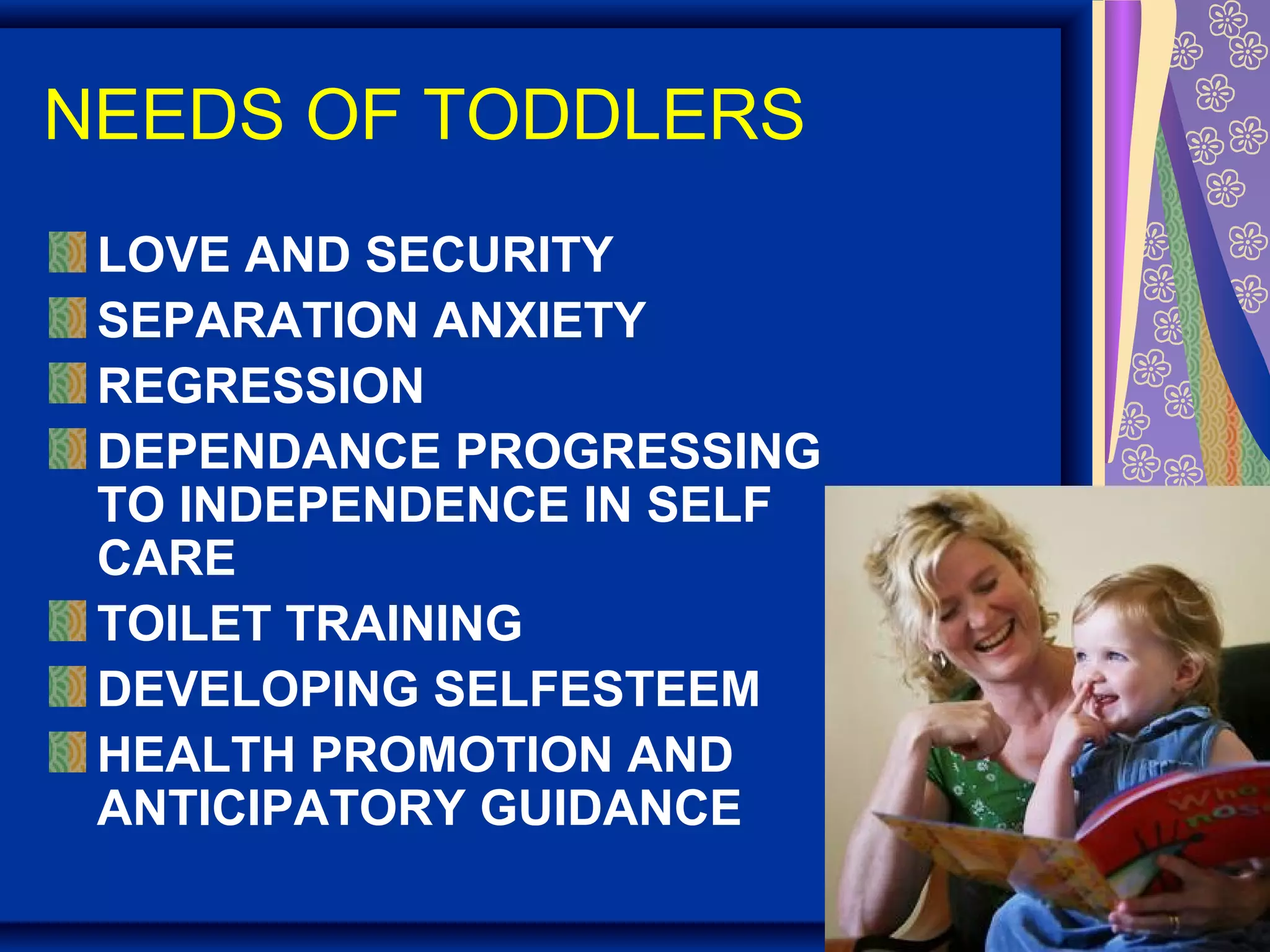
NEEDS OF TODDLERS
LOVE AND SECURITY
SEPARATION ANXIETY
REGRESSION
DEPENDANCE PROGRESSING
TO INDEPENDENCE IN SELF
CARE
TOILET TRAINING
DEVELOPING SELFESTEEM
HEALTH PROMOTION AND
ANTICIPATORY GUIDANCE
NUTRITION
the daily calorie requirement is
100kcal per kg during toddler period
ACCIDENTS PREVENTION
Accidence are the largest single cause
of mortality and disability between the
ages of 1-4 years.
growth and development of Toddler

growth and development of Toddler

  • 1.
  • 2.
    Toddler Toddler is ofthe developmental age group from 1 year to 3 years of age.
  • 3.
    Biologic growth: 1. weight: Average weight gain is 1.8 – 2.7 kg / year Birth weight quadriples at 21/2 years 2. Height height increases about 10 to 12.5cm/ year  at 2yrs ht is about 85 cm  Arms and legs grow at a faster rate than head and trunk  Lumbar lordosis of spine is less evident  Legs have a bowing appearance ( tibial torsion )  Ratio of upper segment : lower segment= 1.7 : 1
  • 4.
    Head circumference  Therate of increase in head circumference slows  HC is equal to CC by 1 to 2 yrs  The rate of increase slows until at age 5 yrs  At 2 yrs HC IS 49 TO 50 cm • The anterior fontanel closes between 1 and 11/2 yrs of age Chest circumference • Continues to increase in size and exceeds head circumference during the toddler year. AP diameter is less than lateral diameter. • Midarm circumference: 13 – 16 cm. DENTITION • Central incisors - 6 to 8 months • Lateral incisors - 8 to 11 months • Canines-16 to 20 months • First molars-10 to 16 months • Second molars-20 to 30 months
  • 5.
    Physiologic parameters Temperature :97.8 – 98.4 ° f Pulse : 1-2 years – 110 -130/ mt 3 years - 100-120/mt Respiration : 24-40/mt Blood pressure : systolic: 91 – 93 mmhg diastolic: 56 mmhg
  • 6.
    Maturation of system Thephysiologic functioning of the body is mature by the end of the toddler period with the exception of the endocrine and reproductive system. • INTEGUMENTARY SYSTEM • The resistance of the skin to infection and its ability to prevent fluid loss is increased as the epidermis and the dermis become more tightly connected to each other. • Sebum production is inadequate. • CARDIOVASCULAR SYSTEM • Pulse rate is 110/mt • Blood pressure is 99/64mmhg • The heart and blood vessels increase in size. • The need for Hb is greater than during infancy, a slightly higher RBC count is necessary.
  • 7.
    RESPIRATORY SYSTEM The structureincrease in size, with increase in thoracic volume. Thus leading to decrease in respiratory rate 26/mt Because of short straight eustachian tube through infection easily reach the ears from the nasopharynx. Respirations are still abdominal Genitourinary system: By 2 years, toddler is able to conserve water & concentrate urine. Myelination of nerves to urethral sphincter & increased ability of bladder to control urine helps in controlling elimination.
  • 8.
    GASTROINTESTINAL SYSTEM The salivarygland reaches functional maturity by the end of second yr The capacity of stomach increases HCL secretion in stomach increases,providing protection against various types of organism IMMUNE SYSTEM Because passive immunity from the mother decreases during infancy, immunization is essential The production of IgM,reaches adult levels during later part of first yr of life NERVOUS SYSTEM The number of brain cells is complete by the beginning of toddler period .
  • 9.
    They continue togrow until the brain has reached 2/3rd of its adult size at 2yrs and 3/4th of adult size by 3yrs of age. As the child matures, specific areas of brain develop, such as brocas area for speech. Other areas of the cerebral cortex develops as the child achieves motor control of the extremities and sphincters. Myelination of the spinal cord is achieved gradualy as toddlers show increasing ability to exert control over posture and coordinated movements As a result , the child is able to stand alone before being able to walk, and to walk before running and jumping After 2yrs , myelination slows down to reach completion during puberty.
  • 10.
    Motor development GROSS MOTORSKILL Development of locomotion By 12 to 13 months walks alone using a wide stance By 18 months try to run but fall easily At 2 yrs walk up and down stairs 2 ½ yrs jump using both feet Stand on one foot Walk on tip toe
  • 11.
    FINE MOTOR DEVELOPMENT By12 months able to grasp a very small object by 15 months can drop a raisin into a narrow neck bottle. Builds a tower of 2-3 cubes. By 18 months can throw a ball overhand. Builds tower of 3-4 cubes By 2yrs use their hands to build towers. Builds a tower of 6-7 cubes. By 3yrs draw a circles on paper . Builds a tower of 8 cubes. Good hand finger coordination.  SENSORY DEVELOPMENT Visual acuity of 20/40 The sense of hearing smell, taste and touch increasingly developed
  • 12.
    PSYCHOSOCIAL OR EMOTIONAL DEVELOPMENT(eric ericksons) AUTONOMY VS SHAME AND DOUBT • Learning to assert self in the expression of needs, desires and wants. • If not allowed to do so, experiences shame & doubt. • Coping skills – temper tantrums, crying, negativisim, breath holding spells
  • 13.
    Psychosexual development (seigmund freud) THEANAL STAGE The child operates primarily on the basis of the id or instincts,the pleasure principle The child begins to operate on the basis of ego,the part of the psyche that posses consciousness Attains pleasure by learning to regulate elimination of bowel and bladder.
  • 14.
    Spiritual development (fowlers) Intutive –projecttive faith- that is a faith derived from the parents or significant others. The child imitates religious behavior, such as bowing the head in prayer, but does not understand the meanings.
  • 15.
    Cognitive development (jeanpiaget) SENSORY MOTOR STAGE(BIRTH TO 2YRS) Substage 5(12 to18 months) tertiary circular reaction – child develops variations of old responses in approaching a new object. ( trial & error method) Substage 6(18 months to 2yrs) the inventions of new means through mental combinations. Deferred imitations and invisible displacement occurs at this stage. Preoperational stage(2 to 7yrs) the childs thinking is based on concrete perceptions and actions on immediate environment. Child uses one word to several rather similar persons or objects.
  • 16.
    Moral development( kohlberg) STAGE0(BIRTH TO 2YRS) during this stage the toddler function on the basis of the good is what the child likes and want. STAGE 1(2YRS TO 3YRS) This period is of punishment- obedience orientation.
  • 17.
    LANGUAGE DEVELOPMENT Approximately 4words are spoken at 1 year 300 words at 2 years of age Buliding the vocabulary  The child a vocabulary first of nouns of 1 syllable (ma,ma da,da)  Use of more difficult nouns relating to objects and people in the environment .  Constantly asks questions.  Talks whether audience present or not.states own names.  Makes specific sound errors ( s, sh, ch,z)
  • 18.
    RECEPTIVE LANGUAGE. By 15months recognise names of various parts of body. Responds to familiar commads. By 18 months identifies pictures of familiar objects when named By 2yrs , understands more complex sentences Identifies 4 body parts when named. By 30 months ,identifies 5 body parts when named.
  • 19.
    Play Parallel play involves inmotor, creative, quiet, dramatic play.
  • 20.
    NEEDS OF TODDLERS LOVEAND SECURITY SEPARATION ANXIETY REGRESSION DEPENDANCE PROGRESSING TO INDEPENDENCE IN SELF CARE TOILET TRAINING DEVELOPING SELFESTEEM HEALTH PROMOTION AND ANTICIPATORY GUIDANCE
  • 21.
    NUTRITION the daily calorierequirement is 100kcal per kg during toddler period ACCIDENTS PREVENTION Accidence are the largest single cause of mortality and disability between the ages of 1-4 years.