DEPARTMENT OF PEDODONTICS
INTRODUCTION
 GENERAL BODY REFLEXES
 FACIAL REFLEX
 ORAL REFLEXES


 REFERENCE
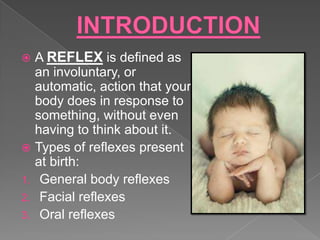
A REFLEX is defined as
an involuntary, or
automatic, action that your
body does in response to
something, without even
having to think about it.
 Types of reflexes present
at birth:
1. General body reflexes
2. Facial reflexes
3. Oral reflexes






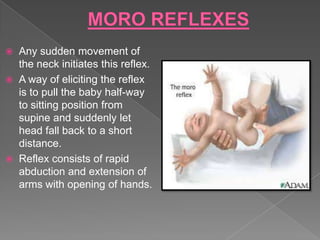
Any sudden movement of
the neck initiates this reflex.
A way of eliciting the reflex
is to pull the baby half-way
to sitting position from
supine and suddenly let
head fall back to a short
distance.
Reflex consists of rapid
abduction and extension of
arms with opening of hands.
Its nature gives an indication of the
muscle tone.

• The responses may be asymmetrical
if muscle tone is unequal on two sides
or there is a weakness of an arm or
injury to humerous or clavicle
This reflex disappears in 2-3 months.
STARTLE
REFLEX

• It is similar to moro reflex, but it is initiated by
sudden noise or any other stimulus
• In this, the elbows are flexed and the hands
remain closed, there is less of embrace, outward
and inward movement of arms.
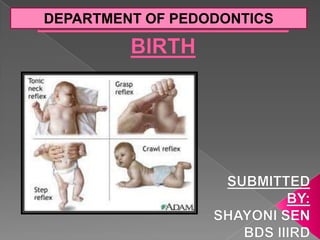
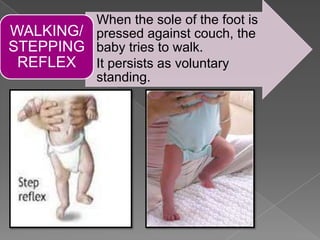
• When the sole of the foot is
WALKING/ pressed against couch, the
STEPPING baby tries to walk.
REFLEX • It persists as voluntary
standing.
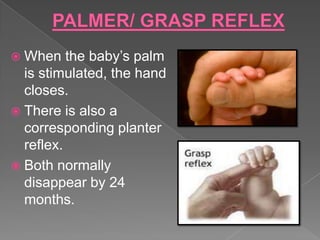
 When

the baby’s palm
is stimulated, the hand
closes.
 There is also a
corresponding planter
reflex.
 Both normally
disappear by 24
months.
An exceptionally strong grasp reflex may be
found in the spastic form of cerebral palsy
and in kernicterus.
 It may be asymmetrical in hemiplegia and in
cases of cerebral damage.
 It should have disappeared in 2-3 months
and persistence may indicate the spastic
form of cerebral palsy.

LIMB PLACEMENT REFLEX
• When the front of the leg below the
knee, or arm below the elbow is
brought into contact with edge of the
table, the child lifts the limb over the
edge.

BABINSKI’S REFLEX
• Stroking of the lateral surface of the
planter surface of the foot from the
heel to the toe results in flexion of the
toe.
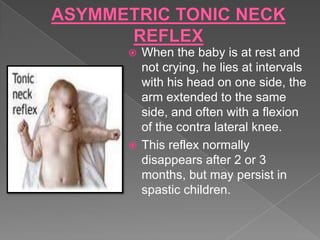
When the baby is at rest and
not crying, he lies at intervals
with his head on one side, the
arm extended to the same
side, and often with a flexion
of the contra lateral knee.
 This reflex normally
disappears after 2 or 3
months, but may persist in
spastic children.

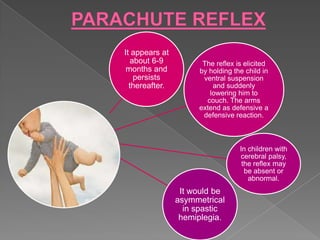
It appears at
about 6-9
months and
persists
thereafter.

The reflex is elicited
by holding the child in
ventral suspension
and suddenly
lowering him to
couch. The arms
extend as defensive a
defensive reaction.

In children with
cerebral palsy,
the reflex may
be absent or
abnormal.

It would be
asymmetrical
in spastic
hemiplegia.
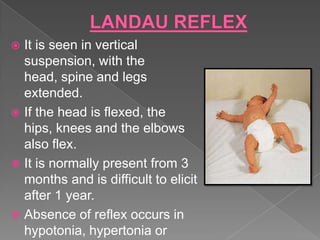
It is seen in vertical
suspension, with the
head, spine and legs
extended.
 If the head is flexed, the
hips, knees and the elbows
also flex.
 It is normally present from 3
months and is difficult to elicit
after 1 year.
 Absence of reflex occurs in
hypotonia, hypertonia or







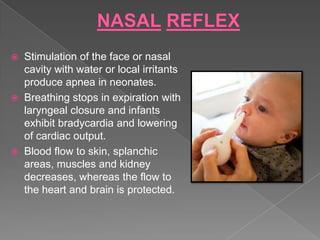
Stimulation of the face or nasal
cavity with water or local irritants
produce apnea in neonates.
Breathing stops in expiration with
laryngeal closure and infants
exhibit bradycardia and lowering
of cardiac output.
Blood flow to skin, splanchic
areas, muscles and kidney
decreases, whereas the flow to
the heart and brain is protected.
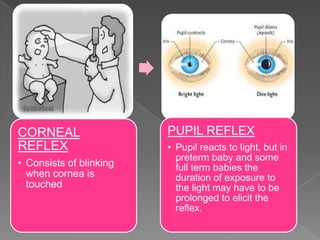
CORNEAL
REFLEX
• Consists of blinking
when cornea is
touched

PUPIL REFLEX
• Pupil reacts to light, but in
preterm baby and some
full term babies the
duration of exposure to
the light may have to be
prolonged to elicit the
reflex.
When the infant’s cheek
contacts the mother’s breast,
the baby’s mouth results in
vigorous sucking movements
resulting in baby rooting for
milk.
 When the corner of mouth is
touched, the lower lip is
lowered, the tongue moves
towards the point stimulated.
 When the finger slides away,
the head turns to follow it.

Onset is 28
weeks IU

Wellestablised
by 32-34
weeks IU

Disappears
by 3-4
months
Onset~ 28
weeks iu

Wellestablised~
32-34
weeks iu

Disappear~
around 12
months

Elicited by~
introducing
a finger into
the mouth
Begins around 12 and half
weeks IU life.
 Full swallowing and
sucking is established by
32-36 weeks of IU life.
 Their absence in full-term
baby would suggest a
developmental defect.

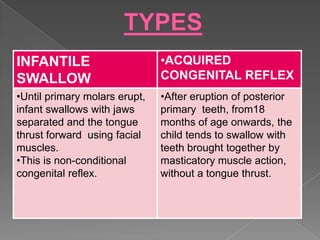
INFANTILE
SWALLOW

•ACQUIRED
CONGENITAL REFLEX

•Until primary molars erupt,
infant swallows with jaws
separated and the tongue
thrust forward using facial
muscles.
•This is non-conditional
congenital reflex.

•After eruption of posterior
primary teeth, from18
months of age onwards, the
child tends to swallow with
teeth brought together by
masticatory muscle action,
without a tongue thrust.
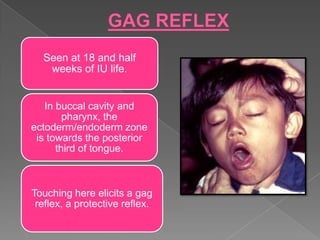
Seen at 18 and half
weeks of IU life.

In buccal cavity and
pharynx, the
ectoderm/endoderm zone
is towards the posterior
third of tongue.

Touching here elicits a gag
reflex, a protective reflex.
It is a nonconditioned
reflex which
accounts for its
lack of individual
character and is
of sporadic
nature.

Starts as early as
21-29 weeks IU life.
It is a conditioned reflex,
learned initially by irregular
and poorely coordinated,
chewing movements.

The proprioceptive responses of
TMJ and PDL of erupting dentition
establishes a stabilized chewing
pattern, aligned to the individual
dental intercuspation.


SHOBHA TONDON (FOR PEDIATRICS
DENTISTRY) 2nd EDITION.
Reflexes present at birth

Reflexes present at birth

  • 1.
  • 2.
    INTRODUCTION  GENERAL BODYREFLEXES  FACIAL REFLEX  ORAL REFLEXES   REFERENCE
  • 3.
    A REFLEX isdefined as an involuntary, or automatic, action that your body does in response to something, without even having to think about it.  Types of reflexes present at birth: 1. General body reflexes 2. Facial reflexes 3. Oral reflexes 
  • 5.
       Any sudden movementof the neck initiates this reflex. A way of eliciting the reflex is to pull the baby half-way to sitting position from supine and suddenly let head fall back to a short distance. Reflex consists of rapid abduction and extension of arms with opening of hands.
  • 6.
    Its nature givesan indication of the muscle tone. • The responses may be asymmetrical if muscle tone is unequal on two sides or there is a weakness of an arm or injury to humerous or clavicle This reflex disappears in 2-3 months.
  • 7.
    STARTLE REFLEX • It issimilar to moro reflex, but it is initiated by sudden noise or any other stimulus • In this, the elbows are flexed and the hands remain closed, there is less of embrace, outward and inward movement of arms.
  • 8.
    • When thesole of the foot is WALKING/ pressed against couch, the STEPPING baby tries to walk. REFLEX • It persists as voluntary standing.
  • 9.
     When the baby’spalm is stimulated, the hand closes.  There is also a corresponding planter reflex.  Both normally disappear by 24 months.
  • 10.
    An exceptionally stronggrasp reflex may be found in the spastic form of cerebral palsy and in kernicterus.  It may be asymmetrical in hemiplegia and in cases of cerebral damage.  It should have disappeared in 2-3 months and persistence may indicate the spastic form of cerebral palsy. 
  • 11.
    LIMB PLACEMENT REFLEX •When the front of the leg below the knee, or arm below the elbow is brought into contact with edge of the table, the child lifts the limb over the edge. BABINSKI’S REFLEX • Stroking of the lateral surface of the planter surface of the foot from the heel to the toe results in flexion of the toe.
  • 12.
    When the babyis at rest and not crying, he lies at intervals with his head on one side, the arm extended to the same side, and often with a flexion of the contra lateral knee.  This reflex normally disappears after 2 or 3 months, but may persist in spastic children. 
  • 13.
    It appears at about6-9 months and persists thereafter. The reflex is elicited by holding the child in ventral suspension and suddenly lowering him to couch. The arms extend as defensive a defensive reaction. In children with cerebral palsy, the reflex may be absent or abnormal. It would be asymmetrical in spastic hemiplegia.
  • 14.
    It is seenin vertical suspension, with the head, spine and legs extended.  If the head is flexed, the hips, knees and the elbows also flex.  It is normally present from 3 months and is difficult to elicit after 1 year.  Absence of reflex occurs in hypotonia, hypertonia or 
  • 16.
       Stimulation of theface or nasal cavity with water or local irritants produce apnea in neonates. Breathing stops in expiration with laryngeal closure and infants exhibit bradycardia and lowering of cardiac output. Blood flow to skin, splanchic areas, muscles and kidney decreases, whereas the flow to the heart and brain is protected.
  • 17.
    CORNEAL REFLEX • Consists ofblinking when cornea is touched PUPIL REFLEX • Pupil reacts to light, but in preterm baby and some full term babies the duration of exposure to the light may have to be prolonged to elicit the reflex.
  • 19.
    When the infant’scheek contacts the mother’s breast, the baby’s mouth results in vigorous sucking movements resulting in baby rooting for milk.  When the corner of mouth is touched, the lower lip is lowered, the tongue moves towards the point stimulated.  When the finger slides away, the head turns to follow it. 
  • 20.
    Onset is 28 weeksIU Wellestablised by 32-34 weeks IU Disappears by 3-4 months
  • 21.
    Onset~ 28 weeks iu Wellestablised~ 32-34 weeksiu Disappear~ around 12 months Elicited by~ introducing a finger into the mouth
  • 22.
    Begins around 12and half weeks IU life.  Full swallowing and sucking is established by 32-36 weeks of IU life.  Their absence in full-term baby would suggest a developmental defect. 
  • 23.
    INFANTILE SWALLOW •ACQUIRED CONGENITAL REFLEX •Until primarymolars erupt, infant swallows with jaws separated and the tongue thrust forward using facial muscles. •This is non-conditional congenital reflex. •After eruption of posterior primary teeth, from18 months of age onwards, the child tends to swallow with teeth brought together by masticatory muscle action, without a tongue thrust.
  • 24.
    Seen at 18and half weeks of IU life. In buccal cavity and pharynx, the ectoderm/endoderm zone is towards the posterior third of tongue. Touching here elicits a gag reflex, a protective reflex.
  • 25.
    It is anonconditioned reflex which accounts for its lack of individual character and is of sporadic nature. Starts as early as 21-29 weeks IU life.
  • 26.
    It is aconditioned reflex, learned initially by irregular and poorely coordinated, chewing movements. The proprioceptive responses of TMJ and PDL of erupting dentition establishes a stabilized chewing pattern, aligned to the individual dental intercuspation.
  • 27.
     SHOBHA TONDON (FORPEDIATRICS DENTISTRY) 2nd EDITION.