Neonatal reflexes
INTRODUCTION
 Actions in response to specific stimuli that are present
in newborn infants.
 These are unconditioned reflexes and not learned or
developed through experience.
 Normally developing neonates or infants are expected
to respond to specific stimuli with a specific,
predictable behaviour or action.
MORO’S REFLEXE
ELICITED BY :
PLACING THE BABY IN SEMI UPRIGHT POSITION
↓
SUDDEN DROPING OF HEAD IN RELATION TO TRUNK AND
CATCHING THE FALLING HEAD
DISAPPEARS AT 3 TO 6 MTHS
RESPONSE
 OPENING OF HAND
 EXTENSION AND ABDUTION OF UPPER EXTRIMITIES
 ANTERIOR FLEXION OF UPPER EXTRIMITIES
 AUDIBLE CRY
ABNORMALITIES:
DEPRESSED OR ABSENT
 GENERALISED DEPRESSION OF CNS
ASYMMETRICAL RESPONSE
 FRACTURE CLAVICLE
 ERB PALSY
 HEMIPARESIS
EXAGERGERATED RESPONSE
 KERNECTERUS
STARTLE REFLEX
It is variant of Moro’s Reflex.
Ellicited by: sudden loud noise or by
tapping the sternum
Response is like Moro’s reflex but elbow
remain flexed and hands closed
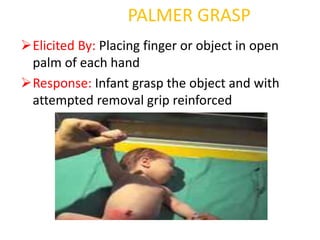
PALMER GRASP
Elicited By: Placing finger or object in open
palm of each hand
Response: Infant grasp the object and with
attempted removal grip reinforced
Appears at 28 weeks of gestation and
disappears at 2-3 months of life
Persistence beyond 6mths: Athetoid CP
TONIC NECK REFLEX
ASYMMETRIC TONIC NECK REFLEX
 Elicited By: Passive rotation of head in supine
position
 Response: Extension of upper limb of same side
and flexion of upper limb of opposite side
Appears at birth and disappear at 3
months
Persistence > 3 months: Spastic CP
Importance: Prevents body from rolling
TONIC NECK REFLEX
SYMMETRIC TONIC NECK REFLEX
 Elicited By: Passive extension of head in prone
position
 Response: Extension of both UL & flexion of
both LL
 Appears in 3 mths and disappear in 6mths
 Persistence > 6mths : CP
Importance: When baby learn to turn to prone position
chocking over bed may asphyxiate him so if baby lift his
chin by extension of neck both upper limbs extend
automatically and chocking avoided.
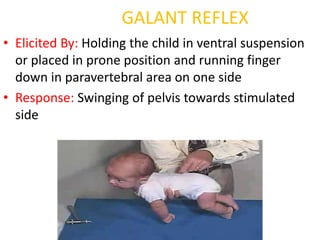
GALANT REFLEX
• Elicited By: Holding the child in ventral suspension
or placed in prone position and running finger
down in paravertebral area on one side
• Response: Swinging of pelvis towards stimulated
side
• Appears at birth disappear by 1 year
• Used for mapping sensory level of trunk
PEREZ REFLEX
Elicited By: Holding the child in prone position
and pressure applied upword along spine.
Response: Flexion of arms and legs with
extension of neck and cry
Appear at birth and disappear at 6 weeks
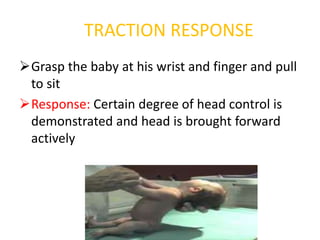
TRACTION RESPONSE
Grasp the baby at his wrist and finger and pull
to sit
Response: Certain degree of head control is
demonstrated and head is brought forward
actively
ADDUCTION RESPONSE
Elicited by: holding leg of baby in extension and
sole of foot is rubbed
Response: the other leg first withdraw and then
extend with fanning of toes and bring toward the
side of stimulation (as to push the noxious
stimulus)
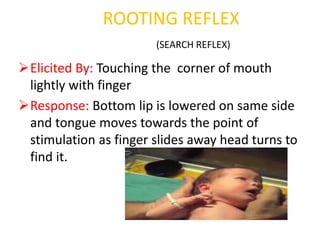
ROOTING REFLEX
(SEARCH REFLEX)
Elicited By: Touching the corner of mouth
lightly with finger
Response: Bottom lip is lowered on same side
and tongue moves towards the point of
stimulation as finger slides away head turns to
find it.
Appear 28 week & disappear 4-7 mths
Importance:
 Absence at birth and persistence beyond 7
months indicate developmental delay
 Helps the baby for finding the breast
SUCKING REFLEX
Elicited By: Introducing finger into babies mouth
Response: Baby starts sucking vigorously
Appear at 28 week disappear at 4-7 months
Absence sucking at birth indicate sickness,
persistence beyond 7 mths developmental delay
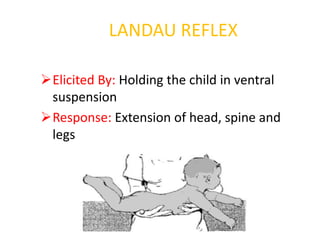
LANDAU REFLEX
Elicited By: Holding the child in ventral
suspension
Response: Extension of head, spine and
legs
Appear at 3 months disappear at 9 months
Absence beyond 3 mths indicate motor
weakness, mental sub normality & CP
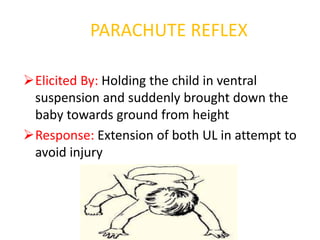
PARACHUTE REFLEX
Elicited By: Holding the child in ventral
suspension and suddenly brought down the
baby towards ground from height
Response: Extension of both UL in attempt to
avoid injury
Appears at 6-9 months persists life long.
Absent in CP and hemiplegia of affected limb
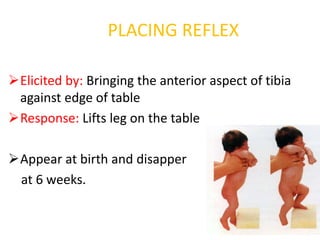
PLACING REFLEX
Elicited by: Bringing the anterior aspect of tibia
against edge of table
Response: Lifts leg on the table
Appear at birth and disapper
at 6 weeks.
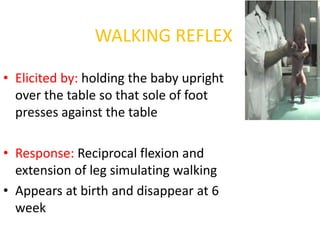
WALKING REFLEX
• Elicited by: holding the baby upright
over the table so that sole of foot
presses against the table
• Response: Reciprocal flexion and
extension of leg simulating walking
• Appears at birth and disappear at 6
week
PALMOMENTAL REFLEX
• Elicited by: Pressing the palm
• Response: Opening of mouth
• Appear at birth and disappear at
3 year
CONCLUSION
Knowledge of neonatal reflexes is important for
 Understanding the human development as a
whole.
 Application for over all assessment of baby
 Recognition of possible neurodevelopemental
damage in prenatal and perinatal period.
 Establishment of the prognosis for future
 Predicting the Childs future potential
THANKS

neonatal reflexes case presentation.pptx

  • 1.
  • 2.
    INTRODUCTION  Actions inresponse to specific stimuli that are present in newborn infants.  These are unconditioned reflexes and not learned or developed through experience.  Normally developing neonates or infants are expected to respond to specific stimuli with a specific, predictable behaviour or action.
  • 3.
    MORO’S REFLEXE ELICITED BY: PLACING THE BABY IN SEMI UPRIGHT POSITION ↓ SUDDEN DROPING OF HEAD IN RELATION TO TRUNK AND CATCHING THE FALLING HEAD DISAPPEARS AT 3 TO 6 MTHS
  • 4.
    RESPONSE  OPENING OFHAND  EXTENSION AND ABDUTION OF UPPER EXTRIMITIES  ANTERIOR FLEXION OF UPPER EXTRIMITIES  AUDIBLE CRY
  • 5.
    ABNORMALITIES: DEPRESSED OR ABSENT GENERALISED DEPRESSION OF CNS ASYMMETRICAL RESPONSE  FRACTURE CLAVICLE  ERB PALSY  HEMIPARESIS EXAGERGERATED RESPONSE  KERNECTERUS
  • 6.
    STARTLE REFLEX It isvariant of Moro’s Reflex. Ellicited by: sudden loud noise or by tapping the sternum Response is like Moro’s reflex but elbow remain flexed and hands closed
  • 7.
    PALMER GRASP Elicited By:Placing finger or object in open palm of each hand Response: Infant grasp the object and with attempted removal grip reinforced
  • 8.
    Appears at 28weeks of gestation and disappears at 2-3 months of life Persistence beyond 6mths: Athetoid CP
  • 9.
    TONIC NECK REFLEX ASYMMETRICTONIC NECK REFLEX  Elicited By: Passive rotation of head in supine position  Response: Extension of upper limb of same side and flexion of upper limb of opposite side
  • 10.
    Appears at birthand disappear at 3 months Persistence > 3 months: Spastic CP Importance: Prevents body from rolling
  • 11.
    TONIC NECK REFLEX SYMMETRICTONIC NECK REFLEX  Elicited By: Passive extension of head in prone position  Response: Extension of both UL & flexion of both LL
  • 12.
     Appears in3 mths and disappear in 6mths  Persistence > 6mths : CP Importance: When baby learn to turn to prone position chocking over bed may asphyxiate him so if baby lift his chin by extension of neck both upper limbs extend automatically and chocking avoided.
  • 13.
    GALANT REFLEX • ElicitedBy: Holding the child in ventral suspension or placed in prone position and running finger down in paravertebral area on one side • Response: Swinging of pelvis towards stimulated side
  • 14.
    • Appears atbirth disappear by 1 year • Used for mapping sensory level of trunk
  • 15.
    PEREZ REFLEX Elicited By:Holding the child in prone position and pressure applied upword along spine. Response: Flexion of arms and legs with extension of neck and cry Appear at birth and disappear at 6 weeks
  • 16.
    TRACTION RESPONSE Grasp thebaby at his wrist and finger and pull to sit Response: Certain degree of head control is demonstrated and head is brought forward actively
  • 17.
    ADDUCTION RESPONSE Elicited by:holding leg of baby in extension and sole of foot is rubbed Response: the other leg first withdraw and then extend with fanning of toes and bring toward the side of stimulation (as to push the noxious stimulus)
  • 18.
    ROOTING REFLEX (SEARCH REFLEX) ElicitedBy: Touching the corner of mouth lightly with finger Response: Bottom lip is lowered on same side and tongue moves towards the point of stimulation as finger slides away head turns to find it.
  • 19.
    Appear 28 week& disappear 4-7 mths Importance:  Absence at birth and persistence beyond 7 months indicate developmental delay  Helps the baby for finding the breast
  • 20.
    SUCKING REFLEX Elicited By:Introducing finger into babies mouth Response: Baby starts sucking vigorously Appear at 28 week disappear at 4-7 months Absence sucking at birth indicate sickness, persistence beyond 7 mths developmental delay
  • 21.
    LANDAU REFLEX Elicited By:Holding the child in ventral suspension Response: Extension of head, spine and legs
  • 22.
    Appear at 3months disappear at 9 months Absence beyond 3 mths indicate motor weakness, mental sub normality & CP
  • 23.
    PARACHUTE REFLEX Elicited By:Holding the child in ventral suspension and suddenly brought down the baby towards ground from height Response: Extension of both UL in attempt to avoid injury
  • 24.
    Appears at 6-9months persists life long. Absent in CP and hemiplegia of affected limb
  • 25.
    PLACING REFLEX Elicited by:Bringing the anterior aspect of tibia against edge of table Response: Lifts leg on the table Appear at birth and disapper at 6 weeks.
  • 26.
    WALKING REFLEX • Elicitedby: holding the baby upright over the table so that sole of foot presses against the table • Response: Reciprocal flexion and extension of leg simulating walking • Appears at birth and disappear at 6 week
  • 27.
    PALMOMENTAL REFLEX • Elicitedby: Pressing the palm • Response: Opening of mouth • Appear at birth and disappear at 3 year
  • 28.
    CONCLUSION Knowledge of neonatalreflexes is important for  Understanding the human development as a whole.  Application for over all assessment of baby  Recognition of possible neurodevelopemental damage in prenatal and perinatal period.  Establishment of the prognosis for future  Predicting the Childs future potential
  • 29.