By DR. BANEET SHARMA (p.t)
Contents
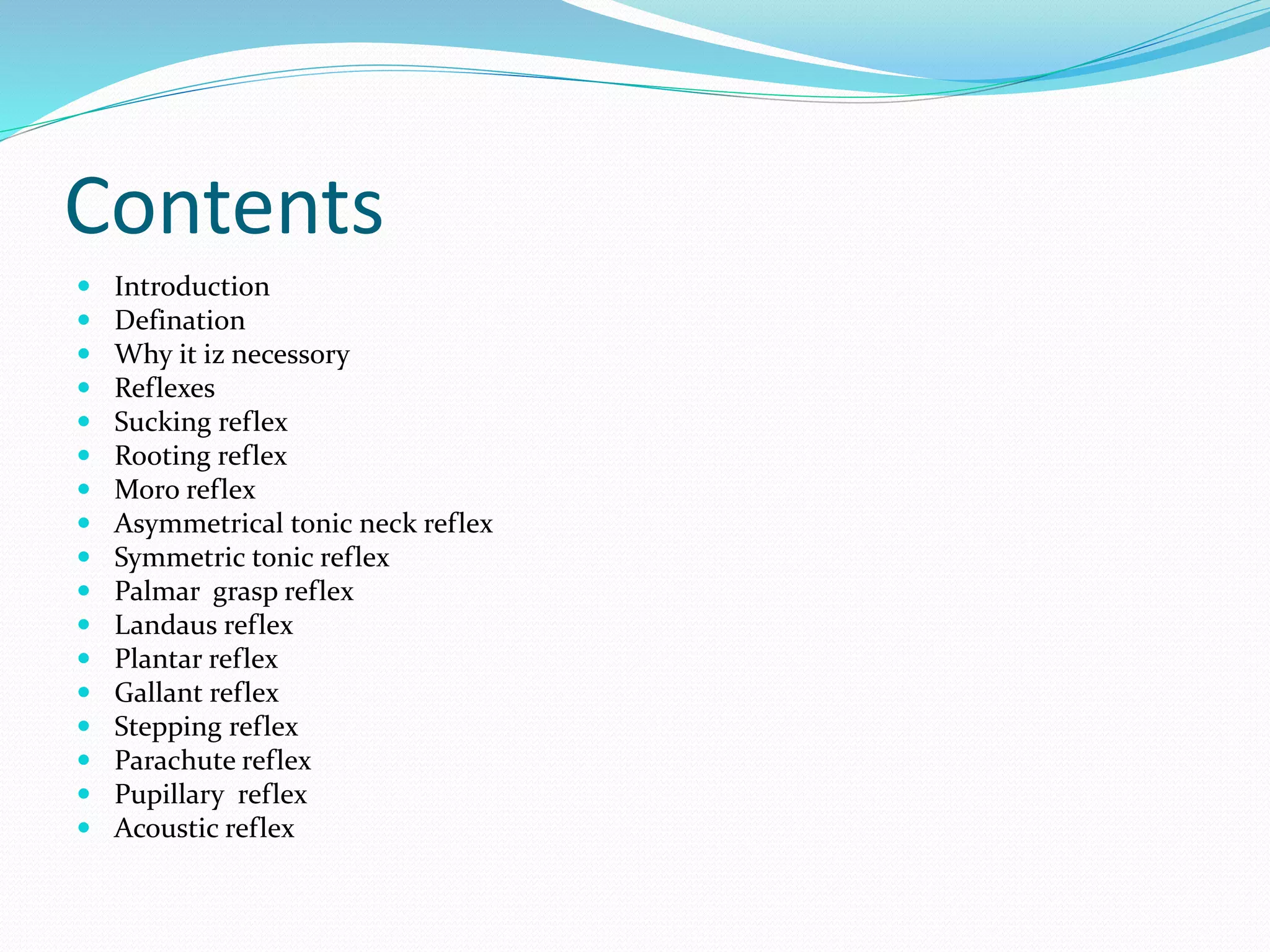
 Introduction
 Defination
 Why it iz necessory
 Reflexes

 Sucking reflex
 Rooting reflex
 Moro reflex
 Asymmetrical tonic neck reflex
 Symmetric tonic reflex
 Palmar grasp reflex
 Landaus reflex
 Plantar reflex
 Gallant reflex
 Stepping reflex
 Parachute reflex
 Pupillary reflex
 Acoustic reflex
Primitive REFLEXES
Also known as
 Infantile
 Infant
 Newborn reflexes
Introduction
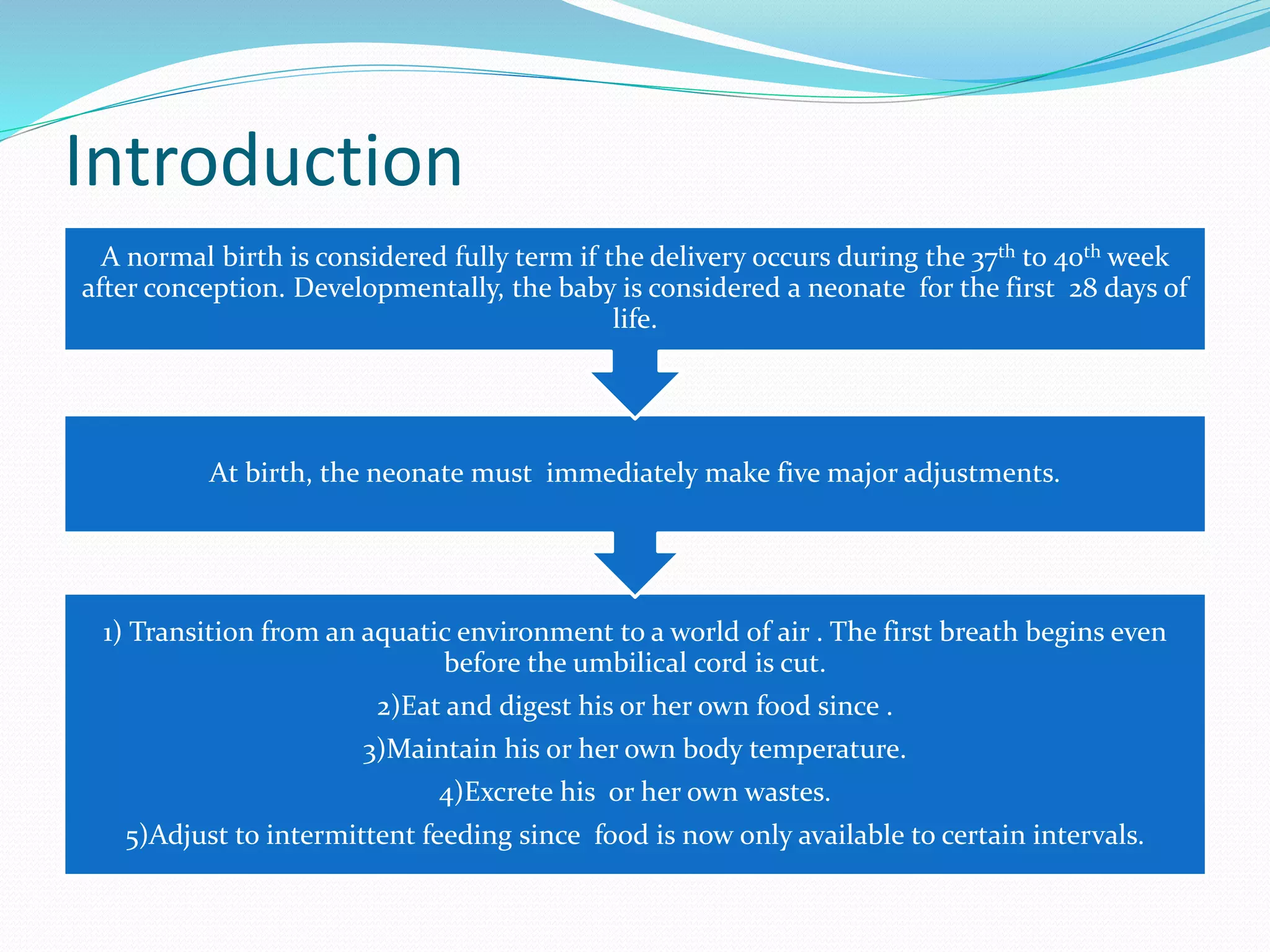
1) Transition from an aquatic environment to a world of air . The first breath begins even
before the umbilical cord is cut.
2)Eat and digest his or her own food since .
3)Maintain his or her own body temperature.
4)Excrete his or her own wastes.
5)Adjust to intermittent feeding since food is now only available to certain intervals.
At birth, the neonate must immediately make five major adjustments.
A normal birth is considered fully term if the delivery occurs during the 37th to 40th week
after conception. Developmentally, the baby is considered a neonate for the first 28 days of
life.
Period of growth
Prenatal period
Ovum
Embryo
fetus
0 to 14 days
14 days to 9 weeks
9 weeks to birth
Perinatal period 22 weeks of gestation to 7 days after
birth
Postnatal period
New born
Infancy
Toddler
Preschool child
First 4 weeks after birth
First year
1 to 3 years
3 to 6 years
School age child 6 to 10 years {girls}
6 to 12 years{boys}
Defination
Neonatal reflexes or primitive reflexes are the inborn
behavioral patterns that develop during uterine life.
 They should be fully present at birth and are gradually
inhibited by higher centers in the brain during the first
3 to 12 months of postnatal life.
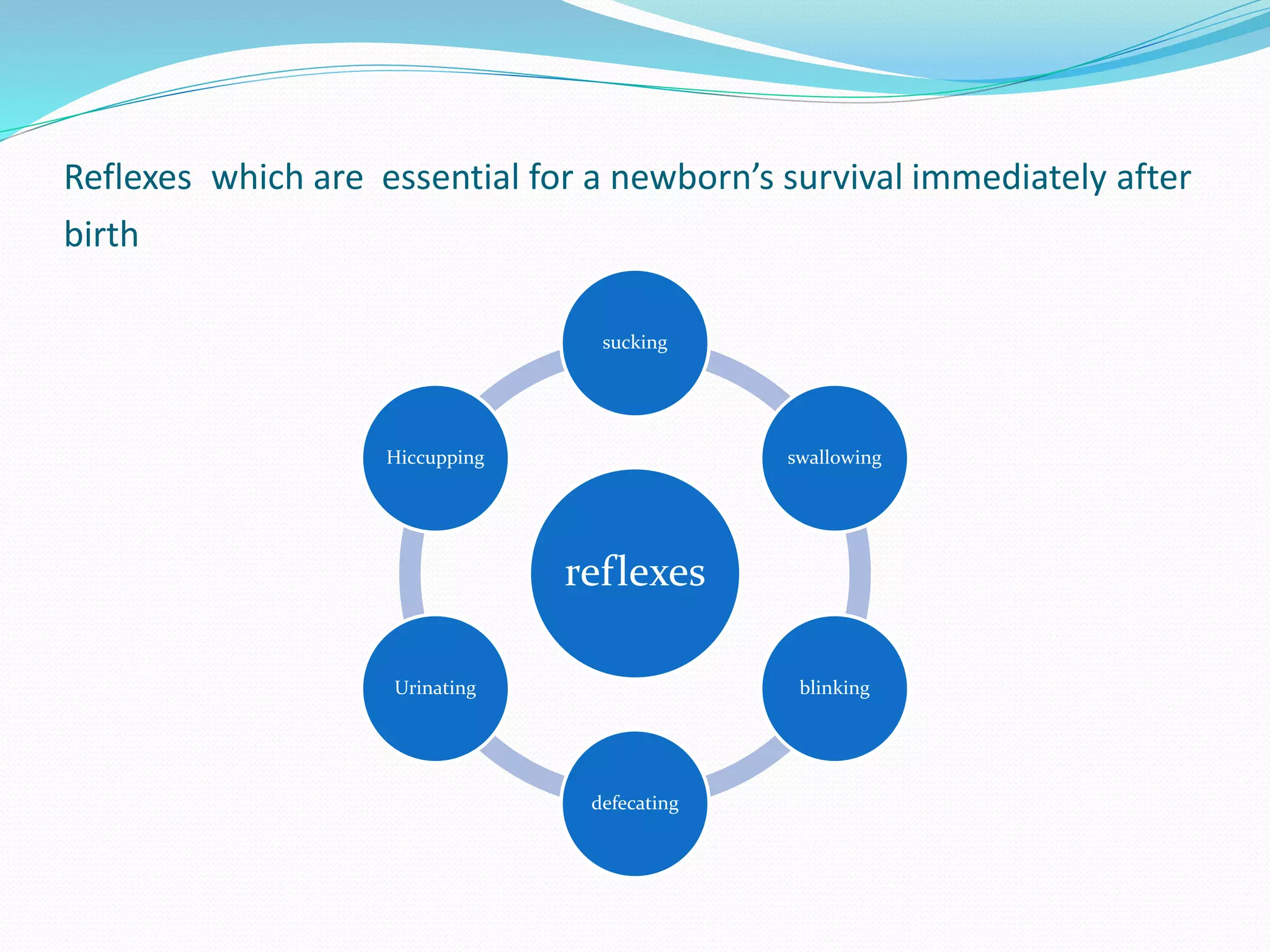
Reflexes which are essential for a newborn’s survival immediately after
birth
reflexes
sucking
swallowing
blinking
defecating
Urinating
Hiccupping
 Under normal developmental conditions, these
neonatal reflexes represent important reactions of the
nervous system and are only observable within a
specific period of time over the first few months of life.
 The following reflexes are normally present from birth
and are part of a normal newborn evaluation
 A normally developing newborn should respond to
certain stimuli with these reflexes, which eventually
become inhibited as the child matures
Why neonatal reflexes are
necessary to asses
 Most primitive reflexes begin to occur in utero through
the early months of the child’s postnatal life.
 •These reflexes are then replaced by voluntary motor
skills.
 •When the reflexes are not inhibited, there is usually a
neurological problem at hand.
 •In those individuals with cerebral palsy and
neurogenic dysphagia, the presence of primitive
reflexes is a characteristic
Classification of reflexes
Automatic
Spinal cord
Brain stem
midbrain
cortex
Automatic reflexes
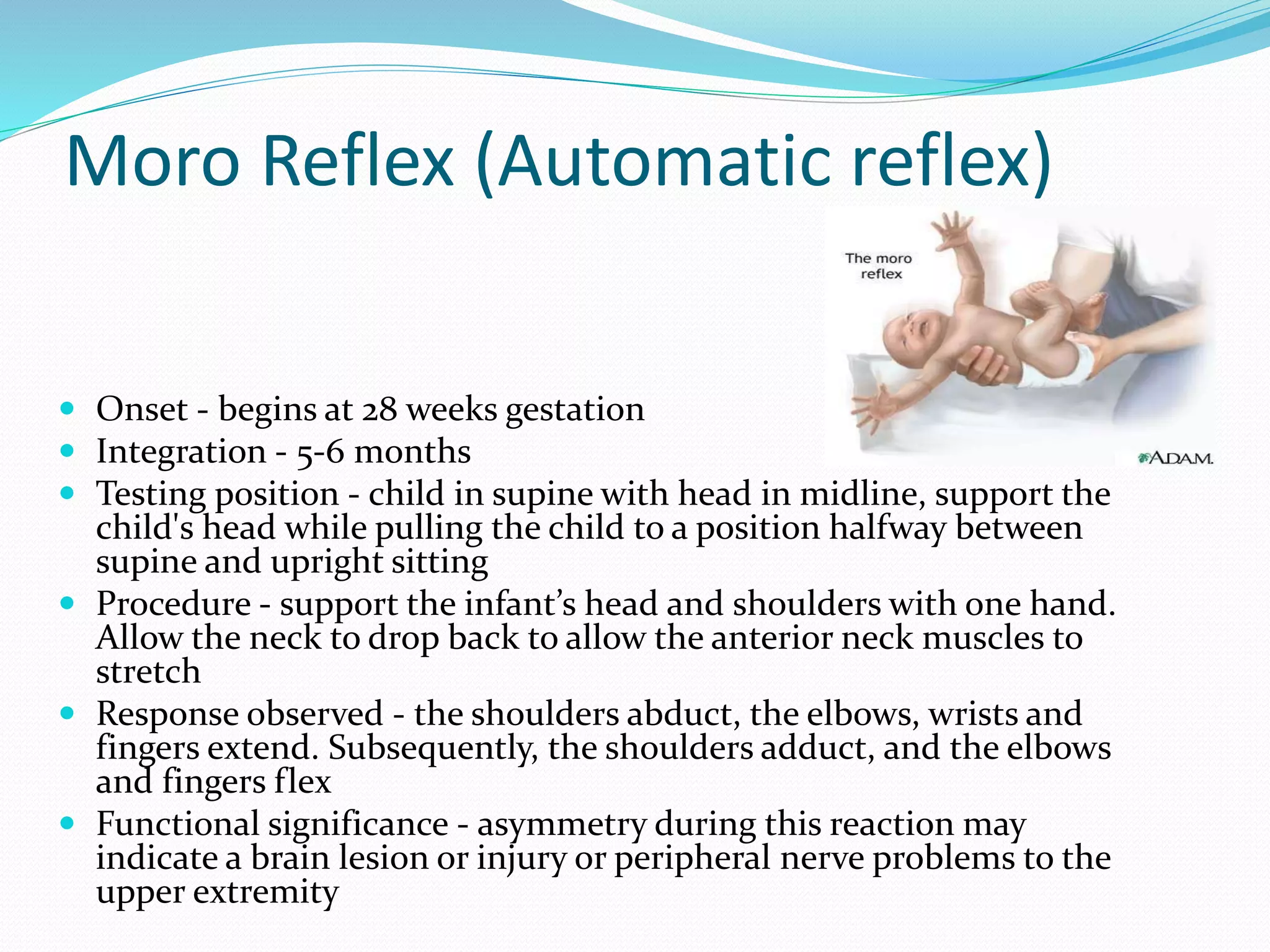
Moro Reflex (Automatic reflex)
 Onset - begins at 28 weeks gestation
 Integration - 5-6 months
 Testing position - child in supine with head in midline, support the
child's head while pulling the child to a position halfway between
supine and upright sitting
 Procedure - support the infant’s head and shoulders with one hand.
Allow the neck to drop back to allow the anterior neck muscles to
stretch
 Response observed - the shoulders abduct, the elbows, wrists and
fingers extend. Subsequently, the shoulders adduct, and the elbows
and fingers flex
 Functional significance - asymmetry during this reaction may
indicate a brain lesion or injury or peripheral nerve problems to the
upper extremity
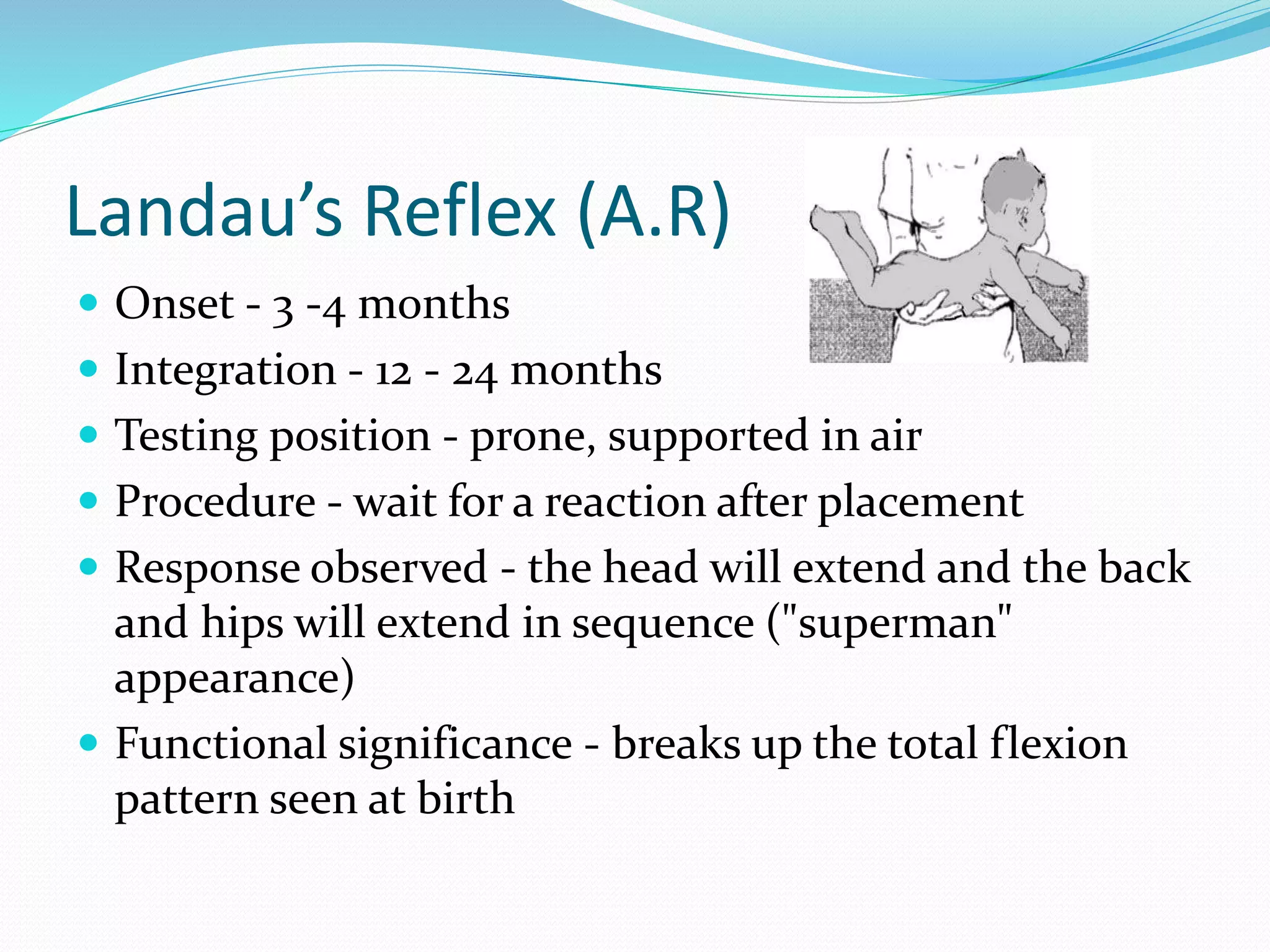
Landau’s Reflex (A.R)
 Onset - 3 -4 months
 Integration - 12 - 24 months
 Testing position - prone, supported in air
 Procedure - wait for a reaction after placement
 Response observed - the head will extend and the back
and hips will extend in sequence ("superman"
appearance)
 Functional significance - breaks up the total flexion
pattern seen at birth
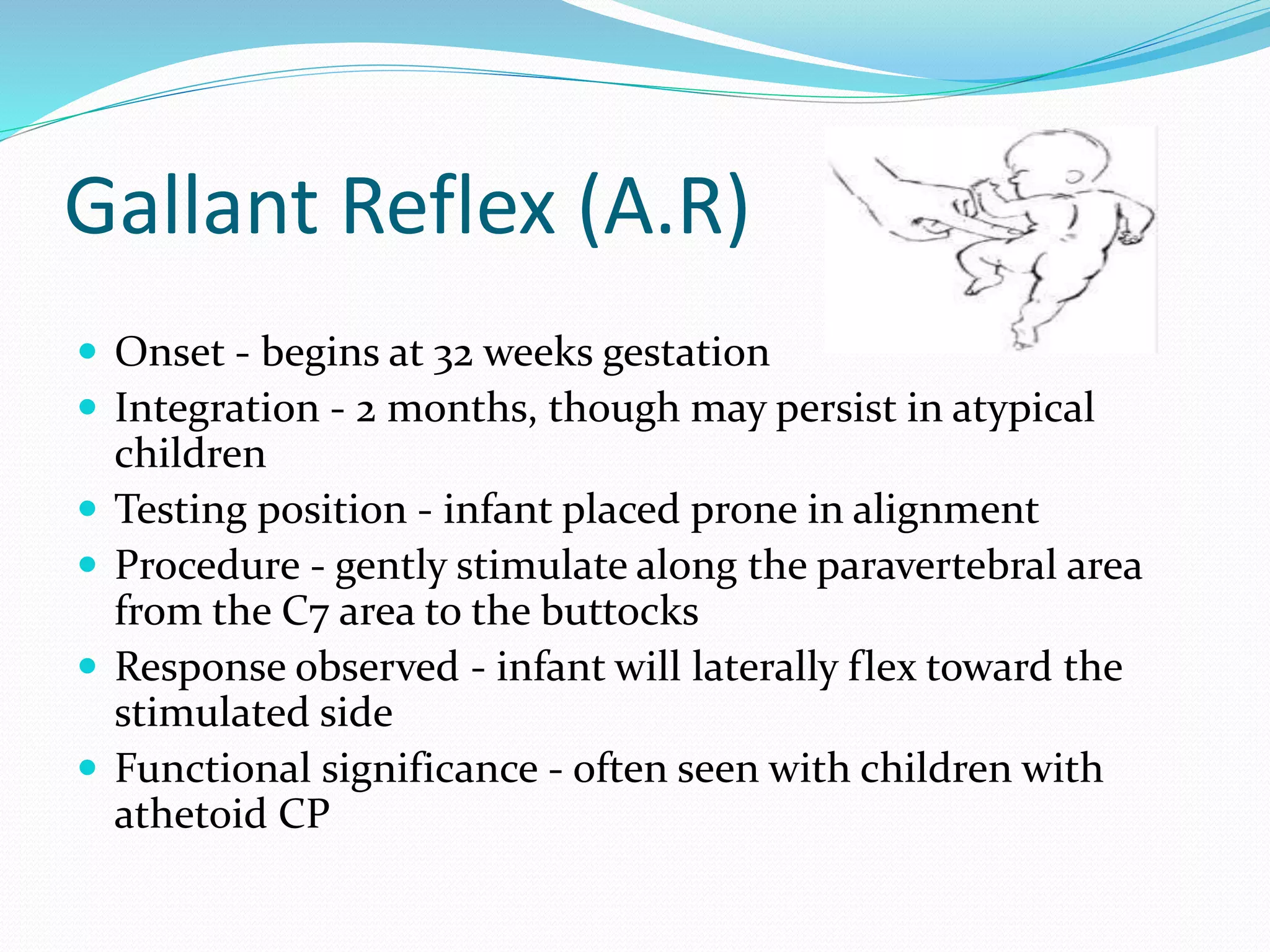
Gallant Reflex (A.R)
 Onset - begins at 32 weeks gestation
 Integration - 2 months, though may persist in atypical
children
 Testing position - infant placed prone in alignment
 Procedure - gently stimulate along the paravertebral area
from the C7 area to the buttocks
 Response observed - infant will laterally flex toward the
stimulated side
 Functional significance - often seen with children with
athetoid CP
Parachute reflex(A.R)
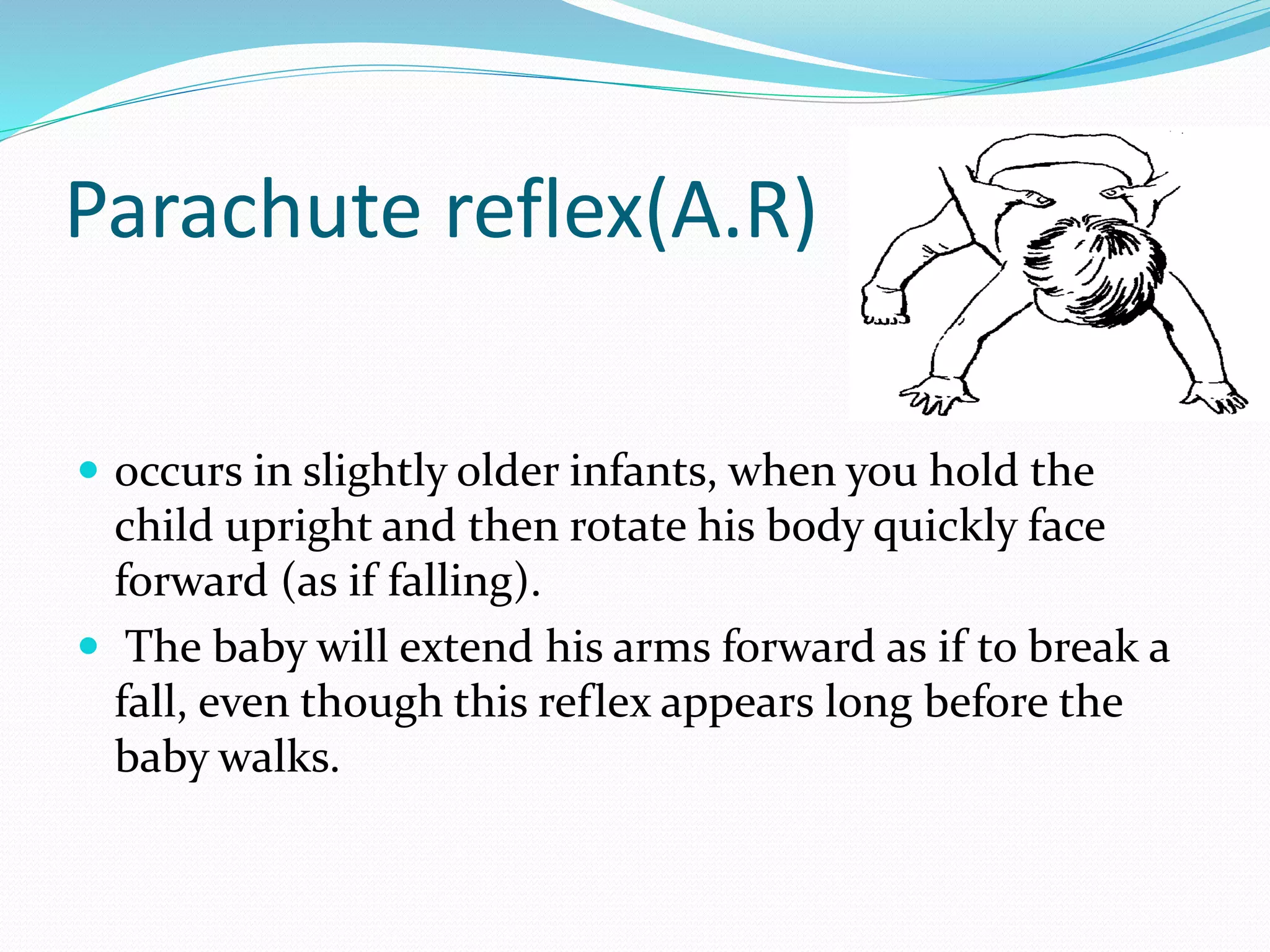
 occurs in slightly older infants, when you hold the
child upright and then rotate his body quickly face
forward (as if falling).
 The baby will extend his arms forward as if to break a
fall, even though this reflex appears long before the
baby walks.
Spinal reflexes
 Flexor withdrawal reflex
 Extensor trust
 Cross extensor
 Palmar grasp
 Plantar reflex
 Sucking reflex
 Rooting reflex
 Primitive walking
Flexior withdrawal
 Position- supine head in neutral position and legs
extended
 Stimulus- sole of foot
 response- uncontrolled flexion of stimulated
extremity
 Present –since birth
 disappears- by 2 months
Extensor trust
 Position- supine head neutral one leg extended and
the other flexed
 Stimulus- sole of flexed leg is given stroking
 Response – immediate extension ,adduction and
internal rotation of flexed led with plantar flexion of
foot
 Present at birth and integrated by 4 months
Sucking Reflex
 Onset - begins at 28 weeks gestation
 Integration - 2-5 months
 Testing position - infant supine with the head in
midline
 Procedure - place a finger of nipple into the infant’s
mouth
 Response observed - rhythmical sucking
 Functional significance - persistence of this reflex may
inhibit voluntary sucking
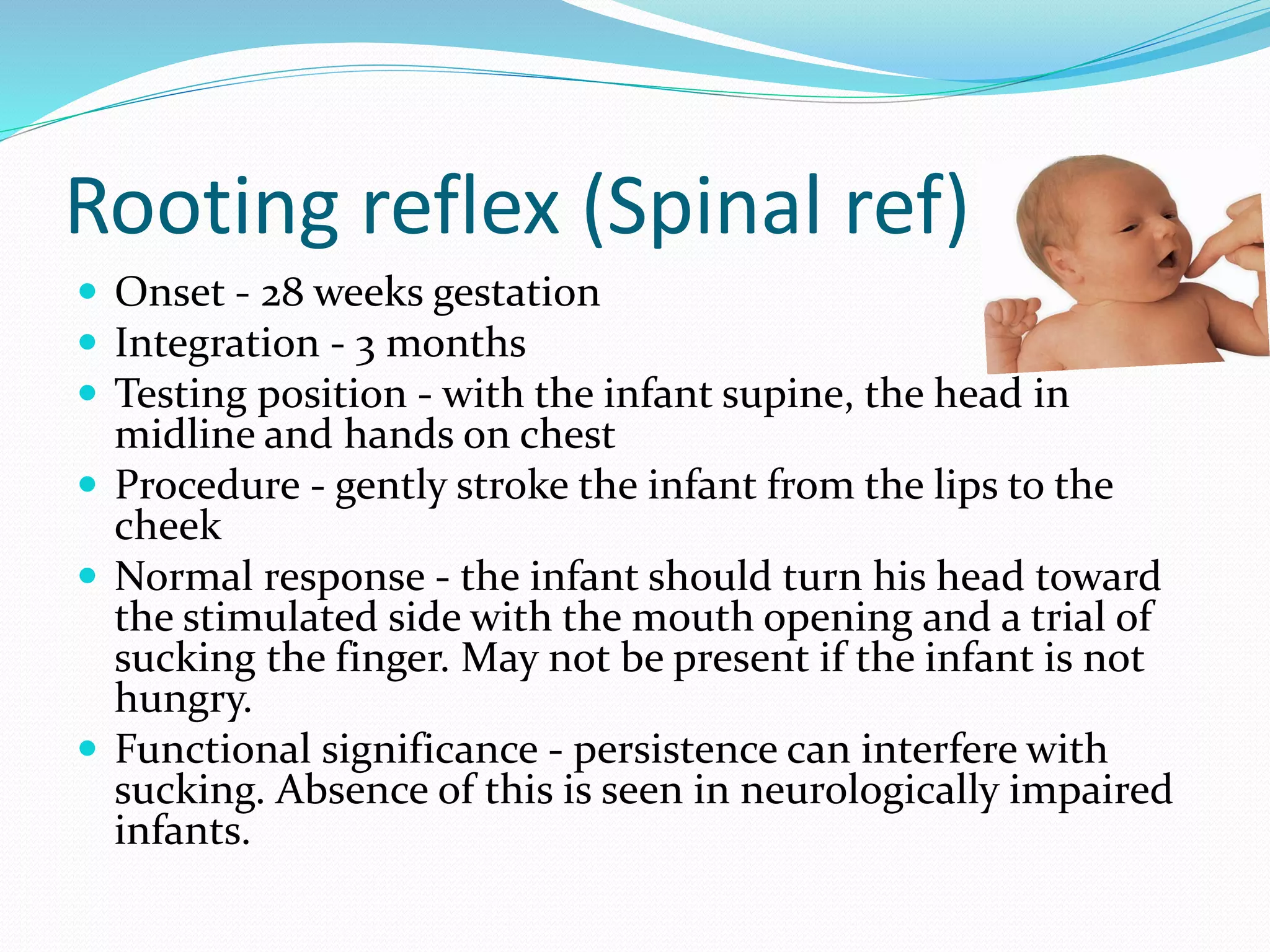
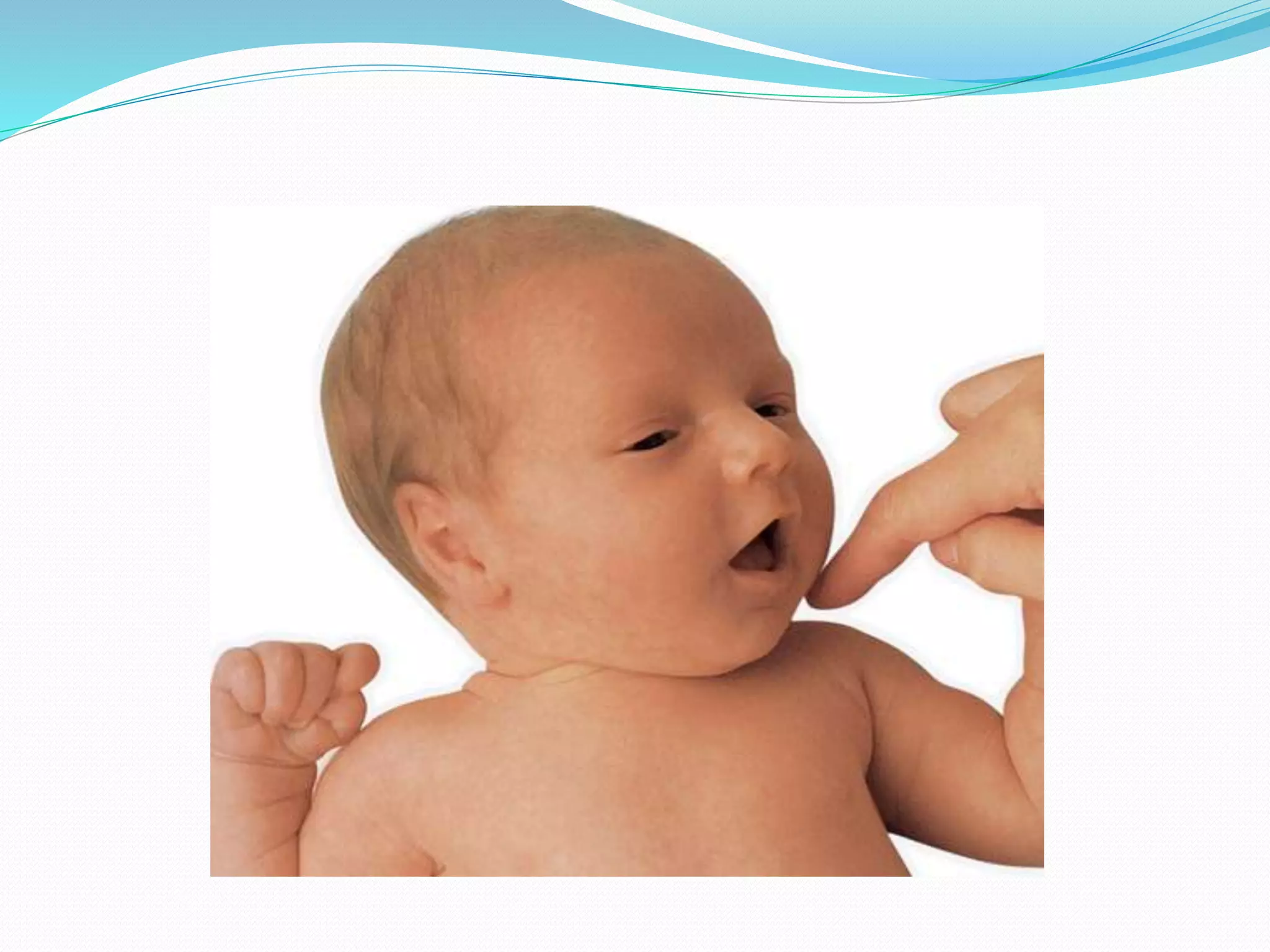
Rooting reflex (Spinal ref)
 Onset - 28 weeks gestation
 Integration - 3 months
 Testing position - with the infant supine, the head in
midline and hands on chest
 Procedure - gently stroke the infant from the lips to the
cheek
 Normal response - the infant should turn his head toward
the stimulated side with the mouth opening and a trial of
sucking the finger. May not be present if the infant is not
hungry.
 Functional significance - persistence can interfere with
sucking. Absence of this is seen in neurologically impaired
infants.
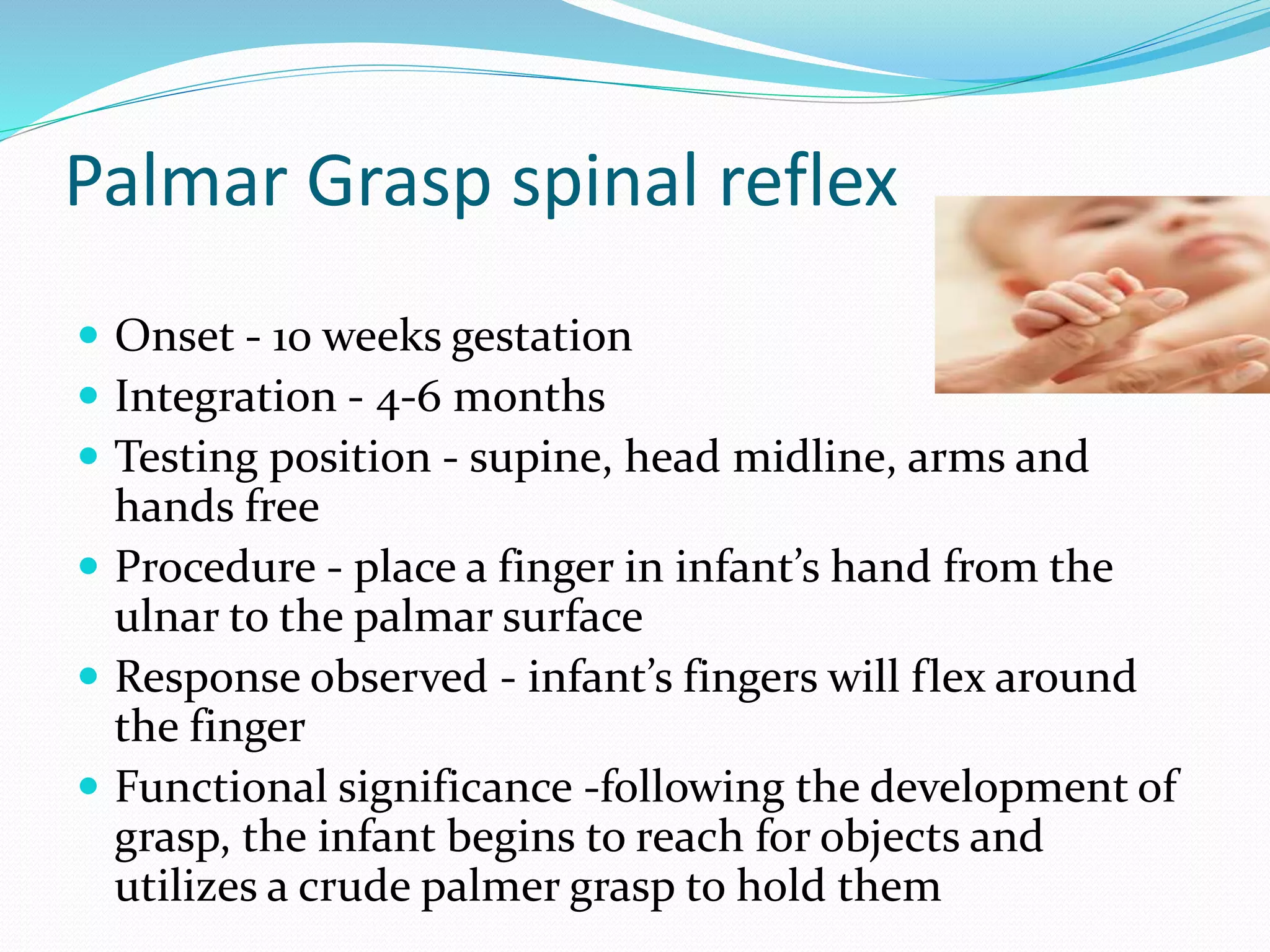
Palmar Grasp spinal reflex
 Onset - 10 weeks gestation
 Integration - 4-6 months
 Testing position - supine, head midline, arms and
hands free
 Procedure - place a finger in infant’s hand from the
ulnar to the palmar surface
 Response observed - infant’s fingers will flex around
the finger
 Functional significance -following the development of
grasp, the infant begins to reach for objects and
utilizes a crude palmer grasp to hold them
Plantar Reflex spinal reflex
 Onset -18 weeks in utero
 Integration – 6 months after birth
 Stimulated by stroking the sole of the foot:
 –toes of the foot should fanning out
 –the foot itself should curl in.
Onset - begins at 37 weeks gestation
Integration - 2 months
Testing position supported in the vertical position
Procedure - support the infant upright with the feet touching a hard surface.
Incline the infant forward and gently move the infant forward to accompany
any stepping
Response observed - alternating, rhythmical, and coordinated steps
Functional significance - premature infants will tend to walk in a roe-heel
fashion while more mature infants will walk in a heel-toe pattern.
Brainstem level reflex
 Symmetrical tonic neck reflex
 Asymmetrical tonic neck reflex
 Tonic labyrinthine reflex
 Positive supporting reaction
Symmetrical tonic reflex
 Onset – 0,4-6 months
 Integration - 8 - 12 months
 Testing position - child in quadruped position
on the floor or either in supine position
 Procedure - passively flex the head forward and
then extend it backwards
 Response observed - forward head flexion will
produce flexion of the upper extremities and
extension of the lower extremities; extension of
the head will produce extension of the upper
extremities and flexion of the lower extremities
 Functional significance - necessary to achieve
quadruped crawling
Asymmetrical tonic reflex
Brain stem reflex
 Onset - 0-2 months
 Integration - 4-6 months
 Testing position - supine
 Procedure - gently turn the infant’s head to one
side
 Response observed – UL and UL of opposite side
goes into flexion and on the same side ,limbs are
extended.
 Functional significance - persistence of this reflex
may indicate CNS damage
Tonic labyrinthine reflex
 Position either supine or prone
 Response: in supine extensor tone is present ,in prone
flexion tone is increased
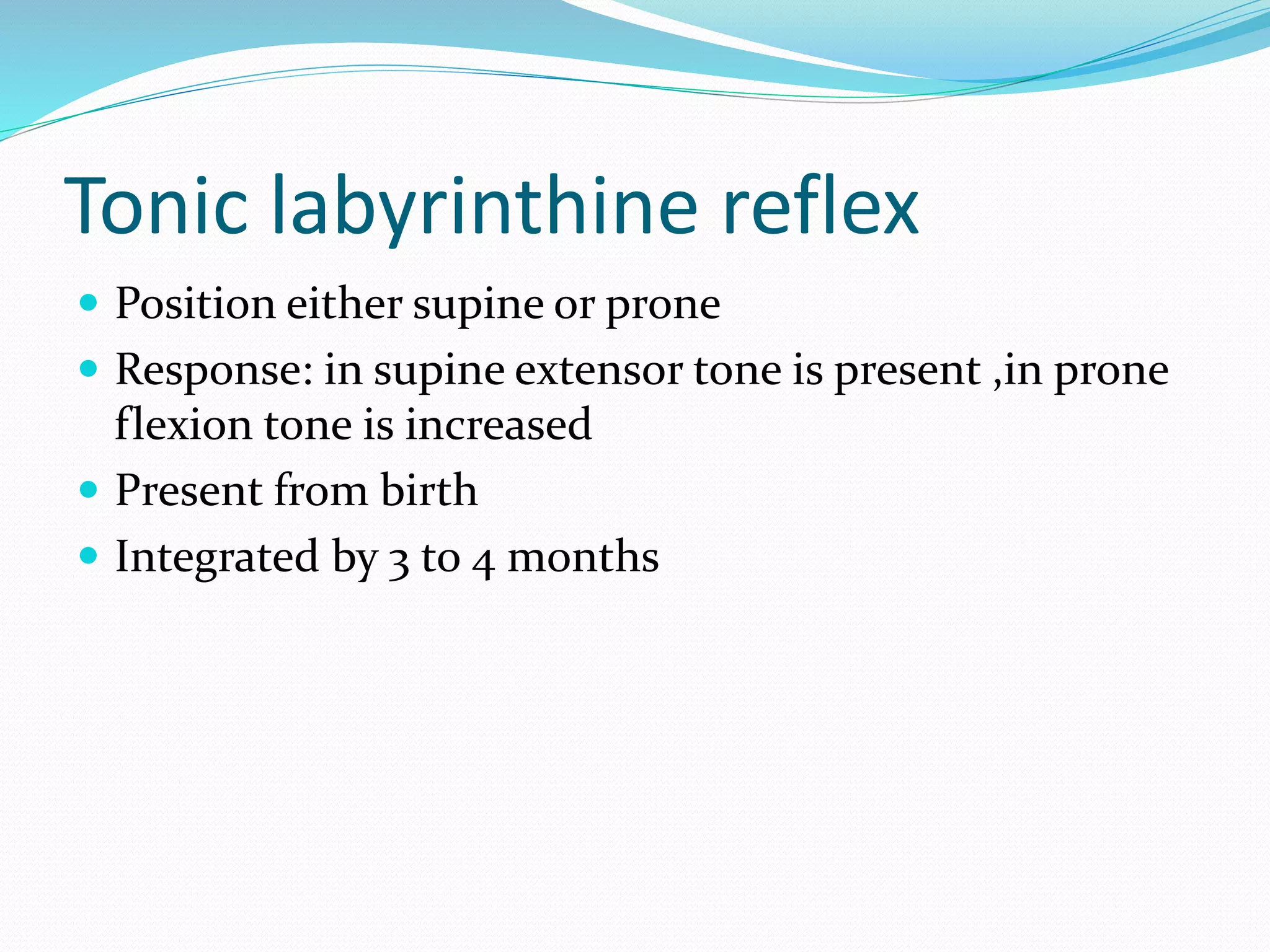
 Present from birth
 Integrated by 3 to 4 months
Positive supporting reaction
 Stimulus : hold child in eract position ,lift him up and
bounce up and down on plinth till sole of foot touches
the plinth
 Responce : exaggerated extension of the lower limbs
 This is present at birth and disappears within 3 to 4
months
Negative supporting reaction
 It can be checked by holding the child in weight
bearing position and suddenly lift him up
 The response is sudden flexion of the lower limb
 Present at birth and integrated by 4 months
Midbrain reflex
 Optical righting reflex
 Neck righting
Optical righting reflex
 Optical righting reflex
 Position – hold child from armpit in a suspended
position then change position of his head from side to
side
 response: eyes will always move to same side as head
 Appears by 1 to 2 year and remains throughout ones
life
Neck righting
 Position : supine blind folded ,rotate head to one side
 Response:body rotates to that side as a whole .
 Generally present at birth but a time may appear as
late as 3 months
Cortical level reflex
 This consists of all the equlibrium reactions
 Usually checked on tilt board or rocking board
Other reflex
ACOUSTIC REFLEX
 ALSO CALLED . STAPEDIUS REFLEX
 It is an involantary muscle contraction that occurs in
the middle ear of mammals in responce to high
intensity sound stimuli.
 Response in neonate ,in response of loud sound upper
limb goes in to extension ,abduction followed by
adduction and flexion.
 Functional significance –to locate injury to facial
nerve. as the stapedius muscle is innervated by the
facial nerve
Pupillary reflex
 reflex occurs with darkening the room and shining a
penlight directly into the neonate's eye for several
seconds.
 The pupils should both constrict equally; this reflex
should not disappear.
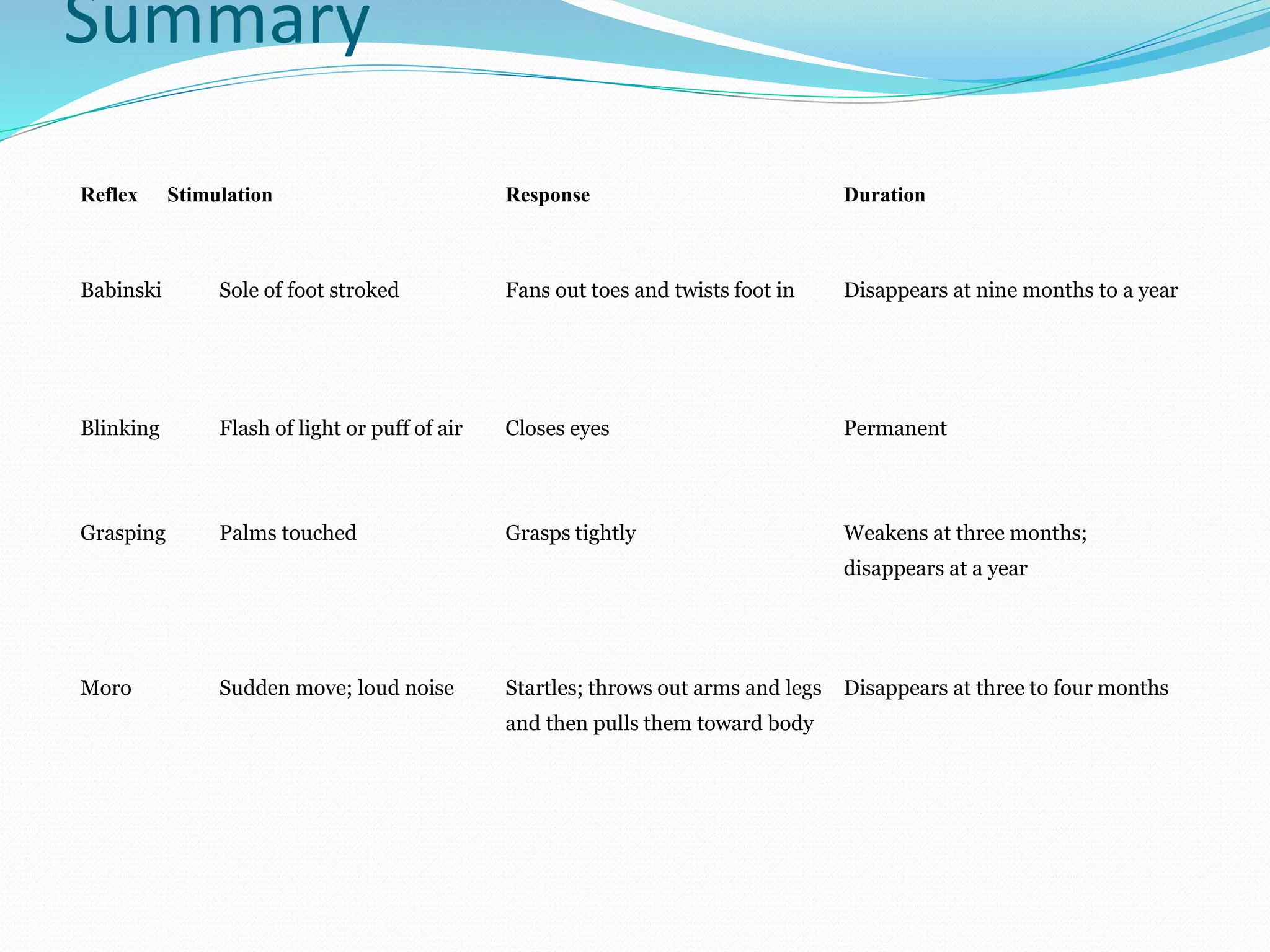
Reflex Stimulation Response Duration
Babinski Sole of foot stroked Fans out toes and twists foot in Disappears at nine months to a year
Blinking Flash of light or puff of air Closes eyes Permanent
Grasping Palms touched Grasps tightly Weakens at three months;
disappears at a year
Moro Sudden move; loud noise Startles; throws out arms and legs
and then pulls them toward body
Disappears at three to four months
Summary
Rooting Cheek stroked or side of mouth touched Turns toward source, opens mouth and
sucks
Disappears at three to four months
Stepping Infant held upright with feet
touching ground
Moves feet as if to walk Disappears at three to four months
Sucking Mouth touched by object Sucks on object Disappears at three to four months
tonic neck Placed on back Makes fists and turns head to
the right
Disappears at two months
Thank you   
Neonatal reflexes  by baneet

Neonatal reflexes by baneet

  • 1.
    By DR. BANEETSHARMA (p.t)
  • 2.
    Contents  Introduction  Defination Why it iz necessory  Reflexes  Sucking reflex  Rooting reflex  Moro reflex  Asymmetrical tonic neck reflex  Symmetric tonic reflex  Palmar grasp reflex  Landaus reflex  Plantar reflex  Gallant reflex  Stepping reflex  Parachute reflex  Pupillary reflex  Acoustic reflex
  • 3.
  • 4.
    Also known as Infantile  Infant  Newborn reflexes
  • 5.
    Introduction 1) Transition froman aquatic environment to a world of air . The first breath begins even before the umbilical cord is cut. 2)Eat and digest his or her own food since . 3)Maintain his or her own body temperature. 4)Excrete his or her own wastes. 5)Adjust to intermittent feeding since food is now only available to certain intervals. At birth, the neonate must immediately make five major adjustments. A normal birth is considered fully term if the delivery occurs during the 37th to 40th week after conception. Developmentally, the baby is considered a neonate for the first 28 days of life.
  • 6.
    Period of growth Prenatalperiod Ovum Embryo fetus 0 to 14 days 14 days to 9 weeks 9 weeks to birth Perinatal period 22 weeks of gestation to 7 days after birth Postnatal period New born Infancy Toddler Preschool child First 4 weeks after birth First year 1 to 3 years 3 to 6 years School age child 6 to 10 years {girls} 6 to 12 years{boys}
  • 7.
  • 8.
    Neonatal reflexes orprimitive reflexes are the inborn behavioral patterns that develop during uterine life.  They should be fully present at birth and are gradually inhibited by higher centers in the brain during the first 3 to 12 months of postnatal life.
  • 9.
    Reflexes which areessential for a newborn’s survival immediately after birth reflexes sucking swallowing blinking defecating Urinating Hiccupping
  • 10.
     Under normaldevelopmental conditions, these neonatal reflexes represent important reactions of the nervous system and are only observable within a specific period of time over the first few months of life.  The following reflexes are normally present from birth and are part of a normal newborn evaluation  A normally developing newborn should respond to certain stimuli with these reflexes, which eventually become inhibited as the child matures
  • 11.
    Why neonatal reflexesare necessary to asses  Most primitive reflexes begin to occur in utero through the early months of the child’s postnatal life.  •These reflexes are then replaced by voluntary motor skills.  •When the reflexes are not inhibited, there is usually a neurological problem at hand.  •In those individuals with cerebral palsy and neurogenic dysphagia, the presence of primitive reflexes is a characteristic
  • 12.
    Classification of reflexes Automatic Spinalcord Brain stem midbrain cortex
  • 13.
  • 14.
    Moro Reflex (Automaticreflex)  Onset - begins at 28 weeks gestation  Integration - 5-6 months  Testing position - child in supine with head in midline, support the child's head while pulling the child to a position halfway between supine and upright sitting  Procedure - support the infant’s head and shoulders with one hand. Allow the neck to drop back to allow the anterior neck muscles to stretch  Response observed - the shoulders abduct, the elbows, wrists and fingers extend. Subsequently, the shoulders adduct, and the elbows and fingers flex  Functional significance - asymmetry during this reaction may indicate a brain lesion or injury or peripheral nerve problems to the upper extremity
  • 16.
    Landau’s Reflex (A.R) Onset - 3 -4 months  Integration - 12 - 24 months  Testing position - prone, supported in air  Procedure - wait for a reaction after placement  Response observed - the head will extend and the back and hips will extend in sequence ("superman" appearance)  Functional significance - breaks up the total flexion pattern seen at birth
  • 18.
    Gallant Reflex (A.R) Onset - begins at 32 weeks gestation  Integration - 2 months, though may persist in atypical children  Testing position - infant placed prone in alignment  Procedure - gently stimulate along the paravertebral area from the C7 area to the buttocks  Response observed - infant will laterally flex toward the stimulated side  Functional significance - often seen with children with athetoid CP
  • 20.
    Parachute reflex(A.R)  occursin slightly older infants, when you hold the child upright and then rotate his body quickly face forward (as if falling).  The baby will extend his arms forward as if to break a fall, even though this reflex appears long before the baby walks.
  • 22.
    Spinal reflexes  Flexorwithdrawal reflex  Extensor trust  Cross extensor  Palmar grasp  Plantar reflex  Sucking reflex  Rooting reflex  Primitive walking
  • 23.
    Flexior withdrawal  Position-supine head in neutral position and legs extended  Stimulus- sole of foot  response- uncontrolled flexion of stimulated extremity  Present –since birth  disappears- by 2 months
  • 24.
    Extensor trust  Position-supine head neutral one leg extended and the other flexed  Stimulus- sole of flexed leg is given stroking  Response – immediate extension ,adduction and internal rotation of flexed led with plantar flexion of foot  Present at birth and integrated by 4 months
  • 25.
    Sucking Reflex  Onset- begins at 28 weeks gestation  Integration - 2-5 months  Testing position - infant supine with the head in midline  Procedure - place a finger of nipple into the infant’s mouth  Response observed - rhythmical sucking  Functional significance - persistence of this reflex may inhibit voluntary sucking
  • 27.
    Rooting reflex (Spinalref)  Onset - 28 weeks gestation  Integration - 3 months  Testing position - with the infant supine, the head in midline and hands on chest  Procedure - gently stroke the infant from the lips to the cheek  Normal response - the infant should turn his head toward the stimulated side with the mouth opening and a trial of sucking the finger. May not be present if the infant is not hungry.  Functional significance - persistence can interfere with sucking. Absence of this is seen in neurologically impaired infants.
  • 29.
    Palmar Grasp spinalreflex  Onset - 10 weeks gestation  Integration - 4-6 months  Testing position - supine, head midline, arms and hands free  Procedure - place a finger in infant’s hand from the ulnar to the palmar surface  Response observed - infant’s fingers will flex around the finger  Functional significance -following the development of grasp, the infant begins to reach for objects and utilizes a crude palmer grasp to hold them
  • 31.
    Plantar Reflex spinalreflex  Onset -18 weeks in utero  Integration – 6 months after birth  Stimulated by stroking the sole of the foot:  –toes of the foot should fanning out  –the foot itself should curl in.
  • 33.
    Onset - beginsat 37 weeks gestation Integration - 2 months Testing position supported in the vertical position Procedure - support the infant upright with the feet touching a hard surface. Incline the infant forward and gently move the infant forward to accompany any stepping Response observed - alternating, rhythmical, and coordinated steps Functional significance - premature infants will tend to walk in a roe-heel fashion while more mature infants will walk in a heel-toe pattern.
  • 35.
    Brainstem level reflex Symmetrical tonic neck reflex  Asymmetrical tonic neck reflex  Tonic labyrinthine reflex  Positive supporting reaction
  • 36.
    Symmetrical tonic reflex Onset – 0,4-6 months  Integration - 8 - 12 months  Testing position - child in quadruped position on the floor or either in supine position  Procedure - passively flex the head forward and then extend it backwards  Response observed - forward head flexion will produce flexion of the upper extremities and extension of the lower extremities; extension of the head will produce extension of the upper extremities and flexion of the lower extremities  Functional significance - necessary to achieve quadruped crawling
  • 37.
    Asymmetrical tonic reflex Brainstem reflex  Onset - 0-2 months  Integration - 4-6 months  Testing position - supine  Procedure - gently turn the infant’s head to one side  Response observed – UL and UL of opposite side goes into flexion and on the same side ,limbs are extended.  Functional significance - persistence of this reflex may indicate CNS damage
  • 39.
    Tonic labyrinthine reflex Position either supine or prone  Response: in supine extensor tone is present ,in prone flexion tone is increased  Present from birth  Integrated by 3 to 4 months
  • 40.
    Positive supporting reaction Stimulus : hold child in eract position ,lift him up and bounce up and down on plinth till sole of foot touches the plinth  Responce : exaggerated extension of the lower limbs  This is present at birth and disappears within 3 to 4 months
  • 41.
    Negative supporting reaction It can be checked by holding the child in weight bearing position and suddenly lift him up  The response is sudden flexion of the lower limb  Present at birth and integrated by 4 months
  • 42.
    Midbrain reflex  Opticalrighting reflex  Neck righting
  • 43.
    Optical righting reflex Optical righting reflex  Position – hold child from armpit in a suspended position then change position of his head from side to side  response: eyes will always move to same side as head  Appears by 1 to 2 year and remains throughout ones life
  • 44.
    Neck righting  Position: supine blind folded ,rotate head to one side  Response:body rotates to that side as a whole .  Generally present at birth but a time may appear as late as 3 months
  • 45.
    Cortical level reflex This consists of all the equlibrium reactions  Usually checked on tilt board or rocking board
  • 46.
  • 47.
    ACOUSTIC REFLEX  ALSOCALLED . STAPEDIUS REFLEX  It is an involantary muscle contraction that occurs in the middle ear of mammals in responce to high intensity sound stimuli.  Response in neonate ,in response of loud sound upper limb goes in to extension ,abduction followed by adduction and flexion.  Functional significance –to locate injury to facial nerve. as the stapedius muscle is innervated by the facial nerve
  • 48.
    Pupillary reflex  reflexoccurs with darkening the room and shining a penlight directly into the neonate's eye for several seconds.  The pupils should both constrict equally; this reflex should not disappear.
  • 49.
    Reflex Stimulation ResponseDuration Babinski Sole of foot stroked Fans out toes and twists foot in Disappears at nine months to a year Blinking Flash of light or puff of air Closes eyes Permanent Grasping Palms touched Grasps tightly Weakens at three months; disappears at a year Moro Sudden move; loud noise Startles; throws out arms and legs and then pulls them toward body Disappears at three to four months Summary
  • 50.
    Rooting Cheek strokedor side of mouth touched Turns toward source, opens mouth and sucks Disappears at three to four months Stepping Infant held upright with feet touching ground Moves feet as if to walk Disappears at three to four months Sucking Mouth touched by object Sucks on object Disappears at three to four months tonic neck Placed on back Makes fists and turns head to the right Disappears at two months
  • 51.