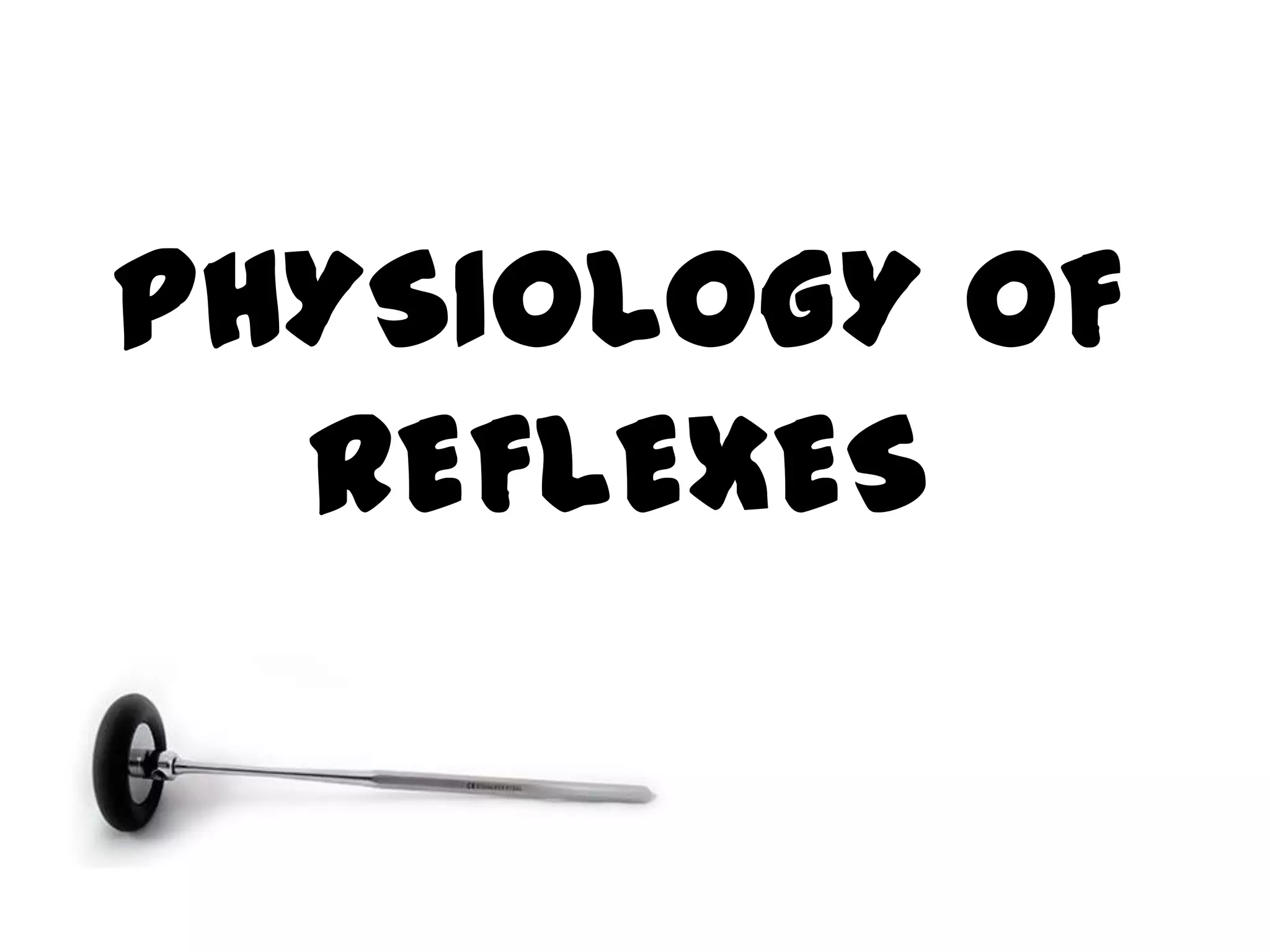
PHYSIOLOGY OF
  REFLEXES
Definition

Classification

Characteristics of reflexes

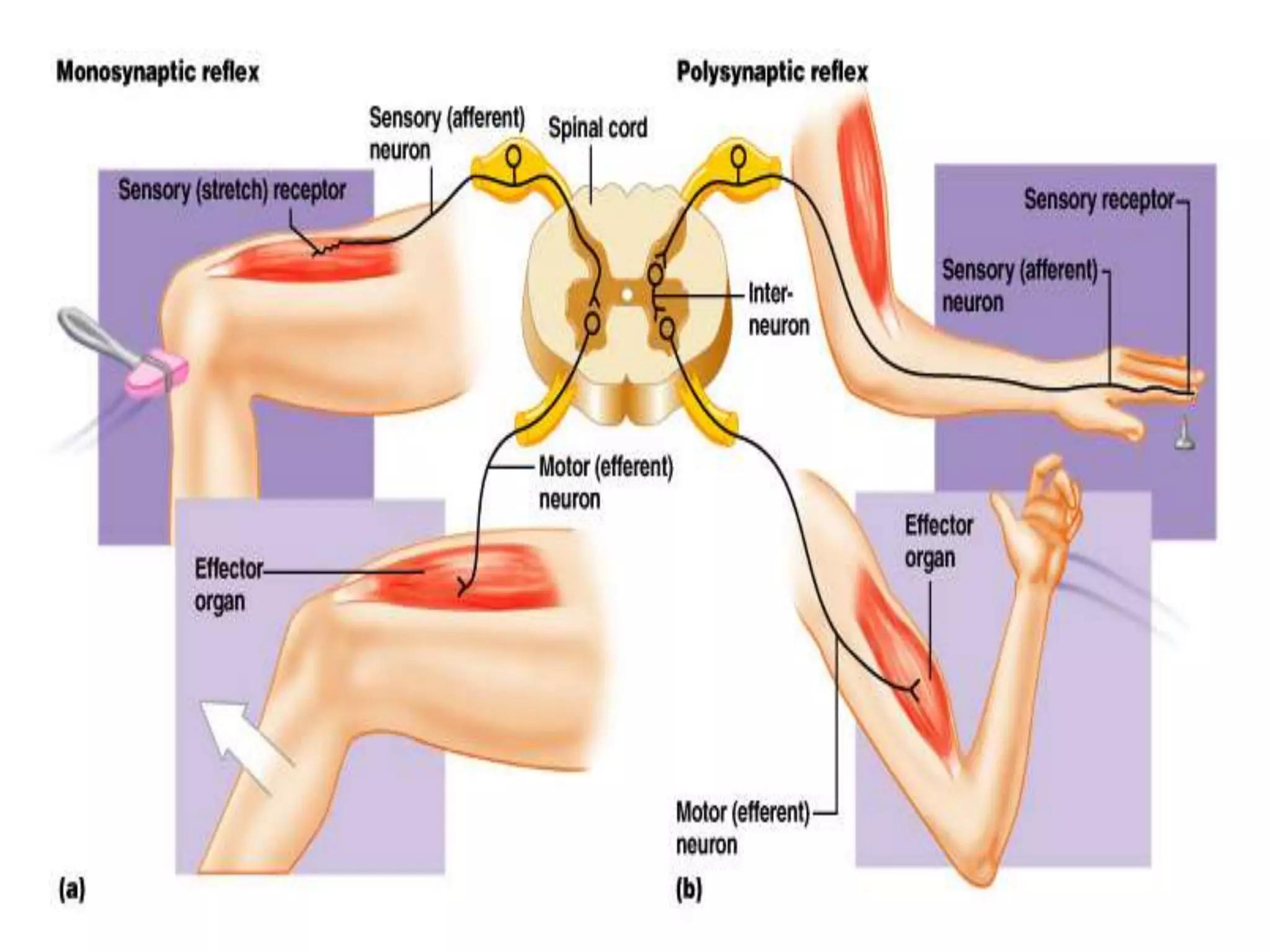
Monosynaptic reflexes

Polysynaptic reflexes

Others
Definition

 Coordinated
 involuntary motor response
 initiated by stimulus,
 applied to peripheral receptors.
• Basic unit of integrated reflex activity is
                                     REFLEX ARC.
    it has 5 components :

1.   Receptor   - muscle spindle       ( DTR)
2.   Afferent   - 1a , II fibers
3.   Centre     - spinal cord
4.   Efferent   - motor nerve
5.   Effector   - extrafusal fibers.
Definition

Classification

Characteristics of reflexes

Monosynaptic reflexes

Polysynaptic reflexes

Others
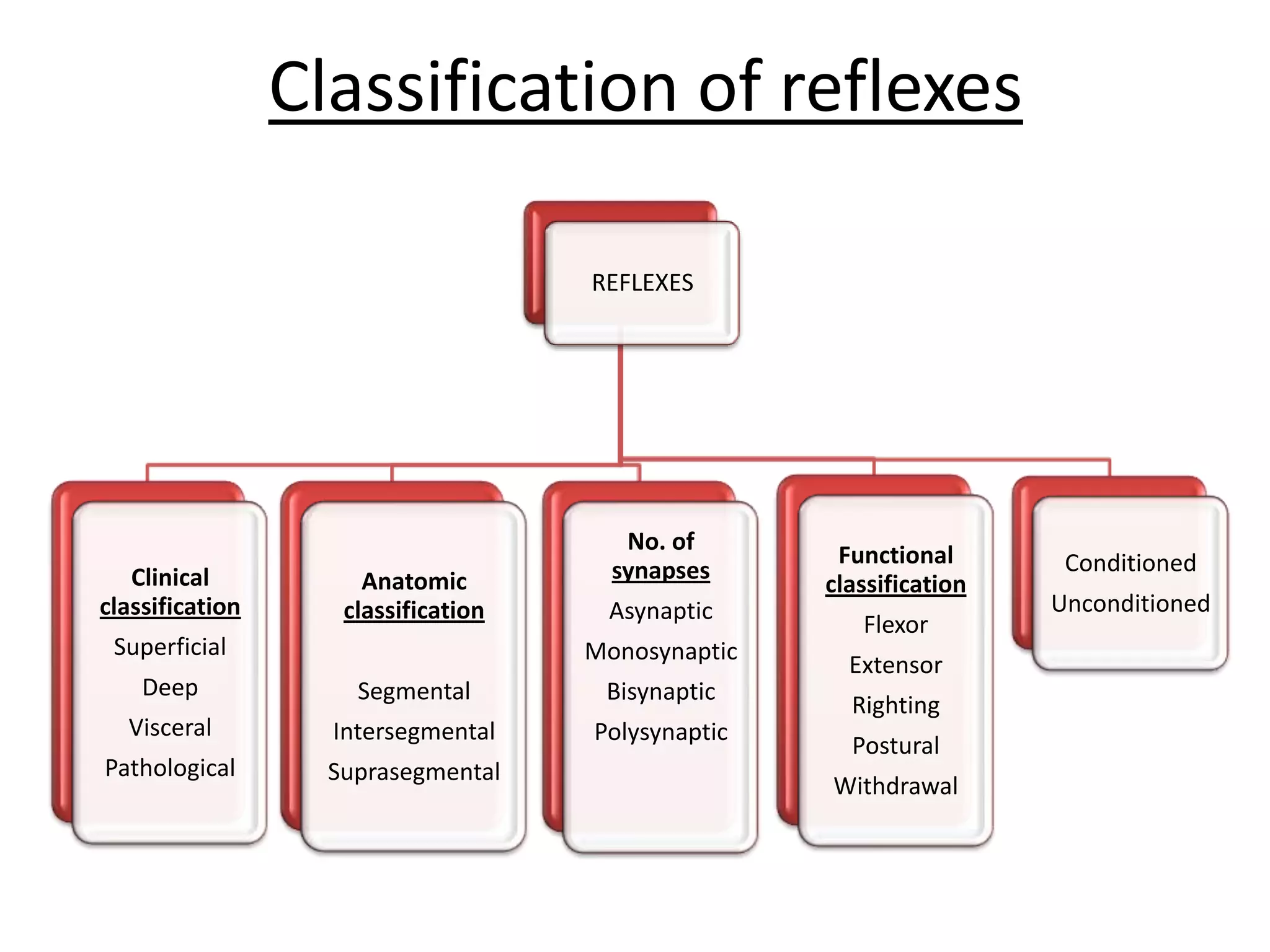
Classification of reflexes

                                     REFLEXES


                                        No. of
                                                     Functional       Conditioned
   Clinical           Anatomic         synapses
                                                    classification
classification      classification    Asynaptic                      Unconditioned
                                                       Flexor
 Superficial                         Monosynaptic
                                                      Extensor
    Deep             Segmental        Bisynaptic
                                                      Righting
  Visceral         Intersegmental    Polysynaptic
                                                      Postural
Pathological       Suprasegmental
                                                    Withdrawal
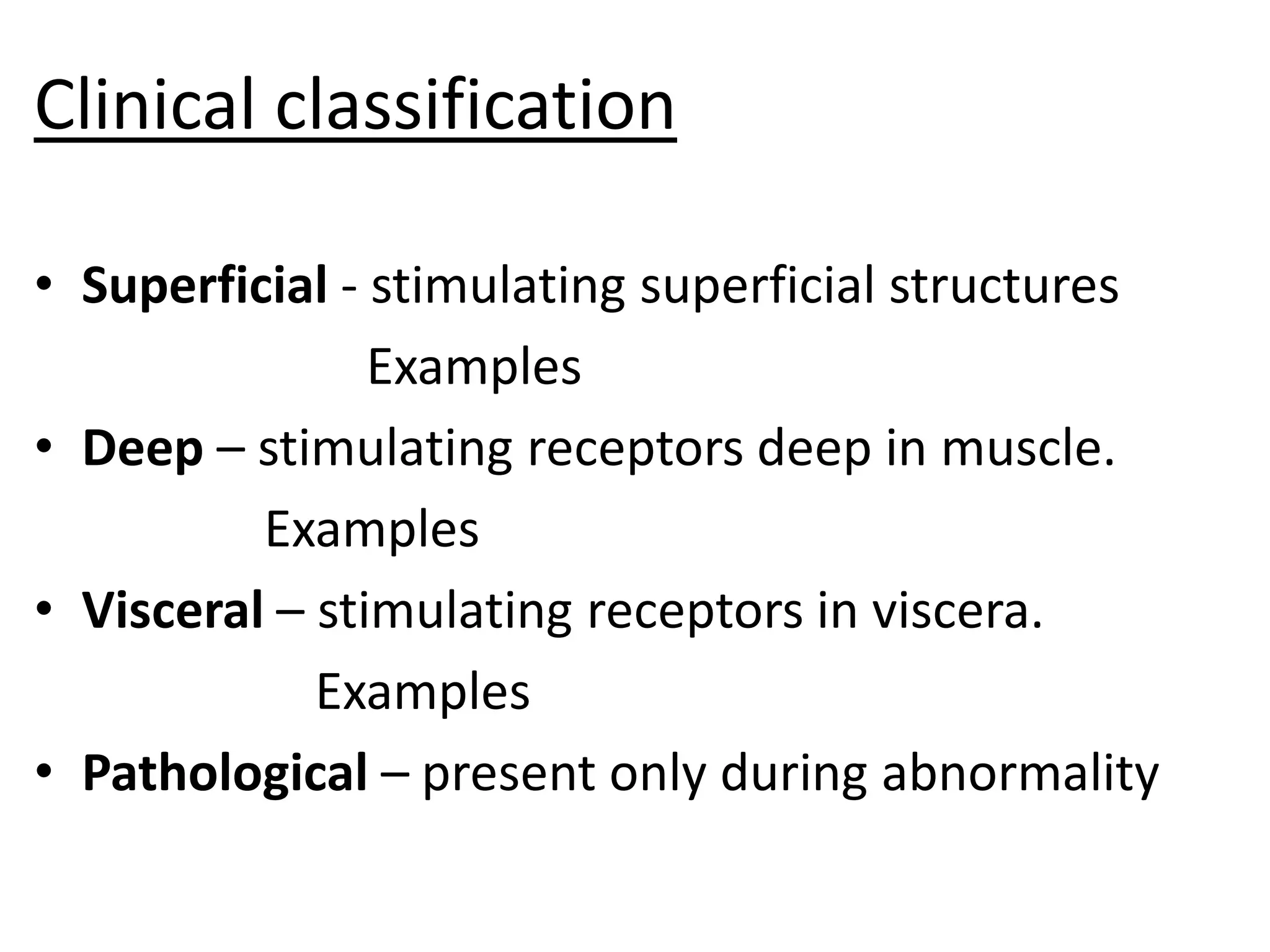
Clinical classification

• Superficial - stimulating superficial structures
                Examples
• Deep – stimulating receptors deep in muscle.
          Examples
• Visceral – stimulating receptors in viscera.
             Examples
• Pathological – present only during abnormality
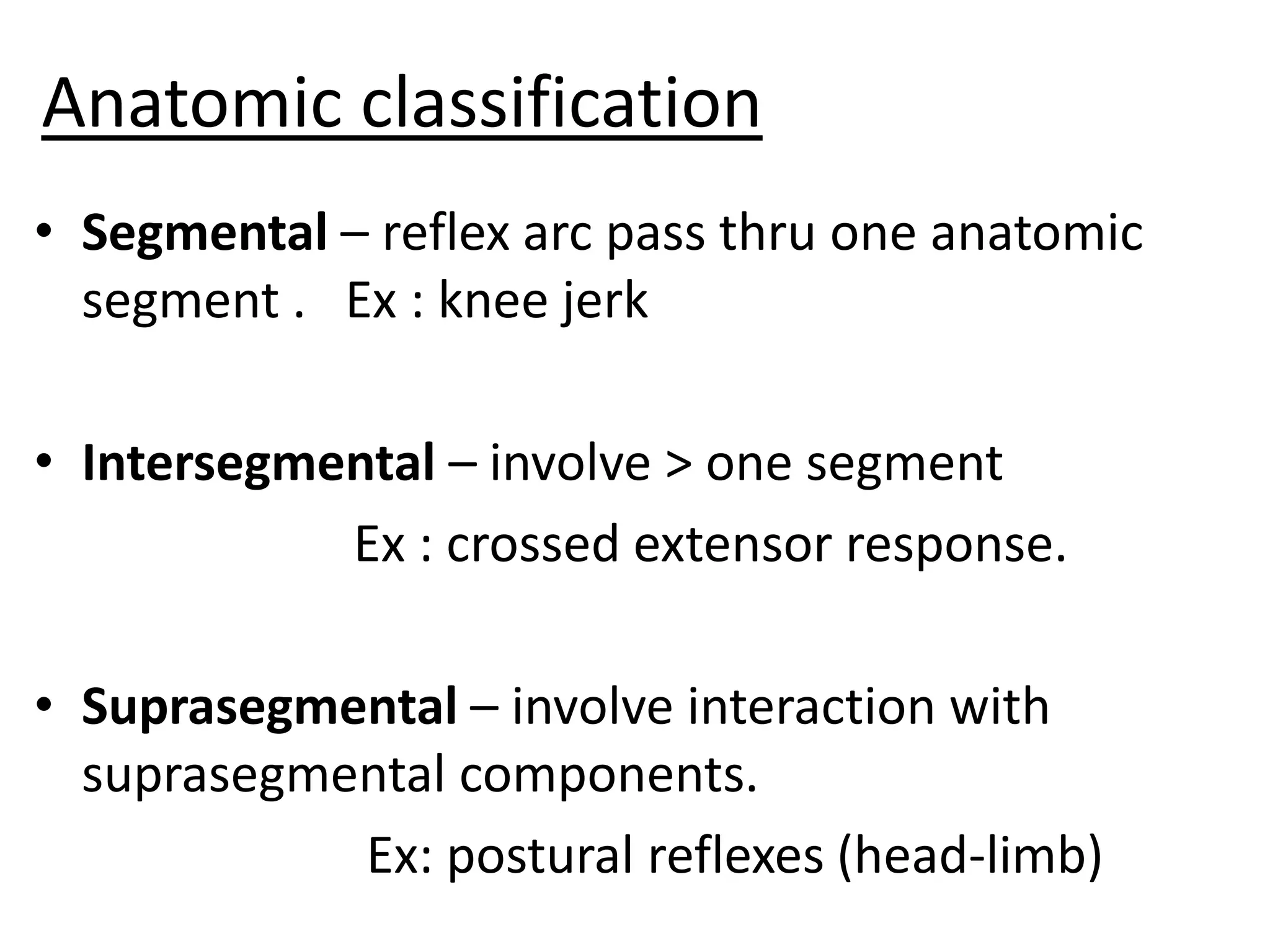
Anatomic classification
• Segmental – reflex arc pass thru one anatomic
  segment . Ex : knee jerk

• Intersegmental – involve > one segment
            Ex : crossed extensor response.

• Suprasegmental – involve interaction with
  suprasegmental components.
            Ex: postural reflexes (head-limb)
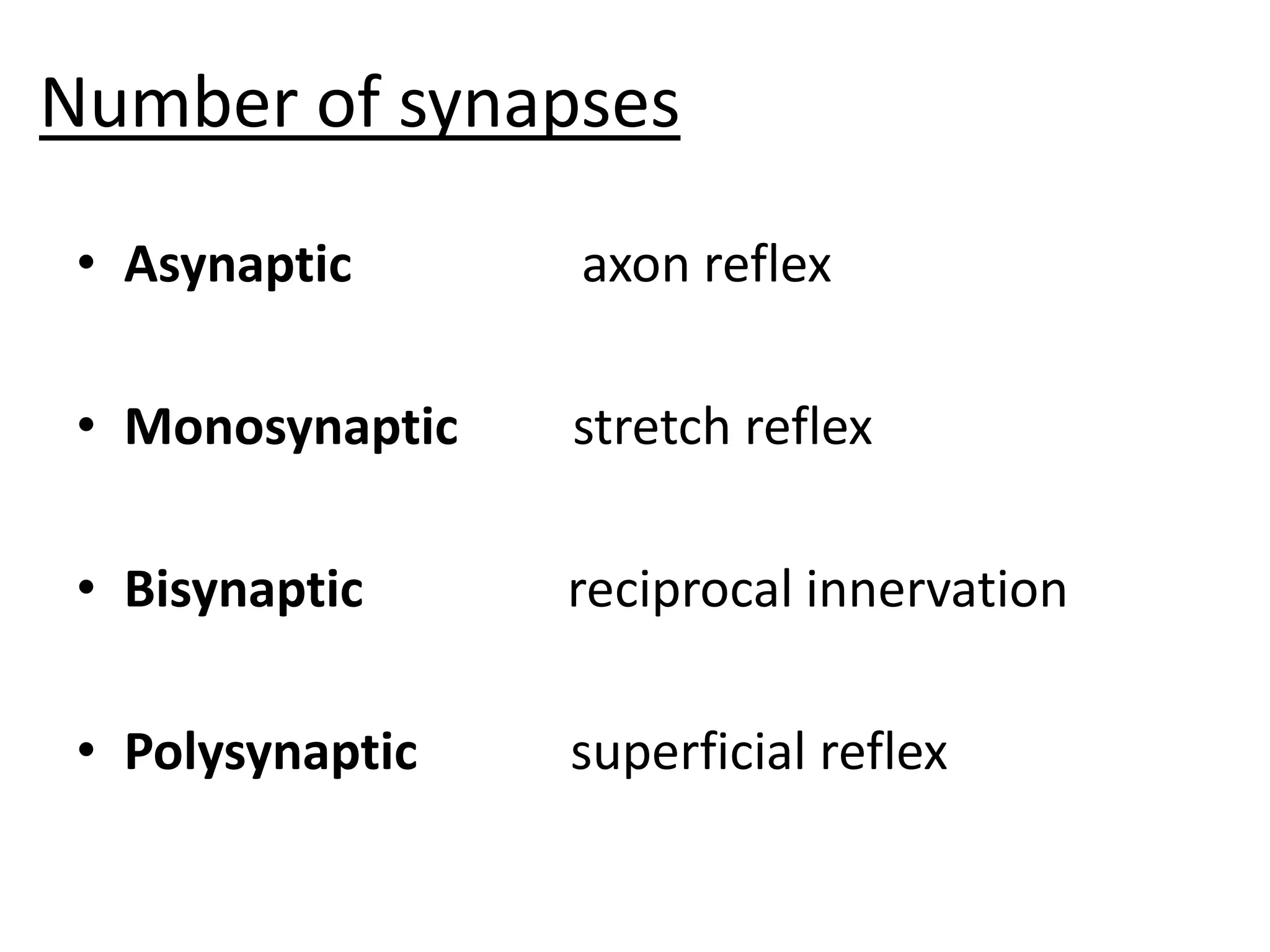
Number of synapses
 • Asynaptic      axon reflex

 • Monosynaptic   stretch reflex

 • Bisynaptic     reciprocal innervation

 • Polysynaptic   superficial reflex
Functional classification
•   Flexor reflexes
•   Extensor reflexes
•   Righting reflexes
•   Postural reflexes
•   Withdrawal reflexes
Others
• Unconditioned reflexes – inborn or inherent
  reflexes .
• Conditioned reflexes – acquired reflexes.


  Secretion of saliva when food is kept in mouth is
  unconditioned reflex and,
  secretion even with thought is ‘conditioned’.
Definition

Classification

Characteristics of reflexes

Monosynaptic reflexes

Polysynaptic reflexes

Others
MONOSYNAPTIC REFLEXES
• Stretch reflex

• Inverse stretch reflex

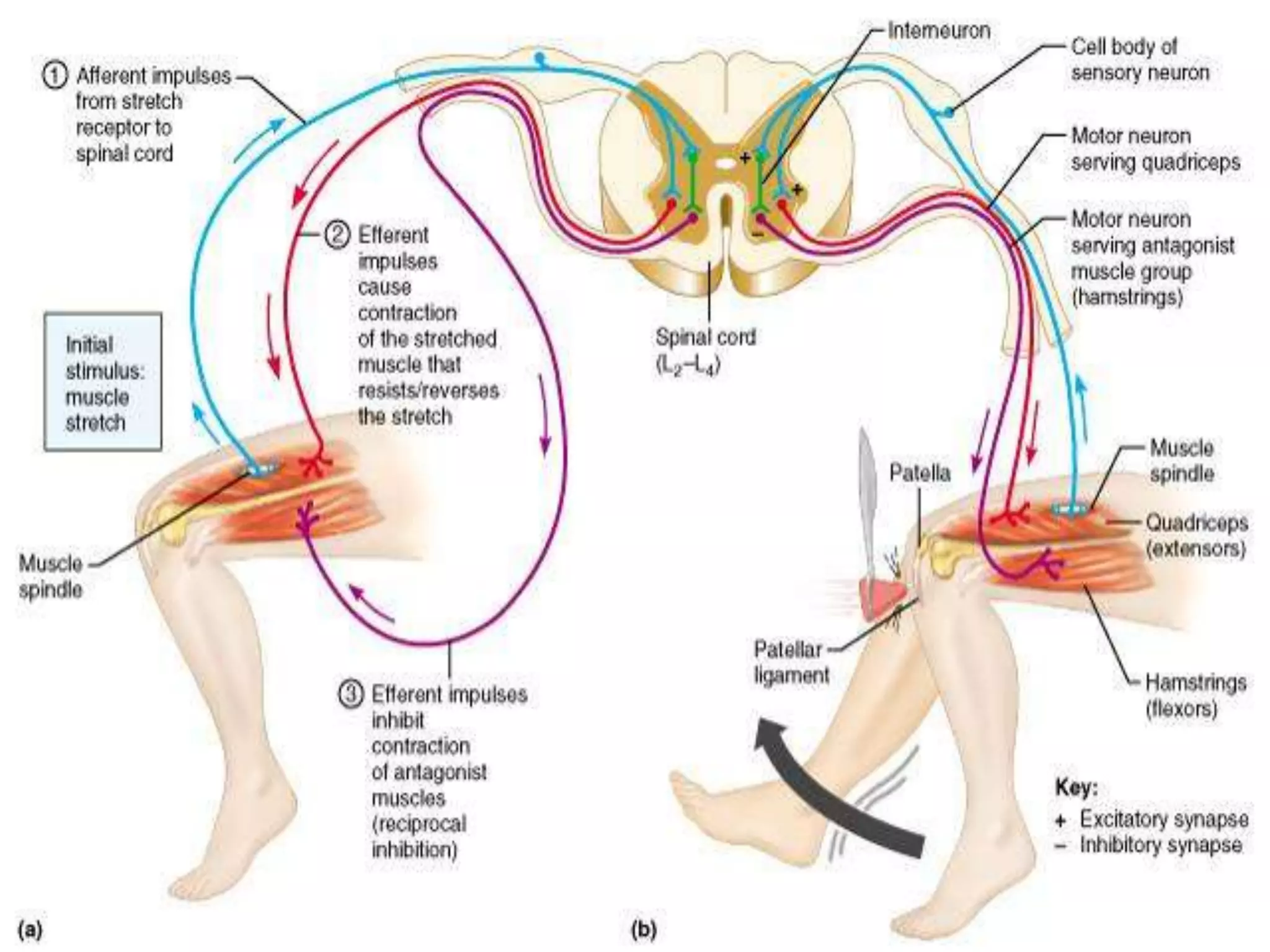
• Reciprocal innervation

• Clonus
Stretch reflex
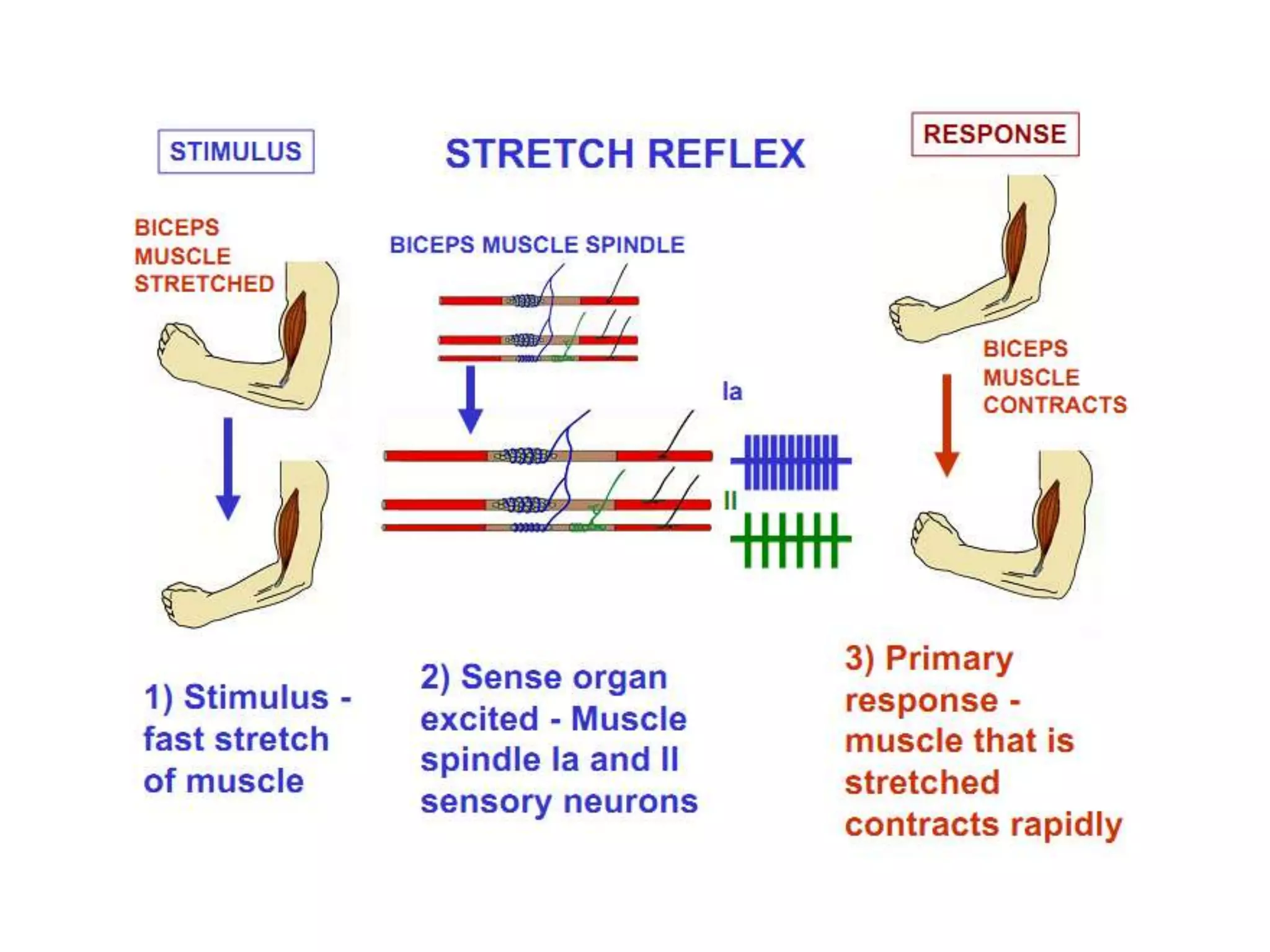
• When a skeletal muscle with intact nerve
  supply is stretched, it contracts – stretch reflex.

• Stimulus – stretch
• Response – contraction
• Sense organ – muscle spindle
Muscle spindle

• Proprioceptor present in skeletal muscle.

• 6-14 muscle fibers - Intrafusal fibers (IFF) - in a
  spindle shaped fibrous sheath.

NBF - nuclear bag fibers
NCF – nuclear chain fibers
• Afferents : I a and II fibers
I a - from central part of all fibers (annulospiral ends)
II – only from NCF ( flower spray ends )

• Efferent :
      gamma fibers to both NBF and NCF.
      alpha motor neurons supply extrafusal fibers

I a and gamma 1 – dynamic response
II and gamma 2 – static response
Functions of muscle spindle :

• Maintains length of muscle fibers (EFF) at rest
  or activity – gives feed back to higher centers
  for comparing with intended movement.

• Monitor velocity of muscle contraction.
Gamma efferent discharge
• IFF are not strong enough or not plentiful enough
  to cause shortening of muscle.

• It causes shortening thru reflex arc (indirectly) –
  shortening of IFF – stretch of NBF and 1a aff -
  reflex muscle contraction through alpha fibers .

• If muscle is stretched during the gamma
  stimulation, additional AP s are stimulated and
  rate of discharge of 1a afferents increases .
(gamma motor neurons increases sensitivity of
muscle spindle to stretch)

Normally there is increased gamma discharge in
parallel to alpha. Due to this alpha-gamma
linkage, spindle also shortens along with muscle.
    Due to this continues response of spindle
through out muscle contraction , the physiologic
oscillation is reduced and muscle contraction is
smoothened.
• Factors influencing gamma discharge –

 noxious stimulus of skin

 anxiety

 Jendrassik’s maneuver : strong simultaneous
 motor act causes increased gamma discharges and
 thru irradiation influences other levels.
        when voluntary act precedes by 0.5 sec, jerk
 is inhibited (negative reinforcement)
Higher centers also influence muscle tone
through influencing gamma efferents – brain
stem nuclei, cerebellum and motor cortex.
      Cortex inhibits gamma neurons and
cerebellum facilitates them.
Importance of stretch reflex
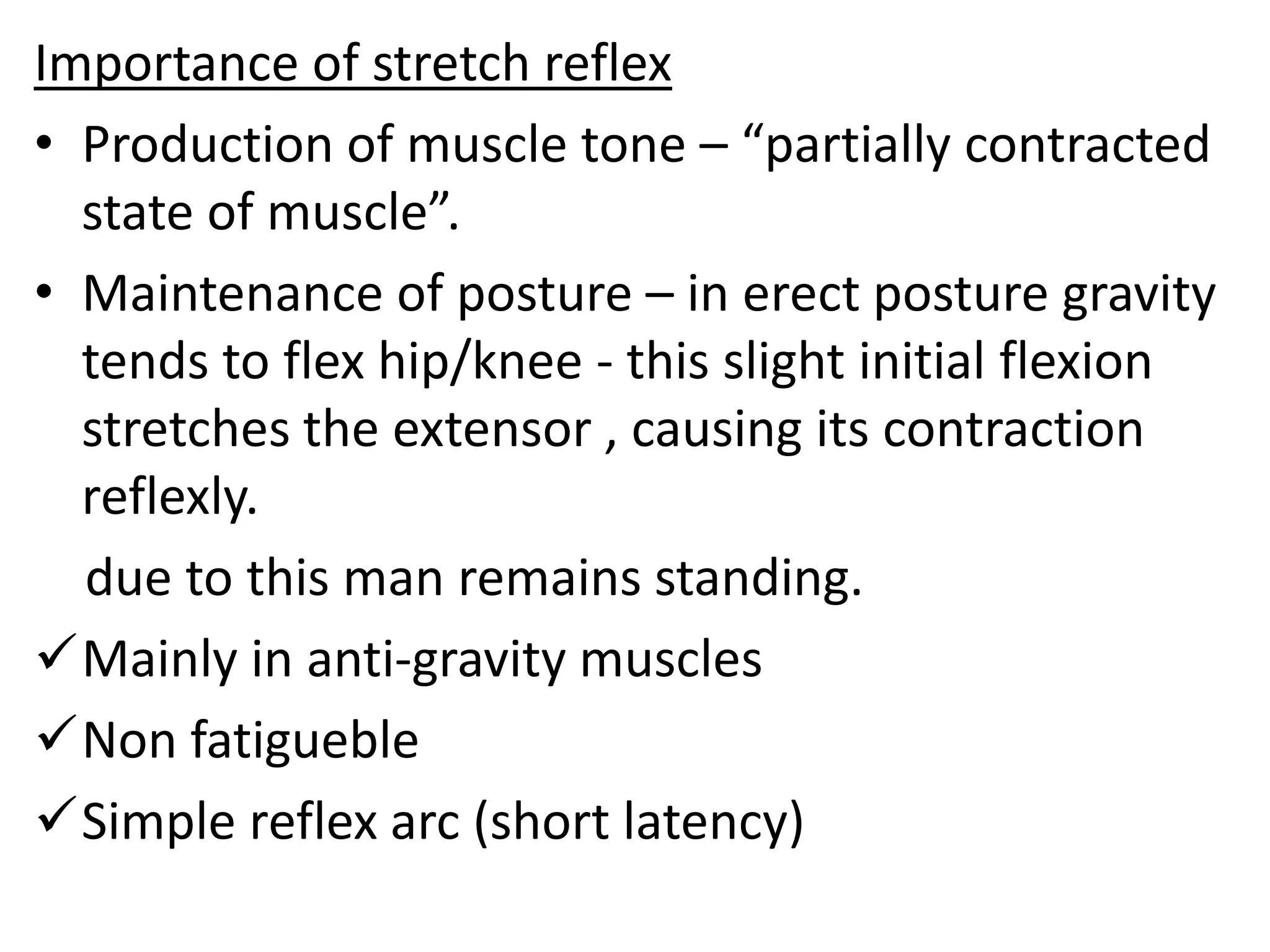
• Production of muscle tone – “partially contracted
  state of muscle”.
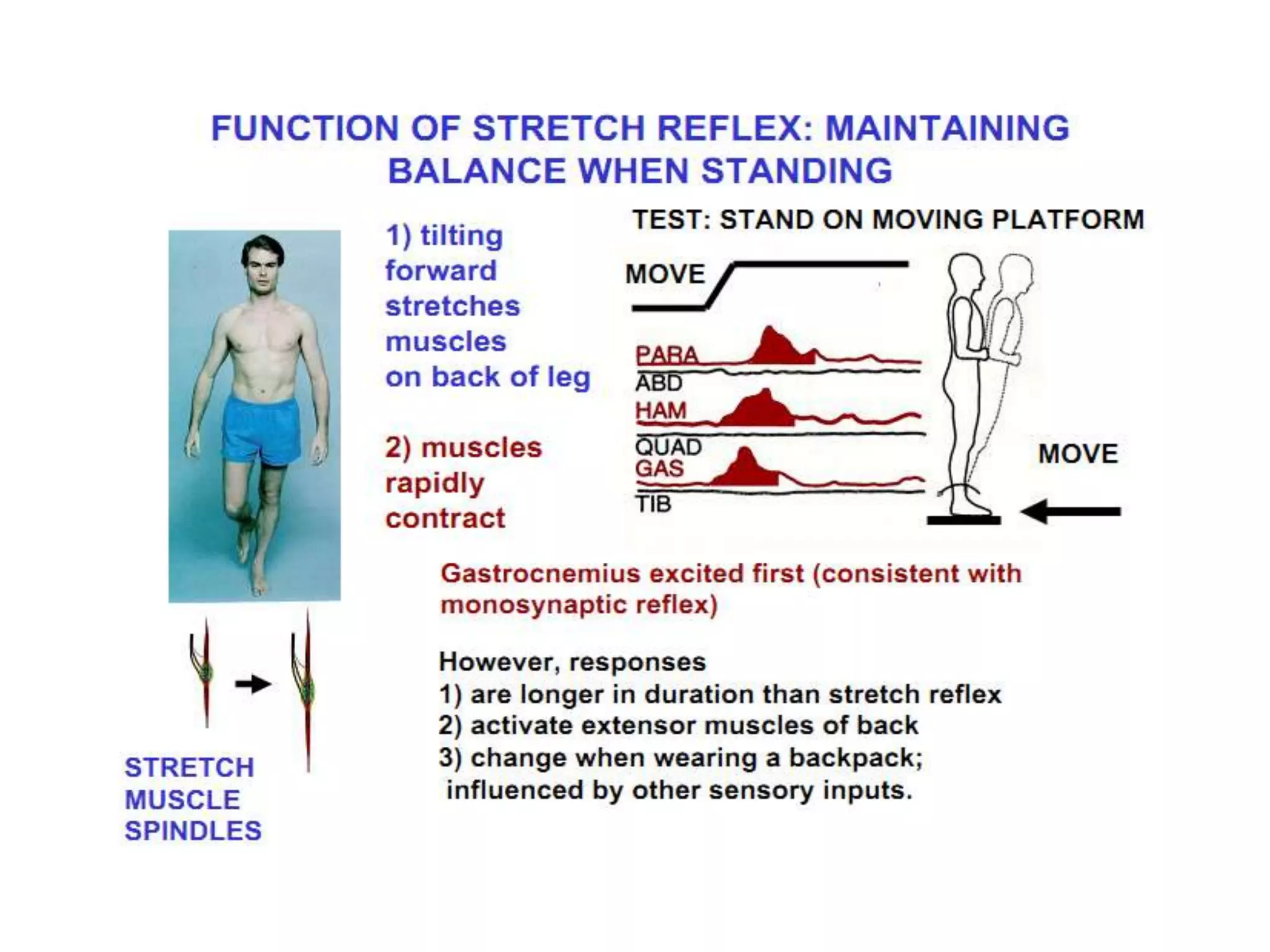
• Maintenance of posture – in erect posture gravity
  tends to flex hip/knee - this slight initial flexion
  stretches the extensor , causing its contraction
  reflexly.
  due to this man remains standing.
Mainly in anti-gravity muscles
Non fatigueble
Simple reflex arc (short latency)
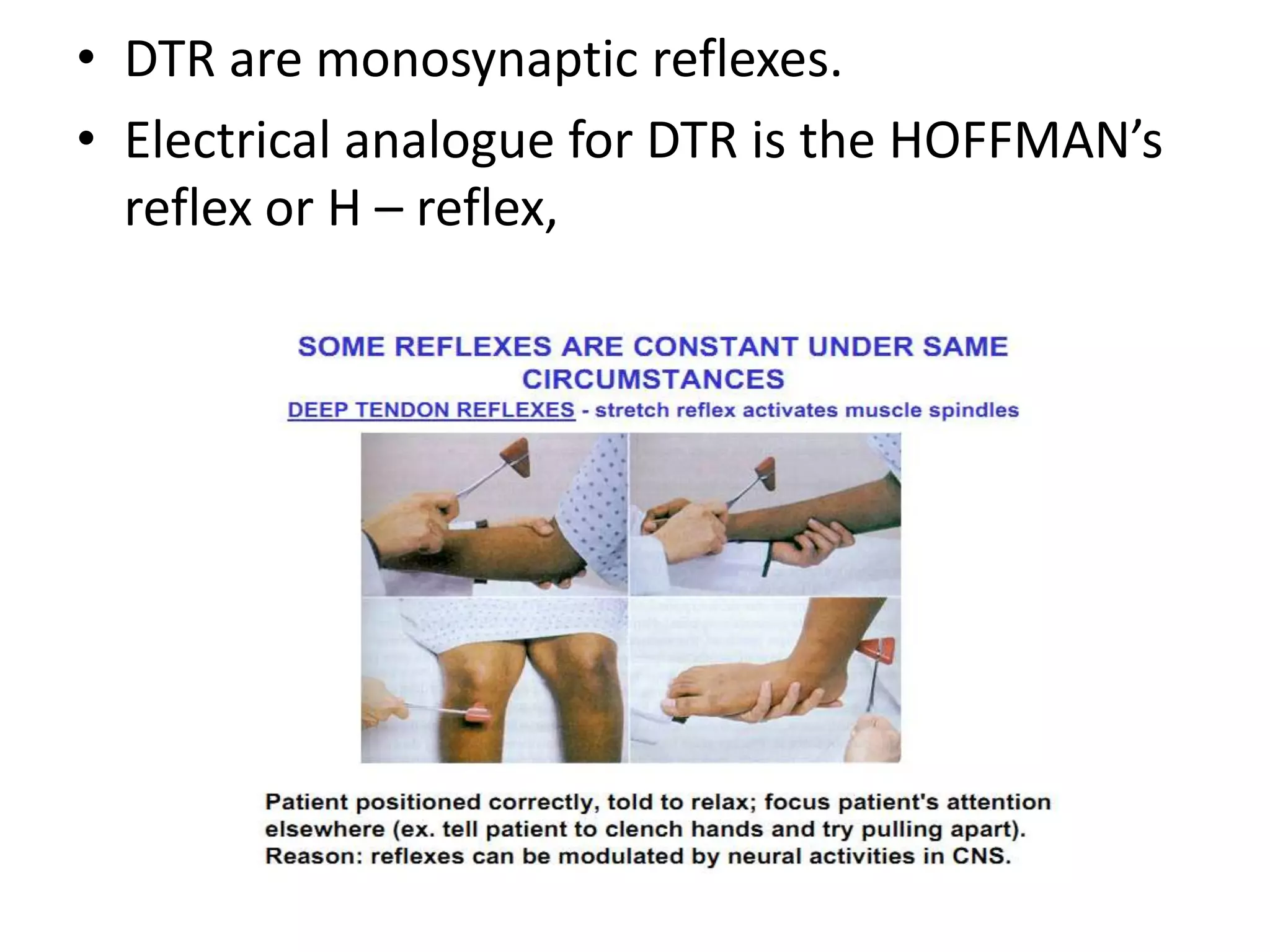
• DTR are monosynaptic reflexes.
• Electrical analogue for DTR is the HOFFMAN’s
  reflex or H – reflex,
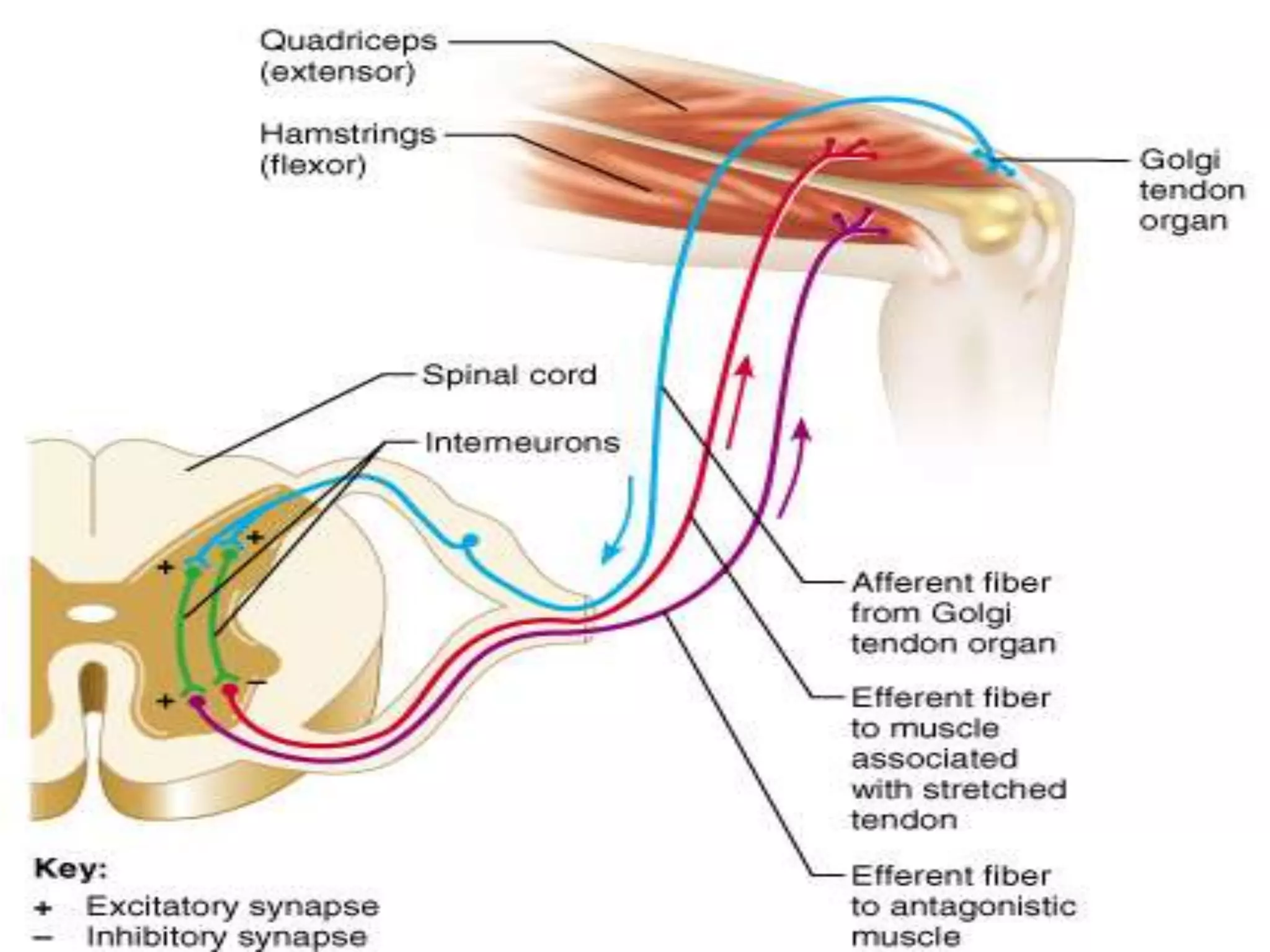
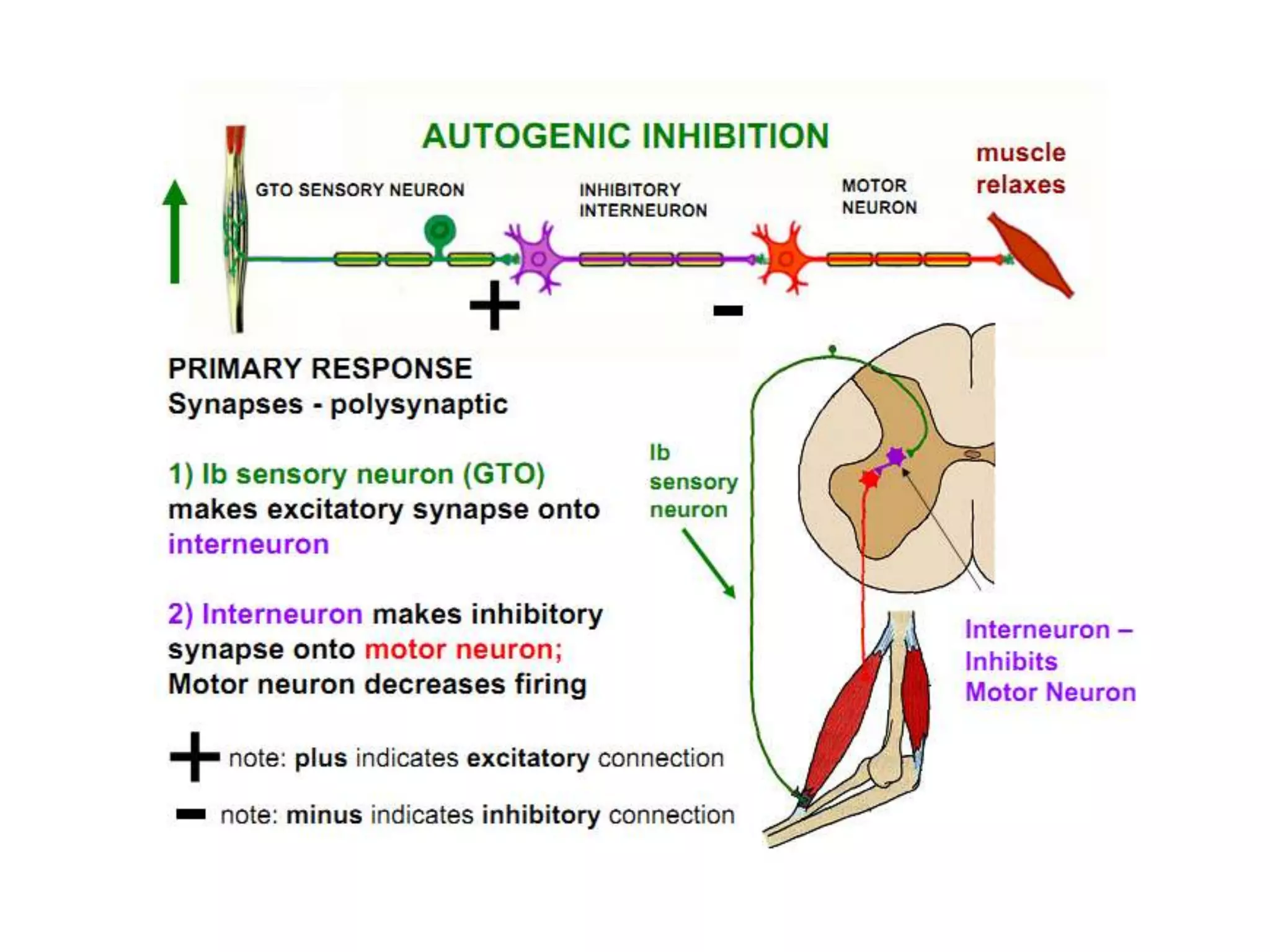
INVERSE STRETCH REFLEX
  [Auto inhibition / lengthening reaction / clasp knife
   reflex ]
• When a limb is passively flexed, in spasticity, lot of
   resistance occurs due to contraction of antagonist
   muscle. ( in this muscle, the spindle is activated by
   stretch which inturn causes contraction of the same
   thru 1a )
• When flexed with force it gives off (clasp knife) .
   This is due to activation of GTO of antagonist
   muscle.
• Impulses from GTO thru 1b afferents – reach
  motor neurons supplying same muscle thru an
  inhibitory interneuron in b/w ( golgi bottle
  organ) . Therefore it relaxes

• GTO detects force of contraction and helps in
  preventing tearing of muscle
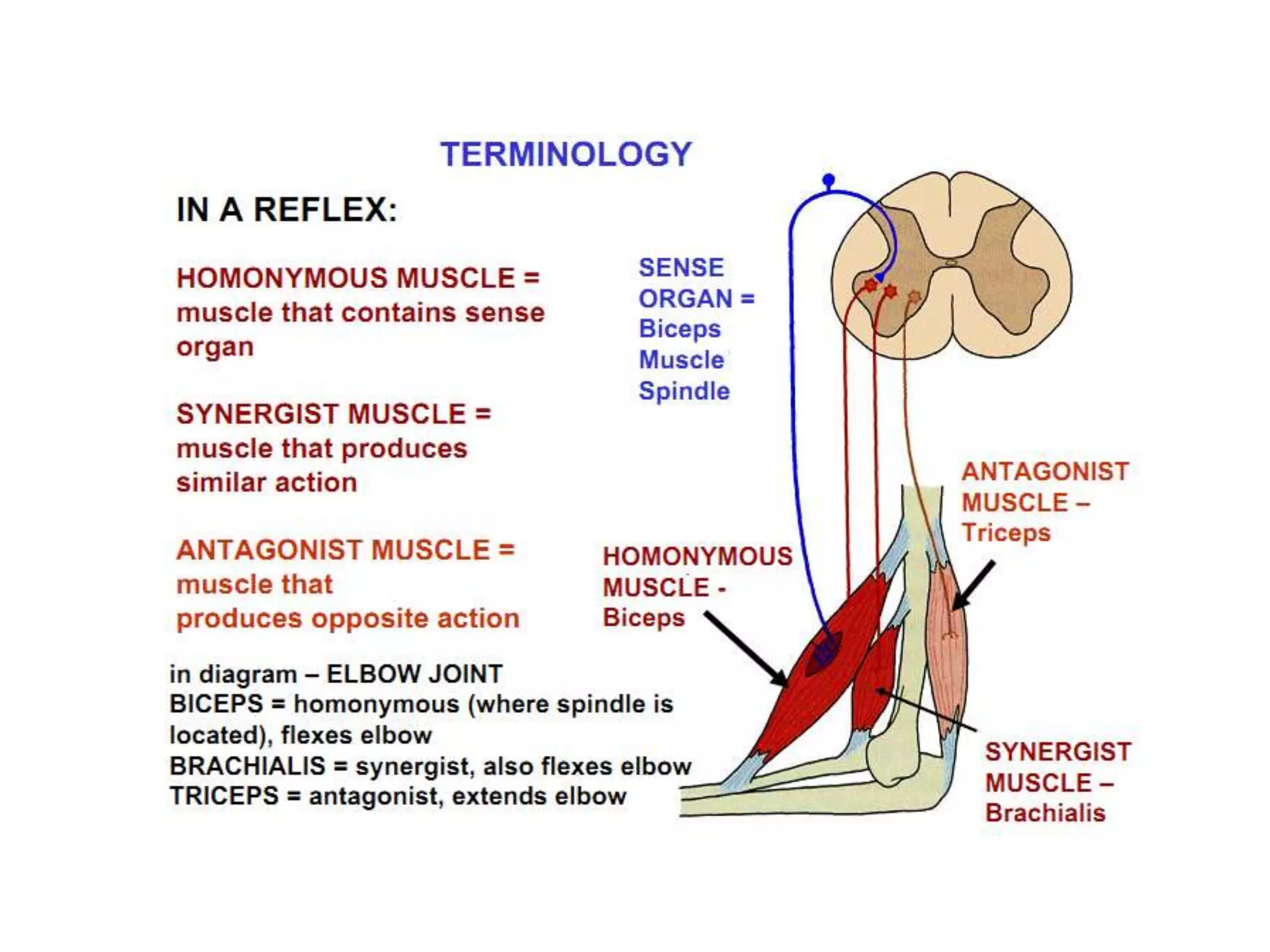
RECIPROCAL INNERVATION
• Stimulation of afferent nerve results in
  contraction of agonist muscle with relaxation
  of antagonist muscle.

• This is the physiological basis for normal
  movements and Crossed extensor reflex
CLONUS
• Regular, rhythmic contractions of muscle,
  subjected to sudden maintained stretch.

• Mechanism – in UMN lesions, the inhibitory effect
  of CST on gamma neurons is lost. So gamma eff
  discharges are increased. So, spindles are already
  hyperactive
• When muscle is stretched passively, bursts of
  impulses from them discharges all the motor
  neurons at once .
  The consequent contraction stops the spindle
  discharges, but due to sustained stretch the
  spindles are again stimulated and it continues
Definition

Classification

Characteristics of reflexes

Monosynaptic reflexes

Polysynaptic reflexes

Others
POLYSYNAPTIC REFLEXES

Response with fewer synapses is earlier than with
more synapses (due to synaptic delay)

Some activities reverberate until they become
unable to cause a propagated transsynaptic
response and dies out.
      These are common in brain and SC
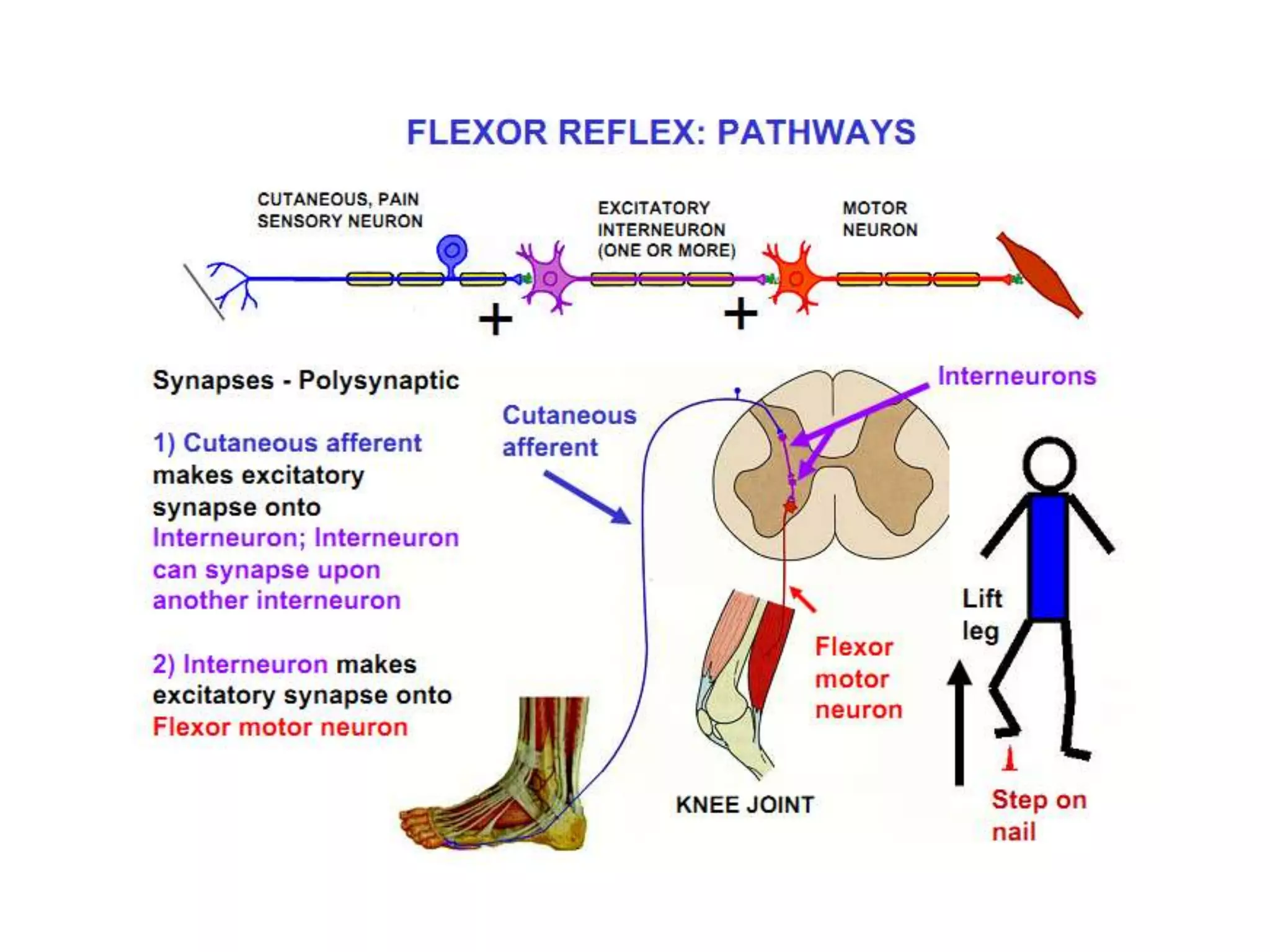
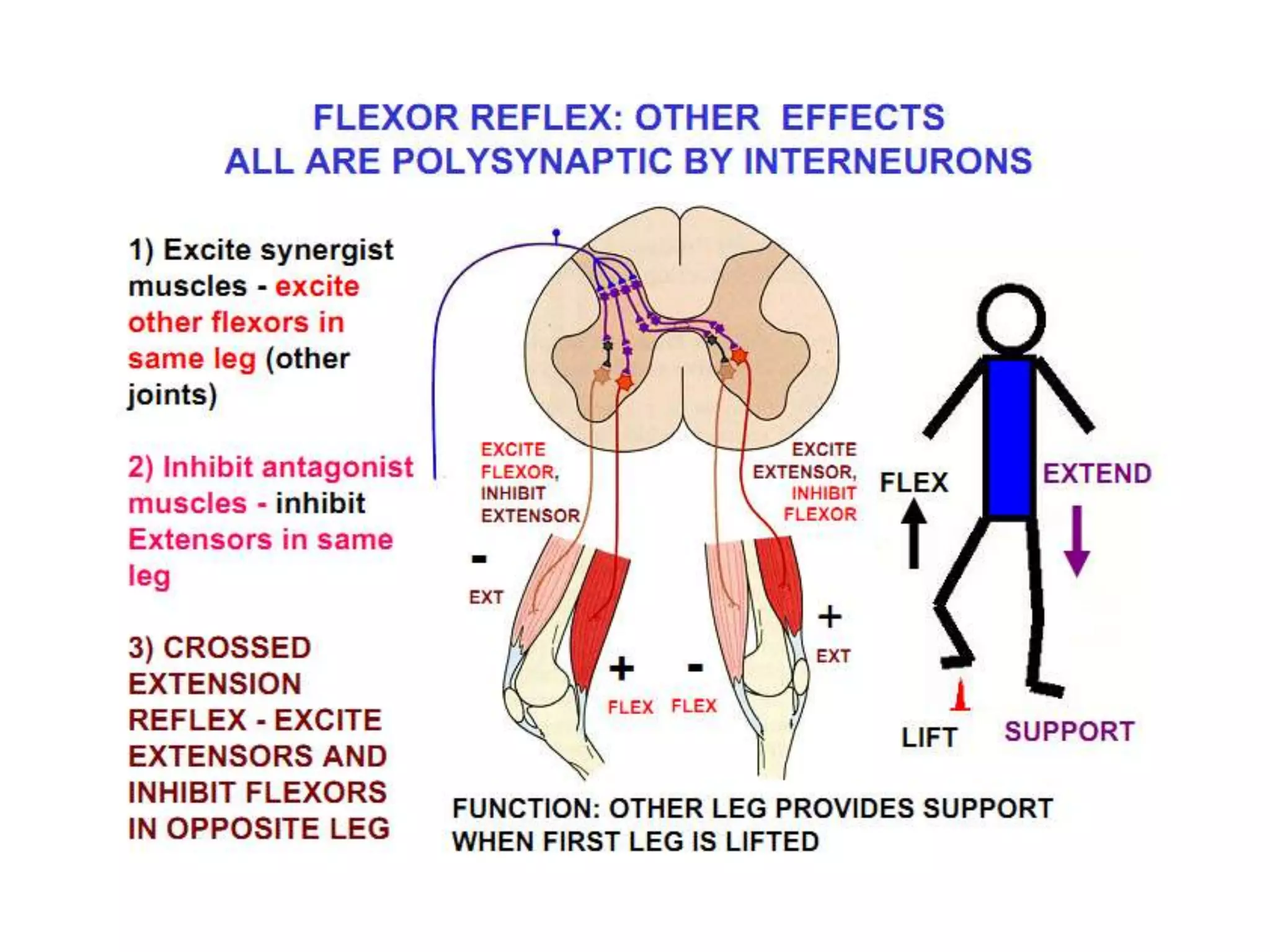
WITHDRAWL REFLEX
• Mechanism is ‘reciprocal innervation’ .
      Severe pain leads to crossed extensor
  response.

 Sherrington pointed out the survival value of it.

 flexion of stimulated limb- is to get away
 extn. Of other limb – to support the body.
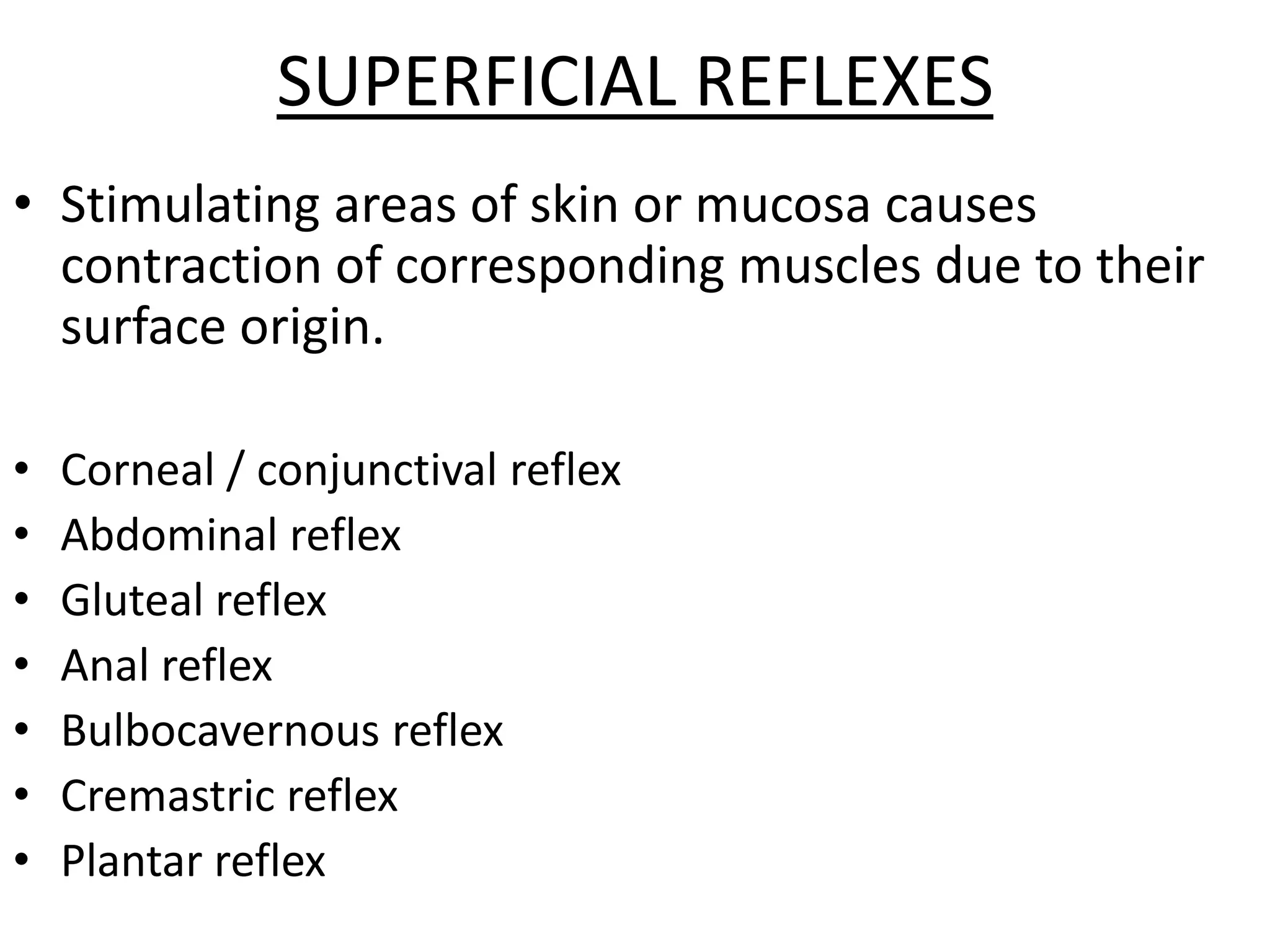
SUPERFICIAL REFLEXES
• Stimulating areas of skin or mucosa causes
  contraction of corresponding muscles due to their
  surface origin.

•   Corneal / conjunctival reflex
•   Abdominal reflex
•   Gluteal reflex
•   Anal reflex
•   Bulbocavernous reflex
•   Cremastric reflex
•   Plantar reflex
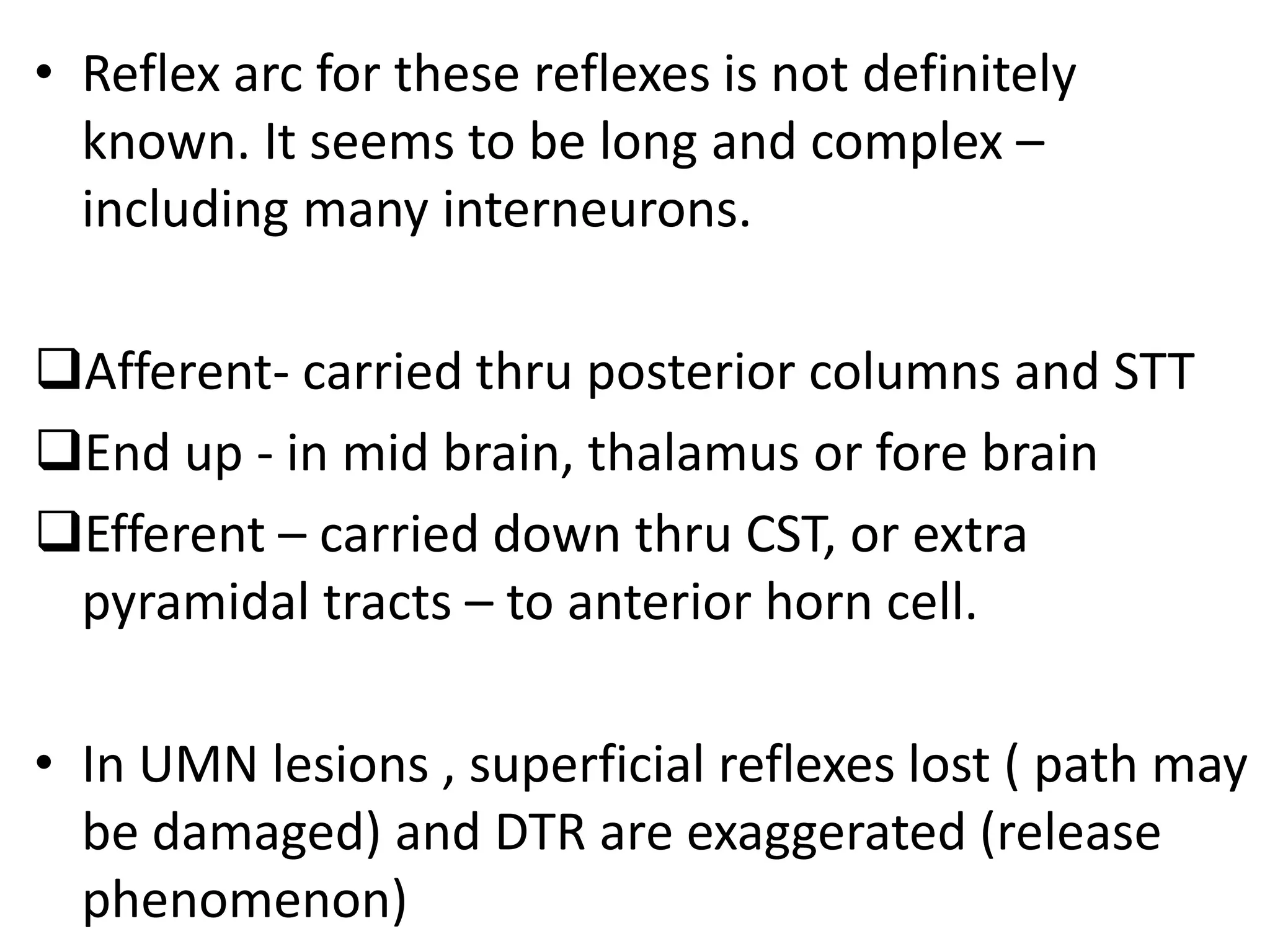
• Reflex arc for these reflexes is not definitely
  known. It seems to be long and complex –
  including many interneurons.

Afferent- carried thru posterior columns and STT
End up - in mid brain, thalamus or fore brain
Efferent – carried down thru CST, or extra
 pyramidal tracts – to anterior horn cell.

• In UMN lesions , superficial reflexes lost ( path may
  be damaged) and DTR are exaggerated (release
  phenomenon)
Definition

Classification

Characteristics of reflexes

Monosynaptic reflexes

Polysynaptic reflexes

Others
MASS REFLEX
• When central excitatory state is marked, the
  excitatory impulses irradiate not only to many
  somatic areas of SC , but also to autonomic areas.

• Ex : In chronic paraplegias, mild noxious stimulus
  cause – in addition to withdrawal response in all 4
  limbs- urination, defecation, sweating and BP
  fluctuations
• Mechanism – when central inhibitions are
  lost, it leads to increased activity through
  reverberating circuits (irradiation)
  Also due to prolonged effects of sympathetic
  mediators.
SPINAL SHOCK
• WHEN spinal cord transection is complete , there
  is a period immediately after the accident when
  all spinal reflexes below the level of transection
  are reduced or suppressed.

• Over wks-months , the reflexes gradually return
  and are exaggerated.
• Mechanism –

        (of shock)- sudden withdrawal ,of tonic
 facilitatory influences from the brain.

       (of recovery) – denervation super-sensitivity
 and increased post synaptic receptors.
Definition

Classification

Characteristics of reflexes

Monosynaptic reflexes

Polysynaptic reflexes

Others
Characteristics of reflexes

•   Irradiation         • After discharge
•   Delay               • Fatigue
•   Summation           • Fractionation
•   Occlusion           • Reciprocal
•   Subliminal fringe     innervation
•   Facilitation        • Rebound
•   Recruitment           phenomenon
Irradiation

• Strong stimulus
• Spread to neighboring neurons producing a
  wider response.
• Mechanism – collaterals

Withdrawal response
Crossed extensor response
Mass reflex
Reinforcement
Delay

• Total reflex delay / reaction time
• Central delay

• Mechanism – due to synapse

 Ex : KNEE JERK - reaction time – 19-24 msec
                  central delay – 0.6-0.9 msec
Summation

• Subliminal stimuli – insufficient response

• Spatial summation – applied simultaneously
• Temporal summation – in series

• Mechanism – persistence of excitability in the
  path of reflex arc, which summates with the next.
Occlusion

T : tension produced by simultaneous stimulation
  of 2 afferents.

t1 : by afferent 1
t2 : by afferent 2

    T < t1 + t2

Mechanism : due to common motor nerves shared
 by both afferents.
t1+t2   T
Subliminal fringe

Reverse of occlusion

    T > t1+t2

Mech – separate stimuli – inadequate for some
 motor neurons ( subliminal )
     - simultaneous stimuli – these subliminal
 ones get summated.
Facilitation

     If reflex is elicted repeatedly at proper
  intervals, the response becomes progressively
  higher .

  Mechanism : passage of 1st impulse facilitates the
  transmission of next one – by decreasing synaptic
  resistance , the next subliminal stimulus becomes
  liminal. (facilitation)
Recruitment

Direct motor nerve stimulation – tension quickly
  rises to maximum.
Sensory afferent stimulation – gradual rise

Mechanism – inteneuron ( ?? )
After discharge

      After a reflex contraction , if stimulus
  discontinued – relaxes gradually ( not at once )

Mechanism – interneuron go on discharging . And
 also impulse takes longer time to reach muscle
 thru interneuron.
Fatigue

If a reflex is elicited repeatedly, it becomes feebler
   and disappear.

Mechanism – seat of fatigue is CNS (mainly synapse)

      Synapse > motor end plate > muscle.
Fractionation

Direct motor N stimulation – higher amount of
  contraction , than reflexly thru afferent N

Mechanism – strength of impulse lost while crossing
 synapse, so only part of ( fraction of ) motor pool
 is stimulated
Reciprocal innervation

      In a reflex , when protagonists contracts,
  antagonists relax to same degree.

Mechanism – bisynaptic – inhibitory interneuron
 present.

      i afferent – at single joint.
      ii, iii, iv - at several joints
Rebound phenomenon

 (just as muscle is excited , it can also be inhibited
  reflexly – reflex inhibition- tone decreased and
  muscle elongated)

     Following it, if stimulus is stopped – tone is
 increased much more , instead of going to normal
 resting tone .

 Mechanism - ??
Reflexes

Reflexes

  • 1.
  • 2.
  • 3.
    Definition Coordinated involuntarymotor response initiated by stimulus, applied to peripheral receptors.
  • 4.
    • Basic unitof integrated reflex activity is REFLEX ARC. it has 5 components : 1. Receptor - muscle spindle ( DTR) 2. Afferent - 1a , II fibers 3. Centre - spinal cord 4. Efferent - motor nerve 5. Effector - extrafusal fibers.
  • 6.
  • 7.
    Classification of reflexes REFLEXES No. of Functional Conditioned Clinical Anatomic synapses classification classification classification Asynaptic Unconditioned Flexor Superficial Monosynaptic Extensor Deep Segmental Bisynaptic Righting Visceral Intersegmental Polysynaptic Postural Pathological Suprasegmental Withdrawal
  • 8.
    Clinical classification • Superficial- stimulating superficial structures Examples • Deep – stimulating receptors deep in muscle. Examples • Visceral – stimulating receptors in viscera. Examples • Pathological – present only during abnormality
  • 9.
    Anatomic classification • Segmental– reflex arc pass thru one anatomic segment . Ex : knee jerk • Intersegmental – involve > one segment Ex : crossed extensor response. • Suprasegmental – involve interaction with suprasegmental components. Ex: postural reflexes (head-limb)
  • 10.
    Number of synapses • Asynaptic axon reflex • Monosynaptic stretch reflex • Bisynaptic reciprocal innervation • Polysynaptic superficial reflex
  • 11.
    Functional classification • Flexor reflexes • Extensor reflexes • Righting reflexes • Postural reflexes • Withdrawal reflexes
  • 12.
    Others • Unconditioned reflexes– inborn or inherent reflexes . • Conditioned reflexes – acquired reflexes. Secretion of saliva when food is kept in mouth is unconditioned reflex and, secretion even with thought is ‘conditioned’.
  • 13.
  • 14.
    MONOSYNAPTIC REFLEXES • Stretchreflex • Inverse stretch reflex • Reciprocal innervation • Clonus
  • 15.
    Stretch reflex • Whena skeletal muscle with intact nerve supply is stretched, it contracts – stretch reflex. • Stimulus – stretch • Response – contraction • Sense organ – muscle spindle
  • 17.
    Muscle spindle • Proprioceptorpresent in skeletal muscle. • 6-14 muscle fibers - Intrafusal fibers (IFF) - in a spindle shaped fibrous sheath. NBF - nuclear bag fibers NCF – nuclear chain fibers
  • 19.
    • Afferents :I a and II fibers I a - from central part of all fibers (annulospiral ends) II – only from NCF ( flower spray ends ) • Efferent : gamma fibers to both NBF and NCF. alpha motor neurons supply extrafusal fibers I a and gamma 1 – dynamic response II and gamma 2 – static response
  • 21.
    Functions of musclespindle : • Maintains length of muscle fibers (EFF) at rest or activity – gives feed back to higher centers for comparing with intended movement. • Monitor velocity of muscle contraction.
  • 22.
    Gamma efferent discharge •IFF are not strong enough or not plentiful enough to cause shortening of muscle. • It causes shortening thru reflex arc (indirectly) – shortening of IFF – stretch of NBF and 1a aff - reflex muscle contraction through alpha fibers . • If muscle is stretched during the gamma stimulation, additional AP s are stimulated and rate of discharge of 1a afferents increases .
  • 23.
    (gamma motor neuronsincreases sensitivity of muscle spindle to stretch) Normally there is increased gamma discharge in parallel to alpha. Due to this alpha-gamma linkage, spindle also shortens along with muscle. Due to this continues response of spindle through out muscle contraction , the physiologic oscillation is reduced and muscle contraction is smoothened.
  • 24.
    • Factors influencinggamma discharge –  noxious stimulus of skin  anxiety  Jendrassik’s maneuver : strong simultaneous motor act causes increased gamma discharges and thru irradiation influences other levels. when voluntary act precedes by 0.5 sec, jerk is inhibited (negative reinforcement)
  • 25.
    Higher centers alsoinfluence muscle tone through influencing gamma efferents – brain stem nuclei, cerebellum and motor cortex. Cortex inhibits gamma neurons and cerebellum facilitates them.
  • 27.
    Importance of stretchreflex • Production of muscle tone – “partially contracted state of muscle”. • Maintenance of posture – in erect posture gravity tends to flex hip/knee - this slight initial flexion stretches the extensor , causing its contraction reflexly. due to this man remains standing. Mainly in anti-gravity muscles Non fatigueble Simple reflex arc (short latency)
  • 29.
    • DTR aremonosynaptic reflexes. • Electrical analogue for DTR is the HOFFMAN’s reflex or H – reflex,
  • 31.
    INVERSE STRETCH REFLEX [Auto inhibition / lengthening reaction / clasp knife reflex ] • When a limb is passively flexed, in spasticity, lot of resistance occurs due to contraction of antagonist muscle. ( in this muscle, the spindle is activated by stretch which inturn causes contraction of the same thru 1a ) • When flexed with force it gives off (clasp knife) . This is due to activation of GTO of antagonist muscle.
  • 34.
    • Impulses fromGTO thru 1b afferents – reach motor neurons supplying same muscle thru an inhibitory interneuron in b/w ( golgi bottle organ) . Therefore it relaxes • GTO detects force of contraction and helps in preventing tearing of muscle
  • 36.
    RECIPROCAL INNERVATION • Stimulationof afferent nerve results in contraction of agonist muscle with relaxation of antagonist muscle. • This is the physiological basis for normal movements and Crossed extensor reflex
  • 37.
    CLONUS • Regular, rhythmiccontractions of muscle, subjected to sudden maintained stretch. • Mechanism – in UMN lesions, the inhibitory effect of CST on gamma neurons is lost. So gamma eff discharges are increased. So, spindles are already hyperactive
  • 38.
    • When muscleis stretched passively, bursts of impulses from them discharges all the motor neurons at once . The consequent contraction stops the spindle discharges, but due to sustained stretch the spindles are again stimulated and it continues
  • 39.
  • 40.
    POLYSYNAPTIC REFLEXES Response withfewer synapses is earlier than with more synapses (due to synaptic delay) Some activities reverberate until they become unable to cause a propagated transsynaptic response and dies out. These are common in brain and SC
  • 41.
    WITHDRAWL REFLEX • Mechanismis ‘reciprocal innervation’ . Severe pain leads to crossed extensor response. Sherrington pointed out the survival value of it.  flexion of stimulated limb- is to get away  extn. Of other limb – to support the body.
  • 44.
    SUPERFICIAL REFLEXES • Stimulatingareas of skin or mucosa causes contraction of corresponding muscles due to their surface origin. • Corneal / conjunctival reflex • Abdominal reflex • Gluteal reflex • Anal reflex • Bulbocavernous reflex • Cremastric reflex • Plantar reflex
  • 45.
    • Reflex arcfor these reflexes is not definitely known. It seems to be long and complex – including many interneurons. Afferent- carried thru posterior columns and STT End up - in mid brain, thalamus or fore brain Efferent – carried down thru CST, or extra pyramidal tracts – to anterior horn cell. • In UMN lesions , superficial reflexes lost ( path may be damaged) and DTR are exaggerated (release phenomenon)
  • 47.
  • 48.
    MASS REFLEX • Whencentral excitatory state is marked, the excitatory impulses irradiate not only to many somatic areas of SC , but also to autonomic areas. • Ex : In chronic paraplegias, mild noxious stimulus cause – in addition to withdrawal response in all 4 limbs- urination, defecation, sweating and BP fluctuations
  • 49.
    • Mechanism –when central inhibitions are lost, it leads to increased activity through reverberating circuits (irradiation) Also due to prolonged effects of sympathetic mediators.
  • 50.
    SPINAL SHOCK • WHENspinal cord transection is complete , there is a period immediately after the accident when all spinal reflexes below the level of transection are reduced or suppressed. • Over wks-months , the reflexes gradually return and are exaggerated.
  • 51.
    • Mechanism – (of shock)- sudden withdrawal ,of tonic facilitatory influences from the brain. (of recovery) – denervation super-sensitivity and increased post synaptic receptors.
  • 52.
  • 53.
    Characteristics of reflexes • Irradiation • After discharge • Delay • Fatigue • Summation • Fractionation • Occlusion • Reciprocal • Subliminal fringe innervation • Facilitation • Rebound • Recruitment phenomenon
  • 54.
    Irradiation • Strong stimulus •Spread to neighboring neurons producing a wider response. • Mechanism – collaterals Withdrawal response Crossed extensor response Mass reflex Reinforcement
  • 55.
    Delay • Total reflexdelay / reaction time • Central delay • Mechanism – due to synapse Ex : KNEE JERK - reaction time – 19-24 msec central delay – 0.6-0.9 msec
  • 56.
    Summation • Subliminal stimuli– insufficient response • Spatial summation – applied simultaneously • Temporal summation – in series • Mechanism – persistence of excitability in the path of reflex arc, which summates with the next.
  • 57.
    Occlusion T : tensionproduced by simultaneous stimulation of 2 afferents. t1 : by afferent 1 t2 : by afferent 2 T < t1 + t2 Mechanism : due to common motor nerves shared by both afferents.
  • 58.
  • 59.
    Subliminal fringe Reverse ofocclusion T > t1+t2 Mech – separate stimuli – inadequate for some motor neurons ( subliminal ) - simultaneous stimuli – these subliminal ones get summated.
  • 60.
    Facilitation If reflex is elicted repeatedly at proper intervals, the response becomes progressively higher . Mechanism : passage of 1st impulse facilitates the transmission of next one – by decreasing synaptic resistance , the next subliminal stimulus becomes liminal. (facilitation)
  • 61.
    Recruitment Direct motor nervestimulation – tension quickly rises to maximum. Sensory afferent stimulation – gradual rise Mechanism – inteneuron ( ?? )
  • 62.
    After discharge After a reflex contraction , if stimulus discontinued – relaxes gradually ( not at once ) Mechanism – interneuron go on discharging . And also impulse takes longer time to reach muscle thru interneuron.
  • 63.
    Fatigue If a reflexis elicited repeatedly, it becomes feebler and disappear. Mechanism – seat of fatigue is CNS (mainly synapse) Synapse > motor end plate > muscle.
  • 64.
    Fractionation Direct motor Nstimulation – higher amount of contraction , than reflexly thru afferent N Mechanism – strength of impulse lost while crossing synapse, so only part of ( fraction of ) motor pool is stimulated
  • 65.
    Reciprocal innervation In a reflex , when protagonists contracts, antagonists relax to same degree. Mechanism – bisynaptic – inhibitory interneuron present. i afferent – at single joint. ii, iii, iv - at several joints
  • 67.
    Rebound phenomenon (justas muscle is excited , it can also be inhibited reflexly – reflex inhibition- tone decreased and muscle elongated) Following it, if stimulus is stopped – tone is increased much more , instead of going to normal resting tone . Mechanism - ??