Growth and development among
schoolers
Presented by :
Miss . Shrutika . S. Navilyale
MSc Nursing 1st year
Child Health Nursing
KAHER INS Belagavi
Introduction :
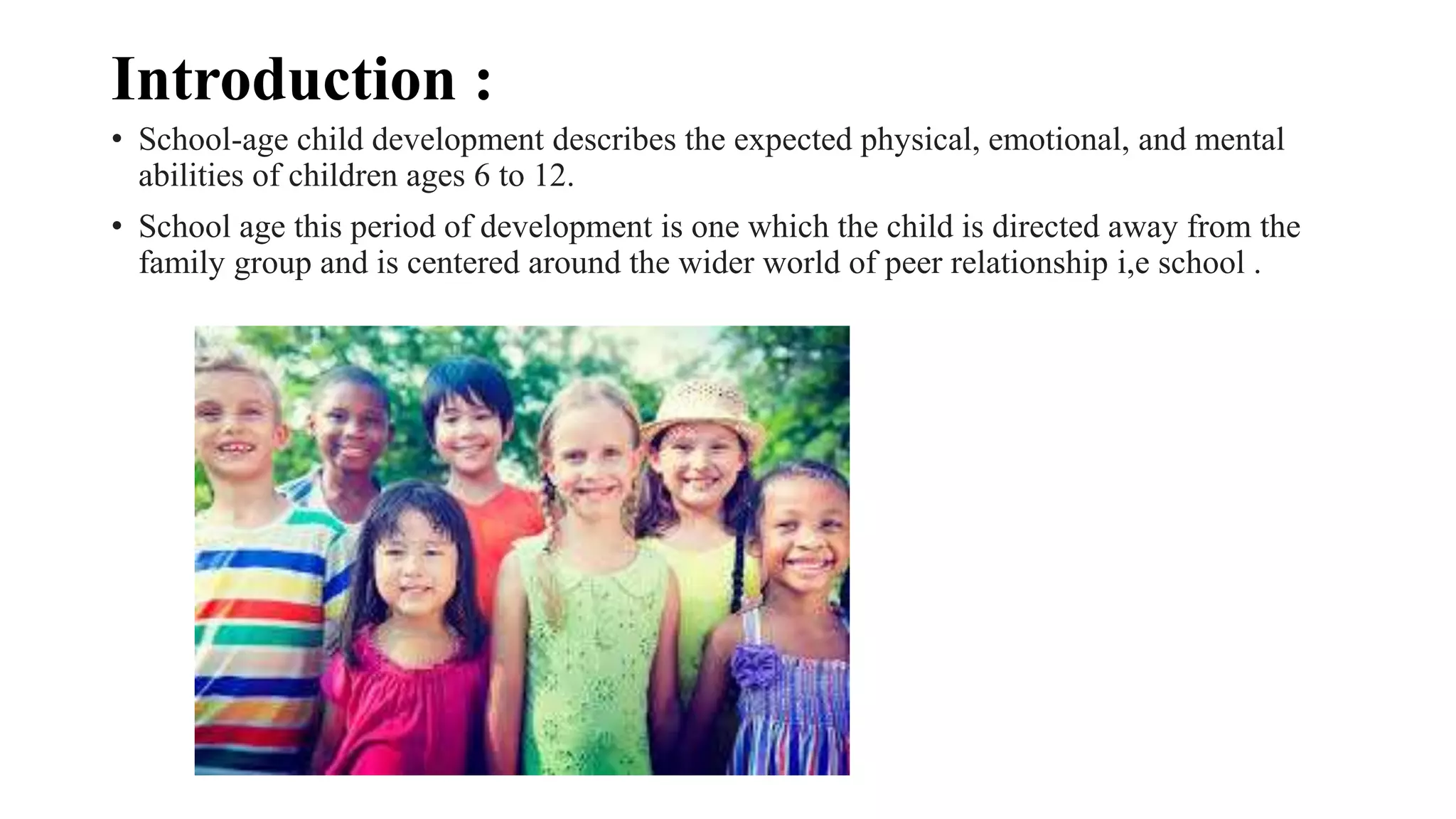
• School-age child development describes the expected physical, emotional, and mental
abilities of children ages 6 to 12.
• School age this period of development is one which the child is directed away from the
family group and is centered around the wider world of peer relationship i,e school .
6- 8 years
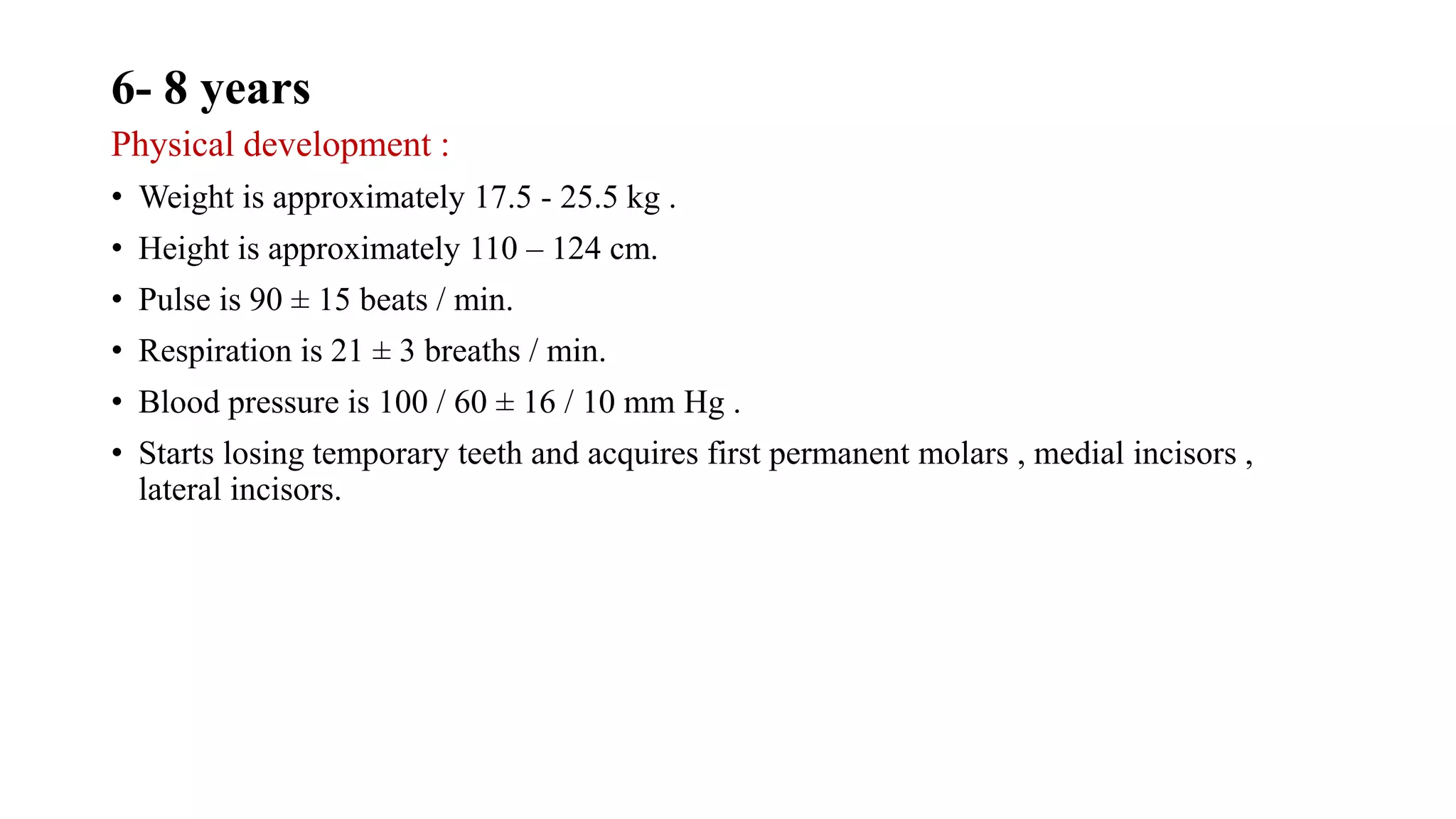
Physical development :
• Weight is approximately 17.5 - 25.5 kg .
• Height is approximately 110 – 124 cm.
• Pulse is 90 ± 15 beats / min.
• Respiration is 21 ± 3 breaths / min.
• Blood pressure is 100 / 60 ± 16 / 10 mm Hg .
• Starts losing temporary teeth and acquires first permanent molars , medial incisors ,
lateral incisors.
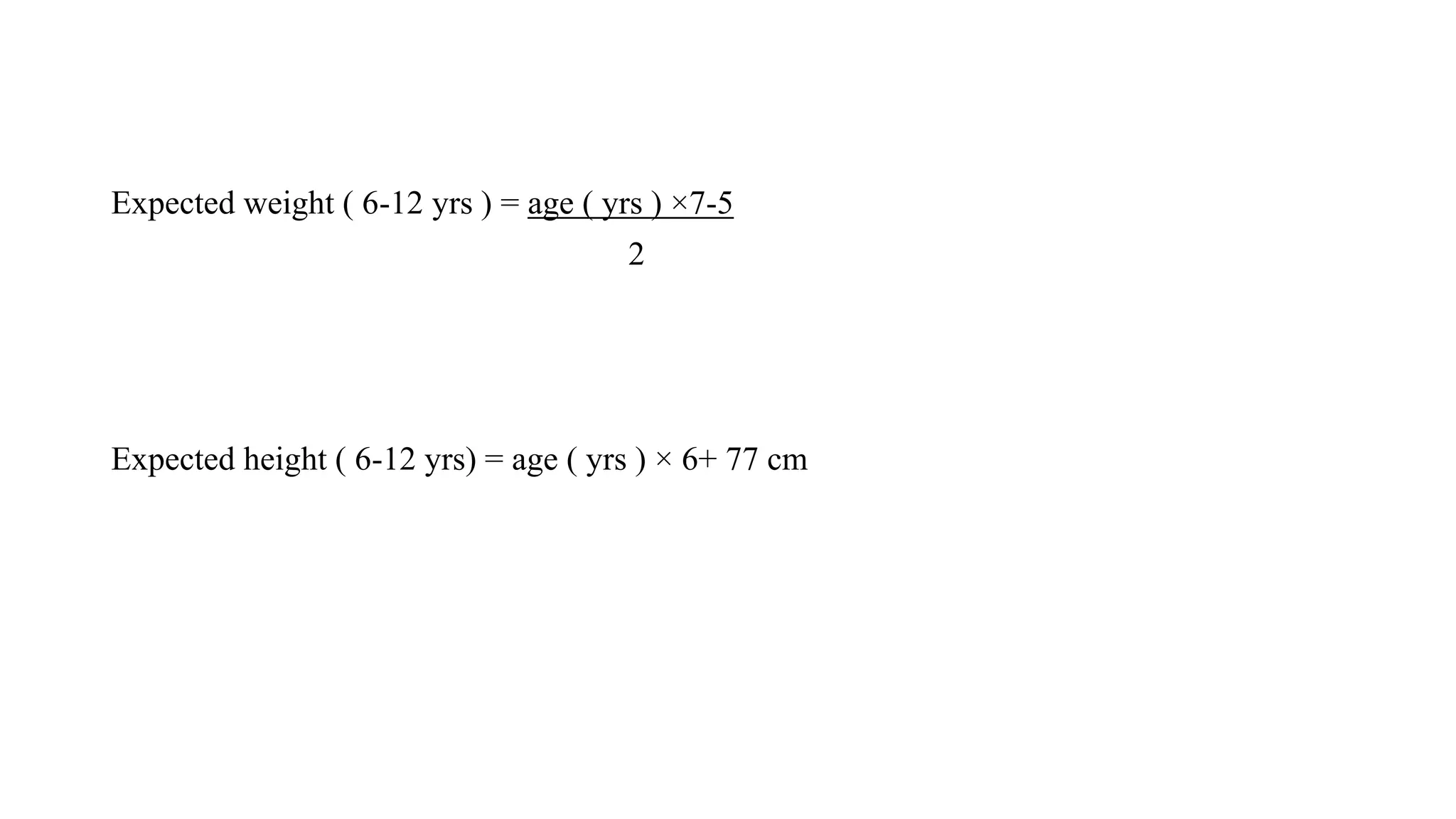
Expected weight ( 6-12 yrs ) = age ( yrs ) ×7-5
2
Expected height ( 6-12 yrs) = age ( yrs ) × 6+ 77 cm
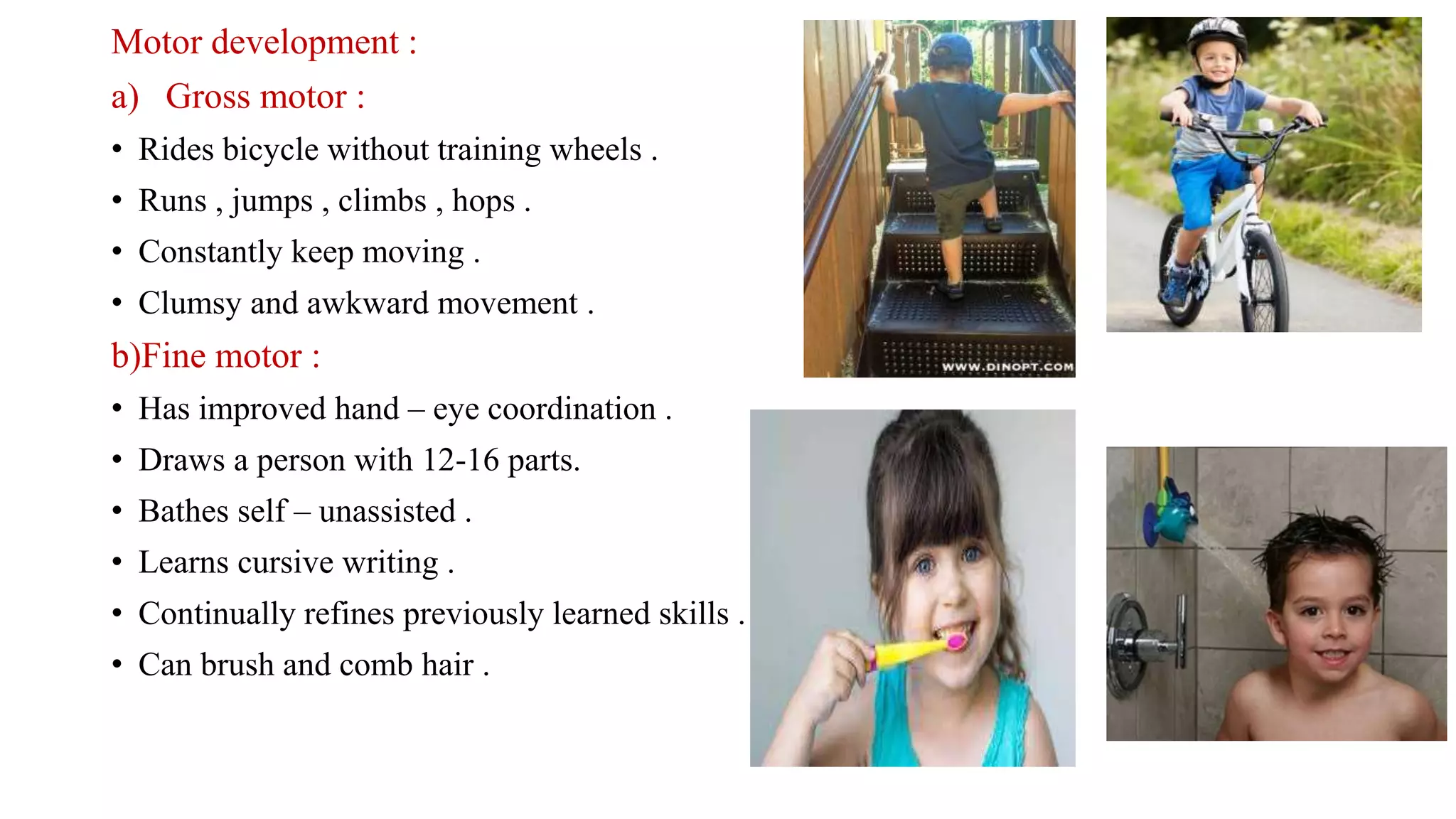
Motor development :
a) Gross motor :
• Rides bicycle without training wheels .
• Runs , jumps , climbs , hops .
• Constantly keep moving .
• Clumsy and awkward movement .
b)Fine motor :
• Has improved hand – eye coordination .
• Draws a person with 12-16 parts.
• Bathes self – unassisted .
• Learns cursive writing .
• Continually refines previously learned skills .
• Can brush and comb hair .
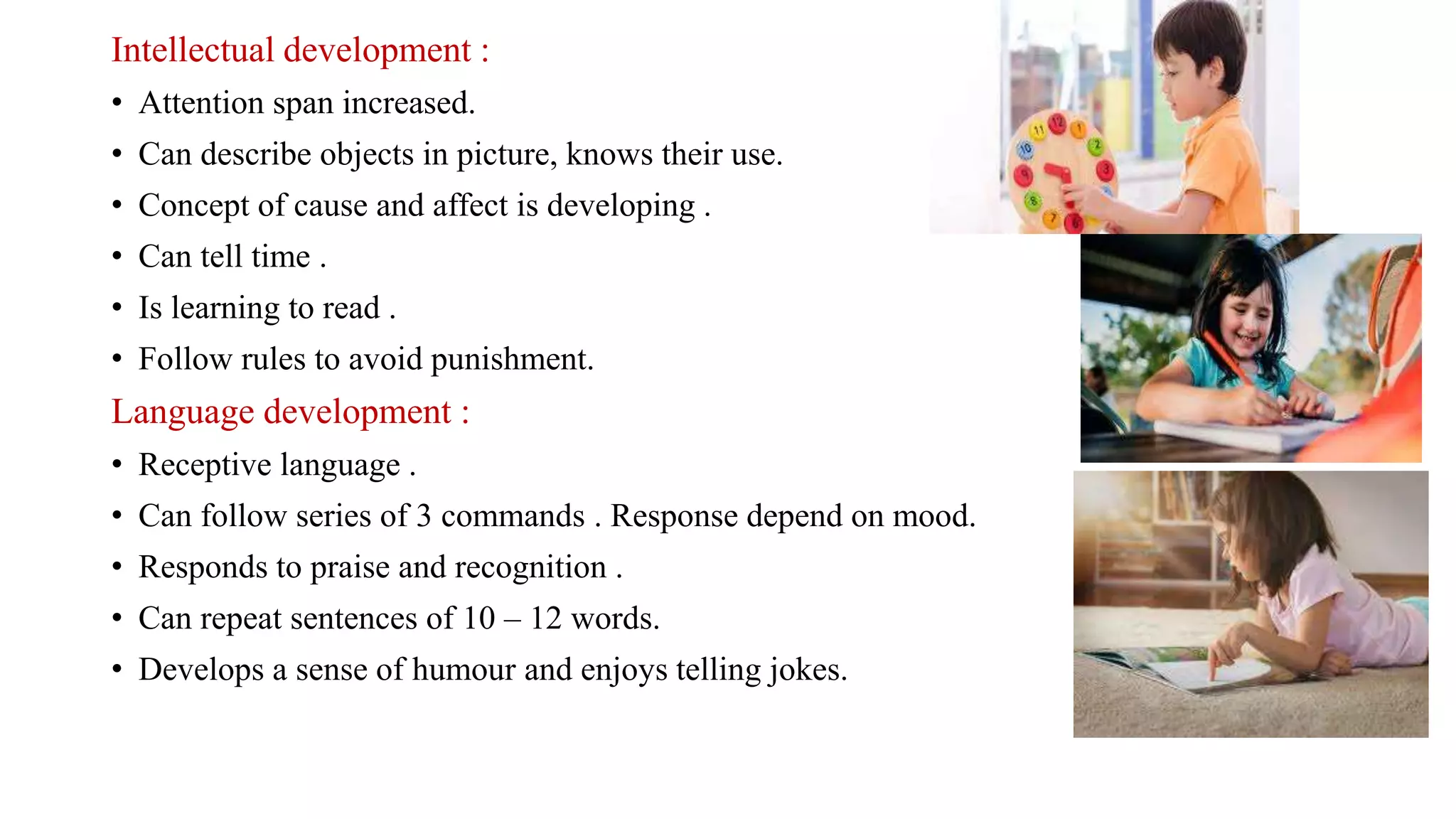
Intellectual development :
• Attention span increased.
• Can describe objects in picture, knows their use.
• Concept of cause and affect is developing .
• Can tell time .
• Is learning to read .
• Follow rules to avoid punishment.
Language development :
• Receptive language .
• Can follow series of 3 commands . Response depend on mood.
• Responds to praise and recognition .
• Can repeat sentences of 10 – 12 words.
• Develops a sense of humour and enjoys telling jokes.
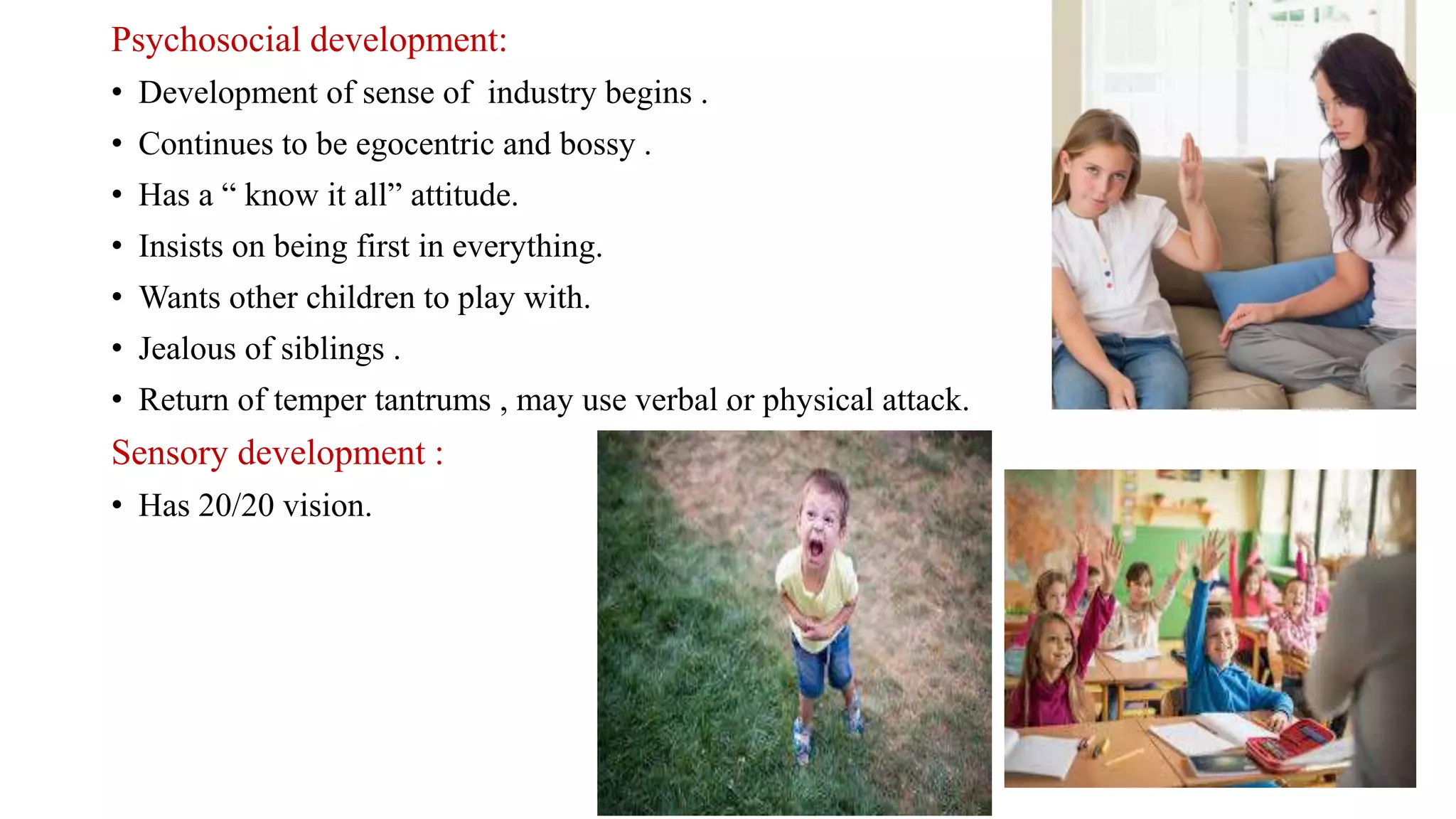
Psychosocial development:
• Development of sense of industry begins .
• Continues to be egocentric and bossy .
• Has a “ know it all” attitude.
• Insists on being first in everything.
• Wants other children to play with.
• Jealous of siblings .
• Return of temper tantrums , may use verbal or physical attack.
Sensory development :
• Has 20/20 vision.
8- 10 years
Physical development:
• Weight is approximately 22- 32 kg .
• Height is approximately 121.5 – 136.5 cm.
• Pulse is 85 ± 10 beats / min.
• Respiration is 20 ± 3 breaths / min.
• Blood pressure is 102/ 60 ± 16 / 10 mmHg.
Motor development :
a) Gross development :
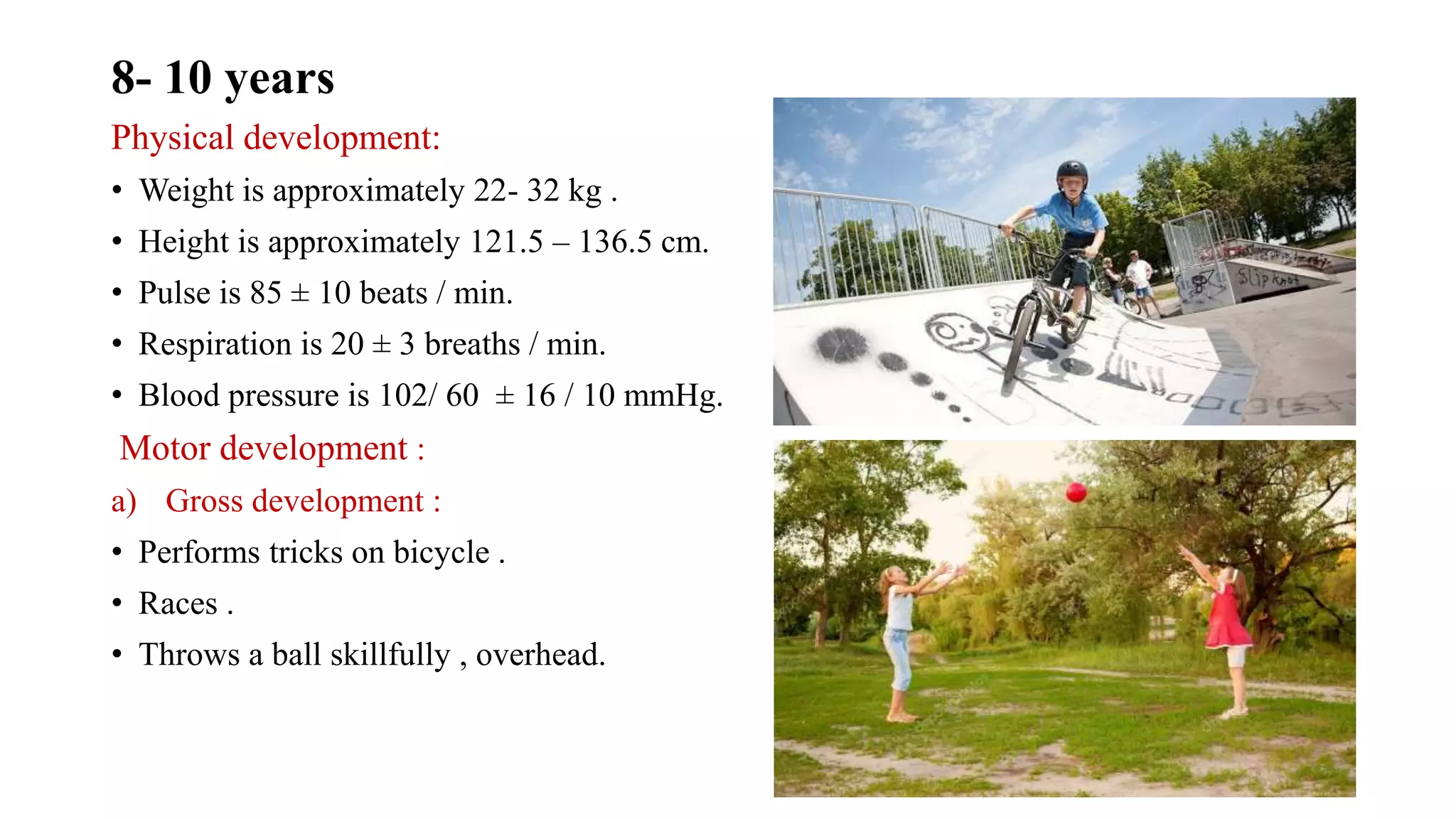
• Performs tricks on bicycle .
• Races .
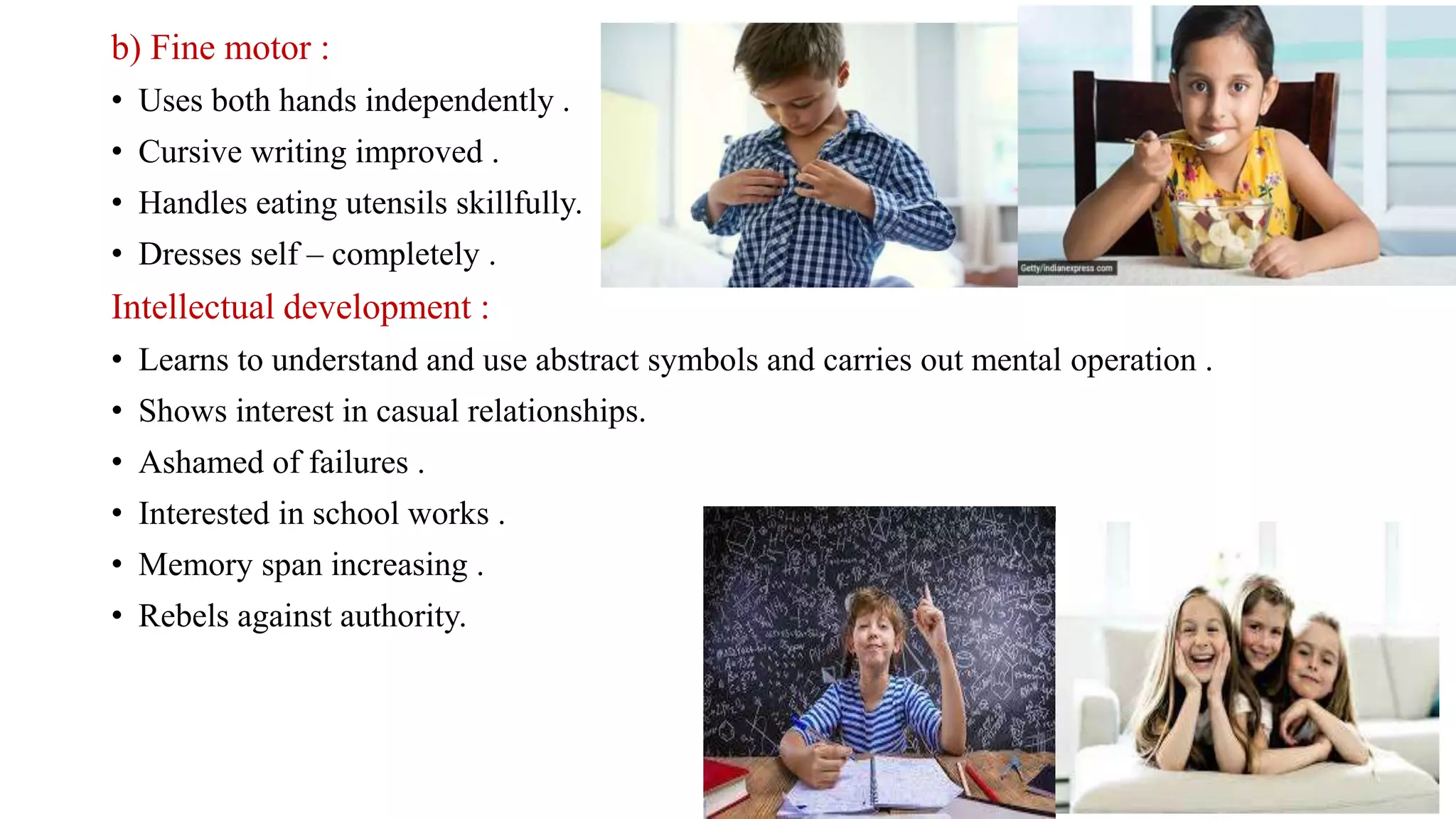
• Throws a ball skillfully , overhead.
b) Fine motor :
• Uses both hands independently .
• Cursive writing improved .
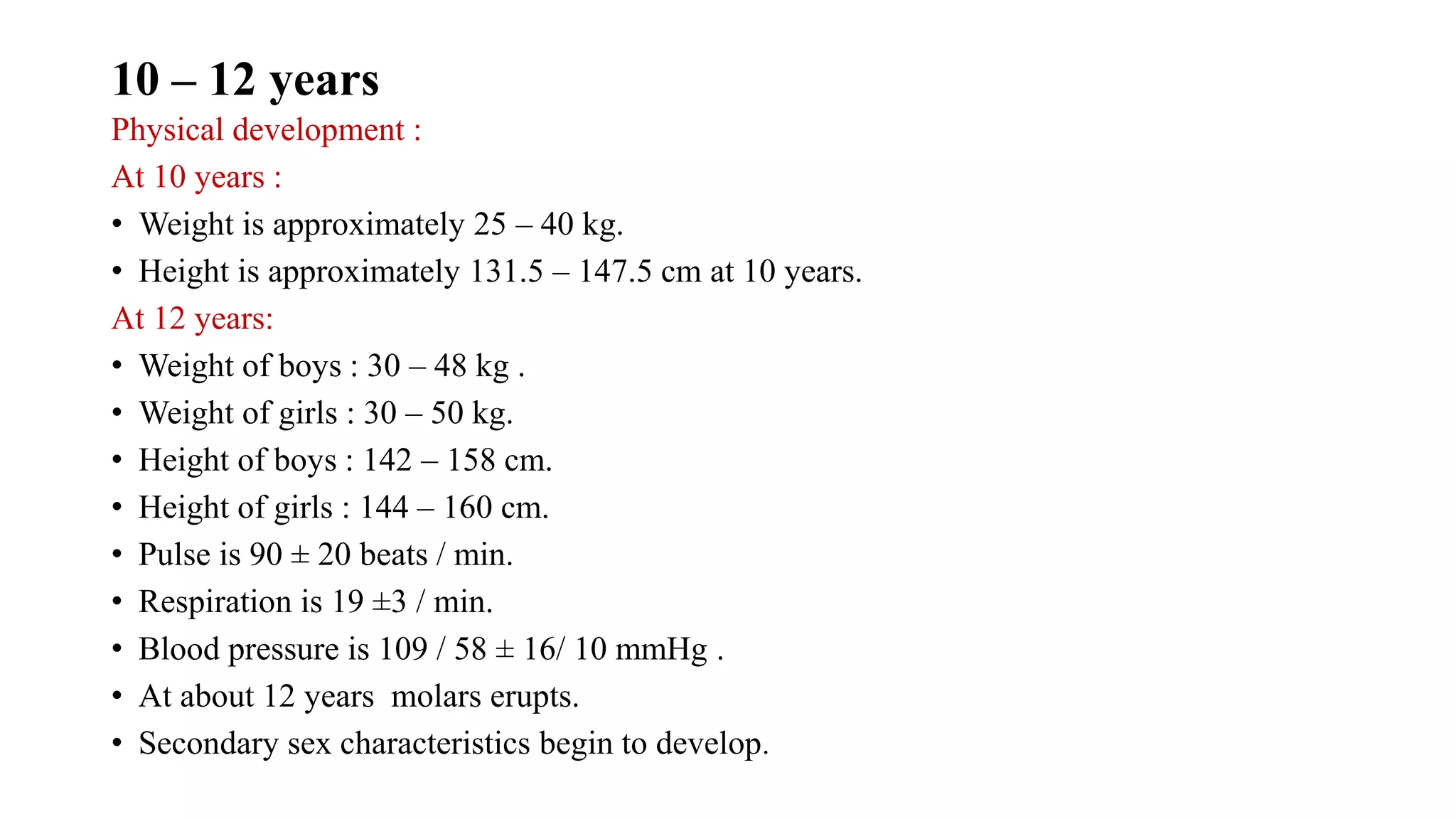
• Handles eating utensils skillfully.
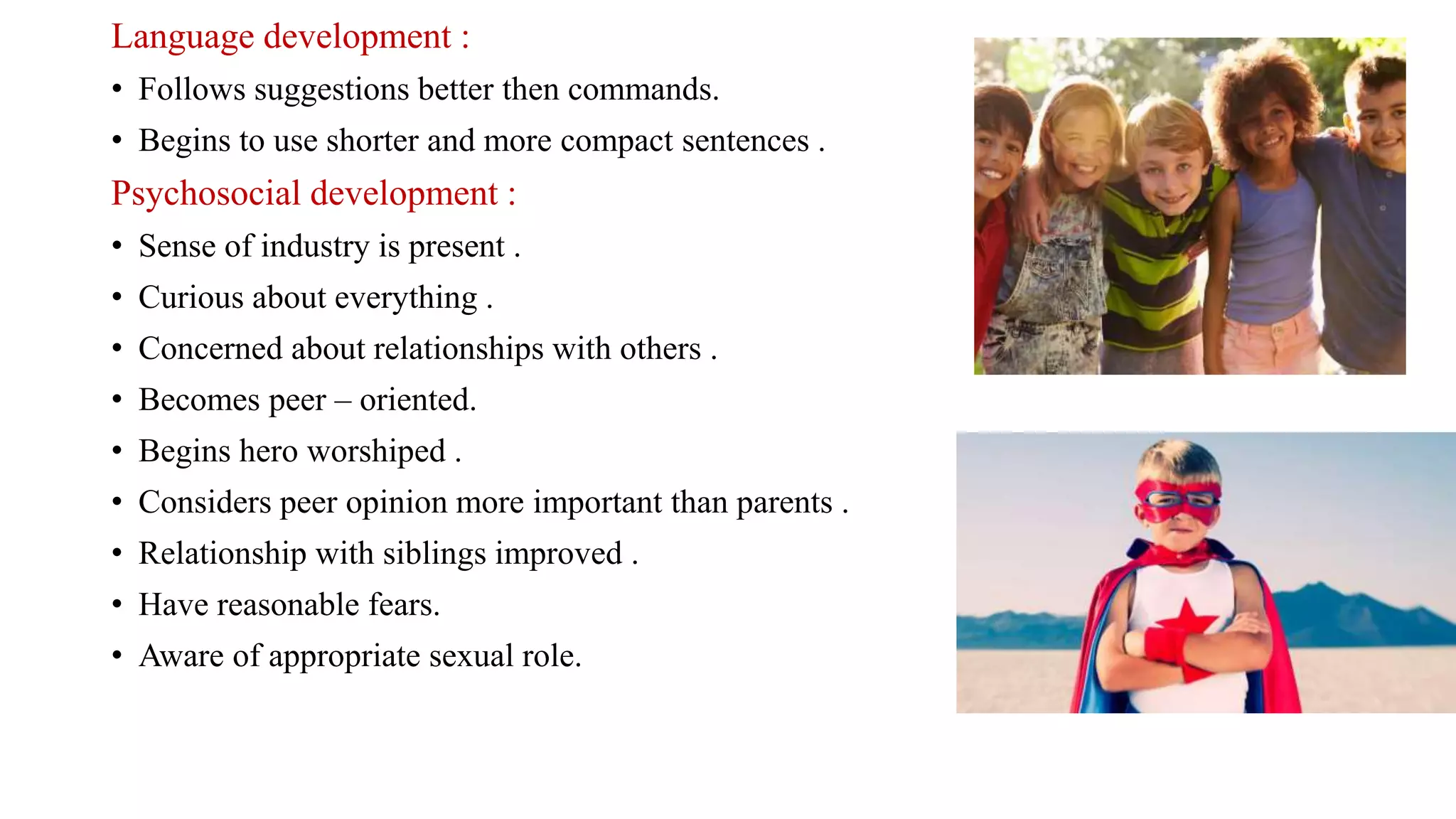
• Dresses self – completely .
Intellectual development :
• Learns to understand and use abstract symbols and carries out mental operation .
• Shows interest in casual relationships.
• Ashamed of failures .
• Interested in school works .
• Memory span increasing .
• Rebels against authority.
Language development :
• Follows suggestions better then commands.
• Begins to use shorter and more compact sentences .
Psychosocial development :
• Sense of industry is present .
• Curious about everything .
• Concerned about relationships with others .
• Becomes peer – oriented.
• Begins hero worshiped .
• Considers peer opinion more important than parents .
• Relationship with siblings improved .
• Have reasonable fears.
• Aware of appropriate sexual role.
Physical development :
At 10 years :
• Weight is approximately 25 – 40 kg.
• Height is approximately 131.5 – 147.5 cm at 10 years.
At 12 years:
• Weight of boys : 30 – 48 kg .
• Weight of girls : 30 – 50 kg.
• Height of boys : 142 – 158 cm.
• Height of girls : 144 – 160 cm.
• Pulse is 90 ± 20 beats / min.
• Respiration is 19 ±3 / min.
• Blood pressure is 109 / 58 ± 16/ 10 mmHg .
• At about 12 years molars erupts.
• Secondary sex characteristics begin to develop.
10 – 12 years
Motor development:
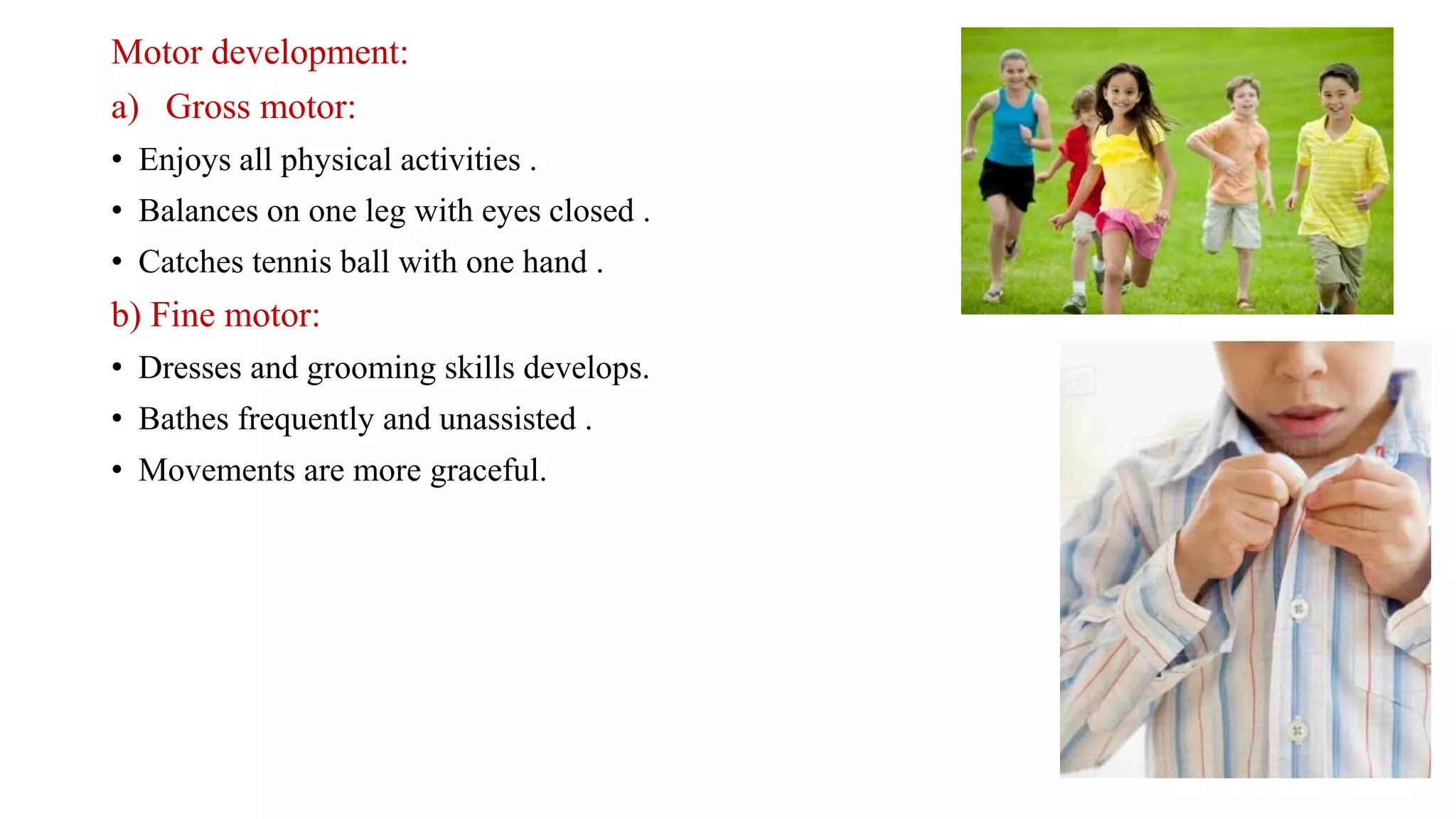
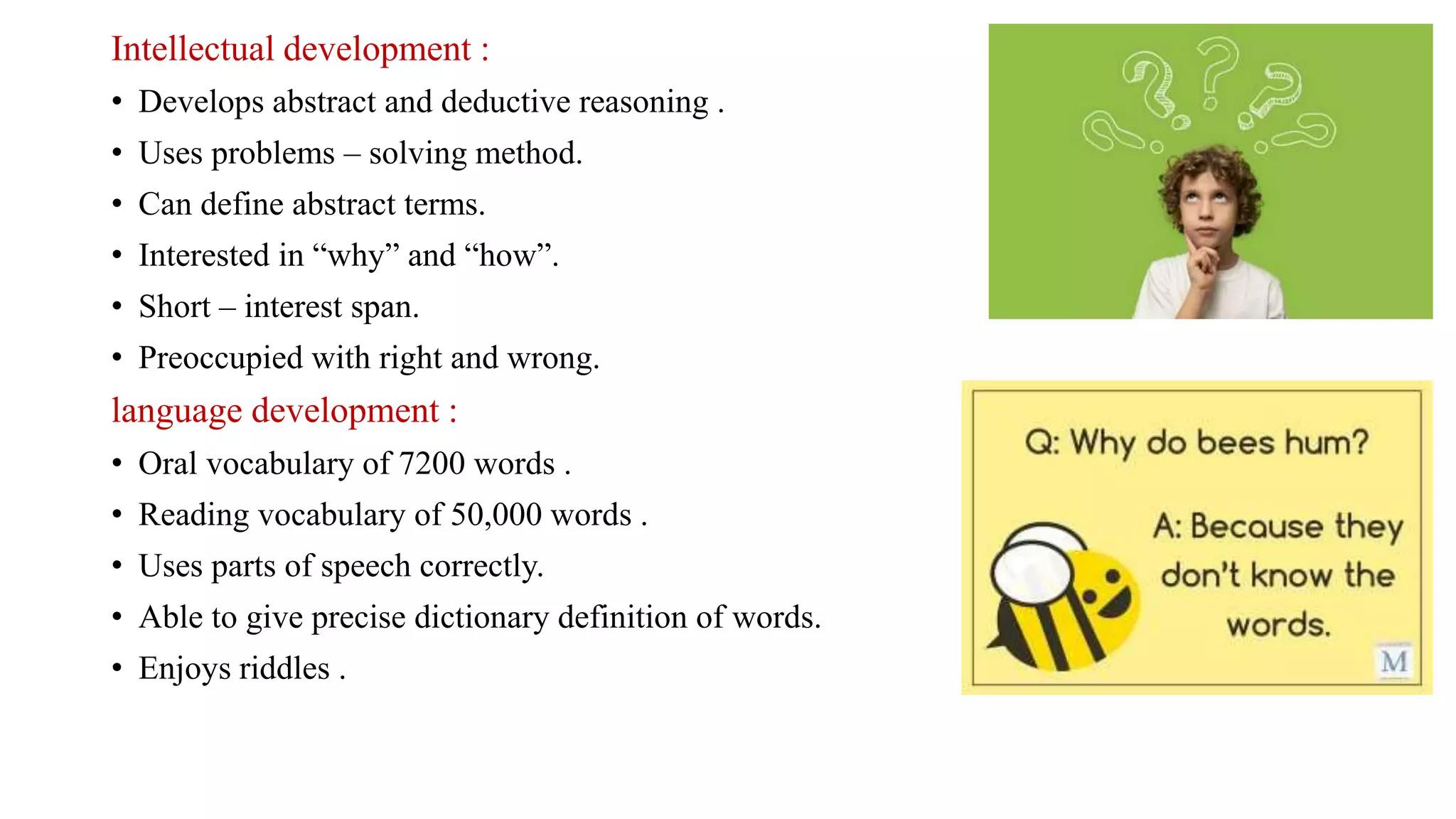
a) Gross motor:
• Enjoys all physical activities .
• Balances on one leg with eyes closed .
• Catches tennis ball with one hand .
b) Fine motor:
• Dresses and grooming skills develops.
• Bathes frequently and unassisted .
• Movements are more graceful.
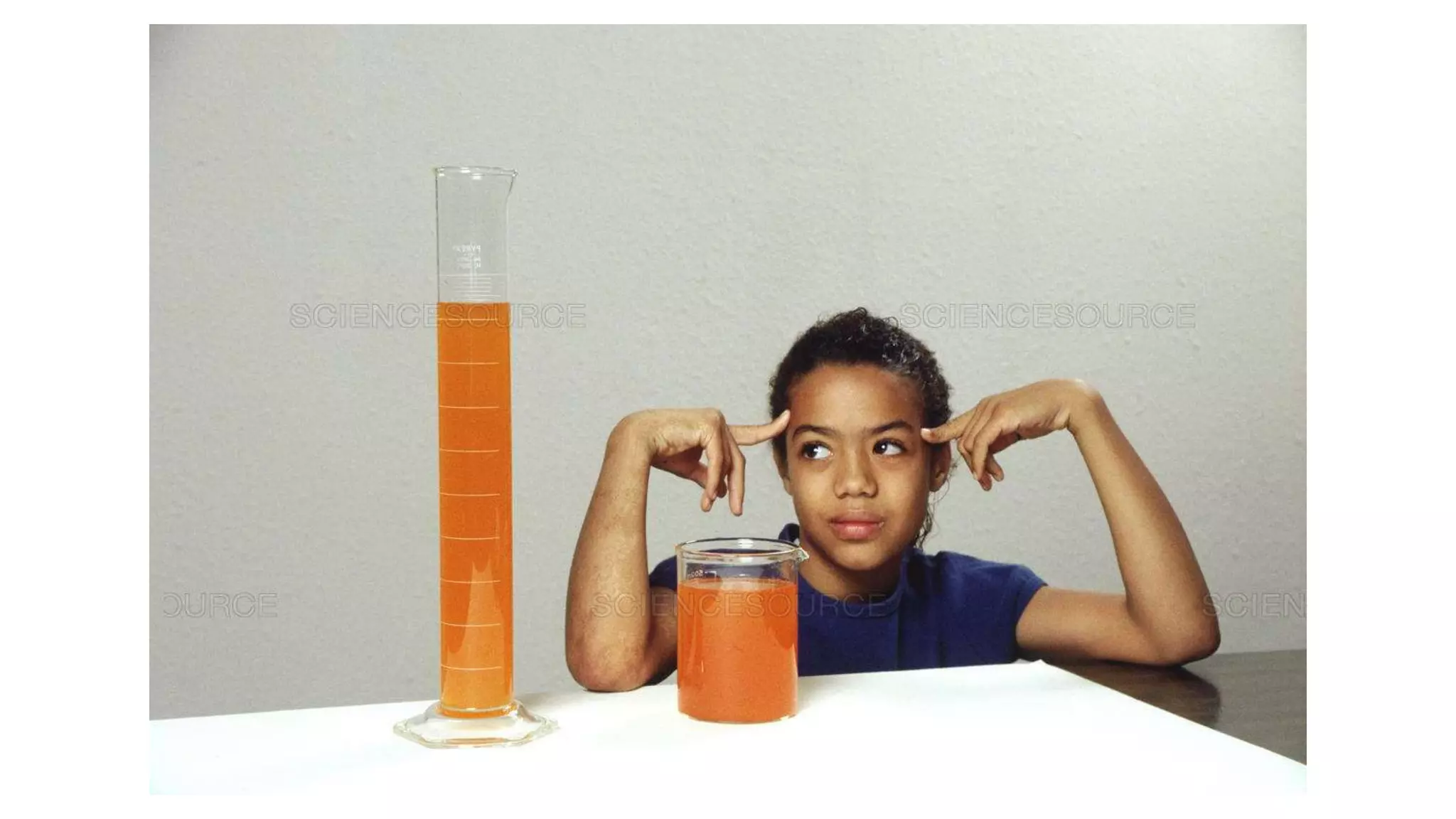
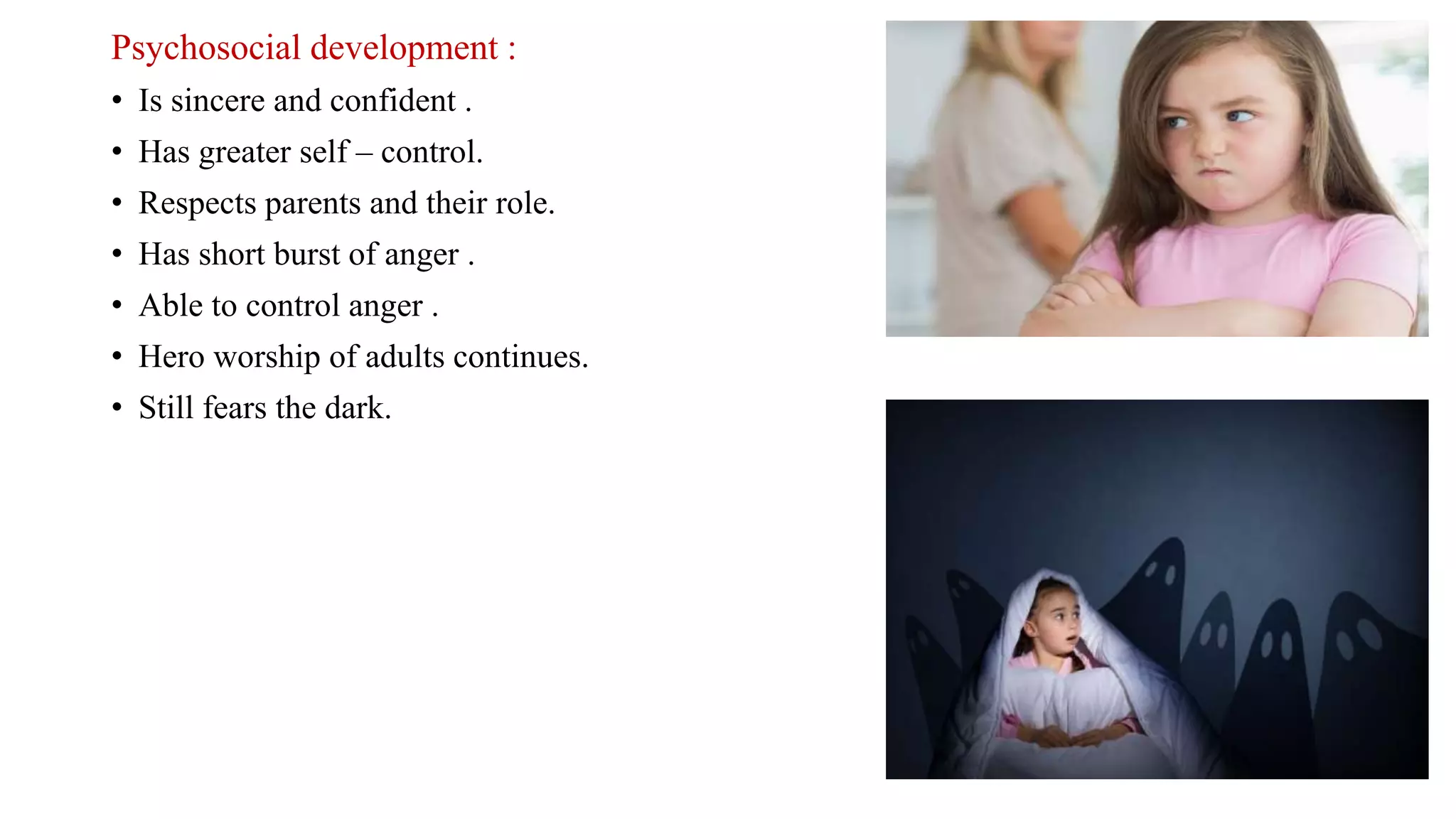
Intellectual development :
• Develops abstract and deductive reasoning .
• Uses problems – solving method.
• Can define abstract terms.
• Interested in “why” and “how”.
• Short – interest span.
• Preoccupied with right and wrong.
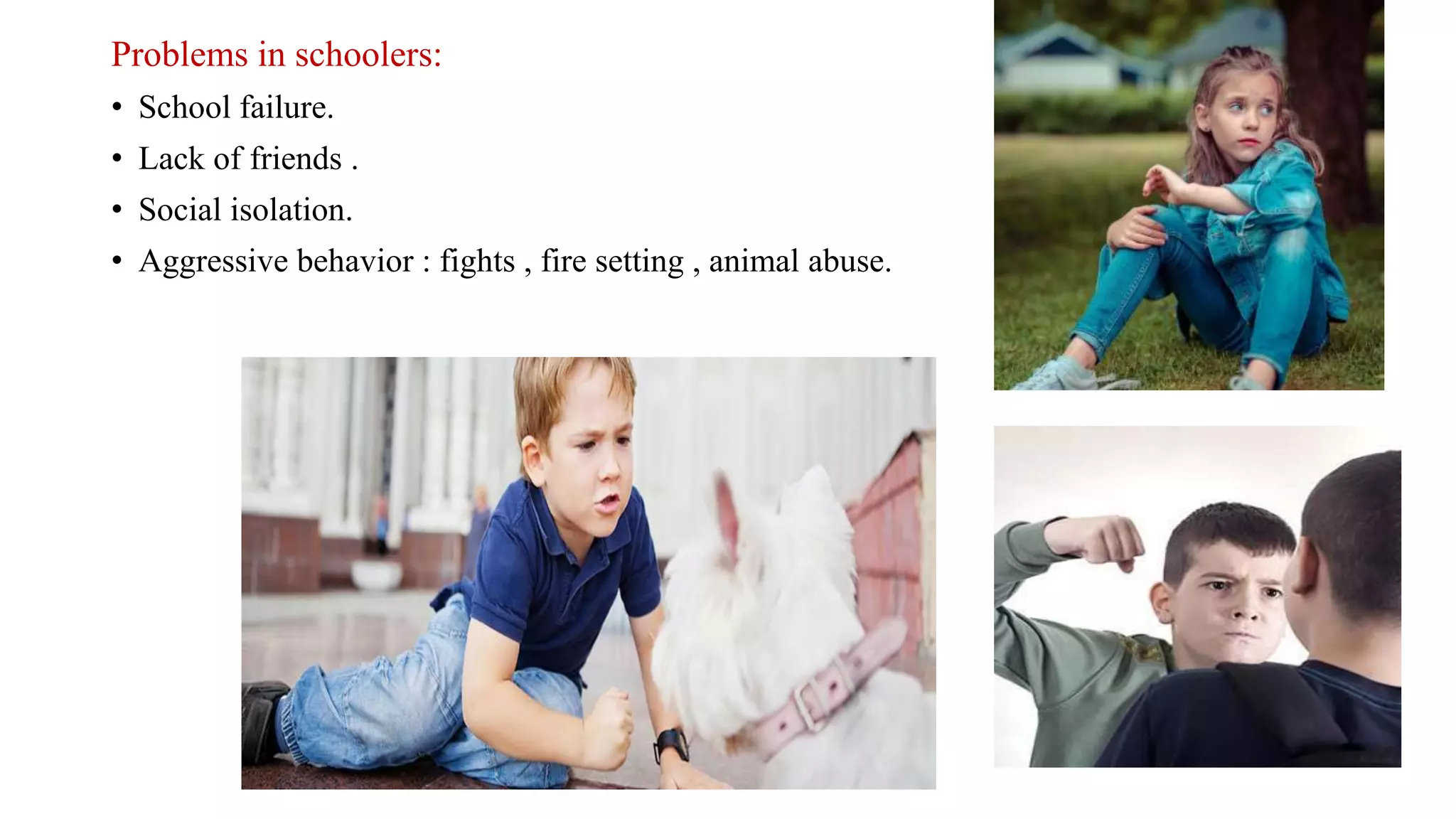
language development :
• Oral vocabulary of 7200 words .
• Reading vocabulary of 50,000 words .
• Uses parts of speech correctly.
• Able to give precise dictionary definition of words.
• Enjoys riddles .
Psychosocial development :
• Is sincere and confident .
• Has greater self – control.
• Respects parents and their role.
• Has short burst of anger .
• Able to control anger .
• Hero worship of adults continues.
• Still fears the dark.
Problems in schoolers:
• School failure.
• Lack of friends .
• Social isolation.
• Aggressive behavior : fights , fire setting , animal abuse.
Common sickness in school children :
• Epistaxis
• Sinusitis
• Recurrent abdominal pain
• Appendicitis
• Allergic disorders
• Headache
• Osteomyelitis
• Rheumatic fever
Play and play materials
Type of play:
• These children are interested chiefly in their immediate environment and immediate
present .
• Play must suit to their interest and attention span.
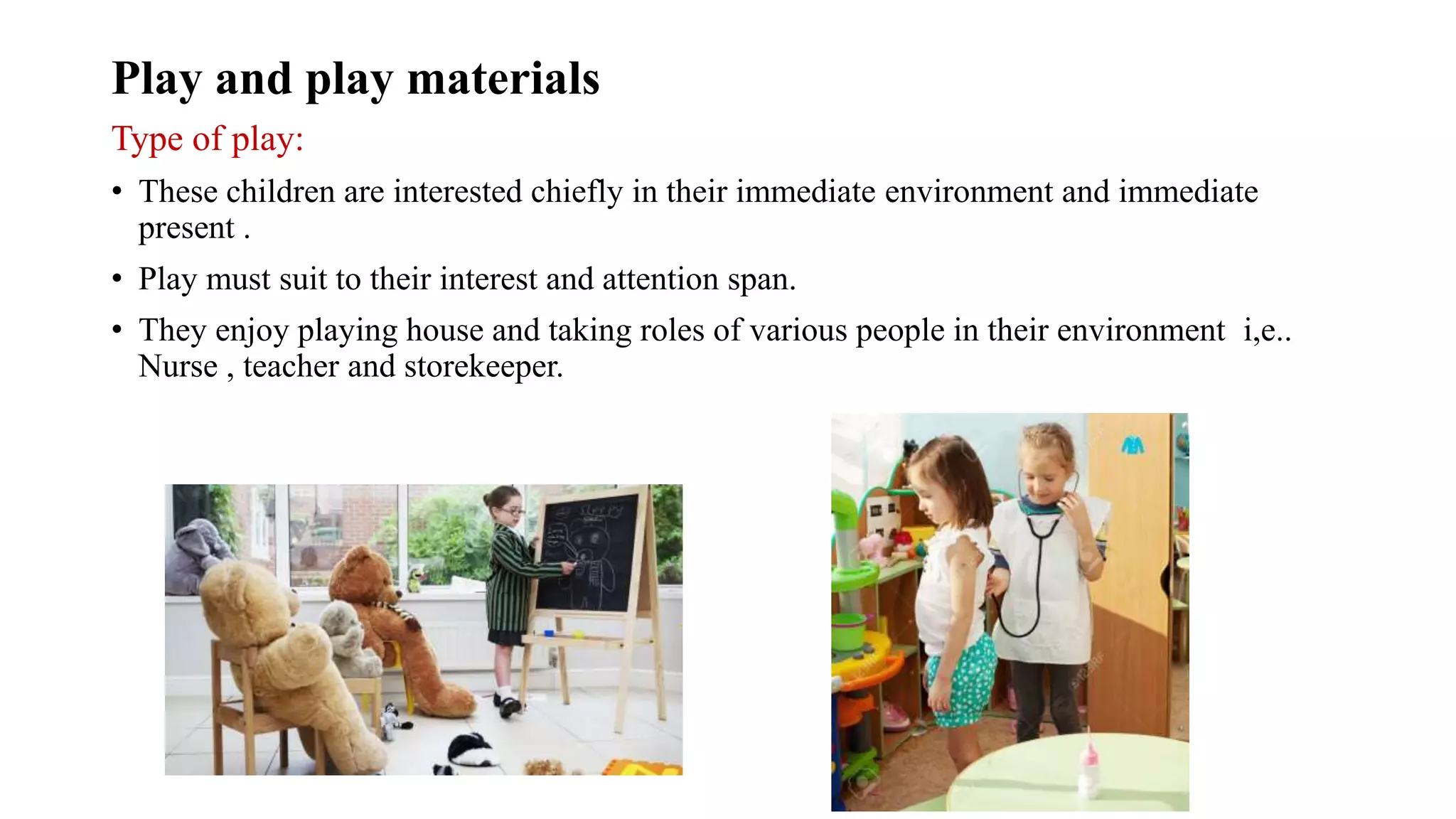
• They enjoy playing house and taking roles of various people in their environment i,e..
Nurse , teacher and storekeeper.
• Children enjoy games of muscular activities running , climbing , swinging etc.
• They like carpentory tools , painting materials , chess, cards , balls , crafts , music,
puzzles , aquarium, maps , animals to make zoo or farm or pets , gardening etc.
Areas of health education
• Nutrition
• Eating habits
• Dental health
• Sleep and rest
• Activities
• Accident prevention
• Sex education
• Prevention of sexual molestation
• Smoking and drugs
Growth and development of schoolers ppt   copy

Growth and development of schoolers ppt copy

  • 1.
    Growth and developmentamong schoolers Presented by : Miss . Shrutika . S. Navilyale MSc Nursing 1st year Child Health Nursing KAHER INS Belagavi
  • 2.
    Introduction : • School-agechild development describes the expected physical, emotional, and mental abilities of children ages 6 to 12. • School age this period of development is one which the child is directed away from the family group and is centered around the wider world of peer relationship i,e school .
  • 3.
    6- 8 years Physicaldevelopment : • Weight is approximately 17.5 - 25.5 kg . • Height is approximately 110 – 124 cm. • Pulse is 90 ± 15 beats / min. • Respiration is 21 ± 3 breaths / min. • Blood pressure is 100 / 60 ± 16 / 10 mm Hg . • Starts losing temporary teeth and acquires first permanent molars , medial incisors , lateral incisors.
  • 4.
    Expected weight (6-12 yrs ) = age ( yrs ) ×7-5 2 Expected height ( 6-12 yrs) = age ( yrs ) × 6+ 77 cm
  • 5.
    Motor development : a)Gross motor : • Rides bicycle without training wheels . • Runs , jumps , climbs , hops . • Constantly keep moving . • Clumsy and awkward movement . b)Fine motor : • Has improved hand – eye coordination . • Draws a person with 12-16 parts. • Bathes self – unassisted . • Learns cursive writing . • Continually refines previously learned skills . • Can brush and comb hair .
  • 6.
    Intellectual development : •Attention span increased. • Can describe objects in picture, knows their use. • Concept of cause and affect is developing . • Can tell time . • Is learning to read . • Follow rules to avoid punishment. Language development : • Receptive language . • Can follow series of 3 commands . Response depend on mood. • Responds to praise and recognition . • Can repeat sentences of 10 – 12 words. • Develops a sense of humour and enjoys telling jokes.
  • 8.
    Psychosocial development: • Developmentof sense of industry begins . • Continues to be egocentric and bossy . • Has a “ know it all” attitude. • Insists on being first in everything. • Wants other children to play with. • Jealous of siblings . • Return of temper tantrums , may use verbal or physical attack. Sensory development : • Has 20/20 vision.
  • 9.
    8- 10 years Physicaldevelopment: • Weight is approximately 22- 32 kg . • Height is approximately 121.5 – 136.5 cm. • Pulse is 85 ± 10 beats / min. • Respiration is 20 ± 3 breaths / min. • Blood pressure is 102/ 60 ± 16 / 10 mmHg. Motor development : a) Gross development : • Performs tricks on bicycle . • Races . • Throws a ball skillfully , overhead.
  • 10.
    b) Fine motor: • Uses both hands independently . • Cursive writing improved . • Handles eating utensils skillfully. • Dresses self – completely . Intellectual development : • Learns to understand and use abstract symbols and carries out mental operation . • Shows interest in casual relationships. • Ashamed of failures . • Interested in school works . • Memory span increasing . • Rebels against authority.
  • 11.
    Language development : •Follows suggestions better then commands. • Begins to use shorter and more compact sentences . Psychosocial development : • Sense of industry is present . • Curious about everything . • Concerned about relationships with others . • Becomes peer – oriented. • Begins hero worshiped . • Considers peer opinion more important than parents . • Relationship with siblings improved . • Have reasonable fears. • Aware of appropriate sexual role.
  • 12.
    Physical development : At10 years : • Weight is approximately 25 – 40 kg. • Height is approximately 131.5 – 147.5 cm at 10 years. At 12 years: • Weight of boys : 30 – 48 kg . • Weight of girls : 30 – 50 kg. • Height of boys : 142 – 158 cm. • Height of girls : 144 – 160 cm. • Pulse is 90 ± 20 beats / min. • Respiration is 19 ±3 / min. • Blood pressure is 109 / 58 ± 16/ 10 mmHg . • At about 12 years molars erupts. • Secondary sex characteristics begin to develop. 10 – 12 years
  • 13.
    Motor development: a) Grossmotor: • Enjoys all physical activities . • Balances on one leg with eyes closed . • Catches tennis ball with one hand . b) Fine motor: • Dresses and grooming skills develops. • Bathes frequently and unassisted . • Movements are more graceful.
  • 14.
    Intellectual development : •Develops abstract and deductive reasoning . • Uses problems – solving method. • Can define abstract terms. • Interested in “why” and “how”. • Short – interest span. • Preoccupied with right and wrong. language development : • Oral vocabulary of 7200 words . • Reading vocabulary of 50,000 words . • Uses parts of speech correctly. • Able to give precise dictionary definition of words. • Enjoys riddles .
  • 15.
    Psychosocial development : •Is sincere and confident . • Has greater self – control. • Respects parents and their role. • Has short burst of anger . • Able to control anger . • Hero worship of adults continues. • Still fears the dark.
  • 16.
    Problems in schoolers: •School failure. • Lack of friends . • Social isolation. • Aggressive behavior : fights , fire setting , animal abuse.
  • 17.
    Common sickness inschool children : • Epistaxis • Sinusitis • Recurrent abdominal pain • Appendicitis • Allergic disorders • Headache • Osteomyelitis • Rheumatic fever
  • 18.
    Play and playmaterials Type of play: • These children are interested chiefly in their immediate environment and immediate present . • Play must suit to their interest and attention span. • They enjoy playing house and taking roles of various people in their environment i,e.. Nurse , teacher and storekeeper.
  • 19.
    • Children enjoygames of muscular activities running , climbing , swinging etc. • They like carpentory tools , painting materials , chess, cards , balls , crafts , music, puzzles , aquarium, maps , animals to make zoo or farm or pets , gardening etc.
  • 20.
    Areas of healtheducation • Nutrition • Eating habits • Dental health • Sleep and rest • Activities • Accident prevention • Sex education • Prevention of sexual molestation • Smoking and drugs