






Lecture-5
Prof. Dr. Sunil Natha Mhaske
Dean
Dr. Vithalrao Vikhe Patil Foundation’s Medical College and Hospital,
Ahmednagar (M.S.) India-414111
Mo- 7588024773
Mail-sunilmhaske1970@gmail.com
Neonatal Reflexes
(Primitive reflexes)
• These are reflex actions originating in the central nervous
system that are exhibited by normal infants, but not
neurologically intact adults, in response to particular stimuli.
• These reflexes are suppressed by the development of
the frontal lobes as a child transitions normally into child
development.
• These primitive reflexes are also
called infantile, infant or newborn reflexes.
• Primitive reflexes are mediated by extrapyramidal functions,
many of which are already present at birth. They are lost as
the pyramidal tracts gain functionality with
progressive myelination.
Neonatal or Primitive reflexes
• A reflex is a response to a stimulus and that occurs without
conscious thought.
• Neonatal Reflexes are involuntary movements or actions.
• Some movements are spontaneous and occur as part of the
baby's normal activity.
• Others are responses to certain actions.
• It indicates the brain and nervous system are working well.
• Some reflexes occur only in specific periods of development.
• Much of the baby’s activity in her first weeks of life is
reflexive. E.g. sucking finger if you put in babies mouth
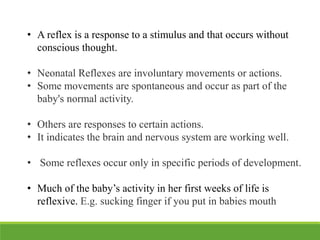
I. Oral Reflexes:
A. Rooting reflex:
• Rooting reflex is stimulated by
touching a finger to the
infant's cheek or the corner of
the mouth.
• The neonate responds by
turning the head toward the
stimulus, opening the mouth
and searching for the stimulus.
• This is a necessary reflex
triggered by the mother's
nipple during breastfeeding.
• It is usually inhibited by the
third to fourth month.
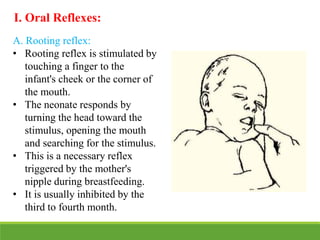
B. Suckling reflex:
• Suckling reflex is triggered by
placing a finger or the mother's
nipple in the infant's mouth.
• The neonate will suck on the
finger or nipple forcefully and
rhythmically and the sucking is
coordinated with swallowing.
• Like the rooting reflex, it is
inhibited by the third to fourth
month.
II. Eye Reflexes:
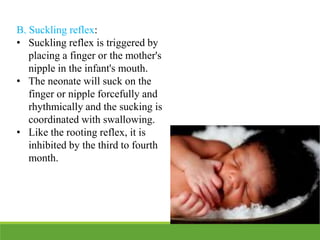
A. Doll’s eye response:
• Doll's eye reflex can be noted with the
infant supine (lying on the back) and
slowly turning the head to either side.
• The infant's eyes will remain stationary.
• This reflex should disappear between
three to four months of age.
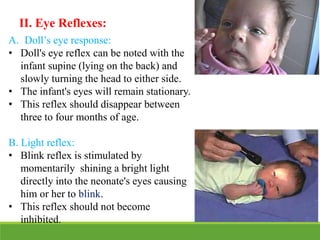
B. Light reflex:
• Blink reflex is stimulated by
momentarily shining a bright light
directly into the neonate's eyes causing
him or her to blink.
• This reflex should not become
inhibited.
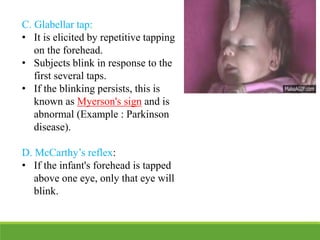
C. Glabellar tap:
• It is elicited by repetitive tapping
on the forehead.
• Subjects blink in response to the
first several taps.
• If the blinking persists, this is
known as Myerson's sign and is
abnormal (Example : Parkinson
disease).
D. McCarthy’s reflex:
• If the infant's forehead is tapped
above one eye, only that eye will
blink.
III. Spine Reflexes:
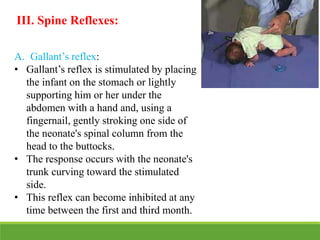
A. Gallant’s reflex:
• Gallant’s reflex is stimulated by placing
the infant on the stomach or lightly
supporting him or her under the
abdomen with a hand and, using a
fingernail, gently stroking one side of
the neonate's spinal column from the
head to the buttocks.
• The response occurs with the neonate's
trunk curving toward the stimulated
side.
• This reflex can become inhibited at any
time between the first and third month.
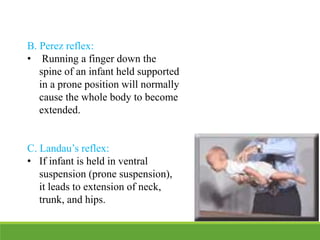
B. Perez reflex:
• Running a finger down the
spine of an infant held supported
in a prone position will normally
cause the whole body to become
extended.
C. Landau’s reflex:
• If infant is held in ventral
suspension (prone suspension),
it leads to extension of neck,
trunk, and hips.
IV. Limb Reflexes:
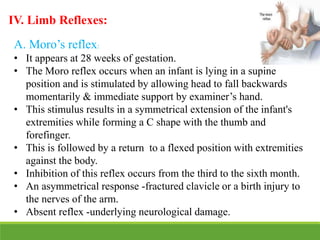
A. Moro’s reflex:
• It appears at 28 weeks of gestation.
• The Moro reflex occurs when an infant is lying in a supine
position and is stimulated by allowing head to fall backwards
momentarily & immediate support by examiner’s hand.
• This stimulus results in a symmetrical extension of the infant's
extremities while forming a C shape with the thumb and
forefinger.
• This is followed by a return to a flexed position with extremities
against the body.
• Inhibition of this reflex occurs from the third to the sixth month.
• An asymmetrical response -fractured clavicle or a birth injury to
the nerves of the arm.
• Absent reflex -underlying neurological damage.
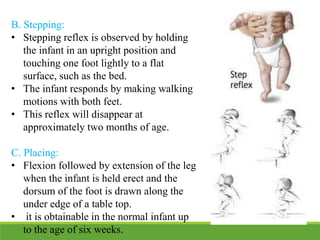
B. Stepping:
• Stepping reflex is observed by holding
the infant in an upright position and
touching one foot lightly to a flat
surface, such as the bed.
• The infant responds by making walking
motions with both feet.
• This reflex will disappear at
approximately two months of age.
C. Placing:
• Flexion followed by extension of the leg
when the infant is held erect and the
dorsum of the foot is drawn along the
under edge of a table top.
• it is obtainable in the normal infant up
to the age of six weeks.
D. Prone crawl reflex :
• It can be stimulated by placing
the neonate prone (face down)
on a flat surface.
• The neonate will attempt to
crawl forward using the arms
and legs.
• This reflex will be inhibited by
three to four months of age.
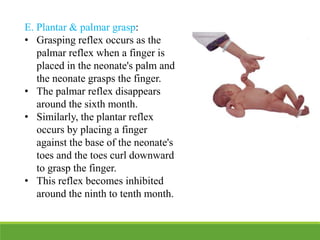
E. Plantar & palmar grasp:
• Grasping reflex occurs as the
palmar reflex when a finger is
placed in the neonate's palm and
the neonate grasps the finger.
• The palmar reflex disappears
around the sixth month.
• Similarly, the plantar reflex
occurs by placing a finger
against the base of the neonate's
toes and the toes curl downward
to grasp the finger.
• This reflex becomes inhibited
around the ninth to tenth month.
F. Crossed adductor reflex:
• Contraction of the adductors of
the thigh and inward rotation of
the limb elicited by tapping the
sole.
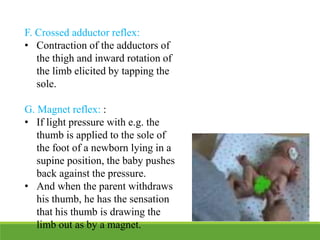
G. Magnet reflex: :
• If light pressure with e.g. the
thumb is applied to the sole of
the foot of a newborn lying in a
supine position, the baby pushes
back against the pressure.
• And when the parent withdraws
his thumb, he has the sensation
that his thumb is drawing the
limb out as by a magnet.
V. Postural reflexes:
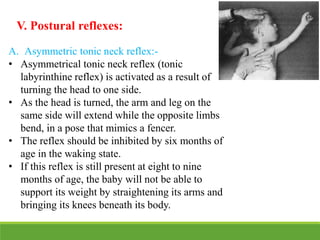
A. Asymmetric tonic neck reflex:-
• Asymmetrical tonic neck reflex (tonic
labyrinthine reflex) is activated as a result of
turning the head to one side.
• As the head is turned, the arm and leg on the
same side will extend while the opposite limbs
bend, in a pose that mimics a fencer.
• The reflex should be inhibited by six months of
age in the waking state.
• If this reflex is still present at eight to nine
months of age, the baby will not be able to
support its weight by straightening its arms and
bringing its knees beneath its body.
B. Symmetric tonic neck reflex:
• Symmetrical tonic neck reflex
occurs with either the extension
or flexion of the infant's head.
• Extension of the head results in
extension of the arms and
flexion of the legs, and a flexion
of the head causes flexion of the
arms and an extension of the
legs.
• This reflex becomes inhibited by
the sixth month to enable
crawling.
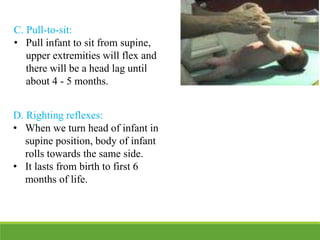
C. Pull-to-sit:
• Pull infant to sit from supine,
upper extremities will flex and
there will be a head lag until
about 4 - 5 months.
D. Righting reflexes:
• When we turn head of infant in
supine position, body of infant
rolls towards the same side.
• It lasts from birth to first 6
months of life.
E. Babinski or plantar reflex :-
• It is triggered by stroking one
side of the infant's foot upward
from the heel and across the ball
of the foot.
• The infant responds by
hyperextending the toes; the
great toe flexes toward the top of
the foot and the other toes fan
outward.
• It generally becomes inhibited
from the sixth to ninth month of
post natal life.
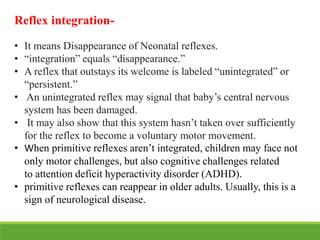
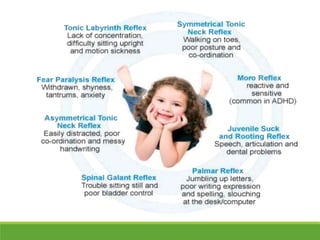
• It means Disappearance of Neonatal reflexes.
• “integration” equals “disappearance.”
• A reflex that outstays its welcome is labeled “unintegrated” or
“persistent.”
• An unintegrated reflex may signal that baby’s central nervous
system has been damaged.
• It may also show that this system hasn’t taken over sufficiently
for the reflex to become a voluntary motor movement.
• When primitive reflexes aren’t integrated, children may face not
only motor challenges, but also cognitive challenges related
to attention deficit hyperactivity disorder (ADHD).
• primitive reflexes can reappear in older adults. Usually, this is a
sign of neurological disease.
Reflex integration-
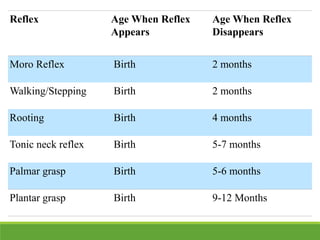
Reflex Age When Reflex
Appears
Age When Reflex
Disappears
Moro Reflex Birth 2 months
Walking/Stepping Birth 2 months
Rooting Birth 4 months
Tonic neck reflex Birth 5-7 months
Palmar grasp Birth 5-6 months
Plantar grasp Birth 9-12 Months
Knowledge of neonatal reflexes is important for-
 Understanding the human development as a whole.
 Application for over all assessment of baby.
 Recognition of possible neurodevelopmental damage in
prenatal and perinatal period.
 Establishment of the prognosis for future.
 Predicting the Childs future potential.
Take home message
1. https://en.wikipedia.org/wiki/Primitive_reflexes
2. https://people.umass.edu/mva/pdf/Neonatal_Reflexes_07.pdf
3. Primitive Reflexes-Alexa K. Modrell; Prasanna Tadi.
4. https://www.healthychildren.org/English/ages-
stages/baby/Pages/Newborn-Reflexes.aspx
5. https://www.stanfordchildrens.org/en/topic/default?id=newborn
-reflexes-90-P02630
References-
Thanks a lot

Lecture 5. Neonatal reflexes

  • 2.
    Lecture-5 Prof. Dr. SunilNatha Mhaske Dean Dr. Vithalrao Vikhe Patil Foundation’s Medical College and Hospital, Ahmednagar (M.S.) India-414111 Mo- 7588024773 Mail-sunilmhaske1970@gmail.com Neonatal Reflexes (Primitive reflexes)
  • 3.
    • These arereflex actions originating in the central nervous system that are exhibited by normal infants, but not neurologically intact adults, in response to particular stimuli. • These reflexes are suppressed by the development of the frontal lobes as a child transitions normally into child development. • These primitive reflexes are also called infantile, infant or newborn reflexes. • Primitive reflexes are mediated by extrapyramidal functions, many of which are already present at birth. They are lost as the pyramidal tracts gain functionality with progressive myelination. Neonatal or Primitive reflexes
  • 4.
    • A reflexis a response to a stimulus and that occurs without conscious thought. • Neonatal Reflexes are involuntary movements or actions. • Some movements are spontaneous and occur as part of the baby's normal activity. • Others are responses to certain actions. • It indicates the brain and nervous system are working well. • Some reflexes occur only in specific periods of development. • Much of the baby’s activity in her first weeks of life is reflexive. E.g. sucking finger if you put in babies mouth
  • 5.
    I. Oral Reflexes: A.Rooting reflex: • Rooting reflex is stimulated by touching a finger to the infant's cheek or the corner of the mouth. • The neonate responds by turning the head toward the stimulus, opening the mouth and searching for the stimulus. • This is a necessary reflex triggered by the mother's nipple during breastfeeding. • It is usually inhibited by the third to fourth month.
  • 6.
    B. Suckling reflex: •Suckling reflex is triggered by placing a finger or the mother's nipple in the infant's mouth. • The neonate will suck on the finger or nipple forcefully and rhythmically and the sucking is coordinated with swallowing. • Like the rooting reflex, it is inhibited by the third to fourth month.
  • 7.
    II. Eye Reflexes: A.Doll’s eye response: • Doll's eye reflex can be noted with the infant supine (lying on the back) and slowly turning the head to either side. • The infant's eyes will remain stationary. • This reflex should disappear between three to four months of age. B. Light reflex: • Blink reflex is stimulated by momentarily shining a bright light directly into the neonate's eyes causing him or her to blink. • This reflex should not become inhibited.
  • 8.
    C. Glabellar tap: •It is elicited by repetitive tapping on the forehead. • Subjects blink in response to the first several taps. • If the blinking persists, this is known as Myerson's sign and is abnormal (Example : Parkinson disease). D. McCarthy’s reflex: • If the infant's forehead is tapped above one eye, only that eye will blink.
  • 9.
    III. Spine Reflexes: A.Gallant’s reflex: • Gallant’s reflex is stimulated by placing the infant on the stomach or lightly supporting him or her under the abdomen with a hand and, using a fingernail, gently stroking one side of the neonate's spinal column from the head to the buttocks. • The response occurs with the neonate's trunk curving toward the stimulated side. • This reflex can become inhibited at any time between the first and third month.
  • 10.
    B. Perez reflex: •Running a finger down the spine of an infant held supported in a prone position will normally cause the whole body to become extended. C. Landau’s reflex: • If infant is held in ventral suspension (prone suspension), it leads to extension of neck, trunk, and hips.
  • 11.
    IV. Limb Reflexes: A.Moro’s reflex: • It appears at 28 weeks of gestation. • The Moro reflex occurs when an infant is lying in a supine position and is stimulated by allowing head to fall backwards momentarily & immediate support by examiner’s hand. • This stimulus results in a symmetrical extension of the infant's extremities while forming a C shape with the thumb and forefinger. • This is followed by a return to a flexed position with extremities against the body. • Inhibition of this reflex occurs from the third to the sixth month. • An asymmetrical response -fractured clavicle or a birth injury to the nerves of the arm. • Absent reflex -underlying neurological damage.
  • 12.
    B. Stepping: • Steppingreflex is observed by holding the infant in an upright position and touching one foot lightly to a flat surface, such as the bed. • The infant responds by making walking motions with both feet. • This reflex will disappear at approximately two months of age. C. Placing: • Flexion followed by extension of the leg when the infant is held erect and the dorsum of the foot is drawn along the under edge of a table top. • it is obtainable in the normal infant up to the age of six weeks.
  • 13.
    D. Prone crawlreflex : • It can be stimulated by placing the neonate prone (face down) on a flat surface. • The neonate will attempt to crawl forward using the arms and legs. • This reflex will be inhibited by three to four months of age.
  • 14.
    E. Plantar &palmar grasp: • Grasping reflex occurs as the palmar reflex when a finger is placed in the neonate's palm and the neonate grasps the finger. • The palmar reflex disappears around the sixth month. • Similarly, the plantar reflex occurs by placing a finger against the base of the neonate's toes and the toes curl downward to grasp the finger. • This reflex becomes inhibited around the ninth to tenth month.
  • 15.
    F. Crossed adductorreflex: • Contraction of the adductors of the thigh and inward rotation of the limb elicited by tapping the sole. G. Magnet reflex: : • If light pressure with e.g. the thumb is applied to the sole of the foot of a newborn lying in a supine position, the baby pushes back against the pressure. • And when the parent withdraws his thumb, he has the sensation that his thumb is drawing the limb out as by a magnet.
  • 16.
    V. Postural reflexes: A.Asymmetric tonic neck reflex:- • Asymmetrical tonic neck reflex (tonic labyrinthine reflex) is activated as a result of turning the head to one side. • As the head is turned, the arm and leg on the same side will extend while the opposite limbs bend, in a pose that mimics a fencer. • The reflex should be inhibited by six months of age in the waking state. • If this reflex is still present at eight to nine months of age, the baby will not be able to support its weight by straightening its arms and bringing its knees beneath its body.
  • 17.
    B. Symmetric tonicneck reflex: • Symmetrical tonic neck reflex occurs with either the extension or flexion of the infant's head. • Extension of the head results in extension of the arms and flexion of the legs, and a flexion of the head causes flexion of the arms and an extension of the legs. • This reflex becomes inhibited by the sixth month to enable crawling.
  • 18.
    C. Pull-to-sit: • Pullinfant to sit from supine, upper extremities will flex and there will be a head lag until about 4 - 5 months. D. Righting reflexes: • When we turn head of infant in supine position, body of infant rolls towards the same side. • It lasts from birth to first 6 months of life.
  • 19.
    E. Babinski orplantar reflex :- • It is triggered by stroking one side of the infant's foot upward from the heel and across the ball of the foot. • The infant responds by hyperextending the toes; the great toe flexes toward the top of the foot and the other toes fan outward. • It generally becomes inhibited from the sixth to ninth month of post natal life.
  • 20.
    • It meansDisappearance of Neonatal reflexes. • “integration” equals “disappearance.” • A reflex that outstays its welcome is labeled “unintegrated” or “persistent.” • An unintegrated reflex may signal that baby’s central nervous system has been damaged. • It may also show that this system hasn’t taken over sufficiently for the reflex to become a voluntary motor movement. • When primitive reflexes aren’t integrated, children may face not only motor challenges, but also cognitive challenges related to attention deficit hyperactivity disorder (ADHD). • primitive reflexes can reappear in older adults. Usually, this is a sign of neurological disease. Reflex integration-
  • 21.
    Reflex Age WhenReflex Appears Age When Reflex Disappears Moro Reflex Birth 2 months Walking/Stepping Birth 2 months Rooting Birth 4 months Tonic neck reflex Birth 5-7 months Palmar grasp Birth 5-6 months Plantar grasp Birth 9-12 Months
  • 25.
    Knowledge of neonatalreflexes is important for-  Understanding the human development as a whole.  Application for over all assessment of baby.  Recognition of possible neurodevelopmental damage in prenatal and perinatal period.  Establishment of the prognosis for future.  Predicting the Childs future potential. Take home message
  • 26.
    1. https://en.wikipedia.org/wiki/Primitive_reflexes 2. https://people.umass.edu/mva/pdf/Neonatal_Reflexes_07.pdf 3.Primitive Reflexes-Alexa K. Modrell; Prasanna Tadi. 4. https://www.healthychildren.org/English/ages- stages/baby/Pages/Newborn-Reflexes.aspx 5. https://www.stanfordchildrens.org/en/topic/default?id=newborn -reflexes-90-P02630 References-
  • 27.