Developmetally Supportive Care
Preterm birth
Preterm is defined as babies born alive before
37 weeks of pregnancy are completed.
Extremely preterm (<28 weeks)
Very preterm (28 to <32 weeks)
Moderate preterm (32 to 34 weeks)
Late-preterm infants (34 to 36 weeks)
Goal
To improve functional outcome, have positive
neuro developmental outcome and achieve
intact survival of the fragile, preterm and/or
critically ill infant.
Development of Various Neonatal
Sensory Systems
Sequence is : tactile, vestibular, gustatory-
olfactory, auditory and then visual.
Hence while carrying out developmental
interventions in the NICU, stimulation of the
senses should begin with the most mature.
Tactile system
Tactile threshold is very low in preterm infants.
It has been demonstrated that preterm infants less
than 30 weeks respond with leg withdrawal to a
plantar pressure stimulus at pressures almost
one-third as compared to same response in a
term infant.
Tactile system
At about 32 weeks PCA, a qualitative shift in
response occurs.
Infants less than 32 weeks respond to repeated
stimulation with a diffuse behavioural response.
In contrast, infants > 32 weeks show habituation
to the same stimuli.
Tactile system
Tactile hypersensitivity is commonly encountered
in children born preterm
Generally the hands or oro-facial regions
Importance of sleep
Disturbance of sleep has biologic and
immunologic consequences.
Secretion of cortisol and adrenaline normally is
inhibited during sleep. Growth hormone, which is
released during quiet sleep, increases protein
synthesis and mobilization of free fatty acids for
energy use.
Thus sleep facilitates healing.
Tactile system
Excess handling can lead to blood pressure
changes and alterations in cerebral blood flow
leading to desaturation episodes and in extreme
cases, even intracranial haemorrhages in unstable
preterm neonate.
Tactile interventions in the NICU
Two general approaches are used – Reduction in
general handling and Provision of planned tactile
experiences.
The general order of tactile intervention might be:
If acutely ill – minimal handling, containment (e.g.
Swaddling), and gentle touch without stroking
When medically stable and near term – holding,
rocking gently, stroking, continue to swaddle
Non-nutritive sucking
Improved gastrointestinal transit time, greater
suck pressure, more sucks per burst and fewer
sporadic sucks.
Non-nutritive sucking has been shown to
decrease motor activity and increase quiet states
in stable preterm infants.
Also, it dampens an infant’s behavioural response
after a painful stimulus.
Vestibular system
Responds to movements as well as directional
changes in gravity
Vestibular stimulation affects levels of alertness
Slow, rhythmic, continuous movement induces
sleep
Periodic or higher amplitude swings increase
arousal.
Vestibular system
Vestibular stimulation is used to affect state
moving to upright or laying down increases
arousal
Monotonous side-to-side rocking and walking in
the form of parental pacing reduce the level of
arousal
Prone Position
Prone positioning in the NICU has been strongly
supported physiologically
Gastric emptying was facilitated in either the
prone or right lateral position compared to the
supine or left lateral position
Prone position, compared to supine, is associated
with more quiet sleep and less active sleep or
crying
Prone Position
Quiet sleep, in turn, is associated with improved
lung volume, more stable respiration, less apnea,
and improved PAO2
The prone position compared to supine is
associated with a higher PAO2 among healthy
preterm infants and, even more significantly, in
those with respiratory distress syndrome
The sick infant should be nursed in a prone or
right lateral position
In the prone position, placing the infant on a small
folded strip from shoulder to hip, could allow more
physiologic flexion and adduction
In side lying, it may be easier to position the infant
in soft flexion. Gentle containment of the limbs
usually can be managed with strips of soft cloth
across the upper arm and thigh
Some movement should be allowed within a
controlled range
Each posture should facilitate the infant bringing
hands to mouth
Gustatory olfactory
Preterm infants (30 to 36 weeks) show stronger
sucking response to glucose
By 28 to 32 weeks gestation majority of newborns
show response to olfactory input, turn their heads
away from noxious smell and they prefer the
odour of their mother’s breast pad
Auditory
The absence of auditory stimulation would cause
cortical neuronal degeneration
2 to 4 days old neonates prefer their mother’s
voice
The intensity of sounds in amniotic fluid is 70 to 85
dB with predominance of low frequency
The aberrant noise levels cause sensory neural
damage, induce stress and contribute to language
or auditory processing disorders
As early as 24 weeks to 28 weeks, a visual
evoked response to bright light can be obtained
and there is lid tightening behavioural response
Around 32 weeks, visual evoked response
becomes more complex and the pupillary reflex is
more efficient.
A bright light will cause immediate lid closure and
the response is sustained.
There is beginning of attention and the neonate
briefly fixates.
New-born are photophobic, visual attention is
facilitated under low illumination.
Neonates can fixate on a high contrast form i.e.
1/16 inch line at a distance of 1 foot.
They have preference for human face.
Bright light in an infant’s face is a source of stress.
Lower ambient light is associated with significantly
less active rapid eye movement and quiet sleep
state.
New-born also have increased eye opening and
awake periods in lower ambient light.
Neuromotor Maturation and Stages
of
Neurobehavioral Organization
All infants who are born prematurely will miss an
important inter-uterine motor milestone: the
development of flexor tone. This critical
component of muscle development occurs
throughout the third trimester of pregnancy.
During the first two trimesters, extensor tone
becomes well established as an infant develops
his extensor muscles along the back of his body.
As the fetus grows larger and more cramped
during months 7, 8, and 9, the muscles used for
flexion, (muscles along the front of the body)
develop.
Prior to 40 weeks gestation, whether in utero or
outside the womb, an infant’s muscle tone
development progresses in a caudo-cephalic (toe
to head) and centripetal (distal to proximal)
direction.
At 40 weeks Post- Conceptual Age (PCA), the
infant’s actual due date, an infant’s motor
development reverses and begins to progress in
the opposite direction in a cephalo-caudal (head
to toe) and proximal to distal (from the middle of
the body out) direction.
The same development pattern found in a normal
term infant.
What is Developmentally Supportive
Care (DSC)?
A holistic module which incorporates care that
supports:
Brain architecture and development
Motor development and normalizing movement
patterns
Sensory system and state system development
Oral/feeding development along with family
development
Interventions include
Control of external stimuli (auditory, visual, tactile,
vestibular)
Clustering of nursing care activities to avoid
disrupting sleep
Positioning or swaddling of the preterm infant
Calming techniques
Why is DSC important?
Neonates are under severe and often life
threatening stress
Immature and or fragile autonomic and nervous
systems
DSC can give them more reserve to heal,
minimize affects of trauma, and promote normal
development of nervous system.
Benefits of DSC
Supports autonomic stability, normal motor,
sensory, neurological development and promotes
behavioral state organization
Decreases length of hospital stay
Improves weight gain
Shortens the time to full enteral feeding
The neuro-developmental scores at 9-12 months
age were seen to be improved showed improved
neurobehavior, electrophysiology and brain
structure
Core measures for DSC
1) Protected sleep
2) Pain and stress assessment and management
3) Activities of daily living (positioning, feeding and
skin care),
4) Family-centred care
5) The healing environment
Core measure 1: Protected sleep
Most important
It involves a totally undisturbed sleep state/phase,
in which the infant conserves energy, experiences
weight gain and has optimal brain growth.
All non-emergent care giving is provided during
wakeful states.
Facilitative tuck, swaddled bathing and skin-to-
skin care
Light and sound levels
Core measure 2: Pain and stress
assessment and management
Routine assessment and documentation of pain
and stress
Non-pharmacologic and / or pharmacologic
measures are utilized prior to all stressful and/or
painful procedures
Each infant is assessed for pain and/or stress at a
minimum of 4 to 6 hours interval
Core measure 3: Developmental
activities of daily living: positioning,
feeding and skin care
Positioning: Provide comfort, safety, physiologic
stability and optimal neuromotor development
Infant is positioned and handled in flexion,
containment and alignment during all care giving
activities.
Feeding
Skin integrity should be ascessed at least once
per shift and documented
Core measure 4: Family-centered care
Access to their infant
Family is supported in parenting activities
Access to resources and supports that assist them
in their short and long term parenting needs
Core measure 5: The healing
environment
Continuous background sound and transient
sound in the neonatal intensive care unit shall not
exceed an hourly continuous noise level of 45 to
50 decibels (dB).
Transient sounds or Lmax (the single highest
sound level) shall not exceed 65 dB.
Core measure 5: The healing
environment
Ambient light levels ranging between 10–600 lux
and 1–60 foot candles shall be adjustable and
measured at each infant bed space.
Core measure 5: The healing
environment
Direct care providers demonstrate caring
behaviors which include
adherence to hand hygiene protocols
cultural sensitivity
open listening skills
sensitive relationship orientation
Core measure 5: The healing
environment
Documentation of evidence-based policies,
procedures and resources to sustain the healing
environment over time.
Synactive theory
Focuses on the neurobehavioral capacity of the
infant as the baby develops
The baby’s neurobehavioral capacity develops
through interactions with caregivers and the
environment [i.e. sensory, medical, and care
giving experiences in the NICU]
The neuro-behaviors are classified
across five subsystems:
Autonomic/physiologic
Motor
Attention/interaction
State (of arousal)
Self-regulatory
Developing the neurobehavioral capacity for self-
regulation is a very important skill that allows
infants to engage in the developmental and daily
activities that support growth and development
Practices of Developmentally
Supportive Care
A. Assessment/ observation of stress and
self-regulatory behaviors
B. Caregiver responses to infant stress & self-
regulatory cues 5 (non-pharmacologic)
[A] Assessment/observation of stress
Stress behaviors
I. Behavioral States (sleep states or states of
arousal)
II. Autonomic stress (signs) behaviors
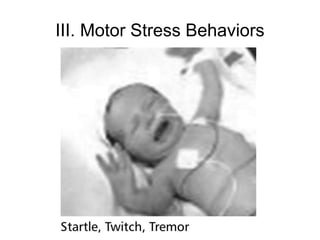
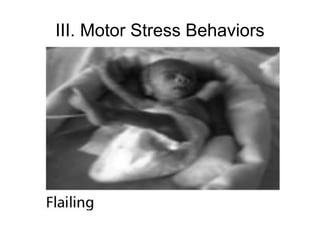
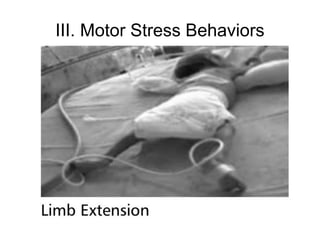
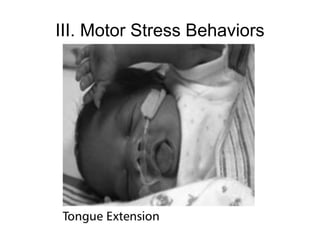
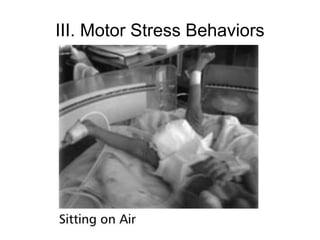
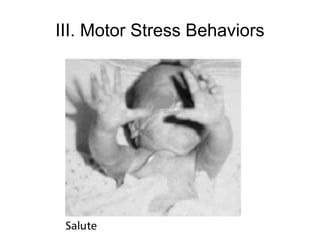
III. Motor Stress Behaviors
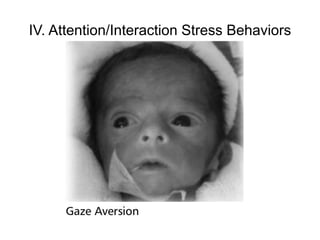
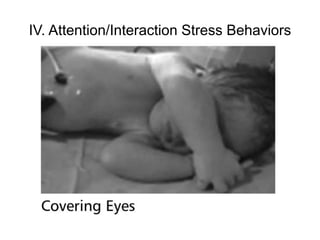
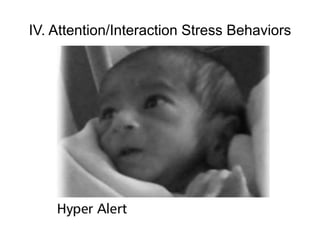
IV. Attention/Interaction Stress Behaviors
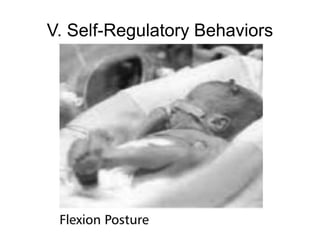
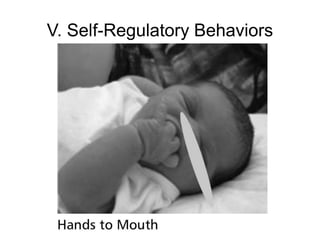
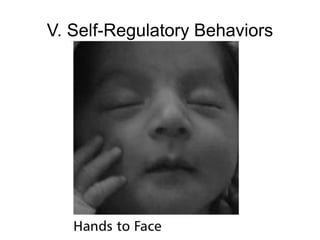
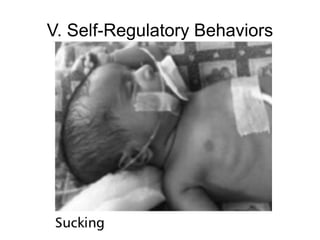
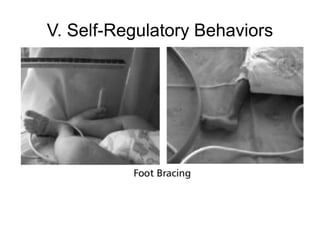
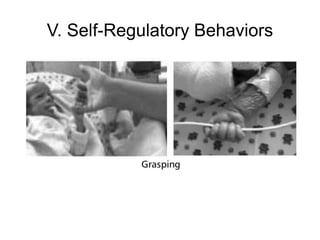
V. Self-Regulatory Behaviors
I. Behavioral States
1. Deep sleep
2. Light sleep
3. Drowsy (Dozing)
4. Quiet Alert
5. Active awake
6. Crying
II. Autonomic stress (signs) behaviors
Changes in HR, RR, SaO2, BP
Color change
Gag
Hiccup
Stooling
Sneeze
Yawn
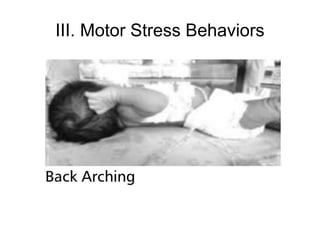
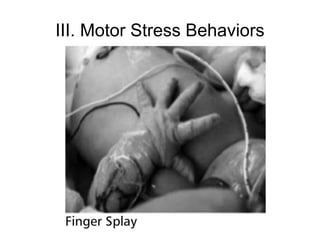
III. Motor Stress Behaviors
IV. Attention/Interaction Stress Behaviors
V. Self-Regulatory Behaviors
B. Caregiver responses to infant stress &
self-regulatory cues 5 (nonpharmacologic)
1) Pain and stress management- supportive
practices
2) Provide routine activities of daily living (i.e.
feeding,
nappy change)
3) Adjust environmental stimuli (sound, light,
temperature, movement, smells)
4) Use developmentally supportive handling and
positioning
1. Pain and Stress Management-
Supportive Practices
General guidelines:
1. Prior to DSC interventions- Physicians, DSC
provider
2. For care
For care
As you would with any person before starting
care-
Softly greet/talk to the baby before touching at the
onset of any handling or procedure
• Minimize handling for very young preterm
babies.
• Use gentle but still, firm touch rather than light
touches or tapping when touching a preterm.
For close to term sick neonates- observe their
response to light touch and if they display a stress
response try the still firm touch.
DSC interventions for stress and pain
(non-pharmacological)
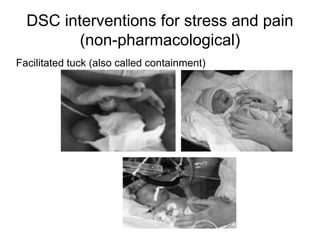
Facilitated tuck (also called containment)
Facilitated Tuck
Facilitated Tuck: “Involves firmly containing the
infant using a care-giver’s hands on both head
and lower limbs to maintain a ’folded-in’ (flexion)
position. Infant may or may not be wearing
clothes”, can be done prior to and during care and
procedures that are known or observed to be
stressful to the baby.
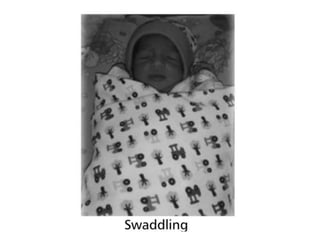
Swaddling (sometimes called
bundling):
“Swaddling is when an infant is securely wrapped
in a blanket to prevent the child’s limbs from
moving around excessively.”
Swaddling helps a baby achieve the “folded in” or
flexion posture achieved through facilitated tuck.
Swaddling has been found effective for stable
preterm infants for reactivity (stress responses)
and immediate regulation of pain.
Practical points for swaddling
Swaddle babies in a flexed and midline position,
hips with a posterior tilt
Have elbows flexed to allow hands to touch mouth
and face
Legs also flexed and tucked up close to the body
Swaddle should be secure so that the swaddle
stays in place, but also so that the infant can have
some movement into extension and back to
flexion
For tiny infants (2kg) use a small thin cloth vs. a
large hot and bulky blanket.
Kangaroo Care (KC)
(also known as skin-to-skin contact):
For preterm babies, KC is effective to manage
pain reactivity and to support immediate pain-
related regulation during stressful or routine
painful procedures (i.e. heel sticks or draws).
Non-Nutritive Sucking (NNS)
For NNS: a pacifier or non-lactating nipple- (after
breast milk is expressed) is placed into an infant’s
mouth to stimulate sucking behaviors.
NNS has been determined to be effective for
preterm babies for pain reactivity and to support
immediate pain-related regulation.
NNS is also considered effective for immediate
pain-related regulation in neonates
• Use for soothing the stressed infant
• Use prior to and during a painful event
Oral sucrose
Sucrose for analgesia: 0.012 g to 0.12 (0.05 ml to
0.5 ml) of 24% solution given orally 2 minutes
prior and just prior to painful procedures is
suggested for infants on the NICU, especially in
combination with other non-pharmacological pain
management techniques (i.e. facilitated tuck,
NNS)
2. Basic care and handling during
activities of daily living
Such as feeding, [nappy changes, bathing],
positioning and maintaining skin integrity
Greet with soft talk to the baby before touching, at
the onset to any handling or procedure.
Monitor baby’s response to soft talking during
routine care- when baby pays attention and does
not display stress, then this can be a good (brief)
time for this bonding or social interactive activity.
It is important to stop the interaction when the
baby demonstrates stress-gaze aversion or other.
Cluster cares, allow times for undisturbed rest
(protected sleep).
But not too many stressful interventions together.
• If baby is stressed - stop and provide ‘time out’
• During care use slow controlled gentle
handling/movement.
Avoid abrupt changes in position
Avoid temperature and postural stress- i.e.
swaddle in a blanket for weighing and subtract the
weight of the blanket from the total on the scale
for the baby’s weight
As much as possible seek to maintain a facilitated
tuck (flexion posture).
Changes in cerebral oxygenation and blood
volume, measured with near-infrared
spectroscopy (NIRS) during diaper change with
elevation of legs and buttocks, during suctioning
and during routine repositioning and movement
have been assoicated with early parenchymal
brain abnormalities
Still, gentle, but firm touch for younger preterm
babies (i.e. those in the turning-in or coming out
stage) or older sick babies if they demonstrate
stress with stroking or patting.
Offer one kind of stimulation at a time (soft talk,
touch, or visual (i.e. a parents face to observe)
with young preterm babies
3. Management of the NICU
environment to minimize infant stress
Adjust to promote rest and sleep, establish
healthy sleep rhythym
Lighting: Minimize light where able
Protect eyes from bright light
Dim lights at night if safe
Cover incubators or try shields without contacting
baby
Visual stimulation before 30-32 wks GA illicits
stress response
Sound: Range -40-45 dB in NICU
Infants get physiologically disorganized with
louder noise
Talk softly at the bedside
Set alarms and phone rings as low as is safe,
silence promptly
Neonate may prefer mother’s voice
Infants respond best to soft voice
4. Practical points of positioning
The flexion posture is not only important for motor
development it is immediately important for the
self-soothing behaviors that supports the baby’s
neuro-behavioral development during this critical
time.
Why support and change head
position?
It helps prevent:
• Brachycephaly: flat in back, wide across
• Scaphocephaly: flat on sides, long front to back
• Torticollis
• Poor visual development for learning skills
Why support neutral neck
positioning/chin tuck
• Unobstructed airway
• Better swallowing
• Avoids postural imbalances and weaknesses
Why shoulder and arm positioning ?
Encourages hands and head in midline which is
important for development
• Hands can explore face, mouth, each other
• Can use hands to perform calming behaviors
(hand to mouth, face, or together)
• Easier to breathe
• Learns normal movement patterns
Why trunk positioning ?
Hypotonia promotes extended body position at
rest:
• Motor stress behaviors tend to be extension
positions
• Flexion posture helps baby manage stress
Why hips ?
Promotes flexion posture, avoids stress to hip joint
Why feet positioning ?
Can lead to deformity that causes challenges with
proper weight bearing for standing and walking
THANK YOU

Developmental supportive care in nicu

  • 1.
  • 2.
    Preterm birth Preterm isdefined as babies born alive before 37 weeks of pregnancy are completed. Extremely preterm (<28 weeks) Very preterm (28 to <32 weeks) Moderate preterm (32 to 34 weeks) Late-preterm infants (34 to 36 weeks)
  • 3.
    Goal To improve functionaloutcome, have positive neuro developmental outcome and achieve intact survival of the fragile, preterm and/or critically ill infant.
  • 4.
    Development of VariousNeonatal Sensory Systems Sequence is : tactile, vestibular, gustatory- olfactory, auditory and then visual. Hence while carrying out developmental interventions in the NICU, stimulation of the senses should begin with the most mature.
  • 5.
    Tactile system Tactile thresholdis very low in preterm infants. It has been demonstrated that preterm infants less than 30 weeks respond with leg withdrawal to a plantar pressure stimulus at pressures almost one-third as compared to same response in a term infant.
  • 6.
    Tactile system At about32 weeks PCA, a qualitative shift in response occurs. Infants less than 32 weeks respond to repeated stimulation with a diffuse behavioural response. In contrast, infants > 32 weeks show habituation to the same stimuli.
  • 7.
    Tactile system Tactile hypersensitivityis commonly encountered in children born preterm Generally the hands or oro-facial regions
  • 8.
    Importance of sleep Disturbanceof sleep has biologic and immunologic consequences. Secretion of cortisol and adrenaline normally is inhibited during sleep. Growth hormone, which is released during quiet sleep, increases protein synthesis and mobilization of free fatty acids for energy use. Thus sleep facilitates healing.
  • 9.
    Tactile system Excess handlingcan lead to blood pressure changes and alterations in cerebral blood flow leading to desaturation episodes and in extreme cases, even intracranial haemorrhages in unstable preterm neonate.
  • 10.
    Tactile interventions inthe NICU Two general approaches are used – Reduction in general handling and Provision of planned tactile experiences. The general order of tactile intervention might be: If acutely ill – minimal handling, containment (e.g. Swaddling), and gentle touch without stroking When medically stable and near term – holding, rocking gently, stroking, continue to swaddle
  • 11.
    Non-nutritive sucking Improved gastrointestinaltransit time, greater suck pressure, more sucks per burst and fewer sporadic sucks. Non-nutritive sucking has been shown to decrease motor activity and increase quiet states in stable preterm infants. Also, it dampens an infant’s behavioural response after a painful stimulus.
  • 12.
    Vestibular system Responds tomovements as well as directional changes in gravity Vestibular stimulation affects levels of alertness Slow, rhythmic, continuous movement induces sleep Periodic or higher amplitude swings increase arousal.
  • 13.
    Vestibular system Vestibular stimulationis used to affect state moving to upright or laying down increases arousal Monotonous side-to-side rocking and walking in the form of parental pacing reduce the level of arousal
  • 14.
    Prone Position Prone positioningin the NICU has been strongly supported physiologically Gastric emptying was facilitated in either the prone or right lateral position compared to the supine or left lateral position Prone position, compared to supine, is associated with more quiet sleep and less active sleep or crying
  • 15.
    Prone Position Quiet sleep,in turn, is associated with improved lung volume, more stable respiration, less apnea, and improved PAO2 The prone position compared to supine is associated with a higher PAO2 among healthy preterm infants and, even more significantly, in those with respiratory distress syndrome
  • 16.
    The sick infantshould be nursed in a prone or right lateral position In the prone position, placing the infant on a small folded strip from shoulder to hip, could allow more physiologic flexion and adduction In side lying, it may be easier to position the infant in soft flexion. Gentle containment of the limbs usually can be managed with strips of soft cloth across the upper arm and thigh Some movement should be allowed within a controlled range Each posture should facilitate the infant bringing hands to mouth
  • 17.
    Gustatory olfactory Preterm infants(30 to 36 weeks) show stronger sucking response to glucose By 28 to 32 weeks gestation majority of newborns show response to olfactory input, turn their heads away from noxious smell and they prefer the odour of their mother’s breast pad
  • 18.
    Auditory The absence ofauditory stimulation would cause cortical neuronal degeneration 2 to 4 days old neonates prefer their mother’s voice The intensity of sounds in amniotic fluid is 70 to 85 dB with predominance of low frequency
  • 19.
    The aberrant noiselevels cause sensory neural damage, induce stress and contribute to language or auditory processing disorders As early as 24 weeks to 28 weeks, a visual evoked response to bright light can be obtained and there is lid tightening behavioural response Around 32 weeks, visual evoked response becomes more complex and the pupillary reflex is more efficient.
  • 20.
    A bright lightwill cause immediate lid closure and the response is sustained. There is beginning of attention and the neonate briefly fixates. New-born are photophobic, visual attention is facilitated under low illumination. Neonates can fixate on a high contrast form i.e. 1/16 inch line at a distance of 1 foot. They have preference for human face.
  • 21.
    Bright light inan infant’s face is a source of stress. Lower ambient light is associated with significantly less active rapid eye movement and quiet sleep state. New-born also have increased eye opening and awake periods in lower ambient light.
  • 22.
    Neuromotor Maturation andStages of Neurobehavioral Organization All infants who are born prematurely will miss an important inter-uterine motor milestone: the development of flexor tone. This critical component of muscle development occurs throughout the third trimester of pregnancy.
  • 23.
    During the firsttwo trimesters, extensor tone becomes well established as an infant develops his extensor muscles along the back of his body. As the fetus grows larger and more cramped during months 7, 8, and 9, the muscles used for flexion, (muscles along the front of the body) develop.
  • 24.
    Prior to 40weeks gestation, whether in utero or outside the womb, an infant’s muscle tone development progresses in a caudo-cephalic (toe to head) and centripetal (distal to proximal) direction. At 40 weeks Post- Conceptual Age (PCA), the infant’s actual due date, an infant’s motor development reverses and begins to progress in the opposite direction in a cephalo-caudal (head to toe) and proximal to distal (from the middle of the body out) direction. The same development pattern found in a normal term infant.
  • 25.
    What is DevelopmentallySupportive Care (DSC)? A holistic module which incorporates care that supports: Brain architecture and development Motor development and normalizing movement patterns Sensory system and state system development Oral/feeding development along with family development
  • 26.
    Interventions include Control ofexternal stimuli (auditory, visual, tactile, vestibular) Clustering of nursing care activities to avoid disrupting sleep Positioning or swaddling of the preterm infant Calming techniques
  • 27.
    Why is DSCimportant? Neonates are under severe and often life threatening stress Immature and or fragile autonomic and nervous systems DSC can give them more reserve to heal, minimize affects of trauma, and promote normal development of nervous system.
  • 28.
    Benefits of DSC Supportsautonomic stability, normal motor, sensory, neurological development and promotes behavioral state organization Decreases length of hospital stay Improves weight gain Shortens the time to full enteral feeding The neuro-developmental scores at 9-12 months age were seen to be improved showed improved neurobehavior, electrophysiology and brain structure
  • 29.
    Core measures forDSC 1) Protected sleep 2) Pain and stress assessment and management 3) Activities of daily living (positioning, feeding and skin care), 4) Family-centred care 5) The healing environment
  • 30.
    Core measure 1:Protected sleep Most important It involves a totally undisturbed sleep state/phase, in which the infant conserves energy, experiences weight gain and has optimal brain growth. All non-emergent care giving is provided during wakeful states. Facilitative tuck, swaddled bathing and skin-to- skin care Light and sound levels
  • 31.
    Core measure 2:Pain and stress assessment and management Routine assessment and documentation of pain and stress Non-pharmacologic and / or pharmacologic measures are utilized prior to all stressful and/or painful procedures Each infant is assessed for pain and/or stress at a minimum of 4 to 6 hours interval
  • 32.
    Core measure 3:Developmental activities of daily living: positioning, feeding and skin care Positioning: Provide comfort, safety, physiologic stability and optimal neuromotor development Infant is positioned and handled in flexion, containment and alignment during all care giving activities. Feeding Skin integrity should be ascessed at least once per shift and documented
  • 33.
    Core measure 4:Family-centered care Access to their infant Family is supported in parenting activities Access to resources and supports that assist them in their short and long term parenting needs
  • 34.
    Core measure 5:The healing environment Continuous background sound and transient sound in the neonatal intensive care unit shall not exceed an hourly continuous noise level of 45 to 50 decibels (dB). Transient sounds or Lmax (the single highest sound level) shall not exceed 65 dB.
  • 35.
    Core measure 5:The healing environment Ambient light levels ranging between 10–600 lux and 1–60 foot candles shall be adjustable and measured at each infant bed space.
  • 36.
    Core measure 5:The healing environment Direct care providers demonstrate caring behaviors which include adherence to hand hygiene protocols cultural sensitivity open listening skills sensitive relationship orientation
  • 37.
    Core measure 5:The healing environment Documentation of evidence-based policies, procedures and resources to sustain the healing environment over time.
  • 38.
    Synactive theory Focuses onthe neurobehavioral capacity of the infant as the baby develops The baby’s neurobehavioral capacity develops through interactions with caregivers and the environment [i.e. sensory, medical, and care giving experiences in the NICU]
  • 39.
    The neuro-behaviors areclassified across five subsystems: Autonomic/physiologic Motor Attention/interaction State (of arousal) Self-regulatory
  • 40.
    Developing the neurobehavioralcapacity for self- regulation is a very important skill that allows infants to engage in the developmental and daily activities that support growth and development
  • 41.
    Practices of Developmentally SupportiveCare A. Assessment/ observation of stress and self-regulatory behaviors B. Caregiver responses to infant stress & self- regulatory cues 5 (non-pharmacologic)
  • 42.
    [A] Assessment/observation ofstress Stress behaviors I. Behavioral States (sleep states or states of arousal) II. Autonomic stress (signs) behaviors III. Motor Stress Behaviors IV. Attention/Interaction Stress Behaviors V. Self-Regulatory Behaviors
  • 43.
    I. Behavioral States 1.Deep sleep 2. Light sleep 3. Drowsy (Dozing) 4. Quiet Alert 5. Active awake 6. Crying
  • 44.
    II. Autonomic stress(signs) behaviors Changes in HR, RR, SaO2, BP Color change Gag Hiccup Stooling Sneeze Yawn
  • 45.
  • 46.
  • 47.
  • 48.
  • 49.
  • 50.
  • 51.
  • 52.
  • 53.
  • 54.
  • 55.
  • 56.
  • 57.
  • 58.
  • 59.
  • 60.
  • 61.
  • 62.
    B. Caregiver responsesto infant stress & self-regulatory cues 5 (nonpharmacologic) 1) Pain and stress management- supportive practices 2) Provide routine activities of daily living (i.e. feeding, nappy change) 3) Adjust environmental stimuli (sound, light, temperature, movement, smells) 4) Use developmentally supportive handling and positioning
  • 63.
    1. Pain andStress Management- Supportive Practices General guidelines: 1. Prior to DSC interventions- Physicians, DSC provider 2. For care
  • 64.
    For care As youwould with any person before starting care- Softly greet/talk to the baby before touching at the onset of any handling or procedure • Minimize handling for very young preterm babies. • Use gentle but still, firm touch rather than light touches or tapping when touching a preterm. For close to term sick neonates- observe their response to light touch and if they display a stress response try the still firm touch.
  • 65.
    DSC interventions forstress and pain (non-pharmacological) Facilitated tuck (also called containment)
  • 66.
    Facilitated Tuck Facilitated Tuck:“Involves firmly containing the infant using a care-giver’s hands on both head and lower limbs to maintain a ’folded-in’ (flexion) position. Infant may or may not be wearing clothes”, can be done prior to and during care and procedures that are known or observed to be stressful to the baby.
  • 67.
    Swaddling (sometimes called bundling): “Swaddlingis when an infant is securely wrapped in a blanket to prevent the child’s limbs from moving around excessively.” Swaddling helps a baby achieve the “folded in” or flexion posture achieved through facilitated tuck. Swaddling has been found effective for stable preterm infants for reactivity (stress responses) and immediate regulation of pain.
  • 69.
    Practical points forswaddling Swaddle babies in a flexed and midline position, hips with a posterior tilt Have elbows flexed to allow hands to touch mouth and face Legs also flexed and tucked up close to the body Swaddle should be secure so that the swaddle stays in place, but also so that the infant can have some movement into extension and back to flexion For tiny infants (2kg) use a small thin cloth vs. a large hot and bulky blanket.
  • 70.
    Kangaroo Care (KC) (alsoknown as skin-to-skin contact): For preterm babies, KC is effective to manage pain reactivity and to support immediate pain- related regulation during stressful or routine painful procedures (i.e. heel sticks or draws).
  • 71.
    Non-Nutritive Sucking (NNS) ForNNS: a pacifier or non-lactating nipple- (after breast milk is expressed) is placed into an infant’s mouth to stimulate sucking behaviors. NNS has been determined to be effective for preterm babies for pain reactivity and to support immediate pain-related regulation. NNS is also considered effective for immediate pain-related regulation in neonates • Use for soothing the stressed infant • Use prior to and during a painful event
  • 72.
    Oral sucrose Sucrose foranalgesia: 0.012 g to 0.12 (0.05 ml to 0.5 ml) of 24% solution given orally 2 minutes prior and just prior to painful procedures is suggested for infants on the NICU, especially in combination with other non-pharmacological pain management techniques (i.e. facilitated tuck, NNS)
  • 73.
    2. Basic careand handling during activities of daily living Such as feeding, [nappy changes, bathing], positioning and maintaining skin integrity Greet with soft talk to the baby before touching, at the onset to any handling or procedure. Monitor baby’s response to soft talking during routine care- when baby pays attention and does not display stress, then this can be a good (brief) time for this bonding or social interactive activity. It is important to stop the interaction when the baby demonstrates stress-gaze aversion or other.
  • 74.
    Cluster cares, allowtimes for undisturbed rest (protected sleep). But not too many stressful interventions together. • If baby is stressed - stop and provide ‘time out’ • During care use slow controlled gentle handling/movement. Avoid abrupt changes in position Avoid temperature and postural stress- i.e. swaddle in a blanket for weighing and subtract the weight of the blanket from the total on the scale for the baby’s weight As much as possible seek to maintain a facilitated tuck (flexion posture).
  • 75.
    Changes in cerebraloxygenation and blood volume, measured with near-infrared spectroscopy (NIRS) during diaper change with elevation of legs and buttocks, during suctioning and during routine repositioning and movement have been assoicated with early parenchymal brain abnormalities Still, gentle, but firm touch for younger preterm babies (i.e. those in the turning-in or coming out stage) or older sick babies if they demonstrate stress with stroking or patting. Offer one kind of stimulation at a time (soft talk, touch, or visual (i.e. a parents face to observe) with young preterm babies
  • 76.
    3. Management ofthe NICU environment to minimize infant stress Adjust to promote rest and sleep, establish healthy sleep rhythym Lighting: Minimize light where able Protect eyes from bright light Dim lights at night if safe Cover incubators or try shields without contacting baby Visual stimulation before 30-32 wks GA illicits stress response
  • 77.
    Sound: Range -40-45dB in NICU Infants get physiologically disorganized with louder noise Talk softly at the bedside Set alarms and phone rings as low as is safe, silence promptly Neonate may prefer mother’s voice Infants respond best to soft voice
  • 78.
    4. Practical pointsof positioning The flexion posture is not only important for motor development it is immediately important for the self-soothing behaviors that supports the baby’s neuro-behavioral development during this critical time.
  • 79.
    Why support andchange head position? It helps prevent: • Brachycephaly: flat in back, wide across • Scaphocephaly: flat on sides, long front to back • Torticollis • Poor visual development for learning skills
  • 80.
    Why support neutralneck positioning/chin tuck • Unobstructed airway • Better swallowing • Avoids postural imbalances and weaknesses
  • 81.
    Why shoulder andarm positioning ? Encourages hands and head in midline which is important for development • Hands can explore face, mouth, each other • Can use hands to perform calming behaviors (hand to mouth, face, or together) • Easier to breathe • Learns normal movement patterns
  • 82.
    Why trunk positioning? Hypotonia promotes extended body position at rest: • Motor stress behaviors tend to be extension positions • Flexion posture helps baby manage stress
  • 83.
    Why hips ? Promotesflexion posture, avoids stress to hip joint
  • 84.
    Why feet positioning? Can lead to deformity that causes challenges with proper weight bearing for standing and walking
  • 85.