Presented by:
Piyush Verma
MDS 2nd yr
Dept of Paedodontics & Preventive Dentistry
Contents
 Introduction
 Reflex arc
 Classification of reflexes
 Significance of reflexes
 Types of reflexes
 Conclusion
Introduction
 A reflex is an involuntary or automatic action that your
body does in response to something without even
having to think about it
 Neonatal reflexes – inborn reflexes present at birth &
occur in a predictable fashion
 Normally developing newborn should respond to
certain stimuli with these reflexes
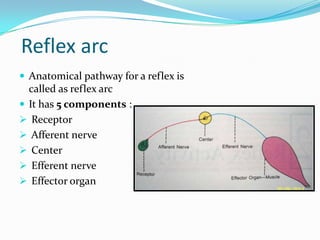
Reflex arc
 Anatomical pathway for a reflex is
called as reflex arc
 It has 5 components :
 Receptor
 Afferent nerve
 Center
 Efferent nerve
 Effector organ
Classification of reflexes
 Depending upon whether inborn or acquired
 Unconditioned reflexes, inborn reflex
 Conditioned reflexes/acquired reflexes
 Depending upon the situation of the center
 Cerebellar reflexes
 Cortical reflex
 Midbrain reflex
 Bulbar or medullary reflexes
 Spinal reflexes
 Depending upon the purpose
 Protective/flexor reflexes
 Antigravity/extensor reflexes
 Depending upon clinical basis
 Superficial reflexes
 Mucus membrane
 Cutaneous reflex
 Deep reflexes
 Visceral reflexes
 Pathological reflexes
Significance of reflexes
 Helps a paedodontist to identify whether the child is
developing normally or not
 Tells about what abnormalities the child may be
having if all reflexes are not proper
 Knowledge of development of motor skills – helps to
identify whether development is going on at a proper
rate or not
Types of reflexes
General body reflexes :
 Moro reflex/Startle reflex
 Palmar/grasp reflex
 Plantar grasp reflex
 Walking/stepping reflex
 Limb placement reflex
 Asymmetric tonic neck reflex
 Symmetric tonic neck reflex
 Babinski’s reflex
 Babkin reflex
 Parachute reflex
 Landau reflex
 Withdrawal reflex
 Trunk incurvation reflex
 Tendon reflexes
 Gallant’s reflex
Tonic labyrinthine reflex
Facial reflexes :
 Nasal reflex
 Blink reflex
 Doll’s eye reflex
 Auditory orienting reflex
Oral reflexes :
 Rooting reflex
 Sucking reflex
 Swallowing reflex
 Gag reflex
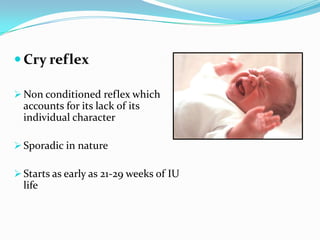
 Cry reflex
General body reflexes
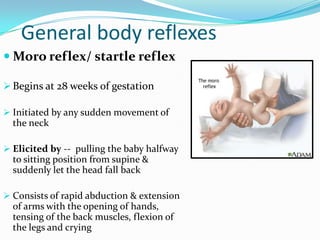
 Moro reflex/ startle reflex
 Begins at 28 weeks of gestation
 Initiated by any sudden movement of
the neck
 Elicited by -- pulling the baby halfway
to sitting position from supine &
suddenly let the head fall back
 Consists of rapid abduction & extension
of arms with the opening of hands,
tensing of the back muscles, flexion of
the legs and crying
Within moments, the arms come together again
 Clinical significance
Its nature gives an indication of muscle tone
Failure of the arms to move freely or the hands to open
fully indicates hypotonia.
It fades rapidly and is not normally elicited after 6
months of age.
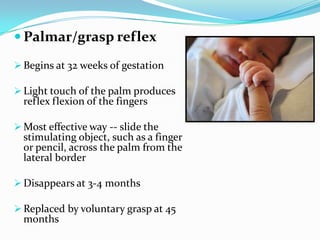
 Palmar/grasp reflex
 Begins at 32 weeks of gestation
 Light touch of the palm produces
reflex flexion of the fingers
 Most effective way -- slide the
stimulating object, such as a finger
or pencil, across the palm from the
lateral border
 Disappears at 3-4 months
 Replaced by voluntary grasp at 45
months
 Clinical significance
 Exceptionally strong grasp reflex -- spastic form of cerebral
palsy & Kernicterus
 May be asymmetrical in hemiplagia & in cases of cerebral
damage
 Persistence beyond 3-4 months indicate spastic form of
palsy
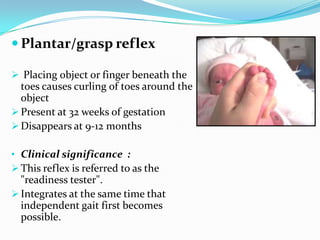
 Plantar/grasp reflex
 Placing object or finger beneath the
toes causes curling of toes around the
object
 Present at 32 weeks of gestation
 Disappears at 9-12 months
• Clinical significance :
 This reflex is referred to as the
"readiness tester".
 Integrates at the same time that
independent gait first becomes
possible.
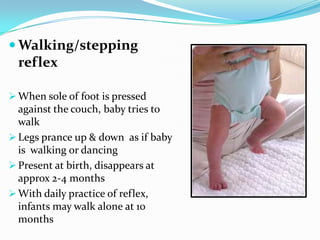
 Walking/stepping
reflex
 When sole of foot is pressed
against the couch, baby tries to
walk
 Legs prance up & down as if baby
is walking or dancing
 Present at birth, disappears at
approx 2-4 months
 With daily practice of reflex,
infants may walk alone at 10
months
Clinical significance
Premature infants will tend to walk in a toe-heel
fashion while more mature infants will walk in a
heel-toe pattern.
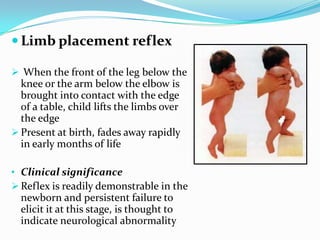
 Limb placement reflex
 When the front of the leg below the
knee or the arm below the elbow is
brought into contact with the edge
of a table, child lifts the limbs over
the edge
 Present at birth, fades away rapidly
in early months of life
• Clinical significance
 Reflex is readily demonstrable in the
newborn and persistent failure to
elicit it at this stage, is thought to
indicate neurological abnormality
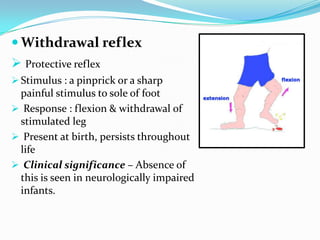
 Withdrawal reflex
 Protective reflex
 Stimulus : a pinprick or a sharp
painful stimulus to sole of foot
 Response : flexion & withdrawal of
stimulated leg
 Present at birth, persists throughout
life
 Clinical significance – Absence of
this is seen in neurologically impaired
infants.
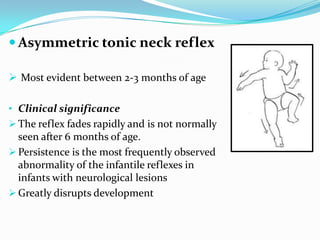
 Asymmetric tonic neck reflex
 Most evident between 2-3 months of age
• Clinical significance
 The reflex fades rapidly and is not normally
seen after 6 months of age.
 Persistence is the most frequently observed
abnormality of the infantile reflexes in
infants with neurological lesions
 Greatly disrupts development
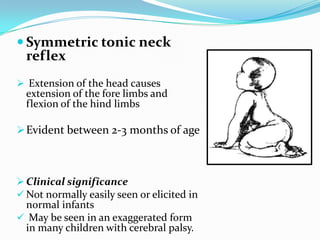
 Symmetric tonic neck
reflex
 Extension of the head causes
extension of the fore limbs and
flexion of the hind limbs
Evident between 2-3 months of age
 Clinical significance
 Not normally easily seen or elicited in
normal infants
 May be seen in an exaggerated form
in many children with cerebral palsy.
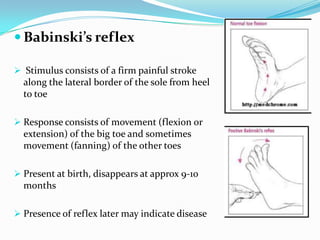
 Babinski’s reflex
 Stimulus consists of a firm painful stroke
along the lateral border of the sole from heel
to toe
 Response consists of movement (flexion or
extension) of the big toe and sometimes
movement (fanning) of the other toes
 Present at birth, disappears at approx 9-10
months
 Presence of reflex later may indicate disease
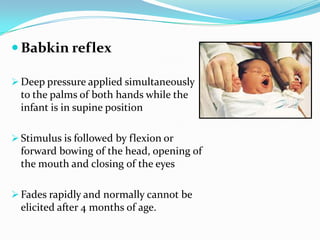
 Babkin reflex
 Deep pressure applied simultaneously
to the palms of both hands while the
infant is in supine position
 Stimulus is followed by flexion or
forward bowing of the head, opening of
the mouth and closing of the eyes
 Fades rapidly and normally cannot be
elicited after 4 months of age.
• Clinical significance
 Reflex can be demonstrated in the newborn, thus showing
a hand-mouth neurological link, even at that early stage
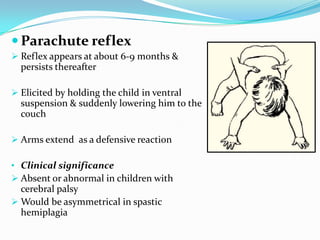
 Parachute reflex
 Reflex appears at about 6-9 months &
persists thereafter
 Elicited by holding the child in ventral
suspension & suddenly lowering him to the
couch
 Arms extend as a defensive reaction
• Clinical significance
 Absent or abnormal in children with
cerebral palsy
 Would be asymmetrical in spastic
hemiplagia
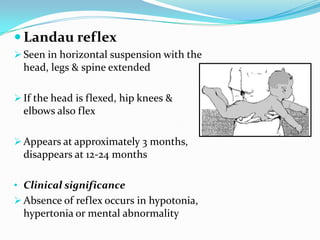
 Landau reflex
 Seen in horizontal suspension with the
head, legs & spine extended
 If the head is flexed, hip knees &
elbows also flex
 Appears at approximately 3 months,
disappears at 12-24 months
• Clinical significance
 Absence of reflex occurs in hypotonia,
hypertonia or mental abnormality
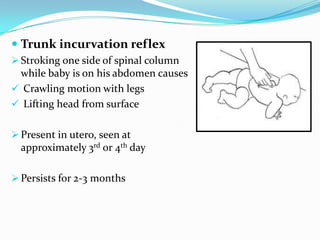
 Trunk incurvation reflex
 Stroking one side of spinal column
while baby is on his abdomen causes
 Crawling motion with legs
 Lifting head from surface
 Present in utero, seen at
approximately 3rd or 4th day
 Persists for 2-3 months
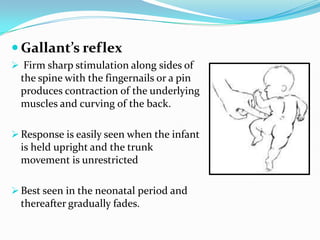
 Gallant’s reflex
 Firm sharp stimulation along sides of
the spine with the fingernails or a pin
produces contraction of the underlying
muscles and curving of the back.
 Response is easily seen when the infant
is held upright and the trunk
movement is unrestricted
 Best seen in the neonatal period and
thereafter gradually fades.
 Tendon reflexes
 Simple monosynaptic reflexes, which are elicited by a
sudden stretch of a muscle tendon
Occurs when the tendon is tapped
Present throughout life
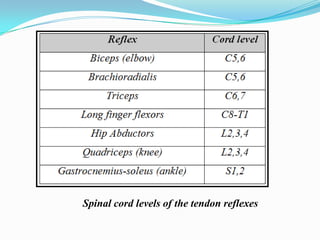
Spinal cord levels of the tendon reflexes
 Clinical significance
 Useful diagnostically for :
Detection of upper motor neuron lesions (exaggerated
response)
Myopathic conditions (depressed or absent response)
Localization of the segmental lesions of the cord.
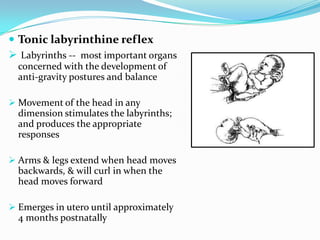
 Tonic labyrinthine reflex
 Labyrinths -- most important organs
concerned with the development of
anti-gravity postures and balance
 Movement of the head in any
dimension stimulates the labyrinths;
and produces the appropriate
responses
 Arms & legs extend when head moves
backwards, & will curl in when the
head moves forward
 Emerges in utero until approximately
4 months postnatally
Facial reflexes
 Nasal reflex
 Stimulation of the face or nasal cavity with water or local
irritants produces apnea in neonates
 Breathing stops in expiration with laryngeal closure in
infants – bradycardia & lowering of cardiac output
 Blood flow to skin, splanchnic areas muscles & kidney
decreases
 Flow to the heart & brain remains protected
 Blink reflex
 A bright light suddenly shone into the eyes, a puff of air
upon the sensitive cornea or a sudden loud noise will
produce immediate blinking of the eyes
 Purpose – to protect the eyes from foreign bodies & bright
light
 May be associated tensing of the neck muscles, turning of
the head away from the stimulus, frowning and crying
 Reflexes are easily seen in the neonate and continue to be
present throughout life
 Clinical significance
 Examination is a part of some neurological exams,
particularly when evaluating coma
Satisfactory demonstration of these reflexes indicate –
 No cerebral depression
 Contraction of appropriate muscles in response
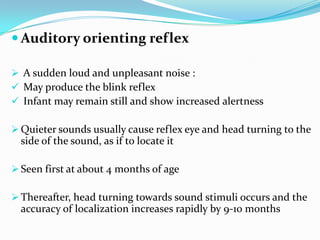
 Doll’s eye reflex
(Oculocephalic reflex)
 Passive turning of the head of
the newborn leaves the eye
“behind”
 A distinct time lag occurs before
the eyes move to a new position
in keeping with the head position
 Disappears at within a week or
two of birth
 Failure of this reflex to appear
indicates a cerebral lesion
Head
Eye
 Auditory orienting reflex
 A sudden loud and unpleasant noise :
 May produce the blink reflex
 Infant may remain still and show increased alertness
 Quieter sounds usually cause reflex eye and head turning to the
side of the sound, as if to locate it
 Seen first at about 4 months of age
 Thereafter, head turning towards sound stimuli occurs and the
accuracy of localization increases rapidly by 9-10 months
 Clinical significance
 Reflex responses are made use of in tests of infants for
hearing loss
 Pattern of the localization responses indicates the level of
neurological maturity
Oral reflexes
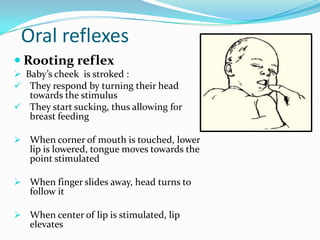
 Rooting reflex
 Baby’s cheek is stroked :
 They respond by turning their head
towards the stimulus
 They start sucking, thus allowing for
breast feeding
 When corner of mouth is touched, lower
lip is lowered, tongue moves towards the
point stimulated
 When finger slides away, head turns to
follow it
 When center of lip is stimulated, lip
elevates
 Onset -- 28 weeks IU
 Well established – 32-34 weeks IU
 Disappears – 3-4 months
 Clinical significance
Persistence can interfere with sucking
 Absence of this is seen in neurologically impaired
infants.
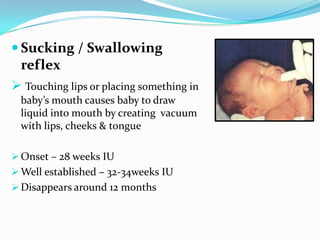
 Sucking / Swallowing
reflex
 Touching lips or placing something in
baby’s mouth causes baby to draw
liquid into mouth by creating vacuum
with lips, cheeks & tongue
 Onset – 28 weeks IU
 Well established – 32-34weeks IU
 Disappears around 12 months
Clinical significance :
Persistence may inhibit voluntary sucking
Sigmund Freud - Any kind of deprivation of the
activity will lead to fixation resulting in oral habits
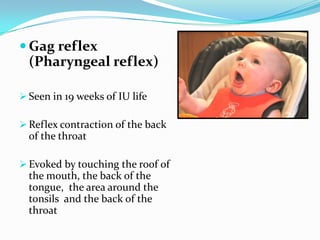
 Gag reflex
(Pharyngeal reflex)
 Seen in 19 weeks of IU life
 Reflex contraction of the back
of the throat
 Evoked by touching the roof of
the mouth, the back of the
tongue, the area around the
tonsils and the back of the
throat
 Functional significance
 It, along with reflexive pharyngeal swallowing, prevents
something from entering the throat except as part of
normal swallowing and helps prevent choking
 Clinical significance
 Absence of the gag reflex -- symptom of a number of
severe medical conditions :
 Damage to the glossopharyngeal nerve, the vagus nerve,
 Brain death.
 Cry reflex
 Non conditioned reflex which
accounts for its lack of its
individual character
 Sporadic in nature
 Starts as early as 21-29 weeks of IU
life
 Importance of cry
 It is infant’s first verbal communication
 Can be interpreted as a message of urgency or distress
 Indicates:
 Hunger
 Pain
 Discomfort
Conclusion
Appropriate knowledge of reflexes enables a paedodontist
 to identify whether the child is developing normally or
not
 to identify whether development is going on at a proper
rate or not
 Knowledge of abnormalities if all reflexes are not proper
References
 Shobha Tandon. Textbook of Paedodontics
 MS Muthu. Paediatric Dentistry, Principals & practice

Reflexes present in infants

  • 1.
    Presented by: Piyush Verma MDS2nd yr Dept of Paedodontics & Preventive Dentistry
  • 2.
    Contents  Introduction  Reflexarc  Classification of reflexes  Significance of reflexes  Types of reflexes  Conclusion
  • 3.
    Introduction  A reflexis an involuntary or automatic action that your body does in response to something without even having to think about it  Neonatal reflexes – inborn reflexes present at birth & occur in a predictable fashion  Normally developing newborn should respond to certain stimuli with these reflexes
  • 4.
    Reflex arc  Anatomicalpathway for a reflex is called as reflex arc  It has 5 components :  Receptor  Afferent nerve  Center  Efferent nerve  Effector organ
  • 5.
    Classification of reflexes Depending upon whether inborn or acquired  Unconditioned reflexes, inborn reflex  Conditioned reflexes/acquired reflexes
  • 6.
     Depending uponthe situation of the center  Cerebellar reflexes  Cortical reflex  Midbrain reflex  Bulbar or medullary reflexes  Spinal reflexes
  • 7.
     Depending uponthe purpose  Protective/flexor reflexes  Antigravity/extensor reflexes  Depending upon clinical basis  Superficial reflexes  Mucus membrane  Cutaneous reflex  Deep reflexes  Visceral reflexes  Pathological reflexes
  • 8.
    Significance of reflexes Helps a paedodontist to identify whether the child is developing normally or not  Tells about what abnormalities the child may be having if all reflexes are not proper  Knowledge of development of motor skills – helps to identify whether development is going on at a proper rate or not
  • 9.
  • 10.
    General body reflexes:  Moro reflex/Startle reflex  Palmar/grasp reflex  Plantar grasp reflex  Walking/stepping reflex  Limb placement reflex  Asymmetric tonic neck reflex  Symmetric tonic neck reflex  Babinski’s reflex  Babkin reflex  Parachute reflex  Landau reflex
  • 11.
     Withdrawal reflex Trunk incurvation reflex  Tendon reflexes  Gallant’s reflex Tonic labyrinthine reflex Facial reflexes :  Nasal reflex  Blink reflex  Doll’s eye reflex  Auditory orienting reflex
  • 12.
    Oral reflexes : Rooting reflex  Sucking reflex  Swallowing reflex  Gag reflex  Cry reflex
  • 13.
    General body reflexes Moro reflex/ startle reflex  Begins at 28 weeks of gestation  Initiated by any sudden movement of the neck  Elicited by -- pulling the baby halfway to sitting position from supine & suddenly let the head fall back  Consists of rapid abduction & extension of arms with the opening of hands, tensing of the back muscles, flexion of the legs and crying
  • 14.
    Within moments, thearms come together again  Clinical significance Its nature gives an indication of muscle tone Failure of the arms to move freely or the hands to open fully indicates hypotonia. It fades rapidly and is not normally elicited after 6 months of age.
  • 15.
     Palmar/grasp reflex Begins at 32 weeks of gestation  Light touch of the palm produces reflex flexion of the fingers  Most effective way -- slide the stimulating object, such as a finger or pencil, across the palm from the lateral border  Disappears at 3-4 months  Replaced by voluntary grasp at 45 months
  • 16.
     Clinical significance Exceptionally strong grasp reflex -- spastic form of cerebral palsy & Kernicterus  May be asymmetrical in hemiplagia & in cases of cerebral damage  Persistence beyond 3-4 months indicate spastic form of palsy
  • 17.
     Plantar/grasp reflex Placing object or finger beneath the toes causes curling of toes around the object  Present at 32 weeks of gestation  Disappears at 9-12 months • Clinical significance :  This reflex is referred to as the "readiness tester".  Integrates at the same time that independent gait first becomes possible.
  • 18.
     Walking/stepping reflex  Whensole of foot is pressed against the couch, baby tries to walk  Legs prance up & down as if baby is walking or dancing  Present at birth, disappears at approx 2-4 months  With daily practice of reflex, infants may walk alone at 10 months
  • 19.
    Clinical significance Premature infantswill tend to walk in a toe-heel fashion while more mature infants will walk in a heel-toe pattern.
  • 20.
     Limb placementreflex  When the front of the leg below the knee or the arm below the elbow is brought into contact with the edge of a table, child lifts the limbs over the edge  Present at birth, fades away rapidly in early months of life • Clinical significance  Reflex is readily demonstrable in the newborn and persistent failure to elicit it at this stage, is thought to indicate neurological abnormality
  • 21.
     Withdrawal reflex Protective reflex  Stimulus : a pinprick or a sharp painful stimulus to sole of foot  Response : flexion & withdrawal of stimulated leg  Present at birth, persists throughout life  Clinical significance – Absence of this is seen in neurologically impaired infants.
  • 22.
     Asymmetric tonicneck reflex  Most evident between 2-3 months of age • Clinical significance  The reflex fades rapidly and is not normally seen after 6 months of age.  Persistence is the most frequently observed abnormality of the infantile reflexes in infants with neurological lesions  Greatly disrupts development
  • 23.
     Symmetric tonicneck reflex  Extension of the head causes extension of the fore limbs and flexion of the hind limbs Evident between 2-3 months of age  Clinical significance  Not normally easily seen or elicited in normal infants  May be seen in an exaggerated form in many children with cerebral palsy.
  • 24.
     Babinski’s reflex Stimulus consists of a firm painful stroke along the lateral border of the sole from heel to toe  Response consists of movement (flexion or extension) of the big toe and sometimes movement (fanning) of the other toes  Present at birth, disappears at approx 9-10 months  Presence of reflex later may indicate disease
  • 25.
     Babkin reflex Deep pressure applied simultaneously to the palms of both hands while the infant is in supine position  Stimulus is followed by flexion or forward bowing of the head, opening of the mouth and closing of the eyes  Fades rapidly and normally cannot be elicited after 4 months of age.
  • 26.
    • Clinical significance Reflex can be demonstrated in the newborn, thus showing a hand-mouth neurological link, even at that early stage
  • 27.
     Parachute reflex Reflex appears at about 6-9 months & persists thereafter  Elicited by holding the child in ventral suspension & suddenly lowering him to the couch  Arms extend as a defensive reaction • Clinical significance  Absent or abnormal in children with cerebral palsy  Would be asymmetrical in spastic hemiplagia
  • 28.
     Landau reflex Seen in horizontal suspension with the head, legs & spine extended  If the head is flexed, hip knees & elbows also flex  Appears at approximately 3 months, disappears at 12-24 months • Clinical significance  Absence of reflex occurs in hypotonia, hypertonia or mental abnormality
  • 29.
     Trunk incurvationreflex  Stroking one side of spinal column while baby is on his abdomen causes  Crawling motion with legs  Lifting head from surface  Present in utero, seen at approximately 3rd or 4th day  Persists for 2-3 months
  • 30.
     Gallant’s reflex Firm sharp stimulation along sides of the spine with the fingernails or a pin produces contraction of the underlying muscles and curving of the back.  Response is easily seen when the infant is held upright and the trunk movement is unrestricted  Best seen in the neonatal period and thereafter gradually fades.
  • 31.
     Tendon reflexes Simple monosynaptic reflexes, which are elicited by a sudden stretch of a muscle tendon Occurs when the tendon is tapped Present throughout life
  • 32.
    Spinal cord levelsof the tendon reflexes
  • 33.
     Clinical significance Useful diagnostically for : Detection of upper motor neuron lesions (exaggerated response) Myopathic conditions (depressed or absent response) Localization of the segmental lesions of the cord.
  • 34.
     Tonic labyrinthinereflex  Labyrinths -- most important organs concerned with the development of anti-gravity postures and balance  Movement of the head in any dimension stimulates the labyrinths; and produces the appropriate responses  Arms & legs extend when head moves backwards, & will curl in when the head moves forward  Emerges in utero until approximately 4 months postnatally
  • 35.
    Facial reflexes  Nasalreflex  Stimulation of the face or nasal cavity with water or local irritants produces apnea in neonates  Breathing stops in expiration with laryngeal closure in infants – bradycardia & lowering of cardiac output  Blood flow to skin, splanchnic areas muscles & kidney decreases  Flow to the heart & brain remains protected
  • 36.
     Blink reflex A bright light suddenly shone into the eyes, a puff of air upon the sensitive cornea or a sudden loud noise will produce immediate blinking of the eyes  Purpose – to protect the eyes from foreign bodies & bright light  May be associated tensing of the neck muscles, turning of the head away from the stimulus, frowning and crying  Reflexes are easily seen in the neonate and continue to be present throughout life
  • 37.
     Clinical significance Examination is a part of some neurological exams, particularly when evaluating coma Satisfactory demonstration of these reflexes indicate –  No cerebral depression  Contraction of appropriate muscles in response
  • 38.
     Doll’s eyereflex (Oculocephalic reflex)  Passive turning of the head of the newborn leaves the eye “behind”  A distinct time lag occurs before the eyes move to a new position in keeping with the head position  Disappears at within a week or two of birth  Failure of this reflex to appear indicates a cerebral lesion Head Eye
  • 39.
     Auditory orientingreflex  A sudden loud and unpleasant noise :  May produce the blink reflex  Infant may remain still and show increased alertness  Quieter sounds usually cause reflex eye and head turning to the side of the sound, as if to locate it  Seen first at about 4 months of age  Thereafter, head turning towards sound stimuli occurs and the accuracy of localization increases rapidly by 9-10 months
  • 40.
     Clinical significance Reflex responses are made use of in tests of infants for hearing loss  Pattern of the localization responses indicates the level of neurological maturity
  • 41.
    Oral reflexes  Rootingreflex  Baby’s cheek is stroked :  They respond by turning their head towards the stimulus  They start sucking, thus allowing for breast feeding  When corner of mouth is touched, lower lip is lowered, tongue moves towards the point stimulated  When finger slides away, head turns to follow it  When center of lip is stimulated, lip elevates
  • 42.
     Onset --28 weeks IU  Well established – 32-34 weeks IU  Disappears – 3-4 months  Clinical significance Persistence can interfere with sucking  Absence of this is seen in neurologically impaired infants.
  • 43.
     Sucking /Swallowing reflex  Touching lips or placing something in baby’s mouth causes baby to draw liquid into mouth by creating vacuum with lips, cheeks & tongue  Onset – 28 weeks IU  Well established – 32-34weeks IU  Disappears around 12 months
  • 44.
    Clinical significance : Persistencemay inhibit voluntary sucking Sigmund Freud - Any kind of deprivation of the activity will lead to fixation resulting in oral habits
  • 45.
     Gag reflex (Pharyngealreflex)  Seen in 19 weeks of IU life  Reflex contraction of the back of the throat  Evoked by touching the roof of the mouth, the back of the tongue, the area around the tonsils and the back of the throat
  • 46.
     Functional significance It, along with reflexive pharyngeal swallowing, prevents something from entering the throat except as part of normal swallowing and helps prevent choking  Clinical significance  Absence of the gag reflex -- symptom of a number of severe medical conditions :  Damage to the glossopharyngeal nerve, the vagus nerve,  Brain death.
  • 47.
     Cry reflex Non conditioned reflex which accounts for its lack of its individual character  Sporadic in nature  Starts as early as 21-29 weeks of IU life
  • 48.
     Importance ofcry  It is infant’s first verbal communication  Can be interpreted as a message of urgency or distress  Indicates:  Hunger  Pain  Discomfort
  • 49.
    Conclusion Appropriate knowledge ofreflexes enables a paedodontist  to identify whether the child is developing normally or not  to identify whether development is going on at a proper rate or not  Knowledge of abnormalities if all reflexes are not proper
  • 51.
    References  Shobha Tandon.Textbook of Paedodontics  MS Muthu. Paediatric Dentistry, Principals & practice