aNUSHIKA bANSAL
lAKSHMI sURESH
VAIBHAVI pATEL
sHREYA sHARMA
VANSHIKA sHARMA
Redox reactions
REDOXREACTIONS
Oxidation reactions are common events
in everyday life :
Example- combustion of fossil fuel,
Corrosion of metals,
Dry cells and accumulators,
Metabolism of nutrients in human
bodies,
Photosynthesis in green plants
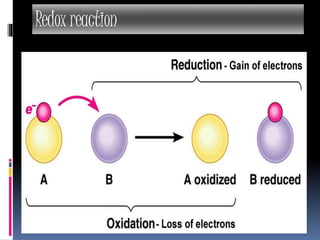
Redoxreaction
Oxidation-ReductionReactions
 Redox reactions are electron transfer reactions.
 The process may involve the complete transfer of
electrons to form ionic bonds or only a partial
transfer or shift of electrons to form covalent bonds.
 In terms of electronic concept, oxidation is the
process which involves loss of electrons whereas
reduction is the process which involves gain of
electrons.
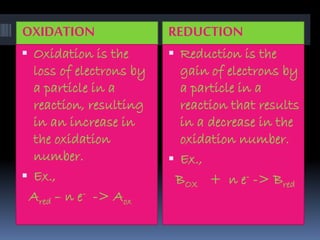
OXIDATION REDUCTION
 Oxidation is the
loss of electrons by
a particle in a
reaction, resulting
in an increase in
the oxidation
number.
 Ex.,
Ared – n e- -> Aox
 Reduction is the
gain of electrons by
a particle in a
reaction that results
in a decrease in the
oxidation number.
 Ex.,
BOX + n e- -> Bred
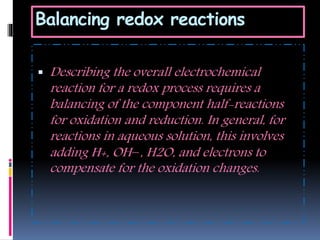
Balancing redox reactions
 Describing the overall electrochemical
reaction for a redox process requires a
balancing of the component half-reactions
for oxidation and reduction. In general, for
reactions in aqueous solution, this involves
adding H+, OH−, H2O, and electrons to
compensate for the oxidation changes.
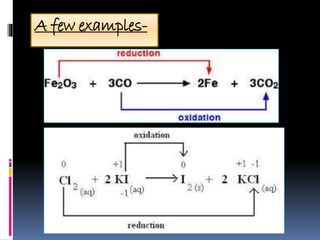
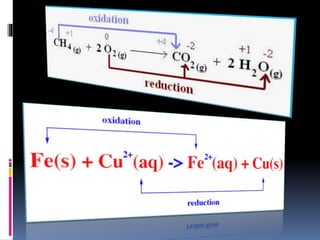
A few examples-
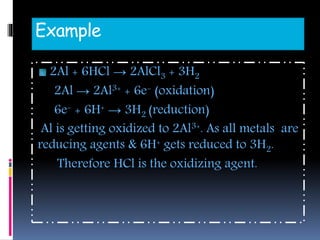
Example
2Al + 6HCl → 2AlCl3 + 3H2
2Al → 2Al3+ + 6e- (oxidation)
6e- + 6H+ → 3H2 (reduction)
Al is getting oxidized to 2Al3+. As all metals are
reducing agents & 6H+ gets reduced to 3H2.
Therefore HCl is the oxidizing agent.
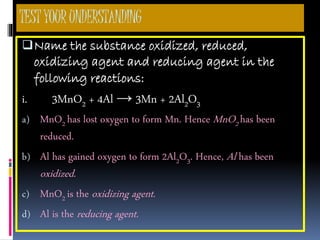
TESTYOURUNDERSTANDING
Name the substance oxidized, reduced,
oxidizing agent and reducing agent in the
following reactions:
i. 3MnO2 + 4Al → 3Mn + 2Al2O3
a) MnO2 has lost oxygen to form Mn. Hence MnO2 has been
reduced.
b) Al has gained oxygen to form 2Al2O3. Hence, Al has been
oxidized.
c) MnO2 is the oxidizing agent.
d) Al is the reducing agent.
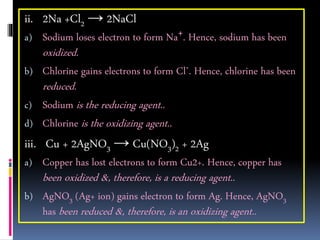
ii. 2Na +Cl2 → 2NaCl
a) Sodium loses electron to form Na+. Hence, sodium has been
oxidized.
b) Chlorine gains electrons to form Cl-. Hence, chlorine has been
reduced.
c) Sodium is the reducing agent..
d) Chlorine is the oxidizing agent..
iii. Cu + 2AgNO3 → Cu(NO3)2 + 2Ag
a) Copper has lost electrons to form Cu2+. Hence, copper has
been oxidized &, therefore, is a reducing agent..
b) AgNO3 (Ag+ ion) gains electron to form Ag. Hence, AgNO3
has been reduced &, therefore, is an oxidizing agent..
Redox reactions

Redox reactions

  • 1.
    aNUSHIKA bANSAL lAKSHMI sURESH VAIBHAVIpATEL sHREYA sHARMA VANSHIKA sHARMA Redox reactions
  • 2.
    REDOXREACTIONS Oxidation reactions arecommon events in everyday life : Example- combustion of fossil fuel, Corrosion of metals, Dry cells and accumulators, Metabolism of nutrients in human bodies, Photosynthesis in green plants
  • 3.
  • 4.
    Oxidation-ReductionReactions  Redox reactionsare electron transfer reactions.  The process may involve the complete transfer of electrons to form ionic bonds or only a partial transfer or shift of electrons to form covalent bonds.  In terms of electronic concept, oxidation is the process which involves loss of electrons whereas reduction is the process which involves gain of electrons.
  • 5.
    OXIDATION REDUCTION  Oxidationis the loss of electrons by a particle in a reaction, resulting in an increase in the oxidation number.  Ex., Ared – n e- -> Aox  Reduction is the gain of electrons by a particle in a reaction that results in a decrease in the oxidation number.  Ex., BOX + n e- -> Bred
  • 6.
    Balancing redox reactions Describing the overall electrochemical reaction for a redox process requires a balancing of the component half-reactions for oxidation and reduction. In general, for reactions in aqueous solution, this involves adding H+, OH−, H2O, and electrons to compensate for the oxidation changes.
  • 7.
  • 9.
    Example 2Al + 6HCl→ 2AlCl3 + 3H2 2Al → 2Al3+ + 6e- (oxidation) 6e- + 6H+ → 3H2 (reduction) Al is getting oxidized to 2Al3+. As all metals are reducing agents & 6H+ gets reduced to 3H2. Therefore HCl is the oxidizing agent.
  • 10.
    TESTYOURUNDERSTANDING Name the substanceoxidized, reduced, oxidizing agent and reducing agent in the following reactions: i. 3MnO2 + 4Al → 3Mn + 2Al2O3 a) MnO2 has lost oxygen to form Mn. Hence MnO2 has been reduced. b) Al has gained oxygen to form 2Al2O3. Hence, Al has been oxidized. c) MnO2 is the oxidizing agent. d) Al is the reducing agent.
  • 11.
    ii. 2Na +Cl2→ 2NaCl a) Sodium loses electron to form Na+. Hence, sodium has been oxidized. b) Chlorine gains electrons to form Cl-. Hence, chlorine has been reduced. c) Sodium is the reducing agent.. d) Chlorine is the oxidizing agent.. iii. Cu + 2AgNO3 → Cu(NO3)2 + 2Ag a) Copper has lost electrons to form Cu2+. Hence, copper has been oxidized &, therefore, is a reducing agent.. b) AgNO3 (Ag+ ion) gains electron to form Ag. Hence, AgNO3 has been reduced &, therefore, is an oxidizing agent..