PRESENTED BY
Khondaker Afrina Hoque
ID:1114015
Reg:900048
Department of chemistry.
Comilla university
11/16/2017 1
PRESENTATION ON
APPLICATION OF E.M.F MEASUREMENT
11/16/2017 2
Definition of electromotive force
The difference between the electrode potentials of the
two electrodes constituting an electrochemical cell is
known as electromotive force of a cell.
11/16/2017 3
Application of measurement of electromotive force
Some of applications are described here:
1.Determination of equilibrium constant
2 Determination of solubility of sparingly soluble salt
3. Determination of Valence
5. Determination of pH of a solution
6. Potentiometric titrations
7. Determination of activity coefficient
8. Determination of transference number
4. Determination of thermodynamic functions
11/16/2017 4
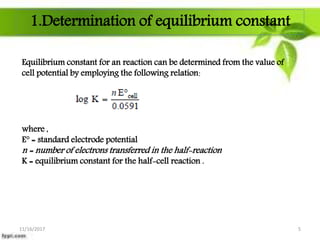
1.Determination of equilibrium constant
where ,
E° = standard electrode potential
n = number of electrons transferred in the half-reaction
K = equilibrium constant for the half-cell reaction .
Equilibrium constant for an reaction can be determined from the value of
cell potential by employing the following relation:
11/16/2017 5
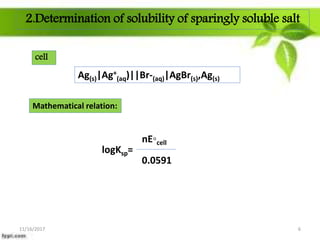
2.Determination of solubility of sparingly soluble salt
cell
11/16/2017 6
Mathematical relation:
Ag(s)|Ag+
(aq)||Br-(aq)|AgBr(s),Ag(s)
logKsp=
nE◦cell
0.0591
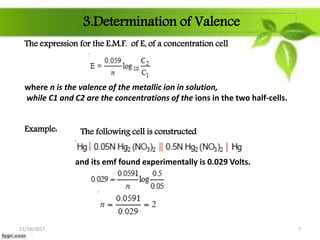
3.Determination of Valence
where n is the valence of the metallic ion in solution,
while C1 and C2 are the concentrations of the ions in the two half-cells.
The following cell is constructed
and its emf found experimentally is 0.029 Volts.
Example:
The expression for the E.M.F. of E, of a concentration cell
11/16/2017 7
4.Determination of thermodynamic functions
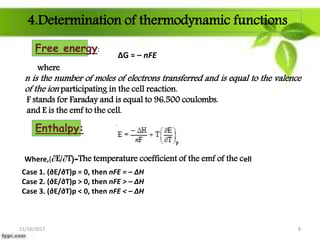
ΔG = – nFE
Free energy:
Enthalpy:
where
n is the number of moles of electrons transferred and is equal to the valence
of the ion participating in the cell reaction.
F stands for Faraday and is equal to 96,500 coulombs.
and E is the emf to the cell.
Where,(∂E/∂T)=The temperature coefficient of the emf of the cell
Case 1. (∂E/∂T)p = 0, then nFE = – ΔH
Case 2. (∂E/∂T)p > 0, then nFE > – ΔH
Case 3. (∂E/∂T)p < 0, then nFE < – ΔH
11/16/2017 8
5.DETERMINATION OF pH OF A SOLUTION
A half-cell is set up with the test solution as electrolyte. The emf of the
cell depends on the concentration of H+ ions or pH of the solution. The
emf of the half-cell is determined by coupling it with another standard
half-cell and measuring the emf of the complete cell.
 The commonly used standard electrodes are :
(a) The hydrogen electrode
(b) The quinhydrone electrode
(c) The glass electrode
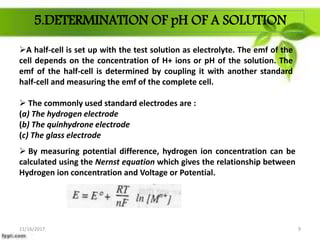
 By measuring potential difference, hydrogen ion concentration can be
calculated using the Nernst equation which gives the relationship between
Hydrogen ion concentration and Voltage or Potential.
11/16/2017 9
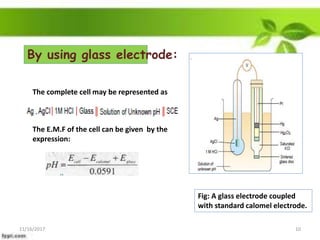
By using glass electrode:
Fig: A glass electrode coupled
with standard calomel electrode.
The E.M.F of the cell can be given by the
expression:
The complete cell may be represented as
11/16/2017 10
6.Potentiometric titrations
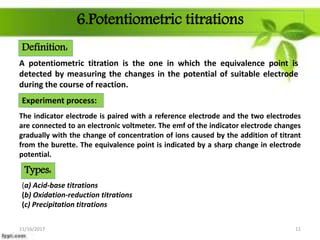
A potentiometric titration is the one in which the equivalence point is
detected by measuring the changes in the potential of suitable electrode
during the course of reaction.
Experiment process:
The indicator electrode is paired with a reference electrode and the two electrodes
are connected to an electronic voltmeter. The emf of the indicator electrode changes
gradually with the change of concentration of ions caused by the addition of titrant
from the burette. The equivalence point is indicated by a sharp change in electrode
potential.
(a) Acid-base titrations
(b) Oxidation-reduction titrations
(c) Precipitation titrations
11/16/2017 11
Definition:
Types:
(a) Acid-base titrations
Fig: Potentiometric
titration curve of an
acid and a base
Fig :Apparatus for
potentiometric acid-base
titrations.
11/16/2017 12
(b) Oxidation-reduction Titrations
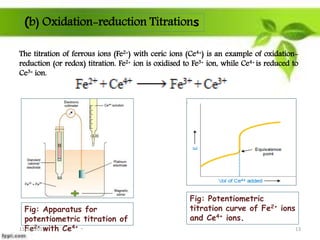
The titration of ferrous ions (Fe2+) with ceric ions (Ce4+) is an example of oxidation-
reduction (or redox) titration. Fe2+ ion is oxidised to Fe3+ ion, while Ce4+ is reduced to
Ce3+ ion.
Fig: Apparatus for
potentiometric titration of
Fe2+ with Ce4+ .
Fig: Potentiometric
titration curve of Fe2+ ions
and Ce4+ ions.
11/16/2017 13
(c): Precipitation Titration
Fig: Potentiometric titration of
sodium chloride against silver
nitrate solution.
Fig: Potentiometric
titration curve.
A typical precipitation titration is that of sodium chloride solution against
silver nitrate solution.
11/16/2017 14
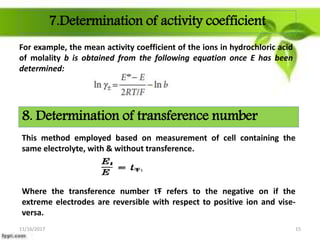
7.Determination of activity coefficient
For example, the mean activity coefficient of the ions in hydrochloric acid
of molality b is obtained from the following equation once E has been
determined:
8. Determination of transference number
This method employed based on measurement of cell containing the
same electrolyte, with & without transference.
Where the transference number tŦ refers to the negative on if the
extreme electrodes are reversible with respect to positive ion and vise-
versa.
11/16/2017 15
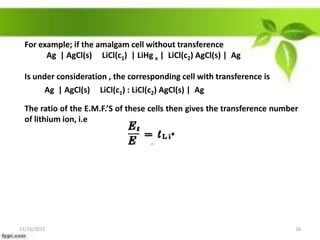
For example; if the amalgam cell without transference
Ag | AgCl(s) LiCl(c1) | LiHg x | LiCl(c2) AgCl(s) | Ag
Is under consideration , the corresponding cell with transference is
The ratio of the E.M.F.’S of these cells then gives the transference number
of lithium ion, i.e
Ag | AgCl(s) LiCl(c1) : LiCl(c2) AgCl(s) | Ag
11/16/2017 16
11/16/2017 17
THANKS TO ALL

Application of e.m.f measurement

  • 1.
    PRESENTED BY Khondaker AfrinaHoque ID:1114015 Reg:900048 Department of chemistry. Comilla university 11/16/2017 1
  • 2.
    PRESENTATION ON APPLICATION OFE.M.F MEASUREMENT 11/16/2017 2
  • 3.
    Definition of electromotiveforce The difference between the electrode potentials of the two electrodes constituting an electrochemical cell is known as electromotive force of a cell. 11/16/2017 3
  • 4.
    Application of measurementof electromotive force Some of applications are described here: 1.Determination of equilibrium constant 2 Determination of solubility of sparingly soluble salt 3. Determination of Valence 5. Determination of pH of a solution 6. Potentiometric titrations 7. Determination of activity coefficient 8. Determination of transference number 4. Determination of thermodynamic functions 11/16/2017 4
  • 5.
    1.Determination of equilibriumconstant where , E° = standard electrode potential n = number of electrons transferred in the half-reaction K = equilibrium constant for the half-cell reaction . Equilibrium constant for an reaction can be determined from the value of cell potential by employing the following relation: 11/16/2017 5
  • 6.
    2.Determination of solubilityof sparingly soluble salt cell 11/16/2017 6 Mathematical relation: Ag(s)|Ag+ (aq)||Br-(aq)|AgBr(s),Ag(s) logKsp= nE◦cell 0.0591
  • 7.
    3.Determination of Valence wheren is the valence of the metallic ion in solution, while C1 and C2 are the concentrations of the ions in the two half-cells. The following cell is constructed and its emf found experimentally is 0.029 Volts. Example: The expression for the E.M.F. of E, of a concentration cell 11/16/2017 7
  • 8.
    4.Determination of thermodynamicfunctions ΔG = – nFE Free energy: Enthalpy: where n is the number of moles of electrons transferred and is equal to the valence of the ion participating in the cell reaction. F stands for Faraday and is equal to 96,500 coulombs. and E is the emf to the cell. Where,(∂E/∂T)=The temperature coefficient of the emf of the cell Case 1. (∂E/∂T)p = 0, then nFE = – ΔH Case 2. (∂E/∂T)p > 0, then nFE > – ΔH Case 3. (∂E/∂T)p < 0, then nFE < – ΔH 11/16/2017 8
  • 9.
    5.DETERMINATION OF pHOF A SOLUTION A half-cell is set up with the test solution as electrolyte. The emf of the cell depends on the concentration of H+ ions or pH of the solution. The emf of the half-cell is determined by coupling it with another standard half-cell and measuring the emf of the complete cell.  The commonly used standard electrodes are : (a) The hydrogen electrode (b) The quinhydrone electrode (c) The glass electrode  By measuring potential difference, hydrogen ion concentration can be calculated using the Nernst equation which gives the relationship between Hydrogen ion concentration and Voltage or Potential. 11/16/2017 9
  • 10.
    By using glasselectrode: Fig: A glass electrode coupled with standard calomel electrode. The E.M.F of the cell can be given by the expression: The complete cell may be represented as 11/16/2017 10
  • 11.
    6.Potentiometric titrations A potentiometrictitration is the one in which the equivalence point is detected by measuring the changes in the potential of suitable electrode during the course of reaction. Experiment process: The indicator electrode is paired with a reference electrode and the two electrodes are connected to an electronic voltmeter. The emf of the indicator electrode changes gradually with the change of concentration of ions caused by the addition of titrant from the burette. The equivalence point is indicated by a sharp change in electrode potential. (a) Acid-base titrations (b) Oxidation-reduction titrations (c) Precipitation titrations 11/16/2017 11 Definition: Types:
  • 12.
    (a) Acid-base titrations Fig:Potentiometric titration curve of an acid and a base Fig :Apparatus for potentiometric acid-base titrations. 11/16/2017 12
  • 13.
    (b) Oxidation-reduction Titrations Thetitration of ferrous ions (Fe2+) with ceric ions (Ce4+) is an example of oxidation- reduction (or redox) titration. Fe2+ ion is oxidised to Fe3+ ion, while Ce4+ is reduced to Ce3+ ion. Fig: Apparatus for potentiometric titration of Fe2+ with Ce4+ . Fig: Potentiometric titration curve of Fe2+ ions and Ce4+ ions. 11/16/2017 13
  • 14.
    (c): Precipitation Titration Fig:Potentiometric titration of sodium chloride against silver nitrate solution. Fig: Potentiometric titration curve. A typical precipitation titration is that of sodium chloride solution against silver nitrate solution. 11/16/2017 14
  • 15.
    7.Determination of activitycoefficient For example, the mean activity coefficient of the ions in hydrochloric acid of molality b is obtained from the following equation once E has been determined: 8. Determination of transference number This method employed based on measurement of cell containing the same electrolyte, with & without transference. Where the transference number tŦ refers to the negative on if the extreme electrodes are reversible with respect to positive ion and vise- versa. 11/16/2017 15
  • 16.
    For example; ifthe amalgam cell without transference Ag | AgCl(s) LiCl(c1) | LiHg x | LiCl(c2) AgCl(s) | Ag Is under consideration , the corresponding cell with transference is The ratio of the E.M.F.’S of these cells then gives the transference number of lithium ion, i.e Ag | AgCl(s) LiCl(c1) : LiCl(c2) AgCl(s) | Ag 11/16/2017 16
  • 17.