OXIDATION AND REDUCTION REACTIONS
OXIDATION AND
REDUCTION
DEFINITIONS
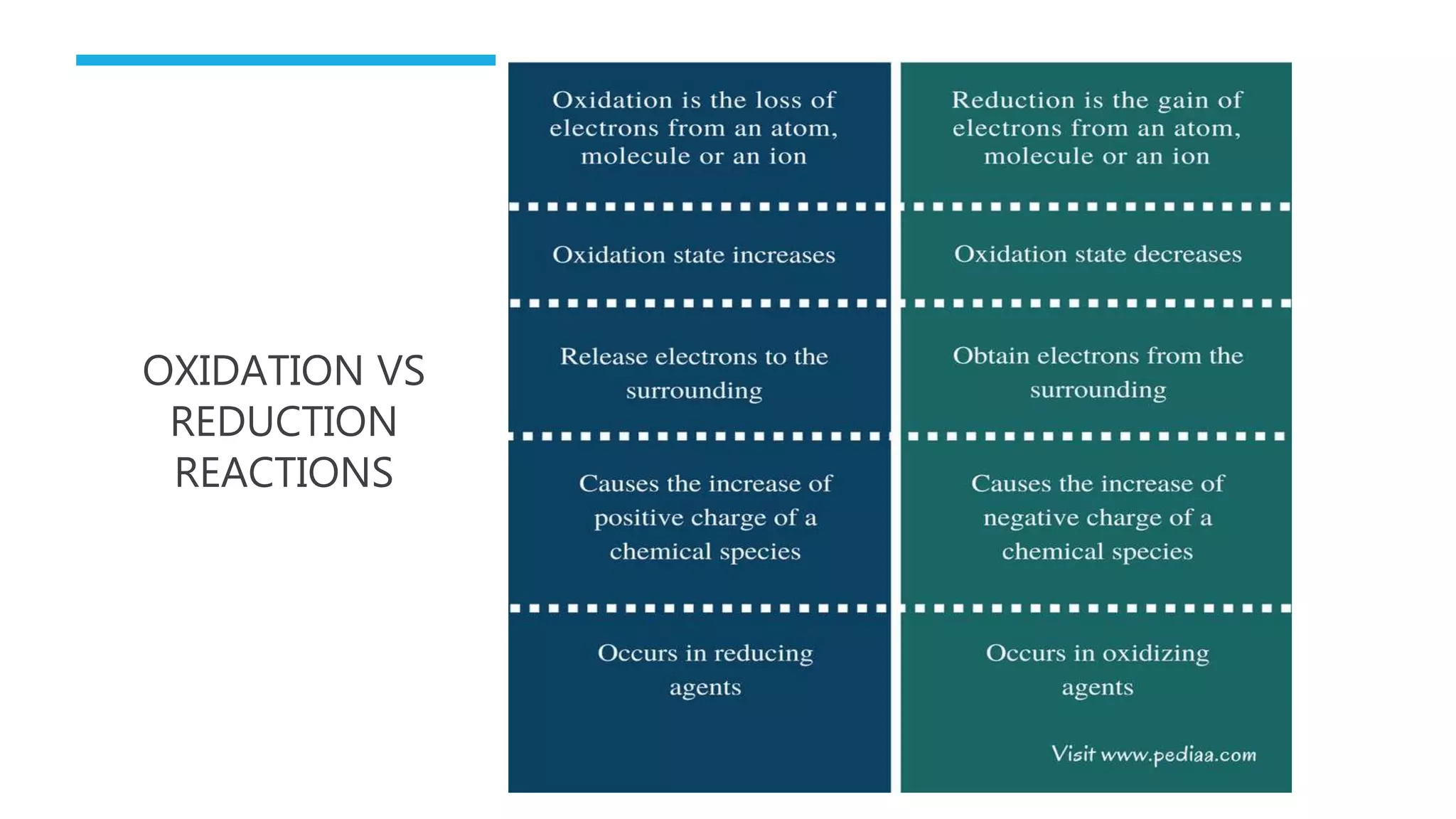
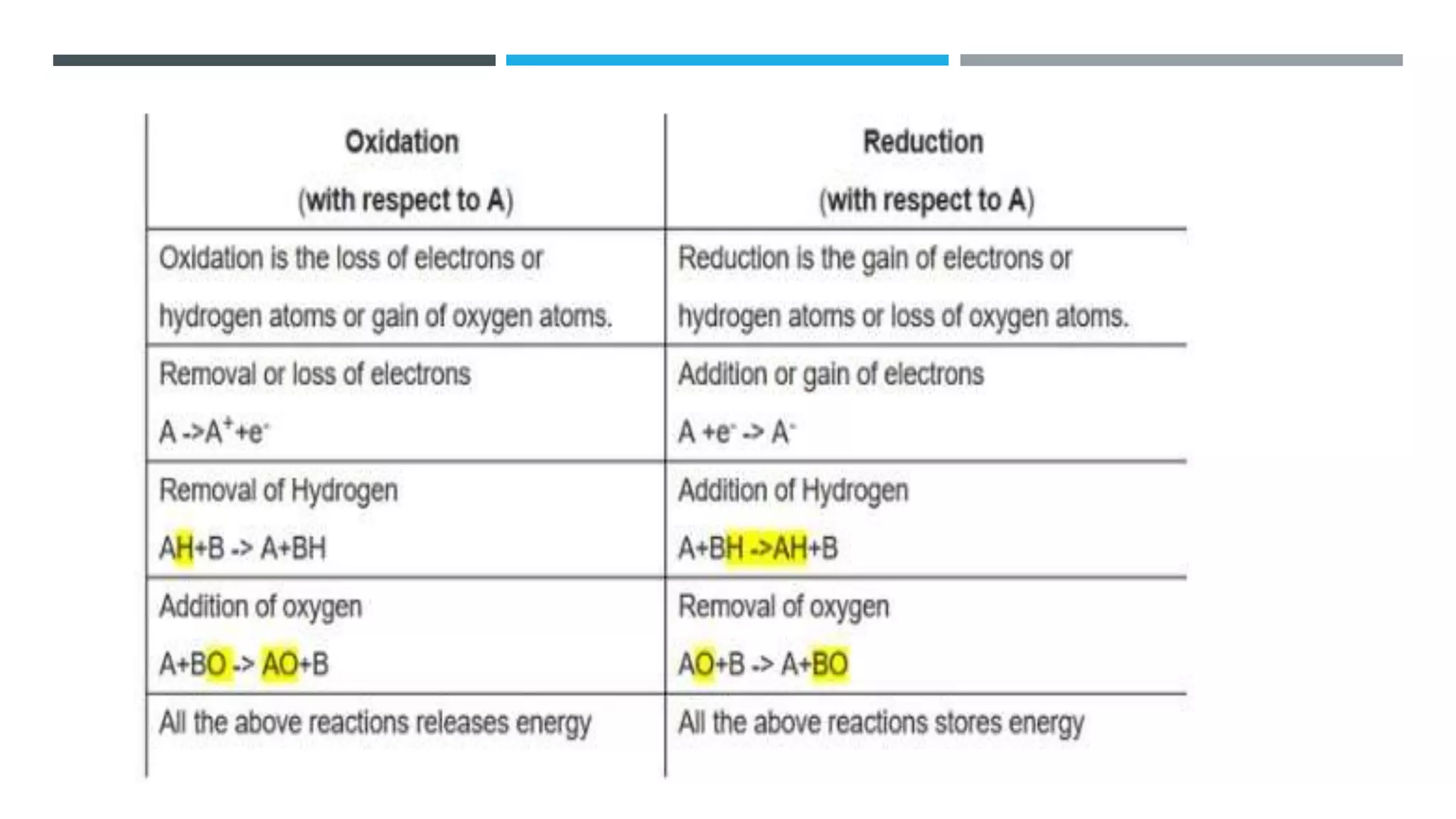
Oxidation is any chemical reaction that
involves the moving of electrons. Specifically, it
means the substance that gives away
electrons is oxidized. Normally, this is a
reaction between oxygen and a substance
such as iron.
REDUCTION DEFINITION
Reduction is a chemical reaction that involves
the gaining of electrons by one of the atoms
involved in the reaction between
two chemicals. The term refers to the
that accepts electrons, as the oxidation
state of the element that gains electrons is
lowered.
An example of a reduction is
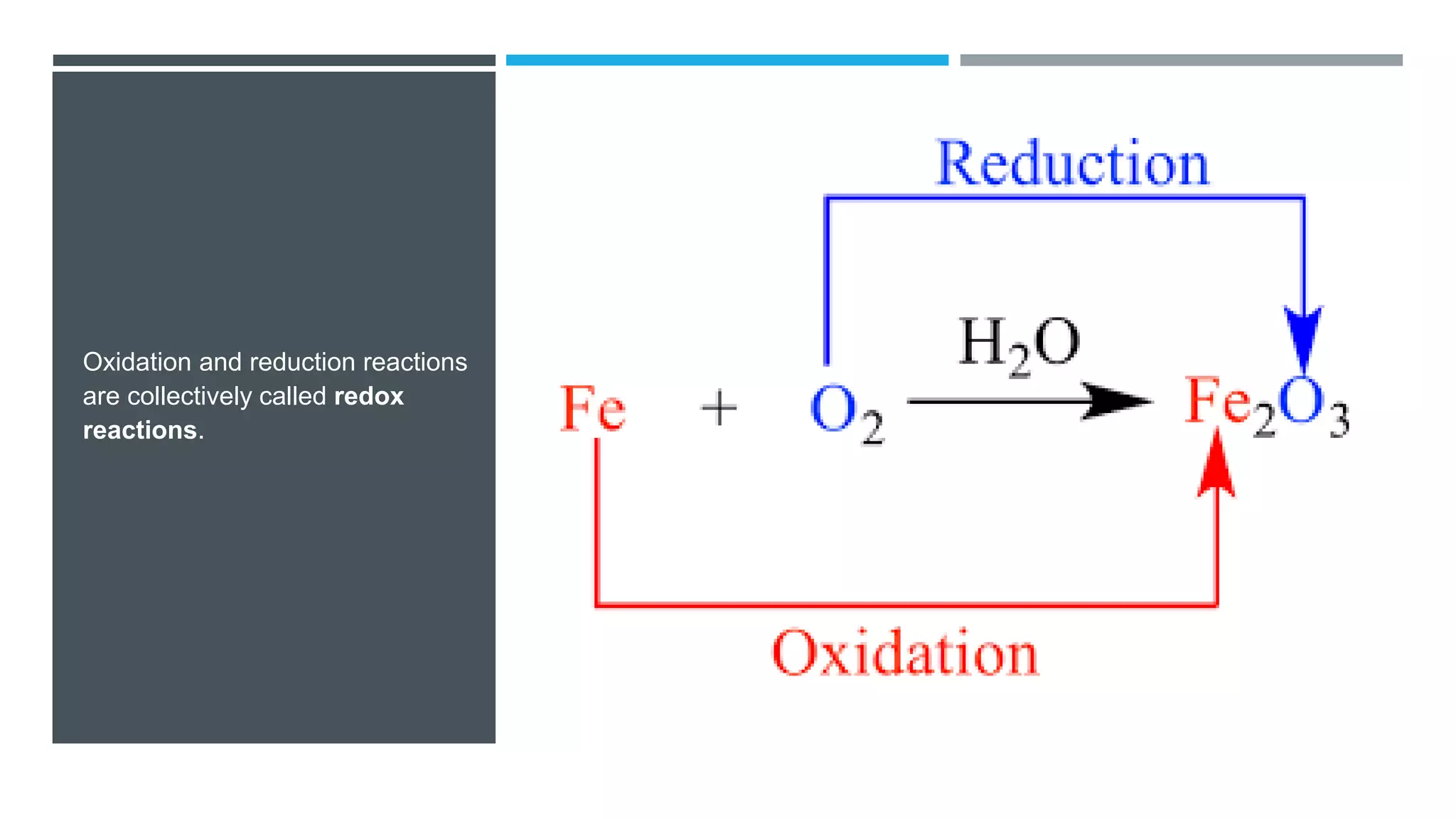
when iron reacts with oxygen, forming iron
oxides (commonly known as rust). In that
example, the iron is oxidized, and the oxygen
is reduced. This is called redox. A blast
reverses that reaction, using carbon
as a reducing agent to reduce the iron.
Oxidation and reduction reactions
are collectively called redox
reactions.
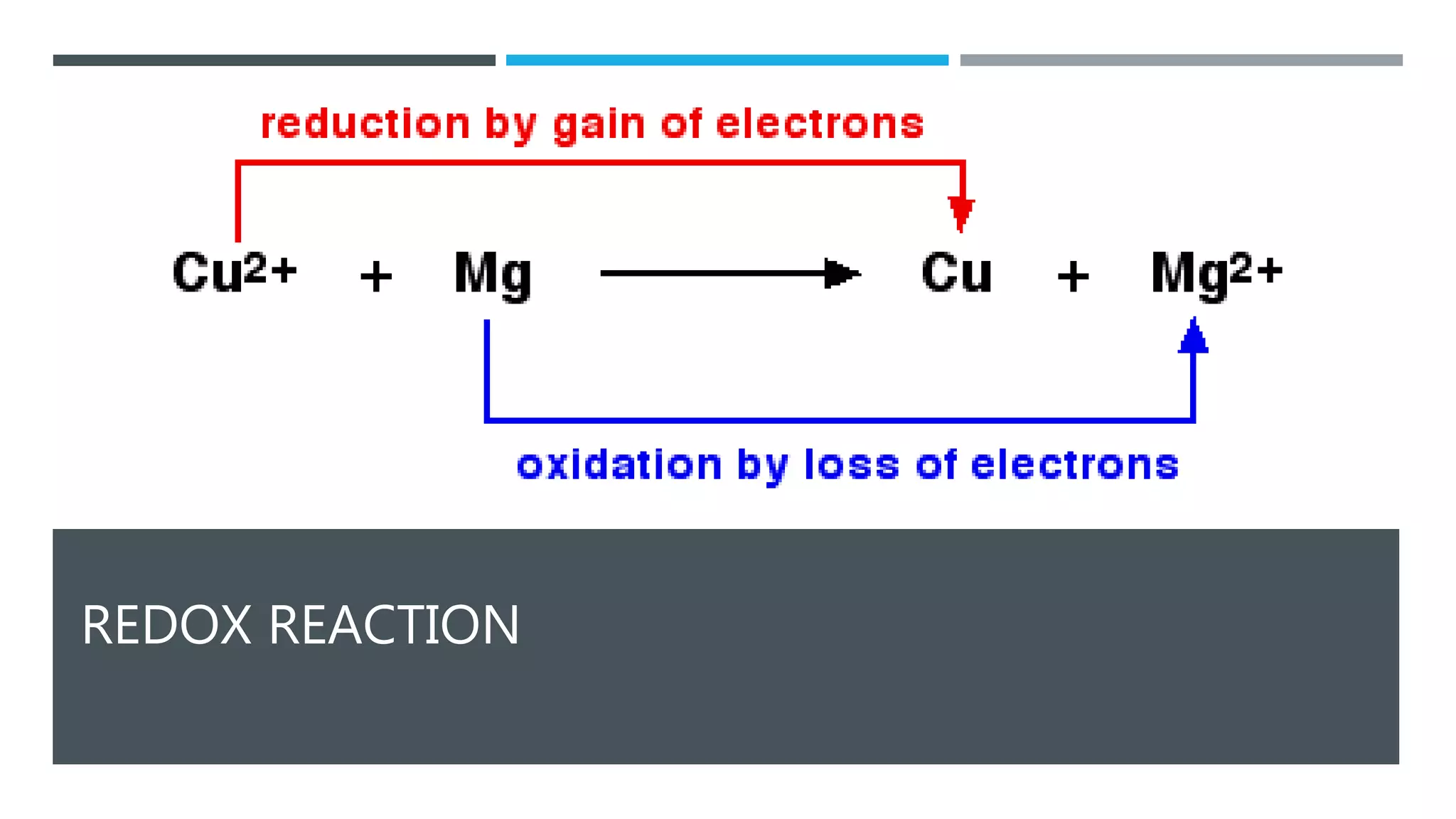
REDOX REACTION
OXIDIZING AND
REDUCING
AGENTS
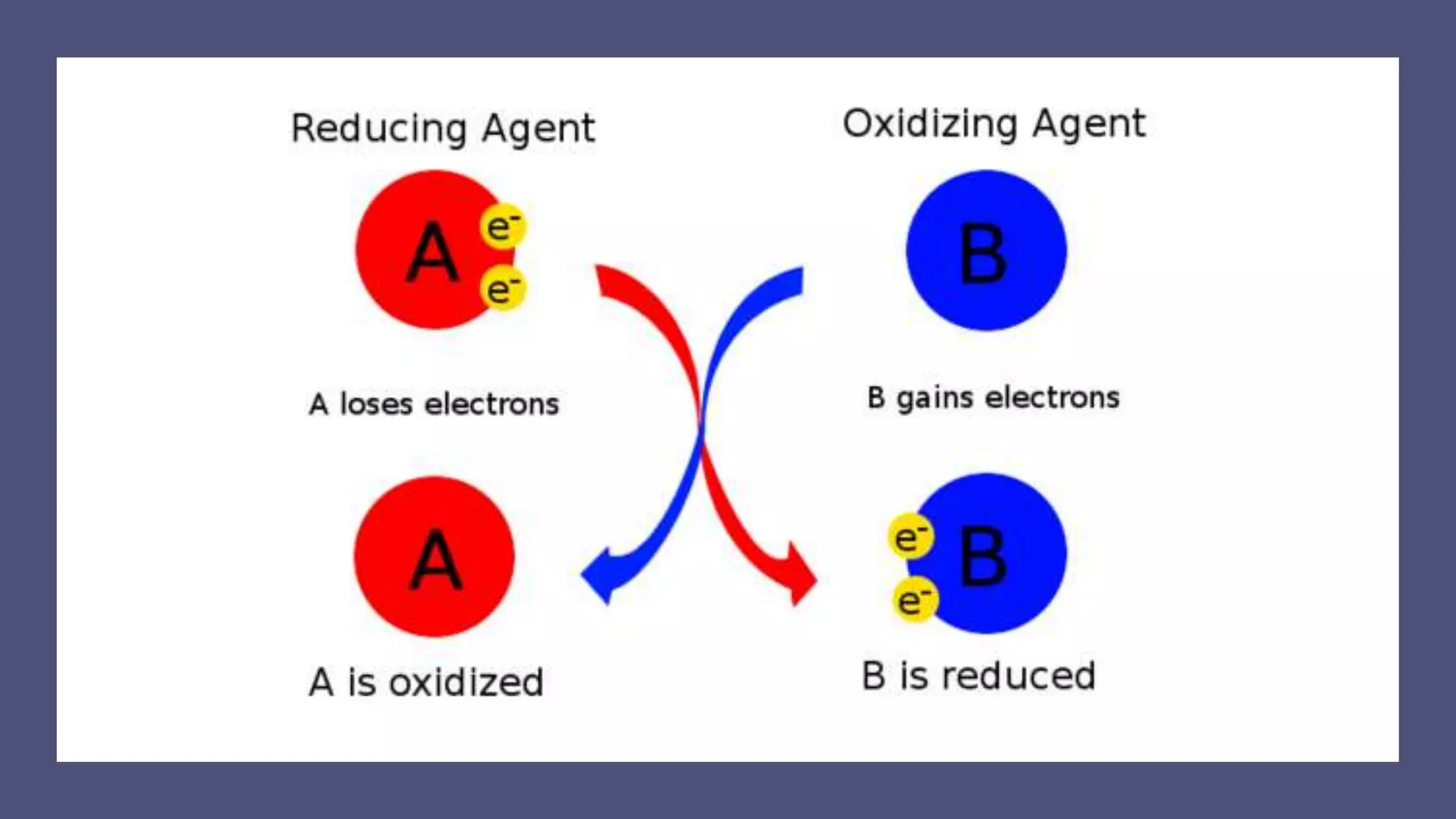
 Reducing agent (also called
a reductant or reducer) is an element or
compound that loses (or "donates") an electron to
an electron recipient (oxidizing agent) in
a redox chemical reaction. A reducing agent is thus
oxidized when it loses electrons in the redox
reaction. Reducing agents "reduce" (or, are
"oxidized" by) oxidizing agents. Oxidizers "oxidize"
(that is, are reduced by) reducers.
 an oxidizing agent (oxidant, oxidizer) is a
substance that can oxidize other substances — in
other words to accept their electrons. Common
oxidizing agents are oxygen, hydrogen
peroxide and the halogens.
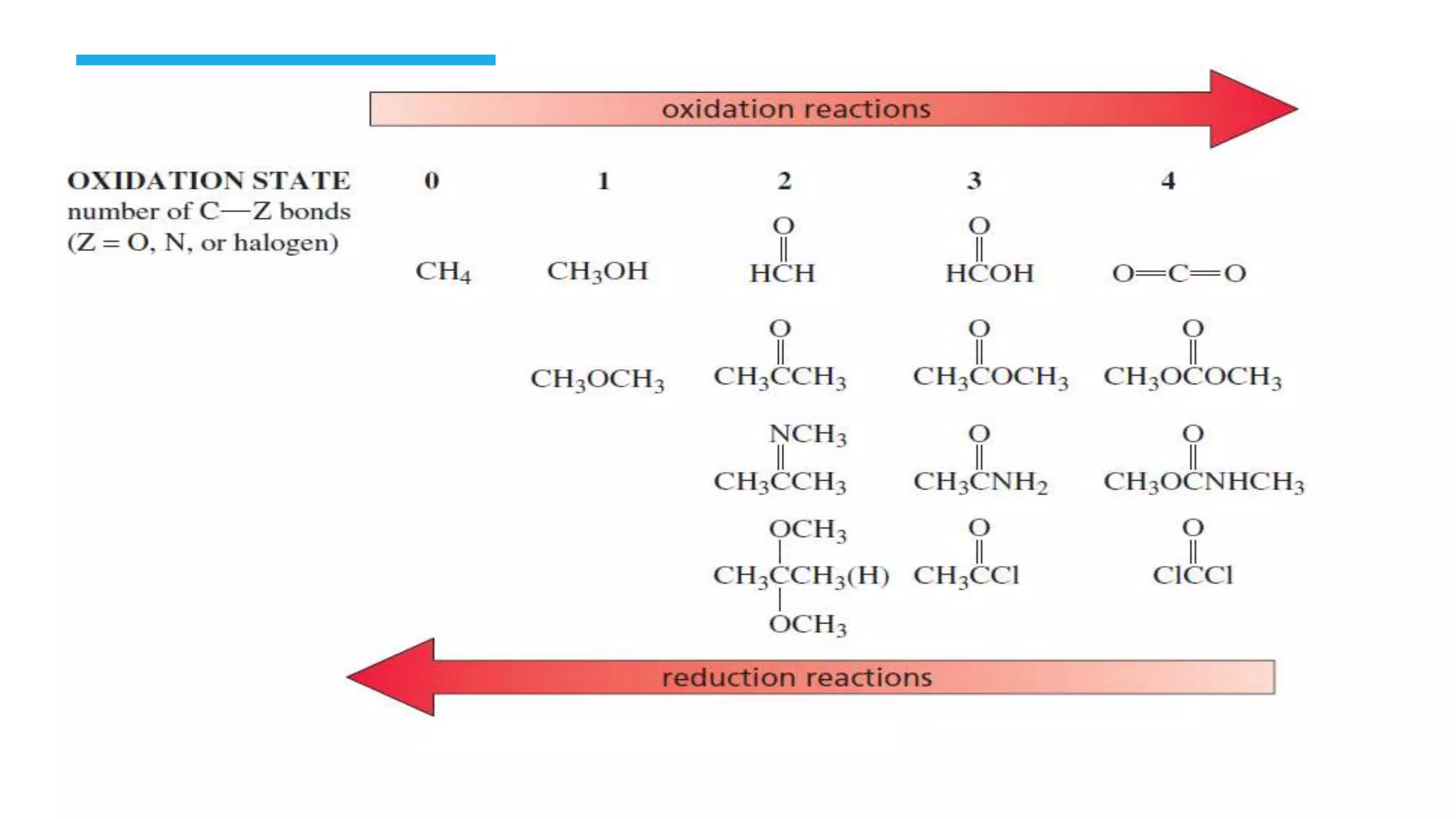
OXIDATION VS
REDUCTION
REACTIONS
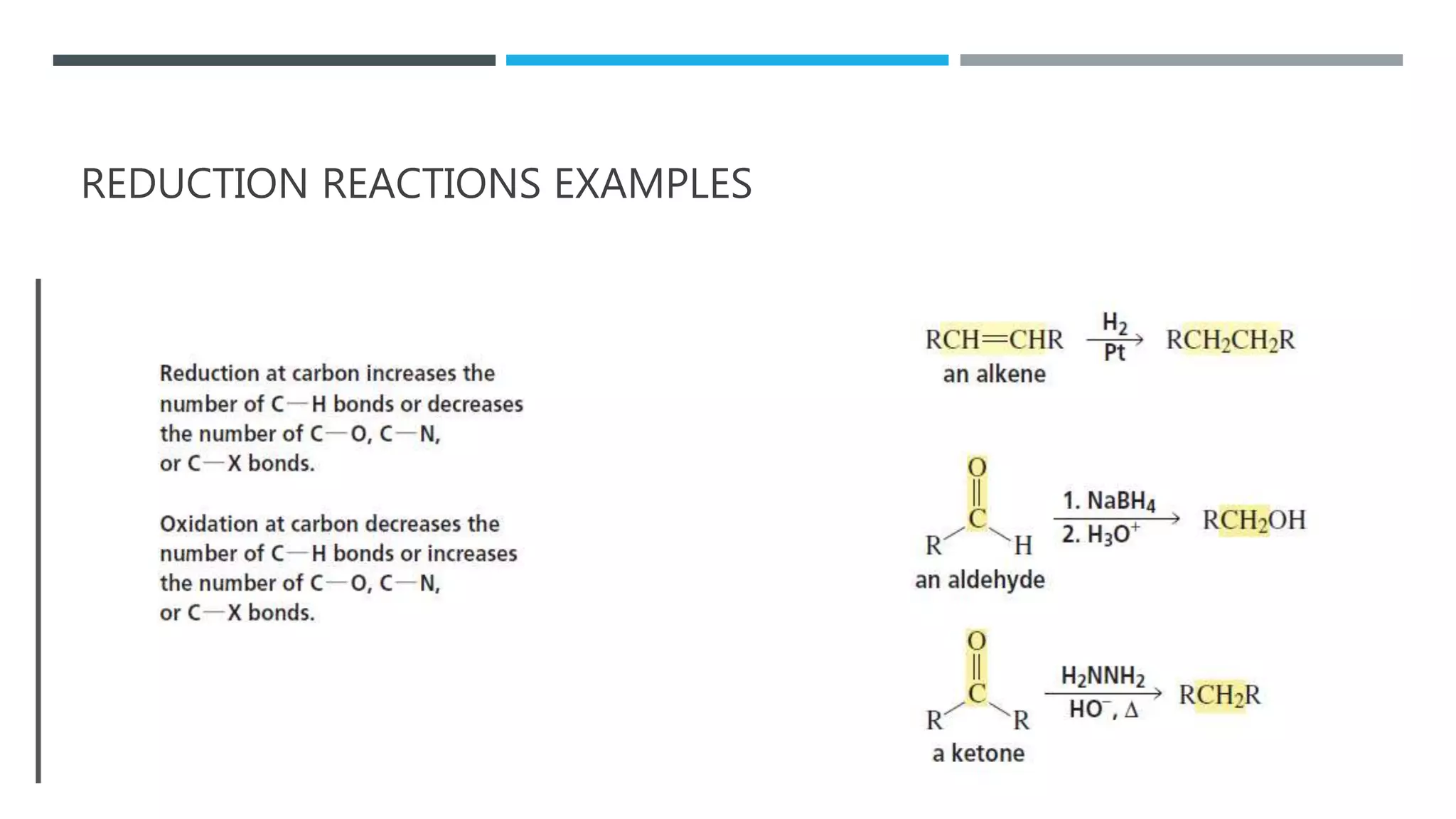
REDUCTION REACTIONS EXAMPLES
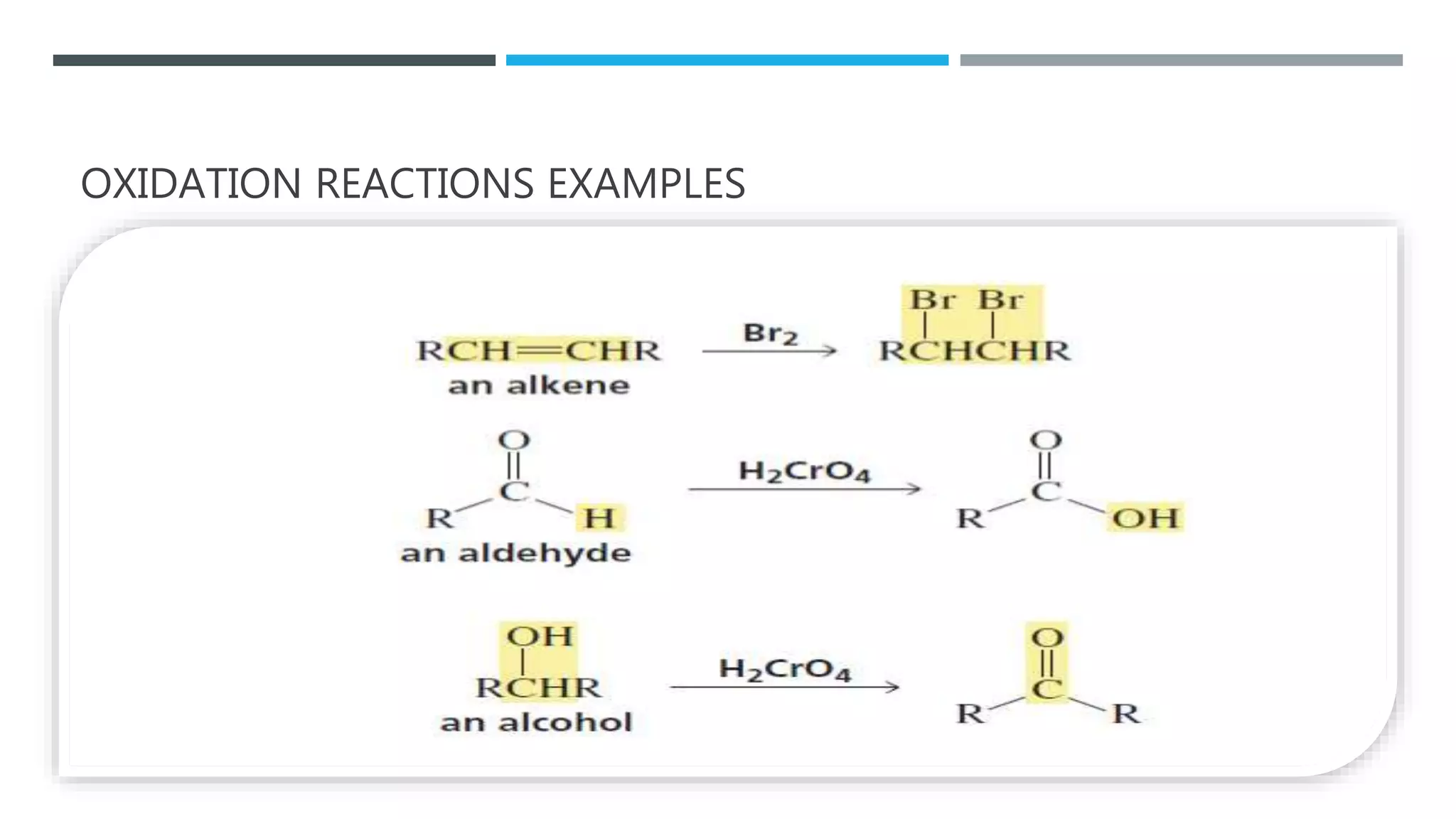
OXIDATION REACTIONS EXAMPLES
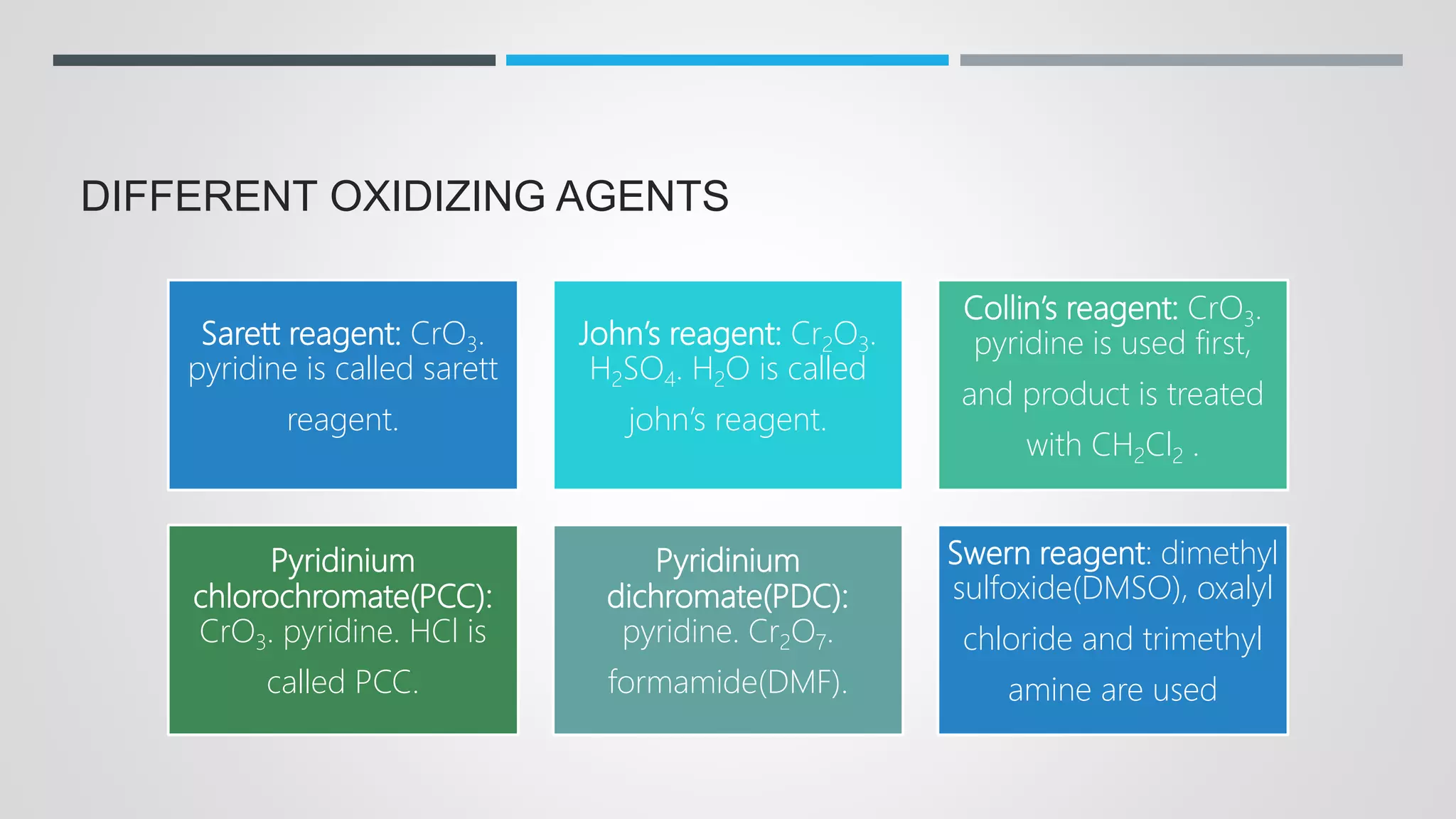
DIFFERENT OXIDIZING AGENTS
Sarett reagent: CrO3.
pyridine is called sarett
reagent.
John’s reagent: Cr2O3.
H2SO4. H2O is called
john’s reagent.
Collin’s reagent: CrO3.
pyridine is used first,
and product is treated
with CH2Cl2 .
Pyridinium
chlorochromate(PCC):
CrO3. pyridine. HCl is
called PCC.
Pyridinium
dichromate(PDC):
pyridine. Cr2O7.
formamide(DMF).
Swern reagent: dimethyl
sulfoxide(DMSO), oxalyl
chloride and trimethyl
amine are used
OXIDATION REACTIONS
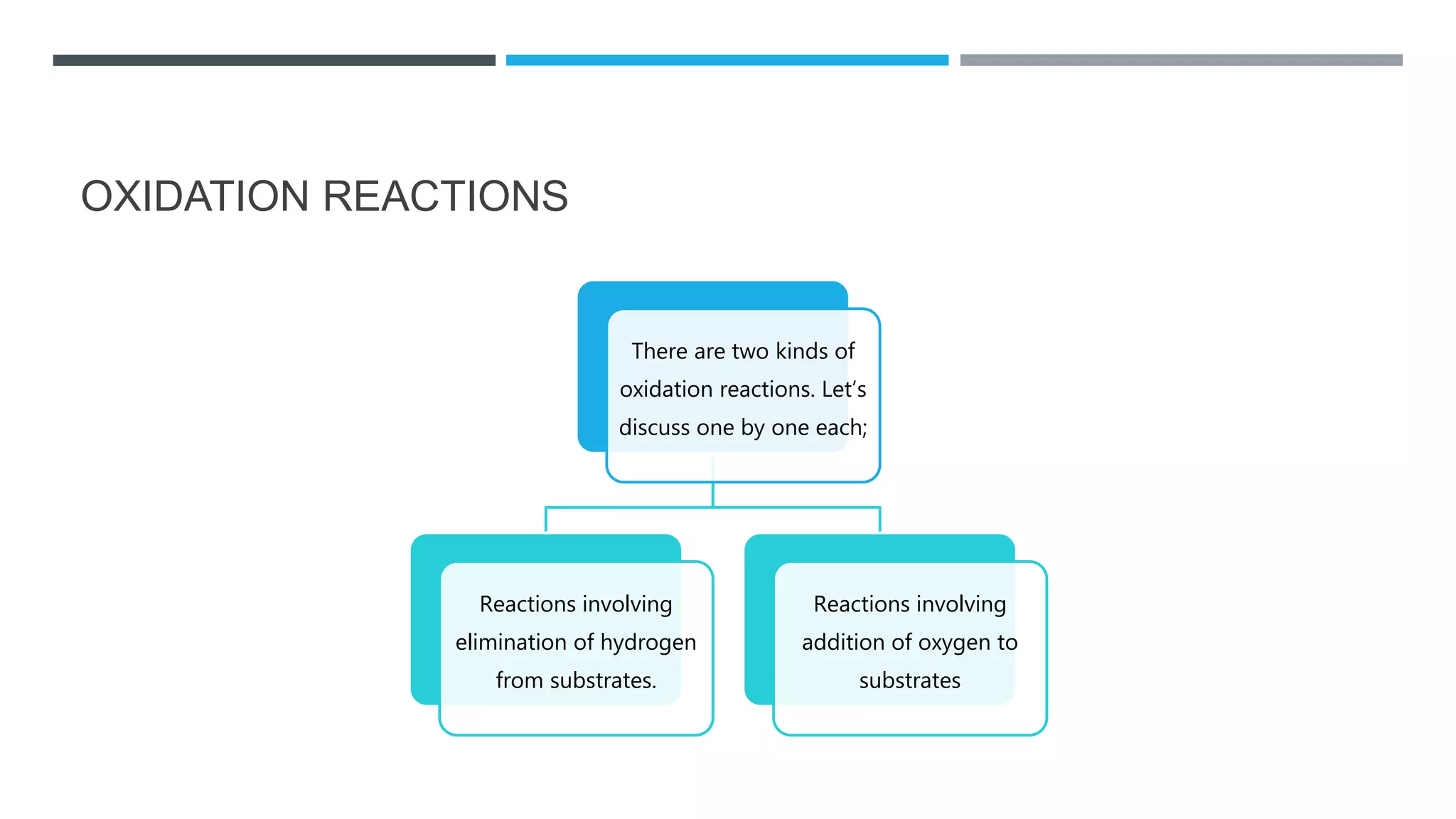
There are two kinds of
oxidation reactions. Let’s
discuss one by one each;
Reactions involving
elimination of hydrogen
from substrates.
Reactions involving
addition of oxygen to
substrates
1.REACTIONS
INVOLVING
ELIMINATION
OF HYDROGEN
FROM
SUBSTRATES
Oxidation of alcohols
There are 3 kinds of alcohols.
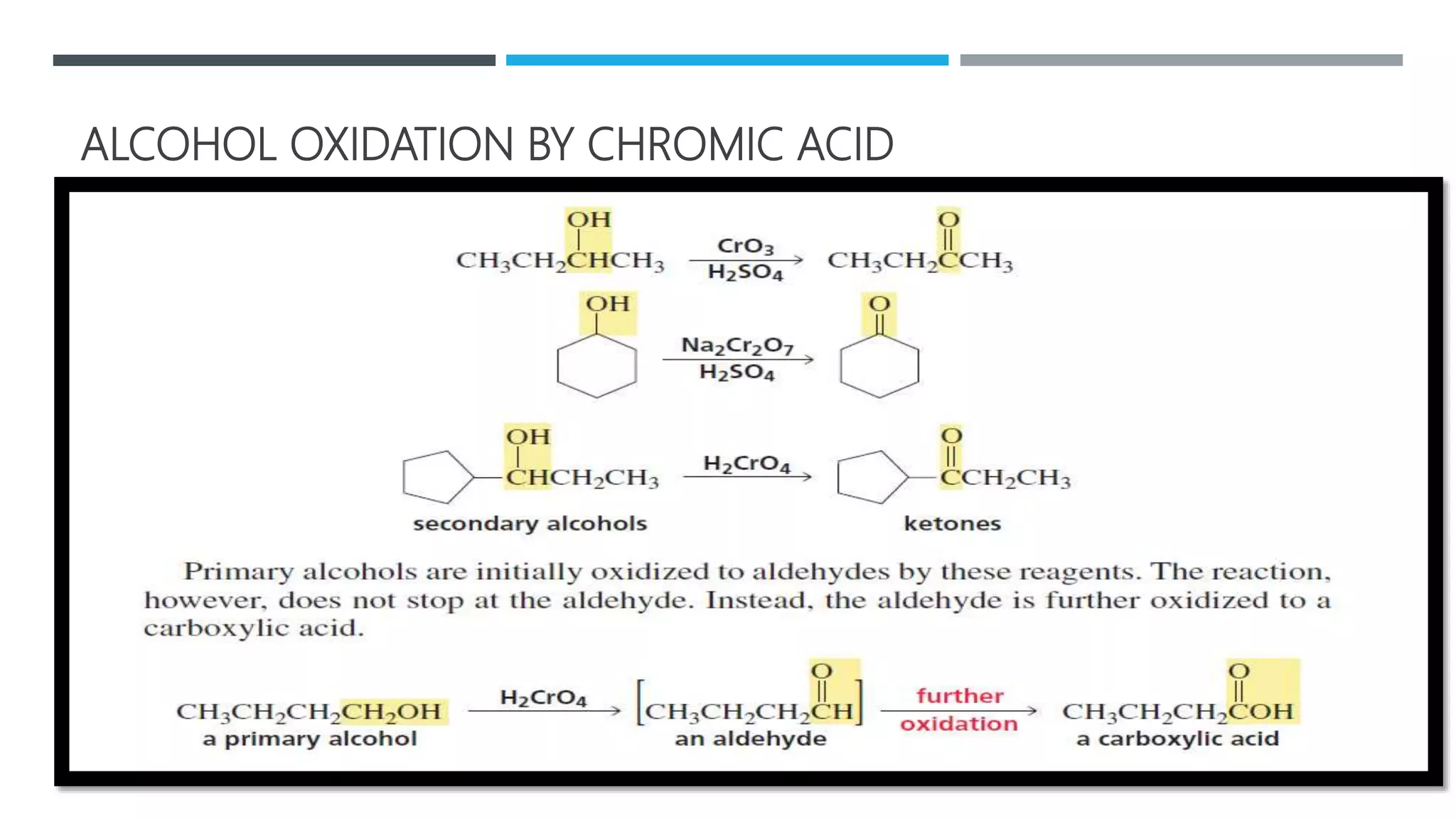
Primary alcohols are oxidized to aldehydes with mild
reagent and to carboxylic acid under strong reagent.
Secondary alcohols are oxidized to ketones, which on
further reaction gives esters.
Tertiary alcohols are not oxidized because there is no
hydrogen that can be eliminated.
OXIDATION OF
ALCOHOLS
a. Alcohol oxidation by chromic acid
Chromic acid is formed when chromium trioxide or sodium
dichromate is dissolved in aqueous acids. These reactions
easily recognized as oxidation because the number of C-H
bonds decreases, and number of C-O bonds increases.
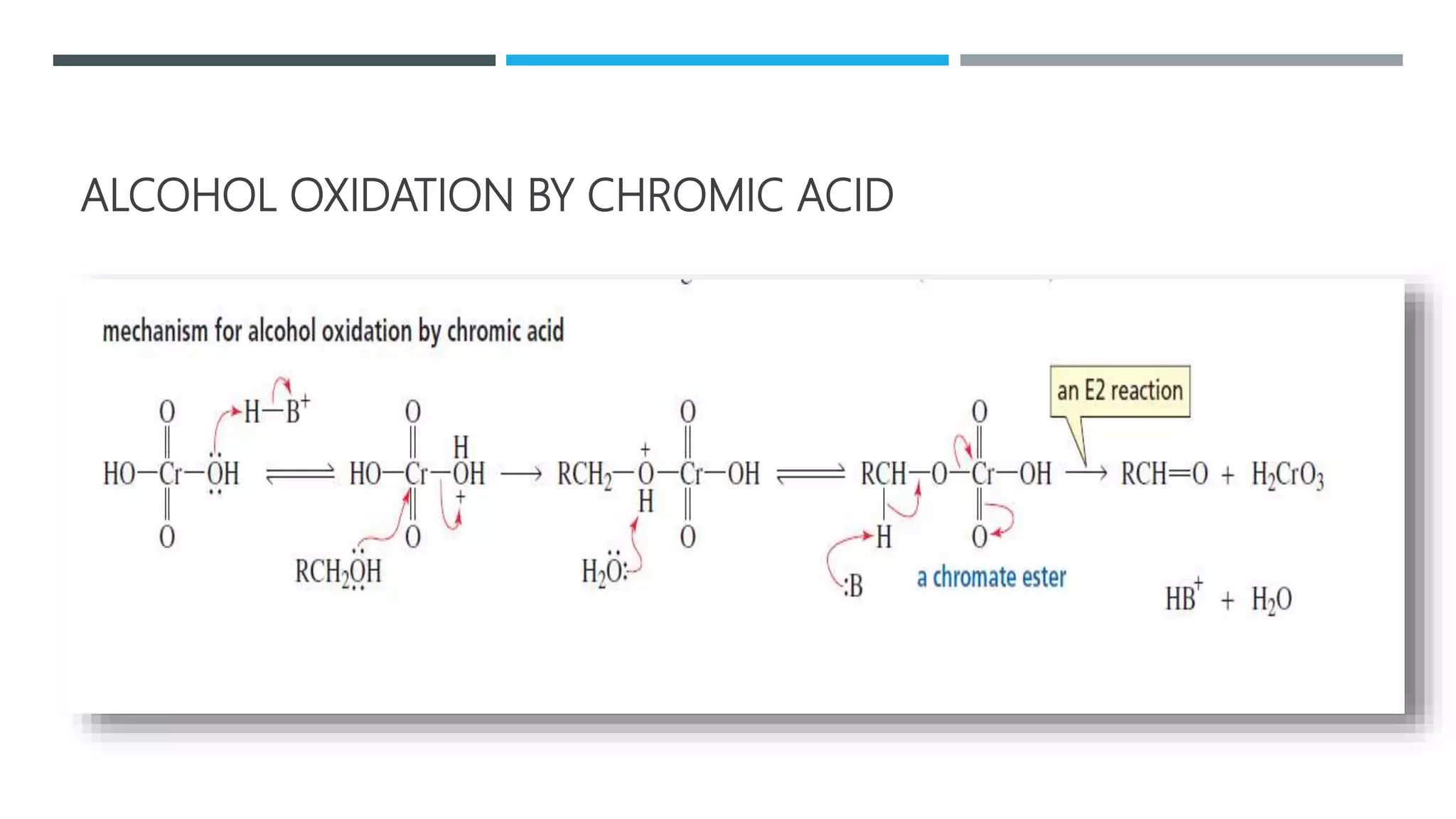
ALCOHOL OXIDATION BY CHROMIC ACID
 MECHANISM
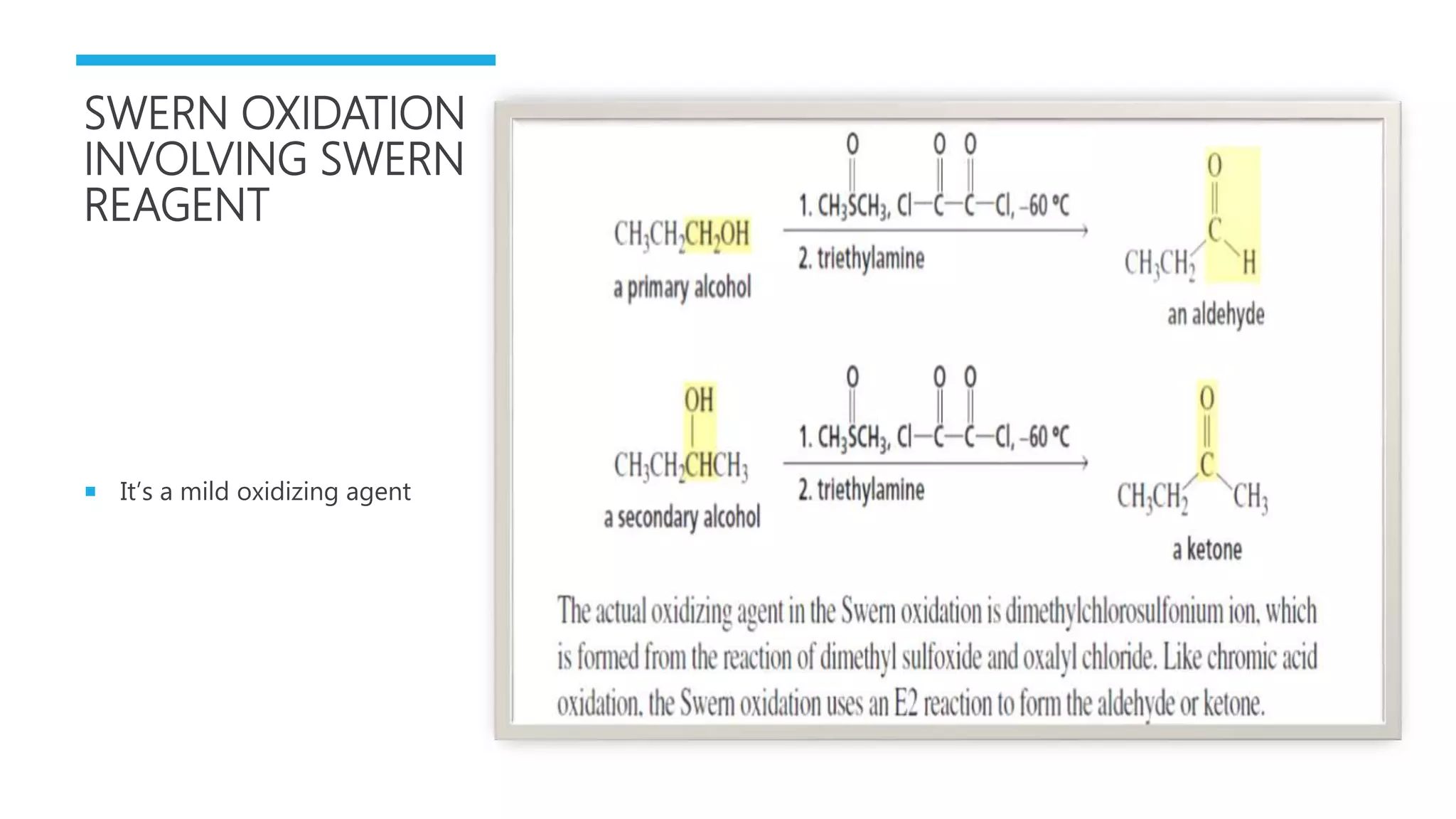
SWERN OXIDATION
INVOLVING SWERN
REAGENT
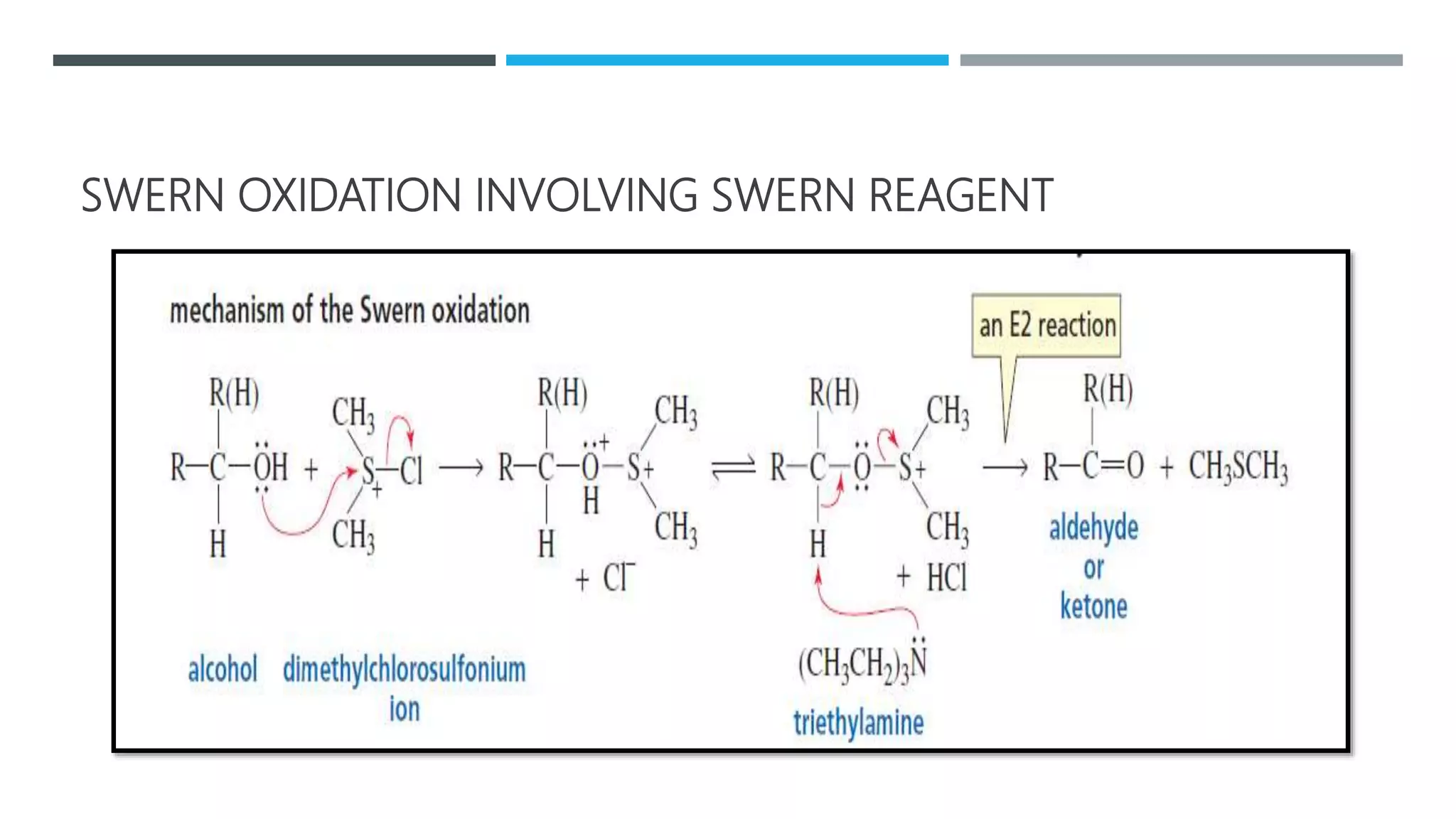
 It’s a mild oxidizing agent
SWERN OXIDATION INVOLVING SWERN REAGENT
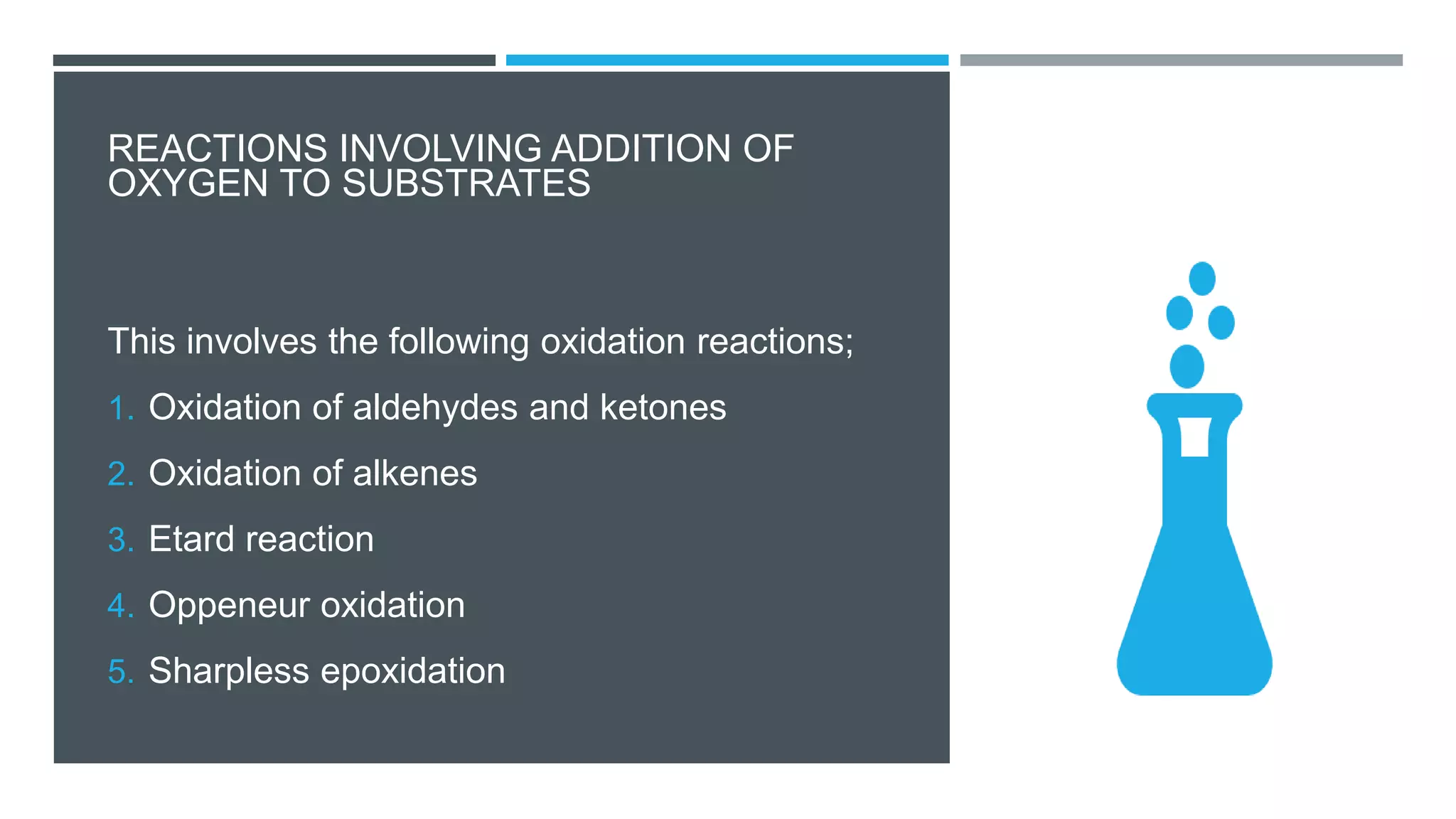
REACTIONS INVOLVING ADDITION OF
OXYGEN TO SUBSTRATES
This involves the following oxidation reactions;
1. Oxidation of aldehydes and ketones
2. Oxidation of alkenes
3. Etard reaction
4. Oppeneur oxidation
5. Sharpless epoxidation
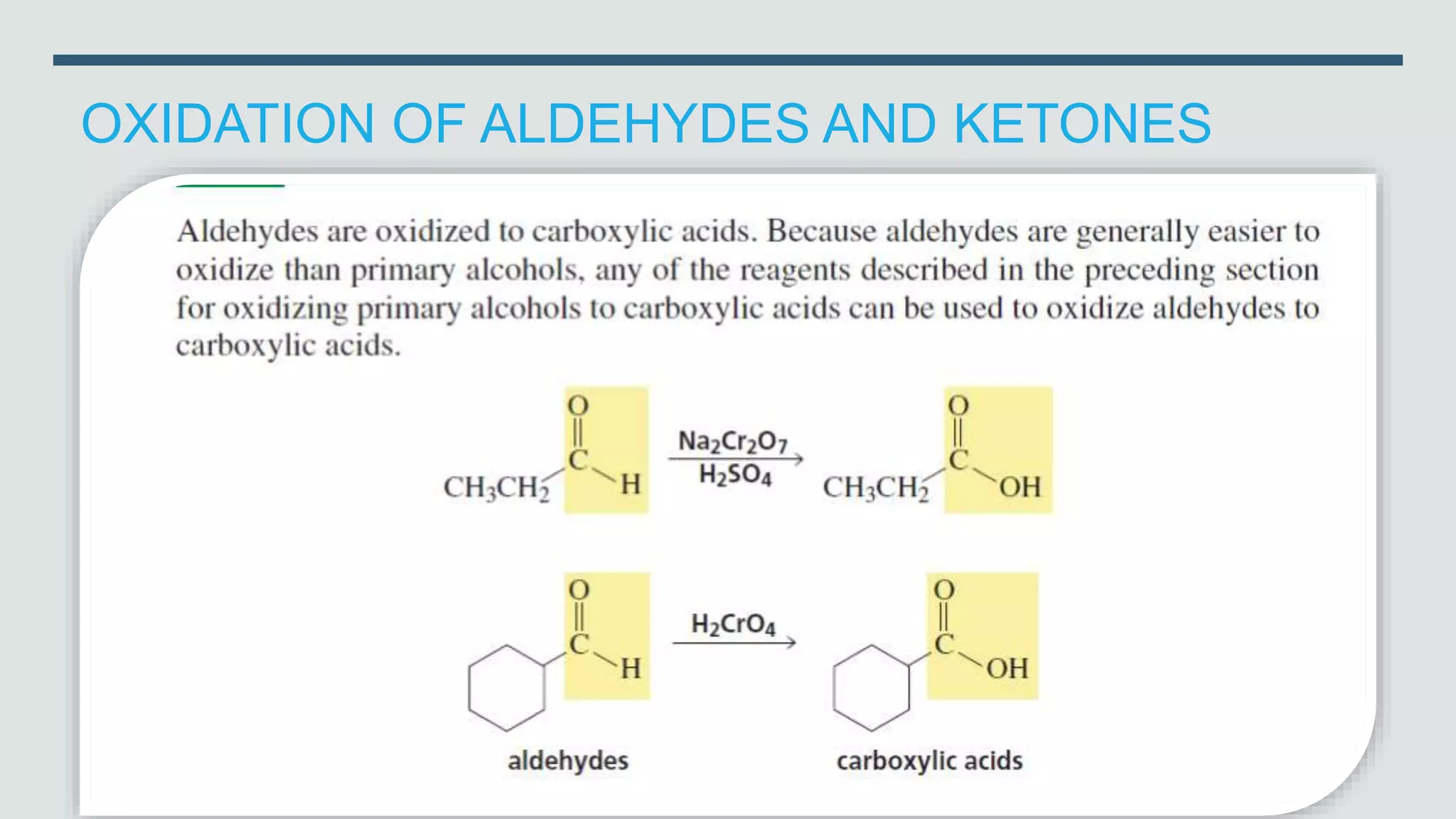
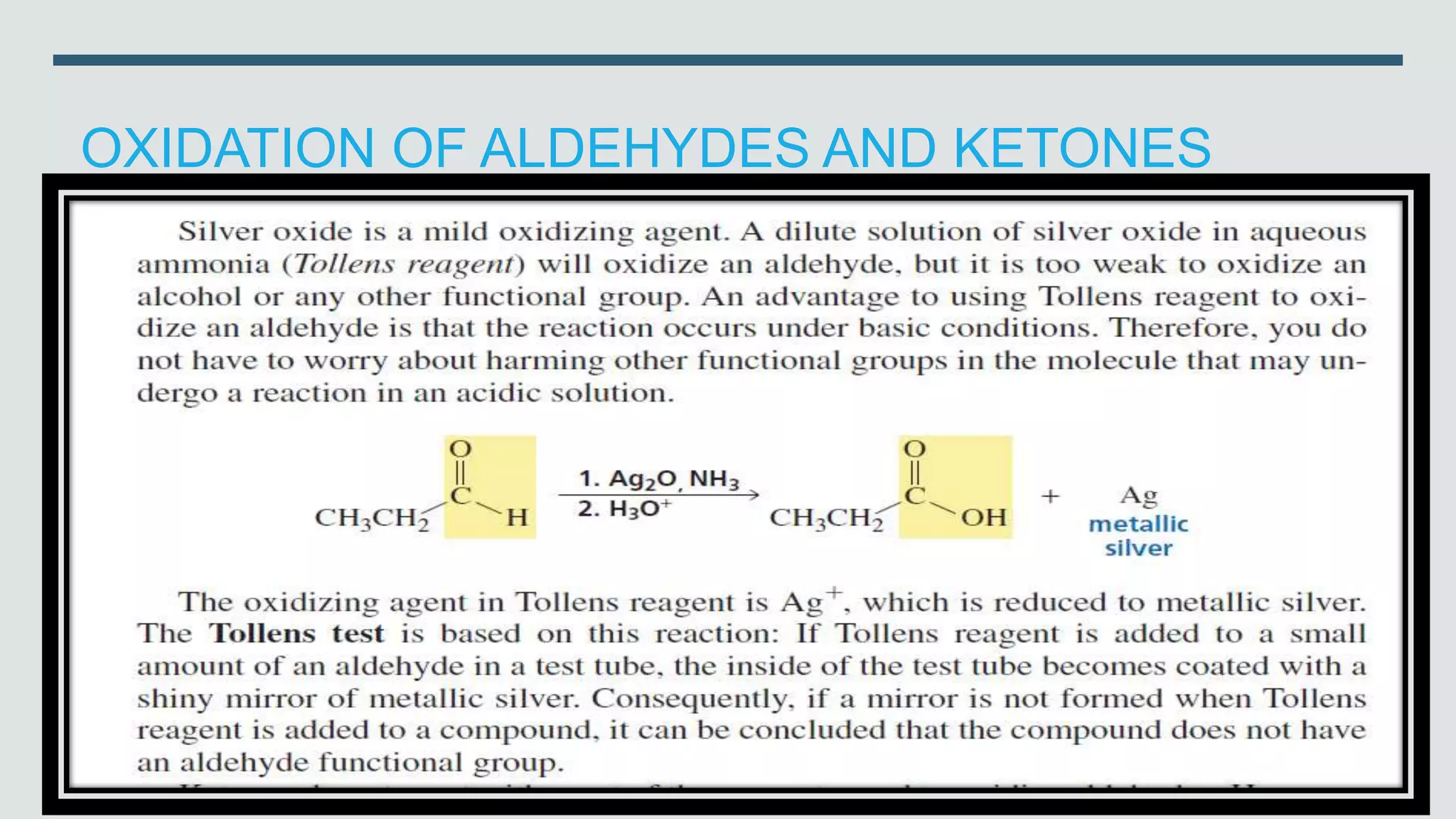
OXIDATION OF ALDEHYDES AND KETONES
OXIDATION OF
ALDEHYDES
AND KETONES
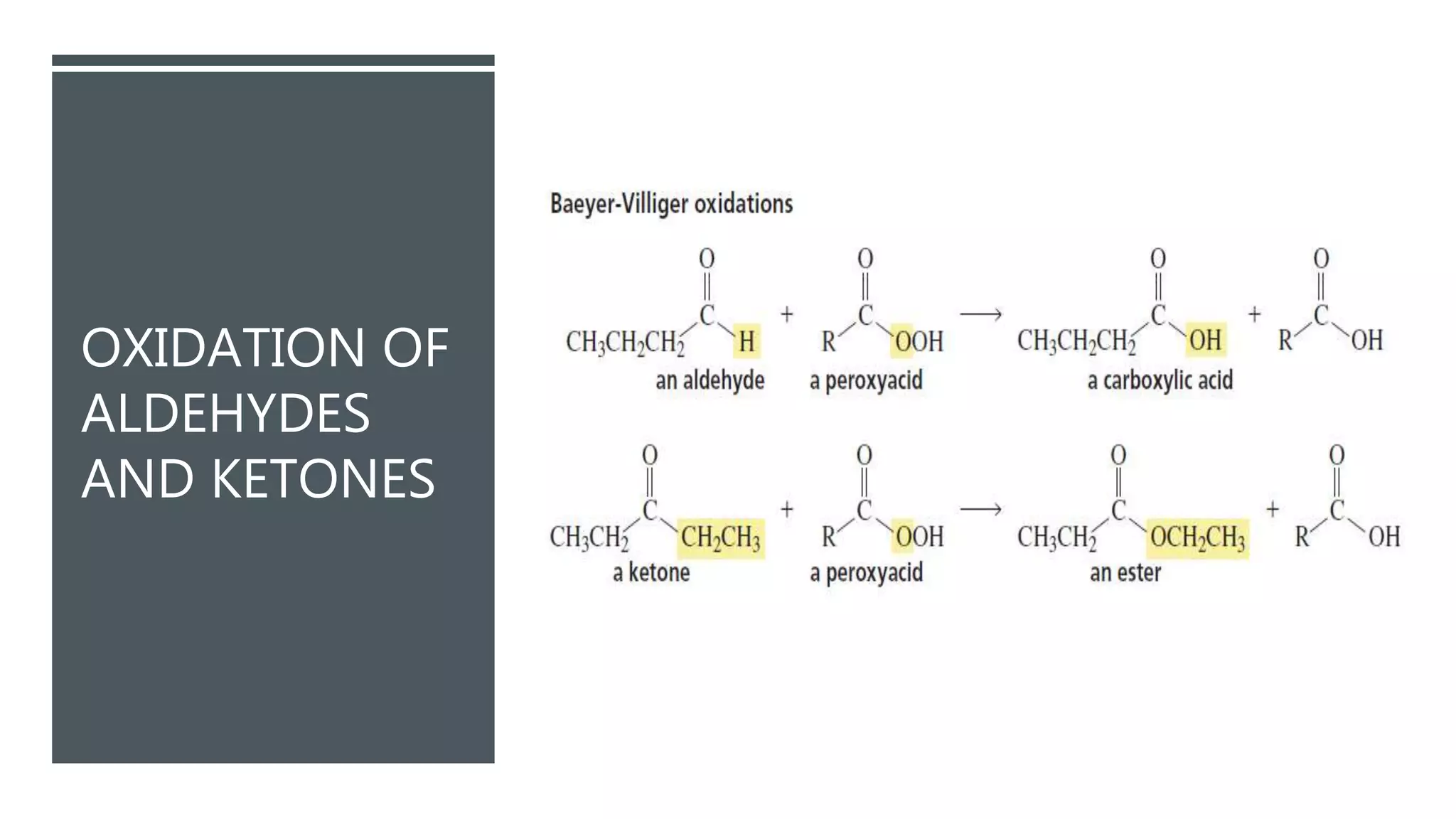
BAEYER VILLIGER REACTION MECHANISM
PERFORMIC ACID,
PERACETIC ACID,
PERBENZIOC ACID
AND TRIFLUORO
ACETIC ACID ARE
USED.
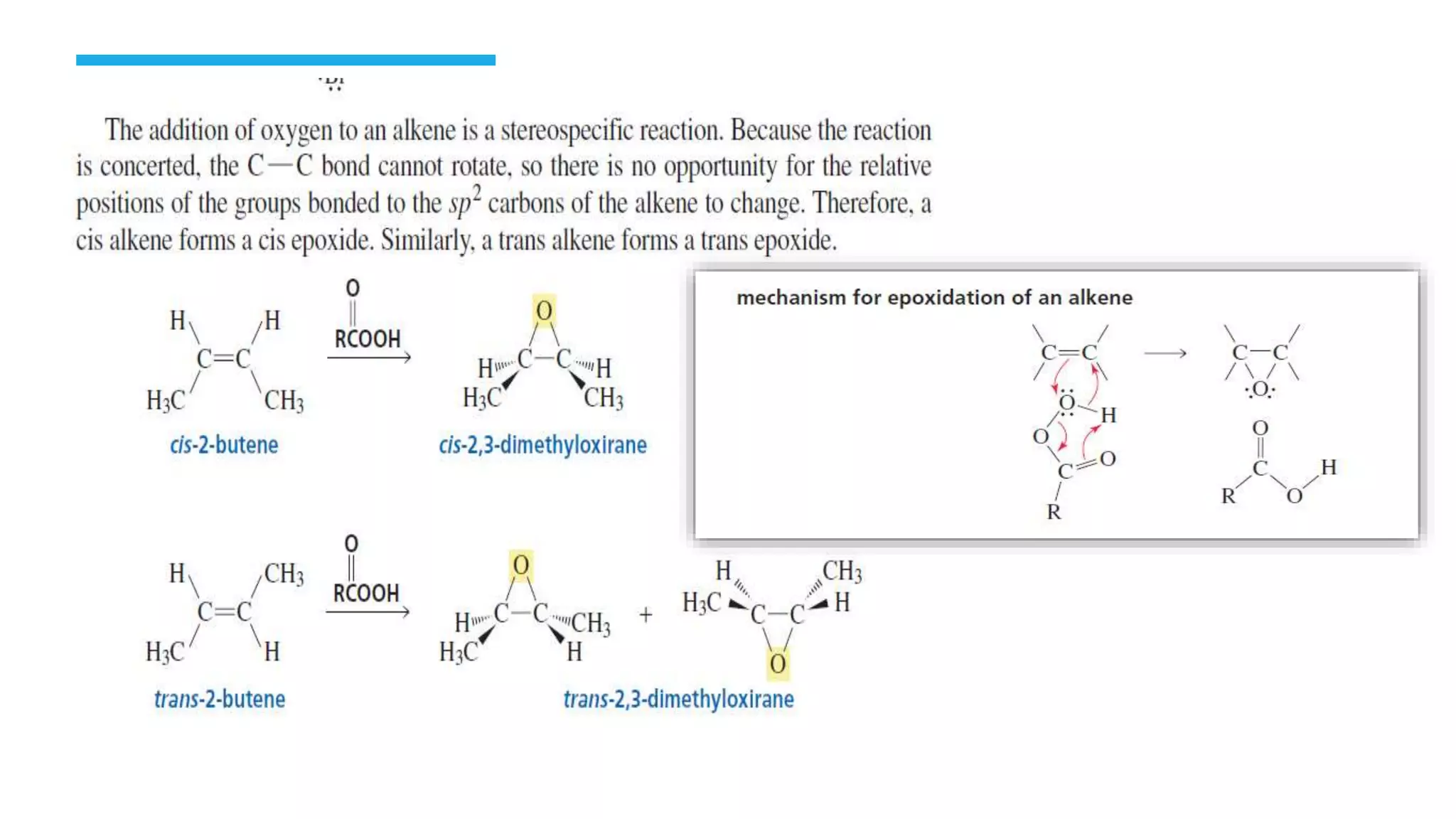
OXIDATION
OF ALKENES
WITH
PEROXYACIDS
HYDROXYLATION OF ALKENES
An alkene can be oxidized
to 1,2 diols using
potassium permanganate
or osmium tetraoxide.
1
Dioles with OH groups on
adjacent carbons is called
vicinal dioles.
2
This reaction is
stereospecific as cis
cycloalkane gives cis diol.
3
OXIDATIVE
CLEAVAGE OF
DIOLS
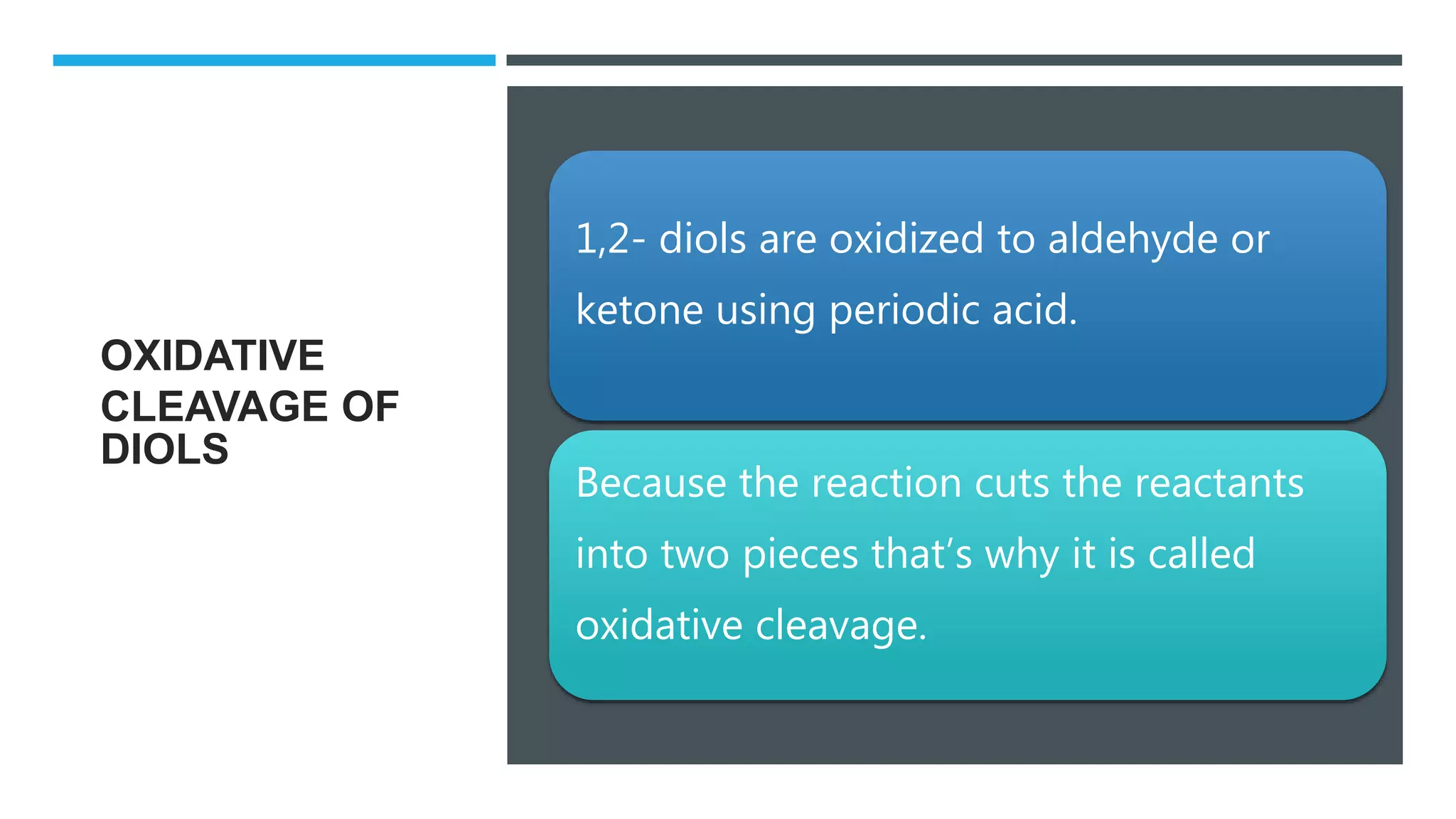
1,2- diols are oxidized to aldehyde or
ketone using periodic acid.
Because the reaction cuts the reactants
into two pieces that’s why it is called
oxidative cleavage.
OXIDATIVE
CLEAVAGE OF
DIOLS
OXIDATIVE
CLEAVAGE OF
ALKENES
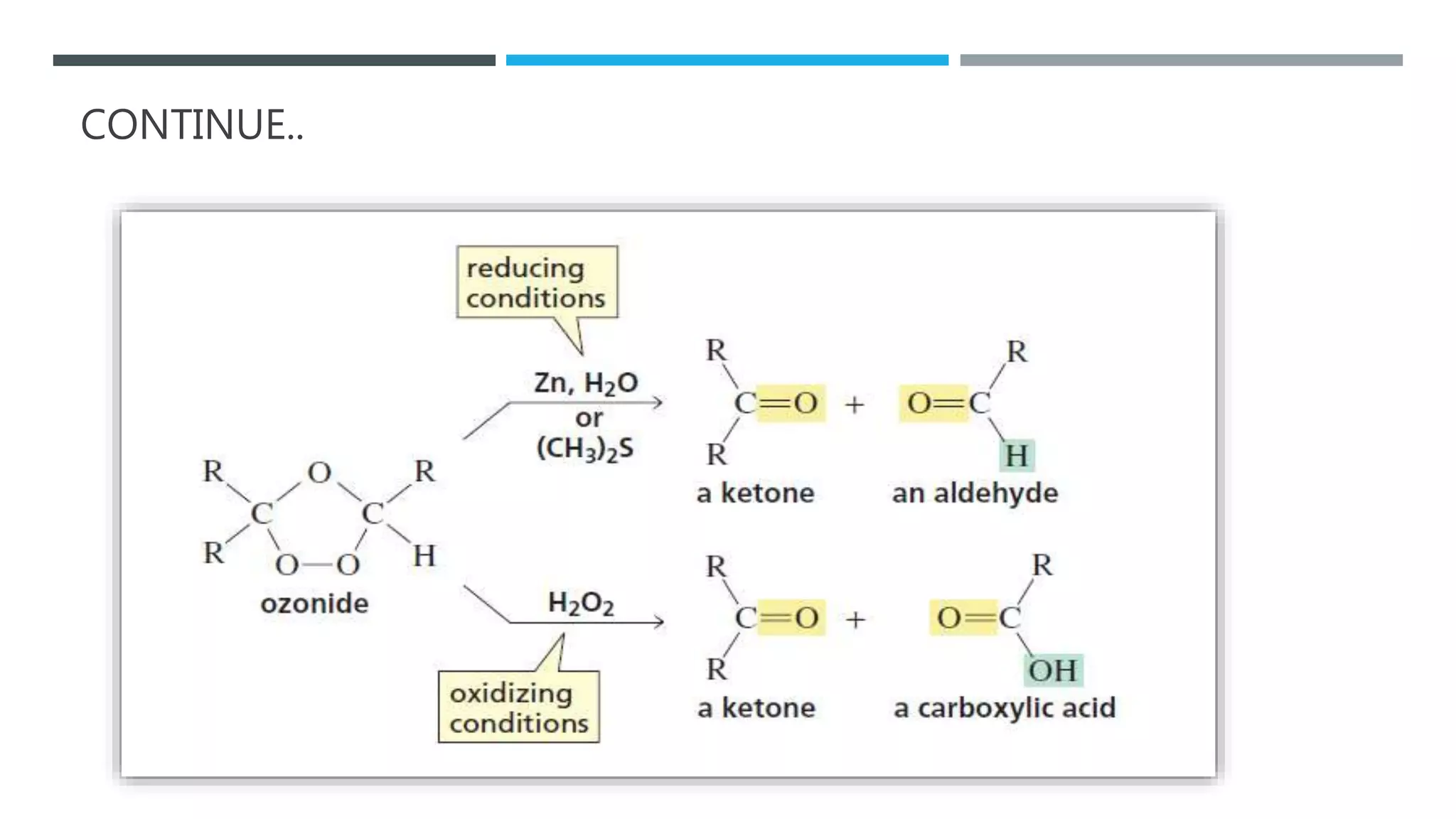
OZONOLYSIS
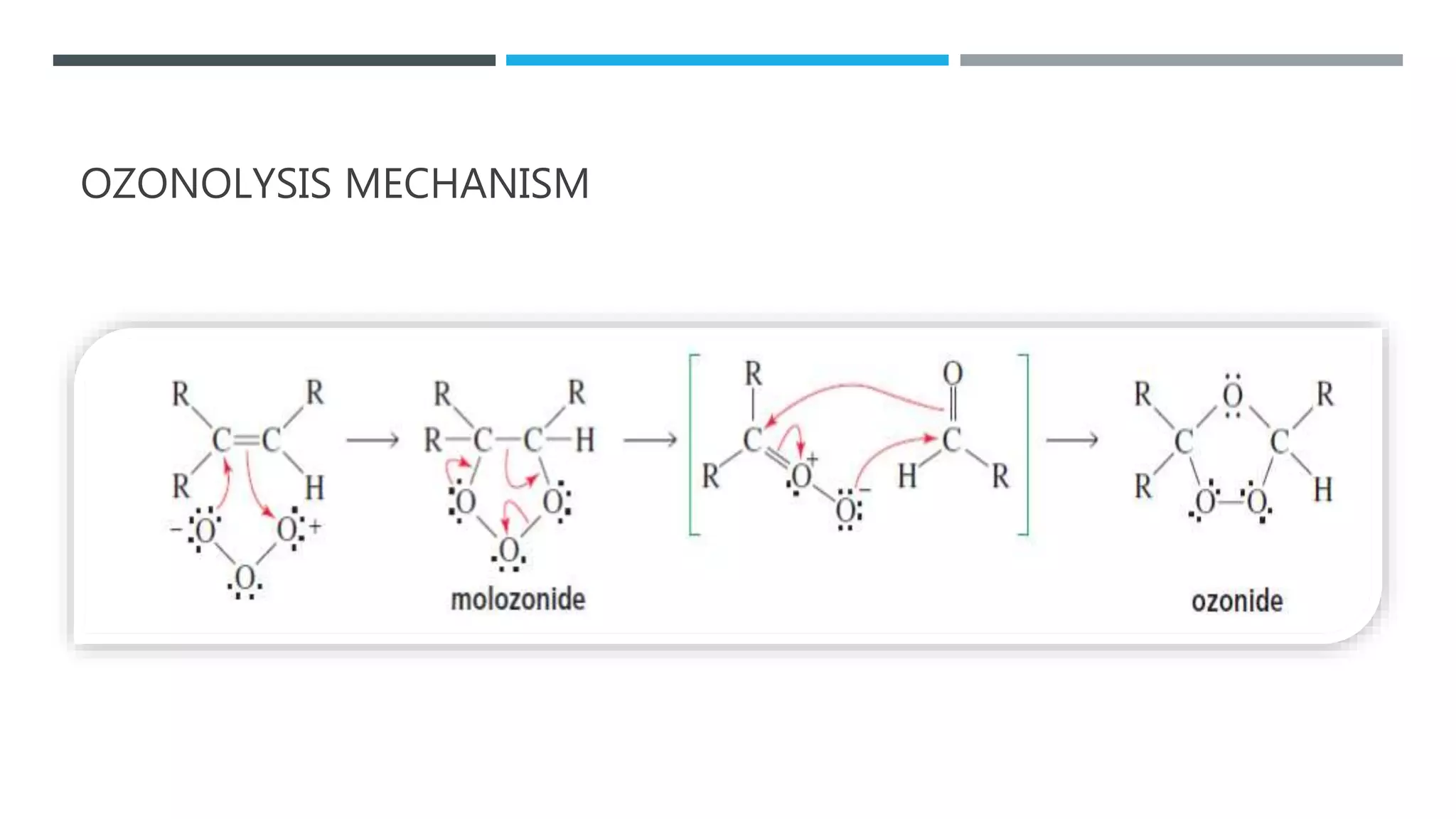
 Alkenes can be directly oxidized to
aldehydes and ketones using ozone.
 Alkenes are treated with ozone at low
temperature, double bond breaks and the
carbons that were doubly bonded to each
other find themselves doubly bounded to
the oxygens instead. This is known as
ozonolysis.
OZONOLYSIS MECHANISM
CONTINUE..
PERMANGANATE CLEAVAGE OF ALKENES
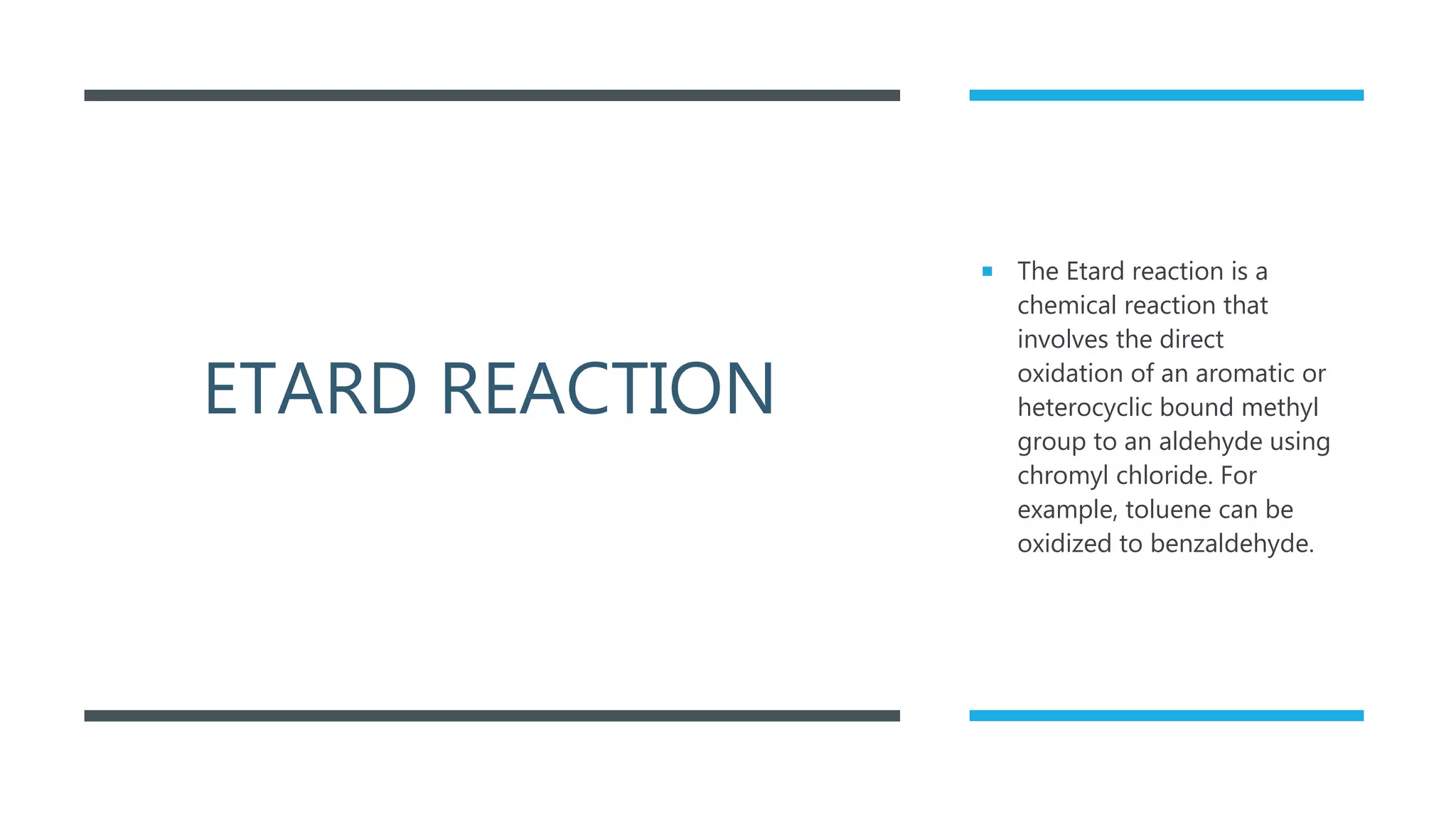
ETARD REACTION
 The Etard reaction is a
chemical reaction that
involves the direct
oxidation of an aromatic or
heterocyclic bound methyl
group to an aldehyde using
chromyl chloride. For
example, toluene can be
oxidized to benzaldehyde.
CONTINUE..
SHARPLESS
EPOXIDATION
 The Sharpless epoxidation reaction is an
enantioselective chemical reaction to
prepare 2,3-epoxyalcohols from primary
and secondary allylic alcohols. The
stereochemistry of the resulting epoxide
is determined by the enantiomer of the
chiral tartrate diester employed in the
reaction.
CONTINUE..
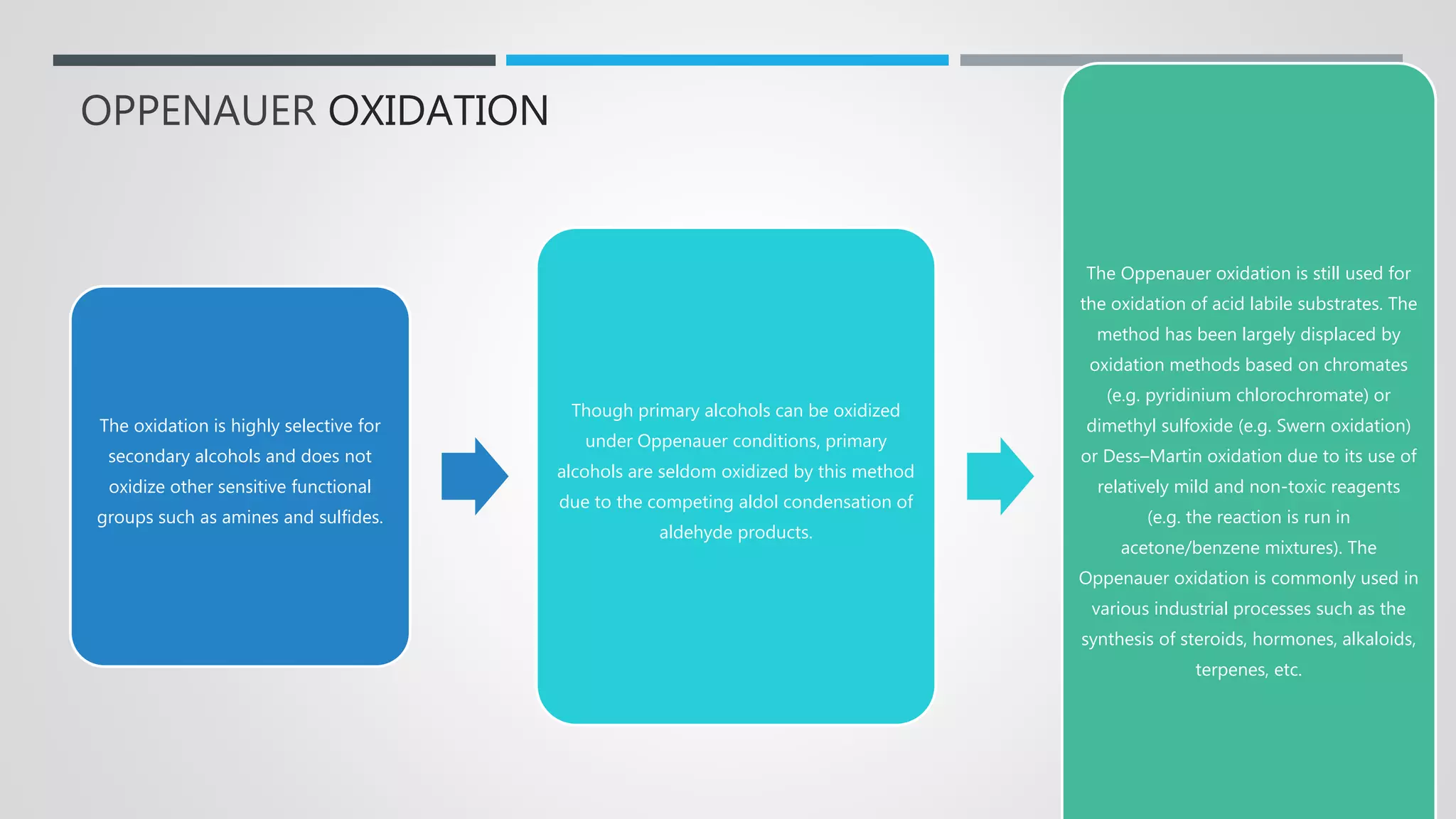
OPPENAUER OXIDATION
The oxidation is highly selective for
secondary alcohols and does not
oxidize other sensitive functional
groups such as amines and sulfides.
Though primary alcohols can be oxidized
under Oppenauer conditions, primary
alcohols are seldom oxidized by this method
due to the competing aldol condensation of
aldehyde products.
The Oppenauer oxidation is still used for
the oxidation of acid labile substrates. The
method has been largely displaced by
oxidation methods based on chromates
(e.g. pyridinium chlorochromate) or
dimethyl sulfoxide (e.g. Swern oxidation)
or Dess–Martin oxidation due to its use of
relatively mild and non-toxic reagents
(e.g. the reaction is run in
acetone/benzene mixtures). The
Oppenauer oxidation is commonly used in
various industrial processes such as the
synthesis of steroids, hormones, alkaloids,
terpenes, etc.
CONTINUE
THE END

Oxidation and reduction reactions

  • 1.
  • 2.
    OXIDATION AND REDUCTION DEFINITIONS Oxidation isany chemical reaction that involves the moving of electrons. Specifically, it means the substance that gives away electrons is oxidized. Normally, this is a reaction between oxygen and a substance such as iron.
  • 3.
    REDUCTION DEFINITION Reduction isa chemical reaction that involves the gaining of electrons by one of the atoms involved in the reaction between two chemicals. The term refers to the that accepts electrons, as the oxidation state of the element that gains electrons is lowered. An example of a reduction is when iron reacts with oxygen, forming iron oxides (commonly known as rust). In that example, the iron is oxidized, and the oxygen is reduced. This is called redox. A blast reverses that reaction, using carbon as a reducing agent to reduce the iron.
  • 4.
    Oxidation and reductionreactions are collectively called redox reactions.
  • 5.
  • 6.
    OXIDIZING AND REDUCING AGENTS  Reducingagent (also called a reductant or reducer) is an element or compound that loses (or "donates") an electron to an electron recipient (oxidizing agent) in a redox chemical reaction. A reducing agent is thus oxidized when it loses electrons in the redox reaction. Reducing agents "reduce" (or, are "oxidized" by) oxidizing agents. Oxidizers "oxidize" (that is, are reduced by) reducers.  an oxidizing agent (oxidant, oxidizer) is a substance that can oxidize other substances — in other words to accept their electrons. Common oxidizing agents are oxygen, hydrogen peroxide and the halogens.
  • 8.
  • 11.
  • 12.
  • 13.
    DIFFERENT OXIDIZING AGENTS Sarettreagent: CrO3. pyridine is called sarett reagent. John’s reagent: Cr2O3. H2SO4. H2O is called john’s reagent. Collin’s reagent: CrO3. pyridine is used first, and product is treated with CH2Cl2 . Pyridinium chlorochromate(PCC): CrO3. pyridine. HCl is called PCC. Pyridinium dichromate(PDC): pyridine. Cr2O7. formamide(DMF). Swern reagent: dimethyl sulfoxide(DMSO), oxalyl chloride and trimethyl amine are used
  • 14.
    OXIDATION REACTIONS There aretwo kinds of oxidation reactions. Let’s discuss one by one each; Reactions involving elimination of hydrogen from substrates. Reactions involving addition of oxygen to substrates
  • 15.
    1.REACTIONS INVOLVING ELIMINATION OF HYDROGEN FROM SUBSTRATES Oxidation ofalcohols There are 3 kinds of alcohols. Primary alcohols are oxidized to aldehydes with mild reagent and to carboxylic acid under strong reagent. Secondary alcohols are oxidized to ketones, which on further reaction gives esters. Tertiary alcohols are not oxidized because there is no hydrogen that can be eliminated.
  • 16.
    OXIDATION OF ALCOHOLS a. Alcoholoxidation by chromic acid Chromic acid is formed when chromium trioxide or sodium dichromate is dissolved in aqueous acids. These reactions easily recognized as oxidation because the number of C-H bonds decreases, and number of C-O bonds increases.
  • 17.
  • 18.
    ALCOHOL OXIDATION BYCHROMIC ACID  MECHANISM
  • 19.
    SWERN OXIDATION INVOLVING SWERN REAGENT It’s a mild oxidizing agent
  • 20.
  • 21.
    REACTIONS INVOLVING ADDITIONOF OXYGEN TO SUBSTRATES This involves the following oxidation reactions; 1. Oxidation of aldehydes and ketones 2. Oxidation of alkenes 3. Etard reaction 4. Oppeneur oxidation 5. Sharpless epoxidation
  • 22.
  • 23.
  • 24.
  • 25.
  • 26.
    PERFORMIC ACID, PERACETIC ACID, PERBENZIOCACID AND TRIFLUORO ACETIC ACID ARE USED.
  • 27.
  • 29.
    HYDROXYLATION OF ALKENES Analkene can be oxidized to 1,2 diols using potassium permanganate or osmium tetraoxide. 1 Dioles with OH groups on adjacent carbons is called vicinal dioles. 2 This reaction is stereospecific as cis cycloalkane gives cis diol. 3
  • 31.
    OXIDATIVE CLEAVAGE OF DIOLS 1,2- diolsare oxidized to aldehyde or ketone using periodic acid. Because the reaction cuts the reactants into two pieces that’s why it is called oxidative cleavage.
  • 32.
  • 33.
    OXIDATIVE CLEAVAGE OF ALKENES OZONOLYSIS  Alkenescan be directly oxidized to aldehydes and ketones using ozone.  Alkenes are treated with ozone at low temperature, double bond breaks and the carbons that were doubly bonded to each other find themselves doubly bounded to the oxygens instead. This is known as ozonolysis.
  • 34.
  • 35.
  • 36.
  • 37.
    ETARD REACTION  TheEtard reaction is a chemical reaction that involves the direct oxidation of an aromatic or heterocyclic bound methyl group to an aldehyde using chromyl chloride. For example, toluene can be oxidized to benzaldehyde.
  • 38.
  • 39.
    SHARPLESS EPOXIDATION  The Sharplessepoxidation reaction is an enantioselective chemical reaction to prepare 2,3-epoxyalcohols from primary and secondary allylic alcohols. The stereochemistry of the resulting epoxide is determined by the enantiomer of the chiral tartrate diester employed in the reaction.
  • 40.
  • 41.
    OPPENAUER OXIDATION The oxidationis highly selective for secondary alcohols and does not oxidize other sensitive functional groups such as amines and sulfides. Though primary alcohols can be oxidized under Oppenauer conditions, primary alcohols are seldom oxidized by this method due to the competing aldol condensation of aldehyde products. The Oppenauer oxidation is still used for the oxidation of acid labile substrates. The method has been largely displaced by oxidation methods based on chromates (e.g. pyridinium chlorochromate) or dimethyl sulfoxide (e.g. Swern oxidation) or Dess–Martin oxidation due to its use of relatively mild and non-toxic reagents (e.g. the reaction is run in acetone/benzene mixtures). The Oppenauer oxidation is commonly used in various industrial processes such as the synthesis of steroids, hormones, alkaloids, terpenes, etc.
  • 42.
  • 43.