REDOX REACTION
(reduction-oxidation reaction)

 First grade second semester
 of senior hight school material
REDUCTION AND OXIDATION REACTION
 Development of oxidation and reduction reaction concept

  Oxidation Numbers

 Determining Oxidation Numbers of Elements

 Redox Reaction

 Oxidizing Agent [Oxidant] and Reducing Agent [Reductant]

 Auto Redox Reaction

 IUPAC Nomenclature
Development of oxidation and reduction reaction concept
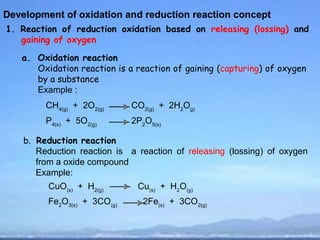
1. Reaction of reduction oxidation based on releasing (lossing) and
   gaining of oxygen

   a. Oxidation reaction
      Oxidation reaction is a reaction of gaining (capturing) of oxygen
      by a substance
      Example :
         CH4(g) + 2O2(g)     CO2(g) + 2H2Og)
         P4(s) + 5O2(g)      2P2O5(s)

    b. Reduction reaction
       Reduction reaction is a reaction of releasing (lossing) of oxygen
       from a oxide compound
       Example:
         CuO(s) + H2(g)        Cu(s) + H2O(g)
         Fe2O3(s) + 3CO(g)      2Fe(s) + 3CO2(g)
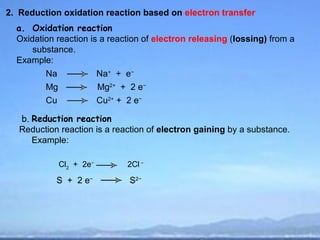
2. Reduction oxidation reaction based on electron transfer
  a. Oxidation reaction
  Oxidation reaction is a reaction of electron releasing (lossing) from a
      substance.
  Example:
         Na               Na+ + e−
         Mg               Mg2+ + 2 e−
         Cu               Cu2+ + 2 e−

   b. Reduction reaction
   Reduction reaction is a reaction of electron gaining by a substance.
      Example:

              Cl2 + 2e−         2Cl −

            S + 2 e−             S2−
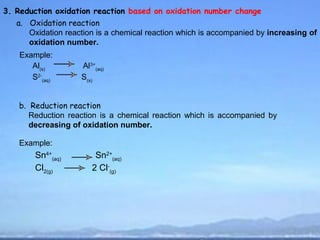
3. Reduction oxidation reaction based on oxidation number change
   a. Oxidation reaction
      Oxidation reaction is a chemical reaction which is accompanied by increasing of
      oxidation number.
    Example:
       Al(s)         Al3+(aq)
       S2-(aq)       S(s)


    b. Reduction reaction
       Reduction reaction is a chemical reaction which is accompanied by
       decreasing of oxidation number.

    Example:
        Sn4+(aq)         Sn2+(aq)
        Cl2(g)          2 Cl-(g)
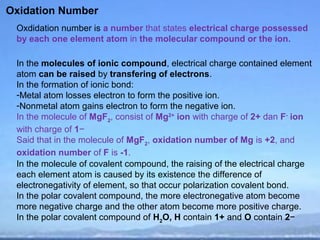
Oxidation Number
 Oxdidation number is a number that states electrical charge possessed
 by each one element atom in the molecular compound or the ion.

 In the molecules of ionic compound, electrical charge contained element
 atom can be raised by transfering of electrons.
 In the formation of ionic bond:
 -Metal atom losses electron to form the positive ion.
 -Nonmetal atom gains electron to form the negative ion.
 In the molecule of MgF2, consist of Mg2+ ion with charge of 2+ dan F- ion
 with charge of 1−
 Said that in the molecule of MgF2, oxidation number of Mg is +2, and
 oxidation number of F is -1.
 In the molecule of covalent compound, the raising of the electrical charge
 each element atom is caused by its existence the difference of
 electronegativity of element, so that occur polarization covalent bond.
 In the polar covalent compound, the more electronegative atom become
 more negative charge and the other atom become more positive charge.
 In the polar covalent compound of H2O, H contain 1+ and O contain 2−
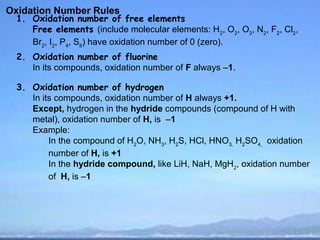
Oxidation Number Rules
  1. Oxidation number of free elements
     Free elements (include molecular elements: H2, O2, O3, N2, F2, Cl2,
     Br2, I2, P4, S8) have oxidation number of 0 (zero).
  2. Oxidation number of fluorine
     In its compounds, oxidation number of F always –1.

  3. Oxidation number of hydrogen
     In its compounds, oxidation number of H always +1.
     Except, hydrogen in the hydride compounds (compound of H with
     metal), oxidation number of H, is –1
     Example:
          In the compound of H2O, NH3, H2S, HCl, HNO3, H2SO4, oxidation
          number of H, is +1
          In the hydride compound, like LiH, NaH, MgH2, oxidation number
          of H, is –1
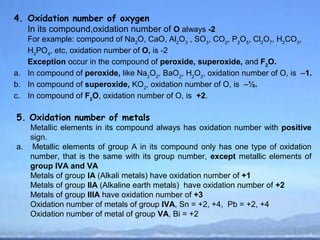
4. Oxidation number of oxygen
   In its compound,oxidation number of O always -2
   For example: compound of Na2O, CaO, Al2O3 , SO3, CO2, P2O5, Cl2O7, H2CO3,
   H3PO4, etc, oxidation number of O, is -2
   Exception occur in the compound of peroxide, superoxide, and F2O.
a. In compound of peroxide, like Na2O2, BaO2, H2O2, oxidation number of O, is –1.
b. In compound of superoxide, KO2, oxidation number of O, is –½.
c. In compound of F2O, oxidation number of O, is +2.

5. Oxidation number of metals
   Metallic elements in its compound always has oxidation number with positive
   sign.
a. Metallic elements of group A in its compound only has one type of oxidation
   number, that is the same with its group number, except metallic elements of
   group IVA and VA
   Metals of group IA (Alkali metals) have oxidation number of +1
   Metals of group IIA (Alkaline earth metals) have oxidation number of +2
   Metals of group IIIA have oxidation number of +3
   Oxidation number of metals of group IVA, Sn = +2, +4, Pb = +2, +4
   Oxidation number of metal of group VA, Bi = +2
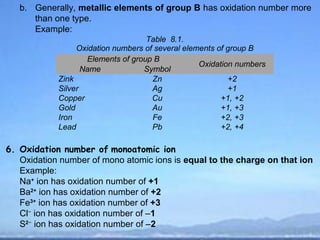
b. Generally, metallic elements of group B has oxidation number more
      than one type.
      Example:
                                    Table 8.1.
                 Oxidation numbers of several elements of group B
                    Elements of group B
                                                  Oxidation numbers
                   Name            Symbol
            Zink                     Zn                   +2
            Silver                   Ag                   +1
            Copper                   Cu                 +1, +2
            Gold                     Au                 +1, +3
            Iron                     Fe                 +2, +3
            Lead                     Pb                 +2, +4

6. Oxidation number of monoatomic ion
   Oxidation number of mono atomic ions is equal to the charge on that ion
   Example:
   Na+ ion has oxidation number of +1
   Ba2+ ion has oxidation number of +2
   Fe3+ ion has oxidation number of +3
   Cl− ion has oxidation number of –1
   S2− ion has oxidation number of –2
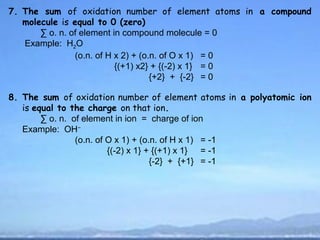
7. The sum of oxidation number of element atoms in a compound
   molecule is equal to 0 (zero)
       ∑ o. n. of element in compound molecule = 0
   Example: H2O
                (o.n. of H x 2) + (o.n. of O x 1) = 0
                           {(+1) x2} + {(-2) x 1} = 0
                                     {+2} + {-2} = 0

8. The sum of oxidation number of element atoms in a polyatomic ion
   is equal to the charge on that ion.
        ∑ o. n. of element in ion = charge of ion
   Example: OH−
                 (o.n. of O x 1) + (o.n. of H x 1) = -1
                          {(-2) x 1} + {(+1) x 1} = -1
                                      {-2} + {+1} = -1
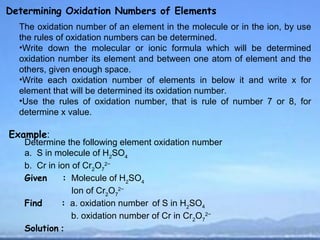
Determining Oxidation Numbers of Elements
  The oxidation number of an element in the molecule or in the ion, by use
  the rules of oxidation numbers can be determined.
  •Write down the molecular or ionic formula which will be determined
  oxidation number its element and between one atom of element and the
  others, given enough space.
  •Write each oxidation number of elements in below it and write x for
  element that will be determined its oxidation number.
  •Use the rules of oxidation number, that is rule of number 7 or 8, for
  determine x value.

Example:
   Determine the following element oxidation number
   a. S in molecule of H2SO4
   b. Cr in ion of Cr2O72−
   Given     : Molecule of H2SO4
                Ion of Cr2O72−
   Find      : a. oxidation number of S in H2SO4
                b. oxidation number of Cr in Cr2O72−
   Solution :
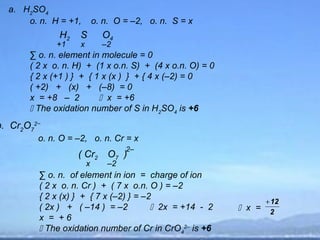
a. H2SO4
      o. n. H = +1,         o. n. O = –2, o. n. S = x
              H2    S         O4
             +1     x         –2
       ∑ o. n. element in molecule = 0
       ( 2 x o. n. H) + (1 x o.n. S) + (4 x o.n. O) = 0
       { 2 x (+1 ) } + { 1 x (x ) } + { 4 x (–2) = 0
       ( +2) + (x) + (–8) = 0
       x = +8 – 2          x = +6
        The oxidation number of S in H2SO4 is +6
b. Cr2O72−
         o. n. O = –2, o. n. Cr = x
                                     2–
                   ( Cr2        O7 )
                        x       –2
         ∑ o. n. of element in ion = charge of ion
         ( 2 x o. n. Cr ) + ( 7 x o.n. O ) = –2
         { 2 x (x) } + { 7 x (–2) } = –2
                                                                  + 12
         ( 2x ) + ( –14 ) = –2           2x = +14 - 2     x =    2
         x = +6
          The oxidation number of Cr in CrO42– is +6
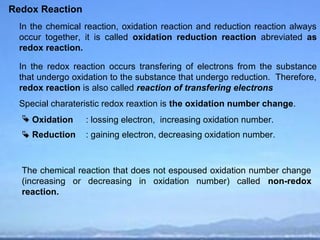
Redox Reaction
  In the chemical reaction, oxidation reaction and reduction reaction always
  occur together, it is called oxidation reduction reaction abreviated as
  redox reaction.

  In the redox reaction occurs transfering of electrons from the substance
  that undergo oxidation to the substance that undergo reduction. Therefore,
  redox reaction is also called reaction of transfering electrons
  Special charateristic redox reaxtion is the oxidation number change.
   Oxidation     : lossing electron, increasing oxidation number.
   Reduction     : gaining electron, decreasing oxidation number.


  The chemical reaction that does not espoused oxidation number change
  (increasing or decreasing in oxidation number) called non-redox
  reaction.
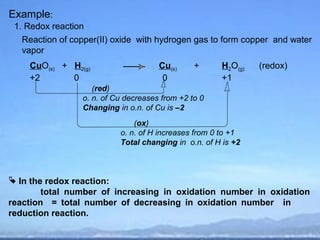
Example:
 1. Redox reaction
   Reaction of copper(II) oxide with hydrogen gas to form copper and water
   vapor
    CuO(s) + H2(g)                    Cu(s)     +     H2O(g)   (redox)
    +2       0                         0              +1
                    (red)
                 o. n. of Cu decreases from +2 to 0
                 Changing in o.n. of Cu is –2
                               (ox)
                           o. n. of H increases from 0 to +1
                           Total changing in o.n. of H is +2


 In the redox reaction:
        total number of increasing in oxidation number in oxidation
reaction = total number of decreasing in oxidation number in
reduction reaction.
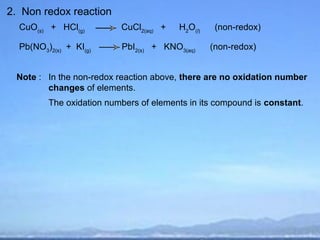
2. Non redox reaction
  CuO(s) + HCl(g)         CuCl2(aq) +   H2O(l)    (non-redox)

  Pb(NO3)2(s) + KI(g)     PbI2(s) + KNO3(aq)     (non-redox)


 Note : In the non-redox reaction above, there are no oxidation number
        changes of elements.
         The oxidation numbers of elements in its compound is constant.
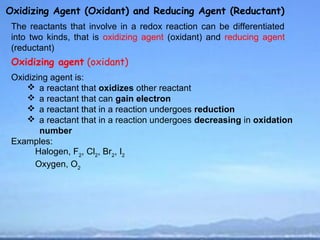
Oxidizing Agent (Oxidant) and Reducing Agent (Reductant)
 The reactants that involve in a redox reaction can be differentiated
 into two kinds, that is oxidizing agent (oxidant) and reducing agent
 (reductant)
 Oxidizing agent (oxidant)
 Oxidizing agent is:
      a reactant that oxidizes other reactant
      a reactant that can gain electron
      a reactant that in a reaction undergoes reduction
      a reactant that in a reaction undergoes decreasing in oxidation
        number
 Examples:
       Halogen, F2, Cl2, Br2, I2
       Oxygen, O2
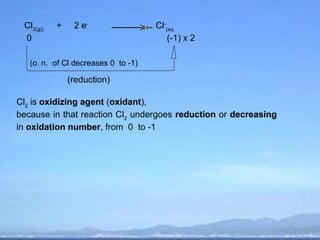
Cl2(g))   +    2 e-                 Cl-(aq
 0                                       (-1) x 2

   (o. n. of Cl decreases 0 to -1)

               (reduction)

Cl2 is oxidizing agent (oxidant),
because in that reaction Cl2 undergoes reduction or decreasing
in oxidation number, from 0 to -1
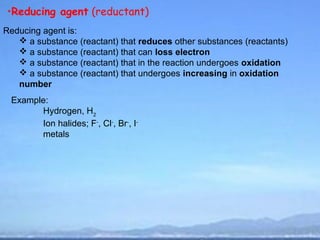
•Reducing agent (reductant)
Reducing agent is:
    a substance (reactant) that reduces other substances (reactants)
    a substance (reactant) that can loss electron
    a substance (reactant) that in the reaction undergoes oxidation
    a substance (reactant) that undergoes increasing in oxidation
   number
 Example:
       Hydrogen, H2
       Ion halides; F-, Cl-, Br-, I-
       metals
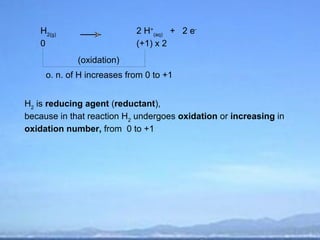
H2(g)                    2 H+(aq) + 2 e-
   0                        (+1) x 2
             (oxidation)
     o. n. of H increases from 0 to +1


H2 is reducing agent (reductant),
because in that reaction H2 undergoes oxidation or increasing in
oxidation number, from 0 to +1
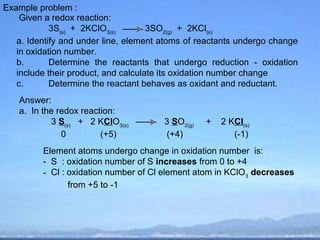
Example problem :
    Given a redox reaction:
            3S(s) + 2KClO3(s)        3SO2(g) + 2KCl(s)
   a. Identify and under line, element atoms of reactants undergo change
   in oxidation number.
   b.       Determine the reactants that undergo reduction - oxidation
   include their product, and calculate its oxidation number change
   c.       Determine the reactant behaves as oxidant and reductant.
   Answer:
   a. In the redox reaction:
           3 S(s) + 2 KClO3(s)         3 SO2(g)   +   2 KCl(s)
              0         (+5)           (+4)              (-1)
         Element atoms undergo change in oxidation number is:
         - S : oxidation number of S increases from 0 to +4
         - Cl : oxidation number of Cl element atom in KClO3 decreases
                from +5 to -1
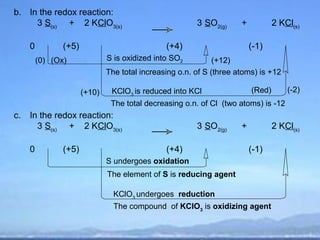
b. In the redox reaction:
     3 S(s) + 2 KClO3(s)                                 3 SO2(g)     +           2 KCl(s)

     0          (+5)                            (+4)                      (-1)
         (0) (Ox)              S is oxidized into SO2          (+12)
                               The total increasing o.n. of S (three atoms) is +12

                       (+10)    KClO3 is reduced into KCl                 (Red)       (-2)
                                The total decreasing o.n. of Cl (two atoms) is -12
c.   In the redox reaction:
       3 S(s) + 2 KClO3(s)                               3 SO2(g)     +           2 KCl(s)

     0          (+5)                            (+4)                      (-1)
                               S undergoes oxidation
                               The element of S is reducing agent

                                 KClO3 undergoes reduction
                                 The compound of KClO3 is oxidizing agent
Auto Redox Reaction (Disproportionation)
    Auto redox reaction is a reaction of reduction and oxidation that occur
    in the same substance (reactant).

    Example of auto redox reaction:
            Reaction of chlorine gas with sodium hydroxide solution
     Cl2(g) + 2 NaOH(aq)      Na Cl(aq) + Na Cl O(aq) + H2O(l)
     0                             –1          +1

        (reduction)
        o. n. of Cl decreases from 0 into –1

                (oxidation)
                o. n. of Cl increases from 0 into + 1
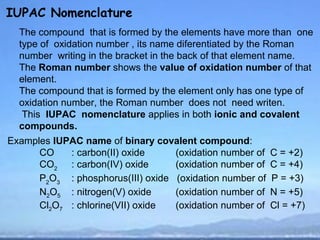
IUPAC Nomenclature
  The compound that is formed by the elements have more than one
  type of oxidation number , its name diferentiated by the Roman
  number writing in the bracket in the back of that element name.
  The Roman number shows the value of oxidation number of that
  element.
  The compound that is formed by the element only has one type of
  oxidation number, the Roman number does not need writen.
   This IUPAC nomenclature applies in both ionic and covalent
  compounds.
Examples IUPAC name of binary covalent compound:
      CO    : carbon(II) oxide     (oxidation number of   C = +2)
      CO2 : carbon(IV) oxide       (oxidation number of   C = +4)
      P2O3 : phosphorus(III) oxide (oxidation number of   P = +3)
      N2O5 : nitrogen(V) oxide     (oxidation number of   N = +5)
      Cl2O7 : chlorine(VII) oxide  (oxidation number of   Cl = +7)
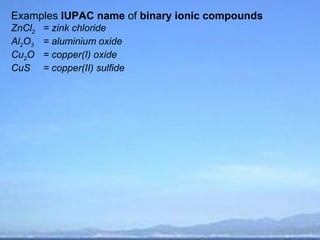
Examples IUPAC name of binary ionic compounds
ZnCl2   = zink chloride
Al2O3   = aluminium oxide
Cu2O    = copper(I) oxide
CuS     = copper(II) sulfide
EXERCISE


           Home
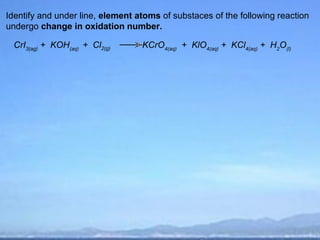
Identify and under line, element atoms of substaces of the following reaction
undergo change in oxidation number.

 CrI3(ag) + KOH(aq) + Cl2(g)      KCrO4(aq) + KlO4(aq) + KCl4(aq) + H2O(l)

Redox reaction

  • 1.
    REDOX REACTION (reduction-oxidation reaction) First grade second semester of senior hight school material
  • 2.
    REDUCTION AND OXIDATIONREACTION Development of oxidation and reduction reaction concept Oxidation Numbers Determining Oxidation Numbers of Elements Redox Reaction Oxidizing Agent [Oxidant] and Reducing Agent [Reductant] Auto Redox Reaction IUPAC Nomenclature
  • 3.
    Development of oxidationand reduction reaction concept 1. Reaction of reduction oxidation based on releasing (lossing) and gaining of oxygen a. Oxidation reaction Oxidation reaction is a reaction of gaining (capturing) of oxygen by a substance Example : CH4(g) + 2O2(g) CO2(g) + 2H2Og) P4(s) + 5O2(g) 2P2O5(s) b. Reduction reaction Reduction reaction is a reaction of releasing (lossing) of oxygen from a oxide compound Example: CuO(s) + H2(g) Cu(s) + H2O(g) Fe2O3(s) + 3CO(g) 2Fe(s) + 3CO2(g)
  • 4.
    2. Reduction oxidationreaction based on electron transfer a. Oxidation reaction Oxidation reaction is a reaction of electron releasing (lossing) from a substance. Example: Na Na+ + e− Mg Mg2+ + 2 e− Cu Cu2+ + 2 e− b. Reduction reaction Reduction reaction is a reaction of electron gaining by a substance. Example: Cl2 + 2e− 2Cl − S + 2 e− S2−
  • 5.
    3. Reduction oxidationreaction based on oxidation number change a. Oxidation reaction Oxidation reaction is a chemical reaction which is accompanied by increasing of oxidation number. Example: Al(s) Al3+(aq) S2-(aq) S(s) b. Reduction reaction Reduction reaction is a chemical reaction which is accompanied by decreasing of oxidation number. Example: Sn4+(aq) Sn2+(aq) Cl2(g) 2 Cl-(g)
  • 6.
    Oxidation Number Oxdidationnumber is a number that states electrical charge possessed by each one element atom in the molecular compound or the ion. In the molecules of ionic compound, electrical charge contained element atom can be raised by transfering of electrons. In the formation of ionic bond: -Metal atom losses electron to form the positive ion. -Nonmetal atom gains electron to form the negative ion. In the molecule of MgF2, consist of Mg2+ ion with charge of 2+ dan F- ion with charge of 1− Said that in the molecule of MgF2, oxidation number of Mg is +2, and oxidation number of F is -1. In the molecule of covalent compound, the raising of the electrical charge each element atom is caused by its existence the difference of electronegativity of element, so that occur polarization covalent bond. In the polar covalent compound, the more electronegative atom become more negative charge and the other atom become more positive charge. In the polar covalent compound of H2O, H contain 1+ and O contain 2−
  • 7.
    Oxidation Number Rules 1. Oxidation number of free elements Free elements (include molecular elements: H2, O2, O3, N2, F2, Cl2, Br2, I2, P4, S8) have oxidation number of 0 (zero). 2. Oxidation number of fluorine In its compounds, oxidation number of F always –1. 3. Oxidation number of hydrogen In its compounds, oxidation number of H always +1. Except, hydrogen in the hydride compounds (compound of H with metal), oxidation number of H, is –1 Example: In the compound of H2O, NH3, H2S, HCl, HNO3, H2SO4, oxidation number of H, is +1 In the hydride compound, like LiH, NaH, MgH2, oxidation number of H, is –1
  • 8.
    4. Oxidation numberof oxygen In its compound,oxidation number of O always -2 For example: compound of Na2O, CaO, Al2O3 , SO3, CO2, P2O5, Cl2O7, H2CO3, H3PO4, etc, oxidation number of O, is -2 Exception occur in the compound of peroxide, superoxide, and F2O. a. In compound of peroxide, like Na2O2, BaO2, H2O2, oxidation number of O, is –1. b. In compound of superoxide, KO2, oxidation number of O, is –½. c. In compound of F2O, oxidation number of O, is +2. 5. Oxidation number of metals Metallic elements in its compound always has oxidation number with positive sign. a. Metallic elements of group A in its compound only has one type of oxidation number, that is the same with its group number, except metallic elements of group IVA and VA Metals of group IA (Alkali metals) have oxidation number of +1 Metals of group IIA (Alkaline earth metals) have oxidation number of +2 Metals of group IIIA have oxidation number of +3 Oxidation number of metals of group IVA, Sn = +2, +4, Pb = +2, +4 Oxidation number of metal of group VA, Bi = +2
  • 9.
    b. Generally, metallicelements of group B has oxidation number more than one type. Example: Table 8.1. Oxidation numbers of several elements of group B Elements of group B Oxidation numbers Name Symbol Zink Zn +2 Silver Ag +1 Copper Cu +1, +2 Gold Au +1, +3 Iron Fe +2, +3 Lead Pb +2, +4 6. Oxidation number of monoatomic ion Oxidation number of mono atomic ions is equal to the charge on that ion Example: Na+ ion has oxidation number of +1 Ba2+ ion has oxidation number of +2 Fe3+ ion has oxidation number of +3 Cl− ion has oxidation number of –1 S2− ion has oxidation number of –2
  • 10.
    7. The sumof oxidation number of element atoms in a compound molecule is equal to 0 (zero) ∑ o. n. of element in compound molecule = 0 Example: H2O (o.n. of H x 2) + (o.n. of O x 1) = 0 {(+1) x2} + {(-2) x 1} = 0 {+2} + {-2} = 0 8. The sum of oxidation number of element atoms in a polyatomic ion is equal to the charge on that ion. ∑ o. n. of element in ion = charge of ion Example: OH− (o.n. of O x 1) + (o.n. of H x 1) = -1 {(-2) x 1} + {(+1) x 1} = -1 {-2} + {+1} = -1
  • 11.
    Determining Oxidation Numbersof Elements The oxidation number of an element in the molecule or in the ion, by use the rules of oxidation numbers can be determined. •Write down the molecular or ionic formula which will be determined oxidation number its element and between one atom of element and the others, given enough space. •Write each oxidation number of elements in below it and write x for element that will be determined its oxidation number. •Use the rules of oxidation number, that is rule of number 7 or 8, for determine x value. Example: Determine the following element oxidation number a. S in molecule of H2SO4 b. Cr in ion of Cr2O72− Given : Molecule of H2SO4 Ion of Cr2O72− Find : a. oxidation number of S in H2SO4 b. oxidation number of Cr in Cr2O72− Solution :
  • 12.
    a. H2SO4 o. n. H = +1, o. n. O = –2, o. n. S = x H2 S O4 +1 x –2 ∑ o. n. element in molecule = 0 ( 2 x o. n. H) + (1 x o.n. S) + (4 x o.n. O) = 0 { 2 x (+1 ) } + { 1 x (x ) } + { 4 x (–2) = 0 ( +2) + (x) + (–8) = 0 x = +8 – 2  x = +6  The oxidation number of S in H2SO4 is +6 b. Cr2O72− o. n. O = –2, o. n. Cr = x 2– ( Cr2 O7 ) x –2 ∑ o. n. of element in ion = charge of ion ( 2 x o. n. Cr ) + ( 7 x o.n. O ) = –2 { 2 x (x) } + { 7 x (–2) } = –2 + 12 ( 2x ) + ( –14 ) = –2  2x = +14 - 2  x = 2 x = +6  The oxidation number of Cr in CrO42– is +6
  • 13.
    Redox Reaction In the chemical reaction, oxidation reaction and reduction reaction always occur together, it is called oxidation reduction reaction abreviated as redox reaction. In the redox reaction occurs transfering of electrons from the substance that undergo oxidation to the substance that undergo reduction. Therefore, redox reaction is also called reaction of transfering electrons Special charateristic redox reaxtion is the oxidation number change.  Oxidation : lossing electron, increasing oxidation number.  Reduction : gaining electron, decreasing oxidation number. The chemical reaction that does not espoused oxidation number change (increasing or decreasing in oxidation number) called non-redox reaction.
  • 14.
    Example: 1. Redoxreaction Reaction of copper(II) oxide with hydrogen gas to form copper and water vapor CuO(s) + H2(g) Cu(s) + H2O(g) (redox) +2 0 0 +1 (red) o. n. of Cu decreases from +2 to 0 Changing in o.n. of Cu is –2 (ox) o. n. of H increases from 0 to +1 Total changing in o.n. of H is +2  In the redox reaction: total number of increasing in oxidation number in oxidation reaction = total number of decreasing in oxidation number in reduction reaction.
  • 15.
    2. Non redoxreaction CuO(s) + HCl(g) CuCl2(aq) + H2O(l) (non-redox) Pb(NO3)2(s) + KI(g) PbI2(s) + KNO3(aq) (non-redox) Note : In the non-redox reaction above, there are no oxidation number changes of elements. The oxidation numbers of elements in its compound is constant.
  • 16.
    Oxidizing Agent (Oxidant)and Reducing Agent (Reductant) The reactants that involve in a redox reaction can be differentiated into two kinds, that is oxidizing agent (oxidant) and reducing agent (reductant) Oxidizing agent (oxidant) Oxidizing agent is:  a reactant that oxidizes other reactant  a reactant that can gain electron  a reactant that in a reaction undergoes reduction  a reactant that in a reaction undergoes decreasing in oxidation number Examples: Halogen, F2, Cl2, Br2, I2 Oxygen, O2
  • 17.
    Cl2(g)) + 2 e- Cl-(aq 0 (-1) x 2 (o. n. of Cl decreases 0 to -1) (reduction) Cl2 is oxidizing agent (oxidant), because in that reaction Cl2 undergoes reduction or decreasing in oxidation number, from 0 to -1
  • 18.
    •Reducing agent (reductant) Reducingagent is:  a substance (reactant) that reduces other substances (reactants)  a substance (reactant) that can loss electron  a substance (reactant) that in the reaction undergoes oxidation  a substance (reactant) that undergoes increasing in oxidation number Example: Hydrogen, H2 Ion halides; F-, Cl-, Br-, I- metals
  • 19.
    H2(g) 2 H+(aq) + 2 e- 0 (+1) x 2 (oxidation) o. n. of H increases from 0 to +1 H2 is reducing agent (reductant), because in that reaction H2 undergoes oxidation or increasing in oxidation number, from 0 to +1
  • 20.
    Example problem : Given a redox reaction: 3S(s) + 2KClO3(s) 3SO2(g) + 2KCl(s) a. Identify and under line, element atoms of reactants undergo change in oxidation number. b. Determine the reactants that undergo reduction - oxidation include their product, and calculate its oxidation number change c. Determine the reactant behaves as oxidant and reductant. Answer: a. In the redox reaction: 3 S(s) + 2 KClO3(s) 3 SO2(g) + 2 KCl(s) 0 (+5) (+4) (-1) Element atoms undergo change in oxidation number is: - S : oxidation number of S increases from 0 to +4 - Cl : oxidation number of Cl element atom in KClO3 decreases from +5 to -1
  • 21.
    b. In theredox reaction: 3 S(s) + 2 KClO3(s) 3 SO2(g) + 2 KCl(s) 0 (+5) (+4) (-1) (0) (Ox) S is oxidized into SO2 (+12) The total increasing o.n. of S (three atoms) is +12 (+10) KClO3 is reduced into KCl (Red) (-2) The total decreasing o.n. of Cl (two atoms) is -12 c. In the redox reaction: 3 S(s) + 2 KClO3(s) 3 SO2(g) + 2 KCl(s) 0 (+5) (+4) (-1) S undergoes oxidation The element of S is reducing agent KClO3 undergoes reduction The compound of KClO3 is oxidizing agent
  • 22.
    Auto Redox Reaction(Disproportionation) Auto redox reaction is a reaction of reduction and oxidation that occur in the same substance (reactant). Example of auto redox reaction: Reaction of chlorine gas with sodium hydroxide solution Cl2(g) + 2 NaOH(aq) Na Cl(aq) + Na Cl O(aq) + H2O(l) 0 –1 +1 (reduction) o. n. of Cl decreases from 0 into –1 (oxidation) o. n. of Cl increases from 0 into + 1
  • 23.
    IUPAC Nomenclature The compound that is formed by the elements have more than one type of oxidation number , its name diferentiated by the Roman number writing in the bracket in the back of that element name. The Roman number shows the value of oxidation number of that element. The compound that is formed by the element only has one type of oxidation number, the Roman number does not need writen. This IUPAC nomenclature applies in both ionic and covalent compounds. Examples IUPAC name of binary covalent compound: CO : carbon(II) oxide (oxidation number of C = +2) CO2 : carbon(IV) oxide (oxidation number of C = +4) P2O3 : phosphorus(III) oxide (oxidation number of P = +3) N2O5 : nitrogen(V) oxide (oxidation number of N = +5) Cl2O7 : chlorine(VII) oxide (oxidation number of Cl = +7)
  • 24.
    Examples IUPAC nameof binary ionic compounds ZnCl2 = zink chloride Al2O3 = aluminium oxide Cu2O = copper(I) oxide CuS = copper(II) sulfide
  • 25.
  • 26.
    Identify and underline, element atoms of substaces of the following reaction undergo change in oxidation number. CrI3(ag) + KOH(aq) + Cl2(g) KCrO4(aq) + KlO4(aq) + KCl4(aq) + H2O(l)

Editor's Notes

  • #14 nder
  • #18 ction) o. n. of Cl decreases 0 to -1 (reduction) o. n. of Cl decreases 0 to -1 (reduction) o. n. of Cl decreases 0 to -1 (reduction) o. n. of Cl decreases 0 to -1 (reduction) o. n. of Cl decreases 0 to -1 (reduction) o. n. of Cl decreases 0 to -1 (reduction) o. n. of Cl decreases 0 to -1   (reduction) o. n. of Cl decreases 0 to -1 Cl2 is called oxidizing agent (oxidant), because in that reaction Cl 2 undergoes reduction or decreasing in oxidation number .   (reduction) o. n. of Cl decreases 0 to -1 Cl 2 is called oxidizing agent ( oxidant ), because in that reaction Cl 2 undergoes reduction or decreasing in oxidation number .