DEVIATION FROM IDEAL
GAS BEHAVIOR
XI FDC CHEMISTRY
CHAPTER 4: GASES
SIDRA JAVED
DEVIATION FROM IDEAL GAS
BEHAVIOR
A gas which obeys PV=nRT and all gas laws is called
an ideal gas.
The gases which do not obey PV=nRT and gas laws
strictly are called real gases.
Real gases show deviation from ideal behavior at low
temperature and high pressure.
All gases are found to be real under certain
conditions.
WHY REAL GASES DEVIATE FROM
IDEAL GAS BEHAVIOR?
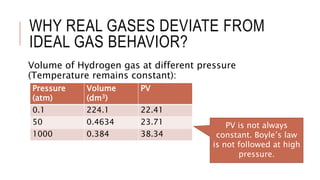
Volume of Hydrogen gas at different pressure
(Temperature remains constant):
Pressure
(atm)
Volume
(dm3)
PV
0.1 224.1 22.41
50 0.4634 23.71
1000 0.384 38.34
PV is not always
constant. Boyle’s law
is not followed at high
pressure.
FAULTS IN KINETIC MOLECULAR
THEORY
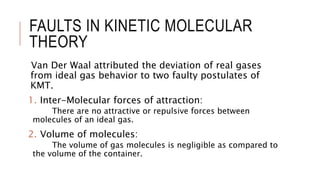
Van Der Waal attributed the deviation of real gases
from ideal gas behavior to two faulty postulates of
KMT.
1. Inter-Molecular forces of attraction:
There are no attractive or repulsive forces between
molecules of an ideal gas.
2. Volume of molecules:
The volume of gas molecules is negligible as compared to
the volume of the container.
EXPLANATION OF DEVIATION
1. AT LOWER TEMPERATURE:
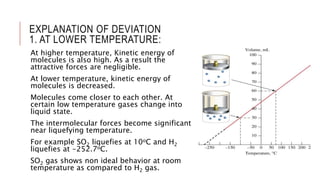
At higher temperature, Kinetic energy of
molecules is also high. As a result the
attractive forces are negligible.
At lower temperature, kinetic energy of
molecules is decreased.
Molecules come closer to each other. At
certain low temperature gases change into
liquid state.
The intermolecular forces become significant
near liquefying temperature.
For example SO2 liquefies at 10oC and H2
liquefies at -252.7oC.
SO2 gas shows non ideal behavior at room
temperature as compared to H2 gas.
EXPLANATION OF DEVIATION
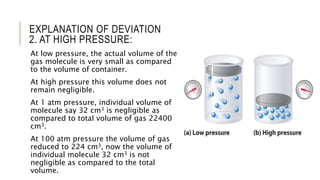
2. AT HIGH PRESSURE:
At low pressure, the actual volume of the
gas molecule is very small as compared
to the volume of container.
At high pressure this volume does not
remain negligible.
At 1 atm pressure, individual volume of
molecule say 32 cm3 is negligible as
compared to total volume of gas 22400
cm3.
At 100 atm pressure the volume of gas
reduced to 224 cm3, now the volume of
individual molecule 32 cm3 is not
negligible as compared to the total
volume.
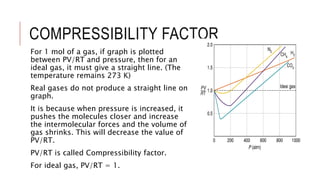
COMPRESSIBILITY FACTOR
For 1 mol of a gas, if graph is plotted
between PV/RT and pressure, then for an
ideal gas, it must give a straight line. (The
temperature remains 273 K)
Real gases do not produce a straight line on
graph.
It is because when pressure is increased, it
pushes the molecules closer and increase
the intermolecular forces and the volume of
gas shrinks. This will decrease the value of
PV/RT.
PV/RT is called Compressibility factor.
For ideal gas, PV/RT = 1.
VAN DER WAALS EQUATION –
CORRECTION FACTORS
J. D. Van Der Waals corrected the ideal
gas equation in a simple, but useful way.
A equation that is applicable on real
gases called Van Der Waals equation.
Van der Waals made corrections for
Volume and pressure of the gases.
Johannes Diderik van der Waals
VOLUME CORRECTION
When a gas is compressed, molecules are pushed so closer that repulsive
forces operates between them. Further increase in pressure is opposed by
the molecules themselves because molecules have definite volume.
Volume available to gas molecules = V = Vvessel – Vmolecule
V is “Free volume”
Vmolecule = nb
Where n is the total no. of molecules and b is individual volume of one mole
of the gas molecules.
So V = Vvessel – nb …..(i)
b is not equal to actual volume of gas. It is in fact four times the actual
volume of molecules
b = 4Vm
PRESSURE CORRECTION
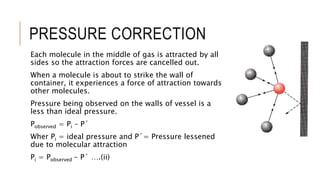
Each molecule in the middle of gas is attracted by all
sides so the attraction forces are cancelled out.
When a molecule is about to strike the wall of
container, it experiences a force of attraction towards
other molecules.
Pressure being observed on the walls of vessel is a
less than ideal pressure.
Pobserved = Pi – P´
Wher Pi = ideal pressure and P´= Pressure lessened
due to molecular attraction
Pi = Pobserved - P´ ….(ii)
PRESSURE CORRECTION
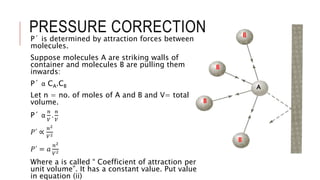
P´ is determined by attraction forces between
molecules.
Suppose molecules A are striking walls of
container and molecules B are pulling them
inwards:
P´ α CA.CB
Let n = no. of moles of A and B and V= total
volume.
P´ α
𝑛
𝑉
.
𝑛
𝑉
𝑃´ ∝
𝑛2
𝑉2
𝑃´ = 𝑎
𝑛2
𝑉2
Where a is called “ Coefficient of attraction per
unit volume”. It has a constant value. Put value
in equation (ii)
A
B
B
B
B
VAN DER WAALS EQUATION
Ideal gas equation: PV = nRT
Now put values from equation (i) and (iii):
𝑃 + 𝑎
𝑛2
𝑉2 𝑉 − 𝑛𝑏 = 𝑛𝑅𝑇
For 1 mole of a gas n=1
𝑃 +
𝑎
𝑉2 𝑉 − 𝑏 = 𝑅𝑇
UNITS OF VAN DER WAALS
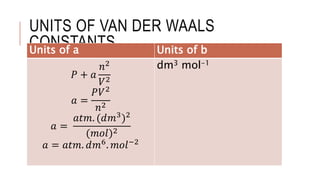
CONSTANTSUnits of a Units of b
𝑃 + 𝑎
𝑛2
𝑉2
𝑎 =
𝑃𝑉2
𝑛2
𝑎 =
𝑎𝑡𝑚. (𝑑𝑚3
)2
(𝑚𝑜𝑙)2
𝑎 = 𝑎𝑡𝑚. 𝑑𝑚6
. 𝑚𝑜𝑙−2
dm3 mol-1
END OF LESSON sidra.javedali@gmail.com

Vander Waals Equation

  • 1.
    DEVIATION FROM IDEAL GASBEHAVIOR XI FDC CHEMISTRY CHAPTER 4: GASES SIDRA JAVED
  • 2.
    DEVIATION FROM IDEALGAS BEHAVIOR A gas which obeys PV=nRT and all gas laws is called an ideal gas. The gases which do not obey PV=nRT and gas laws strictly are called real gases. Real gases show deviation from ideal behavior at low temperature and high pressure. All gases are found to be real under certain conditions.
  • 3.
    WHY REAL GASESDEVIATE FROM IDEAL GAS BEHAVIOR? Volume of Hydrogen gas at different pressure (Temperature remains constant): Pressure (atm) Volume (dm3) PV 0.1 224.1 22.41 50 0.4634 23.71 1000 0.384 38.34 PV is not always constant. Boyle’s law is not followed at high pressure.
  • 4.
    FAULTS IN KINETICMOLECULAR THEORY Van Der Waal attributed the deviation of real gases from ideal gas behavior to two faulty postulates of KMT. 1. Inter-Molecular forces of attraction: There are no attractive or repulsive forces between molecules of an ideal gas. 2. Volume of molecules: The volume of gas molecules is negligible as compared to the volume of the container.
  • 5.
    EXPLANATION OF DEVIATION 1.AT LOWER TEMPERATURE: At higher temperature, Kinetic energy of molecules is also high. As a result the attractive forces are negligible. At lower temperature, kinetic energy of molecules is decreased. Molecules come closer to each other. At certain low temperature gases change into liquid state. The intermolecular forces become significant near liquefying temperature. For example SO2 liquefies at 10oC and H2 liquefies at -252.7oC. SO2 gas shows non ideal behavior at room temperature as compared to H2 gas.
  • 6.
    EXPLANATION OF DEVIATION 2.AT HIGH PRESSURE: At low pressure, the actual volume of the gas molecule is very small as compared to the volume of container. At high pressure this volume does not remain negligible. At 1 atm pressure, individual volume of molecule say 32 cm3 is negligible as compared to total volume of gas 22400 cm3. At 100 atm pressure the volume of gas reduced to 224 cm3, now the volume of individual molecule 32 cm3 is not negligible as compared to the total volume.
  • 7.
    COMPRESSIBILITY FACTOR For 1mol of a gas, if graph is plotted between PV/RT and pressure, then for an ideal gas, it must give a straight line. (The temperature remains 273 K) Real gases do not produce a straight line on graph. It is because when pressure is increased, it pushes the molecules closer and increase the intermolecular forces and the volume of gas shrinks. This will decrease the value of PV/RT. PV/RT is called Compressibility factor. For ideal gas, PV/RT = 1.
  • 8.
    VAN DER WAALSEQUATION – CORRECTION FACTORS J. D. Van Der Waals corrected the ideal gas equation in a simple, but useful way. A equation that is applicable on real gases called Van Der Waals equation. Van der Waals made corrections for Volume and pressure of the gases. Johannes Diderik van der Waals
  • 9.
    VOLUME CORRECTION When agas is compressed, molecules are pushed so closer that repulsive forces operates between them. Further increase in pressure is opposed by the molecules themselves because molecules have definite volume. Volume available to gas molecules = V = Vvessel – Vmolecule V is “Free volume” Vmolecule = nb Where n is the total no. of molecules and b is individual volume of one mole of the gas molecules. So V = Vvessel – nb …..(i) b is not equal to actual volume of gas. It is in fact four times the actual volume of molecules b = 4Vm
  • 10.
    PRESSURE CORRECTION Each moleculein the middle of gas is attracted by all sides so the attraction forces are cancelled out. When a molecule is about to strike the wall of container, it experiences a force of attraction towards other molecules. Pressure being observed on the walls of vessel is a less than ideal pressure. Pobserved = Pi – P´ Wher Pi = ideal pressure and P´= Pressure lessened due to molecular attraction Pi = Pobserved - P´ ….(ii)
  • 11.
    PRESSURE CORRECTION P´ isdetermined by attraction forces between molecules. Suppose molecules A are striking walls of container and molecules B are pulling them inwards: P´ α CA.CB Let n = no. of moles of A and B and V= total volume. P´ α 𝑛 𝑉 . 𝑛 𝑉 𝑃´ ∝ 𝑛2 𝑉2 𝑃´ = 𝑎 𝑛2 𝑉2 Where a is called “ Coefficient of attraction per unit volume”. It has a constant value. Put value in equation (ii) A B B B B
  • 12.
    VAN DER WAALSEQUATION Ideal gas equation: PV = nRT Now put values from equation (i) and (iii): 𝑃 + 𝑎 𝑛2 𝑉2 𝑉 − 𝑛𝑏 = 𝑛𝑅𝑇 For 1 mole of a gas n=1 𝑃 + 𝑎 𝑉2 𝑉 − 𝑏 = 𝑅𝑇
  • 13.
    UNITS OF VANDER WAALS CONSTANTSUnits of a Units of b 𝑃 + 𝑎 𝑛2 𝑉2 𝑎 = 𝑃𝑉2 𝑛2 𝑎 = 𝑎𝑡𝑚. (𝑑𝑚3 )2 (𝑚𝑜𝑙)2 𝑎 = 𝑎𝑡𝑚. 𝑑𝑚6 . 𝑚𝑜𝑙−2 dm3 mol-1
  • 14.
    END OF LESSONsidra.javedali@gmail.com