Mr.Harangule Y. R.
M.Sc Organic chemistry Bed
What is it?
Redox Reactions are chemical reactions that involve
oxidation and reduction.
Oxidation can be defined as a loss of electrons to another
substance. Reduction can be defined as an acceptance of
electrons from another substance.
Redox reactions are those in which electrons are transferred
from one reactant to another.
Everyday redox reactions include:
 Photosynthesis
 Respiration
 Combustion of coal
 Production and use of fertilisers
Key Terms
If electrons are transferred, it is a redox
reaction.
1) A loss of electrons is called oxidation. A gain in
electrons is called reduction.
2) Reduction and oxidation happen simultaneously,
hence the name “redox”
3) An oxidising agent (oxidant) accepts electrons and
thus gets reduced
4) A reducing agent donates electrons and thus gets
oxidised
OIL RIG
Oxidation Is Loss of electrons Reduction Is Gain of
electrons
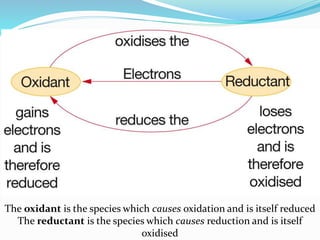
The oxidant is the species which causes oxidation and is itself reduced
The reductant is the species which causes reduction and is itself
oxidised
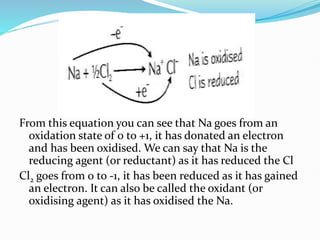
From this equation you can see that Na goes from an
oxidation state of 0 to +1, it has donated an electron
and has been oxidised. We can say that Na is the
reducing agent (or reductant) as it has reduced the Cl
Cl2 goes from 0 to -1, it has been reduced as it has gained
an electron. It can also be called the oxidant (or
oxidising agent) as it has oxidised the Na.
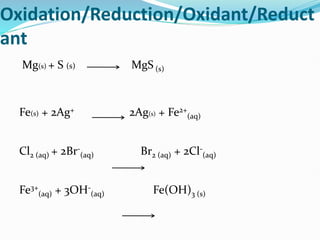
Oxidation/Reduction/Oxidant/Reduct
ant
Mg(s) + S (s) MgS (s)
Fe(s) + 2Ag+ 2Ag(s) + Fe2+
(aq)
Cl2 (aq) + 2Br-
(aq) Br2 (aq) + 2Cl-
(aq)
Fe3+
(aq) + 3OH-
(aq) Fe(OH)3 (s)
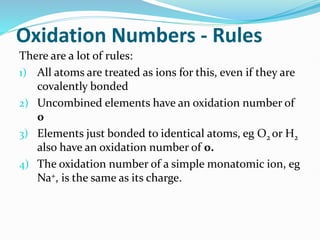
Oxidation Numbers - Rules
There are a lot of rules:
1) All atoms are treated as ions for this, even if they are
covalently bonded
2) Uncombined elements have an oxidation number of
0
3) Elements just bonded to identical atoms, eg O2 or H2
also have an oxidation number of 0.
4) The oxidation number of a simple monatomic ion, eg
Na+, is the same as its charge.
Oxidation Numbers - Rules
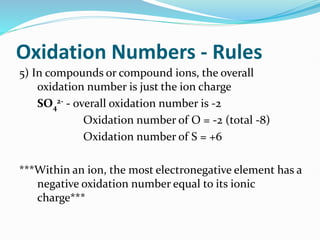
5) In compounds or compound ions, the overall
oxidation number is just the ion charge
SO4
2- - overall oxidation number is -2
Oxidation number of O = -2 (total -8)
Oxidation number of S = +6
***Within an ion, the most electronegative element has a
negative oxidation number equal to its ionic
charge***
Oxidation Numbers - Rules
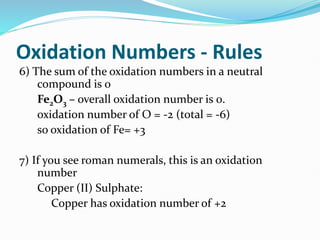
6) The sum of the oxidation numbers in a neutral
compound is 0
Fe2O3 – overall oxidation number is 0.
oxidation number of O = -2 (total = -6)
so oxidation of Fe= +3
7) If you see roman numerals, this is an oxidation
number
Copper (II) Sulphate:
Copper has oxidation number of +2
Oxidation Numbers - Rules
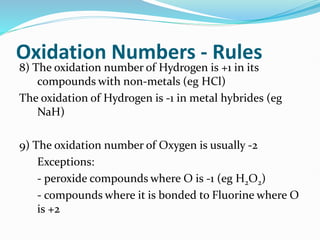
8) The oxidation number of Hydrogen is +1 in its
compounds with non-metals (eg HCl)
The oxidation of Hydrogen is -1 in metal hybrides (eg
NaH)
9) The oxidation number of Oxygen is usually -2
Exceptions:
- peroxide compounds where O is -1 (eg H2O2)
- compounds where it is bonded to Fluorine where O
is +2
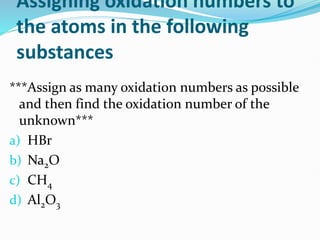
Assigning oxidation numbers to
the atoms in the following
substances
***Assign as many oxidation numbers as possible
and then find the oxidation number of the
unknown***
a) HBr
b) Na2O
c) CH4
d) Al2O3
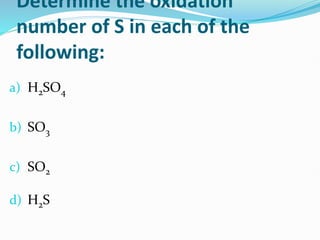
Determine the oxidation
number of S in each of the
following:
a) H2SO4
b) SO3
c) SO2
d) H2S
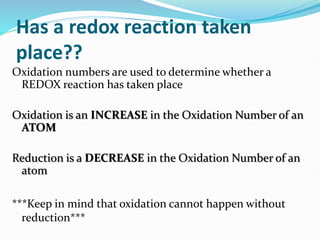
Has a redox reaction taken
place??
Oxidation numbers are used to determine whether a
REDOX reaction has taken place
Oxidation is an INCREASE in the Oxidation Number of an
ATOM
Reduction is a DECREASE in the Oxidation Number of an
atom
***Keep in mind that oxidation cannot happen without
reduction***
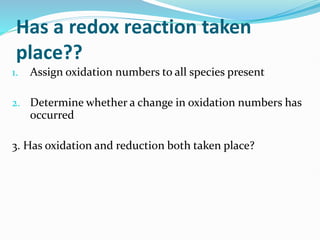
Has a redox reaction taken
place??
1. Assign oxidation numbers to all species present
2. Determine whether a change in oxidation numbers has
occurred
3. Has oxidation and reduction both taken place?
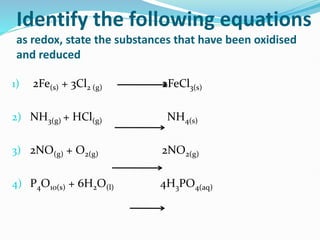
Identify the following equations
as redox, state the substances that have been oxidised
and reduced
1) 2Fe(s) + 3Cl2 (g) 2FeCl3(s)
2) NH3(g) + HCl(g) NH4(s)
3) 2NO(g) + O2(g) 2NO2(g)
4) P4O10(s) + 6H2O(l) 4H3PO4(aq)
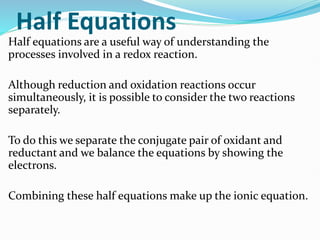
Half Equations
Half equations are a useful way of understanding the
processes involved in a redox reaction.
Although reduction and oxidation reactions occur
simultaneously, it is possible to consider the two reactions
separately.
To do this we separate the conjugate pair of oxidant and
reductant and we balance the equations by showing the
electrons.
Combining these half equations make up the ionic equation.
Half Equations
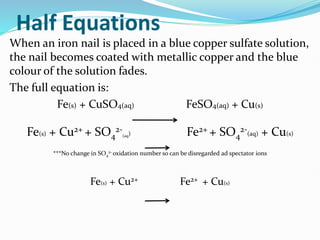
When an iron nail is placed in a blue copper sulfate solution,
the nail becomes coated with metallic copper and the blue
colour of the solution fades.
The full equation is:
Fe(s) + CuSO4(aq) FeSO4(aq) + Cu(s)
Fe(s) + Cu2+ + SO4
2-
(aq) Fe2+ + SO4
2-(aq) + Cu(s)
***No change in SO4
2- oxidation number so can be disregarded ad spectator ions
Fe(s) + Cu2+ Fe2+ + Cu(s)
Half Equations
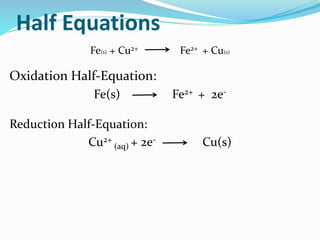
Fe(s) + Cu2+ Fe2+ + Cu(s)
Oxidation Half-Equation:
Fe(s) Fe2+ + 2e-
Reduction Half-Equation:
Cu2+
(aq) + 2e- Cu(s)
Half Equations
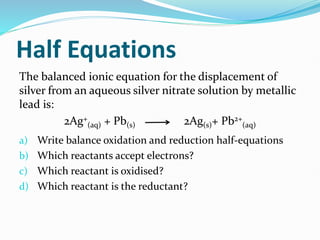
The balanced ionic equation for the displacement of
silver from an aqueous silver nitrate solution by metallic
lead is:
2Ag+
(aq) + Pb(s) 2Ag(s)+ Pb2+
(aq)
a) Write balance oxidation and reduction half-equations
b) Which reactants accept electrons?
c) Which reactant is oxidised?
d) Which reactant is the reductant?
Chapter Review Questions
22, 23, 26, 27, 41

REDOX REACTION 01.ppt

  • 1.
    Mr.Harangule Y. R. M.ScOrganic chemistry Bed
  • 2.
    What is it? RedoxReactions are chemical reactions that involve oxidation and reduction. Oxidation can be defined as a loss of electrons to another substance. Reduction can be defined as an acceptance of electrons from another substance. Redox reactions are those in which electrons are transferred from one reactant to another. Everyday redox reactions include:  Photosynthesis  Respiration  Combustion of coal  Production and use of fertilisers
  • 3.
    Key Terms If electronsare transferred, it is a redox reaction. 1) A loss of electrons is called oxidation. A gain in electrons is called reduction. 2) Reduction and oxidation happen simultaneously, hence the name “redox” 3) An oxidising agent (oxidant) accepts electrons and thus gets reduced 4) A reducing agent donates electrons and thus gets oxidised OIL RIG Oxidation Is Loss of electrons Reduction Is Gain of electrons
  • 4.
    The oxidant isthe species which causes oxidation and is itself reduced The reductant is the species which causes reduction and is itself oxidised
  • 5.
    From this equationyou can see that Na goes from an oxidation state of 0 to +1, it has donated an electron and has been oxidised. We can say that Na is the reducing agent (or reductant) as it has reduced the Cl Cl2 goes from 0 to -1, it has been reduced as it has gained an electron. It can also be called the oxidant (or oxidising agent) as it has oxidised the Na.
  • 6.
    Oxidation/Reduction/Oxidant/Reduct ant Mg(s) + S(s) MgS (s) Fe(s) + 2Ag+ 2Ag(s) + Fe2+ (aq) Cl2 (aq) + 2Br- (aq) Br2 (aq) + 2Cl- (aq) Fe3+ (aq) + 3OH- (aq) Fe(OH)3 (s)
  • 8.
    Oxidation Numbers -Rules There are a lot of rules: 1) All atoms are treated as ions for this, even if they are covalently bonded 2) Uncombined elements have an oxidation number of 0 3) Elements just bonded to identical atoms, eg O2 or H2 also have an oxidation number of 0. 4) The oxidation number of a simple monatomic ion, eg Na+, is the same as its charge.
  • 9.
    Oxidation Numbers -Rules 5) In compounds or compound ions, the overall oxidation number is just the ion charge SO4 2- - overall oxidation number is -2 Oxidation number of O = -2 (total -8) Oxidation number of S = +6 ***Within an ion, the most electronegative element has a negative oxidation number equal to its ionic charge***
  • 10.
    Oxidation Numbers -Rules 6) The sum of the oxidation numbers in a neutral compound is 0 Fe2O3 – overall oxidation number is 0. oxidation number of O = -2 (total = -6) so oxidation of Fe= +3 7) If you see roman numerals, this is an oxidation number Copper (II) Sulphate: Copper has oxidation number of +2
  • 11.
    Oxidation Numbers -Rules 8) The oxidation number of Hydrogen is +1 in its compounds with non-metals (eg HCl) The oxidation of Hydrogen is -1 in metal hybrides (eg NaH) 9) The oxidation number of Oxygen is usually -2 Exceptions: - peroxide compounds where O is -1 (eg H2O2) - compounds where it is bonded to Fluorine where O is +2
  • 12.
    Assigning oxidation numbersto the atoms in the following substances ***Assign as many oxidation numbers as possible and then find the oxidation number of the unknown*** a) HBr b) Na2O c) CH4 d) Al2O3
  • 13.
    Determine the oxidation numberof S in each of the following: a) H2SO4 b) SO3 c) SO2 d) H2S
  • 15.
    Has a redoxreaction taken place?? Oxidation numbers are used to determine whether a REDOX reaction has taken place Oxidation is an INCREASE in the Oxidation Number of an ATOM Reduction is a DECREASE in the Oxidation Number of an atom ***Keep in mind that oxidation cannot happen without reduction***
  • 16.
    Has a redoxreaction taken place?? 1. Assign oxidation numbers to all species present 2. Determine whether a change in oxidation numbers has occurred 3. Has oxidation and reduction both taken place?
  • 17.
    Identify the followingequations as redox, state the substances that have been oxidised and reduced 1) 2Fe(s) + 3Cl2 (g) 2FeCl3(s) 2) NH3(g) + HCl(g) NH4(s) 3) 2NO(g) + O2(g) 2NO2(g) 4) P4O10(s) + 6H2O(l) 4H3PO4(aq)
  • 18.
    Half Equations Half equationsare a useful way of understanding the processes involved in a redox reaction. Although reduction and oxidation reactions occur simultaneously, it is possible to consider the two reactions separately. To do this we separate the conjugate pair of oxidant and reductant and we balance the equations by showing the electrons. Combining these half equations make up the ionic equation.
  • 19.
    Half Equations When aniron nail is placed in a blue copper sulfate solution, the nail becomes coated with metallic copper and the blue colour of the solution fades. The full equation is: Fe(s) + CuSO4(aq) FeSO4(aq) + Cu(s) Fe(s) + Cu2+ + SO4 2- (aq) Fe2+ + SO4 2-(aq) + Cu(s) ***No change in SO4 2- oxidation number so can be disregarded ad spectator ions Fe(s) + Cu2+ Fe2+ + Cu(s)
  • 20.
    Half Equations Fe(s) +Cu2+ Fe2+ + Cu(s) Oxidation Half-Equation: Fe(s) Fe2+ + 2e- Reduction Half-Equation: Cu2+ (aq) + 2e- Cu(s)
  • 21.
    Half Equations The balancedionic equation for the displacement of silver from an aqueous silver nitrate solution by metallic lead is: 2Ag+ (aq) + Pb(s) 2Ag(s)+ Pb2+ (aq) a) Write balance oxidation and reduction half-equations b) Which reactants accept electrons? c) Which reactant is oxidised? d) Which reactant is the reductant?
  • 22.