Records Retention Scheduling
What is a Retention Schedule? “ An approved legal document that specifies minimum retention periods for a record series and gives agencies ongoing disposition authority after approved retention periods are met”
APPLY RETENTION SCHEDULES For records that need to be retained for  operational, fiscal, legal or historical reasons ,  a retention schedule serves as an “instruction sheet ” for the rules of caring for  and preservation of records
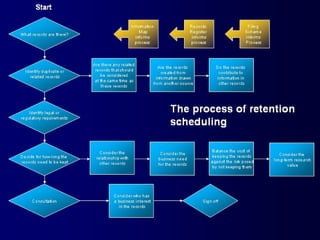
determining the length of time that the records should remain in the originating office usually influenced by such factors as their administrative values to the creator as a general rule, records are to remain in the originating office as long as they are active records that are inactive should remain in a storage facility; while records with no archival value should be disposed of records with archival values should be transferred to the archives Retention scheduling
Procedures involved First step : analyze the records of the organization to determine what categories of materials exist (correspondence, administrative files, project files, personnel records, etc.) Second step : determine whether various categories of materials have intrinsic, evidentiary, or informational value Third step : if documents are evidentiary or informational in nature, determine if their value has expired
Procedures involved… Fourth : if value is time restricted, determine what the end dates of the value are and schedule destruction of records on or after that date.  Fifth : If value is enduring, determine whether records are needed for operation of organization; if so, keep on site.  If not, identify and prepare to be sent to off-site storage center or vault.
 
 
Suggested Retention Periods Keep permanently and preserve. Keep permanently (transfer to Archives at intervals of 5 years) Keep for 10 years, then destroy. Keep for 5 years, then destroy. Keep for two years, then destroy. Review at intervals, keeping only those with continuing value.
Keep permanently and preserve annual reports minutes of meetings papers relating to policies & decisions, development plans, budget approvals,  etc.) property/investment records contracts/agreements personnel records (201 files)
Keep permanently and transfer to Archives accreditation records employment contracts ledgers (summaries of receipts and disbursements) audit reports building maintenance and operations files (including plans, blueprints, cost records)
Keep permanently and transfer to Archives Students’ transcripts of records (inactive) reports / plans (including working papers)  projects (proposals, progress reports, etc) government permits court records/decisions photo/clippings files publications
Keep for ten years, then destroy budget records and ledgers (including vouchers, requisitions, cancelled checks, payroll records, etc.) building maintenance inventories purchase orders, requisitions, invoices for major items accounts (audited after 5 years)
Keep for five years, then destroy purchase orders, requisitions, etc. payroll transactions credit investigation reports job evaluation reports school calendars price lists/maps/brochures/flyers
Keep for two years, then destroy acknowledgements application records attendance / job performance reports duplicate/multiple copies of minutes, reports, plans, printed material (catalogs, brochures),  etc. survey questionnaires unused forms
Subject to Regular Review/Appraisal correspondence and other papers (review every five years, keeping/ transferring to Archives those with continuing value) accreditation records/government permits  projects/program proposals student files (correspondence, etc.)  student accounts
writing a records retention schedule Hands on experience
Sample Retention Schedule Store in vault Paper and digital copy Keep permanently Original copies Permits to Operate Subject to regular review/appraisal Electronic and paper Five years Received/sent by management Correspondence Paper Two years Original copies Attendance records Paper Five years Annual staff evaluations Job evaluation reports Destroy after audit Paper Five years Original copies Bank statements Destroy after BIR audit Paper Ten years Original copies Receipts and Invoices Electronic and paper Ten years Original Copy Annual Budget for 2009 Remarks Retention Medium Retention Period Description Document
Annual Reviews A review date will be assigned after the approval of your retention schedules Any additions or changes to your schedules can be done at this time You don’t have to wait until your annual review to make changes to your schedule.
You can submit revisions, discontinue, or modify the schedule in order to meet the needs of the agency as records may evolve over time.
basic categories   of    records active inactive dead
Inactive Records What do you do with records that you don’t use, but that still have not reached their retention period? Remove from your active record system for the sake of economy and efficiency. Pack with disposition in mind. Offsite storage is an option.
In other words If you want to clear up space and don’t want to wait for end of the retention period to clean off the shelves or empty out boxes, you’ll need a storage facility for inactive records.
Inactive records management A Records Center ensures the protection, access and retrieval of institutional records until their retention value has been met. It includes accession and inventory control, security and access provisions, and environmental controls.  The records manager should work with the data manager and information technology staff to ensure the retention of electronic data, and that data remain accessible and retrievable throughout their life cycle.
Records disposition ensures the destruction of records according to approved retention policies requires appropriate handling of confidential materials requires the transfer of records designated for permanent preservation to the institution's archives
Records disposition inventorying  appraising  scheduling retiring   disposal policies transfer guidelines archival procedures
Records Disposal Does not have to get pre-approval for disposition with a retention schedule Anytime your office has been notified of impending litigation do not dispose of any records for any reason. Retention schedules become mute at this point.
Records Disposal Shredding is the preferred method for destruction of records A completed Certificate or Authority for Disposal is required for any disposal – destruction or transfer Certificates of Disposal demonstrate that we are following our policies and are proof of legal disposition
Records for disposal drafts routine transmittals acknowledgments specific financial transactions requests/replies to questionnaires blank/unused forms multiple copies
To retention and beyond! It doesn’t make sense to keep every scrap of paper generated, so why would you want to keep every bit and byte of data generated?
Why not just keep it all? Consider this: Searching The more you have, the more you have to review and search through Think needle in a haystack.. less hay, easier to find the needle Discovery costs increase Remember those 3 hours a day looking for stuff? How much is your time worth?
Use less, get more! Where are the savings? Less storage; Less to search; Faster to find what you do need; Less to migrate.
Keeping stuff you don’t need  costs money Adding more storage issues: Increased administration costs Increased maintenance costs Increased IT staffing needs Increased energy costs Get rid of what you don’t need
How to implement retention/ disposition policies Make them available to those in the working offices; i.e., office administrative staffs. Publicize them using the most accessible communication vehicle; e.g., administrative manuals, Web pages or other online communication technologies. Share retention and disposition policies with information technology staffs and with those responsible for the institution's information resource planning. Implementation should include provision for periodic audits and reviews to insure that the retention policies are up to date and that campus offices are implementing them appropriately.
 
Where do you start? Develop records management policies  and procedures Get management support Have training and education on  records management
Proactive vs Reactive A policy is critical so that your employees know what to do – guidelines on the creation, use and care of records and that everyone is on the same page Having a policy also cuts down your level of liability in the event of legal action, agency can demonstrate “due diligence” and use of best practices
Drafting a policy Some items to include in your policy: Address legal requirements Roles and list of responsibilities Incorporate appropriate use  Basics of records management Make sure all media is covered, not just email
For example Purpose: The purpose of this policy is to provide records management requirements and guidelines for managing the agency’s records and information
Include Compliance: Compliance with this policy is mandatory for all departments, sections and every employee of this agency  (NO EXCEPTIONS)
Where do you start? Become familiar with your retention schedules Then actively apply your  retention schedules
You are done! Congratulations!
Workshop on  Records Retention Schedule From the sample Retention Plan, revise the suggested retention schedules according to your office practice Expand the sample Retention Plan by including your office files and provide your suggested retention schedules
Contact fe.verzosa@dlsu.edu.ph Questions?

Records Retention Scheduling

  • 1.
  • 2.
    What is aRetention Schedule? “ An approved legal document that specifies minimum retention periods for a record series and gives agencies ongoing disposition authority after approved retention periods are met”
  • 3.
    APPLY RETENTION SCHEDULESFor records that need to be retained for operational, fiscal, legal or historical reasons , a retention schedule serves as an “instruction sheet ” for the rules of caring for and preservation of records
  • 4.
    determining the lengthof time that the records should remain in the originating office usually influenced by such factors as their administrative values to the creator as a general rule, records are to remain in the originating office as long as they are active records that are inactive should remain in a storage facility; while records with no archival value should be disposed of records with archival values should be transferred to the archives Retention scheduling
  • 5.
    Procedures involved Firststep : analyze the records of the organization to determine what categories of materials exist (correspondence, administrative files, project files, personnel records, etc.) Second step : determine whether various categories of materials have intrinsic, evidentiary, or informational value Third step : if documents are evidentiary or informational in nature, determine if their value has expired
  • 6.
    Procedures involved… Fourth: if value is time restricted, determine what the end dates of the value are and schedule destruction of records on or after that date. Fifth : If value is enduring, determine whether records are needed for operation of organization; if so, keep on site. If not, identify and prepare to be sent to off-site storage center or vault.
  • 7.
  • 8.
  • 9.
    Suggested Retention PeriodsKeep permanently and preserve. Keep permanently (transfer to Archives at intervals of 5 years) Keep for 10 years, then destroy. Keep for 5 years, then destroy. Keep for two years, then destroy. Review at intervals, keeping only those with continuing value.
  • 10.
    Keep permanently andpreserve annual reports minutes of meetings papers relating to policies & decisions, development plans, budget approvals, etc.) property/investment records contracts/agreements personnel records (201 files)
  • 11.
    Keep permanently andtransfer to Archives accreditation records employment contracts ledgers (summaries of receipts and disbursements) audit reports building maintenance and operations files (including plans, blueprints, cost records)
  • 12.
    Keep permanently andtransfer to Archives Students’ transcripts of records (inactive) reports / plans (including working papers) projects (proposals, progress reports, etc) government permits court records/decisions photo/clippings files publications
  • 13.
    Keep for tenyears, then destroy budget records and ledgers (including vouchers, requisitions, cancelled checks, payroll records, etc.) building maintenance inventories purchase orders, requisitions, invoices for major items accounts (audited after 5 years)
  • 14.
    Keep for fiveyears, then destroy purchase orders, requisitions, etc. payroll transactions credit investigation reports job evaluation reports school calendars price lists/maps/brochures/flyers
  • 15.
    Keep for twoyears, then destroy acknowledgements application records attendance / job performance reports duplicate/multiple copies of minutes, reports, plans, printed material (catalogs, brochures), etc. survey questionnaires unused forms
  • 16.
    Subject to RegularReview/Appraisal correspondence and other papers (review every five years, keeping/ transferring to Archives those with continuing value) accreditation records/government permits projects/program proposals student files (correspondence, etc.) student accounts
  • 17.
    writing a recordsretention schedule Hands on experience
  • 18.
    Sample Retention ScheduleStore in vault Paper and digital copy Keep permanently Original copies Permits to Operate Subject to regular review/appraisal Electronic and paper Five years Received/sent by management Correspondence Paper Two years Original copies Attendance records Paper Five years Annual staff evaluations Job evaluation reports Destroy after audit Paper Five years Original copies Bank statements Destroy after BIR audit Paper Ten years Original copies Receipts and Invoices Electronic and paper Ten years Original Copy Annual Budget for 2009 Remarks Retention Medium Retention Period Description Document
  • 19.
    Annual Reviews Areview date will be assigned after the approval of your retention schedules Any additions or changes to your schedules can be done at this time You don’t have to wait until your annual review to make changes to your schedule.
  • 20.
    You can submitrevisions, discontinue, or modify the schedule in order to meet the needs of the agency as records may evolve over time.
  • 21.
    basic categories of records active inactive dead
  • 22.
    Inactive Records Whatdo you do with records that you don’t use, but that still have not reached their retention period? Remove from your active record system for the sake of economy and efficiency. Pack with disposition in mind. Offsite storage is an option.
  • 23.
    In other wordsIf you want to clear up space and don’t want to wait for end of the retention period to clean off the shelves or empty out boxes, you’ll need a storage facility for inactive records.
  • 24.
    Inactive records managementA Records Center ensures the protection, access and retrieval of institutional records until their retention value has been met. It includes accession and inventory control, security and access provisions, and environmental controls. The records manager should work with the data manager and information technology staff to ensure the retention of electronic data, and that data remain accessible and retrievable throughout their life cycle.
  • 25.
    Records disposition ensuresthe destruction of records according to approved retention policies requires appropriate handling of confidential materials requires the transfer of records designated for permanent preservation to the institution's archives
  • 26.
    Records disposition inventorying appraising scheduling retiring disposal policies transfer guidelines archival procedures
  • 27.
    Records Disposal Doesnot have to get pre-approval for disposition with a retention schedule Anytime your office has been notified of impending litigation do not dispose of any records for any reason. Retention schedules become mute at this point.
  • 28.
    Records Disposal Shreddingis the preferred method for destruction of records A completed Certificate or Authority for Disposal is required for any disposal – destruction or transfer Certificates of Disposal demonstrate that we are following our policies and are proof of legal disposition
  • 29.
    Records for disposaldrafts routine transmittals acknowledgments specific financial transactions requests/replies to questionnaires blank/unused forms multiple copies
  • 30.
    To retention andbeyond! It doesn’t make sense to keep every scrap of paper generated, so why would you want to keep every bit and byte of data generated?
  • 31.
    Why not justkeep it all? Consider this: Searching The more you have, the more you have to review and search through Think needle in a haystack.. less hay, easier to find the needle Discovery costs increase Remember those 3 hours a day looking for stuff? How much is your time worth?
  • 32.
    Use less, getmore! Where are the savings? Less storage; Less to search; Faster to find what you do need; Less to migrate.
  • 33.
    Keeping stuff youdon’t need costs money Adding more storage issues: Increased administration costs Increased maintenance costs Increased IT staffing needs Increased energy costs Get rid of what you don’t need
  • 34.
    How to implementretention/ disposition policies Make them available to those in the working offices; i.e., office administrative staffs. Publicize them using the most accessible communication vehicle; e.g., administrative manuals, Web pages or other online communication technologies. Share retention and disposition policies with information technology staffs and with those responsible for the institution's information resource planning. Implementation should include provision for periodic audits and reviews to insure that the retention policies are up to date and that campus offices are implementing them appropriately.
  • 35.
  • 36.
    Where do youstart? Develop records management policies and procedures Get management support Have training and education on records management
  • 37.
    Proactive vs ReactiveA policy is critical so that your employees know what to do – guidelines on the creation, use and care of records and that everyone is on the same page Having a policy also cuts down your level of liability in the event of legal action, agency can demonstrate “due diligence” and use of best practices
  • 38.
    Drafting a policySome items to include in your policy: Address legal requirements Roles and list of responsibilities Incorporate appropriate use Basics of records management Make sure all media is covered, not just email
  • 39.
    For example Purpose:The purpose of this policy is to provide records management requirements and guidelines for managing the agency’s records and information
  • 40.
    Include Compliance: Compliancewith this policy is mandatory for all departments, sections and every employee of this agency (NO EXCEPTIONS)
  • 41.
    Where do youstart? Become familiar with your retention schedules Then actively apply your retention schedules
  • 42.
    You are done!Congratulations!
  • 43.
    Workshop on Records Retention Schedule From the sample Retention Plan, revise the suggested retention schedules according to your office practice Expand the sample Retention Plan by including your office files and provide your suggested retention schedules
  • 44.

Editor's Notes

  • #18 ERM- Washington State Archives
  • #33 http://www.secstate.wa.gov/archives What is a Record Series? KEY = information that’s related (same action or same subject) This records retention schedule documents the life cycle of a records series. This means: all books, papers, microforms, computer-readable materials, maps, photographs, film, video and sound recordings, or other documentary materials, regardless of physical form or characteristics , made or received by any agency in connection with the transaction of public business Records Series can be: S imple : Birth Certificates; Complex: Case Files and Personnel File Combined media types : may contain paper, electronic, photographed, imaged. Example: OFFENSE/INCIDENT REPORTS Investigation reports and notes; witnesses and suspects statements; results of chemical analysis and polygraph tests; crime scene information and photograph, citations . No matter what media types they must all be disposed of as a unit!