Records Management 2007 Data Protection Seminar TMA Privacy Office
Records Management Purpose The purpose of this presentation is to provide guidance on the laws and regulations that govern TRICARE Management Activity (TMA) records.  This presentation will also provide specific examples of policies and procedures that are both protective and compliant when handling TMA records.
Records Management Objectives Upon completion of this lesson, you will be able to: Discuss records management concepts Determine what is a TMA record Recognize a records lifecycle Define the impact of record freezes Locate your records Identify when TMA records can be destroyed
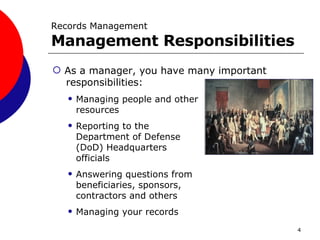
As a manager, you have many important    responsibilities: Managing people and other resources Reporting to the Department of Defense (DoD) Headquarters officials Answering questions from beneficiaries, sponsors, contractors and others Managing your records Records Management Management Responsibilities
Why should I care about my records? It’s the Law It’s in your best interest To find the information you need To document your accomplishments To avoid embarrassment, litigation, loss of security clearance, dismissal from Federal service and prosecution To protect the rights of citizens and the government (TMA)  Records Management Why Care?
What Can You Do to Help Improve TMA Recordkeeping? Ensure that a  living, breathing  records program is established in your office(s) Records management is a part of new employee orientations (government and contractors) and out briefings The proper amount of resources and people are assigned to operate the program Continuous  support is provided by management   Records Management How to Improve Recordkeeping
Records Management Regulations 36 CFR 1234 and 1228.270, Office of Management and Budget (OMB), U.S. General Services Administration (GSA), etc. Assign responsibility Integrate with other records and information management Procedures Training Documentation Keep track of electronic records Schedule for disposal Security Contractors Follow requirements
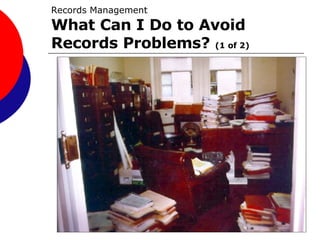
Records Management What Can I Do to Avoid Records Problems?  (1 of 2)
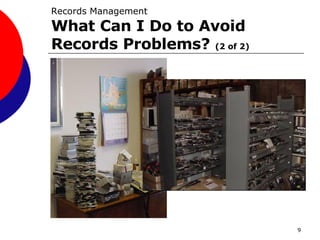
Records Management What Can I Do to Avoid Records Problems?  (2 of 2)
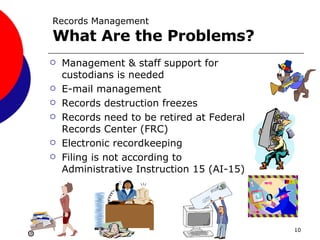
Records Management What Are the Problems? Management & staff support for custodians is needed E-mail management Records destruction freezes Records need to be retired at Federal Records Center (FRC) Electronic recordkeeping Filing is not according to Administrative Instruction 15 (AI-15)
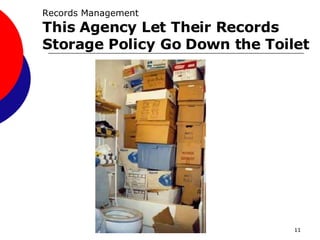
Records Management This Agency Let Their Records Storage Policy Go Down the Toilet
Records Management Cheney Defiant on Classified Material Executive Order Ignored Since 2003 Cheney aides have not filed reports on their possession of classified data and at one point blocked an inspection of their office In 2004, the Archives' Information Security Oversight Office, decided to conduct an on-site inspection of Cheney's office to see how sensitive material was handled. The Vice President's staff blocked the inspection  Cheney's office argued that it was exempt from the rules in this case because it is not strictly an executive agency The Justice Department confirmed that it is looking into the issue  By Peter Baker – Washingtonpost.com - Updated: 9:38 p.m. MT June 21, 2007
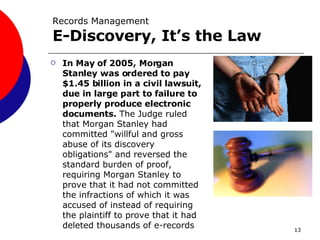
Records Management E-Discovery, It’s the Law   In May of 2005, Morgan Stanley was ordered to pay $1.45 billion in a civil lawsuit, due in large part to failure to properly produce electronic documents.  The Judge ruled that Morgan Stanley had committed "willful and gross abuse of its discovery obligations" and reversed the standard burden of proof, requiring Morgan Stanley to prove that it had not committed the infractions of which it was accused of instead of requiring the plaintiff to prove that it had deleted thousands of e-records
Records Management Court Cases Involving E-mail   (1 of 2) Former star investment banker, Frank Quattrone, was convicted of obstructing federal investigations into stock offerings at Credit Suisse First Boston. Central to the case was an e-mail Quattrone forwarded telling employees it was "time to clean up those files" after he learned of the investigation  More than 500 of former West Virginia Gov. Bob Wise's intimate e-mails with a state employee were obtained under the Freedom of Information Act and made public in 2003.  The employee's husband filed for divorce and Wise didn't seek re-election in 2004
Records Management Court Cases Involving E-mail   (2 of 2) In a Massachusetts class-action suit over the dangers of the diet drug combination Phen-Fen, the court allowed this e-mail from a company executive to be admitted: "Do I have to look forward to spending my waning years writing checks to fat people worried about a silly lung problem?"  Chevron settled a lawsuit for $2.2 million that involved an interoffice e-mail giving 25 reasons why beer is better than   women
Records Management Records Management Records management is a staff function, not "office services."  It cuts across organizational lines Information should be treated as a resource, the same as personnel, facilities, and money  Manage records through their "life cycle“ Paperwork and electronic  processes , not just “media”, need to be managed  A records management program should be  continuous , not a one-time action Records management should never become an administrative "burden"
Records Management First, What is a Record? “ Records include all books, papers, maps, photographs, machine readable materials, or other documentary materials,  made or received by an agency of the United States Government under Federal law or in connection with the transaction of public business and preserved or appropriate for preservation by that agency or legitimate successor as evidence of the organization, functions, policies, decisions, procedures, operations, or other activities of Government or because of the informational value of data in them.” 44 U.S.C. Sec. 3301 In other words, any information  in any media  created or received while fulfilling the duties of your position, or conducting official business, except reference materials Regardless of physical form or characteristics,
Records Management Characteristics of Records Authenticity Proven to be what they purport to be  Created and sent by the person implied to have sent/created them Created/sent at the time claimed Integrity Must remain complete and unaltered – over time! Usability Can be located, retrieved, presented and interpreted Reliability Contents can be trusted as a full and accurate representation of the transaction to which they attest All Records – including electronic records – Must have the following  Trustworthy  characteristics
Records Management General Requirements for Records Content Information contained within the record Context Meta Data – retrieval and makes the record meaningful Structure How the information is organized The electronic record must retain its characteristics over time, for as long as they are required to be legally retained
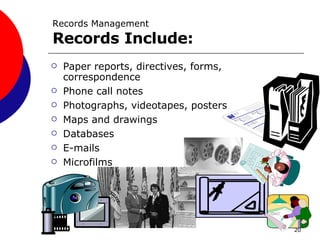
Records Management Records Include: Paper reports, directives, forms, correspondence Phone call notes Photographs, videotapes, posters Maps and drawings Databases E-mails Microfilms
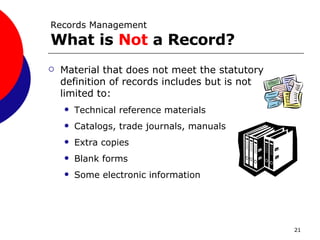
Records Management What is  Not  a Record? Material that does not meet the statutory definition of records includes but is not limited to: Technical reference materials Catalogs, trade journals, manuals Extra copies Blank forms Some electronic information
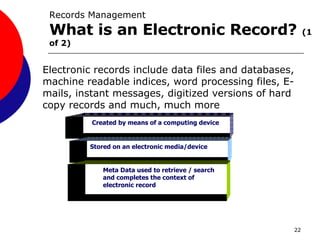
Created by means of a computing device Stored on an electronic media/device Meta Data used to retrieve / search and completes the context of electronic record Records Management What is an Electronic Record?  (1 of 2) Electronic records include data files and databases, machine readable indices, word processing files, E-mails, instant messages, digitized versions of hard copy records and much, much more
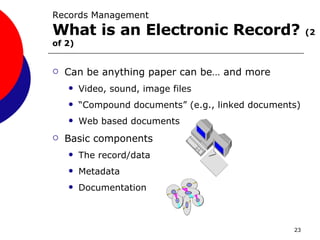
Can be anything paper can be… and more Video, sound, image files “Compound documents” (e.g., linked documents) Web based documents Basic components The record/data Metadata Documentation Records Management What is an Electronic Record?  (2 of 2)
Capture electronic messages and files as “records” and ‘freeze’ them from further change Organize them logically so they can be accessed quickly Maintain security and integrity of each record Preserve records over time Save the hidden background data linked to each E-mail message, word processing file, spreadsheet, etc. Allow the electronic records to be retained and disposed of according to AI 15 and National Archives and Records Administration (NARA) requirements Records Management Electronic Recordkeeping
Electronic mail (E-mail)/PDA’s Scanned   images Electronic Information Systems (EIS), and databases Calendars (Senior Management/High-ranking Officials) Websites Records created/born electronically (Word, pdf’s, etc.) Voice mail saved and played back over E-mail, voice and video-enabled portals/websites, etc NARA estimates that currently 14,000 separate file formats exist – and additional formats are added daily …  Technologies that are unthinkable today will be   commonplace   tomorrow Records Management Proliferating Formats
Easily and quickly sort data Access existing relational data Modify data easily Disseminate information quickly and over large geographic areas Saves space More functions than paper Research value, ex. NARA Preserve history Records Management Benefits of Electronic Records
Security Hardware/software dependence Version control Ad-hoc disposal Personal filing system Authenticity Accessibility “ Much of the information of the late 20th century and 21st century will be lost if we don’t do something about solving the problems of saving electronic information over time.  The truth is that vital digital materials are being lost every day, and the cost of those losses is unknown and unknowable.”  - Reynolds Cahoon, Assistant Archivist and Chief Information Officer at NARA. August 9, 2004 Federal Times Records Management Challenges of Electronic Records
Records Management What is an E-mail Record? 36 CFR 1234.2  Definition: Message that is created or received on an E-mail system, including envelope data, notes, and attachments
Records Management Is My E-mail a Federal Record? Yes, if it does not include: An E-mail truly personal in content and use  An extra copy  Only requires action by another office
Everybody is a Records Manager  It’s MINE! IT personnel unaware of RM Disorganized electronic information Fragmentation Haphazard disposal Future use in question Records Management  Problems of Electronic Records
Records Management  Can I Delete E-mail? Ask your Records Custodian: Do I have authority from NARA to delete E-mail? What is the agency E-mail policy: keeping copies electronically or in paper files? How does the agency capture the whole E-mail record—the transmission data as well as the content of the message?
Records Management  TMA and the DoD E-mail Policy   (1 of 2) Memo Re-issued May 22, 2005 Subject: Electronic Mail Records and Electronic Mail Retention Policies for the DoD, by Linton Wells II, Acting Assistant Secretary of Defense Networks and Information Integration and DoD Chief Information Officer  Print and File Currently, TMA’s policy is to  print record E-mail messages and file them in the appropriate case or subject folder
Documents of short-term interest or value All  non-record  E-mail should be deleted within 180 days Approved Electronic Records Management (ERM) software – DoD Directive 5015.2, “DoD Records Management Program”, March 6, 2000 Record e-mail should be saved to an approved recordkeeping system Records Management   TMA and the DoD E-mail Policy   (2 of 2)
Electronic records must be identified and recognized as records by users Electronic records must be retained in accordance to the AI - 15 records retention schedule Proactive measures must be taken to preserve accessibility and authenticity of electronic records Records management personnel and IT must work together to successfully manage electronic records Records Management   Electronic Records Mandate
Determine whether it meets the legal definition of a record Should contain essential transmission, receipt data, and attachments (metadata) When E-mail is retained as a record, the periods of its retention are governed by records retention schedules Delete non-record E-mail (short term records that have a retention of 180 days or less)   Note:  Messages from PDA’s are treated the same as E-mail Records Management   Points to Remember about  E-mail Records
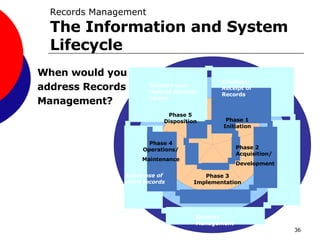
Records Management   The Information and System Lifecycle When would you address Records Management? Phase 1 Initiation Phase 2 Acquisition/ Development Phase 3 Implementation Phase 4 Operations/ Maintenance Phase 5 Disposition Creation/Receipt  of Records Active use of office records Records Management Inactive use: Federal Records Center
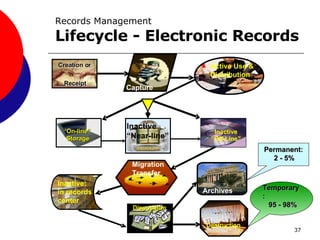
Records Management  Lifecycle - Electronic Records   Creation or Creation or Receipt Receipt ‘ On - line ” Storage ‘ On - line ” Storage Inactive “ Near Line ” Inactive “ Near Line ” Inactive “ - ” Inactive “ - ” Inactive in  Records Center Disposition Disposition Creation or Creation or Receipt Receipt ‘ On - line ” Storage ‘ On - line ” Storage Disposition Disposition Inactive “ Off-Line” Permanent: 2 - 5% Temporary: 95 - 98% Inactive “ Near-line” Capture Active Use & Distribution Migration Transfer Archives Destruction Inactive: in records center
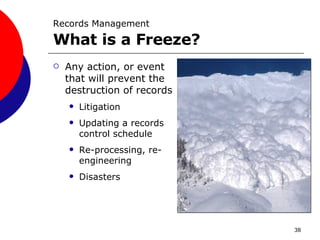
Records Management   What is a Freeze? Any action, or event that will prevent the destruction of records Litigation Updating a records control schedule Re-processing, re-engineering Disasters
Records Management   Freezes on Destruction Records  that could (and should) have been destroyed prior to the freeze  must now be retained! If you did not follow the records schedule and you still have the records on hand you  cannot destroy them  until all issues have been resolved Non-records  until you are absolutely certain (have received notification by legal counsel) of the scope of the freeze you must keep all materials Reference material Office copies Backup tapes All pertinent E-mail messages
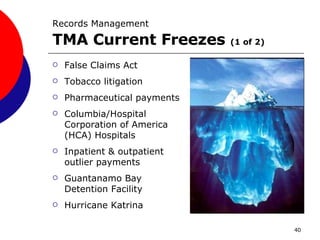
Records Management   TMA Current Freezes  (1 of 2) False Claims Act Tobacco litigation Pharmaceutical payments Columbia/Hospital Corporation of America (HCA) Hospitals Inpatient & outpatient outlier payments Guantanamo Bay Detention Facility Hurricane Katrina
Records Management   TMA Current Freezes  (2 of 2) Corporal Patrick Daniel Tillman Palmera Pineda aka Simon Trinidad Jose Padilla Ferroz Ali Abbasi Pharmacy records White House Briefings-Elections/Candidates White House E-mail
Records Management   Old Records Records that could (and should) have been destroyed prior to the freeze  must now be retained! If you did not follow your records schedule and you still have the records on hand you  cannot destroy them  until all issues have been resolved
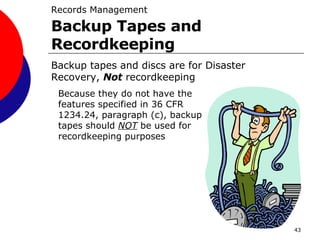
Backup tapes and discs are for Disaster Recovery,  Not  recordkeeping Records Management   Backup Tapes and Recordkeeping Because they do not have the features specified in 36 CFR 1234.24, paragraph (c), backup tapes should  NOT  be used for recordkeeping purposes
Records Management  Transfer to Federal Records Centers It’s in your interest! It’s in the public’s  interest
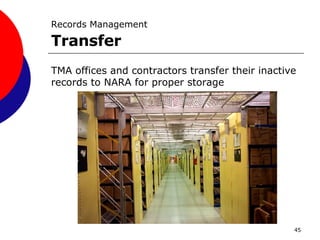
TMA offices and contractors transfer their inactive records to NARA for proper storage Records Management   Transfer
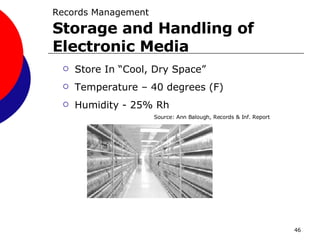
Records Management   Storage and Handling of Electronic Media Store In “Cool, Dry Space” Temperature – 40 degrees (F) Humidity - 25% Rh Source: Ann Balough, Records & Inf. Report
Electronic records may be stored on optical disks, diskettes, CD-ROMs These items must meet the following labeling requirements: Disposition authority File number Originating office symbol Title Beginning and ending dates Security Records Management  Storing and Labeling Requirements
Can I remove, delete or destroy other types of Federal records? No!  Not unless the TMA Records Manager provides a NARA disposition authority  Unauthorized destruction or removal may result in prosecution and criminal penalties  Records Management  Destruction
Records Management  Summary You should now be able to: Discuss records management concepts Determine what is a TMA record Recognize a records lifecycle Define the impact of record freezes Locate your records Identify when TMA records can be destroyed
Records Management  Resources   (1 of 2) Office of Secretary of Defense Records Management Administrative Procedures and Records Disposition Schedules AI-15, Vol. I, November 2006 Vol. II, August 1994 Washington Headquarters Services (WHS) Executive Services Directorate Directives and Records Division:  http://www.dtic.mil/whs/directives/   TMA Privacy Office:  http://www.tricare.mil/tmaprivacy/recordmgmt.cfm NARA):  http:// www.archives.gov /records-mgmt/
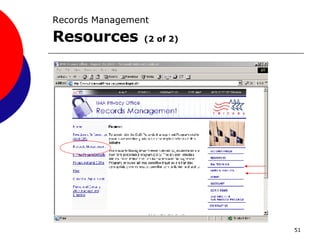
Records Management  Resources   (2 of 2)
Please fill out your critique Thanks!

RecordsManagement_FINAL

  • 1.
    Records Management 2007Data Protection Seminar TMA Privacy Office
  • 2.
    Records Management PurposeThe purpose of this presentation is to provide guidance on the laws and regulations that govern TRICARE Management Activity (TMA) records. This presentation will also provide specific examples of policies and procedures that are both protective and compliant when handling TMA records.
  • 3.
    Records Management ObjectivesUpon completion of this lesson, you will be able to: Discuss records management concepts Determine what is a TMA record Recognize a records lifecycle Define the impact of record freezes Locate your records Identify when TMA records can be destroyed
  • 4.
    As a manager,you have many important responsibilities: Managing people and other resources Reporting to the Department of Defense (DoD) Headquarters officials Answering questions from beneficiaries, sponsors, contractors and others Managing your records Records Management Management Responsibilities
  • 5.
    Why should Icare about my records? It’s the Law It’s in your best interest To find the information you need To document your accomplishments To avoid embarrassment, litigation, loss of security clearance, dismissal from Federal service and prosecution To protect the rights of citizens and the government (TMA) Records Management Why Care?
  • 6.
    What Can YouDo to Help Improve TMA Recordkeeping? Ensure that a living, breathing records program is established in your office(s) Records management is a part of new employee orientations (government and contractors) and out briefings The proper amount of resources and people are assigned to operate the program Continuous support is provided by management Records Management How to Improve Recordkeeping
  • 7.
    Records Management Regulations36 CFR 1234 and 1228.270, Office of Management and Budget (OMB), U.S. General Services Administration (GSA), etc. Assign responsibility Integrate with other records and information management Procedures Training Documentation Keep track of electronic records Schedule for disposal Security Contractors Follow requirements
  • 8.
    Records Management WhatCan I Do to Avoid Records Problems? (1 of 2)
  • 9.
    Records Management WhatCan I Do to Avoid Records Problems? (2 of 2)
  • 10.
    Records Management WhatAre the Problems? Management & staff support for custodians is needed E-mail management Records destruction freezes Records need to be retired at Federal Records Center (FRC) Electronic recordkeeping Filing is not according to Administrative Instruction 15 (AI-15)
  • 11.
    Records Management ThisAgency Let Their Records Storage Policy Go Down the Toilet
  • 12.
    Records Management CheneyDefiant on Classified Material Executive Order Ignored Since 2003 Cheney aides have not filed reports on their possession of classified data and at one point blocked an inspection of their office In 2004, the Archives' Information Security Oversight Office, decided to conduct an on-site inspection of Cheney's office to see how sensitive material was handled. The Vice President's staff blocked the inspection Cheney's office argued that it was exempt from the rules in this case because it is not strictly an executive agency The Justice Department confirmed that it is looking into the issue By Peter Baker – Washingtonpost.com - Updated: 9:38 p.m. MT June 21, 2007
  • 13.
    Records Management E-Discovery,It’s the Law In May of 2005, Morgan Stanley was ordered to pay $1.45 billion in a civil lawsuit, due in large part to failure to properly produce electronic documents. The Judge ruled that Morgan Stanley had committed "willful and gross abuse of its discovery obligations" and reversed the standard burden of proof, requiring Morgan Stanley to prove that it had not committed the infractions of which it was accused of instead of requiring the plaintiff to prove that it had deleted thousands of e-records
  • 14.
    Records Management CourtCases Involving E-mail (1 of 2) Former star investment banker, Frank Quattrone, was convicted of obstructing federal investigations into stock offerings at Credit Suisse First Boston. Central to the case was an e-mail Quattrone forwarded telling employees it was "time to clean up those files" after he learned of the investigation More than 500 of former West Virginia Gov. Bob Wise's intimate e-mails with a state employee were obtained under the Freedom of Information Act and made public in 2003. The employee's husband filed for divorce and Wise didn't seek re-election in 2004
  • 15.
    Records Management CourtCases Involving E-mail (2 of 2) In a Massachusetts class-action suit over the dangers of the diet drug combination Phen-Fen, the court allowed this e-mail from a company executive to be admitted: "Do I have to look forward to spending my waning years writing checks to fat people worried about a silly lung problem?" Chevron settled a lawsuit for $2.2 million that involved an interoffice e-mail giving 25 reasons why beer is better than women
  • 16.
    Records Management RecordsManagement Records management is a staff function, not "office services." It cuts across organizational lines Information should be treated as a resource, the same as personnel, facilities, and money Manage records through their "life cycle“ Paperwork and electronic processes , not just “media”, need to be managed A records management program should be continuous , not a one-time action Records management should never become an administrative "burden"
  • 17.
    Records Management First,What is a Record? “ Records include all books, papers, maps, photographs, machine readable materials, or other documentary materials, made or received by an agency of the United States Government under Federal law or in connection with the transaction of public business and preserved or appropriate for preservation by that agency or legitimate successor as evidence of the organization, functions, policies, decisions, procedures, operations, or other activities of Government or because of the informational value of data in them.” 44 U.S.C. Sec. 3301 In other words, any information in any media created or received while fulfilling the duties of your position, or conducting official business, except reference materials Regardless of physical form or characteristics,
  • 18.
    Records Management Characteristicsof Records Authenticity Proven to be what they purport to be Created and sent by the person implied to have sent/created them Created/sent at the time claimed Integrity Must remain complete and unaltered – over time! Usability Can be located, retrieved, presented and interpreted Reliability Contents can be trusted as a full and accurate representation of the transaction to which they attest All Records – including electronic records – Must have the following Trustworthy characteristics
  • 19.
    Records Management GeneralRequirements for Records Content Information contained within the record Context Meta Data – retrieval and makes the record meaningful Structure How the information is organized The electronic record must retain its characteristics over time, for as long as they are required to be legally retained
  • 20.
    Records Management RecordsInclude: Paper reports, directives, forms, correspondence Phone call notes Photographs, videotapes, posters Maps and drawings Databases E-mails Microfilms
  • 21.
    Records Management Whatis Not a Record? Material that does not meet the statutory definition of records includes but is not limited to: Technical reference materials Catalogs, trade journals, manuals Extra copies Blank forms Some electronic information
  • 22.
    Created by meansof a computing device Stored on an electronic media/device Meta Data used to retrieve / search and completes the context of electronic record Records Management What is an Electronic Record? (1 of 2) Electronic records include data files and databases, machine readable indices, word processing files, E-mails, instant messages, digitized versions of hard copy records and much, much more
  • 23.
    Can be anythingpaper can be… and more Video, sound, image files “Compound documents” (e.g., linked documents) Web based documents Basic components The record/data Metadata Documentation Records Management What is an Electronic Record? (2 of 2)
  • 24.
    Capture electronic messagesand files as “records” and ‘freeze’ them from further change Organize them logically so they can be accessed quickly Maintain security and integrity of each record Preserve records over time Save the hidden background data linked to each E-mail message, word processing file, spreadsheet, etc. Allow the electronic records to be retained and disposed of according to AI 15 and National Archives and Records Administration (NARA) requirements Records Management Electronic Recordkeeping
  • 25.
    Electronic mail (E-mail)/PDA’sScanned images Electronic Information Systems (EIS), and databases Calendars (Senior Management/High-ranking Officials) Websites Records created/born electronically (Word, pdf’s, etc.) Voice mail saved and played back over E-mail, voice and video-enabled portals/websites, etc NARA estimates that currently 14,000 separate file formats exist – and additional formats are added daily … Technologies that are unthinkable today will be commonplace tomorrow Records Management Proliferating Formats
  • 26.
    Easily and quicklysort data Access existing relational data Modify data easily Disseminate information quickly and over large geographic areas Saves space More functions than paper Research value, ex. NARA Preserve history Records Management Benefits of Electronic Records
  • 27.
    Security Hardware/software dependenceVersion control Ad-hoc disposal Personal filing system Authenticity Accessibility “ Much of the information of the late 20th century and 21st century will be lost if we don’t do something about solving the problems of saving electronic information over time. The truth is that vital digital materials are being lost every day, and the cost of those losses is unknown and unknowable.” - Reynolds Cahoon, Assistant Archivist and Chief Information Officer at NARA. August 9, 2004 Federal Times Records Management Challenges of Electronic Records
  • 28.
    Records Management Whatis an E-mail Record? 36 CFR 1234.2 Definition: Message that is created or received on an E-mail system, including envelope data, notes, and attachments
  • 29.
    Records Management IsMy E-mail a Federal Record? Yes, if it does not include: An E-mail truly personal in content and use An extra copy Only requires action by another office
  • 30.
    Everybody is aRecords Manager It’s MINE! IT personnel unaware of RM Disorganized electronic information Fragmentation Haphazard disposal Future use in question Records Management Problems of Electronic Records
  • 31.
    Records Management Can I Delete E-mail? Ask your Records Custodian: Do I have authority from NARA to delete E-mail? What is the agency E-mail policy: keeping copies electronically or in paper files? How does the agency capture the whole E-mail record—the transmission data as well as the content of the message?
  • 32.
    Records Management TMA and the DoD E-mail Policy (1 of 2) Memo Re-issued May 22, 2005 Subject: Electronic Mail Records and Electronic Mail Retention Policies for the DoD, by Linton Wells II, Acting Assistant Secretary of Defense Networks and Information Integration and DoD Chief Information Officer Print and File Currently, TMA’s policy is to print record E-mail messages and file them in the appropriate case or subject folder
  • 33.
    Documents of short-terminterest or value All non-record E-mail should be deleted within 180 days Approved Electronic Records Management (ERM) software – DoD Directive 5015.2, “DoD Records Management Program”, March 6, 2000 Record e-mail should be saved to an approved recordkeeping system Records Management TMA and the DoD E-mail Policy (2 of 2)
  • 34.
    Electronic records mustbe identified and recognized as records by users Electronic records must be retained in accordance to the AI - 15 records retention schedule Proactive measures must be taken to preserve accessibility and authenticity of electronic records Records management personnel and IT must work together to successfully manage electronic records Records Management Electronic Records Mandate
  • 35.
    Determine whether itmeets the legal definition of a record Should contain essential transmission, receipt data, and attachments (metadata) When E-mail is retained as a record, the periods of its retention are governed by records retention schedules Delete non-record E-mail (short term records that have a retention of 180 days or less) Note: Messages from PDA’s are treated the same as E-mail Records Management Points to Remember about E-mail Records
  • 36.
    Records Management The Information and System Lifecycle When would you address Records Management? Phase 1 Initiation Phase 2 Acquisition/ Development Phase 3 Implementation Phase 4 Operations/ Maintenance Phase 5 Disposition Creation/Receipt of Records Active use of office records Records Management Inactive use: Federal Records Center
  • 37.
    Records Management Lifecycle - Electronic Records Creation or Creation or Receipt Receipt ‘ On - line ” Storage ‘ On - line ” Storage Inactive “ Near Line ” Inactive “ Near Line ” Inactive “ - ” Inactive “ - ” Inactive in Records Center Disposition Disposition Creation or Creation or Receipt Receipt ‘ On - line ” Storage ‘ On - line ” Storage Disposition Disposition Inactive “ Off-Line” Permanent: 2 - 5% Temporary: 95 - 98% Inactive “ Near-line” Capture Active Use & Distribution Migration Transfer Archives Destruction Inactive: in records center
  • 38.
    Records Management What is a Freeze? Any action, or event that will prevent the destruction of records Litigation Updating a records control schedule Re-processing, re-engineering Disasters
  • 39.
    Records Management Freezes on Destruction Records that could (and should) have been destroyed prior to the freeze must now be retained! If you did not follow the records schedule and you still have the records on hand you cannot destroy them until all issues have been resolved Non-records until you are absolutely certain (have received notification by legal counsel) of the scope of the freeze you must keep all materials Reference material Office copies Backup tapes All pertinent E-mail messages
  • 40.
    Records Management TMA Current Freezes (1 of 2) False Claims Act Tobacco litigation Pharmaceutical payments Columbia/Hospital Corporation of America (HCA) Hospitals Inpatient & outpatient outlier payments Guantanamo Bay Detention Facility Hurricane Katrina
  • 41.
    Records Management TMA Current Freezes (2 of 2) Corporal Patrick Daniel Tillman Palmera Pineda aka Simon Trinidad Jose Padilla Ferroz Ali Abbasi Pharmacy records White House Briefings-Elections/Candidates White House E-mail
  • 42.
    Records Management Old Records Records that could (and should) have been destroyed prior to the freeze must now be retained! If you did not follow your records schedule and you still have the records on hand you cannot destroy them until all issues have been resolved
  • 43.
    Backup tapes anddiscs are for Disaster Recovery, Not recordkeeping Records Management Backup Tapes and Recordkeeping Because they do not have the features specified in 36 CFR 1234.24, paragraph (c), backup tapes should NOT be used for recordkeeping purposes
  • 44.
    Records Management Transfer to Federal Records Centers It’s in your interest! It’s in the public’s interest
  • 45.
    TMA offices andcontractors transfer their inactive records to NARA for proper storage Records Management Transfer
  • 46.
    Records Management Storage and Handling of Electronic Media Store In “Cool, Dry Space” Temperature – 40 degrees (F) Humidity - 25% Rh Source: Ann Balough, Records & Inf. Report
  • 47.
    Electronic records maybe stored on optical disks, diskettes, CD-ROMs These items must meet the following labeling requirements: Disposition authority File number Originating office symbol Title Beginning and ending dates Security Records Management Storing and Labeling Requirements
  • 48.
    Can I remove,delete or destroy other types of Federal records? No! Not unless the TMA Records Manager provides a NARA disposition authority Unauthorized destruction or removal may result in prosecution and criminal penalties Records Management Destruction
  • 49.
    Records Management Summary You should now be able to: Discuss records management concepts Determine what is a TMA record Recognize a records lifecycle Define the impact of record freezes Locate your records Identify when TMA records can be destroyed
  • 50.
    Records Management Resources (1 of 2) Office of Secretary of Defense Records Management Administrative Procedures and Records Disposition Schedules AI-15, Vol. I, November 2006 Vol. II, August 1994 Washington Headquarters Services (WHS) Executive Services Directorate Directives and Records Division: http://www.dtic.mil/whs/directives/ TMA Privacy Office: http://www.tricare.mil/tmaprivacy/recordmgmt.cfm NARA): http:// www.archives.gov /records-mgmt/
  • 51.
    Records Management Resources (2 of 2)
  • 52.
    Please fill outyour critique Thanks!